The exquisitely rare native flower that refuses to disappear. (more…)
More by Kate Evans



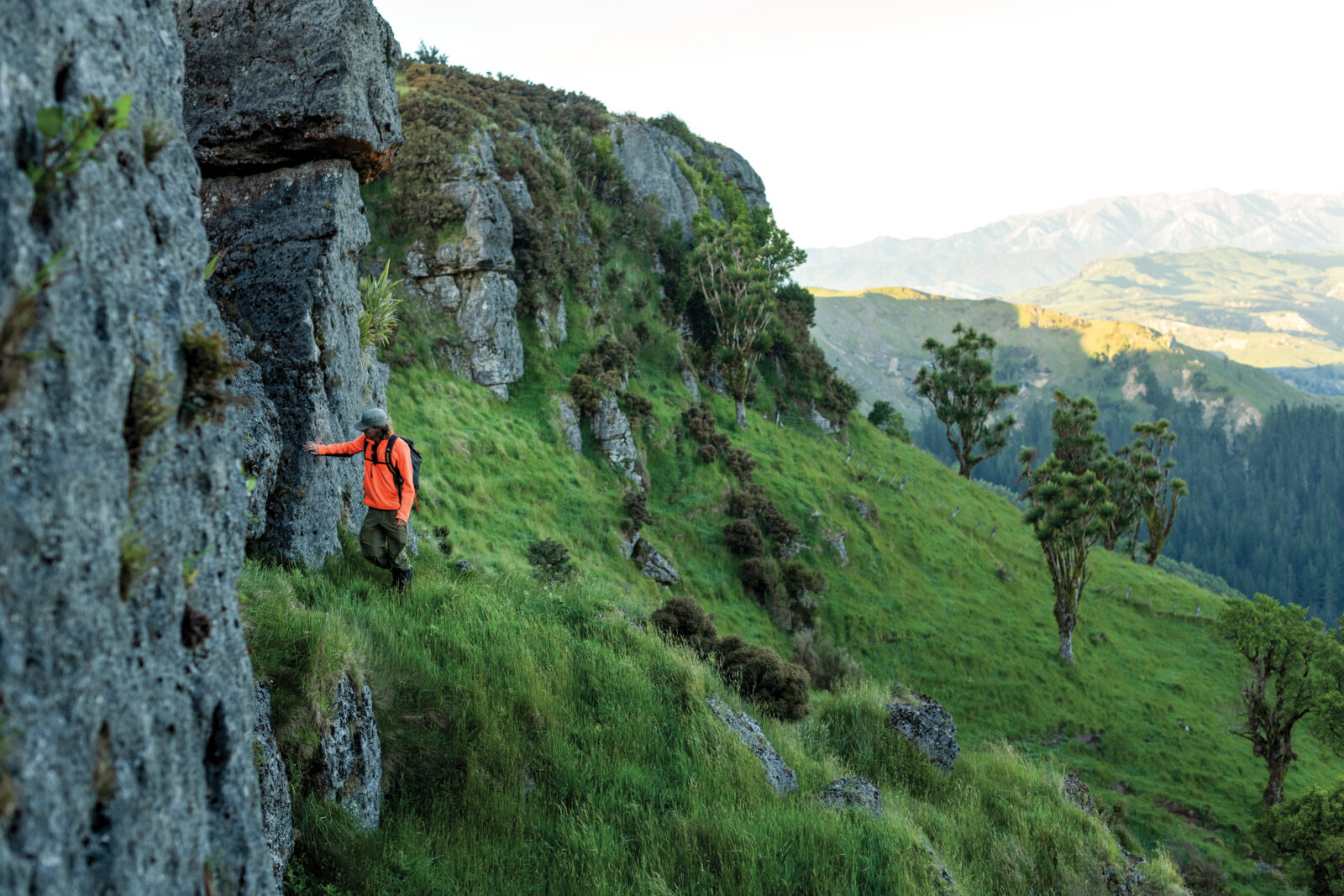
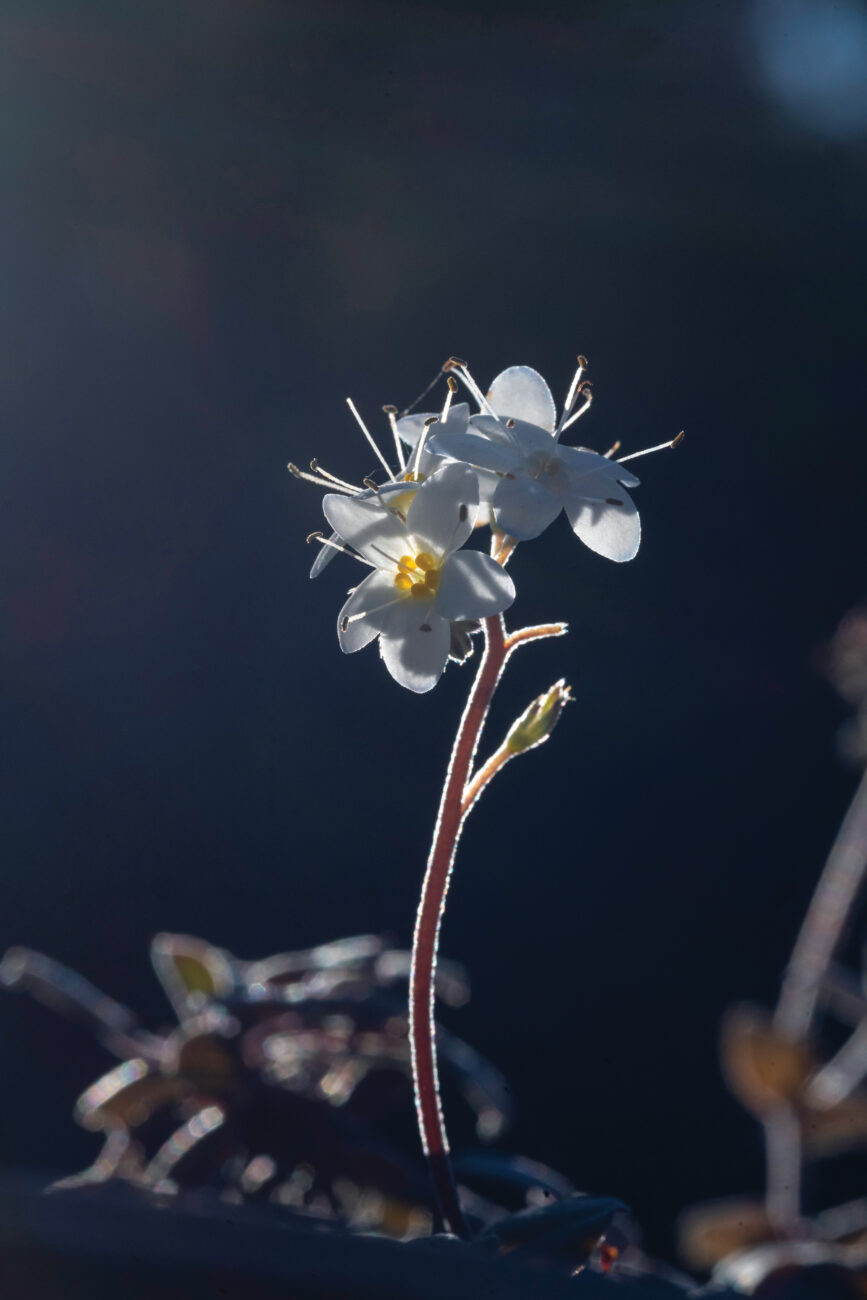
High on a range northwest of Napier, where mist snags on the limestone outcrops and a relentless wind shivers the velvet grasses, three-quarters of the known wild population of Myosotis petiolata is in full bloom.
There are four plants, we think, growing on a couple of rocks a few hundred metres apart. Less than a handful of these tumbling native forget-me-nots with their furry teardrop leaves and, for just a month in summer, precious star-like white flowers. In a country known for its endangered plants—nearly half of them are threatened or at risk—this is one of the rarest.
“It’s not a tōtara,” says Michael McCandless, a ranger with the Department of Conservation. “It’s not huge and majestic. It’s this tiny little thing that can play tricks on you.” McCandless has enthusiastically inherited the role of coaxing this taonga back onto solid ground. “Everybody knows that we’re standing on the edge,” he says. “The stakes are so high: if it doesn’t work, it goes extinct.”
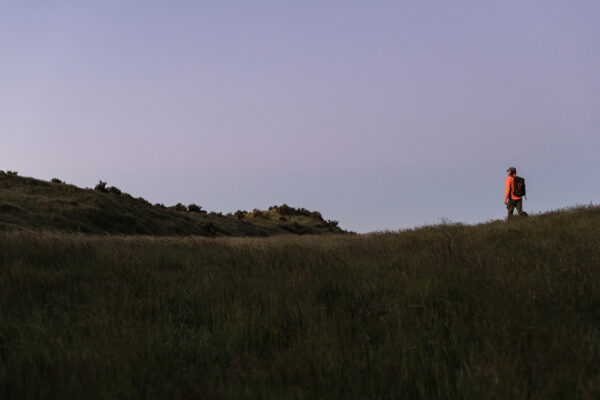
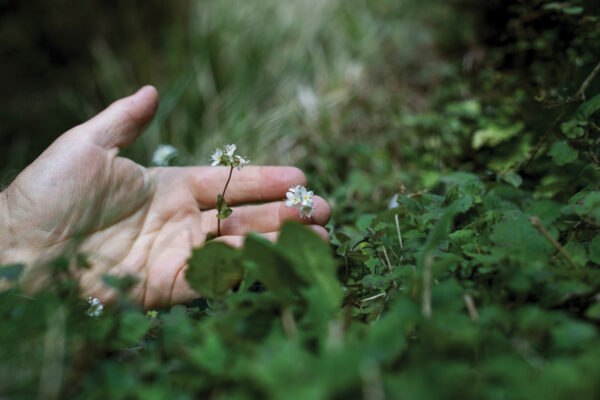
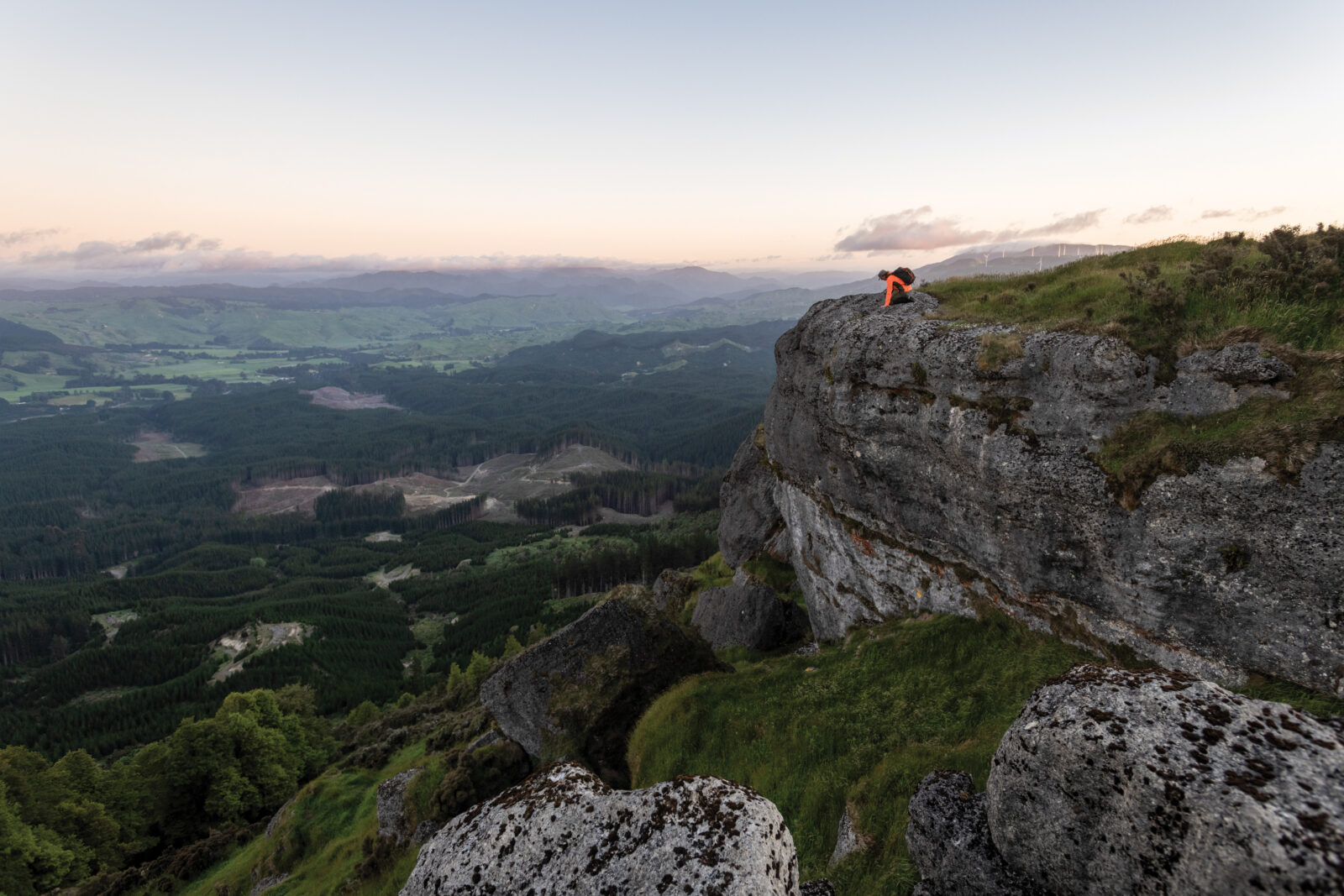
It’s a clear, windy, early December day, and McCandless and I are a kilometre above sea level, perched on a ledge on a grassy bluff on Te Waka Range, so he can show me the record 278 flowers, each smaller than your little fingernail, currently gracing one of the petiolata plants. We timed our visit perfectly, McCandless says in his Northern Irish lilt. “This is the moment they look their best.”
He points out their bright yellow centres, and the way some of the blooms are blushed with blue. When I gush, he’s relieved. Some of the people he brings up here are underwhelmed. “They’ll either be like, ‘Gosh, it’s amazing!’, or ‘Um, why can’t we just let this thing go?’”
Not many people get to see petiolata in the wild. This land is owned by Matariki Forests, and the ridge we’re on is unsuitable for pine trees—though we can see their dark carpet covering the valley below us and spread over the nearby ranges. Andy Fleming, Matariki’s environmental manager, clambers along the cliffs with us, a mountain goat in hi-vis, stubbies and gaiters.
“This is one of my happy places,” he says. “I just love this terrain, there’s a little bit of spooky about it.” His job takes him all over New Zealand, across Matariki’s 150,000 hectares of land—16,000 of those are protected native forest or wetlands, he points out—checking up on frogs and falcons, and ensuring the company meets the conditions of its sustainability certifications.
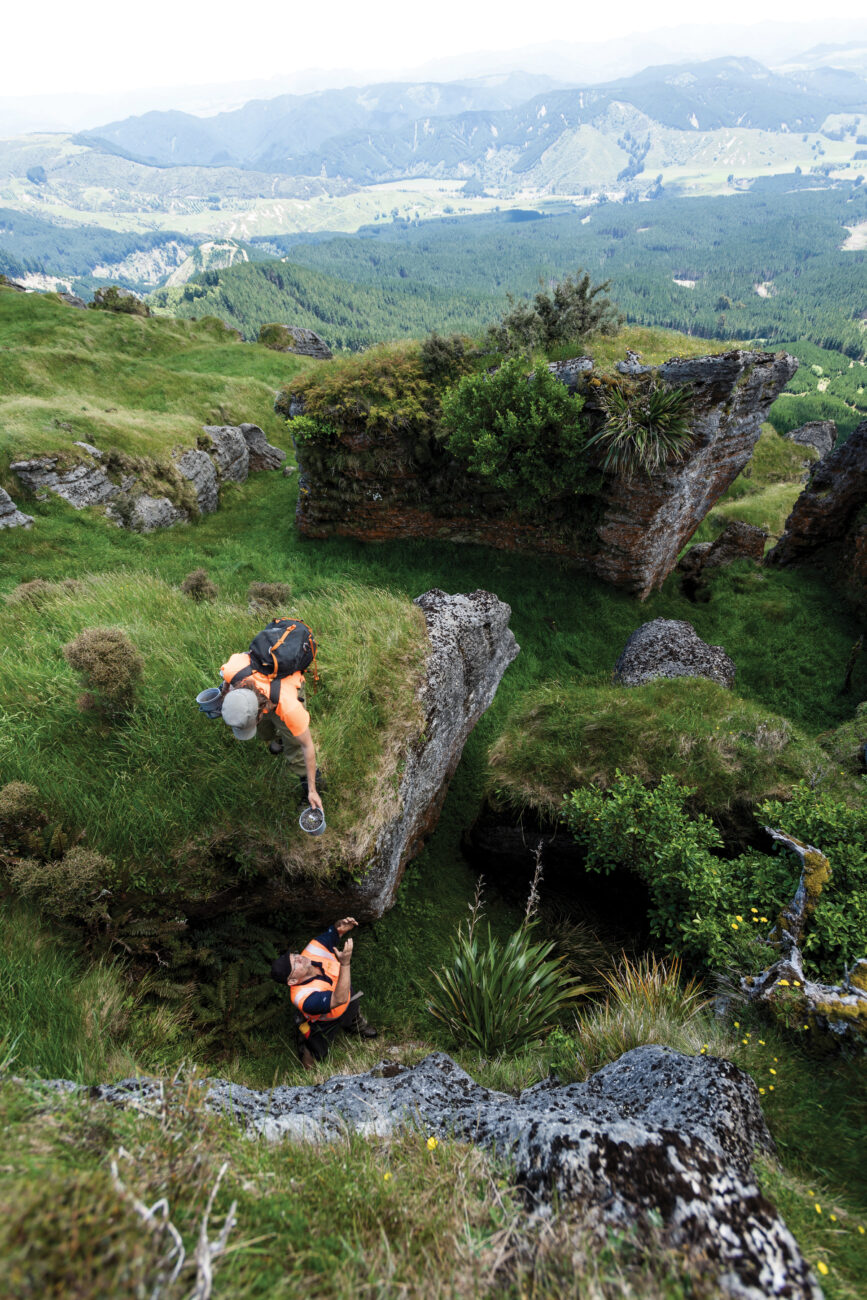
Yet he has a special soft spot for this little flower. He hikes up here at least once a month on his weekends to visit it, and in 2021, when Nicola Toki awarded the species four out of 10 on RNZ’s Critter of the Week spot, Fleming raged at the radio.
“I was dark. I was a petulant little five-year-old boy, like ‘Don’t be mean to my plant!’ My wife was sitting beside me in the truck and said ‘Ooh, sensitive much?’”
Partly, he’s sensitive because he knows what it’s like to lose a rarity. In 2018, Matariki’s entire wild population of critically endangered ngutukākā, kākābeak, was destroyed in a slip when a river flooded. “It tore me to bits,” he says. But there’s something else, too, that gives him a sense of connection to this particular forget-me-not. Fleming discovered the first of these four wild plants—its distinctive forms swimming into focus in the very spot so many others had looked, and not seen.
*
Myosotis petiolata has been found and forgotten numerous times during the last few centuries. Perhaps a mark of its marginality, it has no common name of its own, in English or te reo. Māori tupuna knew forget-me-nots, but did not always distinguish between similar-looking kinds—unsurprising, since Aotearoa is the only home for around 50 species, and lots of them are almost as uncommon as this one. (The blue or pink forget-me-not in your garden, however, is one of about 60 European Myosotis—the genus name means ‘mouse’s ear’, describing the soft, rounded leaves.)
Many of our forget-me-nots are extremely picky about where they live. Myosotis bryonoma is only found in mossy mountain bogs in Central Otago; Myosotis hikuwai just on “excessively well-drained” gravelly river terraces near Wānaka; Myosotis umbrosa only in shadows cast by the rocky tors of Otago’s Rock and Pillar and Lammerlaw ranges. Combine that fussiness with the pressures of weeds, hungry herbivores, and habitat change, and the forget-me-nots are in trouble.
“It’s probably the most highly threatened plant genus in New Zealand,” says Heidi Meudt, a botany curator at Te Papa Tongarewa. Meudt came here from the US for a two-year project in 2004, and ended up embarking on a 15-year one—sorting out the family tree of all 50 of our forget-me-nots.
The scientific story of petiolata, she says, goes back to 1853. The reverend William Colenso, an enthusiastic plant-lover, lived for decades in Hawke’s Bay, travelled extensively across the North Island before there were roads, and sent hundreds of pressed, dried samples back to botanists at London’s Kew Gardens. One of those was a delicate, olive-brown string of petiolata. The species, Colenso wrote, was growing at various locations around Hawke’s Bay, from the river that feeds Lake Tutira in the north, to the eastern flank of the Ruahine Ranges.
Over the following century, botanists made occasional study of these herbarium specimens, at times lumping them in with similar forget-me-nots from the Waitākeres and Nelson and calling them all one species. But no-one thought to record the living little plant in the dry stony places of Hawke’s Bay until the summer of 1972, when Tony Druce, a top New Zealand botanist, observed the flowers’ “pale blue margins” on a “limestone cliff” somewhere on Te Waka Range. “He knew Myosotis. He could tell them apart,” Meudt says. Druce had the presence of mind to collect a specimen, and presumably the plant was abundant enough that he felt he could do so.
On our hike, McCandless points out a limestone ridge running parallel to the one we’re on, perhaps half a kilometre away. In the early 2000s, botanist Mike Thorson found a few petiolata plants there and collected more specimens. But that ridge is private land, and since then, the landowner hasn’t allowed any plant-hunters onto the property. Efforts to locate the forget-me-not elsewhere in Hawke’s Bay, including the places that Colenso found it, came to nothing. So for a while there, says McCandless, no one knew of any petiolata growing wild. They just hoped it was hanging on in that spot they weren’t able to visit.
Then, in 2021, Fleming tramped up with some botanists from the regional council to scour Matariki’s portion of the range. As they looked along the bluffs, Fleming spotted daisy after daisy—and then another little white flower. “What about this one?” he asked. “And then it dawned on me it was something a bit special, because they were doing cartwheels. They were freaking out.” He did detect a touch of disappointment, however—“that some dirty bald forester had found it”.
Now, he shows me how the plant extends several metres along a crack in the lichen-starred cliff face.
“How we missed it is beyond me, given the size of it. I don’t know how many times people squirrelled around it before I got here, but it was quite a few. All these rocks have been searched, but sometimes you can’t see the forest for the trees.”
People kept looking for more plants, and finding nothing. But in 2023, one of McCandless’s DOC colleagues popped around the other side of the rock from Fleming’s plant to have lunch. “She was like, ‘Oh, shit. There’s another one,’” says McCandless. That’s the plant that has 278 flowers today, covering a few square metres of limestone.
Then, in 2025, McCandless and Thorson turned up another small plant, about 200 metres from the first two. Right next to it, a month later, McCandless spotted the first juvenile. Seemingly too young to flower, the fact the plant is here at all, he says, is a good sign. “It’s reproducing in the wild.”
*
Still, just four plants, in all this vast terrain. How did it come to this? Peter de Lange, a botanist at Unitec and an expert on endangered species, says many of our plants are naturally rare, and always were. New Zealand is “tectonically extremely active”—over the millennia, our mountain ranges rise rapidly into the sky and islands slip into the sea. Our climate is diverse and patchy, too. “But then the overlay is all the damage we’ve done. The weeds, the pasture, the browsing animals.”
Then there’s the fact that we tend to pay much more attention—and devote more funding—to our endangered animals than we do to our rare plants. “DOC has a fixation with what is feathered and farts,” as de Lange puts it. The public too, are far more likely to fall in love with a kākāpō than a kākābeak.
But for DOC in Hawke’s Bay, petiolata is a priority, McCandless insists. And the species might be a little more versatile than some of its choosy cousins—it’s been recorded on river banks in the lowlands, for instance, not just the exposed limestone tops.
“For a long time, we’ve kind of been throwing darts with our eyes closed as to why it’s so endangered,” he says. Grazing doesn’t seem to be a problem in this spot, he says; while deer roam within metres of the plant, there’s no sign they’re stopping for a nibble.
“That’s like, a threatened-plant trope—‘It’s threatened, okay, so what’s eating it?’ Not this one,” he says, plucking weeds out around the show-off plant with all the flowers. So far, that seems to be the main threat: competition from pasture grasses and dandelions that could smother the little plants. McCandless remains optimistic.
“A lot of the time in conservation, I do feel like we’re maybe kicking the can down the road. But with this one, if we can put it back in its range, I think we stand a pretty good chance of actually pulling it back from the brink.”
*
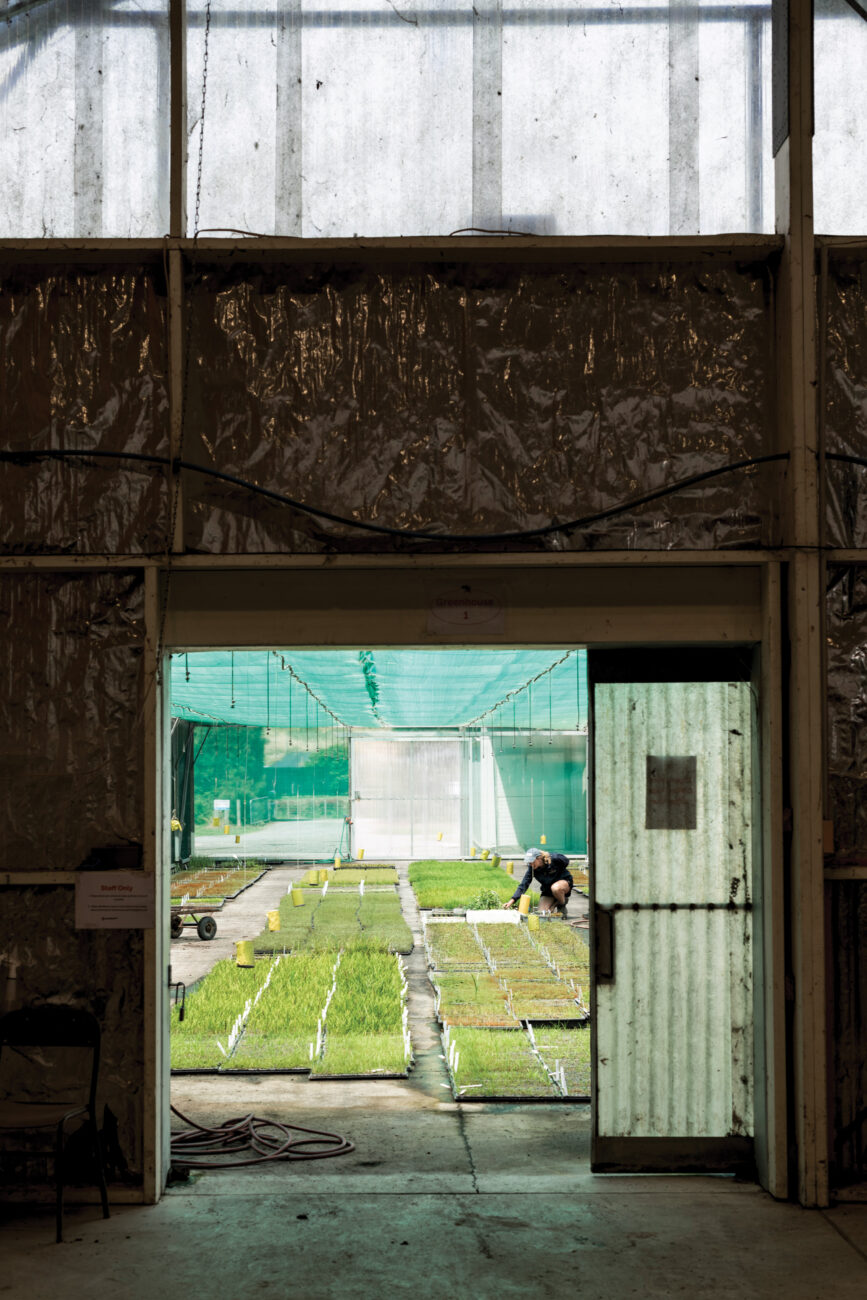
In Marie Taylor’s nursery in Taradale, Plant Hawke’s Bay, the species’ salvation is set out: a regiment several-hundred strong, little mounds of bronze leaves in mossy black plastic pots.
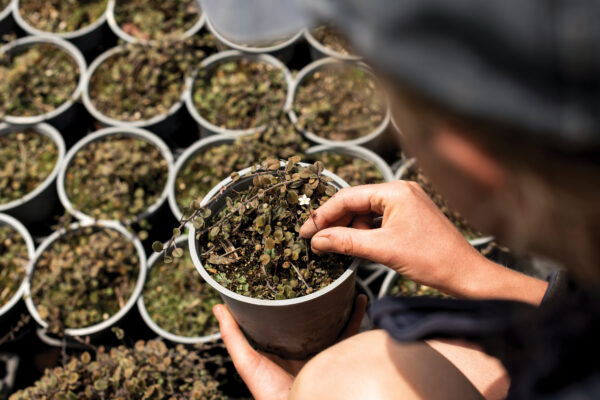
After Cyclone Gabrielle in 2023, Taylor was given 10 petiolata cuttings in containers to look after. She put them in her state-of-the-art greenhouse at first. “Most of them died straight away. It was too hot and humid for them. They like lots of air and rainfall.” Once she moved the surviving three outside, they recovered and started putting out new leaves.
No one had successfully propagated petiolata at scale before, but Paul Treneman, an expert on Taylor’s staff, managed to take about 100 cuttings from those remaining three plants—snipping five-centimetre sections from the growing tips with a little pair of scissors, then sticking them in rooting hormone. “No pressure—we’ve only got three plants!” Treneman says. But the parent plants quickly put out new shoots, the cuttings rooted easily, and six weeks later, the next generation was ready for potting.
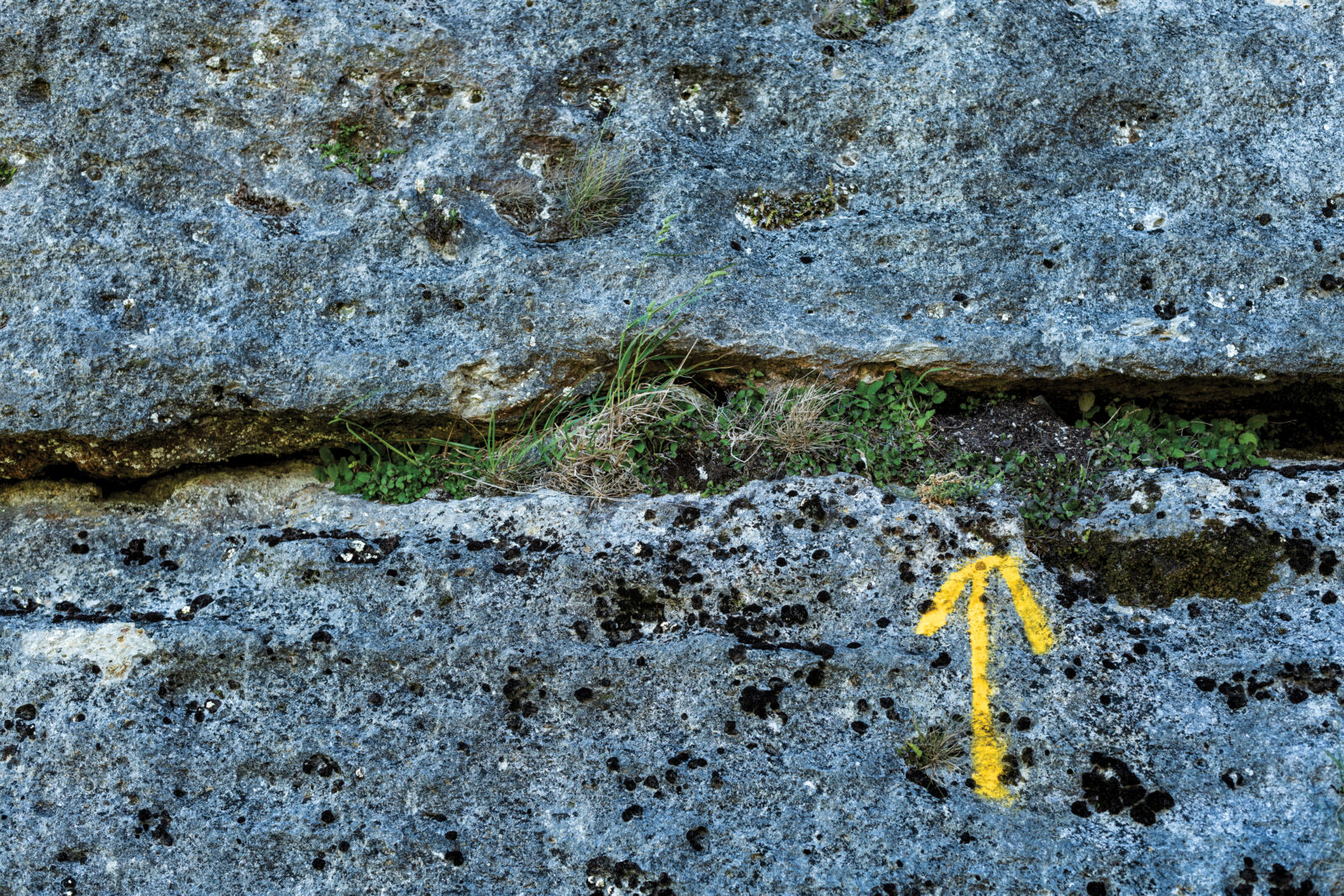
To remind the baby plants of home, Fleming collected half a trailer-load of limestone from the Te Waka Range and brought it down to the nursery. Treneman bashed it up with a sledgehammer—“it was hard, noisy work”—and added it to the potting mix. “And they all lived,” says Taylor. “Seriously, they all lived.” Treneman took further rounds of cuttings from the new plants, and later from three of the four wild plants, to increase genetic diversity. He’s now produced around 700 potted petiolata, and some are even dotted with flowers.
With such abundance, McCandless sent plants to botanic gardens around the country as an insurance policy, and in 2024, he and Fleming joined forces with mana whenua to start planting them out around Hawke’s Bay. A hundred on Matariki’s land, near the wild plants, 100 more on a neighbouring block owned by another forestry company, Pan Pac Forest Products—and a few dozen a little closer to home.
*
In Napier’s Centennial Gardens, tucked between ocean and bluff, Leona Karauria of Te Wairoa clambers down a steep moss-covered bank above the ornamental pond. Tenderly, she brushes fallen leaves away from a tiny, thriving petiolata nestled into the rocks.
She learned about the forget-me-not last winter, when she started working with the environmental team at Hineuru Iwi Trust. “It captured my heart on day one.” She immediately asked that it be her job to monitor them, and every week since, she has visited the 20 petiolata now scattered around the park. She makes notes on which plants are doing well, which are shrivelling, and which are what she calls “fluffy”. “They just sort of soak up the moisture and they puff. It’s like they can express themselves.”
On this sunny morning, a motley crowd of forget-me-not lovers have gathered in the garden to plant out 16 more—McCandless, Fleming, a representative from Taylor’s nursery, and members of several iwi and hapū who count petiolata as a taonga tuku iho from their rohe—cultural heritage, an heirloom, an “extra-special taonga”, as Karauria explains it. They’re all members of a group which meets online monthly to discuss any developments in petiolata conservation.
“It’s an old adage: ‘It takes a village to raise a child,’” says Fleming. “And plants are no different, especially when they’re this threatened.”
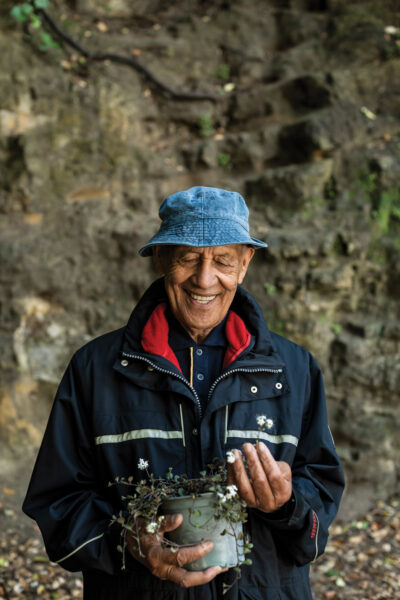
Bevan Taylor, the pou of Maungaharuru-Tangitū Trust—bright-eyed in a blue bucket hat—tells me of his earliest close encounter with a native forget-me-not. More than 70 years ago, when he was 14, he was riding horseback in the hills above Tangoio, on the coast about 25 kilometres from Te Waka Range. Looking for lost sheep, he eventually found two on the edge of a cliff, and had to slide and scramble down a leafy bank to try to help them back up. When he got home, he had long strings of a plant he didn’t recognise tangled in his belt. He thought it was a weed, but the old people told him it was a forget-me-not.
“It’s a long time ago, but I remember it like that plant in the pot there,” he says, pointing at the one in McCandless’s hands. It might have been petiolata that day; it might have been another of its close relatives. Either way, Taylor says, “it’s good to revive it, eh, because those are plants of old. All the plants have their place on Earth. And to come in touch with the forget-me-nots again is awesome.”
We plant some more, trowelling holes in the sandy banks and pressing the plantlets into their new homes. McCandless isn’t too fussy about where: now that we know they can be successfully propagated, he and Fleming have been “quite purposefully breaking the rules” both here and at Te Waka—planting in summer, planting among grasses, or in limestone cracks with little soil. They are testing the plants, trying to understand them better, to see what they can cope with, and where they might thrive.
Afterwards, beneath the crimson pōhutukawa and the park’s sparkling artificial waterfall, Taylor gives a karakia to end the morning. “The sun is shining,” he says. “There’s work to be done.”
More by Kate Evans
Subscribe to our free newsletter for news and prizes
3
$1 trial for two weeks, thereafter $8.50 every two months, cancel any time
Signed in as . Sign out