This four-bunk stone hut in the Ruahine Forest Park is unique and full of stories. (more…)
More by Shaun Barnett



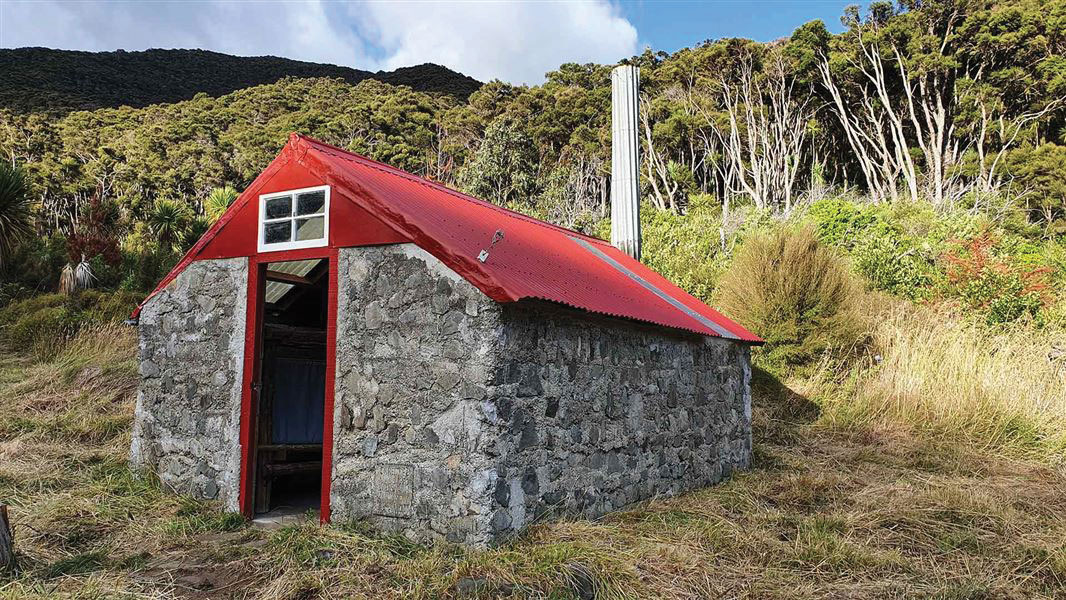
Of all the huts in Ruahine Forest Park, Shutes Hut has special historic significance because it is an example of both a stone hut and rabbiting hut—both now extremely rare in the North Island. It occupies a terrace in the northern Ruahine Range, high above the Taruarau River. Alex Shute, who built the hut, was a stonemason, soldier, rabbiter and recluse. During the 1920s and ‘30s, the hut became the centre of his life and work.
Shute and another man built the hut in 1920, using the abundant local stone. A packhorse carted in other materials, such as the mortar and roofing iron. Big Hill Station grazed a thousand sheep on the nearby tops of the northern Ruahine Range, but rabbits were a plague that made the marginal grazing even leaner. Shute worked from the hut, using his rifle, traps, poison and dogs to kill the pests. He established a little orchard of fruit trees and gooseberry bushes, and even planted flowers around the hut.
A picture of Shute from the 1930s shows a stout man wearing braces and a hat, with a pipe between his teeth. Hawke’s Bay hunter Lester Masters, who took the photograph, knew Shute well and liked him. But Shute’s antics—wrestling with his coat, talking only to his dogs, and wandering around naked—put other visitors off. Shute enjoyed his solitary life in the mountains, but probably had a darker reason for his isolation: it kept him away from too much alcohol.
The most direct access to Shutes Hut begins from Comet Road, off the Napier–Taihape Road. Beyond Comet Hut at the road-end, the track climbs onto Kōmata, a plateau badly infested with wilding lodgepole pines, before beginning a very steep descent to the Taruarau River. There’s a good gravel ford, but don’t attempt to cross when the river is high. From the south bank, the track climbs some 200 metres to reach Shutes Hut (allow three hours in total). It’s worth staying long enough to browse through the impressive hut books, which go back to the 1950s.
More by Shaun Barnett
Subscribe to our free newsletter for news and prizes
3
$1 trial for two weeks, thereafter $8.50 every two months, cancel any time
Signed in as . Sign out