





Timelapse photography shows the tiny superstars of the world’s most famous glow-worm cave system, Waitomo, flickering in response to us pesky humans.
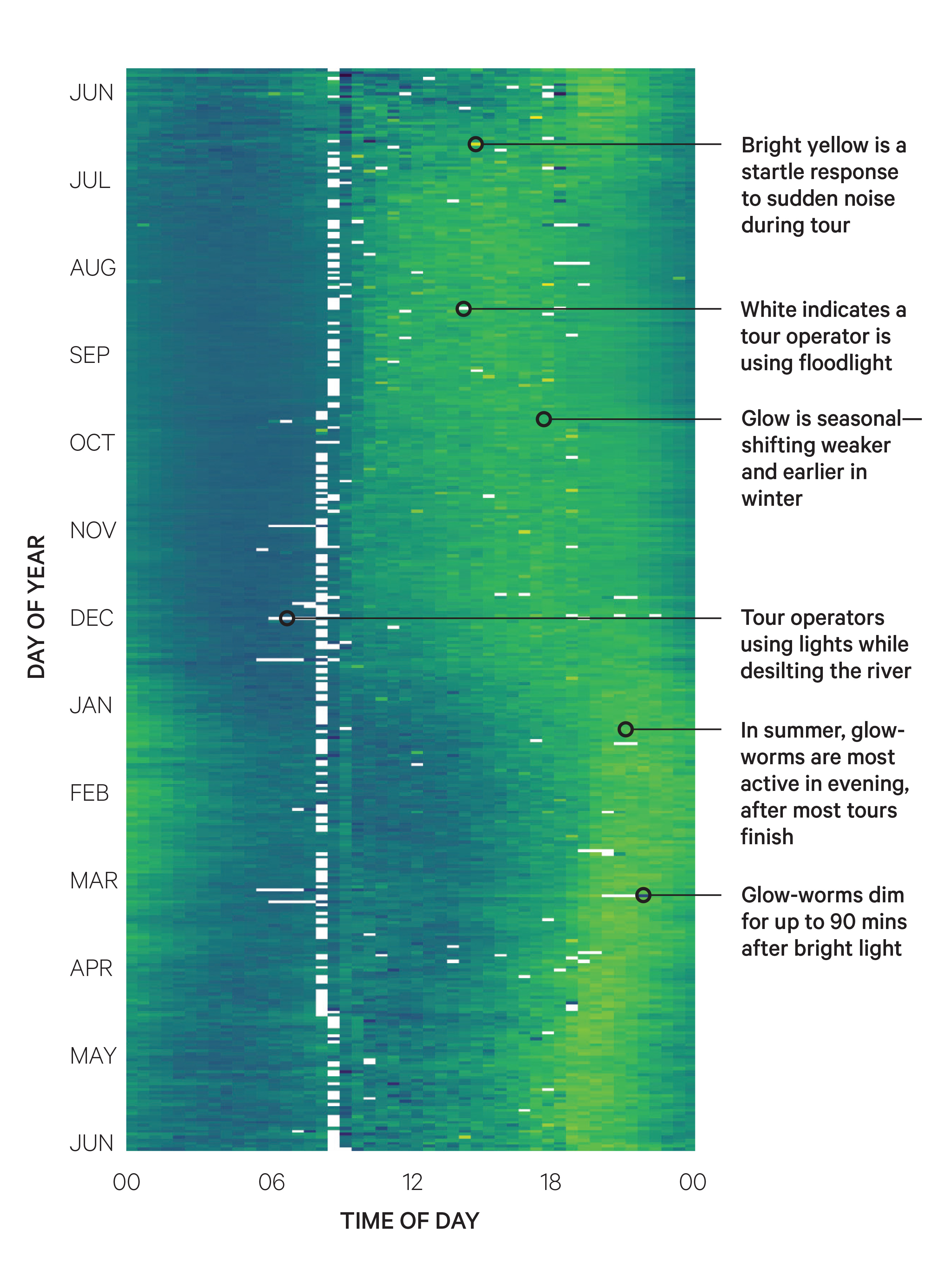
Noise makes the glow-worms dial up their bioluminescence, and artificial light prompts them to dim, or switch off for a while. This heat map tracks the intensity of the light show across the year beginning June 2024.
It was made by David Merritt, a scientist at the University of Queensland who specialises in glow-worms and has long worked with the kaitiaki at Waitomo. He set the camera up in Glowworm Grotto, where tour operators pull boats slowly along a U-bend using a system of cables on the cave ceiling. It recorded one 30-second exposure every half hour.
Merritt explains that the white blips represent moments during which tour operators use a floodlight on the cave’s jetty—a necessity for safety checks, the occasional desilting of the river, and for wiping down boats soaked by the dripping ceiling overnight. In response, the glow-worms dim or blink out, but bounce back within about an hour and a half.
Bright-yellow pixels, on the other hand, are a “population-wide startle response” to noise: perhaps a boat nudging the wall, or too-loud chatter. “The guides ask the visitors to stay quiet, but it’s impossible,” says Merritt. “Obviously, you can’t stop a baby from crying.”
Merritt finds this picture reassuring. After each fright, he points out, the glow-worms recover quickly. And their population has held steady since a crash in the 1970s. He concludes the insects are only “slightly perturbed” by the hundreds of thousands of visitors they endure each year.
Merritt quietly enjoys the fact that the tours, for logistical reasons, knock off right when the glow-worms, driven by their body clocks, are peaking. “They’re left alone and they do their own thing,” he says.
More by Catherine Woulfe