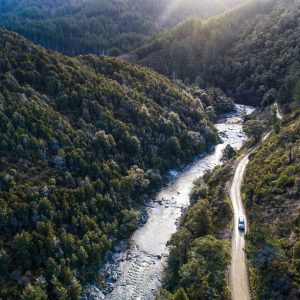





Picture a map of New Zealand. Now delete the land. What you’re left with is a vascular system pumping fresh water: swampy hearts, lakes, rivers, thousands of trickling capillaries. This is the Aotearoa that eels know.
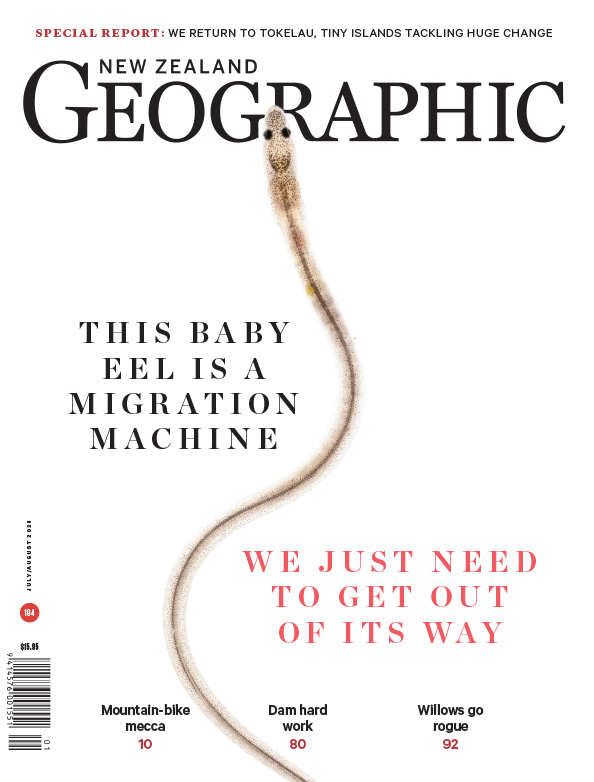
Another perspective-shifter: the biggest eels that are in our waterways now, the ones as thick as your arm, arrived in Aotearoa as glass eels like our cover star. That was 80, 90 years ago. Those eels were here before you, probably. They arrived before hydro power and massive dams. Before most of the turbines and culverts. They had smelled fresh water, whispers of it through a Pacific laden with salt, and they followed it to the rivers.
As Bill Morris writes, the glass eels arriving now are faced with an entirely different map, scattered with thousands of unclimbable obstacles. Quite aside from trashing the water quality, we have changed their whole world. The babies are stuck at the bottom of the rivers, and the elders are trapped upstream, with dangerous turbines between them and their breeding grounds at sea.
Morris and photographer Richard Robinson spent many months reporting the story of the eels and the people who care for them. Both came away deeply moved, and incredulous. How could we get water so wrong?
For now, mana whenua are spending long, cold nights catching eels young and old and carting them around obstacles in buckets. It’s piecemeal, slimy, a slog. It is at once an obligation and an honour. It’s not enough.
Humans have a habit of screwing things up, but we’re also very good at solutions. Surely the shifting of fish from A to B is a problem we can solve.
*
We didn’t mean to make this magazine a waterworld special, but it seeped in regardless. Such is the way of water. And so, on page 92, Morris and photographer Joe Harrison detail the way willows have transformed our rivers, saving us from floods, sometimes, while super-charging other storm events. Rebekah White recounts some truly horrific work stories from the building of the Manapōuri hydro power station (page 80). And publisher James Frankham, with Robinson, heads across the Pacific, in which generations of our eels have hatched, spawned, and died. In Tokelau, they find life is more water than not (page 58).
Here’s another story, about the water in the sky. As we put this magazine to press, I came across a disturbing new study by NASA climate scientists, based on satellite data and published in Geophysical Research Letters. “In the past 24 years the world’s storm-cloud zones have been contracting at a rate of 1.5%–3% per decade,” the scientists write. These are the sorts of clouds that reflect sunlight. Without them we are terribly exposed. “This contraction allows more solar radiation to reach the Earth’s surface and constitutes the largest contribution to the observed 21st century trend of increased solar absorption.”
These scientists aren’t sure yet whether it’s a feedback loop—less cloud means more heat means less cloud—but they worry it could be. Water does like cycles.
When I read such studies I am forever trying to answer one question: How bad will it get in my kids’ lifetime? You might instead like to think about the baby eel on the cover. Lenses like this are useful, I find, in approaching the vast and swelling ocean of climate data.
All going well, that eel will settle in a nice patch of stream in the bush. Many happy, watery decades later, in autumn, there will come a rain that makes it want to migrate again, this time seeking salt. What will the world look like then, I wonder. And I hope.
More by Catherine Woulfe