Like Neptune’s necklaces swaying to Pacific swells, ropes of greenshell mussels create intriguing (and nutritionally rewarding) alleyways for cruising fish at Port Charles, on the eastern tip of the Coromandel Peninsula. Here, and at hundreds of other coastal sites in the North and South Islands, greenshell mussels are grown in their millions to satisfy a worldwide demand for a unique shellfish. No other green mussel is available on international fish markets, and New Zealand’s Perna canaliculus not only looks better, but, say aficianados, tastes better than other mussel varieties. From a fledgling industry in the 1970s (300 tonnes was the total harvest in 1977), mussel farming has become the country’s dominant aquaculture industry, with a harvest of close to 50,000 tonnes in 1992. Despite a setback this summer, in which all harvesting was banned following a bloom of toxic algae, the country’s mussel farmers are determined to see our local “heroes in a half shell” recognised as the world’s best mussel.
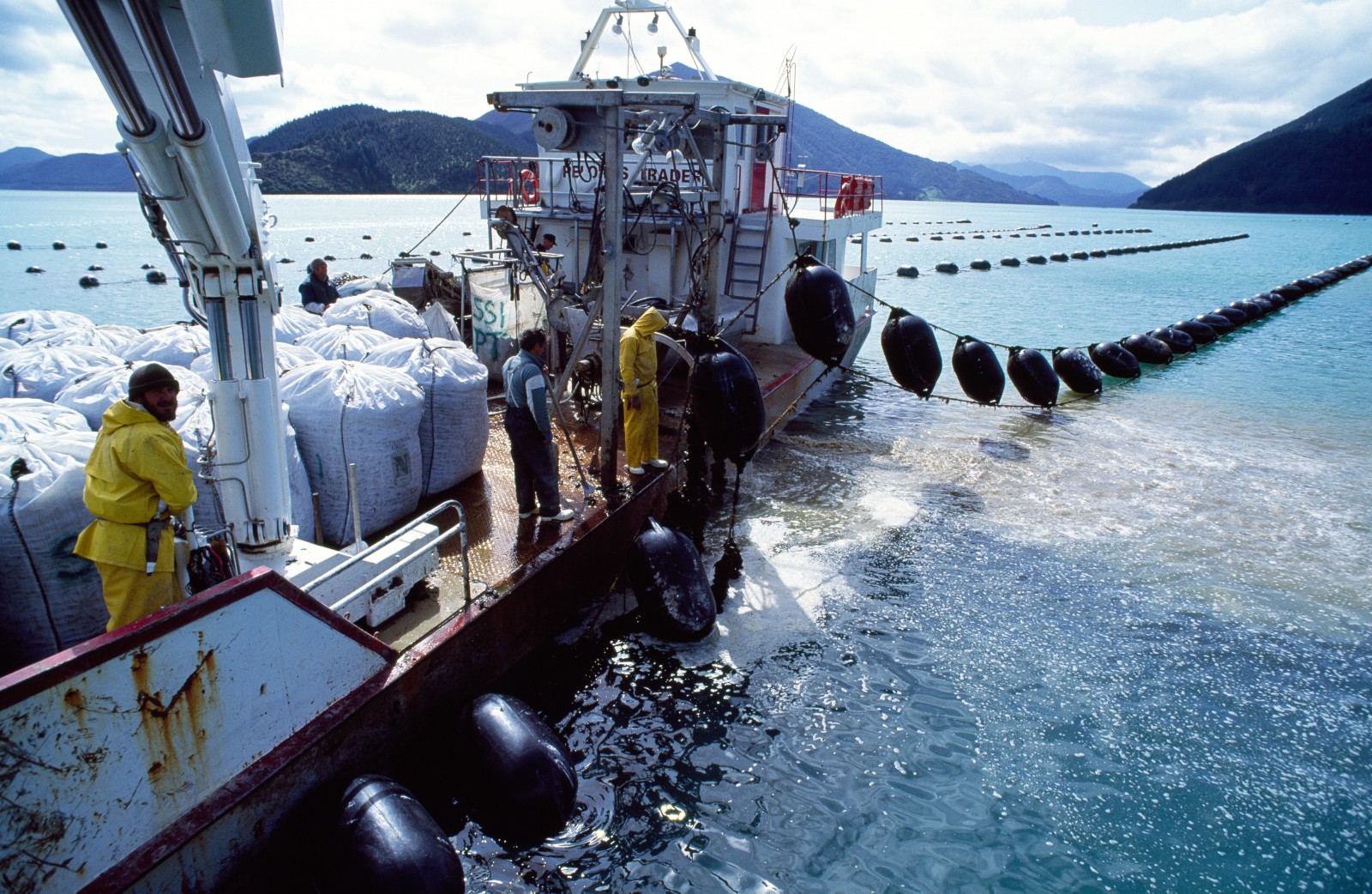
The country’s largest mussel harvester, Pelorus Trader, works its way down the rows of floats of a Marlborough mussel farm. Shellfish-laden growing ropes or “droppers are unclipped and brought aboard while the backbone ropes are left in place, ready to support the next crop. On board processing includes removal of unwanted shellfish (in Marlborough, particularly the competing blue mussel), cleaning encrusting organisms off the shells with high-pressure water, and packing.
Growing greenshell mussels is a bit like growing a weed, says Coromandel marine farmer Allan Bartrom. “Put a log or boat in the water around here for long enough and it will grow mussels.”
Unlike weeds, greenshell mussels have proved a lucrative—if, lately, an unpredictable—crop for New Zealand’s aquaculturalists.
Last year, they earned the country $52 million in export revenue, with a further $10 million-worth being consumed locally. Just a decade ago, the industry was worth less than $5 million.
The greenshell mussel, Perna canaliculus, is native to New Zealand, although it has close relatives in South America, South Africa and the tropics.
Several other species of mussel inhabit the New Zealand coastline (see page 120), but Perna is the only one in cultivation. There are several reasons why this is the case. Perna is a large, meaty mussel which grows in deeper water than most other species. It also grows quickly, reaching a marketable size in 10 to 18 months, depending on the location of the farm: Coromandel mussels grow more quickly than their counterparts in the Marlborough Sounds.
Most important of all, Perna is the only green mussel in cultivation anywhere in the world. In the competitive international shellfish market, with a turnover of more than a million tonnes per year for mussels alone, the New Zealand mussel stands out from the crowd, both in colour and size, and is capable of fetching a premium price.
The attractive green shell (now adopted and patented as the official name, replacing the former “green-lipped mussel”) is nicely complemented by the creamy white (male) or apricot (female) flesh. The New Zealand industry emphasises these features in the way it presents the product: the largest export category is frozen mussels on the half shell. Other products include smoked, stuffed, crumbed, coated and marinated mussels, mussel chowder and mussel “pick ‘n’ dip.”
The live mussel trade is relatively small—about five per cent by volume—but there are hopes that the rapidly growing Asian market may take more live product. At present, Europe is by far the country’s largest export mussel market, followed by Japan, the United States and Australia.
Twenty-five years ago, mussel farming in New Zealand was unknown. The shellfish were either picked from the rocks or dredged from shallow seabeds. The largest, most succulent specimens—with shells up to 180-200 mm—were dredged, particularly near Coromandel.
Stuart McFarlane was one who fished for these beauties, but he soon realised that the harvest was unsustainable. Instead, he took up the idea of farming them.
In 1969 he set up a trial raft at Chamberlin’s Bay, Ponui Island, in the Hauraki Gulf. Ironically, the experiment proved too successful: such was the weight of growing mussels that the raft broke in two and sank.
At about the same time, Keith Yealands, a Marlborough grocer, was developing his own plans to farm mussels. Yealands had suffered a heart attack and been ordered by his doctor to find a less stressful job. He had read about Spanish methods of mussel culture and had seen a Victoria University study on the subject, and decided that aquaculture was just the sort of outdoor pursuit he needed.
The local harbour board granted him permission to establish a one-acre experimental farm in Queen Charlotte Sound. But all was not smooth sailing.
“I built a huge concrete raft with two double pontoons to hold the growing ropes, collected some seed, and in no time at all had a successful crop. But the harbour board wouldn’t let me harvest it. I was allowed to take only the legal daily quota of four gallons. The raft got heavier and heavier as the crop grew. I pleaded with the board to let me take more mussels off, but they refused to allow it. Eventually, in rough weather, the raft broke up and went to the bottom with the mussels.”
Despite this setback, Yealands had proved he could grow mussels, and in 1972 he gained his first licence. The venture was a family enterprise, and, though productive, it was far from profitable. To pay the bills, the family also ran a car-wrecking business. “So much for the quiet lifestyle prescribed by the doctor,” muses Yealands.
In the early 1970s, aquaculture was still a very new concept in New Zealand. Oyster farming was just becoming established, and both the mussel and oyster industries developed slowly. But towards the end of the decade other entrepreneurs began to look at the idea of growing mussels.
Allan Bartrom was one. “We set up an experimental farm in 1979 to determine conditions suitable for cultivating mussels, and then prepared a Marine Farm Plan—akin to a Town and Country Plan—setting out where farms might be established. In all, it took five years of work—and we copped a fair amount of flak. Because recreational boaties and mussel farmers are both looking for the same thing—clean, sheltered waters—the conflict of interests was often intense. In the end, only one per cent of the area we proposed was approved for mussel farming.”
Today, there is general acceptance of the presence of the farms both on the Coromandel Peninsula and in the Marlborough Sounds—the main mussel farming region in the country—although a few dissenting voices remain. For them, mussel farms will always be a blot on the seascape.
*
Although mussel farming had its beginnings as a cottage industry through which individuals, families or small partnerships could supplement their incomes by selling to the local market, today it is big business, with major companies involved, and most of the harvest exported. The Yealands family’s own firm, Marlborough Mussel Company, owns 16 farms and manages a further 17 in the Sounds. It handles 5500-6000 tonnes of export mussels a year, and Keith Yealands’ contributions to aquaculture have been recognised with an OBE.
Getting from those first disintegrating rafts to our present total production of 46,000 greenweight tonnes (1992) has involved considerable refinement of production methods along the way.
Initially, Spanish raft cultivation techniques were used, with 10-metre-square frames growing up to six tonnes of mussels on ropes suspended beneath the raft. This system proved inefficient, as mussels near the centre of the frames did poorly—probably because the shellfish around the outer edges took most of the available food particles in the water currents.
Farmers soon began experimenting with an adaptation of the Japanese longline system, using buoys to suspend parallel lines of growing ropes or “droppers” in the water. The system has been further modified on larger farms, where the droppers are loops in one continuous rope. The loop method greatly facilitates harvesting and re-seeding.
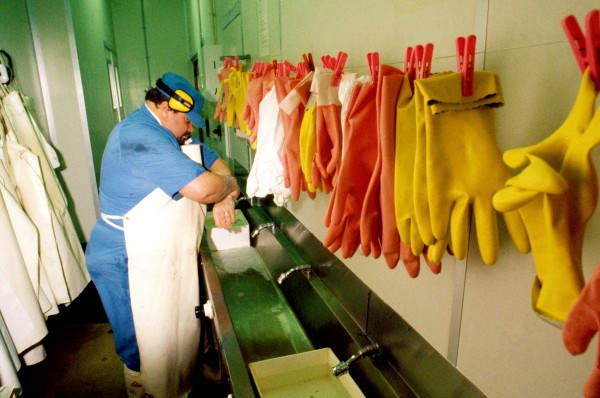
Forty-six thousand tonnes of greenshell mussels were harvested in 1992 and processed in 20 factories around the country. The main product (making up 50 per cent of exports) is mussels on the half shell, cooked and blast frozen. Smoked mussels are a popular product for both local consumption and export. Given the susceptibility of shellfish to contamination, factories are scrupulous about hygiene standards. Every time a worker enters the factory, a rigorous procedure of washing and donning sanitised clothing must be followed.
From the air, today’s typical mussel farm is about three hectares in area, and comprises four parallel rows of large black floats roped together, with the first rows 50 metres offshore and extending out to 200 metres from the coast.
Each row of floats supports a pair of 100-metre-long backbone ropes or longlines which are anchored at each end and aligned parallel to the shore (to allow the best exposure of each mussel to the nutrient-bearing tidal flows). Droppers (either individual ropes or a continuous series of loops) hang 7-10 metres down into the water, and support 300-350 mussels per metre of rope. The combined weight of mussels on each longline can reach 40 metric tonnes in a single growing cycle.
The two backbone ropes in each pair are less than a metre apart, and each set of floats and ropes is separated from the next by just enough room to allow vessels to pass up and down the farm, harvesting and seeding.
Getting tiny juvenile mussels to adhere to the growing ropes was once a laborious, manual task that involved feeding small mussels into long “stockings” through which the growing ropes passed, then lowering the stockinged ropes into the water. Young mussels rapidly attach themselves to the ropes, and the stocking rots away, leaving the mussels to grow to harvest size.
Some small farming operations still use this method, but most farms are seeded by contractors working from specially adapted vessels. Again, it was the Yealands family who pioneered mechanised seeding, some ten years ago. Now the family business manufactures the biodegradable stocking which holds the young mussels in place.
Much of the mussel production of the Coromandel Peninsula ends up in seawater tanks in Auckland supermarkets, to be sold live. After toxic algal problems of the summer, domestic consumption of all fish dropped by as much as 35 per cent compared with the same time in 1992. Many supermarkets staged promotional drives and offered low prices to encourage customers to buy shellfish again.
Curiously, despite its growth in the last 20 years and its technological advances, the mussel farming industry is still heavily reliant on the unpredictable arrival each year of mussel spat on Ninety Mile Beach.
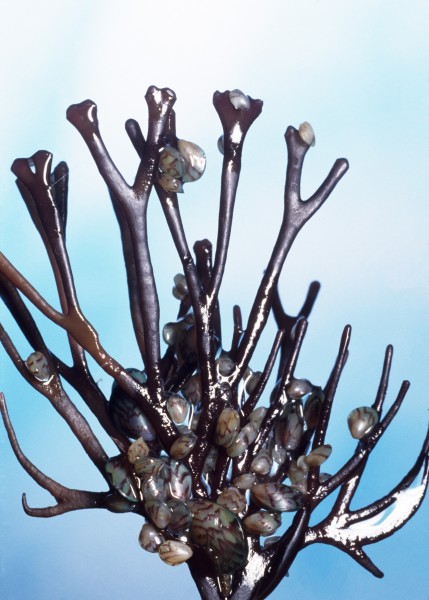
Bob Hickman, an aquaculture research scientist with the Ministry of Agriculture and Fisheries, Wellington, discovered the spat when casually investigating a pile of seaweed on the beach in 1974.
“The weed was absolutely smothered in minute mussel spat. I was surprised to find it washed ashore in the middle of a long sandy beach, far from the usual rocky areas where mussels live,” he recalls.
The potential of this spat bonanza for the development of the industry was immediately apparent, and before long a handful of locals had set themselves up in business as harvesters. They simply picked up the seaweed, packed it into plastic buckets or bags and freighted it to the mussel farmers. If kept cool and damp, the mussel seed survives for several days out of water.
Revenge of the algae
It is a curious thing that many of the least known organisms on our planet are also the most abundant. Bacteria are in this category, and so are phytoplankton.
Phytoplankton are single-celled chlorophyll-containing organisms inhabiting those upper layers of the oceans where there is sufficient light to carry out photosynthesis. Worldwide, there are probably tens of thousands of species, though many are very widely distributed.
Unlike their more familiar cousins, the macro-algae (seaweeds), which are mostly anchored to the substrate, phytoplankton drift around at the mercy of wind and wave.
Because they can convert sunlight into biological tissue, they are the primary producers in the ocean—the basic food for krill and teeming millions of minute zooplankton and, indirectly, for most other marine life as well.
Each litre of sun-penetrated water may contain anything from a few thousand to a million or more phytoplankton. Although this may sound a lot, these organisms are small in size—two microns to two millimetres, with an average of perhaps 50 microns (a micron is 1/1000th of a millimetre)—so, packed together, they wouldn’t weigh more than a fraction of a gram. Yet given that the oceans cover three-quarters of the earth’s surface, the total weight of phytoplankton must be indescribably vast.
Phytoplankton embrace a broad range of different organisms: blue-green algae or cyanobacteria (thought to be amongst the oldest and most primitive of organisms), golden brown types, including coccolithophores, diatoms and dinoflagellates, and green flagellates—to name but a few.
Many species are encased in complex and beautiful arrays of hard plates that may be sculpted into spines, tubes, buttresses and pores. The functional significance of this elaborate ornamentation is obscure, but it has been suggested that it renders these algae unpalatable to small predators, or that it assists with flotation.
Most (but not all) of the toxic algae seem to belong to the dinoflagellates, a group characterised by the possession of two flagella which enable these organisms to swim.
Some dinoflagellates are bioluminescent; others grow as symbionts called zooxanthellae in reef-building corals. Yet others produce potent neurotoxins—the so called toxic algae—and some are responsible for “red tides,” algal blooms involving organisms having a reddish colour.
Was the first of the ten plagues visited upon Egypt a description of a red tide? (“. .. and all the waters that were in the river turned to blood. And the fish that were in the river died, and the river stank.”) The nearby Red Sea certainly got its name from such tides.
Red tides are not necessarily the work of toxic algae. Massive densities of plankton can kill by simply depleting the water of oxygen, and thereby suffocating fish, or by clogging their gills. But some dinoflagellates and microflagellates produce bioactive agents which are thought to cause abnormal mucus secretion and gill damage to fish. Just such a problem affected salmon ranching operations in Big Glory Bay, Stewart Island, in January 1989, when a bloom of microflagellates caused the death of 600 tonnes of caged salmon. Other flora and fauna in the area were unaffected.
“Red” tides are not always red (brown is quite common), and because many of them are nontoxic, it is difficult to know when there is a real threat. For example, most such tides in New Zealand are caused by a protozoan called Mesodinium rubrum—a non-toxic species which apparently constitutes good food for shellfish.
Conversely, in many cases of toxic algal poisoning, there is no visible bloom. (Because of their ability to swim, dinoflagellates are often found in dense bands several metres beneath the sea surface.) The algae produce potent toxins that are ingested by shellfish and other filter-feeders when they go about their normal feeding, removing plankton from water as it passes over their gills.
Toxins from the ingested algae are apparently unaffected by the animal’s digestive system and accumulate in the gut and tissues. From there they can be passed to higher predators: crabs, fish and humans.
Curiously, toxins often have little effect on the shellfish that accumulate them, but ingestion of only a few grams of affected shellfish meat may cause dramatic symptoms in humans
In April 1992, two men in a party of seven fishing on the Canadian coast near Vancouver ate a few lightly cooked butter clams for breakfast. One man (aged 54) ate five; the other (a 31year-old) had just a single small bite of one clam.
Within minutes, both began to experience numbness of the mouth and lips. The loss of feeling quickly spread, and after 20 minutes the younger man was completely paralysed and unable to breathe. Had the other members of the party not started artificial respiration and summoned a rescue helicopter by radio, both men would have died. As it was, the younger man was unconscious for 48 hours and experienced neurological symptoms for a further 48 hours. Both men suffered severe pneumonia as a result of inhaling vomit while they were becoming paralysed during that first 15 minutes.
Analysis of uneaten remains of the shellfish indicated a toxin level of 10,000 micrograms per 100 grams of shellfish meat. The younger man, who had only taken a single nibble, was unlucky in that he had devoured the siphons of the animal, and in butter clams they contain 75 per cent of the total toxin present in the animal.
In scallops, the part that is usually eaten, the adductor muscle, has never been found to contain toxins, whereas other parts of the animal can be simultaneously quite toxic.
Furthermore, different species of shellfish seem to accumulate toxic algae to different extents. Overseas studies have indicated that mussels are often severely affected, whereas oysters are slower to become toxic and do not reach high levels of toxicity.
It seems that filter-feeders are not indiscriminate eaters of any plankton that passes by. Many can actively select the species they wish to consume, and at least one American shellfish, the quahog clam, appears to stop feeding when toxic algae are present.
Unfortunately (for humans), once shellfish have accumulated toxin, they may remain toxic for weeks or months, depending on what the toxin is and where in the animal it becomes concentrated.
The most serious phytoplankton toxins are those which cause paralytic shellfish poisoning (PSP)—the type experienced by the two Canadians described above. The poisons act by binding to proteins in nerves that serve as channels for sodium movement, effectively blocking transmission of all nerve impulses. PSP has resulted in numerous fatalities worldwide.
These toxins can be produced by species within three genera of dinoflagellates: Alexandrium, Gymnodinium and Pyrodinium. and a number of toxins may be present in any one outbreak.
Patient symptoms in the recent outbreak in Northland and the Bay of Plenty suggest that a mild form of this poisoning occurred, with the causative organism being Alexandrium minutum.
However, the major type of shellfish-related illness in the North Island episode was neurotoxic shellfish poisoning. NSP symptoms include muscle weakness and the sensation of being alternately hot and cold. The organism responsible was identified by Oceanographic Institute scientist Hoe Chang as being another dinoflagellate, Gymnodinium breve. Besides causing NSP, G. breve can also produce respiratory disorders, as occurred with several hundred visitors and residents of two Whangaparaoa beaches over the summer, who developed rasping coughs by inhaling airborne fragments of the organism brought in by the onshore wind.
Two further categories of poisoning are caused by phytoplankton. Diarrhetic shellfish poisoning (DSP) results in symptoms similar to those of acute food poisoning: vomiting, nausea and diarrhoea a few hours after ingestion, but with no longterm effects.
Amnesic shellfish poisoning (ASP) is the only known type of shellfish poisoning caused by diatoms (species of the genus Nitzschia). It involves toxins which bind to receptors in the central nervous system, and leads to the death of the nerve cells. Symptoms include gastrointestinal problems, often combined with headaches, confusion, memory loss and, in a few cases, comas and death.
So far, the only recorded outbreak of ASP has been at Prince Edward Island, Canada, in November 1987, in which over 100 people were affected, and several died after eating the blue mussel Mytilus edulis.
Instances of toxic algal poisoning are on the increase worldwide. It is not just that people are more aware of them; a number of human and geophysical factors are exacerbating the situation.
Of primary concern is the fact that previously localised toxin-producing species are probably being dispersed around the world in the ballast water of ships, which take on seawater in one port and discharge it at another. Coastal eutrophication (nutrient enrichment from sewage and fertiliser run-off) increases the likelihood of blooms, and heavy rain or run-off is also thought to play a part in runaway algal growth.
The implications for shellfish fisheries are serious. For example, since the mid-1940s the Alaskan clam industry has been seriously affected by toxic algae, and all Alaska’s 33,000 miles of coastline are considered at risk all year. Seventy per cent of the coast of British Columbia is permanently closed to commercial harvesting of shellfish because of unpredictable dinoflagellate blooms, and during the mid-1980s nascent mussel culture industries in Sweden and Norway were largely closed down by DSP outbreaks. Spanish and, recently, Tasmanian mussel culture has also been seriously affected. In fact, New Zealand has been one of the few countries that have not had problems until now.
What to do? In most countries where commercial shellfishing persists, regular sampling of plankton species and shellfish is used to monitor for the presence of toxic algae. When toxin levels exceed a threshold value-80 micrograms of toxin per 100 grams of bivalve flesh—shellfish beds are quarantined.
The commonest type of assay has been to acid-extract samples of shellfish, and inject this extract into laboratory mice. Toxins produce symptoms that lead to rapid death of the mice. One “mouse unit” of toxin is the amount required to kill a 20 g mouse in 15 minutes following injection. Human illness requires the ingestion of about 600 mouse units, and death, some 3000-5000 mouse units (0.7-1.0 mg of toxin).
It is one thing to detect a toxic presence, but another to be forewarned of algal population explosions. Balloons, satellites and aircraft can potentially provide information on sea colour changes that may signify blooms, but they can’t discriminate between “good” and “bad” phytoplankton, and they can’t spot algae that mass well below the surface (as was the case in Northland).
The first inkling of algal problems in the summer of 1992/93 came in September, when a student studying water clarity at Auckland University’s Leigh marine laboratory noticed the presence of a red tide in the surrounding waters.
Scientists at Nelson’s Cawthron Institute found that the bloom was caused not by a dinoflagellate but by a raphidophyte species which was new to New Zealand, but which had been associated with fish deaths in Japan. Over succeeding weeks this bloom spread across the Hauraki Gulf, and a few weeks later Coromandel mussels were reported to have a hot, bitter taste. Bioassays showed that no toxins were present in the shellfish, and they appeared to be safe for human consumption, but Cawthron scientists suspected that the raphidophyte algae had produced some compound that was making the mussels bitter.
“This problem seemed to slowly fade,” Cawthron biologist Lincoln Mackenzie told me, “but in the first week of January a new one surfaced. Vets in the Auckland-Whangarei area reported that a number of cats had become ill after eating shellfish remains. They notified the area health boards, who then enquired whether people were being affected.
“The answer came back that there were an unusually high number of shellfish-related illnesses, and even some hospital admissions. It was then recalled that a group of children had become sick from eating shellfish from Auckland’s North Shore in the previous month.
“Samples of plankton from an ever-growing area of the north were sent to us for analysis, and these proved to be dominated by various dinoflagellate species. Mouse testing of shellfish extract from these areas revealed mild PSP-type toxins.”
From there on it was a race to try and match organisms to toxins, while at the same time to continue to test shellfish and other marine species to see how widespread the toxic event was.
By mid-January, the planktonic culprit or culprits had still not been identified, and shellfish toxin was being found in mussels from the South Island as well as the North. The Ministry of Agriculture and Fisheries, charged with ensuring compliance with international protocols relating to shellfish poisoning and concerned to maintain the high reputation of the New Zealand aquaculture industry, banned the harvesting of mussels, other shellfish and some crustaceans in several areas of the country.
As more and more shellfish tested positive for toxins, the areas banned to harvesting increased, until the whole New Zealand coastline, including the Chatham Islands, was in quarantine, and the mussel industry ground to a halt.
The next four months were a time of deep frustration for farmers and processors, who suddenly had no livelihood, and for scientists, who struggled to piece together a complex jigsaw of plankton species, toxins and medical symptoms.
By March, with toxic algae on the wane, Marlborough mussel farmers were cleared to begin harvesting again, but it was not until May that Coromandel was given a clean bill of health.
At the time of going to press, the whole episode is receding into (unpleasant) memory. But in six months’ time, with another predicted El Niiio summer bringing colder than usual sea temperatures, there is every chance that the algae will be back. This time, the farmers and their scientific minders will be better prepared.
The only problem with “Kaitaia spat,” as it is called, is its unpredictable arrival. When it does come, it washes ashore in such large quantities that it is scooped up by the truckload. But months can go by when the sea yields nothing. Harvesters check the beach daily—especially after a north-easterly blow—looking for freshly washed up weed. Often, it is only stranded for a single tide before being sucked out again.
“Although very irregular in timing, I think there has only been one period of 12 months in which there hasn’t been at least one stranding of weed,” says Hickman.
In both Coromandel and the Marlborough Sounds, local spat is collected on ropes set out for this purpose, but Kaitaia spat is eagerly taken when it is available. The reason is that local spat appears to produce adults which spawn at a different time from those grown from Kaitaia spat, and by using the two seed sources farmers improve their chances of being able to harvest all year round.
Spat on the Kaitaia weed can be as small as 0.25 mm or as large as 10 mm, depending on its age. It reseeds most successfully at 10 mm, though juveniles as large as 50 mm can be attached to growing lines. Some mussel farmers take the spat directly from those who collect it; others buy older spat that has been on-grown by farmers with specialised mussel “nurseries.” Mussels are usually 4-6 months old by the time they are seeded on to the “production lines.”
*
It was a cold May morning when Chris Godsiff, operations manager for Sanford South Island, took me to see a harvesting team at work on one of the many marine farms his company contract seeds and harvests in the Marlborough Sounds.
Most farms are inaccessible by road, and isolated from each other by kilometres of waterways, but Godsiff makes short work of the distances in his 10-metre jet boat, which hurtles along at close to 30 knots.
I step aboard the country’s largest mussel harvester, the Pelorus Trader, which is capable of harvesting 90 tonnes of mussels a day. Growing ropes, like the monstrous necklaces of some huge sea monster, are being winched aboard and stripped of their emerald jewels.
Sorters quickly separate the green mussels from seaweed and unwanted blue mussels.
Blue mussels, the mainstay of the mussel industry in other parts of the world, are regarded as a pest by New Zealand farmers because they attach themselves to droppers and compete with the greenshells for food and space.
Much of the “raw material” for the country’s mussel farm-seed mussels-comes form Ninety Mile Beach, where it washed up on seaweed in certain weather conditions. At this juvenile size, the tiny mussels are more rounded than they will be as adults, and have zigzag markings which will disappear as the lustrous green shell colour develops.
Harvested mussels are loaded into one-tonne bags, which are labelled with the date of harvest, farm number and harvester. In coded form, this information accompanies the mussels to their final point of retail sale, so that, in the event of problems with quality, the batch can be instantly traced. Ministry of Agriculture and Fisheries inspectors police the system.
The natural vulnerability of shellfish to contamination (highlighted by two recent Listeria-related deaths which resulted in a Marlborough mussel processing plant being temporarily shut down) means that the mussel industry must take the issue of quality control very seriously.
The commitment to strict hygiene standards during processing was brought home to me when I visited Marlborough Perna’s plant in Blenheim.
First, I was obliged to remove shoes, earrings and watch, before stepping over a low barrier and entering a quarantine area. Here I donned white boots, coat and surgical cap, before fumbling with a knee-operated tap as I washed my hands. A foot bath followed, and only then could I enter the factory.
The 100-strong staff must pass backwards and forwards over these hurdles every time they enter or leave the factory, changing their footwear and outer clothes on each occasion. The company has even installed its own laundry to ensure that factory clothing is scrupulously clean.
Staff are required to sign declarations confirming they will not work if they have an infectious illness.
Aspects of the processing itself, such as opening and packing, are strictly separated within the factory. “Our hygiene standards are higher than those required by most mar- kets, but we have set them to enable us to export direct to retail in Britain,” says Cathy Climo, the company’s quality assurance officer.
This year, Marlborough producers have gained access to the Italian mussel market for the first time. MAF inspector Paul Anderson recalls the visit of two Italian veterinarians, who were sent by the Italian government to assess conditions at our mussel farms when the deal was being negotiated.
“They couldn’t believe that we had no industrial plants along the coastline. They were so impressed with the quality of the water they ate the mussels straight from the farms `sa sashimi’ style, raw, right there and then—something not possible on most overseas mussel farms,” says Anderson.
*
The method bywhich mussels are grown may sound deceptively simple—drop the seeded ropes into the water, pull them up when you’re ready to harvest—but it is not without its problems. The molluscs can be knocked off their dropper ropes in rough weather, crowded out by blue mussels or attacked by fish.
Farmers tell of schools of snapper stripping freshly seeded farms, leaving buoys that were once well submerged floating light and high with their diminished loads. Little is known about the extent of fish predation, but some farmers believe farms in deeper water are less vulnerable from bottom-dwelling fish than are shallower farms.
Presuming that they survive to maturity, mussels have a sex life apparently designed to frustrate farmers. They can spawn suddenly and unpredictably, rendering their flesh less palatable and “skinny.”
“Mussels which have spawned lose condition and flavour very quickly. If they do it on the farm, they can be left to regain these qualities, but they can also spawn on the back of a truck on their way to a pack house, or even on the factory floor,” says Anderson.
However, it is seldom that all farms spawn at once, so in the Sounds, where most harvesting is done under contract, operators can move from farm to farm, taking mussels still fit for processing.
These are trifling concerns, however, when compared with the catastrophe which shut down the country’s entire mussel industry in February of this year. Until then, mussel farmers had had a relatively clear run for over a decade, with few disease or parasite problems. Then, around Christmas, an algal bloom, possibly triggered by colder than usual coastal sea temperatures, began to affect shellfish, and cases of poisoning as a result of shellfish consumption began to be reported, first in Northland, and then further south. Rigorous testing of mussels around the country indicated widespread presence of toxins in mussel tissues, and MAF banned all mussel harvesting.
Health from the sea
Much of the early impetus for farming greenshell mussels came from a desire to consume the shellfish not in its whole state as food, but in its powdered form as a medicine.
Stuart McFarlane, one of the pioneers of mussel farming, was harvesting some of his first farmed mussels from Waiheke in the early 1970s, when, more or less by serendipity, his business took a unique turn.
At that time, an American laboratory was screening extracts from all manner of marine organisms for anticancer, as well as other pharmacological, activity. The researchers requested New Zealand mussels from the fisheries department, who in turn asked McFarlane to provide some. A report came back indicating a complete absence of anticancer activity, but some notable anti-inflammatory action.
McFarlane’s entrepreneurial instincts were aroused, and he started giving mussel extracts to a number of acquaintances who suffered from arthritis. Some claimed to have been helped . . . and not only humans. One swore that it had done wonders for his elderly dog.
Word spread, articles were written in the local press, and soon relieved sufferers in New Zealand were buying and sending mussel pills to their relatives overseas. But what really established the product (called Seatone) was an article in a UK medical journal which reported its effectiveness with a group of Scottish arthritic patients. Newspapers around the world picked up the story, and McFarlane Laboratories was suddenly internationally known, and its product in demand.
But it wasn’t all a smooth ride. Other companies began to produce and sell similar extracts, leading to oversupply and, in 1982-83, an inevitable slump.
Continuing medical tests were done on the efficacy of the product, and while some demonstrated its effectiveness, others indicated that it was without merit. Nevertheless, worldwide demand has been sustained for some 20 years now—proof to general manager John Croft that “there has to be something in it.”
Just what that something is is a moot point. Despite the work of several hospital scientists who have taken an interest in the preparation, no one has yet identified the active ingredient, although an Auckland group has narrowed the search down to the polysaccharide glycogen.
At present, McFarlane Laboratories processes 4-5 tonnes of mussels per week. Fresh mussels are macerated and put through a centrifugal extraction process. (John Croft confides that he did the first extractions using a spin-dry washing machine.) The anti-arthritic factor is removed with the water and soluble solids. and freeze-drying (above) converts it into a powder which is then formed into pills (for pets) or capsules (for people).
The company has also developed other freeze-dried health products, including extracts of oyster, shark cartilage and deer velvet.
Elsewhere in the world, blooms of particular types of algae and dinoflagellates which contain toxins frequently render mussels toxic, and lead to the closure of mussel fisheries. The animals become toxic because they filter toxic organisms out of seawater during the course of their regular feeding. (Mussels process six to eight gallons of seawater per hour.)
Some of the accumulated toxins cause little more than minor food poisoning in humans—a short, unpleasant bout of vomiting and diarrhoea, and the disease passes. Other toxins, however, can cause paralysis and even death. (See box)
As well as imbibing potentially toxic plankton, mussels and other shellfish can take in and concentrate bacteria and viruses from seawater that may have been contaminated by effluent. Shellfish meat—like other meat—provides a rich substrate for bacterial growth, hence the importance of farming shellfish in clean water, and maintaining strict hygiene standards during processing and storage.
Research has determined that there is a correlation between rainfall and bacteriological counts in mussel flesh. With heavy rain comes run-off from countryside surrounding the mussel farm, carrying potential pollutants to the filter-feeding mussels, and, consequently, to anyone eating them.
Trace metals, herbicides, pesticides, and especially bacteria and viruses are the main threats, and all are regularly tested for under a rigorous sanitation programme which, among other stipulations, sets rainfall limits for each farm. In the Marlborough Sounds, four automatic gauges at strategic points monitor precipitation, while Coromandel’s six gauges are read manually. When the limit is reached, farms are closed for a set number of days, after which harvesting may begin again. Illegal harvesting carries heavy penalties, but to date there have been no infringements.
In the Sounds, the focus of mussel processing is on export, with nearly all mussels being cooked, while half of Coromandel’s mussel harvest is shipped live to Auckland and sold from seawater tanks in supermarkets.
Brian Walker of Thames is MAF’s shellfish inspector on the Coromandel Peninsula, and is responsible for the 37 local mussel farms and the processing plants.
“Mussel farming has found an ideal niche at Coromandel,” he says, “because as a primary industry it fits like a hand in a glove. It has brought a vital boost to the local economy, which suffered under the fishing quota management system, and it is also one of the reasons Coromandel township has a Rolls Royce sewerage treatment plant. Protecting the marine environment was a vital consideration in the construction of the plant.”
Today, around 100 Coromandel Peninsula people are directly employed in mussel farming, with many more finding work in servicing industries. Coromandel has its own processing factory, with another at Whitianga, one in Tauranga and four in Auckland handling Peninsula mussels. Annual production from the 37 farms-32 of which are close to the Coromandel township—is around 10,000 tonnes.
Mussel farming in New Zealand has not been without its critics, many of whom feel the ubiquitous rows of black buoys spoil the seascape. Other dissenting voices question the effects on downstream marine life of battalions of mussels (several million mussels per farm) taking the lion’s share of nutrients arriving with each tide. Little is known about the biological impact of mussel farms, although it is clear that many creatures, including sea horsesmand fish benefit from the plethora of encrusting organisms which grow on the mussels, and starfish and octopus feast on those shellfish which fall off the growing ropes to the seabed below.
Jim Jessep of Blenheim, president of the New Zealand Marine Farming Association, chairman of the Mussel Industry Council and mussel farmer, has seen the Sounds industry grow to the point where today 355 licensed marine farms produce 35,000 to 40,000 tonnes of mussels each year. Around 900 people in Marlborough are employed within the industry, which is worth $40 million to the region.
Despite the big money involved, mussel farming is not highly profitable for farmers themselves. With a return of around two cents a mussel, many are looking to diversify to improve their livelihood.
Jessep is one who is keeping his options open. He’s applied for licences to farm scallops, crayfish and even seaweed, as well as mussels.
“The whole fishing industry will be totally different in five years’ time,” he says. “It’s worth a billion dollars to the economy now, but the second billion is going to come from aquaculture. The time to diversify is now.”
Not everyone is so upbeat about farming the New Zealand coastline. Environmental groups hold a number of concerns about marine farming, and not infrequently oppose mussel licence applications.
Assistant conservation director with the Royal Forest and Bird Protection Society, Mark Bellingham, voices some of these concerns: “Recreation and landscape values are detrimentally affected by marine farming structures which prevent free passage of boats, and limit access.
“These structures can detract from the harmony and beauty of the Sounds for tourists and residents alike.”
Conservationists also worry about the long-term effects of mussel farms on water quality, arguing for lower mussel densities and better water circulation.
On this issue, Alastair Macfarland, deputy head of the Fishing Industry Board, believes the presence of mussel farms in an area should be regarded as a powerful guarantee of purity. “Mussels are the ultimate canary,” he says. “If there is a farm in a bay, that’s the best proof of water quality you can have.”
But what effect does the massive biomass of mussels have on localised areas of coastline? Does a solid wall of mussels, all filtering away madly, suck out the available nutrients arriving with each incoming tide, depriving downstream marine life of a meal? No one knows. Although it is well established that the outer echelons of mussels on a farm reach maturity more quickly than those closer to the shore, no serious research on this question has been undertaken.
And what about the mussels and associated encrusting organisms which get knocked off the droppers by storms or during harvesting, and end up on the seabed? The Novises of Port Charles talk of large, well-fed octopus feasting on the free meals from above, and an increase in the number of scallops around their farm, but is there a danger of sessile organisms being smothered? Again, no research has been undertaken.
In the long run, arguments about aesthetics or environmental impact may be overtaken by questions of the viability of farming mussels in some parts of the country. This summer’s toxic scare, while mild by international standards, was enough to make some farmers (especially those in Northland) re-examine their long-term prospects.
Most, though, see a great future for what is arguably the cleanest, and certainly the greenest, mussel in the world.
*
Of horses and fleas . . .
Bivalve molluscs have been around for about 450 million years, but only in the last 65 million years have they asserted their dominance over lamp shells (brachiopods), their main filter-feeding shell rivals of the previous age. Primitive bivalves like today’s dog cockle were symmetrical shellfish with a crescent-shaped gill suspended between a pair of similar-sized shell-closing muscles.
From this stock, the asymmetrical mussels evolved. The anterior end, which is pulled down hard against the rock by byssus threads, became narrower and pointed, while the rear of the shell expanded to accommodate a greatly enlarged gill and broad water intake and outlet ports.
The ancestry of mussels can still be seen in the very young spat. As they settle from the plankton to begin life on the shore, the minute shellfish are rounded and symmetrical. Each one has an active exploring foot to haul itself along as it seeks a suitable site to anchor to.
As the juveniles grow, there is little development of the anterior (front) shell-closing muscle, and in some species it is lost altogether. The gape is controlled by an enlarged posterior muscle, and the shellfish quickly takes on the teardrop mussel shape.
Once the mussel has settled, the foot switches from being a locomotory organ to something akin to a glue-gun.
The “sole” of the foot is curled inwards to make a groove along the lower surface. From a gland immediately in front of the foot, byssus substance (“glue”) is squeezed along the length of the groove. With the groove tightly closed over, the foot lengthens greatly, snaking out of the shell and reaching for the rock. There it presses the tip hard against the rock, causing the end of the byssus substance to be flattened and stuck against the surface.
When the glue has set fast, the groove is opened, exposing the stretched byssus material to sea water and causing it to harden into a strong but slightly elastic thread.
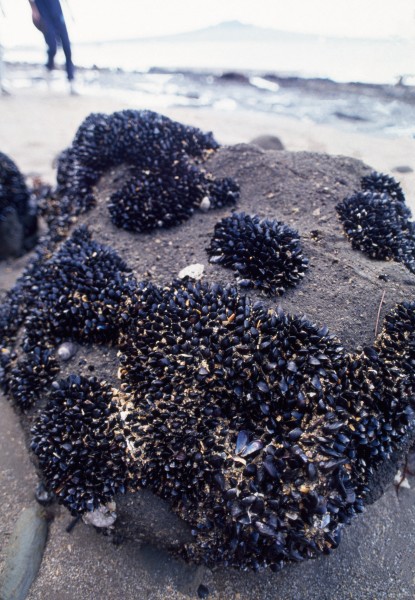
Byssus anchors are particularly important to those mussels which live in exposed places—green, blue, ribbed, bearded and flea mussels. Their interlaced threads are attached either to the rock or to the shells of neighbouring mussels, giving communal resistance to the wrenching forces of breaking waves.
The little black flea mussel occurs high on the shore, and can withstand considerable buffeting by sand and surf.
Surprisingly, for animals that are battered by surf, mussels have very thin shells—much thinner than those of other molluscs on exposed shores. They compensate by having a very streamlined shape, and are covered with a silky-smooth outer periostracum that is as hard and shiny as a plastic coating. With this shape and surface smoothness the drag force of water rushing past is reduced to a minimum.
Having such thin shells would theoretically make mussels vulnerable to many predators, but there are few that can tolerate the strong wave conditions that ribbed, blue and green mussels thrive in, along open shores.
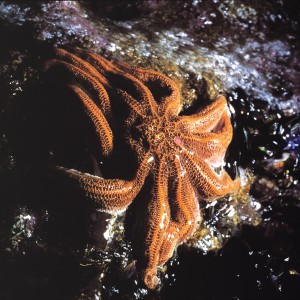
The reef star Stichaster australis, is a notable exception. Its ten arms, each equipped with hundreds of suctorial feet, cling tightly to wave-washed rocks . . . or sheets of mussels. Where there is sufficient shelter, the white rock whelk, Thais orbita, attacks the larger mussel species, while its smaller relative Lepsiella scobina, the so-called oyster borer (that seldom eats oysters), feasts on little black flea mussels higher up the shore.
Flea mussels are one of the few animals found where rocks abut a sandy beach. In these areas, most encrusting animals and plants are unable to colonise exposed surfaces because of the abrasive scouring by sand particles. In the turmoil of breaking waves and swirling currents, the rocks and any attached animals are subject to nature’s own sand-blasting machine.
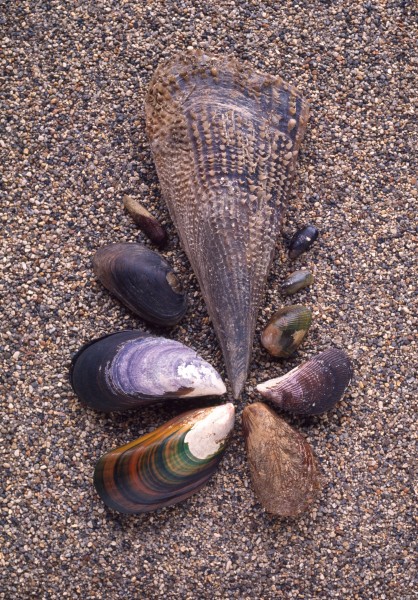
Not all mussels live on such exposed surfaces. Some nestle beneath overhangs, under and between stable boulder litter and within the holdfasts of kelp. The plump, nut-like, nesting mussel, Modiolarca impacta, that grows to the size of an olive and is olive-green to brown in colour, is often found in small clumps just below low-tide mark. Gaining some protection by living in confined spaces, these mussels mask their presence still more with a veil of finely interwoven byssus threads which accumulates silt and will eventually obscure the mussels within. “Windows” in the veil allow water to flow in and out.
Date mussels choose an even more confined habitat: they bore into soft rock. Almost true to its generic name Lithophaga (literally “rock-eater”), this mussel slowly nibbles away at the rock by abrading it with its shell edges as it pulls down hard with its byssus threads (possibly assisted by an acid secretion from its mantle edge when boring into limey rock). In reality, it does not eat any of the rock, but uses ciliary currents to carry away the abraded particles.
The coarse, hairy growth covering the posterior end of the bearded mussel, Modiolus areolatus, is no more than the bristles of the thick periostracal coat that covers the hard chalky part of the shell. The long golden beards that are sometimes found on green mussels are quite different. They are not part of the mussel shell, but are colonies of an encrusting hydrozoan (related to sea anemones) which has coral-like polyps interconnected within a slender horny skeleton.
Beards frequently grow over 15 cm long and have a hundred or more branched hairs, each one commonly consisting of 300 to 500 polyps. They may therefore consist of up to 50,000 individuals.
Living quite a different life from other mussels is New Zealand’s largest species, the horse or fan mussel, Atrina zelandica. It commonly grows to 30 cm in length, and especially large specimens may reach half a metre.
Atrina , a worldwide genus, is not tear-drop-shaped like most other mussels, but looks more like a flattened ice-cream cone. Nor does it attach to hard surfaces; instead it lives upright, partially buried in sand or mud.
Lacking the broad tongue-shaped foot of a tuatua or cockle, the horse mussel cannot burrow quickly to escape danger, and can haul itself only slowly into deeper sediments by sending down byssus threads and then pulling on these.
Eventually, the horse mussel establishes a multi-filament spreading anchor that is somewhat analogous to a land plant’s root system. With enough fine anchor threads deployed, the mussel is able to maintain its position against moderate pulling forces produced by currents along the sea bed or by being tugged by fish.
The shell is never pulled right down into the sand, but is left with a few centimetres protruding, thus keeping its water intake clear of the gill-clogging silt of the sea bed.
The exposed tip of the horse mussel is an ideal settlement site for other marine animals, and these tips may become completely obscured by rich growths of sponges, sea-squirts, tubeworms, barnacles, bryozoans and even the nesting mussel. The encrusting animals probably give some protection to the horse mussel’s exposed posterior shell margins, though the trade-off is that those animals will compete with their host for available plankton food in the water.
In shallow waters, where there is sufficient light, the shell ends also serve as attachment points for seaweeds. If these grow too large, they may become serious survival hazards for their hosts. During a severe storm, large seaweeds can act as an aquatic “sail” and wrench the mussel out of the substrate, leaving it at the mercy of the waves, which invariably wash them up on the shore to die.
One of our most attractive mussels is a fairly recent arrival to the country. Musculista senhousia, a small mud mussel about 3 cm long when fully grown, has a thin olive-green shell patterned with irregular brown zig-zag lines.
In life, these patterns remain hidden, for, like the nesting mussel, the mud mussel covers itself with a cloak of byssus threads, trapping silt and debris.
Mud mussels are usually found in aggregations of thousands of individuals that blanket the sea bed, the whole mass being loosely tied together with silted byssus.
The species, which is common in Asia, was first reported nine years ago in Auckland’s Tamaki Estuary, and has now spread throughout the Auckland region. Along some shores there is now a superabundance of shells—perhaps several million in a 50-metre stretch of beach. Residents of some North Shore beaches are concerned that the character of their shores may be irreversibly changed with the invasion of the mud mussel, and the baggage of silt which accompanies it.
True mussels are confined to salt water but, like most other countries, New Zealand has a few freshwater mussel species as well. Although their shells are inflated at the posterior end, making them mussel-shaped, these shellfish are not closely related to the marine mussels, and are classified in a different order.
A close-up of the mussel shows how it uses its thin, extensile foot to secure anchoring byssus threads (fine silvery lines) to nearby surfaces.
The local species belong to the genus Hyridella. They are found throughout the North and South Islands in lakes, streams and rivers, where they live shallowly settled into soft sand or mud.
Biologically, they are extremely interesting in that they can maintain their distribution upstream in river systems where the water flow is always in one direction: downstream. It would be reasonable to expect that any larvae produced would be flushed out to sea, but freshwatey mussels have an ingenious method of ensuring that this does not occur.
Unlike marine mussels, which release sperm and eggs into the sea at spawning, freshwater mussels brood their larvae inside their mantle cavities until they reach a two-shelled stage. It is then that the mussel plays a biological trump card.
Each of these special larvae, called a glochidium, is equipped with rows of teeth along the margins of its shells and a very long tentacle that protrudes from within. This tentacle is sensitive to the presence of native fish such as the koaro and giant bully, and with it the juvenile shellfish is able to latch on to a passing fish, clamping its toothed shells on to a fin. The hitch-hiking mussels hold on as the fish swims upstream, finally releasing their grip and sinking to the river bed when they judge they have travelled far enough.