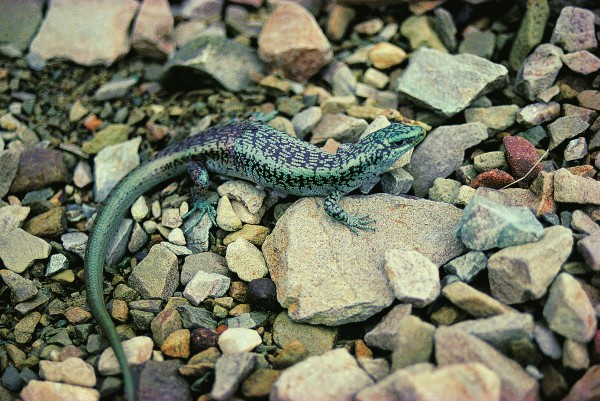
A grand skink cuts a handsome figure in its Otago homeland, but its prospects-like those of all New Zealand’s skinks-are not so attractive. Once abundant on our shores,reptiles are now hard pressed by the twin evils of predation and habitat loss. But the fightback has begun, raising hopes that these sleek, sinuous creatures may return to their haunts of old.
Fog lay in a shroud across the craggy Central Otago landscape. For two days we had hunted for our quarry in vain; a thick “pea souper” had blanketed the entire search area. By the third morning we had almost abandoned hope of finding anything among the rock stacks that loomed out of the murk like the ruins of ancient castles. Then, abruptly, the sun burst through. At once, from under every rock, small, dark heads poked out into the light, followed by long, serpentine bodies. Alert eyes peered at us as the animals, the biggest of which were nearly the length of my forearm, flattened themselves against the rocks to absorb the welcome rays. These were the creatures we sought: Otago skinks, one of New Zealand’s most spectacular lizards. They had been there all along, concealed in the crevices. Now their slick, mottled bodies were almost abundant on the rocks around us.
Skinks and geckos are the only two lizard families found in New Zealand. Both boast numerous species and are well represented around the globe—in contrast to our most famous reptile, the tuatara, which perches in majestic isolation on the taxonomic tree and is confined to just a few offshore islands.
In many ways, skinks are the archetypal lizards. They have a long, smooth body covered in shiny scales, which are laid down in overlapping rows as on a fish, giving the animal a sleek appearance. Although they lack the ornamentation, such as neck frills and dorsal spines, that marks some of their flashier relatives, skinks are among the most successful of lizards, with about 1000 species distributed throughout the world. They tend to frequent tropical and subtropical regions, but are more cold-tolerant than many other lizards. They are particularly plentiful in Africa, southern Asia and Australia, and are scattered widely across the Pacific. They are also present, though in lesser numbers, in Europe and the Americas.
Precisely how they came to be in New Zealand is a mystery. Skinks are hardy creatures, and may have rafted to these shores on drifting clumps of vegetation—they are renowned for their colonising ability. However, estimates of rates of genetic change indicate that divergence between some New Zealand species could have occurred as long ago as 35 million years, and because New Zealand and New Caledonia were connected by dry land until long after this time, skinks need not have arrived here by sea at all. Alternatively, they may have a history here rivalling that of the tuatara, native frogs and other Gondwanan inhabitants, and been occupants before the country’s separation from the supercontinent about 80 million years ago.
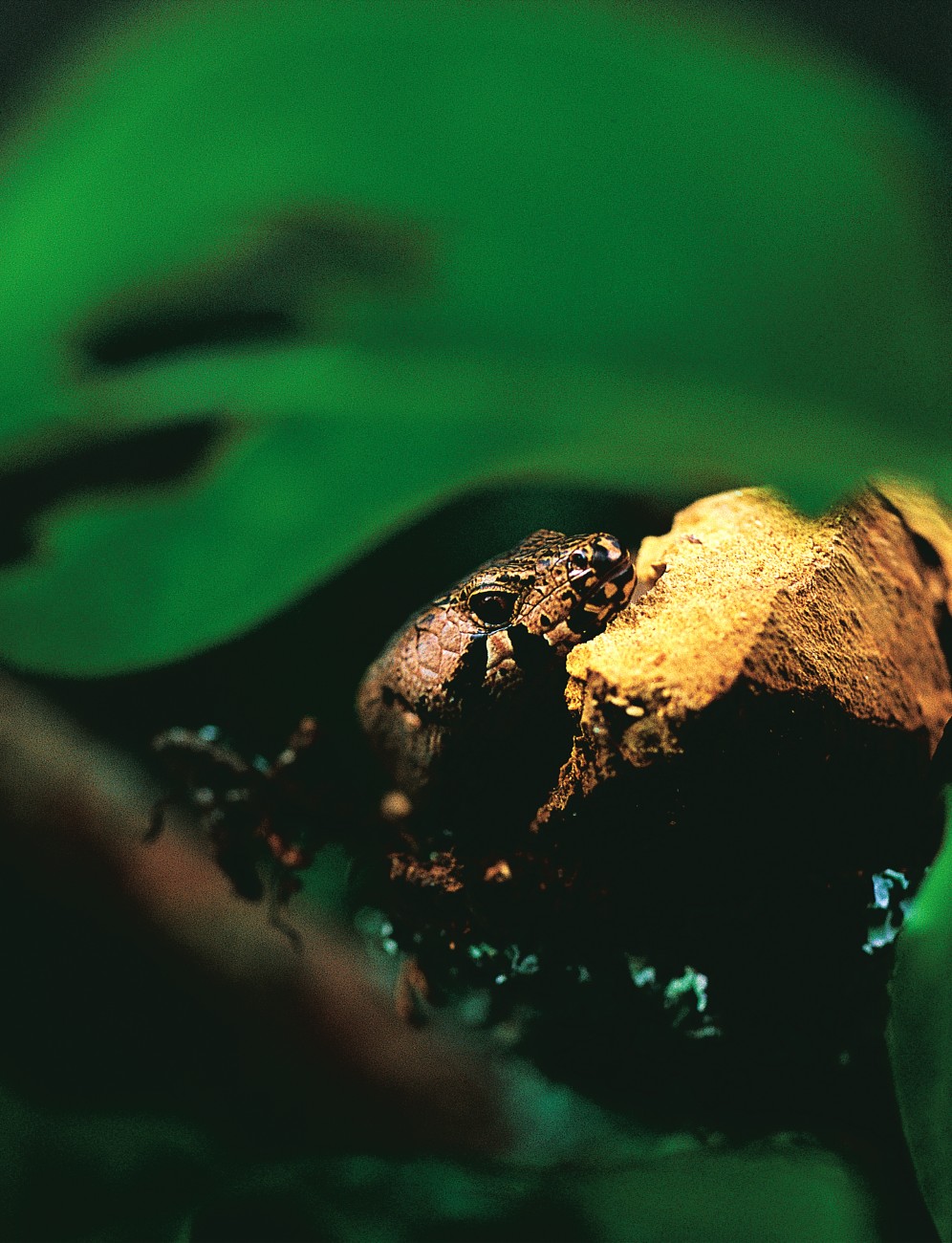
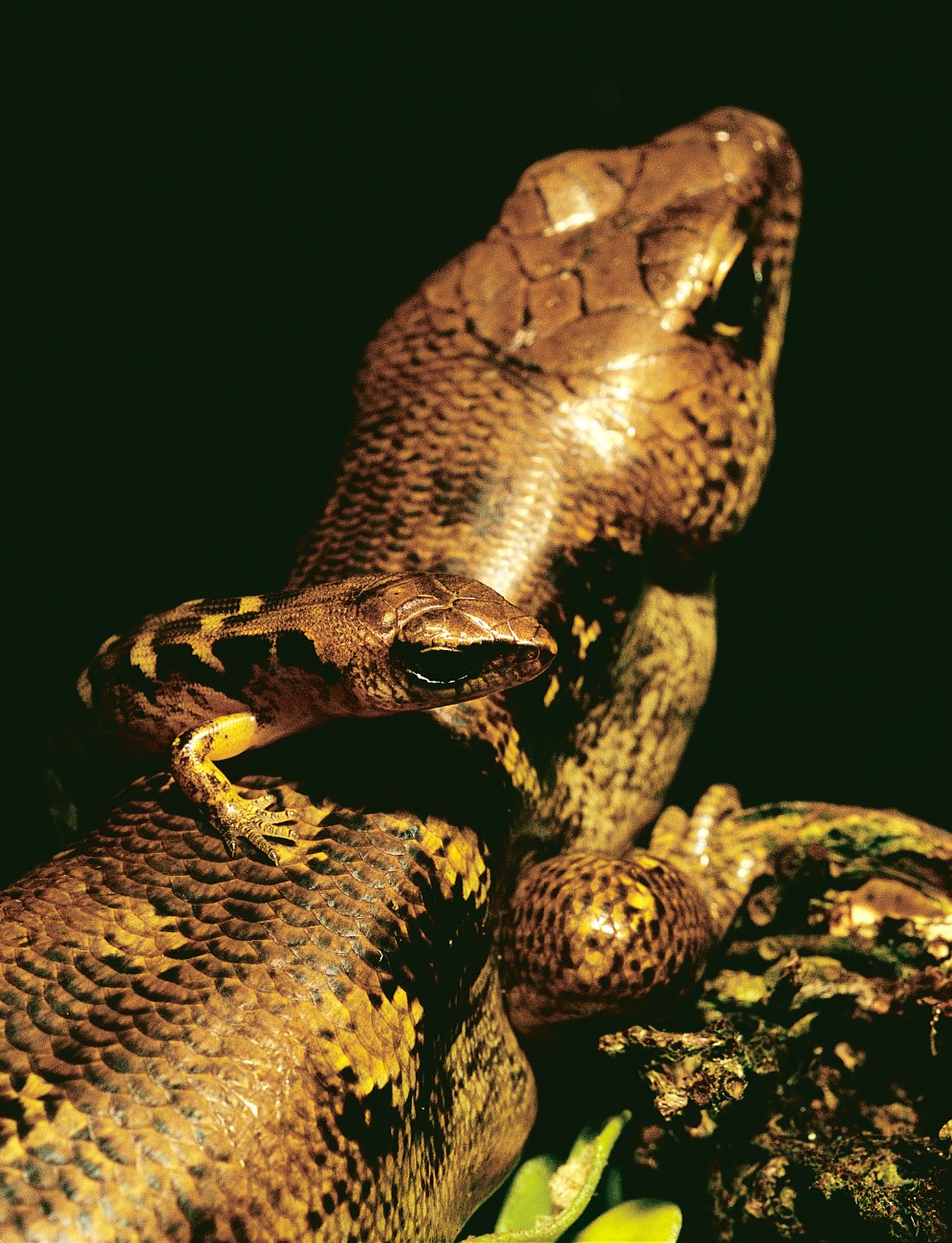
Of the two groups of lizards found in New Zealand- skinks and geckos-skinks have the more classically reptilian features. Indeed, seen head on, this endangered chevron skink looks positively snakelike. New Zealand’s 28 species of skink occupy a wide range of habitats, from garden to forest and shoreline to tussock, but since human arrival they have declined dramatically in both range and number across the country. Only offshore island sanctuaries give a hint of what a reptile heaven mainland New Zealand must once have been.
Whatever their means of arrival, once in prehistoric New Zealand skinks appear to have flourished, and as a result almost every major type of habitat on the main islands now has its associated skink species: garden, seashore, forest floor, canopy, tussock, scree and subalpine. New Zealand lacks true alpine skinks, although roving animals have been found at altitudes of up to 1800 m. Skinks are absent from the Kermadec Islands and the subantarctic islands, but they do inhabit the Three Kings and the Chatham Islands.
Secretive in habit and quick to dart away if disturbed, skinks are mostly ground dwellers, living in leaf litter, under fallen branches and logs, among the roots of shrubs and trees, beneath stones and boulders, amid piles of seaweed and other detritus above the high-tide mark, and inside the cracks and crevices of rocks.
They turn up in the most unlikely places, as I once found in Fiordland. It was the middle of winter, and hail pelted me as I strolled along the beach at Disappointment Cove, on Resolution Island, looking for Fiordland skinks. I dug with numb hands in the stony shore, only to see the animals I was after—skinks that had been lying dormant under the top layer of rubble until I had disturbed them—squirm through the rocks just ahead of my grasping fingers.
These remarkable lizards inhabit two spots on the mainland and numerous bleak islands along the Fiordland coast. It is difficult to imagine anything larger than a limpet surviving on some of these sea-swept islets, which are swamped by the frequent southern storms.
Landcare Research herpetologist Bruce Thomas recalls watching such a storm pound Wairaki Island: “Wairaki is full of cracks and crevices—ideal skink habitat—but it’s only about 20 m high. We were standing on neighbouring Breaksea Island, watching the breakers crash over it. A couple of waves rolled across the rocky headland without cresting. The suction must have been tremendous, and I thought of the skinks in their hiding places trying to hold on under the swirling water. After the storm the island was a mess—piles of bull kelp all through the vegetation on top. But the moment the sun shone, lizards popped out all over the place.”
Unlike most skinks, Fiordland skinks bask communally-30 or more animals may pile on top of one other in a slinky pyramid. When startled, they scatter into nearby hiding places, and even take refuge in splash pools. If waves are a threat, they wedge themselves securely into their holes to avoid being washed away. Thomas believes it is the ability of these animals to survive immersion that has allowed them to colonise so many isolated islands.
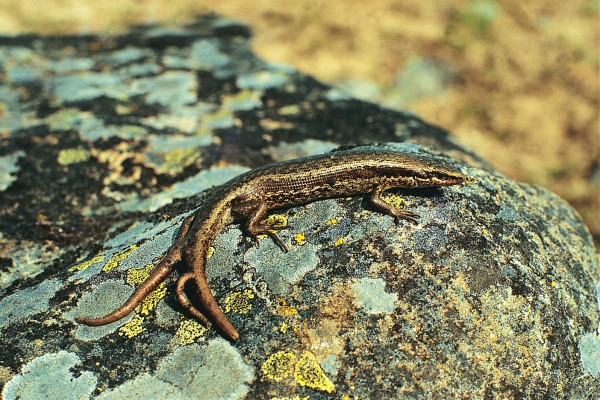
The largest reptile on the mainland today lives in the schist outcrops of Otago’s tussock grasslands. In this classic lizard country-dry, warm and rocky-Otago skinks soak up the sun’s heat on the many convenient ledges, retreating to nearby cracks and crevices if disturbed. Skinks can be highly territorial, fighting in defence of a favourite basking site, but members of the same Otago skink family frequently sunbathe close together.
Their dispersal ability was convincingly demonstrated in 1990. Two years earlier, Thomas led a team that eradicated Norway rats from 170 ha Breaksea Island. The rodents had decimated the populations of almost all ground-dwelling creatures larger than a spider, and Thomas intended restoring Fiordland skinks to the island once he was sure the rats had gone. But the lizards beat him to it.
“I’d always considered natural dispersal a possibility, because there was a stack about 50 m offshore that still harboured Fiordland skinks. I’d been monitoring the beach nearby both before and after we’d got rid of the rats, but the big surprise was being able to confirm recolonisation only two years after the poison campaign. Of course, because the skinks had come back on their own there was much more scientific merit in monitoring their progress from that point on than in releasing some up by the Breaksea but as I’d originally intended.”
*
Almost as inhospitable as Fiordland’s rocky islands are the greywacke scree slopes of the central South Island high country. This arid, unstable environment has its resident lizard, the scree skink, a large animal with dark areas on its back which coalesce into thin, irregular black bands that extend down its sides, making it one of the most strikingly patterned of New Zealand’s skinks.
Many of the features it has in common with other skinks adapt it for life in its harsh surroundings. Its skin, flexible, yet with a tough outer layer of smooth scales, acts like chain-mail, protecting it from abrasions as well as minimising water loss through evaporation. Its eardrums are sunken into cavities in the side of the head, with narrow channels leading to them—a protection against dust and grit which could damage the delicate membranes. Its eyes have two lids, an upper and a lower. The upper is fixed, but the lower is movable and has a transparent “window,” allowing it to see with its eyes “wide shut”—likewise shielding them from dirt particles while burrowing or foraging. The scree skink also has particularly long toes, which allow it to move agilely across the shifting slopes.
Although this species has been found at relatively few sites, it could be very numerous, since greywacke screes cover a large area of the South Island. But as most screes are in remote areas, it will probably be many years before the true size of the scree skink population is known.
Drawn from their crevice hideaways by the merest ray ofsun, Fiordland skinks are communal baskers, clambering over one another to form heaps of30 animals or more.
Not so with the Otago skink, the creature I was hunting that day among the leaden fog and looming outcrops. It is one of the most studied reptiles in the country and an altogether impressive animal—solidly built, weighing in at 35 g or more, and, at up to 124 mm SVL, the biggest skink on the mainland. (SVL stands for “snout to vent” and is the way skinks are usually sized, the vent being the combined genital and excretory opening on the underside at the base of the tail. A skink’s total length is a less useful measure to herpetologists, given that skinks can shed their tails, and a regrown tail is invariably shorter than the original. An undamaged tail can account for anything from 50 to 60 per cent of a skink’s overall length.)
Impressive it may be, but the animal has not fared well in recent times. Surveys in the 1980s showed that the Otago skink’s distribution had shrunk alarmingly. Whereas 100 years ago it was found throughout the dry schist country of Central Otago—two million hectares roughly bounded by Queenstown, Lindis, Palmerston and Lawrence—now it is present in less than 10 per cent of its former range. Almost certainly the decline is due to habitat degradation and destruction (mainly a result of agricultural development) and predation by introduced mammals and birds, with pest-control operations compounding the problem.
During one of the early surveys, in December 1983, a feral cat was killed when it made the mistake of searching an outcrop at the same time as our party. This wary, mangy beast bore little resemblance to the domestic animals we keep as pets, and we were dismayed to find that its stomach contained 14 skinks, all undigested and therefore presumably the result of just that morning’s hunting. Here was evidence that one cat could kill thousands of lizards a year—and cats are only one of a suite of introduced mammals that prey on skinks. Rats, mice, stoats, ferrets, weasels, pigs, hedgehogs and possibly dogs are all implicated in skink decline.
A barren islet pounded by high seas and subject to frigid temperatures seems the unlikeliest of reptile homes. Yet skinks thrive on such inhospitable retreats off the Fiordland shoreline, even toughing out prolonged submersion beneath surging breakers.
Otago skinks and the equally rare grand skink, which also inhabits the rocky outcrops of Otago’s tussock grassland, are hardly ever found in areas that have been intensively farmed. Firing tussock prior to sowing pasture probably incinerates many skinks, while survivors are forced to forage widely over ground with little or no cover, and are therefore at greater risk from predators.
How to pick your lizards
New Zealand skinks are classified into two generic groups. O/igosoma species tend to have a shallow, pointed head, a body which is oval in cross section, comparatively long limbs and toes, and a long tapering tail. They are generally found in fairly open areas and are active during the day (except for Suter’s skink, which is atypical of the genus in various respects). Cyclodina skinks tend to have a chunkier head, a more solid body which is squarish in cross section, and a shorter, stouter tail. They are less mobile, prefer shaded habitats and are usually nocturnal or crepuscular (active at twilight or just before dawn).
There also appear to be physi- ological differences between the genera: some Cyclodina species, for example, lose more body moisture through their skin; this seems to tie them to damp environments. The genera are distributed differently, too. No Cyclodina skinks have ever been found south of Cook Strait, while many Oligosoma species are found in both the North and South Islands.
Slender and fine-featured, the grand skink typifies the genuns Oligosoma. The aptly named robust skink, thickest in all its features, is the archetypal Cyclodina. Both species are rare. Grand skinks live alongside Otago skinks in tussock-country outcrops, while robust skinks are confined to a number of northern offshore islands.
Oligosoma has by far the lion’s share of those species that have been formally described-22 at last count (the latest, the long-toed skink, was added in December 1997). Cyclodina has just six. Many more probably await taxonomic description: six new species have been described in the last seven years, and there is no reason to think there couldn’t be that number again waiting in the wings. Already Oligosoma contains more species than any other genus of New Zealand terrestrial vertebrates, extant or extinct.
New Zealand boasts a surprisingly large variety of lizards compared with other temperate countries. Great Britain, which has atemperate climate and is about the same size as New Zealand, has only three lizard species.
Apart from the cooler British climate, one reason for the abundance of New Zealand species could be the wide range of habitats available in this country. Another is probably the long period of time New Zealand skinks have had to evolve and diversify in the absence of mammals.
Our skink diversity pales alongside Australia’s, however: our transTasman neighbour has 32 skink genera and 312 species. Worldwide, there are an estimated 1000 skink species.
It is likely that pest control has also had a major impact on Otago and grand skink numbers. Huge quantities of poisons have been spread across the Otago landscape over the last century in repeated efforts to control rabbits. Some have been administered in baits attractive to lizards, such as jam and molasses (our skinks seem to have quite a sweet tooth). Others may have affected invertebrates, resulting in secondary poisoning or the depletion of food resources. The introduction of the rabbit calicivirus, RCD, might therefore seem an improvement, as this method of pest control is specific to rabbits and should not have any effect on skinks. Unfortunately, the very effectiveness of RCD poses a threat. When rabbit numbers decline, predators such as cats, stoats and harriers turn to lizards as an alternative food source.
Such is the precarious position of Otago and grand skinks that the Department of Conservation has employed a herpetologist, Mandy Tocher, to work specifically on these species. According to Tocher, the populations she is studying do not appear to be declining, even in highly modified areas, so perhaps the skinks’ fortunes have reached their lowest ebb and can now only improve.
Although rare and endangered, both species can be encountered locally in considerable numbers, with as many as 200 animals per hectare. Otago skinks also appear to live in small family groups.
The factors that limit numbers or density are unclear; nor is it known how siblings recognise one another and avoid mating. But within families Otago skinks, like their Fiordland relatives, are gregarious ray-catchers, often clambering on top of one another in preference to sunbathing on their own.
*
Skinks are mainly carnivorous, subsisting on a diet of invertebrates and even the occasional fellow skink. Some skinks are known to eat carrion; in particular, species that live near seabird colonies, such as egg-laying and shore skinks, scavenge partly digested fish regurgitated by overfull chicks and feeding parents. The prospect of a live meal can drive some skinks to considerable feats of physical exertion. Mandy Tocher has seen grand skinks leap off their rock ledges to snatch passing insects. “I once found a gecko that had skewered itself on a spaniard [spear-grass], also presumably in an airborne quest for sustenance,” she says. “Or maybe it’s simply the case that even lizards get depressed!”
Like all reptiles, a skink smells with its tongue, not its nostrils, constantly flicking it in and out while searching for prey. A skink’s teeth aren’t particularly well adapted for cutting or grinding, so it usually swallows its prey whole or in a few large chunks.
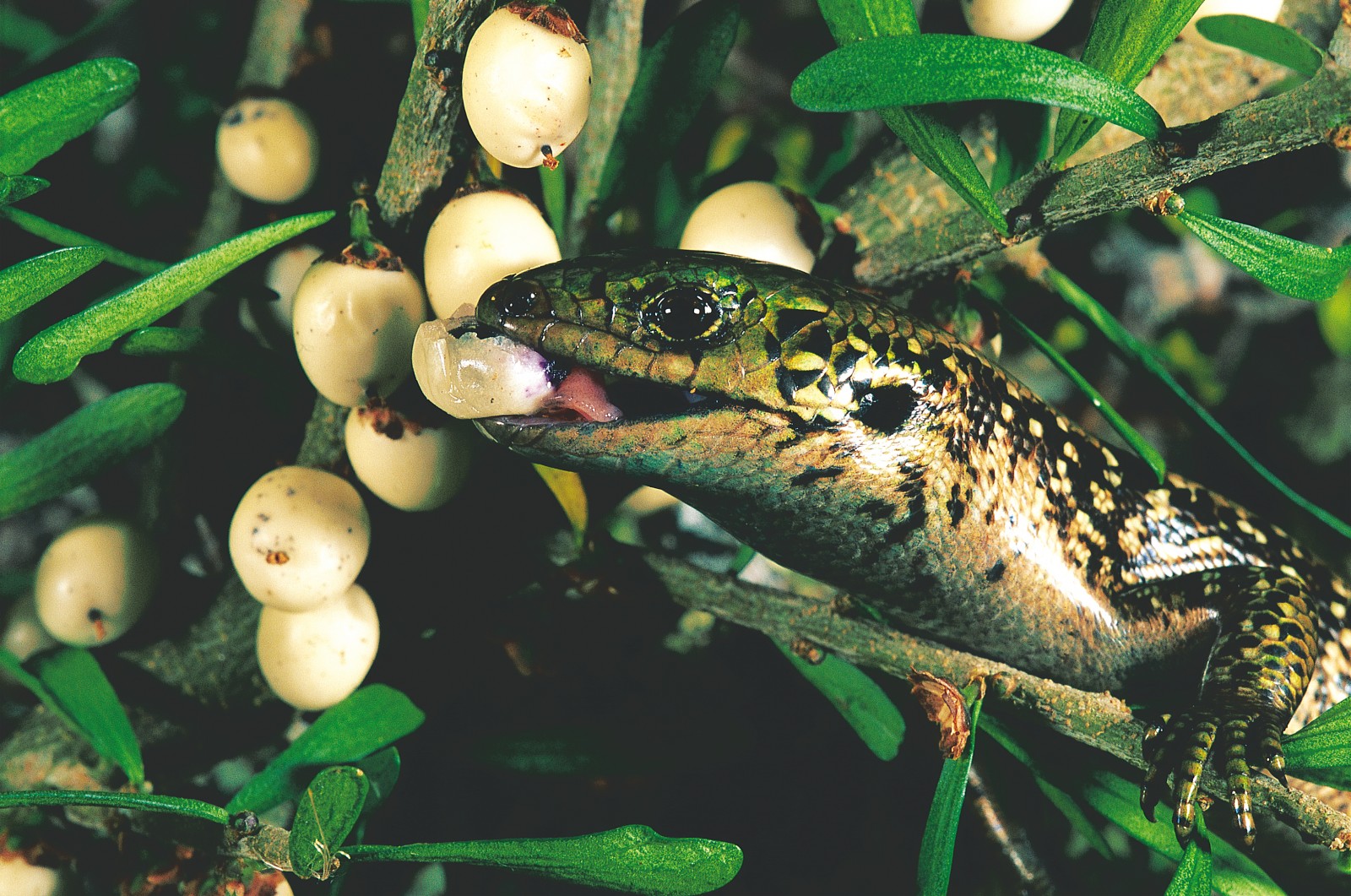
Fruit is an important element in the diet of many skinks. The usually white berries of endemic vines and divaricating shrubs-often inaccessible to the probing beaks of birds are a favourite. Like a bird, this green skink will help disperse the seeds of the Melicytus bush in which it is feeding. An inhabitant of Otago, Southland and stewart Island, the green skink frequents tussock, scrub, boulder fields and areas of coastal vegetation.
Despite their predilection for meat, most skinks supplement their diet with fruit and vegetable matter. For example, during summer as much as a third of the diet of the robust skink consists of fruit. There is now evidence that fruit is particularly important to the females of certain species, and may be necessary to maintain breeding condition. The world’s biggest skink, the giant skink of the Solomon Islands (which can reach a total length of over 700 mm), is completely vegetarian.
While small fruits, such as coprosma berries, are swallowed whole, skinks eat only the ripe portions of larger fruits. The elongate kawakawa berry ripens from the top, and skinks have been seen to scale the smooth, vertical stems of the kawakawa 1.5 m above the ground and clamber about nibbling the soft pulp only where they find it edible. On occasions when they have encountered a berry that is ripe all over, shore skinks have been seen to break it off the plant and fall with it to the ground.
It also appears some plants rely on skinks rather than birds to disperse their seeds, an idea first proposed by Nelson herpetologist Tony Whitaker after many years of accumulating evidence. Typical of the sites he surveyed was Macraes Flat, where, in 1986, he noted that porcupine shrubs, snowberry plants and pohuehue vines were stripped of all their ripe fruit where they grew on outcrops inhabited by grand skinks, while plants on nearby outcrops without skinks were untouched. To clinch the matter, the skinks’ droppings were crammed with seeds of the same plants.
Fruits favoured by skinks commonly grow on divaricating shrubs or densely tangled vines, where they are all but inaccessible to birds, and are often white or nearly colourless, in contrast to the red or orange berries usually attractive to birds. A good example is the porcupine shrub Melitytus alpina, which has white fruit beneath a network of hard spiny twigs. Unlike a bird, a skink can move relatively easily through this botanical maze and so get at the berries.
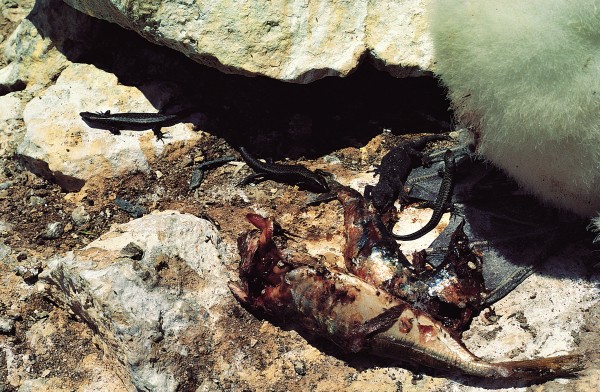
Regurgitated fish in a gannet colony on the Poor Knights Islands make a ready meal for a number ofshore skinks and a local variant of the Pacific gecko. As soon as such tasty offerings fall to the ground, the lizards rush out of nearby crevices to fight over them, crawling over the chicks’ feet in their eagerness to get a share. Their bustling activity is largely ignored by the birds standing over them.
The present density of skinks over most of the country is so low it is hard to imagine they could be significant seed dispersers. However, populations used to be much larger and more extensive. On mammal-free island refuges, where skinks flourish, one can see how numerous lizards in primeval New Zealand might have been, and thus appreciate the major role they could have played in seed dispersal.
Palaeoecologist Trevor Worthy is in no doubt New Zealand was once as alive with reptiles as it was with birds: “If you go to predator-free islands like Breaksea and Maud, in places there’s a skink every 20 cm or so, and there’s no reason to think that much of the mainland wouldn’t once have been the same.”
In limestone caves throughout the country, the fossil record clearly hints at a time when the ground was awriggle with lizards. In one 40 m stretch of underground passage at Waitomo, Worthy found the remains of 43 animals—half of them lizards, half frogs. Finds in other parts of the country—the Far North, Hawkes Bay, Nelson, Canterbury, Otago and Southland—paint a similar picture. “Of course, there would have been bird predators, such as weka, takahe, falcons and owls, but these would never have been in the same densities as rodents are today,” says Worthy.
*
Most of the world’s skinks lay eggs, but all New Zealand skinks, except one, give birth to live young. Scientists think this may be a cool-climate adaptation. There is a tendency for snakes and lizards living in climates such as New Zealand’s to be live-bearers, while those in warmer regions are egg-layers. The disadvantage of laying eggs in a cool climate is that once they have been abandoned to the environment they are subject to the vagaries of the weather, and the temperature can drop so low that development is inhibited. By contrast, offspring nurtured in the mother’s body enjoy a higher, more stable temperature because skinks are adept at keeping their body temperature above that of the air around them. In warm climates, the advantage is with the egg-layer: with little danger to its eggs from the environment, the female can devote its energies to further breeding.
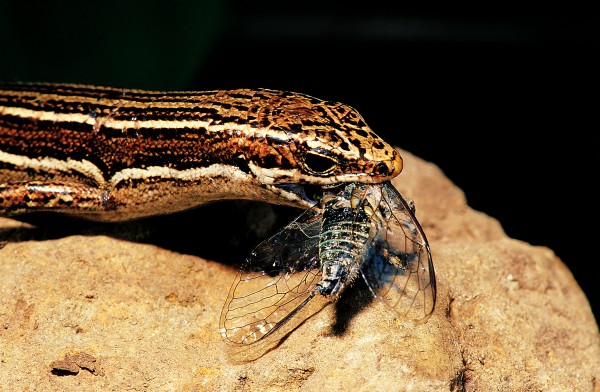
Skinks are enthusiastic carnivores, feeding most commonly on arthro- pods, such as insects and spiders. Because they rely on the sun, rather than the metabolism offood, to give them bodily warmth, they need to feed less often than similarly sized mammals. A juicy cicada will probably last this moko skink-one ofour smaller lizards-several days. (Moko is the Maori word for lizard, as well as tattoo.)
The egg-laying skink is not only New Zealand’s sole native oviparous lizard but also the only Oligosoma species that is primarily nocturnal. It lives on many islands off the north-east coast and in a few North Island coastal localities. Why it should be New Zealand’s only egg-layer is a puzzle, but it is surely no coincidence that it is confined to areas where the weather is mildest and, furthermore, to beaches, where climatic extremes are less pronounced than inland. Eggs are laid in scrapes in sand, silt or gravel under large stones. They are oval, about the size of a jelly bean, and have a tough, parchment-like shell. During incubation, they absorb moisture from their surroundings and swell, so that by the time they hatch they may have increased in size by a third. Eggs are laid in summer, usually three or four per female, and hatch in autumn.
There is one other skink in New Zealand that lays eggs, but it is not a native. The rainbow skink is an Australian immigrant that probably reached Auckland in freight in the 1960s and spread from there in a similar fashion. It is currently restricted to the North Island, and is found in Auckland, Waikato, the Coromandel Peninsula and the Bay of Plenty. A number of other exotic lizard species have been reported in New Zealand, but the rainbow skink appears to be the only one that has become established.
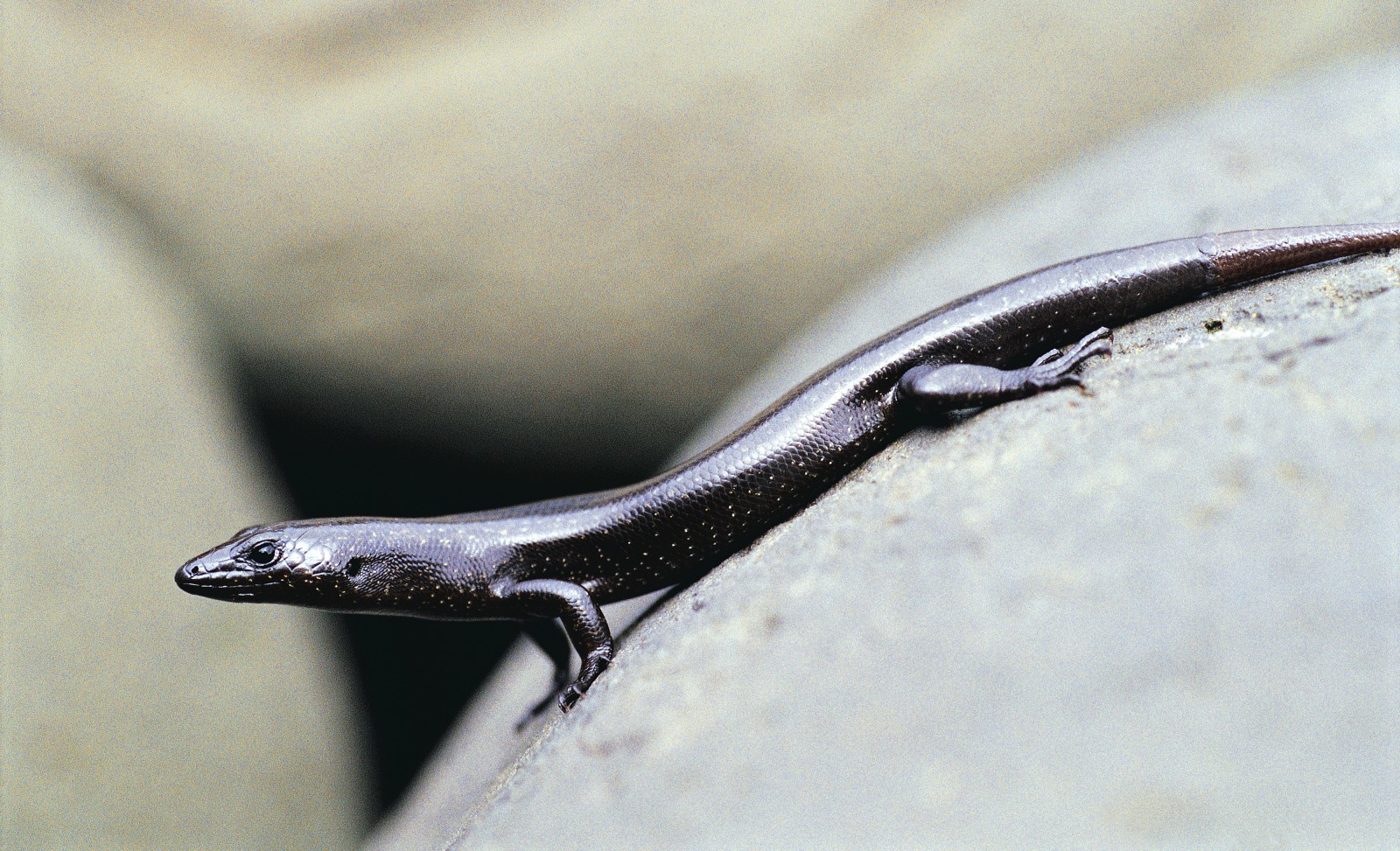
Like other lizards, such as geckos, goannas and chameleons, a skink periodically sheds its outer layer of skin. The scales come away as the animal rubs against rocks and vegetation in the course ofits normal activities. This scree skink has a gleaming new livery, but has yet to exfoliate its tail and hind- quarters.
As well as adopting live birth in preference to egg-laying, lizards have had to adapt in other ways to New Zealand’s cool winters, particularly in the South Island. When I was studying skinks in the Rock and Pillar Range in Central Otago, I observed a marked difference in skink abundance between summer and winter. In the summer skinks were always underfoot among the tussock. In winter the ground was carpeted with snow for many months, but even when it wasn’t, the same areas seemed to be completely skink-free. It was clear that the animals were wintering somewhere out of the reach of frost and snow, but I did not determine where until a colleague, Graeme Bremner, began working on tussock insects. To extract insects, he dug up clumps of tussock and placed them upside-down in a heat extractor, which warmed the roots and drove the insects down onto a collecting tray. The patter of falling insects was often interrupted by the thump of a skink, particularly from tussock dug up in winter. The lizards were lying dormant in the roots, protected to some degree from the winter chill. They also shelter in other nooks and crannies, such as rabbit burrows, as Bremner relates: “One winter I took the roof off a burrow with my spade while I was planting trees near Milton, to find a number of skinks huddled together in a sort of ball 30 cm down.”
Chasing the chevron
“Got one!” The cry goes up some way behind us. I splash back down the forest stream, with tuatara specialist Alison Cree a few steps behind.
Department of Conservation herpetologist Mandy Tocher is holding something and looking pleased with herself. “I was walking slowly past this bank,” she says, “looking a couple of metres in front. I just saw this flick of a tail disappearing, rushed forward and stuck my hand up the hole.”
At last—a chevron skink. We press round to look. It is a predominantly golden-brown colour. Alternate light and dark arrowhead markings extend down its back—the chevrons from which it gets its name. The underside is paler, creamy. The chin and throat are strikingly patterned in silver and black, a silver “teardrop” suspended beneath each gleaming red eye. The tail is long and tapered—one-and-ahalf times as long as the body.
Out come record forms, plastic bags, ruler, scales and cameras. This creature’s particulars are of especial interest to science, the chevron skink being New Zealand’s rarest lizard—or at least the most elusive. It is also the longest, up to 143 mm from snout to vent. When we rejoin the other search parties at the end of the afternoon, we are the heroes of the day.
I am with members of SRARNZ—the Society for Research on Amphibians and Reptiles in New Zealand—on Great Barrier Island. Field trips have been organised by Keri Neilson, who is surveying the chevron skink for DoC.
Neilson has already told me how rare it is to see chevron skinks in the wild. She spent 32 days searching on Great Barrier before finding her first one, and in two years has bagged just 17. She describes the despondent faces of those in her search party who are used to locating skinks, geckos, frogs or tuatara in their own field sites with relative ease. “For me, a single skink is inspiration for another three or four weeks’ searching, but some of these guys were flagging after a couple of hours.”
So few chevron skinks have been reported that there is no way of estimating the size of their population, nor of knowing for sure what their favoured habitat is. The species was first described in 1906, but was then “lost” for almost 70 years. Since its reappearance in the 1970s, there have only been about 100 sightings in some 20 or so locations—all, bar one, on Great Barrier, the exception being a single skink on neighbouring Little Barrier Island in 1992.
Neilson’s own finds have been along the forested banks of streams, and have mostly been juveniles and subadults. Where adults reside remains a mystery. The island’s domestic cats appear to have a better idea, residents occasionally reporting a large chevron brought home by their moggy. Others have reported chevron skinks coming up the plumbing into their houses, or have found them inside the walls of buildings being demolished. Now and again one falls victim to a car on the island’s rough metal roads.
“You can spend days fruitlessly searching in what you consider likely habitat,” says Neilson, “and then find one in a bucket at the DoC hut!”
Noting the chevron skink’s apparent preference for a damp environment, David Towns, leader of the chevron skink recovery group, says: “The chevron seems to think it’s a salamander, which is an intriguing evolutionary reversal. The evolution of reptiles from amphibians was a move away from an aquatic environment.”
Perhaps the chevron is contemplating the path already taken by sea snakes and turtles. There is little evidence that it basks, an activity essential to the metabolism of most other lizards, and there are reports of chevrons seeking refuge in pools when disturbed. Neilson relates how the single animal on Little Barrier, kept in captivity, sometimes takes to its water bowl. After a while its keeper loses her nerve and chases it out, not wanting to be the one to preside over the drowning of the island’s only specimen.
Such un-lizardlike behaviour may yet prove the chevron skink’s undoing, although for now it can count a few blessings. While cats, ship rats, kiore and pigs, all of which eat lizards, abound on Great Barrier Island, and land clearance and goat browsing reduce the forest habitat in which it lives, notably absent are such mainland pests as possums, mustelids, weka and Norway rats. The introduction of any of these would have disastrous consequences. It is feared the Norway rat in particular—like the chevron a coloniser of watercourses and damp places—would rapidly prove terminal.
Because it is so rarely seen, little is known about the chevron skink’s habitat, behaviour or population size. Keri Neilson is surveying a number of field sites on Great Barrier Island in an effort to in- crease our knowledge of this elusive creature.
The next day the search resumes along a stony creek near Tryphena. Quietly we pick our way upstream, pausing often to scan ahead and around us.
Give a chevron any warning of your approach and it will, like all skinks, rapidly make itself scarce. Looking long and hard to distinguish a motionless form from its surroundings—or, characteristically, a length of golden tail protruding from under a leaf—is therefore the most likely way of spotting a chevron. Noisily lifting boulders, pulling aside fallen branches and scrabbling among the undergrowth are more likely to scare away your quarry than reveal it. Lizard whispering is the way to go.
If you come across a chevron skink suddenly, however, it will freeze, relying on its cryptic markings to make itself invisible against the forest floor. This can play into the hands of the human searcher: a creature holding itself stock still rather than bolting for cover is easy to capture. “Once one came hurtling down a boulder bank and landed right in front of me,” says Neilson,”where it froze. That was a gift.”
She is gifted another find today, again almost at her feet. A subadult, it is lying along a dead puriri branch at the edge of the creek. After it is weighed, measured and photographed, Neilson returns it to the branch, where, for a short while, it doesn’t move a muscle. Some chevrons will wait for as long as 15 minutes after handling before going on their way. This one isn’t so inclined to tarry. It soon makes for the nearest tangle of dried fern.
We continue on our way, eventually arriving at a pool beneath a trickling waterfall. In a rooty bank, Mandy Tocher points out what look like burrows—mouse-sized holes, their smooth entrances indicating regular use. Following a hunch, she digs her way into one and, like a conjuror pulling a white rabbit from her hat, delivers the day’s second chevron skink. Neilson is elated. Still no adults, but in just two days her two-year tally has risen to 20.
Tocher strokes the side of the skink’s tail, which curls lightly round her finger.
“Prehensile?” she wonders aloud. It has been suggested the elusive adult chevrons live in trees, where a grasping tail would be an advantage. Chevron skinks at Auckland Zoo have been observed to jump up onto the mesh covering of their cage and hang upside down by their feet, which also suggests they would be at home in the forest canopy. The same adaptations would equip them for a burrowing existence among the rocks and roots of steep banks prior to attaining adulthood and heading for the trees.
We return to base, chuffed with our success. Perhaps a stripe for the sleeve would be appropriate, honouring the accomplishment and the lizard treasure we have been privileged to meet.
Some New Zealand skinks, such as Fiordland skinks, are extremely cold-resistant, and Wellington lizard-breeder Dennis Keall describes how a couple of scree skinks he was keeping in captivity froze rigid one winter—”like pencils.” It took over a year, but he eventually nursed them back to health.
In winter little food is available, and low temperatures mean lizards have difficulty metabolising what they do eat. In preparation, they build up fat stores in the tail and other parts of the body during the warmer seasons; even so, they are usually emaciated by the time spring rolls round.
Many people have had the alarming experience of seeing a skink suddenly part company with its tail, which continues writhing while the truncated owner makes its escape. All skinks can shed their tails in this way, and do so when they sense they are in grave danger of becoming somebody’s meal. There is a fracture plane of cartilage or connective tissue across the centre of most skink tail vertebrae, and by means of powerful opposing contractions of the muscles on either side of this, a vertebra and the surrounding skin, nerves and blood vessels are all cleanly broken. The twitching tail remnant distracts the predator while the lizard escapes.
In extreme circumstances, a skink may shed part or all ofits tail to distract an enemy. In time the lost portion will regrow, but ifa tail is damaged or lost through injury, it might grow back forked. This long- toed skink’s three-pronged tail speaks of an eventful life.
The stump heals quickly and the lost portion regrows, although with a slightly different colour and pattern. This regrowth is supported internally by a cartilage rod without fracture planes, so any further breaks must be made closer to the base of the tail. Occasionally lizards are found with forked or even three-pronged tails. These form when the tail has been shed through being damaged (by being crushed, for example, or chewed in a fight), or when a damaged portion is not completely severed.
Purposely sacrificing a major appendage to escape an enemy is clearly an extreme course of action. To lose an important fat repository just before winter can spell disaster for a skink, and there is also evidence that a lizard of reduced size comes lower down the pecking order. Shedding its tail is therefore a skink’s last resort.
*
Considering the size and significance of New Zealand’s reptile fauna, it is perhaps surprising that lizards, and skinks in particular, have a generally low profile in the public imagination, and that not one museum in the country employs a full-time herpetologist. Part of the problem may be a pervasive sense of distaste for reptiles: terms such as “cold-blooded” and “scaly” carry negative connotations, and no one would be flattered by being described as a “miserable reptile,” much less a “snake in the grass.”
Skinks are all completely harmless to humans, being neither venomous nor able to inflict serious damage with their teeth. They are rarely aggressive towards humans, but can be quite territorial towards one another, and don’t easily tolerate intruders on their favourite basking site. As a result, they often have scars, particularly about the head and neck, and the loss of toes and part of the tail is not unusual.
Apprehensiveness around reptiles is not just a European eccentricity. Maori mythology credits geckos and tuatara with extraordinary powers, and both were regarded with fear and awe—green geckos, their chattering vocalisations disturbingly similar to laughter, were especially dreaded—but there is no evidence of Maori aversion to skinks.
Shore skinks, egg-laying skinks and Fiordland skinks have all adapted to life by the sea, foraging among beach litter for kelp flies and other invertebrates.
While some people may find lizards disconcerting, even scary, lizards, in fact, have every reason to fear people. The arrival in New Zealand of humans and their mammalian hangers-on has been an unmitigated disaster for all native reptiles. Almost every introduced furry predator snacks on skinks, while some, like the feline feaster we caught in Otago, make them the main course. Because they have infested mainland New Zealand longer than other exotic mammals, rats have done the greatest damage. They are almost certainly responsible for the fact that just under half of New Zealand’s known skink species—four Cyclodina and eight Oligosoma species—are now confined in the wild to offshore islands free of rats.
Fossil remains clearly show some island-bound skinks were once widespread on the mainland, while at least one species has become extinct. Department of Conservation herpetologist David Towns says the upper North Island once had as many as 10 species of skink living side by side, more than half of which have disappeared from the region.
Thanks to the efforts of a number of herpetologists, our skinks’ fortunes may finally be turning. One of the places where the prehuman status quo is being restored is the Mercury Islands, 6 km off the Coromandel Peninsula. Seven named islands, ranging in area from 3 ha to 1860 ha, and a number of smaller unnamed islets have become the site of an ambitious project involving the transfer of skinks from islands naturally free of introduced predators to islands from which pests have been removed.
“The rare Whitaker’s skink and the robust skink have been the main focus of the relocations, with the result that the future of these species is probably brighter now than at any time in the past 1000 years,” says Towns. “I say that because mammalian predators first entered their habitat between 1000 and 2000 years ago, starting a massive decline in their range. This has now bottomed out, and the animals are expanding into new habitats, even if their range is still small.”
Unique among Oligosoma species, Suter’s skink is nocturnal. On the Aldermen Islands, in the northern Bay ofPlenty, this means it is out and about at the same time as one ofits oldest predators-the tuatara. Other natives that prey on skinks include weka, moreporks, harriers, falcons, takahe and kingfishers, as well as skinks themselves.
The prospects for mainland skink species are hazy at best. It remains unclear whether their numbers are declining, stable or increasing. The rare striped skink is a good case in point. Of medium size—up to 76 mm SVLthis species is attractively marked with a copper-brown stripe flecked with fawn down its back and a broad pale-brown stripe along each side. In 1969, Tony Whitaker and Bruce Thomas found specimens at Douglas, in Taranaki, and its range is now known to extend from there, through the King Country and Rotorua region, to the Kaipara and Great and Little Barrier Islands.
Since striped skinks were most frequently found in rotting logs—either on the forest floor or in areas cleared of forest Whitaker speculated they might be arboreal, like many small skinks in other parts of the world. Over the 1970s and 1980s, circumstantial evidence mounted in support of this theory: foresters in the central North Island reported seeing striped skinks on or near newly felled trees, and Wellington ecologist Mike Meads collected two specimens from epiphytes low on a spreading mahoe tree. Whitaker suggested the best way to learn more was to check the crowns of trees immediately after they had been cut down.
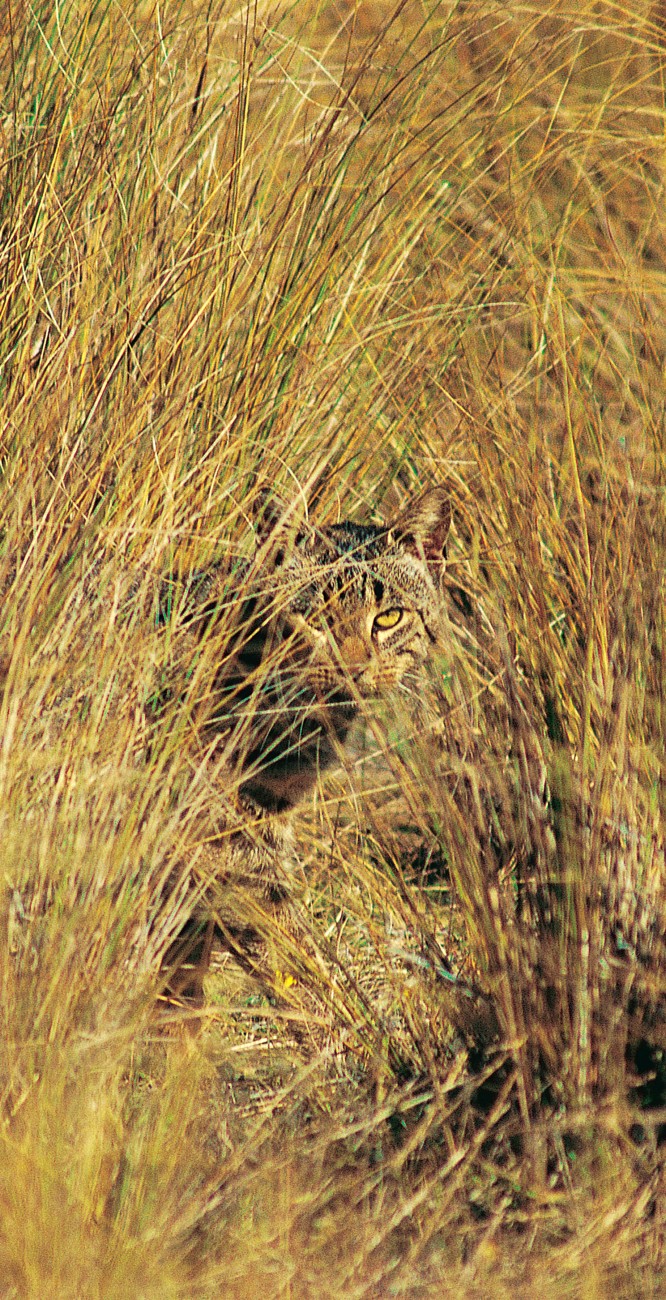
One ofNew Zealand’s most destructive introduced preda- tors is the domestic cat, many of which now live wild. Feral cats stalk the bush and open country in their thousands, preying on insects, birds and reptiles.
In 1994, an opportunity presented itself. A King Country land-owner at Waitaanga, with a permit to clear-fell tawa forest, allowed DoC to inspect the trees as soon as they had hit the ground. Sure enough, towards the end of a long day without so much as a glimpse of a lizard, a member of the DoC team spotted a shiny tail slipping beneath a thick mat of epiphytic orchids and ferns encircling a limb on a tree felled just moments before. Within seconds he had caught the animal and was elated to find it was an adult female striped skink. The epiphytes, in the crown of the tree, had been about 22 m above the ground, and appeared to be the only place in the tree the skink could have been living.
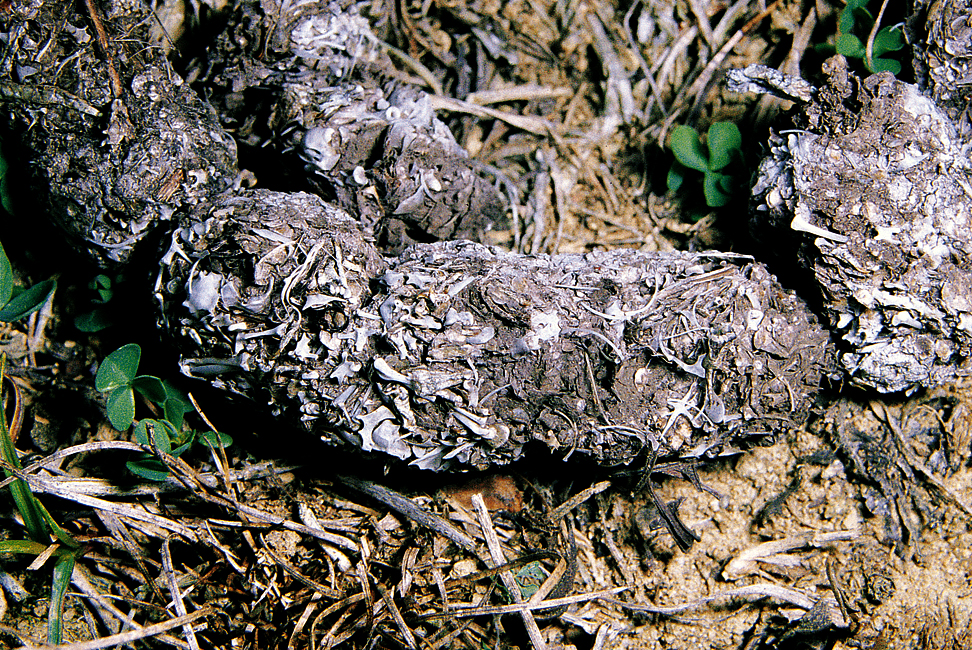
The cat scats, recovered near Lake Hawea, in Otago, are a mass ofskink bones-damning testimony to the damage a cat can wreak in just one day. Over the course ofa year, a single cat may consume hundreds, even thousands, ofskinks.
By 1996, all indigenous New Zealand reptiles and amphibians were fully protected by law, marking the end of a long campaign by conservation groups and lizard enthusiasts to have the animals’ plight recognised. The new rules do not prevent people from keeping lizards in captivity, but now anyone with a lizard of any description has to be registered with DoC. Many New Zealanders keep geckos and skinks as pets, if the membership of the New Zealand Herpetological Society (NZHS) is any guide. The NZHS was set up in the early 1970s as a scientific group, but gradually became a lizard-keepers’ society. In the 1980s, a new scientific organisation, the Society for Research on Amphibians and Reptiles in New Zealand (SRARNZ), was created to cater for professional herpetologists.
Skinks are not difficult to keep in capt T. I remember rescuing skin caught by our pet cat when I was growing up in Gore. I kept them in a child’s bathtub until their wounds had healed, then threw them over the garden fence into the paddock, where our cat no doubt found them once more.
New Zealand’s smallest native lizard, the copper skink (up to 62 mm, excluding the tail), is widespread in the North Island. It is found in forest, open areas with ground cover, and on the seashore near the high-tide mark. It has also taken to life in the suburbs, making itselfparticularly at home in rock gardens and compost heaps.
Lizard-fancying children sometimes grow up into adults like Dennis Keall, who has had 30 years’ experience of breeding skinks and geckos. Most of his section in Wainuiomata is given over to his lizard collection, one of the largest in the country. A dozen custom-built cages house an equal number of species, including some of New Zealand’s rarest. He feeds his small skinks caterpillars, moths and flies, while the larger ones enjoy a more varied diet, including fruit. In his stud books, Keall records which animals have bred with one another, identifying individuals by skin colour and pattern.How does he sex them, I asked?
“It’s very difficult when the animals are young,” he explained, “but as they grow older their body proportions change, so it becomes easier. The best way, though, is just to put two skinks together and see if anything happens.”
I suspect he is playing down his expertise, for Keall has bred hundreds of lizards over the years, many of which have been farmed out to institutions such as zoos. Some of his skinks have lived a surprisingly long time: one Otago skink recently died after 27 years in captivity—and it was already an adult when caught in the wild. Keall has noticed differences in behaviour from one species to another. Some, such as Otago and scree skinks, show considerable curiosity. They come to their cage doors for food, and seem to enjoy being handled.
Baby skinks must fend for themselves from birth. Despite the appearance of parental care seen here. this week-old robust skink is taking a risk-a mother is as likely to eat her young as let them climb on her back. Even if it avoids that fate, the youngster’s future is far from certain. Like all New Zealand lizards, it faces a barrage of threats. But increased awareness of the country’s reptilian riches, together with captive breeding programmes, population transfer and advances in pest control, may yet see skinks re-established in places from which they have long been absent.
Keall would like to see more effort made to reintroduce mainland species, such as Otago skinks, to areas where members of the public could easily view them in the wild. David Towns agrees. Having had such success with interisland transfers, his long-term goal is to bring species currently confined to islands back to the mainland.
This will not be easy, however. The places chosen for such a project will need to be protected in perpetuity, since the skinks will need to be permanently safeguarded against the predators that eliminated them in the first place. Fortunately, DoC’s growing expertise in predator control makes this a very real possibility. The process of local extinctions and range contractions brought about by human beings might finally be reversed, and some of the glories of the country’s reptilian past restored in places where they are accessible to everyone.