

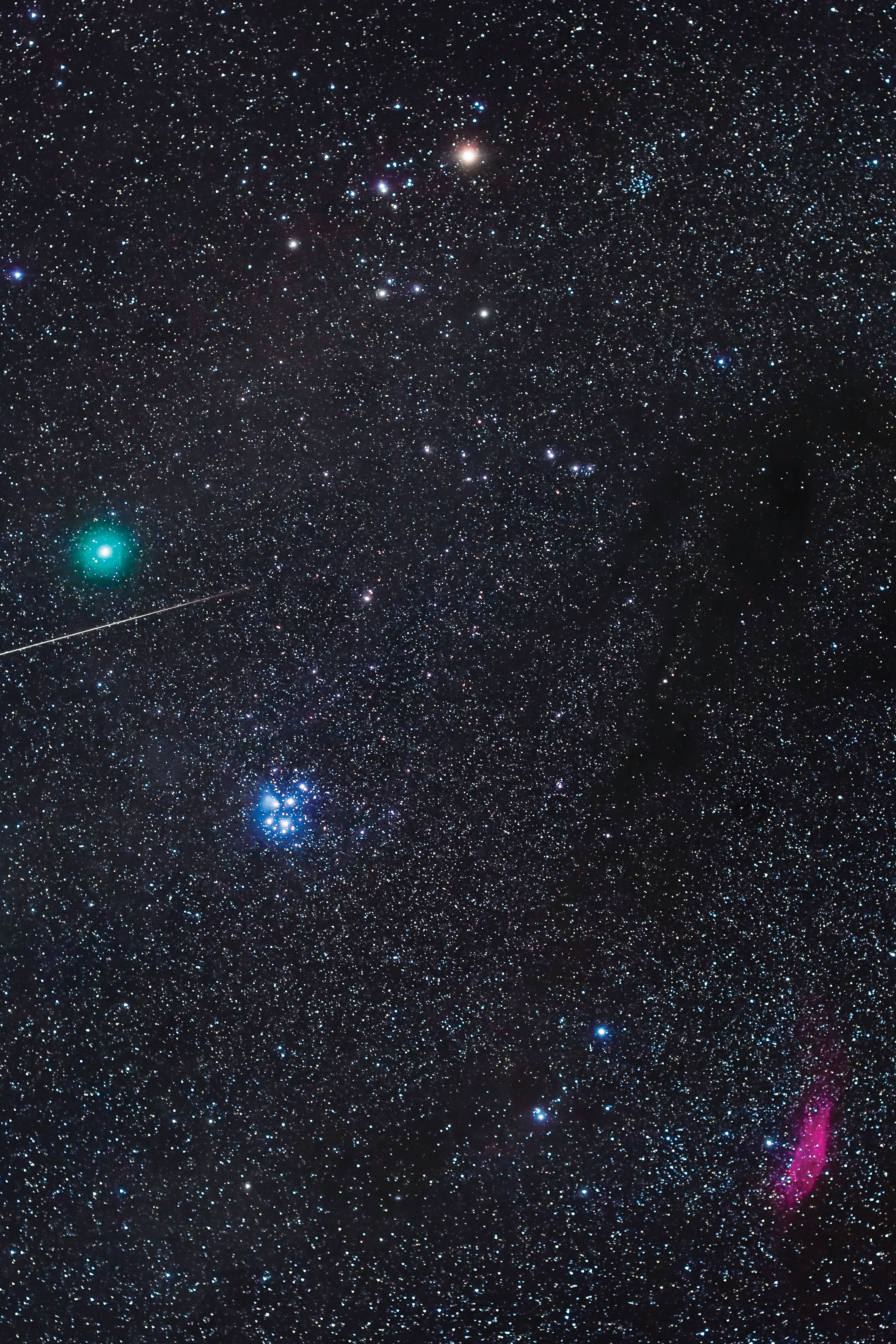
Green light for comets

Max van der Laarse

As comets streak across the night sky, their radiant heads often glow green—but not their long tails. In the 1930s, physicist Gerhard Herzberg suggested that the lime halo may be produced by sunlight destroying diatomic carbon, C2. But because diatomic carbon is so unstable, no one on Earth has been able to test that theory—until now. Researchers in Australia used a vacuum chamber and powerful lasers to simulate the comet environment, proving that the breakdown of C2 produces the emerald hue.

More by

Max van der Laarse

As comets streak across the night sky, their radiant heads often glow green—but not their long tails. In the 1930s, physicist Gerhard Herzberg suggested that the lime halo may be produced by sunlight destroying diatomic carbon, C2. But because diatomic carbon is so unstable, no one on Earth has been able to test that theory—until now. Researchers in Australia used a vacuum chamber and powerful lasers to simulate the comet environment, proving that the breakdown of C2 produces the emerald hue.

More by

Issue 178

Nov - Dec 2022

Preppers
Work-ups
Cave spiders
Cannon
Photographer of the Year

Fallback image

More by

×

Subscribe to our free newsletter for news and prizes

3 FREE ARTICLES LEFT

Subscribe for $1  | 

3 FREE ARTICLES LEFT THIS MONTH


Keep reading for just $1

$1 trial for two weeks, thereafter $8.50 every two months, cancel any time

Signed in as . Sign out