
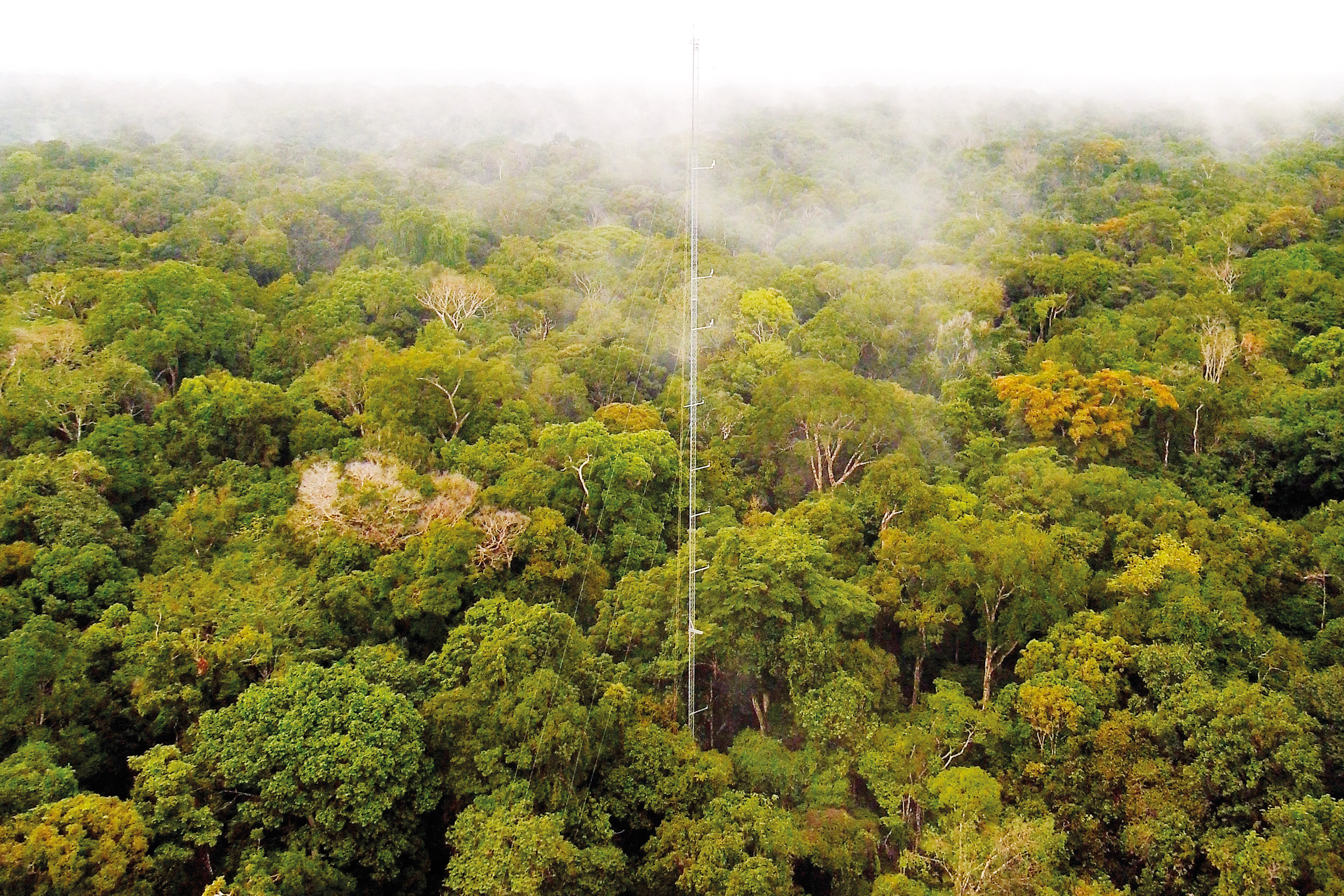
Rainmaking

C Pohlker

The Amazon rainforest creates its own rainfall by releasing tiny potassium-salt particles, shedding light on the
role that biodiversity plays in weather patterns.

For the water vapour in cloud to become water dropletsfalling as rain, it must first ‘seed’ on to a small particle such as dust, soot from fires or factories, sulphates from volcanoes, or sea salt from the ocean spray.

Researchers from the Max Planck Institute in Germany X-rayed particles from the mist over the pristine jungle northwest of Manaus, Brazil, and discovered that, in the Amazon, potassium salts ejected by plants and fungi are responsible for bringing organic gases together to seed clouds.
Scientists have detected potassium in the Amazon air since 1985, but little was known of its concentration or role. “What’s really new is actually being able to identify the particles that carry the potassium and organics, and identifying their role in the water and chemical cycle over the forest,” said researcher Meinrat Andreae.

The study’s co-author, Christopher Pohlker, cited the Amazon as one of the last places on Earth where the atmosphere,for some time of the year at least, is not polluted by anthropogenic emissions. “The Amazon is our proxy for a pre-industrial ‘baseline’ atmosphere in order to understand what, nowadays, the impact of human pollution on atmospheric cycling is,” he says.

More by

C Pohlker

The Amazon rainforest creates its own rainfall by releasing tiny potassium-salt particles, shedding light on the
role that biodiversity plays in weather patterns.

For the water vapour in cloud to become water dropletsfalling as rain, it must first ‘seed’ on to a small particle such as dust, soot from fires or factories, sulphates from volcanoes, or sea salt from the ocean spray.

Researchers from the Max Planck Institute in Germany X-rayed particles from the mist over the pristine jungle northwest of Manaus, Brazil, and discovered that, in the Amazon, potassium salts ejected by plants and fungi are responsible for bringing organic gases together to seed clouds.
Scientists have detected potassium in the Amazon air since 1985, but little was known of its concentration or role. “What’s really new is actually being able to identify the particles that carry the potassium and organics, and identifying their role in the water and chemical cycle over the forest,” said researcher Meinrat Andreae.

The study’s co-author, Christopher Pohlker, cited the Amazon as one of the last places on Earth where the atmosphere,for some time of the year at least, is not polluted by anthropogenic emissions. “The Amazon is our proxy for a pre-industrial ‘baseline’ atmosphere in order to understand what, nowadays, the impact of human pollution on atmospheric cycling is,” he says.

More by

Issue 118

Nov - Dec 2012

Photographer of the year
Playcentre
Pacific festival
The Rifleman

Issue 118 Nov - Dec 2012

More by

×

Subscribe to our free newsletter for news and prizes

3 FREE ARTICLES LEFT

Subscribe for $1  | 

3 FREE ARTICLES LEFT THIS MONTH


Keep reading for just $1

$1 trial for two weeks, thereafter $8.50 every two months, cancel any time

Signed in as . Sign out