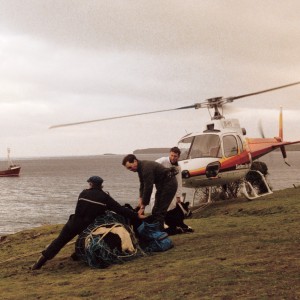
The wounds of war are a long time healing. On Bougainville, where thousands died during the Pacific’s bloodiest conflict since the end of the Second World War, the fighting is over—but the task of rebuilding has only just begun.
The boys breathing filled the silence in the room. He was in the last stages of malaria. It was a racking, gulping, choking noise. He would shudder gently, his body bathed in sweat. There was another boy, skin and bone with some wasting disease. His cry also filled the room. Again and again the same cry.
The room was an edit booth at Television New Zealand. I had brought these boys’ voices back from Bougainville and was carefully, patiently fitting their pain into a current affairs piece as a soundtrack.
On the island I had felt ghoulish, the way I had clinically positioned my microphone, almost as a stethoscope, to properly capture the fullness of the sounds. The way I had asked for quiet. The families didn’t understand the exact television reason for the procedure, they just knew I was taking the story of their sons to the outside world: that they were dying because a gunboat blockade of the island had denied them medicine, as a deliberate act of war.
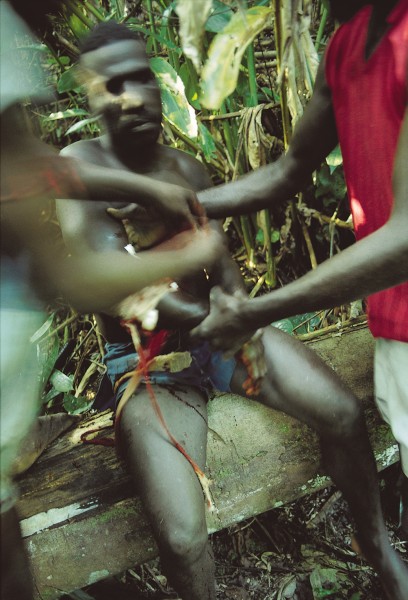
Before New Zealand-brokered talks led to a truce in 1998, war had stalked the forests of Bougainville for nine years. In 1994, Jochim Matruro, an unarmed civilian, was shot by PNG soldiers as he helped an Australian film-maker. Now he is a carpentry apprentice in a New Zealand-run Volunteer Service Abroad scheme.
There in the edit booth I had to play the tracks over and over again, to run them alongside commentary and interview. Sounds that scored the emotions deeply, engaged the instinct to help and protect. The death rattles of lonely, frightened birds. There was no easy way through it.
On the island it had been worse. In my own kit I had the medicine that could have saved David, the boy with malaria, but the firm advice was that giving my medicine could put my own life at risk. In the ward, I filmed myself acknowledging exactly that reality. In order to say my piece to camera cleanly I needed to find strength. I took myself off to a quiet corner of the hospital away from David and sobbed my heart out. To clear myself. To stay professional.
Standing next to David I said the following words: “I have here in my hand a packet of simple anti-malarials that could save David’s life. The truth is, I need these for my own survival. But how many more Davids will have to die miserable, lingering deaths while the governments of New Zealand and Australia watch on?”
Later, in the booth, I was able to build the sound of David’s breath to fill pauses in my delivery. Adjust it perfectly. Push the slide on the audio mix to craft in just the right pitch. Which segment of his cries will fit best? I still feel awful about that. Some kind of final indignity.
I felt very important there in the ward next to David, the boy whose certain death measured less than the chance of mine. I felt sure that, with the outside world acquainted with the facts of this war, something would be done. I was getting the message out. But that was nine years ago, and the killing got a lot worse before it finally stopped.
Out of a population of 160,000, as many as 10,000 died as a result of the blockade, or were shot—three times the number killed during the troubles in Northern Ireland. That is like a quarter of a million New Zealanders dying in a civil war that lasted almost twice as long as World War Two. Death, even among neighbours, can mean very little.
*
Late in 1990, the aid agency Oxfam had contacted me over reports that a blockade of Bougainville by Papua New Guinea gunboats, which seemed to specifically target medicines, was having a dire effect. I knew a little of the background, that Bougainville had been fighting for independence from PNG and that an Australian-owned copper mine—one of the world’s largest—was the focus of the troubles. The islanders were sick of the enormous environmental damage and niggardly compensation. Local landowners had begun a campaign of sabotage. PNG, which derived 40 per cent of its foreign earnings from the mine, had responded by sending in troops to crush the insurrection.
But there was the larger underlying issue of how a cynical colonial carve-up at the turn of the century had attached Bougainville to PNG, with whom the islanders felt not the slightest connection. Bougainvilleans, a proud, separate people, had long felt oppressed by control from Port Moresby, 1000 km distant. The mine was the catalyst.
When Oxfam contacted me, the PNG Defence Force had withdrawn and instead had thrown the blockade—a medieval siege—around the island to starve the people of supplies. Food wasn’t the problem, but with tropical diseases always ready to kill, the denial of medicines amounted to a crude form of germ warfare. Hundreds were reported to be dying, but getting on to the island—by small boat from the neighbouring Solomons—involved running a gauntlet of gunboats and helicopters supplied by Australia. No reporter had made the attempt. I soon found out why.
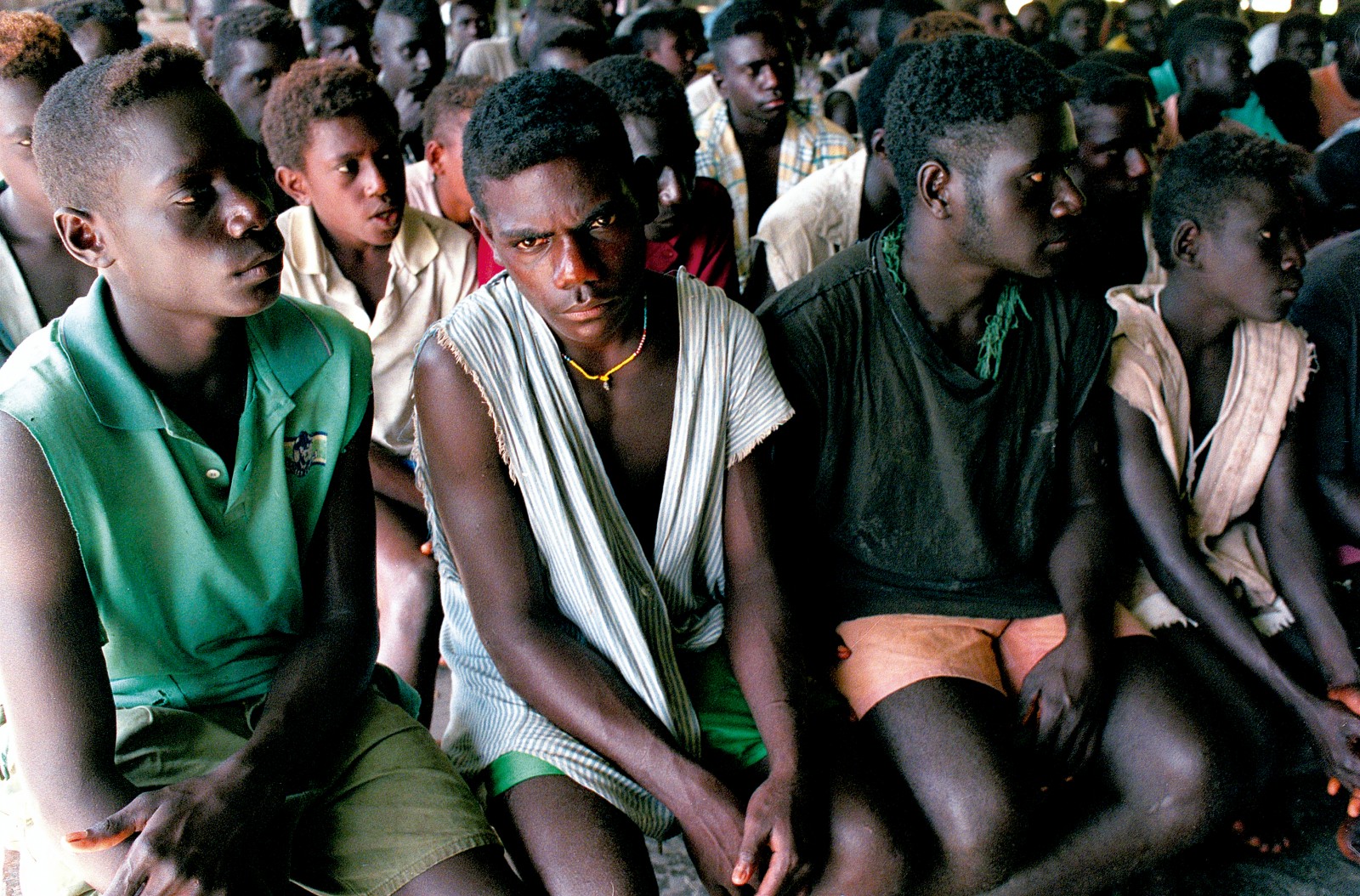
Bougianville Revolutionary Army soldiers, using WWII-vintage weapons, were a determined force on the battlefield, but it was civilians who most often paid the price of war.
Arriving at a trading post in the northern Solomons, where I hoped to hitch a ride, I could see the mountains of Bougainville rising at the horizon. Banana boats—open fibreglass runabouts with 30 hp outboards—were drawn up on the beach. A group of men were talking under a tree. There seemed to be a tense edge. In the middle I spied a European, a dumpy little chap wearing a goatee and a Tyrolean mountain cap. An alpine pixie in the blazing heat.
Father Frank Defland broke free and explained that a gunboat was lying hidden against the shoreline of Bougainville. It had sunk a dinghy with gunfire the day before. The occupants had made a lucky escape, swimming ashore, where they had been hunted in the jungle by a naval shore party.
There was no way to tell if the gunboat was still in position against the haze of the far coastline or if it had moved off elsewhere for fresh pickings. The uncertainty had stranded half a dozen boats. How to judge when it would be safe to leave—this was the subject of discussion.
Some wanted to go under cover of darkness, which to me seemed the obvious thing to do. Others pointed out that the gunboat would have a deadly advantage over us at night, spotting us by radar long before we could see them. This, too, seemed obvious. Still others argued the radar wouldn’t pick up fibreglass. I began to wish I had persevered with fifth-form physics.
I made the decision not to let the German priest out of my sight. As I hoped he would, he offered me a place on his boat with its cargo of urgently needed medical supplies for a clinic he ran in a highlands village. Quite apart from divine protection, I reasoned that the defence force, for fear of international attention, would hesitate before shooting two white men.
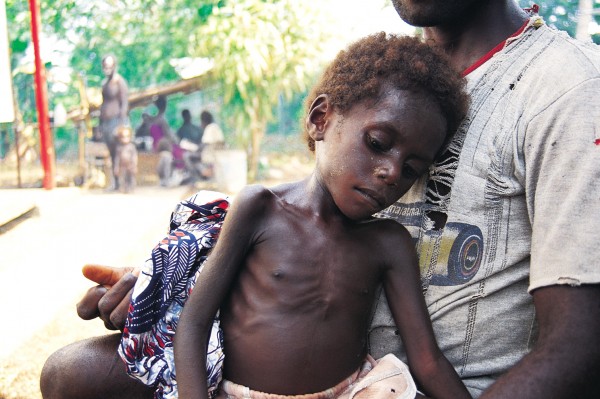
When force of arms proved ineffective against the Bougainville rebels, Papua New Guinea ordered a blockade of the island, cutting off medical supplies. Thousands died, many of them children such as Isaac Deera. With little media interest shown in this isolated trouble spot, the suffering on besieged Bougainville—one of our Pacific neighbours—remained virtually unknown to the New Zealand public.
By now the boatmen had borrowed my camera gear and were using the lenses to scope the horizon. They saw the gunboa still in position. Defland and his assistant, Peter Chanel, decided to wait for morning.
As evening settled I joined the boatmen. I was pleased to discover there was nothing soft, nothing lax about these people to whom I would be entrusting my life. Their bodies were muscled and slim, their skin so black it was almost a deep blue, and in the darkness the eyes stood out—sharp, lively, direct. Some spoke mission English with a gentle Oxford correctness, underpinned by firmness and clarity. A Nelson Mandela dignity.
But trying to find sleep on the concrete floor of a stores shed allowed more than enough time for some serious reality to creep in. The Bougainvilleans had posted sentries to warn of a night-time defence-force raid (later the trading post was destroyed in just such an attack), and I learned that in addition to the gunboat there was the risk of attack by gunship helicopter. In this room of people attempting sleep, there were other bedtime stories—of helicopters strafing defenceless villagers, of abductions and torture, of sudden and surprise attack by high-speed landing craft and helicopters. Helicopters piloted by fellow Kiwis. I thought of the gunboat out there somewhere on the night sea.
By midnight, I had heard enough. I roused the store owner and managed to find a square of hardboard and some yellow paint. By kerosene lantern I used felts to block in “TV” against the yellow background. It would be no protection if they opened up at a distance with ship-mounted cannon, but at close quarters it might cause them to think twice. This seemed an obvious precaution.
Defland wasn’t so sure. “Oh no, my friend, they will use your sign as the principal target! They do not want anyone to know what is happening here. But they will shoot us anyway, so take your sign!” I thought of the Kiwi newsman, killed along with four Australians during the invasion of East Timor, and of his naive faith that his job would be his protection.
Next morning the coast was clear—literally—so we launched into a powerful swell. With six aboard, plus fuel and cargo, our progress was painfully slow as we wallowed on towards the point of no return. I had my sign stowed for ready access. I wouldn’t have traded it for a life-jacket, and there were none of those.
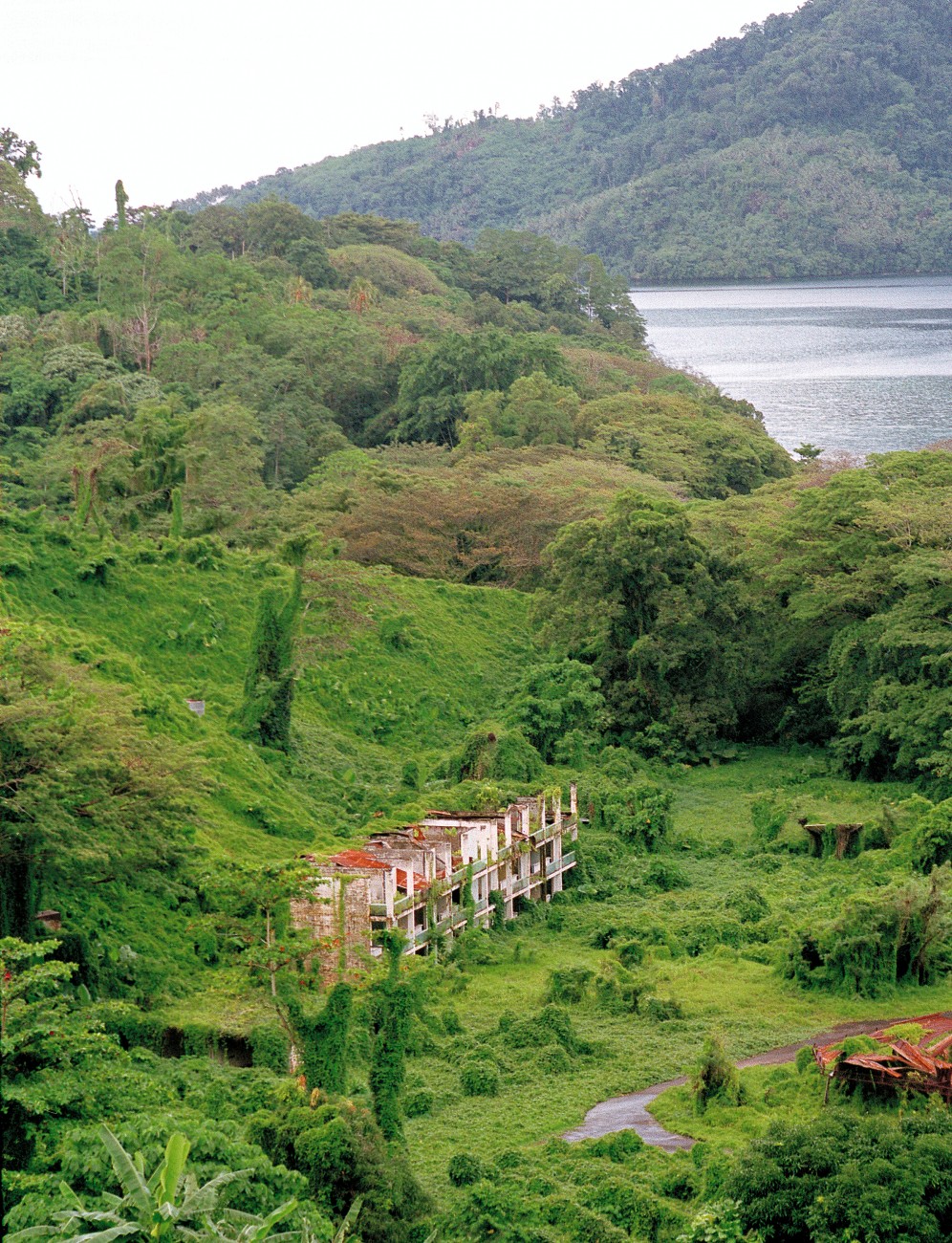
At Kieta, life has gone full circle. In the early 1970s, this quiet backwater, along with neighbouring Arawa, became a bustling service centre for the Panguna mine. Now the jungle is reclaiming the area and its monuments to waitman’s privilege. In 1989, when 300 villagers displaced by the war were to be temporarily house in the Arawa Country Club, members wrote to the Prime Minister of PNG expressing their outrage. They were assure that the refugees would be kept from the gold course and tennis courts.
Open sea presented the greatest danger—an exposure of several hours where there was simply no chance of evasion. Our plan was to take the shortest route across and then track north to our landfall, staying close to the coast, just outside the breaker line, ready to run the boat through the surf and escape into the jungle if we needed to.
Ordinarily, I would find little reassurance in the idea of mad flight through jungle amid a hail of gunfire—this after being tossed into boiling surf. But it is a measure of the awful sense of open-sea vulnerability that by the time we passed the point of no return, we were all looking forward to some escape option. It was precisely at this point that Peter Chanel spotted the gunboat beginning a sweep back down the coast.
I had never been hunted before. There was something about the moment that was surreally impersonal. The sharpest pain connected with the possibility of being machine-gunned in the water was from the thought of not coming home to my daughters. Not being there for them. The actual business of bullets tearing into flesh and drowning was the least of it.
Colonialism, copper and conflict
Before hostilities broke out in 1989, Bougainville was Papua New Guinea’s richest province, and had the most effective local government in the country. How did it end up at odds with the rest of PNG—an island wracked by violence and division?
Even stepping back a century, Bougainville, Buka and the surrounding small islands that make up the North Solomons seem improbable candidates for an independence campaign. Until very recently, this group of islands had no internal sense of identity. Its territories were populated by a series of mutually suspicious and frequently warring clans who spoke no fewer than 19 language groups, some of them, according to one anthropologist, “as different as English is from Arabic.” Bougainville was a microcosm of Papua New Guinea—the very nation from which it seeks to secede—with its myriad distrustful tribes and 800 languages.
It was only the vicissitudes of contact with Europeans and other outsiders that raised the hackles of nationalism on these islands. And that contact was rarely in the islanders’ favour.
During the 19th century, Bougainville and Buka were visited regularly by “blackbirders,” who recruited workers (often against their will) for plantations in Queensland, Samoa, Fiji and elsewhere in the Pacific.
Under German control in the first two decades of the 20th century, 30,000 ha of land was forcibly turned into plantations, and traditional hamlets were amalgamated into larger villages to facilitate administration—an unpopular measure.
Despite a 1921 League of Nations mandate making Bougainville a ward of Australia, in the following 20 years very little progress was made in advancing life for those on Bougainville and Buka. By 1941, some 175 whites and Chinese lived on the islands (planters, missionaries, traders and administrators) with 50,000 indigenes. Missions were the main providers of whatever meagre education was available.
The administration required most local men to periodically build roads and bridges and serve as porters—tasks they resented. It also imposed a poll tax on males, a measure which forced many into paid employment and dislocated village life. The natives considered the tax unfair: it took from those who had so little and gave to colonial bosses who had so much.
Some good flowed from the mandate, however. Health improved, intertribal warfare ceased and pidgin became a common language.
During World War Two, up to 65,000 Japanese occupied the islands. Initially, they treated the locals well, but as food supplies ran low and they took to seizing crops, relations deteriorated. Large contingents of Americans also passed through Bougainville, but towards the end of the war it was Australia which again took control.
Perhaps such comings and goings demonstrated to the Bougainvilleans that colonial powers were not as invincible or permanent as they had thought.
After the war, Bougainville, along with Papua New Guinea, became a trust territory of the United Nations under the control of Australia. International opinion was swinging strongly towards the idea of self-determination for indigenous peoples, and Australia decided that if it was to have an independent nation off its northern coast, it should be a strong one.
Canberra poured millions of dollars into PNG, building hospitals, schools and roads, improving public-health services and encouraging islanders to grow cash crops.
However, not much in the way of aid reached remote Bougainville (no secondary school was built there until 1964, for example) and there were stirrings of discontent among the Bougainvilleans at the slow pace of development. For more than half a century they had seen the waitman’s goods and cooperated with him to a greater or lesser extent, yet few of these goods seemed to come their way. They began to appreciate that they were being ruled not for their own benefit, but for the profit of others.
For instance, in south-eastern Bougainville the Australian government purchased and then on-sold the cutting rights to a large swathe of forest. Locals later learned that the government had made 200 times as much as they had from the deal. Incidents such as this increased mistrust of whites and fed a sense of injustice among local people.
From the early 1960s, there had been interest in mineral deposits on Bougainville, principally copper. The Australian government encouraged the large Australian mining company Conzinc Riotinto Australia to begin prospecting and later to develop a mining operation. Once prospectors started roaming the hills, many land-owners in the target areas became nervous at what might happen. While some were willing to sell or lease to the mining company, others refused, and had their land forcibly acquired by the Australian government.
At Rorovana, on the east coast of Bougainville, land was needed for a port and town site to service the mine. Tensions flared in August 1969, and riot police used teargas to disperse landowners who had lain in front of the bulldozers. This and many lesser confrontations over land for the mine helped to build Bougainvillean xenophobia and national spirit.
Bougainville students studying in Port Moresby and Australia brought back heady ideas of self-rule, for the whole of Papua New Guinea was moving towards independence. A Bougainville Special Political Committee was established to collect views on forms of government. Some areas favoured secession, but others saw merit in casting their political lot with PNG.
In July 1974, the North Solomons Provincial Government was established, but it was hobbled from the start because of lack of funding. In consequence, several Bougainvillean leaders proclaimed independence from PNG on September 1, 1975, just two weeks before PNG declared its own independence from Australia. The proclamation was ignored by the world, the provincial government continued to operate in a hand-to-mouth way, and development became a new emphasis.
Yet without funds, little could be accomplished. On the other hand, a possible source of revenue lay close at hand. Bougainville Copper Ltd’s huge Panguna mine had opened in 1972 and was proving very profitable. Couldn’t money be diverted from there to satisfy development demands on Bougainville? Some money did enter the Bougainville development pool from the mine, but most of the tax take—in 1973, some $34.6 million out of $145 million in profits—went to the central PNG government.
The prospect of an independent Bougainville, with all the wealth from the mine kept for itself alone, was an alluring prospect. But for PNG it was anathema. The mine had made Bougainville PNG’s richest province—a cornerstone of the country’s economy. If Bougainville became independent, the PNG economy would be undermined, and the move would set a precedent for other disaffected groups.
The mine and its perceived wealth became a focus for discontent on Bougainville, but it was not the only sore point. Immigration further fuelled the fires of nationalism. Although locals made up about 30 per cent of the mine’s workforce, thousands of Niugineans from elsewhere in PNG had flooded into Bougainville and taken most of the remaining jobs—a source of deep resentment.
Bougainvilleans (who regarded themselves as mungkas, “blackskins”) felt that they were distinct from and culturally superior to the “redskins” from PNG. While their skin was certainly darker, the cultural distinctions were largely fanciful, given the profound differences between tribal groups on Bougainville.
Landowners affected by the mine had received some compensation for the vast devastation it had wrought, but they came to consider it insufficient. The pit itself covered 400 hectares by 1989, and was 300 m deep. The tailings and overburden amounted to over 1000 million tonnes, much of which was flushed down the Jaba River to the coast. The delta of this river increased from 65 to 900 ha while the mine was in operation, and the water was constantly silted. Environmental degradation became a significant local issue.
The amount of land affected by the operation (over 13,000 ha) also became an issue. Bougainville could not be described as densely populated, but it was experiencing a rate of population increase more rapid than almost anywhere else in the world. The indigenous population was set to double every 15 to 18 years, and agricultural land was starting to come under pressure.
Social structures were under pressure, too. The amounts workers earned at the mine were modest, but they greatly exceeded the funds that other Bougainvilleans could access from customary cropping. The newly affluent workers became part of a cash economy that threatened traditional village structures. Social dislocation and jealousies resulted.
Underpinning the resentment was the fact that under Australian law (and PNG and New Zealand, but not US, law) the government owned most minerals, including those under private land. (On Bougainville, the Beverly Hillbillies would have stayed dirt poor.) That an unpopular and distant government should own their minerals was never really accepted by those on Bougainville.
In August 1987, the Panguna Landowners’ Association (PLA), with which BCL had dealt over compensation issues since 1979, was rent by division, and a new, more militant, organisation (the New PLA) appeared alongside the old. Francis Ona was its secretary. Within a few months, the New PLA produced a set of demands which the mining company and the PNG government considered outrageous. BCL was to pay the New PLA 10 billion kina (one kina was equivalent to about $US1 at the time) as compensation for used resources; 50 per cent of future profits would go to the landowners and the provincial government; the company would become locally owned after five years; and the national government would return 50 per cent of all money received from BCL between 1972 and 1988 to the provincial government.
When the demands were not met, disaffected locals under the leadership of Francis Ona began a series of obstructive actions, starting with roadblocks, then escalating into a campaign of sabotage which eventually closed the mine in 1989
The mine’s closure did nothing to dampen the conflict. As PNG used increasingly heavy military force to bring Bougainville back into the fold, the island’s people united against the foe, and independence became the issue rather than the economic grievances that had been at the top of the agenda for most of the 1980s.
I felt a galling impotence. Our little overloaded boat, barely making headway against the swell, had no hope of outrunning a warship. The priest, still with his hat on, was furiously pulling at a pipe.
We made the coast. Here on the southern shoreline I spied Japanese gun emplacements and bunkers set back into the jungle. After all these years their gun slits still projected a baleful glare over what I imagined were killing beaches. Tracking north, I thought of how little we know of the sacrifice paid by Kiwis in the Pacific campaign. The horror of these beaches, the heat and the disease. How the European theatre of war seems to have commanded all our attention. Even further from our awareness is the sacrifice paid by islanders in places like Bougainville to support us in a war they never asked for. Now mercenary helicopter pilots from New Zealand and Australia were returning the favour.
*
The following day I hitched a ride to the largely abandoned provincial capital, Arawa. Once home to an influx of some 10,000 outsiders attracted by the mine—and laid out like a sort of tropical Twizel—the town had disappeared beneath a cloak of creeper. It was like wandering through some Mayan lost city—that’s if Mayan architecture had featured ranchsliders and carports.
Most of the houses had been left strictly untouched. Families camped on the open ground floor beneath the house proper and cooked on open fires. I stayed with the family of General Sam Kauona, the commander of the Bougainville Revolutionary Army (BRA). Kauona, an Australian-trained explosives expert, helped form the first BRA fighting units in 1989. These guerrilla units used explosives stolen from the mine to fell electricity pylons faster than they could be replaced, eventually forcing the mine’s closure.
Initially, the BRA relied on an extraordinary selection of vintage weapons which they had salvaged from World War Two battlefields around the island. Other guns were made secretly in machine shops. In time, captured defence-force weapons were also added to the weapons stock.
At one armoury I visited a fighter offered me the chance to test-fire a spectacular single-shot .50 calibre weapon which looked to have been made from a broom handle and a water pipe—an offer I declined. There were Stens with golf-ball handles and several .50 calibre machine guns, complete with ammo belts. Some of the vintage weaponry had been modified to take captured modern defence-force ammunition. With this ragtag assortment of weapons, the BRA had seen off the PNG defence force, and would continue to do so, inflicting heavy losses.
My principal mission was to gather evidence about the effects of the blockade, and it wasn’t hard to find: images of gangrenous wounds being treated with bush herbs, of feverish children, and not even paracetamol to control soaring temperatures. Several pregnancies had gone horribly wrong, and in the maternity rooms there was the rich, sweet smell of sepsis.
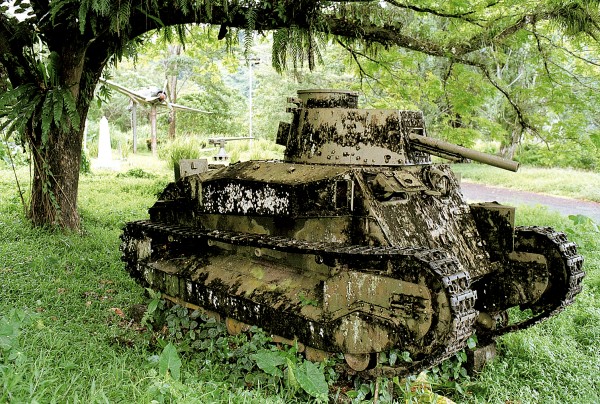
Given the BRA’s ingenuity in restoring weaponry, it is a wonder that this tank—and the plane behind it—weren’t brought into service during the recent conflict. During World War II, 40,000 Japanese soldiers perished here, more than half from starvation and disease.
And another kind of smell. One associated with the knowledge that the needed medicines had been impounded in large quantity, including 15,000 doses of children’s vaccine. The knowledge that church workers had been machine-gunned in the water as they had tried to ease suffering.
I interviewed the local Red Cross representative, Charles Loubai. He denounced the denial of medicine as contravening the Geneva Convention and gave a figure of roughly 4000 dead in just the first eight months of 1991 as a direct result. “The people of civilised nations everywhere must pressure their governments to bring this inhumanity to an end,” he said. Loubai himself was to die later from a heart condition nobody could treat.
I spoke to a New Zealand storekeeper, Ross Noone, an Australian, Clive Wissman, and visited Defland at his mission. They provided first-hand reports of medicines being confiscated even before the blockade was thrown up, reports of defence-force torture and random killings and of helicopters machine-gunning villagers. Wissman, who is married to a Bougainvillean, put it this way: “Australia provided the money, the weapons, the training and the helicopters, and then said, ‘Go to it, boys, and we don’t want to know.’ I’m an Australian citizen, and I am ashamed of my country.”
These expats confirmed the islanders’ overwhelming wish for independence from PNG. This much had already been clear. There was no shortage of commitment. I watched possibly a hundred islanders being drilled in military formation—each using wooden rifles painted in bright colours. Some were clearly grandfathers, others barely into their teens.
Along a jungle trail I encountered a small contingent of BRA fighters. I stopped to film and discovered they had returned from a disastrous pre-dawn attack on a defence-force camp on the northern tip of the island. They had lost 15 men, cut down by heavy machine-gun fire. One told me: “We don’t want PNG on our island any more. It is better we die like this in the field than with our women and children in the villages.”
*
Although I had talked to Joseph Kabui, vice-president of the self-proclaimed Bougainville Interim Government (BIG), there remained the objective of an audience with the president, Francis Ona. Elusive, suspicious, he seldom granted interviews, but after about a week word came that I could visit his mountain stronghold.
Winding up into the mountains was like taking the road through the Ureweras, the only real differences being that here the bush has more creeper and blossom, and here people live in the bush. Cooking-fire smoke trailed into the mist. We stopped at a lookout next to a downed pylon, and there, far below, was Panguna mine, hidden by a vast crest of tailings—a great glacier of gravel gouging out the valley, swallowing villages and gardens and turning the river into a toxic drain.
Driving along the rim of the mine itself, we passed row upon row of gutted buildings standing blackened and hollow in the mist. It was here I would meet the president. We were immediately challenged by the presidential bodyguard—a group of teenagers wearing camouflage gear, head scarves and Bob Marley singlets.
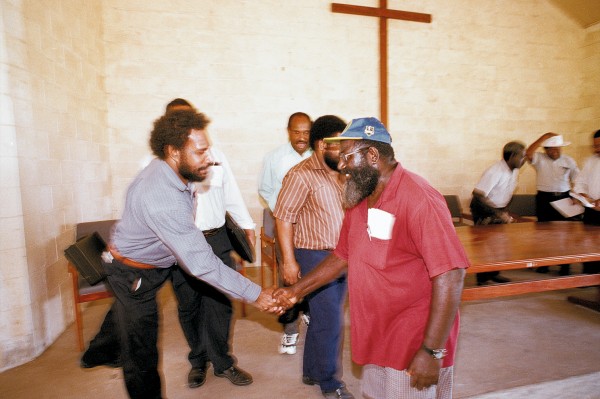
Joseph Kabui (right), president of the Bougainville People’s Congress, meets a delegation from PNG assessing support for self-rule on Bougainville. Kabui, a senior politician in a succession of provincial governments, is perceived to be more moderate than BRA leader Francis Ona, who has stayed aloof from peace talks.
They covered me with captured assault rifles and their own machine-shop versions. I tried a smile and a gently offered handshake to one of the boys—gestures that elsewhere on the island had worked instantly. At that moment I saw in his eyes something I had not seen before: a dreadful opaqueness, a lethal coldness. It was a look I was to see again in Bosnia. Staring into this man’s eyes, I felt a whisper of death.
Kabui’s greeting was grim. “My dear Mark, I am sorry we have some very bad news for you. We have heard from the Solomons that your mother died suddenly four days ago. We have made arrangements for you to go back in the morning.”
There in the mist in the rebel army stronghold among the ruins of this vast mine a tremendous tidal wave washed over me. Kabui, who had seen so much violent death, took me in a bear hug. I found my way to a quiet corner beside a stream gushing out of the bush. I cleared myself, managed to stay professional. I rejoined Kabui and waited for the president to make himself available.
During the interview, Ona was more nervous than me. In a rapid-fire, squeaky voice he delivered a monologue, calling for a ceasefire, a peacekeeping force and a referendum on the island’s future. Since a blind fool could see that in this rugged country there was no way to reopen the mine without a negotiated settlement, Ona’s requests seemed sensible and moderate. I’d said the same thing in a piece to camera earlier: “Since neither side is placed to win decisive victory, there will be bloody conflict for many years to come. That is why the people here want a peacekeeping force sent here without delay.”
Bougainville's long road to freedom
1768 French explorer Louis Antoine de Bougainville is the first European to reach the island.
1886 and 1898 Anglo-German accords see Bougainville, ethnically and geographically part of the Solomons, become part of German New Guinea. 1921 Australia wins a League of Nations mandate over what is now Papua New Guinea, including Bougainville. Under the terms of the mandate, Australia is to “promote to the utmost the material and moral wellbeing and social progress of the inhabitants.” 1942 Japanese forces occupy Bougainville and neighbouring Buka.
1943 Allied troops establish a beachhead at Torokina. The Japanese commander of the Pearl Harbour attack, Admiral lsoruku Yamamoto, is shot down over the island. Tonnes of weapons left on the island after the war become crucial in the 1990s conflict.
1963 Conzinc Riotinto Australia (CRA) begins prospecting for copper in the mountains of central Bougainville. 1967 The Bougainville Copper Agreeement between PNG and Bougainville Copper Ltd (CRA’s operating subsidiary in Bougainville), is signed, giving the PNG government a 19 per cent shareholding. Disgruntled landowners protest over inadequate consultation and compensation. A central issue is their unwillingness to accept a ruling that minerals belong not to the titleholders of the land but to the government.
1971 Construction workforce at the Panguna mine and associated facilities (roads, port, power generation) reaches 10,000. Bougainvilleans become unhappy about the number of Papua New Guineans living and working on their island.
1972 Commercial production starts at Panguna, April 1. 1973 Copper prices rise to record levels, making the Pang una mine spectacularly profitable.
1975 On September 1, two weeks before PNG is granted independence from Australia, Bougainvilleans declare independence for their province—North Solomons. Industrial unrest at Panguna leads to rioting. 1976 Bougainville is granted a provincial government as a compromise measure.
1981 North Solomons Provincial Government demands equity in BCL and greater royalties.
1988 Landowners demand about 20 billion dollars compensation for mining activities, plus a 50 per cent share in BCL profits and greater environmental protection. Their demands are rejected. In November, Francis Ona, one of the landowners and leader of the newly formed Bougainville Revolutionary Army (BRA), leads a raid on the mine explosives store and begins destroying installations.
1989 In the face of repeated sabotage, Panguna mine is closed. PNG begins military operations against rebels, and in June declares a state of emergency.
1990 A massacre on St Valentine’s Day results in five bodies being dropped at sea from Australia-supplied Iroquois helicopters. The PNG army subsequently withdraws from Bougainville and imposes an embargo on goods and services to the island. On May 17, Francis Ona declares independence for the “Republic of Bougainville,” with himself as interim president. On August 5, the Endeavour Accords are signed on board the NZ warship Endeavour. The agreement seeks to restore services but is never implemented.
1991 PNG and Bougainvillean leaders sign the Honiara Declaration, which seeks to restore services and disarm the BRA and its civil opposition, the Buka-based Bougainville Liberation Front.
1992 The PNG army returns. Medical services, schools and food available only to islanders living under army control.
1993 Fighting intensifies, with reports of human rights abuses by both the PNG Defence Force and the BRA. 1994 A PNG offensive to recapture the mine (Operation High Speed) ends in defeat.
1995 Bougainville leaders meet in Cairns to discuss the possibility of a ceasefire. The negotiations are undermined when the defence force attempts to ambush the BRA delegation as it returns to Bougainville.
1997 PNG plans to hire mercenaries from the military consultancy firm Sandline International lead to civil unrest in Port Moresby. Australia and New Zealand announce a joint bid to bring peace to Bougainville. In July and October, talks at Burnham, New Zealand, result in a truce and a declaration aimed at ending the crisis. 1998 In January, all parties sign the Lincoln Agreement, which extends the truce to a permanent ceasefire. Peace-monitoring troops from Australia and New Zealand, plus UN observers, arrive on the island. 1999 The Matakana and Okataina Understandings, signed in April and May, seek to resolve disputes over Bougainville’s political structure.
2000 The Loloata Understanding, signed in March, allows for the establishment of an elected autonomous Bougainville government and ongoing consultations on an independence referendum, and promises “substantial funds for reconstruction, restoration and development activities to support the peace process.”
Well before dawn the next day, I loaded my gear onto a banana boat equipped with two 40 hp outboards which would outrun all but a helicopter or a bullet. The coast slid by in the darkness, and by daybreak we reached the strait. Here there was no choice but to negotiate a string of islands, behind and of which a gunboat could be waiting.
Finally, with a whoosh of bow wave, the boat rammed hard onto the steeply sloping coral beach of an uninhabited island within Solomons territory. I leaped ashore, struggling in the spray with my television camera, tripod and suitcase. A plane would be coming to pick me up. When, exactly, nobody was sure.
To avoid attracting defence-force attention, the banana-boat sped away. For the same reason, I hurriedly hauled my gear off the beach and hid it in the jungle next to the airstrip. An hour or so later I heard the sound of humans. Scouting through the undergrowth, feeling like a paranoid Robinson Crusoe, I saw four men with a coffin. They had no weapons, so I stepped out and introduced myself, and discovered they were Bougainvilleans bringing their father home in a casket. They had taken him to the Solomons for medical care, but he had died before they reached the clinic, and now they were taking him home. I used my last scrap of tape to film them.
*
Six years later, I found myself standing in the bitter cold of a South Island winter’s morning at the Burnham military base, near Christchurch. A delegation of Bougainvilleans, wrapped against the chill, was being welcomed with an earthshaking army haka. Patient, careful diplomacy led by the New Zealand deputy prime minister, Don McKinnon, had arranged this watershed meeting, but the road to Burnham had not been easy. Various agreements, declarations and deals had been made and broken. The blockade had been lifted, then reimposed. Many Bougainvilleans had turned against the BRA, which had shown itself as capable of atrocities as the defence force. Armed opposition to the BRA in the form of a group calling itself the Bougainville Liberation Front had arisen in several areas, leading Bougainville into the quagmire of civil war.
Like East Timor in the 1970s, the conflict rarely made the headlines. Even a damning Amnesty International report released in 1993 failed to spark media attention. The Amnesty list of documented unlawful killings and torture by the defence force was long, and the circumstances chilling. Standing out were repeated massacres: 11 villagers executed after arrest; 17 unarmed villagers, including a chief, his wife and five children, killed after an independence celebration. Later Amnesty reports revealed further instances of defence-force massacre, execution and torture.
Despite pleas from Amnesty—and promises from PNG—no defence-force soldier has ever been brought to justice for these killings. For that matter, New Zealand officials, fully aware of the brutality, continued to claim that Bougainville was an internal dispute for PNG to solve, seemingly using whatever methods it chose. Australia continued to fund a military that was clearly running amok.
In 1994, I attempted to return. In the Solomons, with the benefit of first-hand information, I decided it was unsafe to make the trip. A fortnight later, an Australian filmmaker was ambushed by PNG soldiers, and his guide was seriously wounded. Only the presence of an Australian naval ship with an operating theatre saved his life.
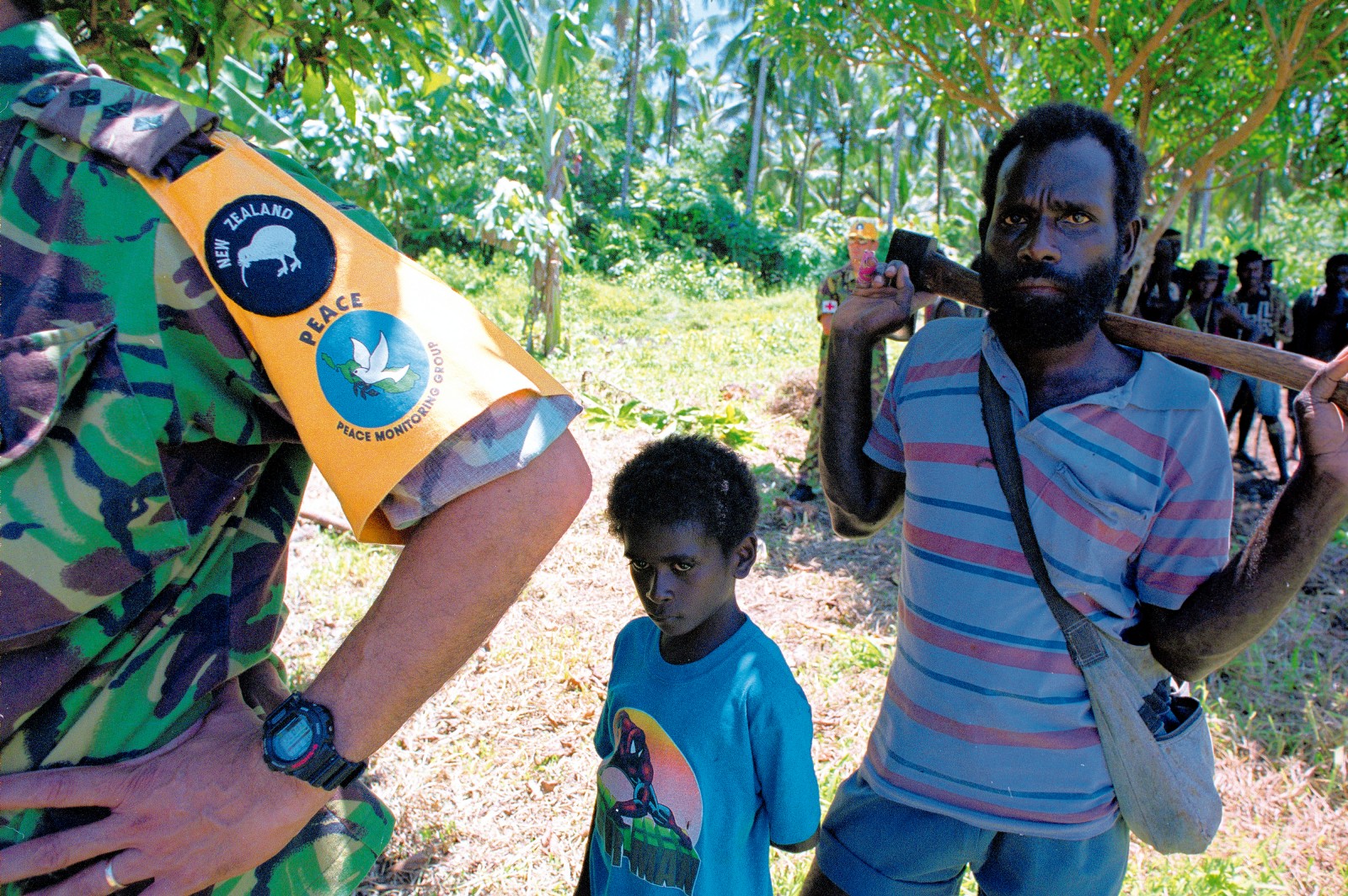
New Zealand diplomacy has been instrumental in bringing political resolution to the troubles on Bougainville, but it is Kiwi soldiers on the ground who have helped restore local confidence by keeping the promise of lasting peace.
Meanwhile, the BRA was refining its tactics, abandoning frontal attacks in favour of surgical strikes. But even in open battle the BRA was proving more than a match for the defence force. Two highly publicised PNG assaults, in which large forces were concentrated against the BRRs mine stronghold, resulted in dismal and costly defeat.
In 1997, it emerged that PNG, in a desperate measure, had hired South African mercenaries to help bring the entire conflict to an end with one decisive strike. Both the Australian and New Zealand governments—whose own citizens had been hired by PNG as mercenary pilots for years without comment—professed outrage at the arrival of this new element in the Pacific. In a plot worthy of a Frederick Forsyth thriller—complete with disappearing millions—the mercenaries were sent packing by a miffed defence force, which mounted a rebellion, forcing Prime Minister Sir Julius Chan to temporarily step down.
It was only against this background that PNG—its regional credibility in tatters and its army unable to launch any kind of effective offensive operation—finally agreed to the involvement of outside agencies. The Burnham meetings, followed by further meetings on Matakana Island, in the Bay of Plenty, were all about reconciling divisions among Bougainvilleans and preparing the ground for a peacekeeping force, which arrived on the island in 1998.
*
Flying back to Bougainville in late 1999, I had no real idea what to expect. But before I even got there—delayed in Port Moresby for several days waiting for a connecting flight—I gained a new appreciation of why the Bougainvilleans want their independence: the corruption and chaos of PNG.
Almost every building in the capital is surrounded by battlements of razor wire to protect against roving, violent gangs. The largest and most organised operate openly as the private armies of politicians for whom corruption is a way of life.
The PNG countryside is, if anything, more lawless and violent. In the space of scanning just three newspapers I read reports of a plane hijacking, a mass rape of schoolgirls, a village holding the rotting body of a pilot hostage, a village destroying a bridge, thereby cutting off a province of 400,000 people from the rest of the country, and of several gun battles with police and robbers. This kind of mayhem is so much the norm that these reports were buried on the inside pages.
Officials I spoke to confirmed the impression that this country of four million people and 800 languages is dangerously out of control, crippled by a traditional system of wantoks—narrow groupings of kin headed by politicians. The least dispute between wantoks is justification for a spectacular range of violent acts and ruthless, implacable compensation demands.
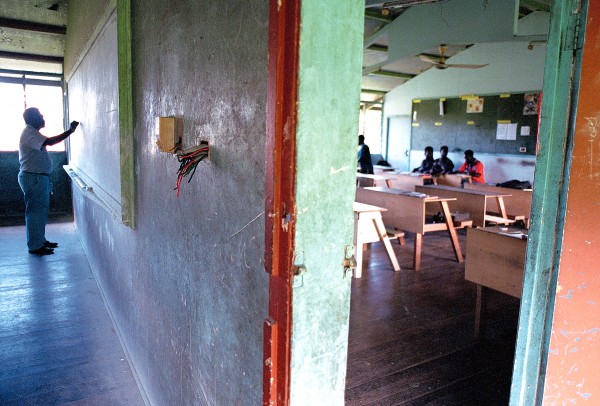
Substandard classrooms are a common feature of most Pacific islands, but with many of its schools looted or destroyed, Bougainville has had to start again from scratch, a process New Zealand is assisting.
In this climate, the chances of a PNG politician having the interests of far-off Bougainville at heart are next to zero. Bougainvilleans might as well be from an alien planet. In this way I came to understand one reason for the prolonged bloodshed on Bougainville.
It was a relief to leave Port Moresby, and an even greater relief to land on Buka, an island separated from Bougainville by a narrow tidal channel, and see at the airport the bright red Iroquois helicopters of the Peace Monitoring Group. The arrival of Anzac and Vanuatu troops—the peace force pushed for by Francis Ona so long ago—has finally sent a message to PNG (and hardline BRA rebels) that no further bloodshed will be tolerated. Bougainville is no longer alone.
I wanted to travel overland to Arawa, but few were making the trip. I filled in time by diving on a Japanese wreck. Seeing the Zero aircraft flipped upside down in the turquoise shallows, I thought of Black Monday, the day—unknown to most New Zealanders—when the RNZAF suffered one of its greatest single losses of the Second World War. It was on January 15, 1945, that eight Kiwi airmen were killed and eight aircraft were lost in these waters during operations against the Japanese.
Although Anzac coastwatchers based on Bougainville, aided by islanders, provided invaluable information on Japanese movements, Bougainville was not a major battlefield during the war. The Americans landed unopposed. With the focus of the war shifted to islands further north, the Japanese and American garrisons—after initial contact—stayed out of each other’s way. That changed when the Australians took over. Their commander, keen to prove his name in this strategic backwater, pushed his men into a costly and pointless campaign to dislodge the Japanese, which cost 516 Australian dead.
*
By chance, we found an island trader due to set sail. The Sankamap—Pidgin for “sunrise”—had only just resumed service to Bougainville. Watching the snail’s-pace loading of a meagre cargo—corrugated iron, cement, reinforcing iron, plywood—gave me a sense of just how long and hard the slog will be to rebuild.
We woke the next morning to the reassuring throb of the engine, only to find we were still tied up. The crane hydraulics had sprung a leak. Now we had to wait until a storeman could be pried from the far side of the island. Development anywhere in the Pacific—even in peace—has always been a struggle.
Finally underway, sprawled out on the after-deck amid cigar smoke from homegrown tobacco, I made a note of how I remembered Bougainville. “Take the most rugged chunk of bush New Zealand has to offer, set it down in the Pacific near the Equator, fringe it with a coral reef and sparkling white sand, fill its trees with extravagant blossom and fruit. Add a people of dignity, humour, education and energy . . .”
An elderly man is sitting next to me. I tell him what I am writing. He snorts. “You know, a man who has tears will cry very easily when he sees Bougainville now.” I learn that this man, William Peperanu, spent the war years in the bush.
“Yes, I was hiding in the mountains, in the caves, for five years. Many came down for education for the children, but it was a numbers game to see how much population each side could control. The BRA was playing that game, too. Even if you went to the coast to boil seawater for salt, or go and fish at night in the sea, both sides might think you are a spy, and kill you.”
Our course took us closer to the coast. “This jungle you see is full of tracks, and during the crisis we only use these tracks. We can use them to take the injured to the coast and down to the Solomons for treatment. We can jump from mountain to mountain, no problem.
“It was hard, but our lives were full of discovery. You will see in the night our mountains are alive with lights. Everywhere we have lights powered by streams—with generators we make ourselves. Before the crisis we don’t have this. We even ran a radio station on coconut oil. And we could grow rice!”
With rice being the most potent symbol of the store-based dependency that existed prior to the war, growing the crop was a special achievement. Self-sufficiency—not needing an Australian mining company for livelihood—was an obvious source of pride.
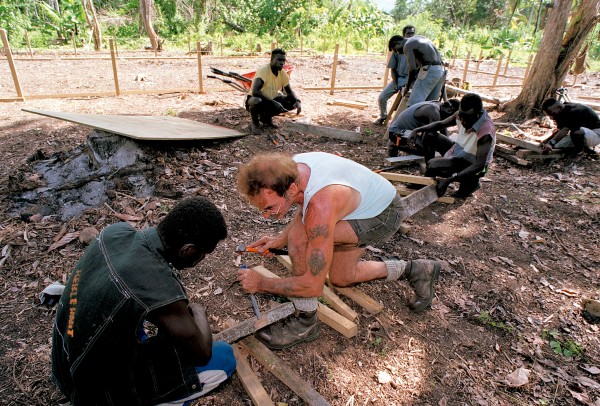
At a VSA school-building project, Kiwi volunteer Roy Bungard helps a former bush fighter with the traditional apprentice chore of building a sawhorse—the first step in learning a new trade, the first step in rebuilding a society.
Peperanu’s anger at PNG also showed. “The defence force was out of discipline. They throw people alive from the helos. I don’t want the kind of peace that will bind me to PNG. That is why Ona will not give up his weapons. He says, ‘If the peace process doesn’t work, I’ll still be here, like an insurance.”‘
Making landfall at dusk I look up to the mountains and, sure enough, far up on impossible bluffs, hidden in deep valleys, I see the first hydro lights twinkling like stars. By the time I hitch a lift into Arawa there are whole constellations of light high on the hills. In the darkened town there is only the flicker of campfire and the light of kerosene lanterns.
On the first morning I make a point of visiting the hospital. I want to find the room where David died, to pay respects. I am momentarily confused by a pile of wreckage where the hospital should be. Then I realise that the tangle of rusted, burned-out girders is the hospital. In the hospital laundry—one part with a roof that is still waterproof—I come across three New Zealanders. Volunteer Service Abroad medical workers Llanie Hadden, Barbara Meier and Melissa Hull are holding a daily medical clinic. I learn that conditions in the villages haven’t changed much since the war.
“Being pregnant here is like having a disease,” Hull tells me. “One pregnant woman had been in labour for four days, and she spent the last two of those days walking down from the village.” It was only the establishment of a fully-equipped field hospital at the Anzac base that saved her.
Out of the corner of my eye I see a man on a farm bike blatting down a gravel road towards an engineering workshop. It is Rob Meier, Barbara’s partner. He looks to me like the embodiment of the VSA tradition: a Kiwi in shorts getting things done, with good humour and genuine sensitivity. Here he was assisting two dozen young BRA men to turn out trusses for buildings, truck bodies, baking ovens—the whole host of unsung metalwork skills and tasks that keeps any modern society functioning.
Meier is a long-time volunteer engineer who has worked in places such as Vietnam, Cambodia and Tanzania. “Out of all the countries I have been to, this is the most satisfying,” he says. “These guys are always asking incredibly probing questions. They’ve got wonderfully logical minds. Every morning we discuss the objectives for the day. The whole philosophy here is self-motivation, doing things for themselves. All I’m doing is teaching the stuff they don’t know—small-business management things such as accurate quotes, profit margins and how to order in raw materials. They pretty much know the rest.
“You’ll see people carrying washing machines and fridges on litters into villages you can’t get to by road, and that’s because they’re all on power! It’s amazing what they’ve done. They’ve turned washing machine motors into water-powered generators. Their hydro schemes look like the Otago goldfields.”
Meier points me to the local man who started the workshop. Benedict Erengeta, a steel rule in his shirt pocket, explains: “During the blockade we helped the fight. I made a small workshop at my home. We did things like modify the old Japanese guns to take modern bullets, and yes, we won! But even then I had a vision of when the fight wa’ over, what would the young men do. To be self-sufficient is part of independence, too. If we do not have skills to be self-sufficient, then independence means nothing. I think we must stand up for ourselves.”
Moving around Arawa, I see that most buildings have suffered the same fate as the hospital. It is possible to understand what motivated the destruction of an expatriate squash court, even a petrol station. But a hospital?
During the war years, some villages held rudimentary classes for their children, but now schools are struggling to cope with the added demand for education from the hundreds of young adults who missed out. Many are deeply traumatised by the war they fought in their teens.
Amnesty International records the first act in this tragedy. In February 1993, defence-force soldiers emptied the wards, kidnapping the rebel government’s health minister, Ken Savia, who was never seen again. The BRA admits destroying the building as part of a wider scorched-earth policy. A BRA representative, Michael Paai Akope, put it this way: “When the defence force left the island, we were looking after the buildings, the assets, but when the defence force tried to retake Bougainville, that’s when the destruction started. If the defence force takes these buildings they will never leave—that’s what we were thinking. We regret burning these buildings, but all we wanted is for PNG to leave us alone.”
Later I talk with Ben Kamda, a BRA commander, and raise the question of BRA brutality. Of spy witch-hunts that led to many summary executions. “There was a book that came to me,” says Kamda, “an Australian army book about how to control a revolution. From it I learn that when there are spies you have to recheck everything. If someone gives you information you get somebody else to check that. If it is same-same, no problem. If it is different, then you get a third report and if that comes back different from the first person too, then you have to kill the first person.”
I ask what if that first person just made a mistake, but I don’t record a clear answer except my own feeling that I am seeing in Kamda’s hard eyes exactly how a civil war turns ugly—particularly when the hardening process has involved thousands of the sick and the old dying through a medical blockade. Or the sound of machine-gun fire from a helicopter. Kamda tells me that even before the shooting started he was held in solitary confinement by the defence force for seven months. “I had only the lizards and ants for my friends. But I studied the ants, and I learned about determination from the ants.” The seed of ruthlessness is planted in many ways.
*
Now the determination is about something else. I travel with VSA co-ordinator Peter Cresswell to a vocational training centre being built by a dozen former bush fighters. There’s a kind of spaghetti-Western Mexican bandit feel to the jungle encampment—an untidy, cheerful sense of menace. I expect to see them picking their teeth with chisels. But in the blazing sun, these Rambo Rastas are busy fathoming the traditional apprentice task of building sawhorses. A Kiwi chippie, Roy Bungard, is playing mother hen. Unaccountably, nailed to a tree is a poster about a Konflik Reso lus in course.
Brand-new shiny saws are wedging, buckling and twanging all over the place. The men watch with envious wonder as Bungard the chippie demonstrates again and again how to gently guide the saw like a knife through butter. Another bush fighter is grappling with the miserable mysteries of the combination square. “You might find it easier doing it this way,” says Bungard. “Give me a cooee if you get stuck.”
I think of the wartime satisfactions of the match and the gas can, the cleansing flame that spread through the island. And now the stubborn, piecemeal business of rebuilding. “Bougainvilleans are pretty extraordinary,” says Cresswell. “They’re taking full responsibility for the situation. They say, ‘We destroyed it, so now we have to build it back.”
Cresswell had earlier ordered some timber for this project direct from the jungle, where a donated portable sawmill is running. We bounce down a jungle track and reach a sawyers’ camp straight out of a kauri forest of last century. I see a tent fly stretched over a tree. There are hammocks, soot-caked cooking pots and the sound of a saw far off in the distance.
To my eyes, this is an aid scheme working in perfect balance: milling local timber so that former bush fighters can learn new skills while building a training centre so that still others can learn more. This VSA project is helping out a mission school run by Brother Bernard McGrath. “We had to start from scratch,” McGrath tells me. “We have people here who’ve been in the bush for 10 years. They want to return to school, but they find it very hard. They can’t deal with the rigid structure of a classroom. So building the school is a good way to start.”
Cresswell confirms the high motivation levels. “Our carpentry students in Arawasome of these chaps walk three hours to reach the projects. They’ve had a decade taken out of their lives, and they are desperate to learn a skill they can take back to their villages. These are married men who would normally be working the gardens to feed their families. We gave them a basic uniform to help foster a sense of identity, but they turned up wearing rags. We were wondering if they’d sold them. But on graduation day, there they all were in these pristine uniforms. They were saving them for best!”
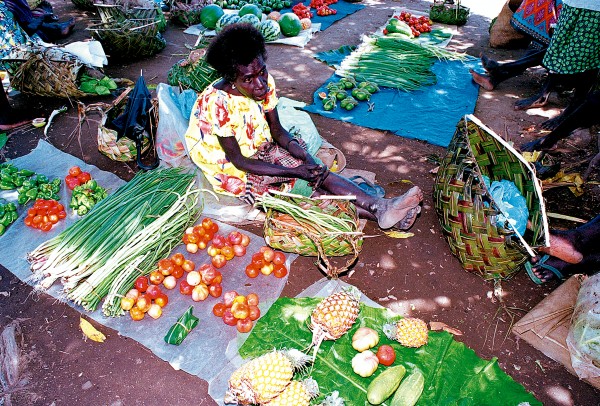
Before the mine opened, subsistence agriculture was the main activity on Bougainville. The only export products were copra and cocoa. Urbanisation accompanying the mine created a demand for fresh food, which allowed some locals to make an income from growing vegetables. Now, even with the mine still closed, a good variety of produce is regularly available in the Arawa market to supplement the staples: taro, sweet potato and breadfruit.
At Arawa High School, deputy principal Anita Salas, who has a donated collection of New Zealand Geographic in pride of place in her empty office, confirms the same keenness: “We have a class here for BRA. These young men put down their arms, and of their own accord came to us wanting education. They were tired of fighting and running around the bush. Now our school captain is BRA. He has cut his hair and looks like a real gentleman now. The boys who are BRA are disciplined; it is the boys who were never in the war who are problems.”
The following day I travel with Chris Baria of Oxfam. We stop at one of the notorious care centres, an Orwellian misnomer for the island-wide refugee camps where, during the war, 67,000 villagers were incarcerated by the defence force. Amnesty International has documented a catalogue of executions, disappearances, brutality and torture in these centres. In one case a mutilated corpse was left out in the sun as a warning to camp residents.
Poking about among the deserted buildings, I am joined by a young woman, Grace Kerepas, and her baby. We talk about life in the camp.
“All they give us is rice, but once in a while we can go to our gardens. One time we went to the bush for some greens, but the soldiers thought we meet the BRA. One boy, they shot him and threw his body in the bush. We lived in fear of both sides. My family is supposed to be eight, but now we are seven. My big brother was killed by the BRA. My father made a mistake, and for this the soldiers made him carry a coconut tree around a field, 20 times in the sun. Now he can’t move his shoulder any more.”
I ask Grace why her family is still at the centre, when most have left. “We have nothing at home, and so we have to make new houses and new gardens before we can move back. It is very depressing to stay here, but we want to be clear about the peace before we return. What we need is a referendum so that we can really find out what the people want. If PNG says yes that will be okay, but if they say no, maybe we will have to fight again. We have lost many loved ones in the crisis, so we want independence so their lives are not wasted.”
Grace has definite plans for the future. “I want to go to school to be a nurse so I can help my people. I want to go to school.” At this the father, who has joined us, says something and laughs. Grace translates. “He says everywhere now in the school the students are bigger than the teachers! It’s true. The teachers are terrified of the students with bush knives. You open the exercise book and see guns drawn all over the pages, instead of the school work. Before they used to listen to the teachers, but now they can get angry very quickly. They bite like a dog that doesn’t bark.
“These boys make me angry! They didn’t suffer like the women suffered. They ran away fighting in the bush, but we had to stay and feed the children, we had to go and look for food—the important work, the family. Now the boys create all these problems, but they didn’t suffer the same in the war! We tell this straight to the boys and it doesn’t make any difference. To me they are just humbugs!” Think of it as trying to get a teenager to tidy his room when he’s the one with the machine gun.
I learn the family hasn’t visited its home village, five hours’ walk away, for months. I offer a ride. North of the detention camp we turn off the road and push through tinder-dry brush and elephant grass for 30 minutes. The first families returned here about a year ago and, as confidence increased, so have other families.
Medical services—dislocated by the destruction of buildings and the blockade of supplies during the conflict—are slowly being restored, albeit in makeshift premises. Despite the deaths from treatable conditions that occurred during the blockade, some islanders claim that their health was actually better then. The absence of imported alcohol and foreign foods high in salt and sugar helped, as did the daily physical demands of self-sufficiency.
The bustling brightness of this village, built on the banks of a river, throws the horror of the war years—the dismal care centre—into tragic focus. The elevated huts—airy and cool with their freshly woven bamboo walls—are fringed with hibsicus hedges. There is ripening pawpaw, and in the shade of a frangipani a bench made from split bamboo. A child comes out of the jungle with a wild hive in a basket. There is a sense of well-being and of perfect order.
Sitting in the shade, I reflect on the shattered confidence of a family headed by a father crippled by defence-force punishment. A family who lost a son and a home. I find myself asking the question: For how long would the New Zealand government and our media have stayed silent if, during these long years, it had been 10,000 Europeans being killed right here in our neighbourhood?
In this village, among a gentle, dignified, smiling people, it is hard to imagine there was ever war or suffering. But then I think of the constant personal reminders that are invisible to the outsider. The trigger of a personal geography, personal to your pain and history. Under this tree is where the BRA shot my husband. Over by the bridge I saw the defence force execute my neighbour’s son. The sound of an Iroquois—the visceral whop, whop, whop of the blades that strikes at the nerves.
For these people, something has been taken from the scene. The adrenalin demands of mere survival during the war have given way to melancholy. Lives seem to be permanently on hold. Learning how to use a saw in the sun’s heat. Waiting five months for a shipment of nails.
“They are a very traumatised people,” says Brother Ken McDonald, who provides counselling. “Most have someone in the family who has been killed or tortured, or who has disappeared. The whole range of responses is there: nightmares, easily startled, no sense of future, a heightened sense of injustice. These emotions can be out of control, and are easily triggered. There is a lot of depression out there.”
An aid worker elaborates: “Once people are fed and housed, aid becomes less about meeting material needs and more about issues of morale and confidence. We are sending a message that they are part of an international community, at a very hands-on level.”
This confidence is vital in helping communities knit back together. Seventy-three-year-old Pat Howley, a chain-smoking Australian brother, tells me proudly that 8000 Bougainvilleans have been through his Peace Foundation Konflik Resolusin course.
“It is very practical—how to facilitate a meeting, how to involve the whole team, how to negotiate a deal. They’ve been very open to this!” he says. “It’s about listening skills, assertiveness training, self-understanding. We’ve had a 78-year-old chief in the same group as his granddaughter. For them to work in a gender-balanced team—unheard of!”
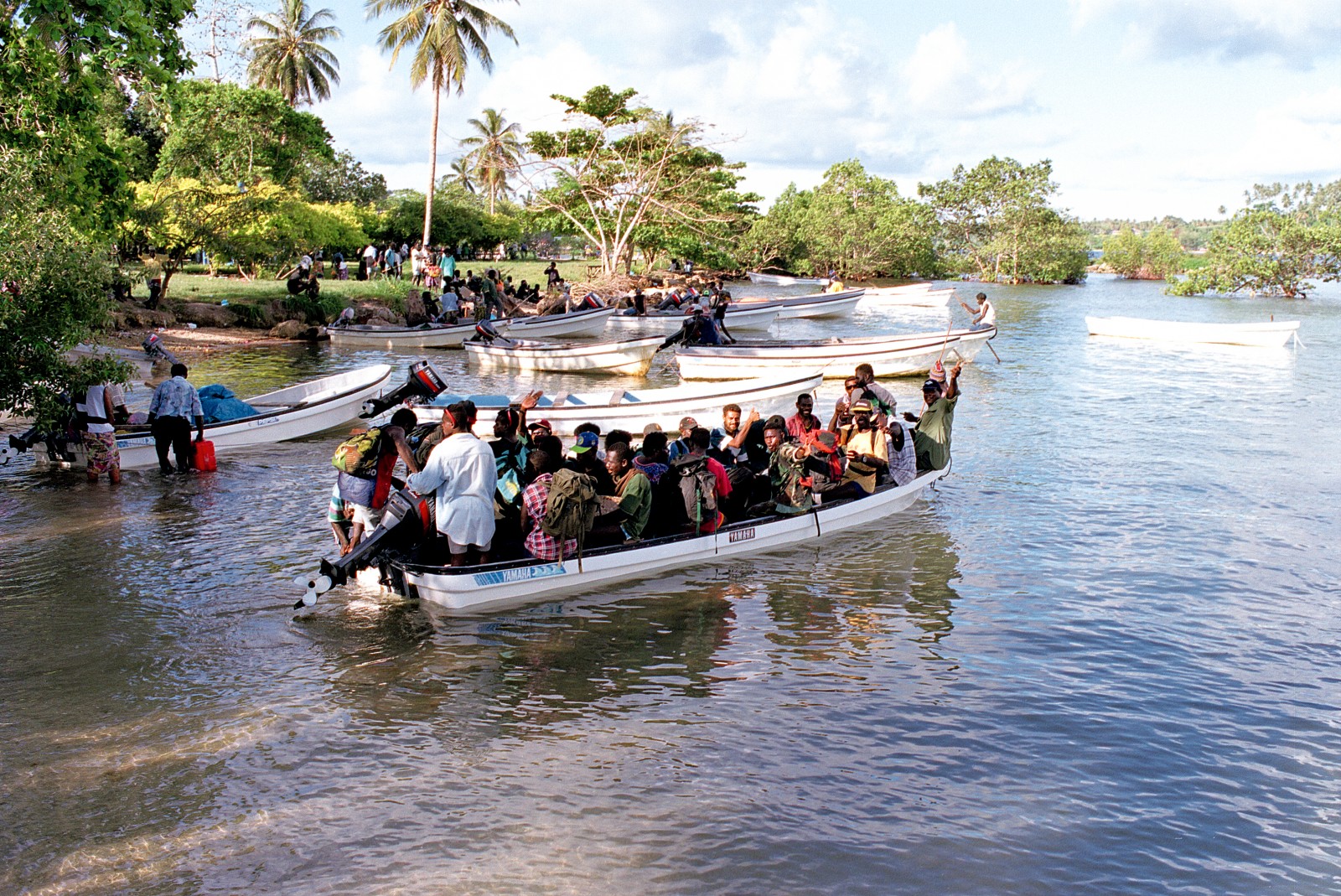
A postcard image of present-day Pacific tranquillity belies the fact that banana boats such as these, ferrying people to and from the Buka market, kept the independence struggle alive. During the war they were used to run the gunboat blockade and to evacuate medical emergencies to the neighbouring Solomon Islands.
From Kiwis in shorts getting things done to new-age empowerment courses, there is a wide range of aid efforts helping Bougainville. But I sensed more than a whiff of irritation as competing aid agencies put baffled villagers through a succession of hoops to justify the obvious. In the words of one senior aid worker, “Asking these villagers to spend a month to work out roles and responsibilities might look good on paper—as if they are being self-empowered—but why put them through it when the question is do they want a water tank or a chainsaw? The communities already have their processes, and we need to respect that structure and not impose some new, irrelevant bureaucratic process when there’s only a limited menu of needs—and, for that matter, help—on offer. Water tank or chainsaw?”
Some agencies hold actual needs assessment courses so that villagers can justify in appropriate language the ongoing sustainability of the pre-existing achieved skills level. Teach a man to prepare an aid application and you feed him for life?
The competitive scrum of good intentions aside, sometimes it is the simple things that count most. The arrival of a plain old lawnmower in Arawa means now the school can host proper sports days as a morale booster and an outlet for tensions—not just for the school, but for the whole town. Sure enough, sports day sees a general movement of people through town, an unusual lightness of purpose. A freshly mown sportsfield. The chance to shout and cheer.
In this way normalcy of a kind returns. There is a threadbare daily market, and down among the burned-out shops a vague sense of hanging out at the mall. Folk wait for the shipments of fizzy drink, ice cream and two-dollar-shop-type merchandise that every so often makes it down from Buka. Be in quick.
*
None of this restoration would have been possible without New Zealand and, more particularly, the New Zealand military, which has supported the peace process with extraordinary professionalism. The army recruitment ads that ran recently on television, in which a mother speaks of the difference New Zealand has made, is a totally authentic statement of our impact and the army’s sensitivity to the needs of the people. The first unarmed Kiwis here broke the ice by teaching local kids the rules of touch rugby, then had a game.
I talk with Kiwi patrol commander Captain Bob Brownlie, just back from a four-day expedition in the mountains. “It was a kind of lifestyle patrol—accompanying medics, making peace awareness presentations and helping with clinics. You see all the mums lining up at the clinics. We get a lot of heart out of that. So many here know about McKinnon and the detail of New Zealand’s role in bringing about this peace.”
Initially the unarmed peace forces were New Zealand-dominated, but for budgetry reasons Australia has now taken over. At one level, the Peace Monitoring Group role is about facilitating communication by transporting leaders to meetings, producing a weekly newspaper—Nius Bilong Peace—and generally keeping isolated villages in touch with one another. But the larger, unseen function is the more subtle act of bearing witness. The world has arrived. Where Bougainville was once in terrible isolation, at the mercy of brutal warring factions and an intransigent central government, now there is a sense of security, where people are free to speak their minds.
This security has allowed the Bougainvilleans to form a fully representative people’s congress, with Joseph Kabui as its president. Unsurprisingly, the agenda is the same as that which fueled the conflict: independence.
Not everyone on Bougainville and the surrounding islands opposed mining or PNG rule. In 1990, residents of Buka, to the north of Bougainville, begged PNG to protect them from the lawlessness and privations they were experiencing under BRA control. PNG obliged, and the provincial headquarters also moved from derelict Arawa to Buka. life on Buka has been somewhat rosier than on Bougainville ever since.
Kabui is determined the mine will never reopen. “We will sell the equipment for scrap. Our priority will be to live in harmony and peace with nature. We can make a good living with sustainable agriculture. Panguna mine taught us a lesson, and we will never have anything like this on our island again.”
Kabui, who until a few years ago had a price on his head, agrees it wasn’t easy to bring people together. “The PNG role was to divide and rule, and, yes, we had clan versus clan, father versus son. This was a grave mistake, and now we have removed the wedge between us. We went about it with open arms and open hearts, and in those first meetings people who would not even look at each other before embraced each other with tears rolling down their cheeks. We decided it would be better to be united for a common vision.”
It was the Bougainvilleans themselves sick of nine years of strife and destruction—who initiated the peace process. And while New Zealand’s input in settling the conflict was crucial, the islanders are under no illusion about who calls the tune in the Pacific—a reality most New Zealanders still try to deny. Says Kabui: “Yes, we understood very quickly that Australia is the superpower, and it is Australia we must convince somehow, that independence will threaten nobody.
“We have our own international lobby now, and it is bearing fruit. The UN is here. Who could have imagined that when you were here, Mark? We will carry on our fight in the jungles of the negotiating table! East Timor is a welcome regional precedent, a welcome wind of change. And if we cannot have a vote about our future in the same way —well, that will be like having a lid on top of a simmering volcano.”
The simmering volcano is already personified in Francis Ona and his followers, up in their stronghold at Panguna, refusing to take part in the peace process. Nor is the wider BRA about to give up its arms. During this visit I was unable to interview Ona. A visiting Chinese motivation expert was giving a seminar on how to be self-sufficient, and the BRA leader was fully occupied. Instead, he sent his roving ambassador to talk with me.
Bougainville has opted for self-reliance rather than soft drinks. While the island may be short on Western comforts, many of its inhabitants consider that having to make do with the simple necessities of life is preferable to living under the shadow of PNG, with whom they feel they have little in common.
Michael Paai Akope, who jointly owned a business with a Kiwi electrician back in the days of the mine, brought a message of no compromise. “We have demonstrated that we are independent. We have survived the hardships of war. We physically won the war. PNG is dead on the island—politically, militarily and economically dead. We want peace, but we will not surrender our weapons while the people who came to destroy us are still on the island. Why should we?
“New Zealand has not done its job if you introduce this peace and then we don’t have a democratic referendum about independence. We can recognise a special relationship with PNG the same as you have with the Cook Islands. We would be happy with that. PNG knows that is what everybody wants, but here they come and want us to become a province again, as if the war never happened. This is an insult. If New Zealand supports the rights of Bougainville to arrive at our own peace process, will they also respect a unified call for independence?”
This remains a central question. There is no doubt that if PNG is allowed to view peace as a pretext for reasserting control, the bloodshed will return. Nor can PNG be expected to act honourably. As one aid worker put it: “If East Timor can have its freedom, then so can Bougainville. We’re here now—we’ve made the commitment, the promise to see this thing through. We can’t let them down.”
*
The day before I leave, I join a convoy of bandsmen, flown all the way from Australia for hearts and minds purposes—the business of cementing trust. The handful of families in the tiny village, when we finally reach it, don’t know what’s struck them. Indeed, there is something deeply incongruous about an army band making like Bob Marley and telling these villagers to “get up, stand up, stand up for your rights.”
The last time these villagers tried that, their homes were burnt down by defence-force troops landed by Aussie helo—or so I discover with a bit of quiet questioning.
Of course, being sprayed with a medley of ersatz reggae, for all its faults, is an improvement on machine-gun fire.
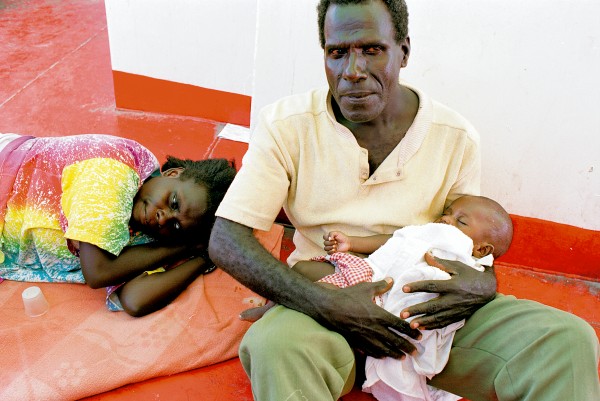
Although the daily horror of war is a thing now only of nightmare, Bougainvilleans still face the long haul of rebuilding their lives and their island. This family on board the local freight ferry Sankamap shares the hope of many: that life in the new millennium will be more assured than it was in the dying years of the old.
Soon the villagers are being led in a conga line in time to an equally ersatz samba. There are a few smiles, a few giggles. Some connection is made at that personal level you find in any village. And then, in the blink of an eye, the Aussies have packed their instruments, their generator, and they’re gone. I want to shout out, “Don’t trust them!” but I realise I don’t have to.
Months later, back in New Zealand, comes the news that PNG has agreed to the creation of an autonomous Bougainville government, with the possibility of a referendum on independence some time later. Perhaps, 10,000 lives on, Bougainville’s long journey to autonomy is nearing its end.
I think of William Peperanu—his pride in the twinkling lights of his mountains and his certainty that he wants no peace that will bind him to PNG. I think of Grace Kerepas, jigging her baby on her knee in the deserted care centre. Think of her dreams to be a nurse, and also her insistence on independence, so that all those lives will not have been lost in vain. And then I hear it clearly: the last dying breath of a young man, a long time ago.