Cascading with unquenchable fury into vast night, the dimly seen Niagara shakes the air with the thrum of its endless arrival. Its cool vaporous breath exhales over the inky water, perfumed by the fragrances of its earthy confinement.
Gripping the ladder’s icy rung, I take another step down into blackness, hesitating just above the rippling surface. The simple elements around me seem newly mysterious—or perhaps it is I who, surrounded by their primeval force, am slipping back into an ancient habit. Perhaps it is inevitable when you get this close to the source.
Above hovers a small rectangle of bleached Christchurch sky below lies its reflection, undulating on the back of gallons of groundwater—among the purest in the world. Soon – it will leave this reservoir and gush from taps across the city to rinse hair, wash cars and fill kettles.
The face and frame of Christchurch City Council’s Bill Aldridge fills the rectangle of light to beckon me up. It is time to go.
*
Driving back to his office, Bill, consumer services manager for the water supply unit, points to sprinklers dousing rose beds under the midday sun and confides one of his chief concerns: “People take this water too much for granted.”
The city gets through 56 million cubic metres a year, 10 to 15 per cent of which goes to industry. Around 40 per cent is used for domestic irrigation, rising to a staggering 90 per cent on a hot summer day as Cantabrians play jets of water on their beloved gardens.
“We have fostered this image of the Garden City, but roses may not be the way to go,” he says. “Our climate is more akin to California than to southern England.”
Now Christchurch, which uses twice the water Auckland does per household, looks like inheriting the problems of California—including running on empty. Bill Aldridge and his colleagues are draining a supply with a finite recharge rate. He worries that the sustainable limit for fresh water extraction may be reached within five years.
Part of the problem is that, to date, the city’s water has been easily won. The first settlers, arriving in 1850, took their water from the Avon River or from the nearest pools in the swampy land that was to be their home. Shallow brick-lined wells were then dug, but it wasn’t until 1861 that a cordial manufacturer sank the first artesian well and discovered “an inexhaustible supply of the purest water.”
The townsfolk realised they had massive reserves of fresh water literally under their feet. For this they could thank the nearby Waimakariri River, which periodically caused sleepless nights by threatening to overflow into old channels that entered the Avon and the Styx. Its very waywardness, a characteristic of plains rivers, had enabled it over the past two million years to lay down vast water-bearing gravel aquifers beneath the present city.
Discovery of the groundwater prompted public and private well-building on a grand scale. A 97-metre well sunk at Addington was claimed in 1890 to be the deepest flowing well in the country.
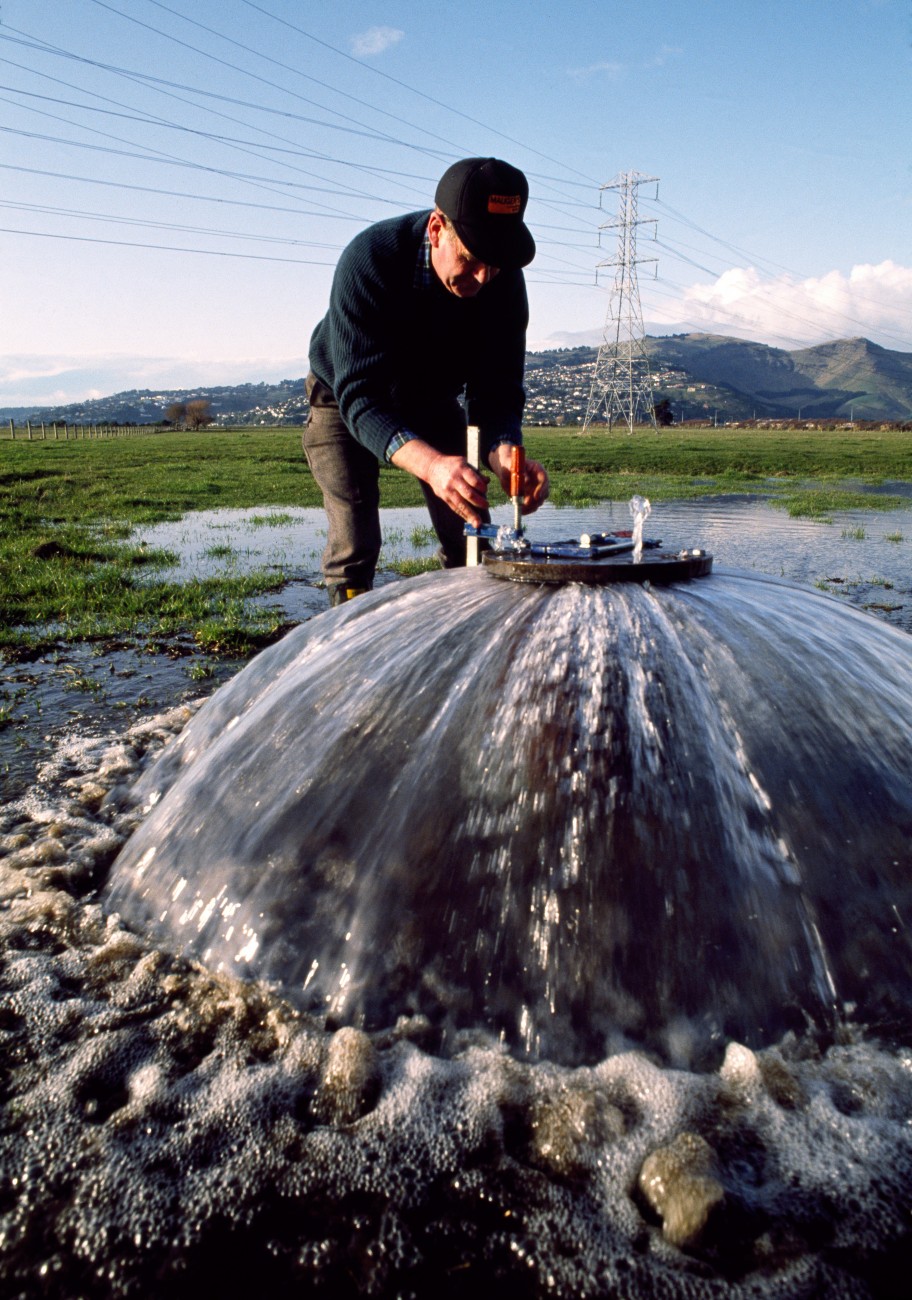
When he left school, Doug Nelson asked his grandfather, an engineer who had worked on the gold dredges, what sort of job he should take up. “Find a job in water,” the canny Scotsman said. “There’ll always be plenty of water in Canterbury.” It proved to be sound advice: Nelson has been servicing wells and pumps in the area for 40 years, maintaining a system which delivers some of the purest water in the world to its customers. The water is drawn from aquifers that are between 20 and 200 metres deep, and some of it hasn’t seen the light of day for 800 years. The deepest water gushes out at considerable pressure-a 150-metre bore creates a nine-metre-high fountain when uncapped.
All told, some 10,000 wells have punctured the ground in metropolitan Christchurch, though digging tailed off as the high pressure network, installed in 1909, spread through the city. Today, a mere one in 5000 households is connected to its own supply, though developers are still inclined to sink private bores for new subdivisions.
Whether private or public, the water comes out of the tap courtesy of a Third World technology—several thousand hectares of it.
“Essentially,” says Bill Aldridge, “the Canterbury Plains is a slow rate sand filter, like the bottom of an enormous fish tank.” Water seeps through this filter at a rate of 5-10 metres per day, and remains underground for as little as 30 or as much as 800 years. Several cubic metres of sand rises with the water each year and accumulates on reservoir floors.
The Plains also constitutes an efficient bacteriological filter. As water trickles through the aquifer the filtration process strips it of organic material, so that few nutrients remain for bacteria to live on. Deep below the surface, bacteria-eating protozoa account for any organisms which do survive, helping ensure a high purity for the largely artesian water.
In the city’s northwest, an alkali is sometimes added to correct for an excess of carbon dioxide picked up from the atmosphere and from naturally decaying vegetation. Not a problem 50 years ago, where it quickly evaporated from household storage tanks, the gas proves destructive in the galvanised iron pipes of modern enclosed systems.
As the only major metropolitan supply that isn’t disinfected, Christchurch’s drinking water is rigorously analysed. The City Council takes 2500 bacteriological test samples a year, and occasional low-level contaminations are almost invariably traced back to reticulation repair.
The people of Christchurch, raised on an unadulterated supply, have developed a keen nose for chemical intrusion. Whenever chlorine is first flushed to waste through a newly commissioned main to purge it of potential health hazards, the phones come alive with citizens who have detected a whiff of municipal meddling in their water.
However, it is chemical pollution of another kind that taxes the minds of the city planners—those of the regional council, who are responsible for managing the groundwater system, and the city council, whose concern is getting the water to the customer. The question they gnaw at is whether stormwater should be filtered into the ground, to eventually find the aquifer, or be piped out to sea.
“Our ultimate disaster would be if a company got hold of a disused gravel pit and dumped the equivalent of agent orange there,” say,, Aldridge. He toys with a phrase to sum up the predicament: “‘We drink our drainage.’ How does that sound?”
The benefit of tapping groundwater is its purity; the downside is this susceptibility to chemical degradation. What is worse, once contaminants get into groundwater, they can be locked in for generations. Some of the world’s reticulation schemes draw on water that seeped into aquifers a million or more years ago.
The watery world we live in
Earth is a singularly inappropriate name for this, the most water-laden planet in the solar system. Perhaps the tag is a way of distancing ourselves from our species’ remote saline beginnings and its more recent amphibian past—an evolution said to be mirrored in the growth stages of every human embryo.
Nevertheless, though we now stand comfortably on dry land, we remain vitally dependent on the life-giving properties of water. Fortunately, there is plenty to go around—at least in theory. If the world’s water were to be divided up equally among its inhabitants, every New Zealander could expect to be inundated with 250,000 million litres of it.
Most, however, would be undrinkable. A mere three per cent of the planet’s liquid reserves is fresh water, and three-quarters of this-30 million cubic kilometres—is locked up in glaciers and ice-caps. Rivers and lakes, the soil and the atmosphere hold a further 0.2 million cubic kilometres. But by far the greatest quantity of accessible freshwater—an estimated four million cubic kilometres of it—flows underground through water-bearing rocks known as aquifers.
Aquifers are recharged by rain, which causes their water tables to rise until they break the surface as springs—usually in low-lying areas such as river valleys. Such springs are the key lo the year-round flow of many streams and rivers which otherwise would dry up.
Water tables are not level. Instead, due to the slowness of its movement through rock, water forms a “head,” tapering away from the high ground where it enters to follow in a subtle way the contours of the land above. And because it is under great pressure it can flow uphill in much the same way that water in a domestic plumbing system does.
Drilling a bore hole into a confined aquifer—one capped by impermeable rock—results in water being forced upward until the pressure in the aquifer is balanced. In an unconfined aquifer, such a level is called the water table. In a confined aquifer it is an imaginary upper zone called the potentiometric surface. Where this lies above ground level, drilling into the aquifer will cause water to rise to the surface unaided. These bores, known as artesian wells, are common in cities such as Christchurch and in many rural areas.
Because groundwater has lain under the surface for a long time—millions of years in the case of some aquifers—it normally harbours no living bacteria. It does, however, contain dissolved minerals which give it a characteristic and often pleasing taste, and distinguish it from river or lake water.
Groundwater is an important and often unacknowledged part of the water cycle, which is all too often depicted as a process where water evaporates from the sea, falls on high ground as rain, then courses through rivers and lakes back to the sea.
In reality, there are two reservoirs: one, salty and vast, the other—spread amongst polar caps, glaciers and aquifers—finite and vulnerable. It is the interchange between the two that helps make life on earth possible.
Though the aquifers serving Christchurch have a less ancient pedigree, their complexity has only recently been understood. Most of the groundwater lying beneath the city has its origins in high altitude precipitation in the Southern Alps. Rain and meltwater is then carried down the Waimakariri River and enters the ground near Christchurch, finding its way into aquifiers of various depths
The key to the groundwater system is the rivers. Most South Island rivers flow over open braided gravel beds and, in flood, swell to ten times their width or more. Hence the need for engineering works like the mile-long bridge spanning the Rakaia River south of Christchurch on State Highway One. Hence also the unparalleled ability of these rivers to feed aquifers.
At present, the interface between fresh groundwater and the sea lies between 15 and 40 kilometres off the coast. If Christchurch draws too heavily on its shallowest aquifer, it risks saltwater intrusion in its supply—Aldridge’s other “great disaster.” Already, the picturesque Avon, which flows through the city’s heart, shrinks over summer because the groundwater from which it springs is being drained for irrigation and a thirsty public. Dry beds in the upper reaches of streams feeding the Heathcote and Avon Rivers, along with falling water levels in city wells, further signal the severity of the problem.
“If this were to continue,” says Aldridge grimly, “we’d have to draw water from the Waimakariri, put it in holding ponds and start chlorinating.”
It is a worst-case scenario that sends shivers down Cantabrian spines, but one Aucklanders have had to live with for years.
Water that sits in the open for any length of time, collecting organic matter, growing algae, and accumulating suspended sediment, is in need of chemical redress. The rain-fed catchments of Auckland’s bush-clad Hunua and Waitakere Ranges are no exception. They channel runoff into a network of open dams, from where it is removed for treatment at filter stations and delivered to the region’s local bodies through 400 kilometres of what are cumbrously described as spiral-welded concrete-lined steel tar-enamelcoated pipes—some big enough, at 1.7 m diameter, to take a small car.
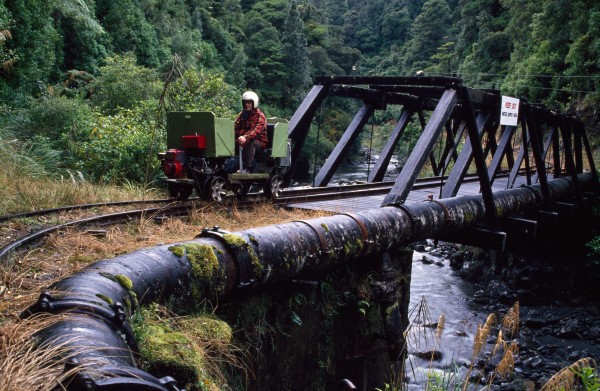
Wellington draws its water from rivers and reservoirs in the hills surrounding the city. At Wainuiomata, caretakers use a private railway to check a pipe that takes water from the Orongorongo River, through a three-kilometre tunnel and into a dam in the adjacent valley. Auckland’s water also comes from a surface catchment, with reservoirs located in the Waitakere and Runua Ranges. In winter, excess water turns the spilllway of the Lower Nihotupu dam in Huia (one of the smaller reservoirs) into a bridal veil of cascading droplets.
If listening to Christchurch’s water specialists sounds like a geology lesson, Auckland conversations resemble chemistry tutorials. And if the southern city can be said to employ a Third World process, its northern cousin has enthusiastically wedded itself to the microchip.
Sitting in the control room of the country’s biggest filter station, Ardmore, in the Hunua Ranges, is like being on a sci-fi film set. Colour monitors display their arcane information amid seeming acres of polished floor, surrounded by impassive banks of switches and wall dials. Ardmore is operated by Watercare Services, formed from the Auckland Regional Council’s water services division, and the first potable water supplier to be corporatised following the restructuring of regional government.
I arrive at the filter station, one of six in Auckland, shortly after 5 p.m. on a Friday evening, and there is an unsettling absence of staff. What if some vengeful urban terrorist were to enter unseen and upend a vial of deadly bacilli into the city’s water?
I am saved further speculation by the arrival of filter attendant Graham Head. Walking out into the still evening, with a fine view of rolling farmland mellowed by the late night, such threats seem remote. The station is more security-conscious than it lets on, I gradually realise, and even if its electronic sensors should fail, the eels and fish Graham points out in the clarifier tanks would probably give early warning of contamination in their part of the system. The fish enter from the Hunua lakes as uninvited spawnings and live out their days in what effectively are enormous concrete aquariums. They are creatures as fitting here as any stray in a factory yard.
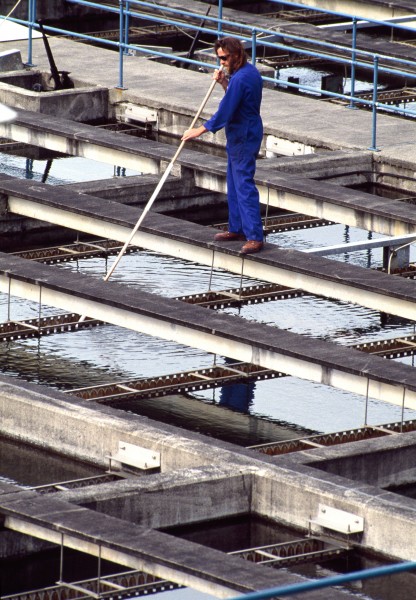
The tanks that house them point up the fundamental function of Auckland’s filter stations. Whereas Christchurch starts with pure water and expends all its efforts on keeping it that way, Auckland begins with what it likes to call “raw” water. This is treated with a coagulating and flocculating agent, aluminium sulphate, which, with the help of polyelectrolyte, drags out the bulk of the water’s suspended and dissolved organic matter. The clarifier or settling tanks, which look like impressively constructed ice trays, decant the water into surface troughs, leaving the floc to be extracted and dumped as landfill.
The water is then strained through sand and gravel filters and mixed with chlorine for disinfection, fluoride for healthy teeth and lime to correct the acidity and render it non-corrosive Finally, the water enters a holding tank where most of the chlorine is dissipated, before it begins its long piped journey towards a tap, and daylight.
The cycle is endlessly repeated 365 days a year, with backflushing of clogged sand filters every 50 hours to mark the passing of time, and delivery of chemicals to alleviate the routine.
“It’s a good life here, no distractions,” says Graham Head, resting his forearms on a safety rail and savouring the night. “You’re just left to get on with things.”
Much of that “getting on with things” is in the hands of WHODAT, the water headworks computer programme. From his city office, Watercare Services supply manager Richard Chandler has access via this system to everything from lake storage levels to daily yield and projected water demand.
As with Christchurch, Auckland water is subject to extensive testing and chemical analysis, but there is perhaps no instrument more sensitive than the one in the mouth of Watercare Services technical water sampler Errol Hamill.
“Water picks up taints very easily, and they can be hard to trace using chemical analysis,” he says. “I can tell by taste whether water has been through a concrete or a metal Pipe.”
When tea became undrinkable at Auckland’s Devonport naval base, Hamill was called in. Helping himself to a glassful, he diagnosed that the water had been sitting in a galvanised pipe. A quick check proved him right. Plumbers installing a sprinkler system had rerouted water through seldom-used conduits.
What about a more subtle trial—picking the difference, say, between Hunua water and water from the Waitakere Ranges? A bashful pause. “I’ve done it in blind tests, but it’s a little hit and miss.”
Unlike regions where underground water is an important source, such as Lower Hutt. Napier, Hastings, the Canterbury Plains and Nelson’s Waimea Plain, Auckland’s delivery system is almost entirely gravity-fed.
While aquifer-sourced water (like Christchurch’s) comes to the surface in a high state of purity, water collected from rivers and rainfall needs extensive filtration and chemical adjustment to remove organic material. unwanted minerals and even living organisms. At New Zealand’s largest filter station, at Ardmore, the processing of “raw” water begins with a dose of aluminium sulphate, a flocculating agent which causes suspended contaminants such as clay and dirt particles, organic matter, bacteria, protozoa, etc to clump together. The water then passes through a series of settling tanks or clarifiers (the station has 83 in all), in which the sediment drops to the bottom and clean water is siphoned off the top.
Thanks to the elevation of the Hunua and Waitakere dams, and a liberal scattering across the isthmus of volcanic cones which seem purpose-built for reservoirs, the system requires a minimum of pumping. Tap pressure is nothing but the tug of gravity.
But what has grown to become New Zealand’s largest bulk water supply network had troubled beginnings. The city’s underlying rock did not yield its water readily, and the shallow wells dug by early settlers, which often became polluted, could not stave off chronic water shortages.
The need for a secure town supply, made urgent by disastrous fires in 1858 and 1863, led to the laying of a 1.5-kilometre pipe from the Domain springs. In the particularly dry summer of 1872, even that source proved inadequate, and locals were forced to buy water from street hawkers. The army tackled the problem in soldierly fashion by firing cannon from Fort Britomart each night in a vain attempt to induce rain.
As an emergency measure, the fledgling Auckland City Council secured water from a private well in Khyber Pass Road, paying the equivalent more than it would fetch a hundred years later. Eventually, after countless military detonations, yet another drought and a bewildering number of aborted relief schemes, the Council purchased Low and Motion’s mill property at Western Springs, present home of the Museum of Transport and Technology.
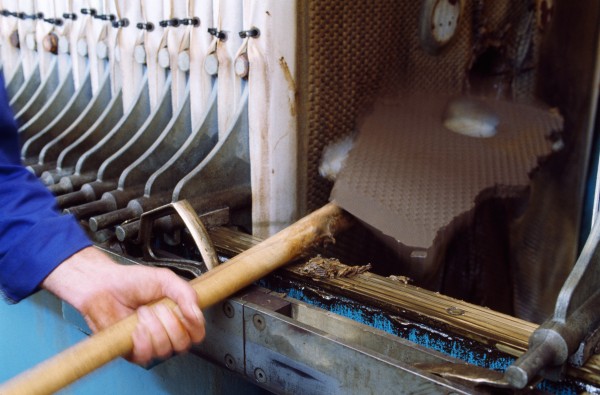
Between five and ten cubic metres of sediment (sludge) is removed from the system each week.
The purity of water from the new source, which was in the vicinity of a refuse tip and nightsoil dumping area, was questioned for many years. Among the fauna emerging from the taps of disgruntled consumers were waterfleas, “insects resembling microscopic shrimps” and “four-inch worms distinctly striped like serpents.”
Nevertheless, the Springs was a major source of city water until dams were built in the Waitakeres in 1901 and 1911, and it served as an emergency supply until 1956. The cast iron rising main, through which water was pumped from the spring to higher ground, still forms part of the modern system.
As populations grow and new uses are found for water—from dishwashers and car cleaning to spa pools and automatic sprinklers—planners are forced to find increasingly abundant supplies. When the Auckland City Council took control of Western Springs in 1875, it had already looked as far afield as the Waikato River. Now, eyes are once again scouring Auckland’s horizons.
A new water supply source will probably be needed early next century. One possibility is a $100 million dam near Kaukapakapa to the north. Another is the Waikato River which, at Tuakau, has sufficient flow to meet the needs of New Zealand’s total population seven times over. Further upriver, at Karapiro, enough water thunders through the hydro station to satisfy three times the country’s total irrigation, agricultural, industrial and domestic water requirements—but pumping water from river to city would be a massive undertaking.
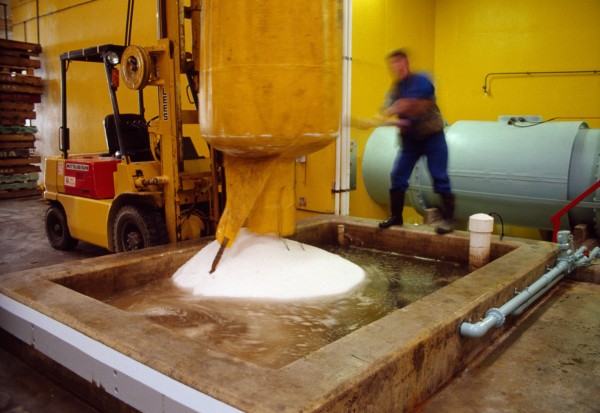
The water is then ready to be chlorinated, killing any microscopic organisms which made it through the filtering stage. The chlorinating agent, sodium hypochlorite, is made on the premises by electrolysing common salt which has been made into a brine slurry.
The rumoured natural store of fresh water under Auckland’s Rangitoto Island is also ruled out at present for environmental reasons, and because, in the words of Watercare Services commercial manager Craig Mcllroy, “there is a degree of conjecture about the amount of water there.”
Before committing the spade to any costly new development, therefore, the Council decided to make the best use of what it had. For Mcllroy, that meant conservation. And the success of its novel public awareness campaign, along with a related technical innovation, has caught the attention of local bodies around the country.
A toast to Adam's ale
An unassuming tasteless, odourless, colourless liquid, water is one of the world’s most mysterious substances. A combination of two gases, hydrogen and oxygen, it is nevertheless a liquid at room temperature, but also occurs naturally as a solid and a gas—the only substance on earth to do so.
Liquid water is a universal solvent, and, given enough time, will dissolve all elements, including gold.
Water has enormous potential strength. It is said that if all the extraneous gases were removed from a column of water, that water would become harder than steel.
Water is also essential for good health. It is present in every cell and is involved in virtually all bodily functions, from delivering nutrients and hormones to helping bowels and kidneys flush out waste.
Health professionals recommend drinking two litres—that’s eight glasses—of liquid each day. Because it is cheap, readily available and doesn’t contain additives like sugar and caffeine, water is the natural choice for fulfilling that intake.
Though drinking water won’t magically make fat vanish, it does remove the extra toxins produced as an exercising or dieting body burns excess calories. Increased water intake also suppresses appetite and helps maintain good muscle tone.
Strenuous workouts can cause much greater water loss as the body sweats to regulate its temperature. The best way to avoid dehydration is to drink small amounts of cool water during exercise, and to continue drinking afterwards.
Those who would lift a glass of something tastier, be warned: alcohol, far from being helpful, actually removes water from the body. The more you drink, the more you need . .. water.
Robert D. Frogg, an energetic and civic-minded amphibian, went public in April 1989, advising anyone who would listen that “drips waste water.” Aucklanders were informed that using a smaller shower head could save up to 10 litres of water for every minute of use, and that a tap leaking at the rate of one drip a second wasted 30 litres a day.
“The payback came more quickly than we thought,” says Mcllroy. “Around 19,000 kids in Auckland now belong to the Robert D. Frogg fan club, and they influence adult behaviour more than we might care to admit—nagging a parent for leaving the hose running when washing the car, for instance.”
By 1990, water use was 3.5 per cent down on the 1988 level, helped in part by a recession which slowed industrial demand. Merchandise featuring the character is helping fund the ongoing campaign.
The public education drive, fronted by the frog, is part of a five-pronged water-saving strategy that Mcllroy claims is the most comprehensive in the world.
Ardmore filter station operates 365 days a year and processes, on average, 240 million litres of water per day. The whole station is monitored by computer (above), and is set up in control modules (below) in which water flow through the filters can be efficiently directed.
Other components included a limited offer rebate voucher for installing dual-flush toilets, and a study to determine whether the introduction of metered water would reduce demand. Results of the study indicated that metered households used a surprising 35 per cent less water than did non-metered households, prompting the Auckland City Council to begin a five-year programme of converting all consumers to metered supply. It is a move Christchurch may well copy.
“We could use a stepped tariff to encourage water conservation—but to do that we need meters,” says Christchurch City Council planning and development manager Errol Young.
The measure, he says, would help educate people who at present place no value on the water they use. Those, for example, who file proposals with the council for swimming pool heat-exchange systems that run large quantities of water to waste.
Part of the problem, concedes Bill Aldridge, is low cost. Cantabrians, who each dispose of around 450 litres a day, get their water for a mere 27 cents a cubic metre.
Autocrats of the table
Early last century, while New Zealand still lay like an uncut gem in the South Pacific, its pristine beauty praised but largely “unimproved” by the work of human hands, Europe’s elite was raising to a new sophistication pursuits it had followed for centuries—among them, taking the cure.
As the decades wore on, antipodean spa enthusiasts became excited by two realisations: first, they discovered, with the aid of scientific analysis, that New Zealand’s natural springs had all the attributes of northern hemisphere spas, and more mineral variety—”from those strong enough to dissolve a galvanised iron bucket to the mildest saline diuretic,” in the words of one guidebook. Second, they guessed that, properly developed, such spas could lure profitable old world clients to the young colony.
Waiwera, the country’s first spa, opened in the 1840s as a house for invalids and travellers, reaching a peak of popularity some 30 years later.
The journey to Waiwera, 50 kilometres north of Auckland, was by steamer, and the novel voyage ended with passengers being ferried to the shallow beach by small boat. The resort’s sulphur springs had long been used by Maori as a cure for skin disorders, a serviceable bath being readily made by digging a pit in the sand where spring water rose, and lining it with branches.
Other spas followed, culminating in the government-managed Cadman Baths at Te Aroha on the Hauraki Plains in 1898, in the Rotorua Bathhouse in 1908, and in the South Island’s Hanmer Hot Springs, first excavated in 1883. Unhappily, a lack of investment capital, too small a population, and an insuperable distance from Europe combined to suffocate the dream of creating great South Sea spas, and the grand buildings gradually succumbed to fire or to rotting decay.
In one respect, though, the impulse to develop spas had fortuitous results: it unleashed a great diversity, a flood almost, of bottled waters. In this, too, the colony was following a European precedent. There, during the sixteenth century, spas such as Carlsbad and Vichy became more famous for their drinking cures than for their baths. In an age when doctors had little access to drugs, the spas came to be seen as natural pharmacies, and roofed pavilions were built to allow visitors to drink mineral waters while promenading.
Chalybeate (iron) waters were prescribed for anaemia—a common affliction among young Victorian women—alkaline waters for dyspepsia and liver disease, and effervescent or earthy mineral waters for stones in the bladder or kidney.
New Zealand’s Kamo Springs, just north of Whangarei, supposedly discovered while a horse was being buried, produced a popular “cooling draught of chalybeate water” which was strongly effervescent.
Waiwera Tonic, marketed as “an unequalled stomachic and appetiser” was sold in North Island hotels. And when the Rotorua Bathhouse opened, water from nearby Te Aroha was sold in its foyer at a penny a cup. This Te Aroha water, the country’s most popular, was advertised as the “autocrat of the dinner table,” though the New Zealand Yearbook of 1913 grudgingly admitted that most local table waters were “so strongly mineralised as to justify the title ‘medicinal’, and almost all contained rather more iron than is consistent with an ideal tablewater.”
This was certainly the case with the water from Puriri, on the eastern rim of the Hauraki Plains. A soda water plant, built in 1879 and set in parklike grounds sporting tame deer and peacocks, shipped water in casks to Auckland for aeration and bottling.
The springs are still there, one bubbling up from soda rock in a field behind the engineering shop run by Moss Smith. When a thirst comes on, Moss’s father Gower still strides out, enamel mug in hand, to draw off a cupful. Squeezing a fresh lemon into the effervescent thirst-quencher, he tells of the barges that would nose up the Waihou River to take on a load of spring water, and of having a preserving jar full of water explode as he carried it home because the lid was screwed on too tightly.
Down the road 15 kilometres lies Paeroa, put on the map when someone hit on adding lemon to its naturally carbonated sweet water—water which had the unnerving quality of turning whisky black.
In 1904, Government scientist Arthur Wollman sniffed, then tasted the clear liquid, comparing it favourably to famous European table waters. Despite a nagging concern about the colony’s passion for tea, and the consequently limited demand for table waters, he suggested it might profitably be bottled to satisfy the Victorian taste for natural soda waters.
So began the life of New Zealand’s best known soft drink which, having been taken over by Grey & Menzies in 1907, was eventually given the lemon treatment and an injection of sugar and caramel colouring. Lemon and Paeroa went on to become the country’s home-grown Coca Cola, a unique flavoursome drink that helped define the New Zealand way of life. It is even possible that an early version of this classic New Zealand drink had just been invented when, in 1886, the first Coke was poured in Atlanta, Georgia.
While no longer using Paeroa spring water, the present L & P bottler, Oasis Industries, claims all the minerals found in the original water are incorporated in the modern soft drink.
Many sources have been tapped to satisfy the country’s demand for bottled water, but perhaps none can rival in importance or volume the spring known as Wai Ariki, “water of the Lord.”
First the Maori, then the early European settlers took advantage of the seemingly limitless pure water flowing from this natural spring in the heart of Auckland. A flue was built to channel water to shipping in the harbour, and in 1845 a factory was constructed over its source in Eden Gres cent by Alexander Wilkie.
The bottler was surrounded by prestigious neighbours which included Government House, Parliament, the colonial secretary, treasury and the surveyor general, as well as officers’ quarters and clubs.
At that time, before reticulated water, Wilkie had a ready market for his products, though with hand-operated machinery and cork-stoppered bottles, output was low.
Even when in 1871 Charles Sutton bought the enterprise, it remained literally a backyard business, with water bubbling up in a sunken barrel shaded by willows.
Three years later, John Grey took over the operation, his sons extending the factory and shipping water throughout the country and even across the Tasman and to the islands of the Pacific.
By the 1890s, the company was despatching four million bottles of aerated water a year, thanks to its prodigious spring. Among its products was soda water, available in bottles and syphons, Te Aroha mineral water and ginger ale.
In 1902, Grey merged with Robert Menzies, a Scot who had pioneered aerated water in Thames. Instead of ordering bottles from England, which could take a year or more to arrive, the new company switched to suppliers in Australia, and, after 1916, discovered a market there for its newly acquired Paeroa water.
Into the 1930s, Wai Ariki was used by Grey & Menzies to make, among other things, raspberryade, lemonade and orangeade. Many mergers and buy-outs followed until, in 1964, the last bottle of L & P rolled off the production line and the Eden Crescent factory was closed in favour of a larger and more modern suburban one.
For collectors like Keith Rusden, who has catalogued the multitude of bottles used over the years by Eden Crescent manufacturers, the site was a microcosm of changing technology and tastes.
Hundreds of patented bottle designs appeared in the last decades of the 19th century, initially from England—the home of carbonated water manufacture—but increasingly from Australia and the United States.
“The name of the game was making money,” says Rusden. “Without a doubt, there was a lot of false advertising.” Thick glass and high kick-ups ensured the bottles held the minimum of aerated water—as little as six mouthfuls in the smaller bottles.
And manufacturers were not fussy about whose containers they used. It was not uncommon for an unscrupulous or desperate proprietor to paste his label over someone else’s expensive embossed bottles.
Nevertheless, in an age of stringent health regulations, uniform plastic PET containers and global brands, the magic of those primitive, unhygienic, weighty and character-filled objects has gone, leaving us, strangely, the poorer.
Like most things, you don’t know what you’ve got till it’s gone. In August 1975, a nor’wester ripped through the city, cutting power and crippling pumping stations. Despite diesel back-up, some homes were without water for up to four hours. “The political flak over that reverberated for a long time,” says Aldridge. With Christchurch’s total reservoir storage equal to an average day’s supply, he calculates that a power loss on a midsummer morning would see the pipes empty by 3 p.m., if there were no restrictions on water use.
And a blistering afternoon on the plains is no time or place to run dry. The day I head for Kaiapoi, 20 kilometres north of Christchurch, to visit the bottling plant of NZ Natural, the forecast is for 21 degrees. By 9.30 a.m. the temperature has already climbed above 25, and the road ahead shimmers. It seems a good time to be heading towards water.
Years ago, Kaiapoi’s river, a tributary of the Waimakariri, is said to have become so laden with whitebait that the townsfolk used it as fowl fodder. Now, however, that remarkable story has been overtaken by the one about the bloke who makes a living shipping the local water to eccentric customers in far-off Germany and Japan.
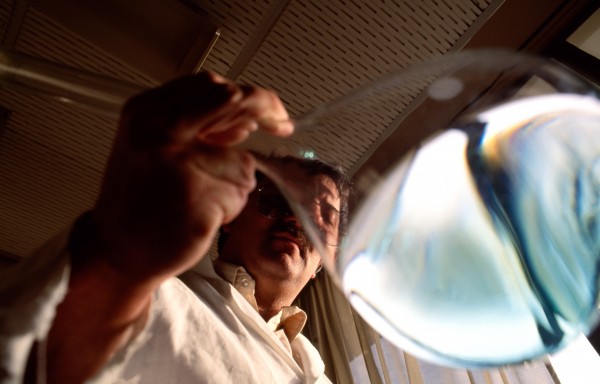
On my arrival, John Macdonald, managing director of AquaSource Holdings, the company that bottles NZ Natural, pours a product or two to lubricate our conversation. The still water tastes crisp, with a slight metallic edge. A second, flavoured, water carries a hint of strawberry and apple.
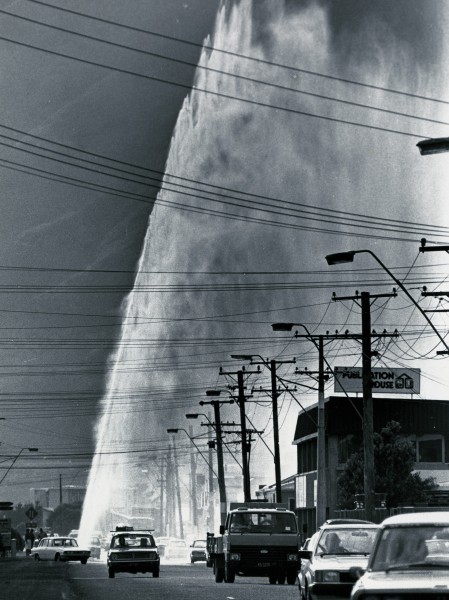
Most city people don’t think about their water supply until something goes wrong. A burst water main in Petone’s main street in 1985 drew everyone’s attention-and showed how much pressure is exerted by the head of water in Wellington’s reservoirs.
The business, he says, grew out of his frustration at never being able to get a decent glass of water when travelling. Public supplies worried him (“I couldn’t put Auckland water to my lips—it was foul, toxic.”) and even the bottled waters did not appeal because they were too highly mineralised.
The first imported waters, Evian (still) and Perrier (carbonated), arrived in New Zealand in 1981—in the same container. Together, they helped create an urban taste for the subtle flavours of mineral water. But to Macdonald it seemed, given the country’s natural advantages—its isolation, its small population and the proximity to Antarctica—that the traffic in water could be reversed.
With the help of a hydrologist, he tested various South Island springs in 1985. North Island waters, flowing through volcanic regions, were dismissed early on as being too highly mineralised. Peat country to the south of Christchurch was also unsuitable, its brownish water tainted with humic acid from the beech forests.
Eventually, Macdonald hit on a spring used since the 1890s by Alexander & Co. to make cordials. In 1987, he took over the family business, selling off the soft drink operation to concentrate on developing NZ Natural, 80 per cent of which is exported.
The company caters for a wide range of tastes, selling still, sparkling and flavoured waters in glass and plastic to Europe, North America, Asia and Australia. The local market, comprising a wide cross-section of the population, but with a bias towards health-conscious women, is equally split between still and carbonated mineral water. Japanese customers prefer still water, says Macdonald, while Americans—brought up on soft drinks—and Germans lean toward the sparkling product.
According to the advertising, NZ Natural “has its origins over the great Southern Oceans near Antarctica,” but pinpointing exactly how the water gets from there to the bottle is less easy. The bottling plant lies in the heart of Kaiapoi, but the bottle label reproduces a scene of an icy river bubbling across tussock land framed by snow-dusted peaks. The foothills of those same peaks are visible from Macdonald’s office.
Pedigree of supply is always a sticking point for bottlers of mineral waters, and one that makes Macdonald edgy—particularly after that favourite White House brand, Artesia Waters, was discovered to come from the same underground source that San Antonio, Texas, uses for its municipal supply. Closer to home, in a survey last year one bottled water with a Marlborough ad‑ dress, but packaged in Auckland, was found to have the chemical composition of “fluoridated, chlorinated reticulated water.” Tap water, in other words, selling at $3.45 a litre.
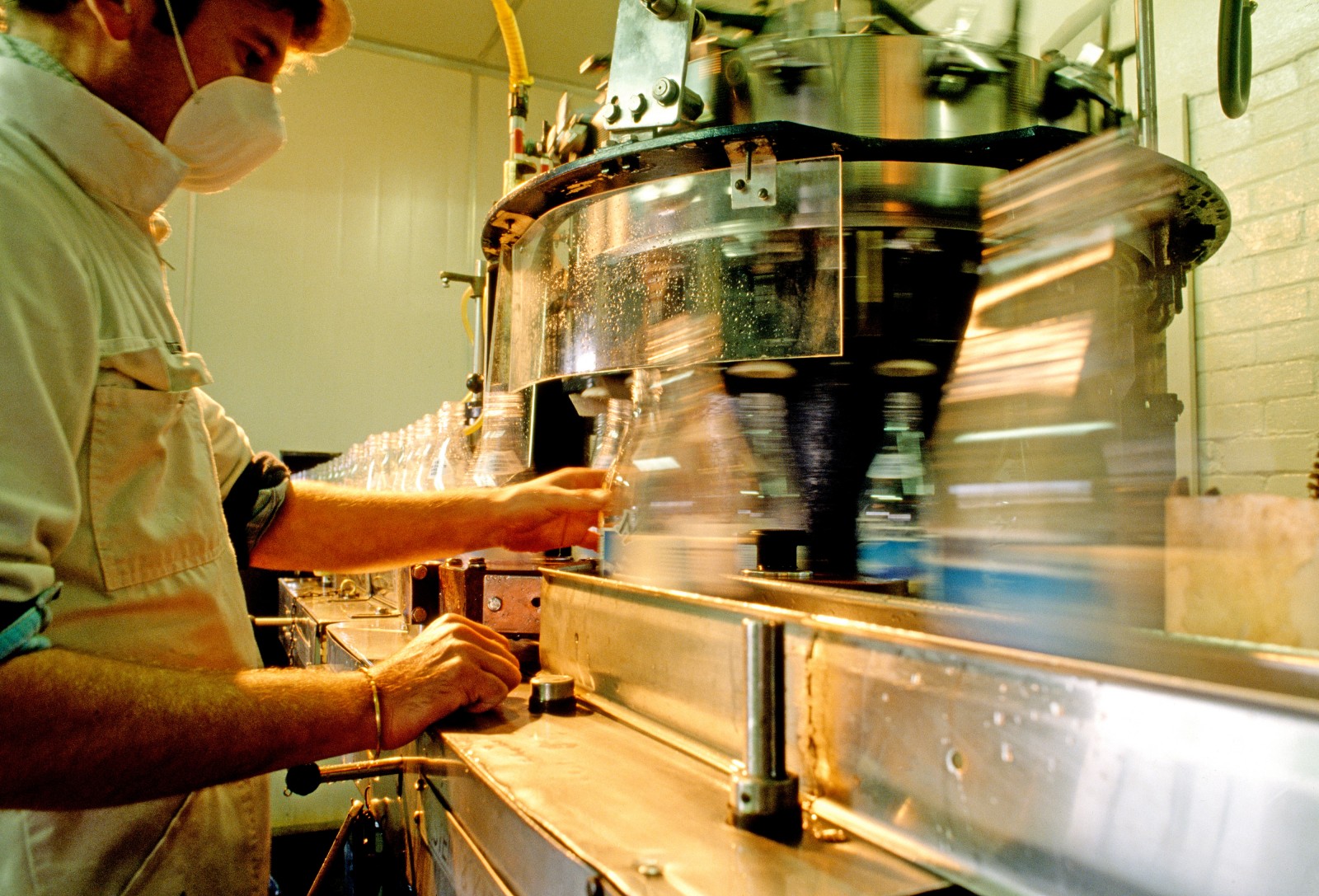
A home-grown alternative to Perrier and Evian rolls off the production line at AquaSource’s bottling plant in Kaiapoi, north of Christchurch. New Zealand Natural, one of ten still and carbonated table waters produced int he country, is drawn from a spring that was used for making cordials in the 1890s.
Macdonald is at pains to dissociate himself from such practices.
“Our water comes from the Alps. It enters aquifers which are trapped between impregnable pans of clay, and stays in those aquifers until it reaches the sea.”
With test records going back to the 1950s, he is confident of the water’s chemical stability.
“That’s important, because as a bottler of water you don’t have alcohol, preservatives, colouring or flavours to protect yourself. Sit a glass of pure water on the bench and see how long it takes to turn green.” Macdonald boasts he has bottles of NZ Natural in storage that are still in perfect condition after four years.
Analysis confirms the success of his hunt for pure water with a low mineral content. Compared with Vichy’s 1,200 parts per million of sodium, for example, NZ Natural contains just 11.4. And while Perrier has a total of 591 ppm of dissolved solids, and Evian 481 ppm, NZ Natural floats in with 91 ppm.
AquaSource, which also owns Waimak, the first of the modern mineral waters to reach local shelves, is not alone in attempting to satisfy the new demand for stylish waters. Among others are:
Fernland, sourced from Tauranga’s Kaimai ranges and bottled in Hamilton.
Westwood, bottled at source in west Auckland.
Zealand Springs, drawn from a source in west Auckland and bottled in Penrose.
Deep Spring, an Australian flavoured mineral water now made in New Zealand from Matamata bore water.
Ch’i, also originally from Australia, now made from Waimauku water and bottled in Auckland’s East Tamaki. Contains flavourings of kiwifruit, honey and 17 herbs.
Cool Spring, sourced in the Waimauku Valley.
While images can mislead—the Auckland-sourced Cool Spring label depicts snow-capped mountains—bottlers often resort to elastic descriptions of their products to overcome legal and commercial barriers. Evian water sold in Britain, for example, is called a natural mineral water. The same water is marketed in the United States as natural spring water. Americans are not keen on mineral-rich drinks. Across the Tasman the forces are economic: spring water is not taxed, whereas mineral water is.
The Europeans make the distinction that mineral water must be bottled at source whereas spring water may be transported to a bottling plant. Confused? Here is a simple guide to testing the waters:
Distilled water is water that has been vaporised, then condensed, and is used mostly for industrial applications. While not containing anything harmful, distilled water has been robbed of any personality. As a consequence it tastes flat.
Mineral water is spring water that naturally contains a certain level of dissolved minerals (in Britain, 500 mg per litre).
Sparkling water is any water aerated with carbon dioxide. Natural sparkling water is spring water treated with carbon dioxide from the same source.
Spring water is water from an underground aquifer which reaches the surface unassisted. It contains no additives, and its mineral content is not altered.
Bottled water is big business worldwide, with estimated yearly sales of US$3 billion. In global terms, the activity of Kaiapoi’s AquaSource, which aims eventually to export up to one million bottles of water a year, looks decidedly small-town when compared with Evian’s celebrated 60 freightcar-loads a day, hauled from a plant on the southern shore of Lake Geneva. But if certain West Coasters have their way, New Zealand will be catapulted into world export ranking almost overnight.
Autocrats of the table
Early last century, while New Zealand still lay like an uncut gem in the South Pacific, its pristine beauty praised but largely “unimproved” by the work of human hands, Europe’s elite was raising to a new sophistication pursuits it had followed for centuries—among them, taking the cure.
As the decades wore on, antipodean spa enthusiasts became excited by two realisations: first, they discovered, with the aid of scientific analysis, that New Zealand’s natural springs had all the attributes of northern hemisphere spas, and more mineral variety—”from those strong enough to dissolve a galvanised iron bucket to the mildest saline diuretic,” in the words of one guidebook. Second, they guessed that, properly developed, such spas could lure profitable old world clients to the young colony.
Waiwera, the country’s first spa, opened in the 1840s as a house for invalids and travellers, reaching a peak of popularity some 30 years later.
The journey to Waiwera, 50 kilometres north of Auckland, was by steamer, and the novel voyage ended with passengers being ferried to the shallow beach by small boat. The resort’s sulphur springs had long been used by Maori as a cure for skin disorders, a serviceable bath being readily made by digging a pit in the sand where spring water rose, and lining it with branches.
Other spas followed, culminating in the government-managed Cadman Baths at Te Aroha on the Hauraki Plains in 1898, in the Rotorua Bathhouse in 1908, and in the South Island’s Hanmer Hot Springs, first excavated in 1883. Unhappily, a lack of investment capital, too small a population, and an insuperable distance from Europe combined to suffocate the dream of creating great South Sea spas, and the grand buildings gradually succumbed to fire or to rotting decay.
In one respect, though, the impulse to develop spas had fortuitous results: it unleashed a great diversity, a flood almost, of bottled waters. In this, too, the colony was following a European precedent. There, during the sixteenth century, spas such as Carlsbad and Vichy became more famous for their drinking cures than for their baths. In an age when doctors had little access to drugs, the spas came to be seen as natural pharmacies, and roofed pavilions were built to allow visitors to drink mineral waters while promenading.
Chalybeate (iron) waters were prescribed for anaemia—a common affliction among young Victorian women—alkaline waters for dyspepsia and liver disease, and effervescent or earthy mineral waters for stones in the bladder or kidney.
New Zealand’s Kamo Springs, just north of Whangarei, supposedly discovered while a horse was being buried, produced a popular “cooling draught of chalybeate water” which was strongly effervescent.
Waiwera Tonic, marketed as “an unequalled stomachic and appetiser” was sold in North Island hotels. And when the Rotorua Bathhouse opened, water from nearby Te Aroha was sold in its foyer at a penny a cup. This Te Aroha water, the country’s most popular, was advertised as the “autocrat of the dinner table,” though the New Zealand Yearbook of 1913 grudgingly admitted that most local table waters were “so strongly mineralised as to justify the title ‘medicinal’, and almost all contained rather more iron than is consistent with an ideal tablewater.”
This was certainly the case with the water from Puriri, on the eastern rim of the Hauraki Plains. A soda water plant, built in 1879 and set in parklike grounds sporting tame deer and peacocks, shipped water in casks to Auckland for aeration and bottling.
The springs are still there, one bubbling up from soda rock in a field behind the engineering shop run by Moss Smith. When a thirst comes on, Moss’s father Gower still strides out, enamel mug in hand, to draw off a cupful. Squeezing a fresh lemon into the effervescent thirst-quencher, he tells of the barges that would nose up the Waihou River to take on a load of spring water, and of having a preserving jar full of water explode as he carried it home because the lid was screwed on too tightly.
Down the road 15 kilometres lies Paeroa, put on the map when someone hit on adding lemon to its naturally carbonated sweet water—water which had the unnerving quality of turning whisky black.
In 1904, Government scientist Arthur Wollman sniffed, then tasted the clear liquid, comparing it favourably to famous European table waters. Despite a nagging concern about the colony’s passion for tea, and the consequently limited demand for table waters, he suggested it might profitably be bottled to satisfy the Victorian taste for natural soda waters.
So began the life of New Zealand’s best known soft drink which, having been taken over by Grey & Menzies in 1907, was eventually given the lemon treatment and an injection of sugar and caramel colouring. Lemon and Paeroa went on to become the country’s home-grown Coca Cola, a unique flavoursome drink that helped define the New Zealand way of life. It is even possible that an early version of this classic New Zealand drink had just been invented when, in 1886, the first Coke was poured in Atlanta, Georgia.
While no longer using Paeroa spring water, the present L & P bottler, Oasis Industries, claims all the minerals found in the original water are incorporated in the modern soft drink.
Many sources have been tapped to satisfy the country’s demand for bottled water, but perhaps none can rival in importance or volume the spring known as Wai Ariki, “water of the Lord.”
First the Maori, then the early European settlers took advantage of the seemingly limitless pure water flowing from this natural spring in the heart of Auckland. A flue was built to channel water to shipping in the harbour, and in 1845 a factory was constructed over its source in Eden Gres cent by Alexander Wilkie.
The bottler was surrounded by prestigious neighbours which included Government House, Parliament, the colonial secretary, treasury and the surveyor general, as well as officers’ quarters and clubs.
At that time, before reticulated water, Wilkie had a ready market for his products, though with hand-operated machinery and cork-stoppered bottles, output was low.
Even when in 1871 Charles Sutton bought the enterprise, it remained literally a backyard business, with water bubbling up in a sunken barrel shaded by willows.
Three years later, John Grey took over the operation, his sons extending the factory and shipping water throughout the country and even across the Tasman and to the islands of the Pacific.
By the 1890s, the company was despatching four million bottles of aerated water a year, thanks to its prodigious spring. Among its products was soda water, available in bottles and syphons, Te Aroha mineral water and ginger ale.
In 1902, Grey merged with Robert Menzies, a Scot who had pioneered aerated water in Thames. Instead of ordering bottles from England, which could take a year or more to arrive, the new company switched to suppliers in Australia, and, after 1916, discovered a market there for its newly acquired Paeroa water.
Into the 1930s, Wai Ariki was used by Grey & Menzies to make, among other things, raspberryade, lemonade and orangeade. Many mergers and buy-outs followed until, in 1964, the last bottle of L & P rolled off the production line and the Eden Crescent factory was closed in favour of a larger and more modern suburban one.
For collectors like Keith Rusden, who has catalogued the multitude of bottles used over the years by Eden Crescent manufacturers, the site was a microcosm of changing technology and tastes.
Hundreds of patented bottle designs appeared in the last decades of the 19th century, initially from England—the home of carbonated water manufacture—but increasingly from Australia and the United States.
“The name of the game was making money,” says Rusden. “Without a doubt, there was a lot of false advertising.” Thick glass and high kick-ups ensured the bottles held the minimum of aerated water—as little as six mouthfuls in the smaller bottles.
And manufacturers were not fussy about whose containers they used. It was not uncommon for an unscrupulous or desperate proprietor to paste his label over someone else’s expensive embossed bottles.
Nevertheless, in an age of stringent health regulations, uniform plastic PET containers and global brands, the magic of those primitive, unhygienic, weighty and character-filled objects has gone, leaving us, strangely, the poorer.
In schemes that rival a bizarre 1970s plan to tow icebergs to the Middle East, and a later one to fill supertankers at Doubtful Sound, two homegrown enterprises want to take some of the ample runoff from their wet landscape and put it onboard ships—in bulk.
Big money often comes from simple things. Okuru Enterprises, headed by husband and wife Ian and Helen Rasmussen, stands to make $32 million a year from customers such as Kuwait if it gets a Department of Conservation nod. That figure would double if it sold all the water covered by rights and consents it already has.
The main sticking point is that a national park is in the way. The Okuru plan originally called for building a weir in the rustically-named Tuning Fork Creek—recently incorporated into the Mount Aspiring National Park—then piping water down to Jackson Bay, the end of the road on that coast. With that possibility of taking water from the Arawata’s alpine tributary ruled out late last year by Minister of Conservation Denis Marshall, the consortium must now look at the feasibility of taking water from further downstream.
Rival company Blackstump, headed by Hokitika cattle farmer Warren Diedrichs, plans to skirt the problem by taking water from outside the park and ducting it to the shoreline. Either project would turn Jackson Bay into the country’s largest port, tonnage-wise. But while the government, rumoured to be in favour of privatising the country’s water, is sympathetic to the schemes, public pressure to protect areas like the pristine southwest is mounting.
That pressure comes from most people’s daily experience of a polluted environment. For many, turning on the tap is confirmation enough that life isn’t what it used to be. The chemical taste of chlorine, and the knowledge that in most places public water is fluoridated, sustains the membership of organisations like the Tauranga-based New Zealand Pure Water Association. A group of what might be called kitchen sink naturalists, these people want nothing more than to be able to turn on their water taps and get, well, water—not be subjected to what they see as indiscriminate and dangerously toxic “medication.”
All municipal water supplies are tested every three years by scientists in Christchurch’s “water group”-a section of the Institute of Environmental Health and Forensic Sciences. One in five fail to comply with Department of Health standards for chemical contaminants of health significance. Often, the samples exceed the 30 parts per billion maximum allowable concentration of chloroform-a byproduct of the chlorination process.
They point out that New Zealand is one of only six countries in the world that fluoridate 40 per cent or more of the national water supply, the others being Australia, Eire, Hong Kong, Singapore and the United States. Most countries, they claim, remain sensibly fluoride-free.
Among the health risks, say fluoride critics, are dental mottling, a decrease in bone strength and a demonstrable link (in experimental animals, at least) with bone cancer. There is no international evidence, they say, that children raised in fluoridated areas have appreciably better teeth than those not exposed to fluoridation. The widespread availability of fluoride from other sources, particularly toothpaste, has encouraged several New Zealand towns and cities to stop fluoridating their water, including Tauranga, Hokitika, Timaru, Twizel and Gore. Hastings, the first city to introduce fluoridation, in 1954, called a halt to the practice in 1991. At present, around 55 per cent of the country is on a fluoridated supply.
In 1992, scientists at the former DSIR’s water laboratory in Christchurch, undertaking a three-yearly national water quality survey for the Department of Health, raised fresh concerns. Their results confirmed that many of the problems associated with drinking water are being caused by the very processes used to treat it.
In one modern plant, says scientist Alistair Sheat, the alum added to remove water cloudiness was actually degrading the quality of the supply. One of the reasons, he believes, is that water treatment has been viewed primarily from an engineering perspective, without taking account of the chemical properties of the local water.
Like the Pure Water Association, Sheat would like to see greater effort spent on improving tap water. Until that happens though, many people are taking comfort from a bottle, or from another recent trend—home treatment. A survey by the Auckland Regional Council found that some eight per cent of households in the city now run their tapwater through a cleansing device.
And it isn’t just urbanites disenchanted with chemicals who are turning to such gadgetry. With 13 per cent of the population relying on private bores, rainwater collection and the like, the threat of contamination is high. Forget the image of some isolated farmlet with crystal clear artesian water, hundreds of miles from the nearest pollution.
True, one of the major pollutants is chloroform, caused—along with other chlorinated byproducts—by chlorination of urban supplies to disinfect them. But the rural heartland is equally at risk, as fertilisers, pesticides and animal waste increasingly leach nitrates and other potential contaminants into the surface waters and groundwater.
Peter Pettigrew, managing director of treatment company Contamination Control, favours non-chemical ultraviolet treatment for water serving rural communities. Assuming harmful dissolved solids have been removed, exposure to ultravioet radiation disinfects water without leaving residues, says Pettigrew. It is, he claims, the process used by mineral water bottlers to ensure their products remain clear and free of living organisms.
But the desire for purity can be carried too far, says Pettigrew. Domestic attempts to forcibly remove all minerals from drinking water fall into the category of what he calls “the Mrs Ogmore syndrome” after the germ-obsessed widow of Dylan Thomas’s Under Milk Wood.
“If you strip everything out of the water it becomes incredibly aggressive. It will suck the lead out of brass alloy fittings, leaving you with worse water than you put in. Rainwater is so soft and aggressive that you shouldn’t take anything more out. It isn’t good for the body.”
Sceptics say they have heard such talk before, but have never seen evidence to back up the claims. However, bottler John Macdonald retells the story of a viaduct in Haast crumbling because local water—arguably the purest in the country—leached lime from the concrete.
Pettigrew admits that naturally occurring minerals can cause problems. Wanganui has notoriously hard water, he says. Whenever it is heated or frozen, calcium and magnesium deposits accumulate, and as a result water cylinders burn out.
Further north, people in the Waikato have what Pettigrew calls “diabolical iron problems.” The iron, which can occur in one of four forms, makes treatment far from straightforward. The situation is aggravated by the presence of manganese, a mineral widely occurring in New Zealand water.
Pettigrew leaves off talking. His eyes wander around his company’s showroom, taking in the filters, the purifiers and the complicated devices for ultraviolet treatment. I am reminded of one manufacturer’s boast that its equipment was “developed for space flight,” and of the heated debate over medicated water. Of pure water’s tendency to act like a wet magnet, and of the phenomenon of waters from distant lands ranged like beauty contestants on supermarket shelves, their transparent hearts indistinguishable under the fluorescent lighting.
“The more you know about water, the less you realise you know,” sums up Pettigrew.