To board a flying boat was to enter a world as rarefied as that of the Orient Express or Graf Zeppelin. These elegant, ocean-going aircraft—Empires, Clippers and Solents—were synonymous with fast, comfortable and stylish travel to exotic destinations. Pioneers of the passenger airways, they opened up routes around the globe, and enabled New Zealand to stake a claim in the business of international air travel.
Shortly before dawn a motor launch carried us across the dark, calm water to our aircraft, riding at a buoy with its portholes lit. There were lights burning in the cockpit too, high on the upper deck where the captain, a grizzled, white-haired man, sat drinking tea with his officers.
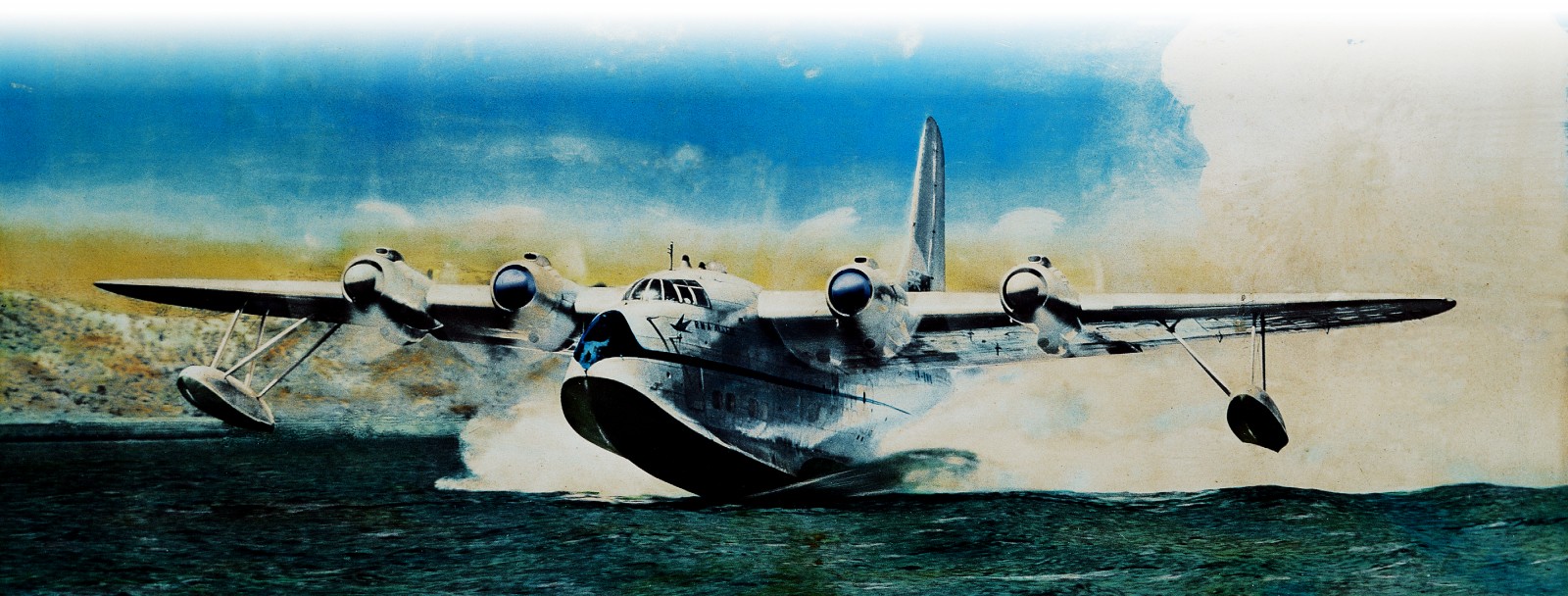
“As the launch driver cut the engine I noted the name Coriolanus painted on the Empire’s massive tugboat nose and, further back, the words ‘Qantas Empire Airways’. . . . We drifted beneath a high, broad wing that hid the paling sky and fading stars. Our wash sucked lazily at the flared keel and giant portside float, secured to the wingtip by a cat’s cradle of wires and struts. Clambering through a low doorway with a curved lintel I sniffed a faint, heady tramp steamer aroma of coffee, grease, paraffin and candlenut which I took to be the smell of the sky itself.”
The place was Rose Bay, Sydney; the date, December 1946. Years later, while chief travel correspondent of the Observer, Alexander Frater would write about this experience and the lifelong infatuation with air travel it sparked in his book Beyond the Blue Horizon. Then, he was an awestruck eight-year-old boy about to fly for the first time.
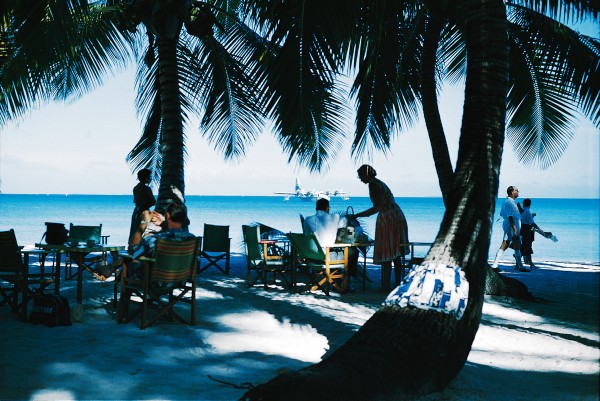
Tasman Empire Airways’ crowning achievement was the all-first-class Coral Route, and the brightest gem on that exotic journey was uninhabited Akaiami, in the Cook Islands. Here, passengers relaxed by the lagoon while the flying boat was refuelled and coconuts, which might puncture the hull, were cleared from the runway.
Frater was fortunate. The Empire flying boat that took him and his family to Fiji to start a new life belonged to an era of aviation which was coming to an end. Airlines were replacing their “ships of the air” with more economical landplanes. The 21-tonne Empires—state of the art when they first flew in 1936—were nudging retirement.
Many were sad to see them go. With their pleasingly flared chines and uncluttered aerodynamic hulls, they were creatures of considerable beauty. Afloat at their moorings, and with their towering flush-riveted sides and shiplike portholes and hatches, they evoked the luxury and the exotic sense of theatre of a Cunard liner. The Empires, built by British shipbuilders-turned-aircraft-makers Short Brothers, offered unstinting comfort on two decks with a promenade, sleeper accommodation, a restaurant and bar, and all at up to 320 kph—the speed of contemporary fighters.
With these aircraft, Imperial Airways and its sister company Qantas Empire Airways spun the long red thread of the antipodean air service that wound its way across the globe from London to the South Seas.
For New Zealand, this golden age of fast, pampered travel to distant lands, which would give the country its first taste of an intimate connection with the world, began on St Patrick’s Day, 1937. In Alameda, California, on March 17, an ungainly twin-tailed Sikorsky S42B flying boat thundered off the water and headed south over an uncharted route that would take it to Honolulu, Kingman Reef, Pago Pago and, finally, Auckland.
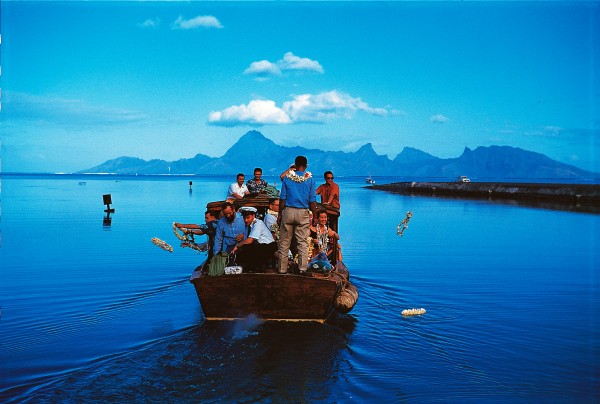
In Tahiti, the quintessential island paradise, departing passengers cast their lies from the launch as it bore them to the sequestered comfort of their cabin.
On board the Pan American World Airways’ survey craft Pan American Clipper II were the airline’s chief pilot, Captain Edwin C. Musick, and six crew. Their job, after three years of planning and negotiation, was to survey a commercial air route between the United States and New Zealand, testing the accuracy of navigation techniques, the safety of refuelling stops and the suitability of the Sikorsky for the 11,000 km voyage.
Shortly after takeoff they sighted the Electra piloted by Amelia Earhart, at the beginning of a solo round-the-world journey which was to end prematurely with a crash on takeoff in Hawaii. They themselves were delayed for five days at Pago Pago by a hurricane.
On March 29, crowds gathered at vantage points around the leaden-grey waters of Auckland’s Waitemata Harbour to welcome Musick’s Clipper. At 4.43 P.M. word came from the Auckland Harbour Board’s signal station on Tiritiri Matangi Island that the aircraft had just passed overhead.
After a circuit up the harbour, Musick took the Sikorsky east and banked again just off Orakei. “Lower and lower she came, her four propellers just turning over,” wrote a Weekly News eyewitness. “Off the end of the tide deflector her shadow appeared on the water below her and then the lowest point of her keel neatly broke the surface. In a moment she was afloat, gradually losing way as a white wave foamed up on either side of her hull.”
The journey was over, the symbolic connection made.
Onlookers, too caught up in the moment to cheer, silently followed the action: the rapid dash forward of two shepherding air force launches, the gentle rock of the Sikorsky’s brick-red wings, the dip and rise of its floats.
A man in white appeared at one of the hatches and took a rope which had been rowed out from the mooring pontoon. As he did so, a workplace siren somewhere ashore sounded the five o’clock knock-off. It was a fitting salute.
Over the course of 12-and-a-half days and just under 50 hours of flying time, Captain Musick and his crew had signalled the end of New Zealand’s isolation, opening up speculation on what the emerging technology of flight held for life in these remote islands.
The issue of the Weekly News that reported Clipper’s arrival gave its front page over to exploring the possibilities of a transTasman service. The paper’s aviation specialist, Leo White, asked what had become of plans to use the giant Empire flying boats to bridge the Tasman—and so, finally, to link New Zealand to the long line reaching back to Imperial’s English base. It was known that Union Airways—an offshoot of the Union Steam Ship Company—and several Australian operators had been exploring a Tasman service, but for White the real question was: landplane or seaplane?
Flying boats might be necessary on long ocean voyages such as that pioneered by Musick, but for crossing the “Ditch” one of the big multi-engined landplanes then being built in Britain or the United States would, in White’s view, prove more economical, and would enable all-weather departures. Given that neither Auckland nor Wellington had a suitable airport, argued White, the landplanes would use those at Palmerston North or New Plymouth, with feeder flights from Auckland and Dunedin.
It was a bright and sensible vision, but one which was somewhat undermined by the accompanying illustrations showing an artist’s rendering of the airliner of the future. The craft was a gigantic flying boat consisting of two towering and streamlined pontoon hulls with wrap-around windows supporting a single wing of vast dimensions.
The artist had drawn the flying boat moored alongside a busy wharf. The thing was so big that automobiles being winched up as cargo through flaps in the wing were dwarfed to insignificance. A cutaway diagram revealed a smoking room, a promenade, an upper gallery, a baggage reception hall and even a stowed auxiliary aeroplane complete with catapult—the whole ensemble being something of a loadmaster’s nightmare.
As fate would have it, the artist, not the writer, was closer to the mood of the politicians, and an unswerving focus on flying boats was to dominate aviation policy for the next two decades.
The New Zealand government had fought long and hard to “close the loop” by extending the Empire route across the Tasman and by encouraging an air route to the United States. A conference the previous year in Wellington had, under pressure from Britain, decided in favour of flying boats.
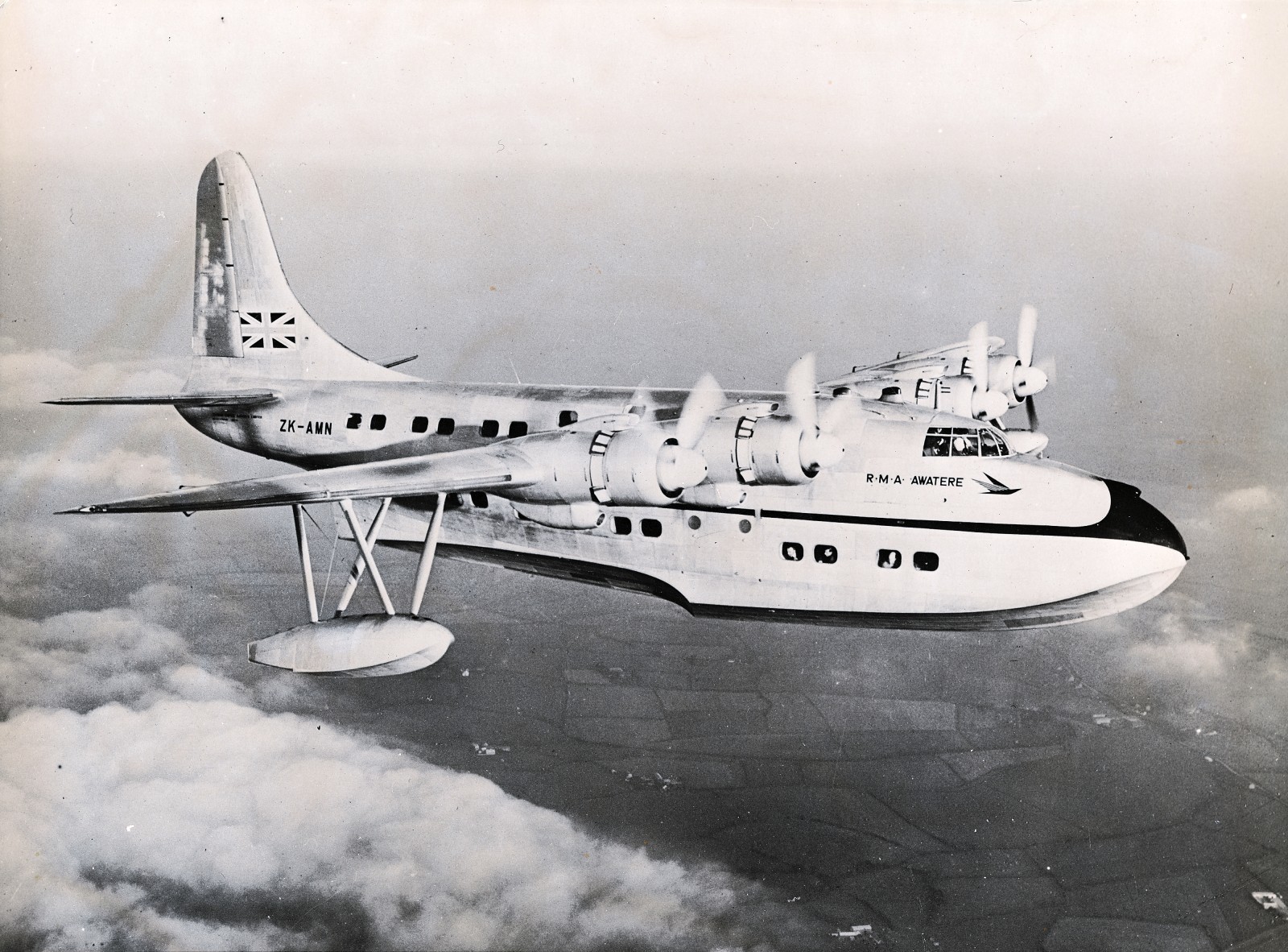
A journey by flying boat was as memorable as the destination. The eagerness, tempered by trepidation, with which many passengers approached the event; the irresistible sense of chick exclusivity; the thrill of landing and taking off—such a potent mixture was sure to beguile all but the most seasoned traveller. To be borne aloft in a MK IV Solent—the Aotearoa II, Ararangi Awatere or Aranui—was to enjoy matchless standards of passenger comfort and in-flight service.
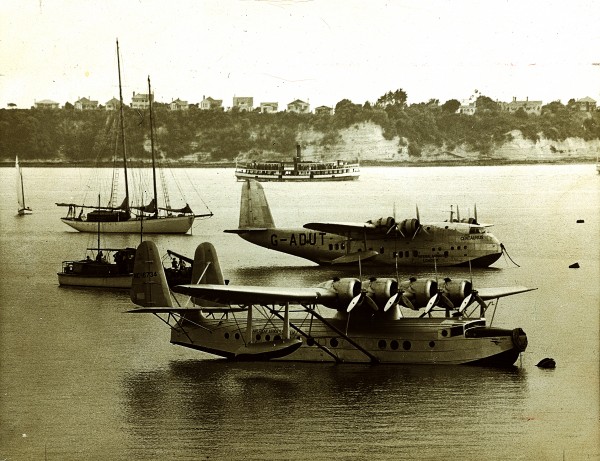
On December 27, 1937, the Imperial Airways flying boat Centaurus, piloted by expatriate New Zealander John Burgess, touched down on the Waitemata to a gala welcome. It was a Short Empire, busy surveying a new air route from Britain. On arrival, Burgess taxied in and moored alongside Musick’s Samoan Clipper, which had landed the previous day on another Pan American survey flight. The two craft floating on the sparkling Waitemata hinted at the future significance of Auckland as an international air junction.
Centaurus had crossed the Tasman in a mere 9 hours 10 minutes, averaging 212 kph and trimming 1 hour 20 minutes off Jean Batten’s 14-month-old record. The Australian prime minister, Joseph Lyons, took the opportunity to observe that Burgess’s flight had drawn New Zealand four hours closer to Australia than Tasmania was by fast steamer.
Since 1928, when Charles Kingsford Smith first crossed the Tasman in his Southern Cross, people such as White had savoured the idea of a regular air service connecting the two countries. Eventually, however, it became obvious that private initiatives would get nowhere. In 1934, the New Zealand government rejected a plan by Charles Ulm, who had made the historic crossing with Kingsford Smith, which would have seen his Great Pacific Airways connecting Australia and the United States via New Zealand. Smithy’s proposal for a route linking Australasia with Fiji and Hawaii using Sikorsky flying boats was likewise dismissed Soon afterwards, both aviators were killed in air accidents, leaving the arguments over the best way forward to large, well-muscled companies.
Eventually, an agreement was hammered out by the Australian, British and New Zealand governments. A new company was to be formed, exclusively operating British aircraft on a Tasman route which would connect through to England and create, at 23,000 km, the world’s longest air route. The company, jointly owned by the Union Steam Ship Company, the New Zealand government, Imperial Airways and Qantas, was to be known as Tasman Empire Airways Limited (TEAL).
Securing the aircraft seemed the most straightforward part of the venture. A new 19-passenger long-range version of the Empire flying boat, the S30, had been developed for the Atlantic crossing, and Imperial took three on behalf of TEAL, employing them elsewhere until the infrastructure in New Zealand was ready.
Meanwhile, a breakwater and workshops were built at Mechanics Bay, on the Auckland waterfront, which was to be the New Zealand terminal. The bay itself was dredged, moorings dropped and a U-shaped pontoon built for passengers to step onto once the flying boat had been towed in, tail first.
When the terminal building, a neat white single-storey structure housing check-in counters and customs areas, was finished, Wings magazine wryly noted: “Auckland is probably one of the few places in the world where an important airport has smaller overall dimensions than some of the aircraft that use it.”
The first S30, Aotearoa, made a record Tasman crossing of seven hours 48 minutes, arriving out of thick mist on August 28, 1939. The pilot had been assisted by the new Musick Point radio station, built near Howick, in East Auckland, to communicate with aircraft in the South Pacific and named after Edwin Musick, who had been killed seven months earlier when his Samoan Clipper exploded in midair after leaving Samoa.
On the delivery flight was 22-year-old Gerald Brown, now retired in Auckland, but at the time an autopilot specialist for the British instrument maker Smiths, and aboard to see how a newly designed autopilot performed.
Six days later, Brown was sitting in Auckland’s Waverley Hotel when over the radio he heard Neville Chamberlain declare war on Germany.
“I thought hello, hello, they’ll want this aircraft back,” says Brown, running a finger over his close-cropped moustache. “They didn’t, though. And we got the second one six months later.”
In fact, only strenuous persistence by acting prime minister Peter Fraser secured that second boat, the Awarua, enabling scheduled Tasman services to begin on April 30, 1940. The third aircraft, the Australia, was badly damaged in Iraq on its delivery flight, and, when repaired, was kept in Britain.
New Zealand was ushered into the world of international air travel by Captain Edwin Musick (above), whose survey flights in a Sikorsky flying boat (here anchored in the Waitemata, with John Burgess’s Empire-class aircraft Centaurus behind) mapped out a route from Auckland to San Francisco.
The Awarua was brought out by Scottish skipper Oscar Garden on what was to be the last civilian flight over France for the duration of the war. Garden, who spent much of his early life in New Zealand, had begun his flying career in spectacular fashion by spotting a secondhand biplane in a London department store and trading in his car for it, there and then. He was later to become TEAL’s chief pilot.
The significance of having two aircraft with international capabilities soon became apparent. With the outbreak of war, the fast liners used in regular shipping services were quickly pressed into service as armed merchantmen or hospital ships. For nearly two years in the darkest days of the war the Empires were New Zealand’s only regular means of communication with the world, carrying priority passengers to Australia and, importantly, international airmail. They also flew diplomats and others on war-related missions as far as Hawaii and California and, equipped with bomb racks and gun turrets, carried out maritime reconnaissance in New Zealand waters.
Three months after Teal’s Tasman service began, Pan American reopened its San Francisco-Auckland route—closed since the death of Captain Musick—flying the roomy new Boeing 314 clippers.
In September 1941, American journalist Hallett Abend caught the Auckland-bound clipper on the first leg of a whistlestop tour to report on preparations for the defence of the Pacific. Among his fellow passengers were importers and exporters, manufacturers of war materials, an army captain on some mysterious mission, the young American wife of an Indian maharaja (travelling with courier and strongbox full of cut rubies and emeralds) and Peter Fraser, who by then had become Prime Minister and who was on the last leg of a round-the-world trip. It was just the exotic mix that was to become the hallmark of civilian flying boats in the Pacific.
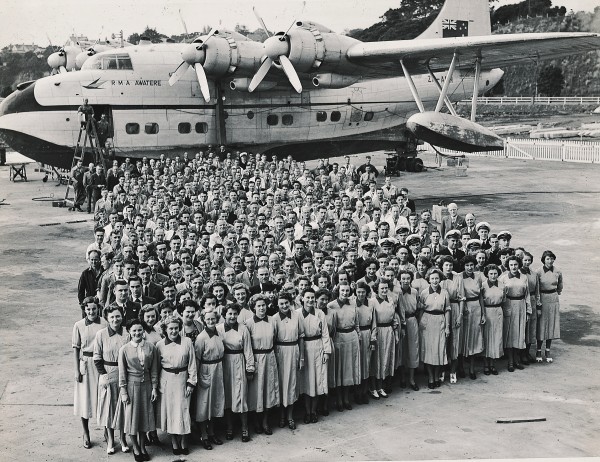
In TEAL’s early days, mail took priority over passengers, who would sometimes be left behind in favour of bulging canvas bags. The initials RMA—Royal Mail Airliner—before the name of each TEAL’s flying boats reflected the importance of contracts to carry mail in financial balance sheets of early airlines.
Abend’s prose was equal to the poetry of the flight. In the book of his travels, Ramparts of the Pacific, he painted a word picture that would warm the heart of any airline publicist:
“Highballs and dinner, black coffee and cigarettes, bridge and small chat with strangers—the petty habits of modern man carried higher into the moonlighted heaven than the top of Mount Olympus, where man once thought the high gods dwelt in majesty and power . . .
“The night was too beautiful for sleep. My berth was in the curve of the belly of the plane, and two large windows permitted me to look down upon the billowing silvered clouds . . . For a time the shadow of the plane upon the silver cloud bank below was sharp and clear, and later the tumbled masses of mist seemed to be hurrying eastward with breath-taking speed.
“Once I got up, stepped into slippers, wrapped myself in a long Chinese silk gown, for the air in the clipper was fresh and cold, and went to the smoking room for a cigarette and a cup of hot black coffee with some of the officers and members of the crew.”
Three months after Abend’s flight the Japanese attacked Pearl Harbour, and with America at war Pan American’s flying boats once again left the South Pacific, never to return. At one point the Awarua, carrying finance minister Walter Nash on a secret return flight from Honolulu, was fired at by a wary American carrier-based fighter. A civil ensign hurriedly pushed through one of the flying boat’s hatches satisfied the American pilot, but not before a warning shot had punctured one wing.
Flying boat captains such as Ian Patterson (seated at the front) needed many skills besdies those normally demanded of a pilot. They had to be able to navigate over the open ocean and, due to the low altitude at which they flew, to skirt around any bad weather they ecountered.In April 1950, TEAL celebrated 10 years of scheduled services. The following year, the company was awarded the annual Cumberbatch Trophy by the Guild of Air Pilots and Air Navigators for “outstanding contributions towards maintenance of safety in the air.
The war intruded less to the west of New Zealand, where mostly, but not always, crossing the Tasman was as routine as a ferry trip. Maurice McGreal, who flew TEAL boats for years, set down the vital, if primitive, navigation routine in his autobiography A Noble Chance:
“Soon after takeoff the second officer climbed from the right-hand seat and spread the big chart of the Tasman on the navigation table, took a few sharp pencils, his parallel rule and Douglas protractor and pushed the drift recorder through the hole in the side of the aircraft. He was ready for the day’s work.
“Navigation was all dead reckoning and ‘drift crawling’ supported by sun lines and bearings from long-range shore stations . . . The radio officer would bang away on his Morse key to a group of three shore stations, then hold the key down. After a minute or so back they would come with good plottable bearings. On other occasions he would rotate the big loop aerial that sat above the upper fuselage, its operating wheel almost as big as my car’s steering wheel, and with careful skill he would take a bearing on a shore transmitter . . .
“His main routine, though, was the sending of hourly position reports together with weather data observed by the skipper, who sat through his long watch maintaining a progressive sketch of the cloud formations over, through, or under which we passed. Some skippers were good artists and drew a truly Picasso-like representation.”
But the notorious sea below them could, in the words of greybeard flyer Francis Chichester, be “a dirty stretch of water, breeding a vicious type of young storm.”
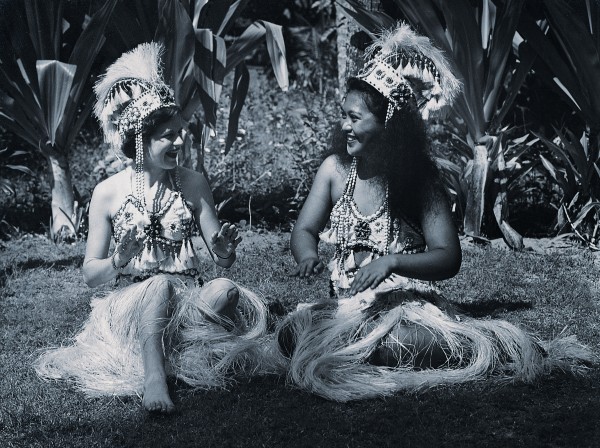
Going native? What will people think? In Tahiti, Coral Route stewardess Jean Stanich aroused the displeasure of TEAL management when she swapped her uniform for something a little more exotic. To market the route, however, TEAL had no compunction about using a naked female figure to embody the romantic allure of the islands.
Gerald Brown was soon to know all about Tasman storms. A frequent passenger on the Empires with both Burgess and Garden, Brown vividly remembers his second return flight from Australia. Delays had for the first time forced a night departure, and an hour out of Rose Bay they struck violent weather.
“There was a lot of crashing and so much electrical disturbance that the instruments were useless,” says Brown. “I asked the radio operator how we were doing. He looked at me in exasperation and said, ‘How the hell would I know?” The navigator, sitting gloomily at his work table, could offer nothing more encouraging.
Those daring young men
On the foreshore of Auckland’s Mission Bay, not far from the site of the old flying boat terminal, stands an easily missed sundial plinth, set in place by Tasman Empire Airways to salute the company’s first scheduled passenger flight from the harbour in April 1940.
The squat monument also marks the headquarters of the New Zealand Flying School, an institute of plucky enthusiasts that did much to boost marine aviation early this century.
When brothers Leo and Vivian Walsh started their school in 1915, the bay—known only as an extension of nearby Kohimarama—was an isolated tract of farmland best got to by ferry. A summer haunt for holidaymakers keen to net piper or splash about in modest woollen bathers, its inhabitants soon grew accustomed to the pre-dawn squeal of iron wheels as the homebuilt Walsh flying boats were pushed on trolleys out of their sheds and down specially laid railway tracks into the tide to begin the day’s work.
The Walsh brothers had been among the first to seize on the possibilities opened up by those more famous brothers, the Wrights. A mere seven years after Kitty Hawk, Leo and Vivian uncrated a kitset aircraft they had ordered from the United States. It was a Howard-Wright biplane, similar to the one that made history in 1903.
At a private racecourse in Papakura, with a marquee for a workshop, they painstakingly assembled the packaged wire, wood, linen, pipes and engine into something the prime minister, Sir Joseph Ward, was pleased finally to christen Manurewa (“flying bird”) No 1.
On February 5, 1911, clad in heavy jersey and topcoat, his cap flamboyantly twisted back to front, and with a teddy bear mascot tied to a wing strut, Vivian coaxed the machine into the air. When, 400 metres later, he turned and glided to a gentle touchdown, spectators cheered the country’s first successful powered flight.
Fellow enthusiasts later wrote off the Manurewa in a heavy crash at Grey Lynn, but by then the Walsh brothers were busy on a new project—designing and building the southern hemisphere’s first flying boat. On New Year’s Day 1915, having modestly and in the dead of night carried wing parts across the Hobson Bay sewer line to Orakei, to where the hull had earlier been floated, they put the thing together and successfully tested it.
A surprised New Zealand Yachtsman reported: “For some time past there have been rumours of a strange craft which has been seen on the lower end of the harbour, and last Sunday was seen manoeuvring around when many of our yachts and launches were returning from their cruise. This strange craft, which was said to do over 50 miles per hour, turned out to be a flying boat.”
Though underpowered, it went on to some impressive flights, and later that year the brothers began training pilots to fight in the European war. By war’s end, 110 pilots had learned to fly through the school.
Soon the Walshes moved to the old Selwyn Mission House near Kohimarama, fashioning hangars from packing cases supplied by their principal backer, the American Reuben Dexter, who held the Auckland Cadillac franchise. Tents were pitched nearby for students, and over the next few years the school accumulated an assortment of seaplanes—Caudrons, Avros, Curtiss flying boats, DH9s, a Supermarine Channel—all endlessly repaired, rebuilt or modified.
Among the early aircraft were two imposing floatplanes from a Seattle-based newcomer to aviation, lumberman William E. Boeing. The Walsh Boeing & Westervelts that flew out of Kohi were said to have been the first aircraft made by the United States company.
was absolutely essential to carry a sea anchor, for the main floats were rounded off downward at their after ends and if you stopped the engine in a wind of more than 20 mph the aircraft would drift backward, water would run up over the top of the floats and the machine would start to go over onto its back. When that sort of thing happened, it was a case of getting quickly out of the seat and making a wild rush for the forward end of the floats to restore the balance, a procedure which often had the passengers wondering what it was all about.”
Aerial mishaps were less predictable. Early in 1919, having seized on air travel as a way of visiting remote parishes in his diocese, the Catholic Bishop of Auckland, the Most Reverend Henry Cleary, went for a short trial run in one of the Boeings with Bolt. They hadn’t been in the air more than a few minutes when the aircraft’s crankshaft broke.
Bolt wrote: “There was a bang and a puff of smoke and the big bus just about shook to pieces. The whole front half of the engine burst through the radiator and, with the propeller still on it, flew into the sea.”
Despite the catastrophe, Bolt kept a cool head and somehow managed to glide safely back onto the water. Unfazed, the bishop then clambered onto a float to inspect the damage, and when he had taken it in, said simply: “Well, well! That is a pity.” Later, he told Leo that he was keen to fly to Mercury Bay the following week. Thanks to the New Zealand Flying School and the endurance of the Boeings, Cleary went on to become the country’s first frequent flier.
It was in a Boeing that George Bolt made several distance and altitude records—the height registered on a barograph strapped to his leg—and carried the country’s first true airmail. A slump in pilot training after the war had forced the Walsh brothers to cast about for alternative income and, like many companies since, they hit on mail delivery.
Having won approval for a trial flight, Bolt uplifted 825 letters and 10 kg of newspapers from the Flying School launch Aviator on December 16, 1919, and took off into a clear, calm morning from near the man-of-war steps at the bottom of Auckland’s Albert Street. His destination was Dargaville, 120 km north of the city, and, anticipating mechanical failure en route, he flew mostly over water. Indeed, the flight was considered so risky that the Post & Telegraph Department had refused to accept registered mail. As a further precaution, post offices along the route were instructed to telegraph the Boeing’s position as it flew overhead, and soon after takeoff the reports began coming in: Hobsonville sighted the floatplane at 10.27 A.m.; Mullet Point at 10.45; Leigh at 10.48. Then, with sufficient altitude gained, Bolt made the brief 16 km dash overland to the Kaipara. A mere 95 minutes after takeoff, he and his passenger, Leo Walsh, set down on the Wairoa River near Dargaville to the ringing of the town firebell and blasts from nearby factories and river steamers.
Schooled by the Walsh brothers, who hired him as an apprentice engineer, George Bolt proved such a gifted pilot he soon became an instructor himself, and went on to become TEAL’s chief engineer. This early photograph was taken after he had set a New Zealand altitude record in one of the Walshes’ Boeing and Westerfelt seaplanes. A fitting tribute to the aviation pioneer is the face that the main road to Auckland’s airport is named after him.
More trial runs followed, often courtesy of Bishop Cleary, who generously offered to carry mail on his aerial wanderings. An incident in 1920—again with the unstoppable bishop aboard—underscored the resourcefulness that was to remain a necessary quality of seaplane pilots even into the age of the mighty Solent flying boats. Just before midday on June 21, a broken valve rocker arm forced Bolt, bishop and Boeing down inside the Hokianga Heads
The “Big Boeings,” as they came to be known, were not without their idiosyncrasies. Engineer George Bolt, one of the school’s most gifted pilots, described one of their more endearing tendencies: “It Hitching a tow ashore from a boat, Bolt flung himself on an old borrowed horse and, though he knew nothing about riding, managed to coax it to nearby Opononi. Scrounging some borax, pieces of steel plate and a little brass in the form of an old tap, he returned to the stricken plane and managed to make a temporary engine repair. Then, scribbling a note asking people at Kohi to send a new rocker assembly, he tied it to a pigeon—carried in the aeroplane for just such an emergency—released the bird, and pressed on northward.
For Bolt and others, the adventure was not to last. Just four years after the Hokianga ditching, the Walsh brothers received a letter informing them that the government was to take over the assets of their flying school. Several DH9s and an Avro were taken away to Hobsonville. The older aircraft suffered a poor fate, in the words of Edgar Harvie: “to be burned at the water’s edge by men with no sense of history.” Rumours persist that the Boeings lie forgotten in the labyrinthine naval tunnels under North Head, across the water from Kohimarama.
The closure of the school sealed the end of civilian seaplanes in New Zealand until the arrival of the big British and American flying boats more than a decade later. George Bolt went on to become chief engineer for Tasman Empire Airways, but the Walsh brothers, tired and disillusioned at the lack of thanks for their efforts, were to quit aviation forever.
Then, through a window, Brown saw St Elmo’s fire. “Balls of blue fire were floating about under the wings. It was a weird sight, but I was told they were perfectly harmless.”
Lightning could be less benign, unless everything had been earthed, as Oscar Garden discovered. On a flight some 640 kilometres from Sydney, he encountered a towering storm front brightly illuminated by lightning. Garden’s radio operator, new to the game, forgot to wind in the 65-metre trailing aerial, and while they were somewhere in the bowels of the storm, lightning struck. In an instant it shot up the back of Garden’s seat, taking all the hair off the back of his head. As if that wasn’t enough, the skipper was then liberally doused by an extinguisher wielded by the nimble first officer.
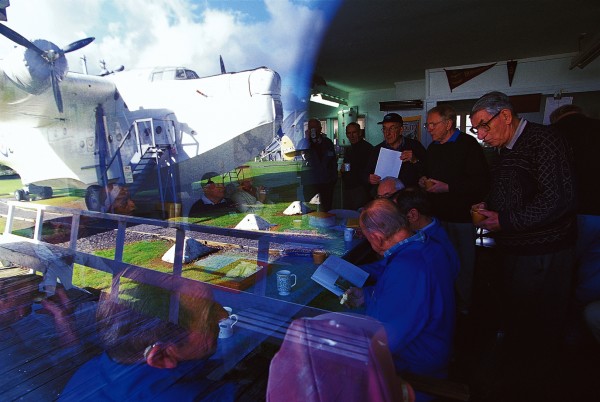
Th old hands of the Solent Preservation Society, many of whom worked with flying boats in their glory days, have been meeting weekly for over 15 years at Auckland’s Museum of Transport, Technology and Social History (MOTAT) to lovingly restore Aranui, pulled from the Coral Route in 1960. A Sunderland, just outside the tea-room, is tended by a band of like-minded enthusiasts.
Battling the forces of nature was to be a perennial problem for flying boat crews, who, unlike those flying pressurised landplanes, could not take their unpressurised aircraft above 10,000 feet, and so were forced to find a way through or around bad weather. Passengers often endured being jostled about by heavy turbulence and deafened by drumming rain on the cabin skin as the aircraft punched through a squall.
“The torrential rain in these fronts found entry through every joint and crevice of the cockpit windows, and the skipper would sit hunched with his raincoat draped across his shoulders as the rain drove in,” wrote McGreal. “One even tried using his umbrella in an effort to stay dry.”
In such circumstances, the first officer would pack up his gear, lash down the sextant and stoically lower ” himself into the right-hand seat of the cockpit, ready to do whatever might become necessary if things worsened. With no information available about weather conditions mid-Tasman, skippers were often forced back to Auckland by unexpected headwinds. If strong westerlies were blowing, extra fuel was loaded before takeoff and fewer passengers could be carried. It was not unknown for passengers to be outnumbered by crew.
Another worry for Empire crews in the early war years was the inability to feather propellers—to angle the blades of a stopped engine in the direction of the airstream, and so reduce drag. Without feathering, the propeller of a troubled engine windmilled, causing drag and more strain on the remaining good engines. Not only that, the shaking caused by the rogue prop threatened to rip the engine itself right out of the wing. After one such flight, engineers counted some 2000 loosened rivets.
The only means of heating the Empire cabins was with a petrol engine which, perversely, failed to work above 5000 feet—exactly when it was needed most, as temperature falls with increasing altitude. As a backup, ample supplies of woollen rugs and foot-warmers were carried, and cabin crew wore winter-weight clothing.
Aranui’s four Bristol Hercules engines gave her a cruising speed of 322 kph, cutting the average Tasman crossing to six-and-a-half hours. Many children today will have completed the journey in half that time, but school visits to the MOTAT hangar impress younger generations with a taste of magic long lost to international air travel.
Despite the discomforts of the journey, there was no shortage of people prepared to pay the £30 one-way fare, particularly as the war drew to a close and opportunities for travel increased. (To put that cost in perspective, buying a passage from Auckland to Sydney in 1940 required the equivalent of 30 days’ pay, at the average income. By 1990, with jet travel, that figure was down to just five days.)
Writing in 1953, Leslie Jillet put a finger on one attraction of the flying boats: “Even after over thirteen years of regular Tasman air travel one would be blasé indeed not to be faintly thrilled by a service which enables one to attend a theatre in Sydney, drive to the Rose Bay terminal, board a flying-boat, go to sleep and be ready to resume an ordinary day’s work in Auckland or Wellington well before nine o’clock the next morning.”
Glamour. Novelty. A toying with time zones. A magic wardrobe into other worlds. Flying boats gave adventurous New Zealanders a foretaste of life in the jet set.
But Jillet was writing long after the Empires had fallen silent. Coriolanus itself, the aircraft that carried Frater skyward and the last of the Empires to fly, made its final touchdown in Sydney Harbour in December 1947. That same month, Shorts printed a requiem for the Empires in the monthly magazine Aeronautics, calling them “our ambassadors of the air.” The company claimed that by the time it was decommissioned, the first one to be built, Canopus, had flown the equivalent of 11 trips to the moon. The New Zealand boats also retired in 1947, after more than seven years of accident-free flight in which they carried 13,000 passengers and 16 million letters. The Awarua was broken up in June, and the Aotearoa stood down in October after clocking up 1,970,000 km on a record 442 Tasman crossings, to linger dishearteningly for a time with new owners as a tearooms at Mission Bay.
*
The Empires’ Replacement was to prove an unfortunate choice. It was the Sandringham, a civilian version of the military Sunderlands used by the RNZAF and by 1947 already, in the puffery of Shorts, “the most popular flying boat in the world.”
The decision to buy four, recognised even at the time as a temporary measure, was again the result of pressure from Britain. TEAL had wanted DC4 landplanes, but state ownership of airlines in Britain, Australia and New Zealand made them all vulnerable to ministerial persuasion. Oscar Garden, who had accumulated 10,000 hours on the Empires, promptly showed what he thought of the decision to stay with flying boats by resigning. The Australian air route pioneer Gordon Taylor, himself a flying boat veteran, argued in vain for the three-finned Lockheed Constellation already chosen by Qantas for its London route.
About the only thing that could be said in the Sandringham’s favour was the lack of suitable runways in the country—Whenuapai being the only airport at that time able to take DC4s. Though most Pacific islands had good all-weather runways thanks to wartime construction, Tahiti—a strategic travel destination—could only be got to by flying boat, and TEAL recognised the importance of developing its Pacific routes.
The Sandringhams, renamed the Tasman class by TEAL, were deeper hulled than the Empires and had seating for a further 11 passengers, but they were only marginally faster. However, with the change of aircraft came a welcome innovation: air hostesses. Six began work with the airline in 1946, chosen from 3000 applicants.
Handling a flying boat on the water during landing, take-off, taxiing and mooring required a high degree of seamanship—yet another side to the multi-talented captain.
Ill-adapted for the increased loading made necessary on the Tasman a run, the Sandringhams were beset by mechanical problems, including engine overheating. One of the most gut-wrenching engine failures happened in December 1947, when New Zealand was 640 km out of Sydney with 29 passengers aboard. Mid-ocean the skipper, Ian Patterson, was forced to shut down a smoking engine and turn back for Rose Bay. The flying boat, already low because of bad weather, continued to lose height until it was no more than 20 metres above the towering waves. Having sent out an SOS, Patterson ordered all freight and luggage to be jettisoned, the first officer miraculously finding the strength to shift a 270 kg plastics die that had taken four people to load, and the boat managed to limp back to safety. Incredibly, the harshest backlash came as a result of the loss of Bishop Ashton Oldham’s ecclesiastical robes, for which he filed a surprisingly large insurance claim.
Shortly after this mechanical failure the Sandringham fleet was grounded for technical modifications, and within two years of being introduced on the Tasman run all the craft were retired.
One could be forgiven for thinking that this would be the end of saltwater aviation—that airline accountants, weary mechanics and storm-dishevelled passengers would all tick the landplane option, and that New Zealand would fall in line with the rest of the world. To the dismay of pragmatists and the delight of romantics, the opposite happened. For reasons best known to TEAL, it laid out good money for four new aircraft: Short Solents. They were at the time the biggest commercial flying boats in the world, and TEAL was the only airline to operate the powerful final version, the mark IV
(Thanks to TEAL’s chief engineer George Bolt, the British government had been persuaded to take the advanced Bristol Hercules engines off the secret list and allow Shorts to fit them to a commercial aircraft.)
The first Belfast-built Solent, the flagship Aotearoa II, was christened by Princess Elizabeth (in a lapse of judgment, Australian wine was used) on May 27, 1949. They entered service with TEAL later that year, soon joined by a Mark III, and, with a fleet of five, the airline augmented its flights with a transTasman run out of Evans Bay in Wellington. After the comparative austerity of the earlier boats, the Solents were exercises in extravagance.
In a Pacific shortwave broadcast of the christening ceremony, the BBC’s airline correspondent became lyrical about the new aircraft. Having dutifully noted the specs-35 tonnes in weight, takeoff power of more than 8000 horsepower, 240-knot maximum speed, a range of 2000 sea miles (“and that should be very useful for the stormy Tasman crossings for which she was designed”), room for 45 passengers in six cabins—he came to the nub of things: “As a potential passenger I was more impressed with the care and workmanship spent on the interior. The colour scheme is a nice restful creamy beige, with great big seats in deep blue. These are the most comfortable things you could imagine. If you want to adjust them, you just press a button on the arms.” The cooking galley, he added, was one of the biggest ever fitted in an aircraft.
Thanks to uncommon foresight and the labours of skilled enthusiasts, it is possible, half a century on, to experience something of the majestic presence of these imposing craft. The last Solent IV to fly, Aranui, rests hangared and almost fully restored in Auckland’s Museum of Transport, Technology and Social History.
For more years than he cares to remember, former TEAL ground engineer Ray Gasparich has headed the Solent Preservation Society, a volunteer group of former crew and aficionados now in their 70s and 80s who have passionately toiled to get the boat into museum condition.
Visitors entering the hangar are first struck by Aranui’s sheer size. The float-carrying wings stretch out nearly 35 metres, and the broad tail soars up more than 11 metres above the concrete floor to kiss the building’s roof. Most striking, though, is the monolithic hull, a metal wall of hatches, portholes and oblong windows rising up two decks above the beguiling amalgam of sculpted curves that form its planing keel. A fuselage-hugging gantry built by Gasparich’s gang gives viewers their first glimpses of the interior—intimate cabins housing the lavish upholstered chairs that so caught the BBC’s imagination and, between the chairs, linen-covered tables set with Noritake china and silver cutlery.
When rough weather prevented Ararangi from approaching the disembarkation pontoon at Mechanics Bay, passengers had to be brought ashore by launch. Typically preceded by a bumpy flight and several minutes’ taxiing in a choppy harbour, such an ordeal could prove the last straw for passengers of a less-than-iron constitution. Many a flying-boat meal travelled on a “return ticket”.
Entering the aircraft through the rounded door so familiar to travellers, visitors find it easy to imagine the salt-laden air of excitement, the hull slap of waves, the duck and bob of hats as men and elegantly dressed women stepped aboard, accompanied by their luggage. Booking a passage on a flying boat was, even in the early 1950s, a social event, with hats and gloves de ri gueur, and even corsages and furs making an appearance. Passenger lists were published in the daily newspapers.
Immediately inside the Solent is a small smoking lounge, its soft couch a haven for tired cabin crew or wandering passengers. Towards the tail a hatch opens into the rear baggage store where freight and mail were tied back with netting. It is a mass of exposed anodised sheets, ribs and longerons, looking as pristine as the day they were fabricated 50 years ago. The untarnished metalwork is a testimony to the care taken at construction, with all holes drilled before anodising to guard against the threat of saltwater corrosion.
Forward are more cabins, nestling between bulkheads which descend, in true marine tradition, through the floor and down into the bilges. One of the jobs of the hardworking stewards before takeoff was to work their way forward, slotting watertight doors across the aisle, effectively sealing the bulkheads to waist height. That done, the main deck cabins would have felt even more like a series of distinct rooms. For those craving the adrenalin rush, this was the deck to be on at takeoff. As the power came on, a wall of white water would rise up over the windows and—seals being what they were in unpressurised aircraft—rinse passengers in spray for the deafening minute or more it took to lift the big bird off the deck.
In the blunt nose is number-one hold and the bow hatch, which the radio officer would make a dash for on touchdown, to be ready with a boathook for the mooring buoy. Midships is a stairwell, leading to the splendid upper deck and the stainless-steel galley with its electric oven. From here fine cuisine—for the times—would be served, including fricasseed chicken, which in the 1950s was rarely seen beyond the Christmas table. Solent passengers were said to have been the world’s first to be offered a choice of eggs for breakfast—boiled, scrambled, poached or fried—along with freshly cooked bacon.
Up here, too, was the bar with its spirit miniatures and a dumb waiter to the deck below. Wall labels introduced crew names and gave route details, updated hourly. And suffusing all was that ambience of secluded comfort, of aloof serenity—the padded plenty of a Pullman service which encouraged passengers to indulge in a hand of cards or even, on occasion, a round of miniature golf.
“On a long night flight, the lower deck would be dark and quiet,” says former flight clerk John van Duivenboden. “But up here the bar was open. You could talk and relax.” Or stroll down to the tail lounge for a contemplative cigarette—pipes and cigars were forbidden.
In emulation of the early days of Imperial Airways, when captains were king, the flying boat skipper was last aboard. Climbing in through the crew’s entrance, gold braid verdigrised by the sea air, he made for the flight deck with its array of dials and switches—many colour-coded port (red) and starboard (green) after the manner of oceangoing vessels. The flight deck, with its navigation table, engineer’s station, radio post and crew’s rest seats, has the generous, uncrowded dimensions of a less cost-conscious age.
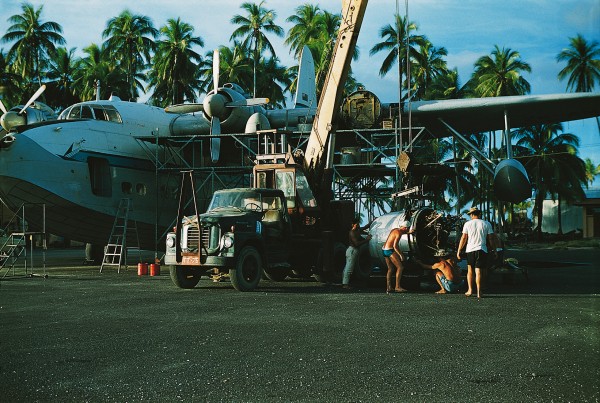
A spare engine for the flying boat Aranui was stored in Tahiti in case of emergency, but itself had to be replaced every six to nine months because of the ravages of heat and humidity. Repairs in such remote locations always meant lengthy travel delays. The author Graham Greene once spent two days on Akaiami atoll while a new tailplane was flown from Auckland. He and the other passengers became beach-combers—swimming, fishing and dining on food the cabin crew cooked over driftwood fires.
The skippers needed to be supremely good fliers. Not only required to find a way through whatever the weather threw at them below 10,000 feet, they had to be proficient at finding their way to distant locations—sometimes mere specks on the ocean—using the primitive tools of the trade. The Solent was the last commercial airliner to be fitted with an astrodome—a big perspex bubble on the fuselage up behind the flight deck, from inside which crew took sightings with an averaging sextant.
Every skipper also held a master mariner’s ticket. At take-off and on landing they had to orchestrate a nimble dance that balanced the conflicting forces of wind, wave and tide. The waters of Wellington’s Evans Bay could be especially daunting, with two-metre waves testing men and machines. Between 1950 and 1954, TEAL skippers accumulated more experience in rough-water flying than any group in the world.
Red Cat rising
As I kill the car ignition, the wipers stop midscreen, leaving the aircraft’s slender blue tailfin out on the tarmac dissolving in droplets of water. I’m at one of Auckland’s recreational airfields, Ardmore, ready—eager—to catch this plane. It’s a Wanaka-bound Catalina, a Consolidated PBY, and I’m hitching a ride to find out what big flying boats are all about.
The dispiriting drizzle and low cloud look set to end play, but stepping into the cool early morning I’m heartened to see that at least the Cat is in her new livery: white belly, with light blue sides deepening above to ultramarine. Just aft of the fuselage’s trademark blister windows is a big red star. The Warbirds show she is booked for has a Russian theme this year, and the colours are not out of keeping—Russia built several hundred of the American-designed Catalinas under licence during World War II. This one, Canadian-built, stands in the half light, transformed.
Catalinski.
Passengers are already standing about under the massive parasol wing, which is supported by a single pylon rising from the hull. These aircraft were so ruggedly built that in one wartime photo I counted 138 men crowding onto that bench of a wing to strike a pose. Today, no one is striking poses, except maybe the Cat itself. Aft of the planing hull, the fuselage flattens and tapers as it lifts, as if imitating a whale giving that last flick of the flukes before sounding. From any angle Papa Bravo Yankee has a playful set of curves.
Loadmaster ex-RAF quartermaster Richard Moody is busy stowing luggage and provisions—sleeping bags, chilly bins, tools, engine covers. As with the old TEAL boats, everything must be carefully positioned to maintain trim. At least this time round there is no weighing of the travellers.
Richard’s daughter Tina is eyeing up the hull. “You painted the plane, but why didn’t you fix the oil leaks?” she wants to know.
“That’s to give it the authentic look,” calls someone from inside.
Tina’s interest is no idle thing. She owns shares in this plane, in the form of a $1000 lifetime membership to the Catalina Club of New Zealand—the group which bought the veteran Z-Cat in Zimbabwe, where it had flown safari tourists. Billed as the “African Catalina,” it featured in a BBC documentary which screened in New Zealand a few years ago and is one of the few Cats around that is still flyable (only 89 survive worldwide).
An earlier PBY bought in the US by the syndicate and dubbed the “Spirit of the Coral Route” sank midPacific after a forced ditching caused by mechanical problems—fortunately without injury to the crew.
Come 9 A.M., more than an hour late, we are ready to climb the boarding ladder forward of the wing struts—war crews got in by squeezing past a waist gun in the blister window.
What I’m not prepared for is just how different inside the Cat is from other aircraft—say from the similarly sized and vintaged Dakota, which is also powered by two Pratt & Whitney twin Wasp radials. The flying boat has the feel of a submarine, even in its stripped-back, 16-seat civilian guise. The smallish compartments are separated by bulkheads with high steps, metal panels are everywhere and there seem to be any number of floor levels: the flight deck, main decks and galley and the blister compartment all differ. The boat even has a conning tower of sorts, the hollow wing pylon where, from his elevated perch, the engineer can keep an eye on his spinning hardware through two small windows.
After preflight checks the Cat lumbers down the runway and eases into the air, its floats folding to become elegant wingtips. Pilot Chris Snelson, one of the original delivery crew, banks it over farmland and, with a touch more autorich mixture, climbs south. Last time I was up above Ardmore it was in a Moth and there are similarities: the feathery prop chatter (despite earplugs), the low altitude, the sense of lazy passage.
As we journey down over the North Island I find the quip that Cats climb at 90 knots, cruise at 90 knots and land at 90 knots is not far wrong. And that the giant wing from which everything hangs—its back third fabric, its middle section between engines one big fuel tank—is largely responsible for the feel of the plane. For the distinctive sway of the Cat in turbulent air, its floaty reassurance. And for its stunning endurance. Being patrol and rescue aircraft, Catalinas needed to hang about up there a long while and cover a lot of ocean. In civilian service they once flew one of the world’s longest airline stages-33 hours airborne between India and Australia.
Their value was brought to international notice by Australian pilot Gordon Taylor, who used one for his pioneering journeys across the Indian and Pacific Oceans, surveying wartime routes for fledgling Qantas. A PBY was also used by TEAL to establish its Coral Route.
Midmorning, off the Wanganui coast at 2400 feet, we sight two richly decorated Harvards to starboard en route to Wanaka. Then the flash of something below the starboard bow: a yellow-muzzled Messerschmitt Bf 108. For a moment the skies are alive with history, then we are alone again.
The RNZAF operated a total of 56 Catalinas in the war, stationed in exotic locales like Funafuti and Espiritu Santo, but headquartered mostly in Fiji’s Laucala Bay, which itself was a later port of call on the Coral Route.
The air force Cats were all true flying boats, living and dying on the water. Like the TEAL Empires, Sandringhams and Solents, they needed to be fitted with beaching gear—temporary wheels before being ramped ashore for maintenance. The syndicate’s Cat, by contrast, is an amphibian, its retractable landing gear retrofitted into the hull.
Having taken on 800 litres of avgas at Paraparaumu, copilot Ben Sinnock takes us off the deck for Christchurch. Off the Kaikoura coast a creeping rise in cylinder and oil temperatures has Chris ordering up more autorich and shedding a little altitude. Nursing engines seems to be a large part of life aboard a flying boat, not helped by these short hops which give the air-cooled engines a hard time.
After a requested flyby over central Christchurch for the benefit of television cameras and more ended his Tasman crossing, we press on towards the foothills of the Alps.
When the Auckland Catalina Club bought PBY, she was painted in Peter Stuyvesant colours and being used for tourist transportation in Zimbabwe.
The bench seat of the blister is a fine place to be. It gives a person the sensation of being in the gondola of a Zeppelin. Up front, past the wing struts, the engine nacelles radiate the steady beat of the twin Wasps. Down below is the leaden ribbon of Grays River, south of Tekapo. A thousand feet beneath the gentle rock and yaw of the boat, Earth drifts past.
Come late afternoon, the elevated plateau of Wanaka field winds into view, the airstrip reduced to a plaything by the line-up of Boys’ Own machinery—Mustang, Dakota, Harvard, Yak, Avenger, Corsair, Spitfire. And a hundred or more visitor aircraft.
After manually checking that the nosewheel is down—”never rely on instruments”—we land with a puff of tyre burn. Ahead, three days of (red) star status and scenic flights.
Bob Dyck, one of the world’s most seasoned Cat pilots, with more than 3000 hours in his log, has—not for the first time—flown over from Canada to share his hard-won knowledge with the Cat crew.
“If you can fly a Dakota you’d be right at home in a Cat—she’s a lumbering old gal,” says Bob in his genial drawl. “It’s the water that separates a Dak pilot from a Cat pilot.”
The next day I accompany Bob and a handful of others on some pilot training exercises. Dave Clews, an orthopaedic surgeon from Hamilton, is in the hot seat. I take my accustomed place on the bench seat—rather foolishly, as it turns out. There follows an hour or more of being flung and wrenched way aft of the centre of gravity as Dave throws the
obliging Cat through tight turns, stalls and single-engine landings on and above an unsuspecting countryside. Last on Bob’s menu of trauma for Dave is a touch-and-go on what has become adiscouragingly choppy Lake Wanaka.
As Dave drops between the hills and levels up for his approach, I think of the danger involved in landings on glassy water, where pilots often had trouble judging height. One trick, I was told, was to do a flypast first, scattering newspapers which would then float on the surface.
Taking off from calm water was all but impossible, the water’s suction stopping the boat getting up “onto the step”—onto the planing surface of its hull. Skippers overcame this problem by first weaving across their intended path to create wash.
No trouble today seeing how close the surface is as we drift down, clipping a series of wave crests with hull-smacking booms—water is not soft at this speed. Then Dave guns the engines and we lift off out of there. The biggest seas TEAL skippers set down in were 1.8 metres. With Tasman waves sometimes running at 10 times that, there was next to no chance of a happy mid-ocean ditching.
Back on the airfield, Dave cuts the engines, the Cat’s props ruffle to a stop with a last click of valves and our collective ordeal is over. Gathering my jacket, I notice the pilot passengers who came along, including Bob, are standing on the tarmac in a row facing Dave. He looks up from the controls and, as if on cue, they drop to hands and knees and kiss the ground in gratitude.
It is a mock comment on the day’s flying, but from where I stand it takes on more the feel of a salute. To one of the most dependable and best-loved of all flying boats.
McGreal records the technique of one of these veterans: “He would hold his height at about 2000 feet and his line for landing was aimed into the teeth of the fifty- or sixty-knot wind . . . Still holding about 2000 feet, we crossed the southern shoreline of Evans Bay by the old gas works and then it all started to happen. He closed the four throttles, extended the landing flaps and nosed the aircraft steeply down towards the heaving waters of the Bay . . . The aircraft was now plummeting towards the Bay and the passengers, I guess, were gripping their arm rests after having already looked rather askance as the stewards had swiftly moved through their cabins raising the watertight bulkhead door. . .
“The skipper allowed the airspeed to decay during this headlong rush until somewhere about 50 feet above the heaving, gale-torn waves, where, with fine judgment, he started to raise the nose to almost a stalled attitude. . . Just when we could almost see the whites of the eyes of people on the shore waiting to meet the aircraft, the skipper, with superb touch, closed the throttles and the red mooring buoy seemed almost to be at our nose as the aircraft surged to a stop and sank back into the sea. . .
“With a grin and his blue eyes twinlding the old skipper would take a pull at his sweeping moustache and say, ‘What turbulence?’ Then jamming his white-topped cap on his balding pate he would pick up his flight bag and make his way down the ladder from the flight deck and stride ashore.”
*
Yet all of this the unquestionable skill, the trappings of luxury, the eccentric meld of sea and sky—might have been elbowed aside by the force of economics had it not been for one singular marketing masterstroke.
In 1950, BOAC, Imperial Airways’ successor, quit flying boats altogether, leaving New Zealand the sole country using them on longhaul routes. In May of that year TEAL took over the Fiji route that New Zealand’s domestic airline, NAC, had been flying with Sunderlands. Then on December 27, 1951, 14 years to the day after John Burgess arrived in Auckland on his survey flight, TEAL launched a service worthy of the Solent, one which would give an image—a brand—to the era. It was to be the last and most legendary flying boat run in the world. The PR machine called it the Coral Route.
Spanning almost half the southern ocean-7500 km from Auckland to Suva, the Cook Islands and Tahiti—the two-and-a-half-day trip took passengers out of their familiar towns and cities and into a fantasy world of remote atolls and warmly inviting South Pacific cultures. Initially monthly, the Coral Route caught the imagination of jaded Westerners and became fortnightly in 1952, when a much-appreciated Samoan stopover was added. The following year a link was made to Tonga.
Passengers would gaze out of the large windows to the often uninhabited atolls close below, seeing through the clear water colourful coral formations, and even the occasional school of sharks.
“People who haven’t been on the Coral Route have missed out on the greatest flight in history,” says one-time Solent skipper Eddie Treadrea.
Favourite stop among passengers was Akaiami in the Cook Islands, a jewel of an island three kilometres long, with dazzling white sand and coconut palms on the edge of a turquoise lagoon. The warm, shallow water was perfect for swimming or snorkelling, and airline staff thoughtfully handed out togs to passengers who had forgotten to pack their own.
While the travellers forgot their cares in the sun and surf or sipped cold fruit drinks in the shade of a thatched shelter, crew supervised the hand-pumping of fuel barged in from nearby Aitutaki, whose waters were too shallow to set the big boats down in.
The rest was made more exquisite for passengers by the early start forced on them at their previous stopover, Apia in Samoa. They were roused from Aggie Grey’s hotel in time for an ungodly 1 A.M. departure, to ensure a dawn landing at the lagoon. This was necessary because Akaiami, the world’s only international airport on an uninhabited island, was an essential refuelling point, and the fuel drums needed to be handled before the tropical sun rose too high.
Conditions in the lagoon were demanding, nevertheless. One engineer resorted to hiring a local boy to pour water over him as he worked out on the wings checking engine air intakes and oil levels. As a further demonstration of the heat, a steward took to cracking eggs and frying them on the wing flaps. Eventually, TEAL was persuaded to coat the upper surfaces white, the extra 78 kg of paint meaning one fewer passenger could be taken. Those who did travel were, however, thankful. The reflecting paint lowered the cabin temperature by four degrees.
The terminus of the Coral Route was Tahiti, the archetypal Pacific paradise. In the 1950s it was without an airfield and still remarkably difficult to get to. The capital, Papeete, was served six-weekly by two French government-run passenger ships, the Tahitien and the Caledonien, and other than that only irregularly by cargo ships.
The Solent service was seized on by locals as a lifeline to the outside world that the French colonial government itself had so demonstrably failed to offer. The weekly flying boat arrivals were festive occasions, with rousing displays of Pacific hospitality. The day before the boat was due, blackboards outside restaurants and bars would announce: “L’avion TEAL arrivera demain.” Next evening, at Les Tropiques or the Royal Tahitian, at Quinns or Bar Lea, something special would be going down, ending in the small hours with a dance known locally as the “soirée de TEAL.”
Solent crew were treated as local celebrities, none more than the irrepressible and outgoing skipper Joe Shephard. According to one story, long after the Coral Route had been closed, a Tahitian audience was halfheartedly watching an old newsreel film when the footage suddenly showed a grainy Shephard going about his business. Instantly the audience came alive with shouts of “Captain Joe, Captain Joe!”
Thundering down her watery runway at Evans Bay, the view from within obscured by flying spray, Awatere approaches the moment when her hull will lift clear of the waves and her passengers will see Wellington Harbour fall away beneath them. When the curtain came down on the age of the flying boat, one of the great joyrides of modern times was over.
Captain Joe had further contributed to Coral Route lore one day when, as his plane approached Akaiami at daybreak, an engine had failed. Shephard got permission from New Zealand to take off on three engines and fly on to Tahiti for repairs. But the flight steward, Dennis Marshall, hostesses and 40 passengers, including two New Zealanders, were first unloaded on the atoll. Among the passengers was a European count, a restaurateur, a professor and Martine Carol, siren of the French movies. Surrounded by piles of blankets, food, pillows and alligator luggage, they watched the Solent lift off and drone towards the horizon.
Having food for only one day, they were barged to the larger but still sparsely inhabited Aitutaki, where they slept in huts built during the war. Some of the travellers were disconcerted at first, one German tourist complaining that his world trip bookings had been ruined, and, in the words of Marshall, demanding to know “Venn do ye get off dis island?”
Soon, however, the Pacific exerted its charm. The steward caught and killed a pig and wrote out IOUs for food. The professor had some luck in the lagoon with a spear gun, and permission was given to enter the resident agent’s unoccupied house and break open his wine cellar. Martine added spice of her own by wanting to swim in the lagoon naked.
Each day Marshall contacted Tahiti, using a Morse set, to attempt to discover the likely return of the Solent, but each day he was given a different story. Frustrated, the steward began making up stories for the passengers, who seemed in any case to take less and less interest. The last evening before Shephard returned, when they had been eight days on the atoll, the passengers put on a feast and concert.
“At first I think they wanted to lynch me and my hostesses,” said Marshall. “The second day they were relatively calm, and really by the time we left they were absolutely in love with the place because it was probably the holiday they had been looking for all their lives.”
With such unexpected pleasures, the Coral Route looked set to have an enduring place in an increasingly straitjacketed world. For the flying boats, however, it was to be nothing more than a splendid Indian summer.
In 1954, TEAL inherited landplanes from a defunct British Pacific Commonwealth Airlines, and the Solents’ days were numbered. That year the aircraft, which had been averaging more than one Tasman crossing a day, were pulled from the run, and also replaced by land planes on the Auckland-to-Suva leg of the Coral Route. The Aranui, affectionately nicknamed “the orphan,” continued to ply the airways to Tahiti until 1960, when old age and a new international airport at Papeete put an end to its work even there, and a unique piece of aviation magic was snatched from the sky.
In September of that year, with Captain Joe at the helm, Aranui made its last touchdown on the Waitemata, its keel lifting a feather of spray as the sturdy wings surrendered the weight of the hull to the sea. The world’s most famous flying boat service had drawn to a close.