At dawn on the morning of February 16, 1986, the luxury Russian liner Mikhail Lermontov steamed past the bush-covered hills of Tory Channel towards Picton, on the last leg of a two-week cruise. The ship never made it out of the Marlborough Sounds. That night, she lay in 30 metres of water in Port Gore, her hull sliced open like a tin of herrings. Miraculously, all but one of her 738 passengers and crew were rescued in a Dunkirk-style operation involving dozens of vessels ranging from fishing boats to an inter-island ferry.Thirteen years on, however, suspicion still lingers around New Zealand’s largest shipwreck.
In port gore, three hours’ steaming from Picton on the dive boat Sandpiper, a black buoy rides the Cook Strait swell, tugging rhythmically at something deep below the surface. The rope that tethers this bulbous plastic drum is arm thick from 13 years of bloating, and feels slimy even through a neoprene glove. But when you descend its length, free-falling into the gloom with half an hour of air strapped to your back, you want to hold on to it, and never mind that it yanks you up and down like a yo-yo. In the soup of silt and ocean nutrients that presses around you, inducing a weightless myopia, this rope is your only reference—a handrail to a sunken mystery.
The bottom looms out at 15 metres, flat and barren, and only as you touch down, kicking up a cloud of sediment, does it become apparent that it is not the bottom at all. The surface is unnaturally smooth, and its contours have the regularity of a building. A row of rectangular windows—now hatchways oozing cryptic darkness—runs off in both directions from where the rope is shackled down. Here you have to let go your lifeline to the surface, but don’t swim off just yet, and whatever you do, don’t swim inside! Somewhere in there, perhaps floating limply against a ceiling or a wall, are the bodies of two people who never found their way out. Pause for a moment and try to imagine the size of this thing. Imagine, because you’ll never see it all. Not in this murk, not on the clearest of days.
This silt-smothered hulk was once a gleaming ocean liner, a floating island of bargain luxury 155 metres long and 23.6 metres wide. It was also a crosscultural curiosity, a place where the Iron Curtain was temporarily lifted, allowing glimpses of Russian culture against the unlikely backdrop of the South Pacific. On board, you could dine on red caviar and cold-smoked sturgeon to the accompaniment of balalaika folk songs, or watch the fiery Moldavian dancers and learn to drink Stolichnaya vodka the Russian way: “Do dna! To the bottom!”
You could also partake of more conventional cruise ship fare: deck quoits and trapshooting, leatherwork and lotteries, bingo and blackjack. There was a disco every night, and croupiers were on hand to relieve you of your spare change at the roulette wheel. If you didn’t feel like dancing, you could watch a movie or catch Pirate Pete and his Hirsute Pirates and Nubile Maidens at a South Seas show.
Unfazed by the drizzly weather, many of Mikhail Lermontov’s 408 passengers took the opportunity to explore the part town of Picton and the nearby vineyards of Blenheim. Most were elderly Australians, enjoying what tour brochures advertised as “the cruise of a lifetime” on a ship that was commanding presence wherever she berthed.
Mikhail Lermontov boasted five bars, a swimming pool, two hair salons, gymnasium, sauna, shops and a library. Medical care was gratis, and the staffing ratio was one crew member to every two passengers. Tipping was discouraged: “Our smiles are free,” the ship’s brochure declared. The same brochure also spoke of the “unlikely event of emergency”—though perhaps no one paid much attention. The fresh-painted whiteness of her hull seemed to imply invincibility; her size, safety.
Just how she got where she is now—lying flat on her starboard side, $45 million of maritime glory turned into a 20,000-tonne garbage can stuck in the sandy bottom—is still one of the country’s most perplexing maritime riddles, even more so because the entire incident was promptly sealed off in a cloche of bureaucratic silence, as if it were an embarrassment to be expunged and forgotten, neither explained nor fully investigated.
But in the Marlborough Sounds the memory of February 16, 1986, lingers, and the wreck has become something of a landmark. Divers from around the country and from overseas come here to experience the sunken behemoth, and after their adventures sip cappuccinos at a picnic table in Lifeboat No 10, outside the Mariners’ World café. Maybe they joke about the New Zealand harbour pilot who ran her aground. “How do you think he likes his vodka?” one might quip. “Straight or on the rocks?”
All things considered, the loss of the ship was a “lucky” disaster. One crew member lost his life, probably trapped in a forward hold when the ship struck rocks, but 329 crew and 408 passengers were rescued. This despite the fact that the captain did not consider he had a mayday situation on his hands, and so no formal rescue operation was mounted. Had it not been for the vigilance and courage of local fishermen and farmers who took matters into their own hands, or had the ship gone down in more exposed waters, the sinking of Mikhail Lermontov could have been a tragedy of Titanic proportions.
*
One of five sister ships built in the Baltic port of Wismar, in what was then East Germany, Mikhail Lermontov was named after a freedom-loving Russian poet and novelist of the Pushkin era. The Russians seem to have had a penchant for christening ships after their literary luminaries, particularly those extolling the romantic exotica of the far-off steppes or the pastoral folklore of Rodina, Mother Russia. Consequently, there was Aleksandr Pushkin (now Marco Polo, and regularly seen in New Zealand ports), Ivan Franko, Taras Shevchenko and Shota Rustaveli.
The ships, furnished with all the splendour and chic that their builders could muster, were the Soviet Union’s answer to the Cunard and Norwegian Line’s ultra-deluxe floating palaces of pleasure on which, for a thousand dollars a night, you could buy happiness and romance.
Amid those ocean Edens of credit-card delight, the Russians—always hard-up for hard currency—offered a bon marche deal, an affordable holiday for all, a champagne paradise at a rock-bottom price. Mikhail Lermontov’s South Seas cruises were particularly popular with Australian holidaymakers—on February 16 there were 370 of them on board.
At 8 A.M. that Sunday, they berthed at Picton’s Waitohi Wharf after an overnight crossing from the capital and a dawn entry through Tory Channel, where the Marlborough harbourmaster and pilot, Don Jamison, impressed the Russian captain and bridge crew with his deft manoeuvring in the narrow waterway. In port, the ship dwarfed all other boats, as well as the inter-island ferries. It dwarfed the port itself.
Surrounded by steep and forested hills, Picton is a sheltered haven for mariners, nestled near the end of Queen Charlotte Sound. A little town of motels, fishing boats and tourist operators, it makes its living from the sea and ferry traffic between the North and South Islands. Here Lermontov’s passengers could visit a petite museum displaying relics from the whaling station they had passed earlier that day: the jaws of an orca, a Norwegian whaling gun which hurled 85 kg harpoons, an enormous black trypot that brings to mind feasting cannibals. Or if they wanted something less grisly, they could take a coach tour to Marlborough’s burgeoning wine district and stroll among the vines.
Just after 3 P.M., Mikhail Lermontov slipped her berth on the outgoing tide, bound for Milford Sound before crossing the Tasman back to Sydney. One of the last aboard was the pilot. The Marlborough Harbour Board had been going through tough times, with a bitter legal battle raging, and Don Jamison, as harbourmaster, pilot and acting general manager, had been working cruelly long hours as a result. He had been working that afternoon, too, and no doubt sighed a heavy sigh of relief as he locked the office on his way out. After piloting the ship out of the Sounds—his last official duty—he was on leave for a week.
Things seemed to go wrong from the start. While steaming out of Shakespeare Bay, after showing passengers the derelict immigrant ship Edwin Fox, Jamison became aware that the ship wasn’t turning quickly enough. He ordered full power to the starboard bow thruster to tighten the turn, but nothing happened. With both main engines roaring in full reverse, the ship pulled up at right angles to the shore, just 30 metres short of running aground. It transpired that the bow thrusters had not been turned on. The crew had not expected that they would be needed, and Jamison hadn’t thought to check. The captain, Vladislav Vorobyov, reprimanded him for risking his ship by taking her so close to shore.
“Like playing Russian roulette with three bullets int he chamber” is how a local fisherman describes the pilot’s attempt to navigate Mihail Lermontov between the pinnacles of Jackson Passage. The reconstruction above shows the ship in the correct size relation to Cape Jackson and Jackson Head, at approximately the position she would have been in when she grounded, and at the same time of tide.
Jamison continued up Queen Charlotte Sound, hugging the coast while accelerating up to the ship’s maximum manoeuvring speed of 15 knots. Off Golden Point, the captain again told him to move further out from shore. Even the yachties among the passengers commented that the pilot was taking her remarkably close to land. “You could just about have reached out and touched the leaves on the trees,” said one.
But Jamison, an experienced mariner with extensive local knowledge—he had contributed to A Cruising Man’s Guide to The Marlborough Sounds and Tasman Bay—appeared not to heed the captain’s request. He had already demonstrated his piloting skills on the inbound journey through Tory Channel, hadn’t he? And besides, his job was to show the passengers of this floating belvedere the best of his home scenery, and by keeping a distance of about one boat length from the shore he was giving them a dramatic close-up view.
At about 4.30 P.M., with a safe course plotted out of the sound and into Cook Strait, Captain Vorobyov retired to his cabin to shower and catch up on paper work, leaving the pilot on the bridge with chief navigator Sergey Stepanishchev, second mate Sergey Gusev and helmsman Anatoliy Burin. He asked to be called when they reached Ship Cove. Dinner was announced, and Mikhail Lermontov continued her way towards Cape Jackson.
The cape, outlining the Northern Entrance to Queen Charlotte Sound, is an exposed headland running out into a pinnacled underwater reef which terminates at Walker Rock. Some 550 metres out from the cape is Jackson Head, a knife-shaped sliver of rock topped by a disused lighthouse beacon. The winds bend around the headland and the tides surge through the passage. The water on both sides of the reef is over 100 metres deep, and the tidal currents well up and pour over this underwater barricade, often creating a boiling mass of white water.
In the shallows of the cape, under a swaying canopy of leathery kelp and dotted with spiky clumps of kina, lie the remains of Rangitoto, a passenger steamer that foundered here in 1873. Nine years later, the sailing ship Lastingham was also wrecked here, with the loss of 18 lives. Early editions of The New Zealand Pilot, the mariners’ Bible, used to carry a warning: “The tidal streams around Cape Jackson are rapid and there is but little slack water. Several vessels have met with accidents, principally due to the rapidity and the irregular direction of the tidal streams when using the passage between Cape Jackson and Jackson Head. Vessels should not use this passage.”
But from newer editions of the Pilot this warning has been deleted—perhaps because it is so blindingly obvious. Why try to squeeze between a rock and a hard place when there is enough room in the Northern Entrance for a ship of Lermontov’s size—a ship of any size—to spin pirouettes or figures-of-eight, bow thrusters or not? The course plotted by Sergey Gusev gave Cape Jackson a wide berth, but Jamison kept favouring the coast, broadcasting a sightseeing commentary on the PA system.
Jamison swung the ship through an arc between Ship Cove and Motuara Island, the site of James Cook’s 1770 landing and of a later visit by the Russian explorer Fabian Gottlieb von Bellingshausen. He spoke briefly about the historic events that had taken place here, then bade his audience good afternoon and hung up the microphone.
The captain had not returned to the bridge, so Jamison continued to pilot the ship towards the open sea. However, instead of taking the pre-plotted course out past the cape and its outlying rocks, the pilot kept favouring the coast. At Anakakata Bay he ordered a helm change of 10 degrees to port. When the bridge crew expressed their
concern, Jamison said he wanted to give passengers a close look at Cape Jackson.
Nine minutes later he again ordered “Helm, port 10 degrees,” and began taking the ship through the gap between
the cape and Jackson Head. The two Russian officers were now visibly alarmed.
“I can see a line of white water in there,” said second mate Gusev to the navigator. “What is he doing?”
Stepanishchev asked the pilot directly: “Captain, why are you taking us in so close?”
Jamison was confident and calm. “There is no reason to worry,” he replied. “There is enough water in that place.”
It was about an hour and a half to low tide. Had the visibility been better, the bridge crew might have seen that the gap and distant Stephens Island lined up like a gunsight.Taking the ship along this line,Jamison might as well have been steering into the path of an oncoming torpedo.
As with a torpedo, there was a delay. About six minutes.During this time, some of the passengers on deck, sipping whisky and watching the coastline slip by, noticed white water foaming around the ship. “Any sailor will tell you that white water means danger,” one of them commented later. “If he doesn’t hit those rocks, I’ll eat my hat,” said another.
His hat was safe. At 5.37 P.M., just as a wine-tasting session was getting under way in the Bolshoi Lounge, the ship suddenly shuddered,groaned and shuddered again as she slit her iron belly on an underwater pinnacle.
Moments later, Captain Vorobyov was running up the stairs and bursting through the door onto the bridge.
*
The sound of the impact was heard some eight kilometres away in the Baker family’s homestead in Anakakata Bay.
Tony Baker had lived here since 1965, farming the 647 ha finger of steep land jutting into Cook Strait that includes Cape Jackson. They had watched Lermontov sail by only 15 minutes earlier.
Tony Baker knew Don Jamison well, and called him up on the VHF radio to tell him how beautiful the ship looked. She was the biggest vessel ever to pass by their remote outpost. All other liners shunned this side of the sound, choosing the wider Southern Channel. He wished the pilot a safe voyage and radioed off. Now came this distant thud.
“He musts hit something,” Tony’s son David quipped impishly. It was such an improbable thought.
But soon they knew it was no joke. As they sat down to dinner around 6 P.M. there came a radio message: “This is a mayday situation. The Mikhail Lermontov. We have struck a rock at Cape Jackson, and we are proceeding into Port Gore . . . We will require emergency assistance. The vessel in danger of sinking. The vessel in danger of sinking. Making water. Proceeding into Port Gore. Over.”
The distress message met with an instant response. The LPG tanker Tarihiko, captained by John Reed-man, was in the vicinity of d’Urville Island, some 17 nautical miles away, and it turned for Cape Jackson at full power. Reedman estimated he needed about one and a half hours to get to the troubled ship. Captain John Brew, navigating the inter-island ferry Arahura in Tory Channel bound for Picton, also heeded the call. Meanwhile David Baker, his son Jason and cousin Denis Cox were racing their trail bikes to the top of the hill.
*
On reaching the bridge, Captain Vorobyov found Jamison white-faced and shaking. The ship had already developed a list, and reports started coming in iliat water was entering the bulkJlead compartments. The captain ordered a general alarm and the closure of all watertight doors. He informed the passengers that the
ship was experiencing a “slight water intrusion.”
In fact, the intrusion was more of a hara-kiri wound: three gashes on the port side totalling almost 25 metres in length. As the ship was still moving forward at speed, the initial surge of flooding was estimated at 63 tonnes per second-fast enough to fill an average community swimming pool while you read this one sentence.
The pumps, working at full capacity, could each displace about 160 tonnes of water a hour. Staff Captain Georgy Melnik made a quick calculation. They could take in up to 4000 tonnes of water and still remain afloat. But when all the damaged compartments were flooded the ship would be holding almost twice that amount.
Vorobyov realised that his ship could not stay afloat. He ordered the evacuation procedure to be got under way and began looking for a sandy place to beach his ship. She could then be repaired and refloated. Apparently thinking he had the crisis under control, at 6.19 he cancelled the mayday situation.
And the band played on. Literally. Barmen served drinks-albeit on a sloping bar. Passengers continued their card games. Some even danced. Others were in their cabins, asleep.Perhaps some were looking forward to the eight o’clock screening of the Spielberg movie Gremlins.Lermontov had bumped into a rock. So what? An announcement assured passengers that the ship had “a good captain and a good crew, and they fix.”
That wasn’t the way it looked to Denis Cox, watching the scene from the hilltop lookout: “We could clearly see the ship with bow down, a starboard list and the stern quite a way out, showing five or ten feet of anti foul. It didn’t look good, yet while we waited we could hear [via a handheld radio] the pilot telling Wellington Radio that they did not require assistance.” David Baker added: “We watched her until about 7.15, stuttering into Port Gore. She had a lot of water aboard and looked in a bad way. She was obviously in trouble, but what were we to do? We’d never dealt with anything so enormous.”
With the mayday deactivated, Arahura resumed her course for Picton.
Half an hour later, seawater entered Lermontov’s engine room. It sprayed the main switchboard, short-circuiting the pumps and stopping both engines. Silently now, the ship continued its momentum towards the beach.
“Our next instructions were to get life jackets on and to lie on the floor, or hold on, because the captain was trying to run the ship aground,” an Australian croupier recounted. And so the passengers did, hanging on to tables and posts, waiting for a crash that never came. Some passengers felt sure that she touched lightly, and Jamison later stated that they stopped about “a ship’s length from the shore”—an assessment that was confirmed by professional diver Alan Perano, who found the furrow the ship’s hull ploughed in the seafloor at that point. But, in a decision that still puzzles mariners, the captain chose not to drop the anchors. He told the preliminary inquiry into the sinking that he expected the rising tide to take the ship even closer into shore.
It didn’t. As darkness fell and an offshore wind picked up, the mortally wounded and powerless Lermontov began to drift back out to sea.
*
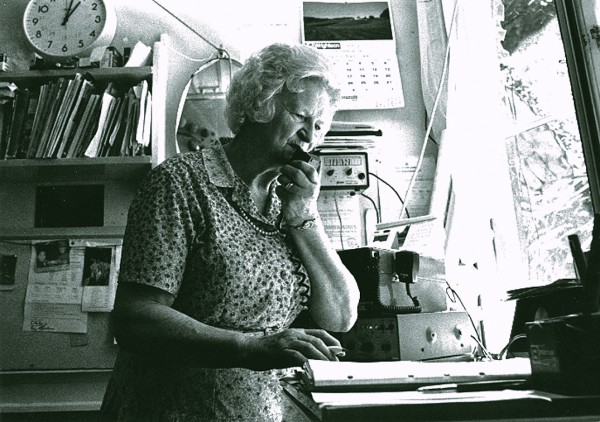
Like many back country farmers, the Bakers lived an isolated life. Their sole physical connection with the outside world was a 20 km private telephone line running over rugged country to an exchange in Endeavour Inlet. It was notoriously unreliable and required constant maintenance, and so, with time, they came to depend more and more on a double-side-band radio they had removed from their boat Tiki. With this radio they could order their groceries, relay medical emergencies, talk to their friends and far-off neighbours. In the maritime community of the Marlborough Sounds they became known as Radio Tiki.
Before long their station was the hub of radio traffic in the area. Strategically placed at the outskirts of the Sounds, the Bakers had more reliable news on Cook Strait conditions than did the Meteorological Service, whose forecasts they nevertheless relayed. On their busiest day, Betty Baker logged 110 calls, and David’s wife, Sandra, used to take a handheld radio when she hung out the washing. They got to know every boat and every skipper in the area. Even the local pigeon fanciers homed in on their knowledge of wind conditions.
From their home in Anakakata Bay, Better Baker and her husband Tony were strategically placed to monitor and relay radio messages from the sinking ship to other vessels in the are and to shore stations in Wellington and Picton. The Bakers received Queen’s Service Medals for their part in the rescue and for services to the Marlborough Sounds boating community over three decades.
In 1984, the Waikawa Cruising Club presented the Bakers with a VHF radio to replace the old set. The station was still Radio Tiki to friends, but formally it became Radio Cape Jackson.
Not surprisingly, on the evening when Mikhail Lermontov was sinking, the Bakers found themselves at the centre of the crisis. There was chaos on the air. A mayday call was sent out, then cancelled. Two tugs were requested by Vorobyov, but when it was found they would have to come from Wellington they were then recalled, as it would have taken them about four hours to get across the strait. Arahura was also told it was not needed. Officially the trouble was over, yet all this time the biggest ship the Bakers had ever seen was sinking in their backyard, and no one seemed to be doing anything about it. “There was a lack of communication,” Betty Baker said later. “I think the captain just didn’t want to admit that his boat was going down.”
The Bakers decided there was only one thing to do. Tony and Betty manned the VHF set and the telephone, while David and Denis Cox readied their four-metre aluminium dinghy. From about 7 P.M. onwards, Radio Tiki began pulsing out a call for help. Soon a flotilla of small fishing boats was converging on Port Gore.
Terror in the Darkness
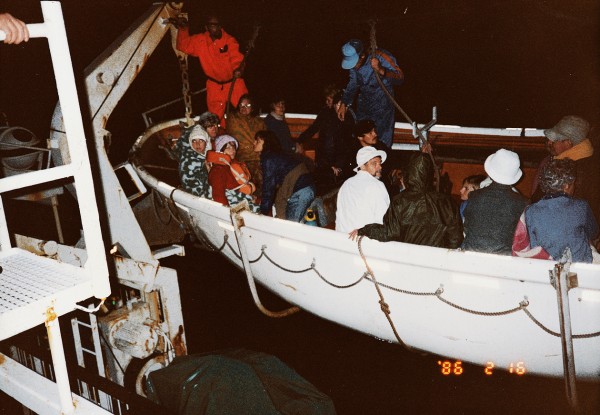
No passengers died when Mikhail Lermontov sank. Indeed, apart from a few cases of mild hypothermia and one broken bone, the 408 passengers (average age 70) came through their ordeal remarkably unscathed. But the outcome could easily have been very different. While most passengers later praised the efficiency and selflessness of the Russian crew, aspects of the rescue drama bore the hallmarks of scenes from Titanic. Passengers were forced to drop into lifeboats from rope ladders that were too short to reach the sea, in total darkness, trusting themselves to the arms of Russian sailors waiting below. Lifeboats headed aimlessly around the bay, their crews unsure where to take their complement of passengers. One lifeboat, towing two others, was spotted heading resolutely out to sea. When asked where it was going, the Russian officer in charge replied in a torrent of Russian, the only recognisable word being “Picton.” It took a direct order from the Russian captain, via a VHF radio, to get the officer to change direction and take his charges to Arahura.
Perhaps the most frightening aspect of the rescue was queuing to get off the ship—especially as its list increased and its decks, made slippery by the rain, became impossible to walk on. In a new book on the sinking, Death of a Cruise Ship, to be published by Cape Catley in July 1999, Tom O’Connor describes the terrifying experience of a group of passengers who became trapped inside. .
Joan Dillon and her daughter Gail Cottle had been mighty relieved when the announcement had finally come that they were to go to the lifeboats. They’d waited anxiously for several hours, not knowing what was happening, so they headed eagerly for their lifeboat station.
Outside on deck they both became soaked by the rain but they hurried along with the others. When they reached their appointed station there was no one in charge to tell them what to do. They stood anxiously in the cold rain while the ship’s list worsened.
Eventually a Russian woman crew member came and indicated they were all to follow her to another lifeboat station. They went through the interior of the ship to a narrow corridor, then on to a staircase with a steel door at the top. It obviously led to the outside, but was firmly shut. The ship was now listing over so far that people were slipping and falling down the stairs. On one side a wooden rail provided a hand-hold, and they clung to that.
The woman rushed off to attend to other duties, saying there would be someone to help them “in a short time.”
Here they were crammed together in the near-dark, in a crowded, frightened, part-vertical queue. No one knew what was happening.
After what seemed an eternity, other Russian crew members arrived to tie a rope from the steel door to the bottom of the stairwell for people to hang on to. These crew members, too, left as quickly as they had arrived.
Now began the worst nightmare of all. The passengers couldn’t go back. Water was now swirling in below. They couldn’t go forward. The steel door blocked their way. They had to wait in their dark prison, in what they now all knew was a sinking ship.
That they didn’t all panic and fall, crushing themselves to death in a modern-times Black Hole of Calcutta, seems miraculous. Sheer strength of character kept them going.
They estimate they were left for an hour and a half. They didn’t know where in the ship they were. Worse, they didn’t know if anybody in authority knew where they were.
Joan Dillon, resolute woman though she was, became seriously distressed by the growing black-out and the oppressive warmth of the crowded staircase. There seemed no movement of the air, as if they might suffocate. Her arms and neck burned with the strain of holding on to the rope to support herself.
Behind her an elderly woman sounded as if she were having a heart attack. Trying to comfort her, Joan wondered if she would have the strength to hold on to both the rope and the other woman if she collapsed.
She was convinced they had been forgotten. They would be trapped when the ship went down. Guilt assailed her. Why on earth had she brought her daughter with her on this terrible voyage? Gail had a husband and family back in Australia. How would Gail’s family be able to cope without her?
Voices rose and fell as people encouraged one another or asked others to move a little and make room in the packed stairwell. Sudden cries kept erupting against a background of quiet weeping or praying.
Someone cursed the “stupid bloody Russians” for running the ship aground, and others joined in. Yet others blamed themselves for even being on the ship.
One old man was almost hysterical because he couldn’t find his wife. She was nearly blind, he said, and they’d got separated in the Bolshoi Lounge. He kept saying he wanted to get out and find her but he couldn’t get out of the stairwell. Others tried to calm him but he seemed not to hear them.
Tom Archer was near the top of the stairs. He was hanging on to the wooden rail with one hand, with his other arm around his wife to support her, when a man above them lost his footing and came tumbling down. He crashed into several people, sending Dorothy Archer backwards down the steep stairwell. When her frantic husband managed to push and shove his way down to reach her, she was lying quite still, blood oozing from a cut on her forehead.
The water at the bottom of the stairwell was mere inches from her feet. When she opened her eyes Tom told her to roll on to her front, so he could help her to her feet, but the floor was at too steep a pitch for them. She began to panic. To calm her Tom said the first thing that came into his mind. “Don’t worry—we can both swim, and there’s plenty of furniture floating about to hang on to.”
At last, from above them, a Russian crewman appeared with a rope, which he lowered. People began to haul themselves up, slowly and clumsily, groaning and panting, past others who were falling down.
One man who didn’t believe that the situation was under control was John Reedman, on Tarihiko. At 6.48 P.M. he heard the “no assistance required” message, but chose to continue on his course to Port Gore, just in case he was needed. An hour later, after rounding Cape Lambert, at the entrance to the bay, he saw a harrowing sight: Mikhail Lermontov listing badly, with some of her lifeboats in the water.
He radioed an offer of assistance, but received a surprising reply: No, Vorobyov did not want to make use of Tarihiko’s lifeboats, but would he mind giving Lermontov a push ashore? Reedman was dubious. His ship was “gassed up;” he had no wish to add fireworks to the drama.
Instead, he anchored half a nautical mile off the Lermontov and lowered his lifeboats anyway. The sea was being chopped up by a freshening southerly, and the afternoon’s drizzle had turned to driving rain. In the approaching darkness, he soon lost sight of the stricken liner and had to monitor her position on the radar screen.
On board, curiosity and excitement among passengers at the unexpected turn of events had given way to confusion and fear. The inevitability of having to leave their cruise ship in the darkness and rain, leaving all their possessions behind, was now all too apparent. Language difficulties only added to the rising panic some passengers were feeling (see sidebar page 116).
From 9 P.M. the Russian lifeboats began drawing alongside the Tarihiko, offloading passengers. By now there were some 30 small craft in the bay, and soon the Arahura, Wellington-bound, also arrived, lowering her lifeboats and using them as lifts to bring the passengers on board, and lighting the scene with her powerful searchlights.
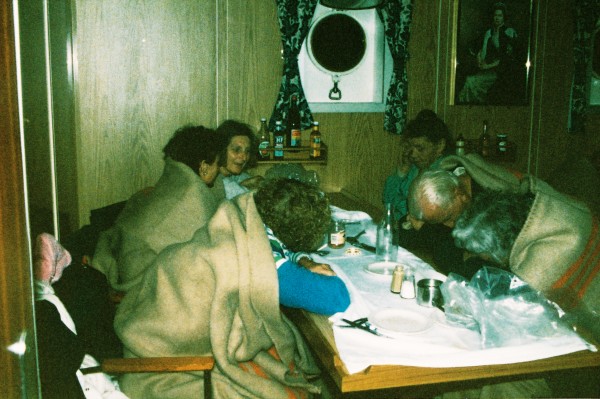
The inter-island ferry Arahura used its lifeboats as lifts to transfer passengers from the Lermontov’s liferafts.Passengers were also taken aboard the LPG tanker Tarihiko, which had steamed at full speed for Port Gore despite being told by the Russian captain it was not needed and there was “no mayday situation.” Suffering from shock and exhaustion, many tried to sleep as the long night of rescue continued.
The lights revealed an apocalyptic imbroglio building up towards a dramatic finale. The water in Lermontov’s torn bulkheads was reaching critical mass, and her list had increased to nearly 40 degrees. There were people hanging in mid-air on rope ladders, life-rafts being swamped and boats spinning out of one another’s way to avoid collisions. The sea was littered with lifejackets, floating deck chairs, ropes and other debris. Somewhere amongst it all, circling the sinking giant, were Baker and Cox in their aluminium dinghy.
“We towed some life-rafts, but that was easier and more safely done with the bigger boats, so we opted for patrolling the starboard side of Lermontov,” David Baker remembers. “She had such a heavy list that you’d expect people to be falling over that side. Both propellers were above water, and we could see that the ship was dying.
“There was a life-raft trapped beneath the stern, water pouring on its roof, and the ship towering above it, about to topple. We were trying to get brave enough to go in and have a look if there was anyone in it, but as we approached a container broke free from the deck and hurtled past, breaking glass, bashing through the railings, making a hell of a noise.
“Then the ship started to sink so fast that we raced off, afraid that she was gonna suck us in. The raft stayed afloat and later we saw that there was no one inside.”
The bridge went under, then the funnel, giving out great bursts of steam. Air trapped inside the ship roared out, lifting up fountains of water 10 metres high and shooting loose objects into the air like missiles. Then everything went quiet. At 10.45 Mikhail Lemontov disappeared from the radar screen.
While Tarihiko and Arahura steamed for Wellington, the search for survivors continued, because none of the rescuers knew for sure how many people had been on board. They sifted through the floating debris, fishing out every horse-collar lifejacket they could find. Based on an earlier passenger manifest (which failed to take account of passengers who had left the ship at Picton), at least 100 people were feared dead, and at 2.30 A.M., when the search was finally called off for the night, there was an atmosphere of a battle lost. Not until 11 A.M., after an aerial search and a precise headcount of passengers in Wellington, was it established that only one crewman, refrigeration engineer Pavel Zaglyadimov, was missing, presumed dead.
*
Over the following days and months there was to be much questioning and speculation about the events of February 16 (see sidebar page 122). But in Port Gore there was a problem of a much more immediate nature: an oil slick had appeared above the sunken ship.
Fifteen hundred kilometres away, Malcolm Blair was stuck in foul weather at the Auckland Islands in the company of five other divers. He had been hunting for the remains of General Grant, wrecked on these inhospitable specks of land in 1866 with the loss of 68 lives and 2576 ounces of gold.
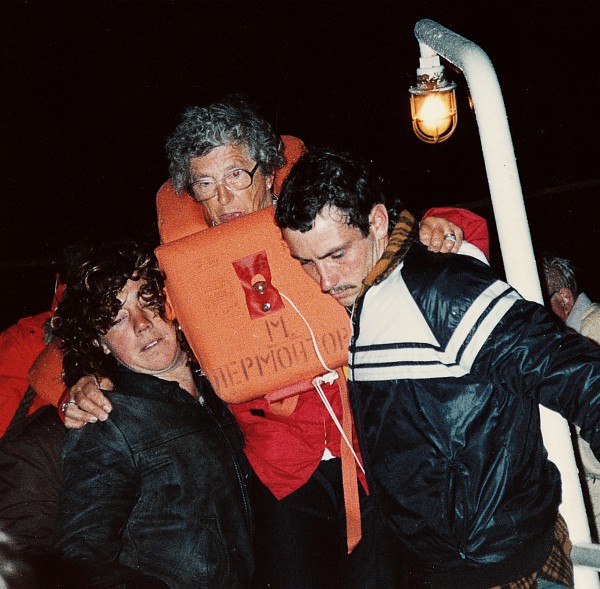
Dressed for summer weather, and for the most part forced to abandon ship with nothing but what they stood up in, many passengers faced an hour or more in open lifeboats, buffeted by wind and rain, before finally being helped aboard Arahura and Tarihiko. One hundred and fifty-one passengers brought claims against the chartering cruise company as a result of the shipwreck
Blair has a focused problemsolver’s face rimmed by a grey beard, wears his wetsuit as if it were a second skin and, had evolution been a little quicker, probably wouldn’t need to use an aqualung any more. He has been in the diving industry for 22 years, established the Divers’ World retail and training network and participated in the laying of the Cook Strait communication cable.
For him and his diving buddies, the sinking of Lermontov couldn’t have come at a better time. Searching for General Grant was costing them $5000 a day, and after eight fruitless weeks they were all—as treasure hunters often are—flat broke. It was then that they received a radio message inviting their salvage company to take part in a joint contract to recover the ship’s safes and other valuables and extract 1500 tonnes of fuel and oil that were still lying in her tanks.
The aftermath: wrap-up or cover-up?
As the hull of Mikhail Lermontov settled into its muddy grave in the Marlborough Sounds, on the other side of Cook Strait, in Wellington’s corridors of power, the wheels of justice and politics were beginning to turn.
Under New Zealand law, an investigation into a maritime disaster begins with a preliminary inquiry to establish the facts of the case, which may then lead to a full inquiry and possible prosecution of the persons deemed responsible.
On this occasion, chief marine inspector Steve Ponsford, an experienced seaman and nautical surveyor, was chosen to reconstruct the events of the fateful night and find out just how the ship was lost.
Within 10 days Ponsford had produced his report. The reason for the sinking, he pronounced, was that Captain Jamison “made a sudden decision to navigate the ship through [Jackson] passage.” He also concluded that although the ship was being directed by the pilot at the time of grounding, the “safe navigation of the ship” was the responsibility of the senior deck officer on watch, Sergey Stepanishchev, standing in for the ship’s master, Vladislav Vorobyov. In other words, it was ultimately the Russians’ problem. And since he had established “beyond any reasonable doubt” the facts leading to the loss of Mikhail Lermontov, Ponsford recommended that “no formal investigation be carried out.”
His report was duly accepted by the Minister of Transport, Richard Prebble. The case was closed. The Russian witnesses were free to return to the USSR. There would be no prosecution arising from the death of the refrigeration engineer.
But it soon came to public attention that the preliminary investigation was not as thorough as it might have been. Suspicion shadowed its results, and it became known not for what it did do but for what it didn’t.
The report stated, for example, that at the time of the grounding Jamison was “in the employ of the Marlborough Harbour Board,” but made no mention of the fact that he was on leave, or that Cape Jackson is outside the board’s pilotage area. (Jamison had a private contract with the ship’s charterers, Charter Travel Company, to pilot the vessel in Milford Sound, but it could be argued that at the time of grounding he was acting for neither the harbour board nor CTC.) The report misstated the ship’s course prior to Jamison’s decision to take the passage (it was 030, not 040 degrees), and claimed the ship grounded on its starboard side (the damage is on the port side).
Discrepancies in the testimony of various witnesses, such as which charts were on hand when the ship grounded and how close the stricken vessel came to the shore in Port Gore, were not investigated, leaving crucial issues of liability unresolved. The fact that Ponsford and Jamison were personal friends was not considered prejudicial, nor was it explained why the pilot was not required to give evidence under oath, while the Russian navigator was.
The decision not to launch a public inquiry denied passengers the opportunity to testify. It also allowed serious allegations about the poor state of lifesaving equipment on board the ship to be cursorily dismissed.
To a public still watching the political twists and turns of the Rainbow Warrior affair, the Ponsford inquiry seemed to wrap up the case a little too neatly and too quickly. Ever since, there has been an air of unfinished business about the sinking, and a certain uneasiness about whether justice was done. Why was the largest shipwreck in New Zealand history not formally investigated? Did it have something to do with maintaining good trade relations with the USSR?
Five years ago, Michael Guerin, a 65-year-old retired Blenheim man, took on the challenge of unravelling the mystery. His book, The Mikhail Lermontov Enigma, published in 1998, gave the first comprehensive account of the sinking, the rescue and the aftermath, and probed the legal and political dimensions of the disaster.
As a former airline pilot who has clocked some 15,000 flying hours, Guerin understands the difficulties faced by the Russian watch officers when the pilot directed the ship into foul ground. They voiced their concern, but to override the decision of an experienced and respected pilot who was also their senior by many years would be a major judgment call—and time was against them.
Guerin likens Jamison’s manoeuvre to trying to take a Boeing 747 under the Auckland Harbour Bridge. Was it an act of professional vanity or a just a monumental gamble?
Like the sea around Lermontov, the deeper you delve the murkier things become, and Guerin’s one-man campaign for truth has raised as many questions as it has found answers. Why, he asks, do many of the official files on the sinking have an access restriction placed on them, requiring Richard Prebble’s permission in order to be viewed? (Guerin believes that some carry the legend: “Never to be seen again.”) And on what basis did the Marlborough Harbour Board pay out $2.5 million to the Baltic Shipping Company, LermontoVs owner, when the sinking happened outside the board’s pilotage area and the pilot was officially on leave?
On the question of why no public inquiry was held into the sinking, Guerin finds the political responses unsatisfactory. Both Prebble and the then prime minister, David Lange, have reiterated that since the Russians had indicated they would not cooperate, a public inquiry would represent an expensive exercise in futility. Ponsford had established the cause; why investigate further?
Guerin counters that, under the rules and protocol governing such things, a public inquiry is warranted if it would throw more light on the cause, establish ways to prevent a similar catastrophe occurring again, examine any areas of negligence, incompetence or misconduct or help to restore public confidence—all of which criteria which would seem to be have been met in the Mikhail Lermontov case.
Tom O’Connor, a 55-year-old former journalist for the Marlborough Express, has his own take on the case. During his decade-long stint as a Blenheim reporter he got to know Jamison well, interviewed the Russian captain and gathered, for the first time, the recollections of the Lermontov passengers. The result of his three years of research is the book Death of a Cruise Ship, to be published in July 1999.
“I believe the Ponsford inquiry was genuine, if somewhat bungled,” he says. “You have to realise that the sinking happened at a time when New Zealand was being left out in the international cold. ANZUS was dead in the water, and the trade door was closing to Europe. The Soviet Union was our great trading hope. And we’d just gone and sunk one of their flashest ships. Can you wonder that there was a political desire to make the Lermontov problem go away.”
O’Connor also believes that the sinking cannot be separated from what he calls “small-town politics at their worst.” Since 1977 there had been a bitter and damaging struggle for power within the ranks of the Marlborough Harbour Board that left the board split into two camps: Jamison in one and the general manager, Mike Goulden, in the other. In 1984, Goulden was sacked. He sued for wrongful dismissal, and the litigation dragged on for three years. During that time, Jamison was acting general manager as well as harbourmaster and pilot.
The legal battle between Goulden and the board was finally settled out of court, but not without an incident that courtroom-drama filmmakers would kill for. A few days after the fateful February 16, Jamison, giving evidence at the hearing, accused Goulden of incompetence in running the harbour board. A member of the Harbours Tribunal stood up and replied: “Mr Jamison, you’ve just succeeded in sinking the biggest ship to go down in peace time since the Titanic, and you’re accusing my client of incompetence?”
“You must understand, though,” says O’Connor, “that Jamison is one of the best mariners in this country. He can dock any ship in Picton, without the use of tugs, and there are not many people who can do that. But at the time of the disaster he was a mental and physical wreck.”
He was an overworked, stressed and exhausted man, O’Connor says, but neither he nor his employers recognised his state, or did anything about it. This doesn’t make writing off a ship and jeopardising the lives of more than 700 people any less reprehensible, but in O’Connor’s view Jamison was as much a victim as he was a perpetrator. And his colleagues were not the only ones at fault in failing to assist a floundering man. LermontoVs officers were also to blame.
Says O’Connor: “Jamison almost ran the ship aground in Shakespeare Bay, and then again off Golden Point, and was reprimanded both times by the captain for being too close to shore. The master could have taken him off the bridge at any time. He chose not to. Stepanishchev could have overruled the pilot’s orders, but didn’t. Several people made serious errors of judgement, and they all compounded and got the ship sunk.”
Back in the USSR, a marine court dealt severely with the three central Russian officers, imposing a four-year suspended prison sentence on Stepanishchev and fining him 20,000 roubles, stripping Vorobyov of his qualifications and assigning him to shore duties and suspending Gusev, the second mate, for three years.
Don Jamison, 65 this year, surrendered his pilot’s licence but was never prosecuted, despite a police recommendation to press charges over the death of the refrigeration engineer.
In the end, although Guerin continues to crusade for justice “to be done and be seen to be done,” and O’Connor hopes that by giving the passengers’ perspective a sense of closure to the Mikhail Lermontov trauma can be found, both authors agree that learning a lesson from the event is far more important than dishing out blame.
Commercial diving is no underwater picnic. It is dirty, cold, dangerous work, with the ever-present risk of the bends and a multitude of other less conspicuous hazards.On Lermontov, Blair and his team would be spending up to an hour a dive at depths of up to 40 metres—the limit of recreational diving—then surfacing rapidly and recompressing in a diving bell or a chamber. They’d be using power tools underwater, including Oxy Arc, a gothrough-anything gas cutting tool, highly pyrophorous if accidentally poked into an unseen airspace containing oil. On a previous job 18 months earlier, diving supervisor Joe Engwirda had his hearing permanently damaged and both eyes blown out of their sockets by an underwater explosion. Apparently he put the eyes back in himself, prompting a round of matey jokes: “You just keep an eye out for us, won’t you, Joe!”
Blair told me that on their first big contract—the salvaging of Pacific Charger, a 10,000-tonne freighter that sank in 1981 at the entrance to Wellington Harbour—they had to use a high-pressure hose to break the oil slick so that the divers could get into the water.
Lermontov would prove an even bigger challenge. The oil spill wasn’t yet as severe, but the immensity of the wreck was overwhelming. The engine room alone was six storeys high. As luck would have it, Aleksandr Pushkin happened to be visiting New Zealand at the time, so the divers could study her layout and draw up a plan of attack. Still, the job would stretch their abilities and redefine the concept of fear. Says Blair: “One night at the dinner table I asked: ‘Hands up all those who weren’t scared today,’ and no hands went up.”
What did they fear? He explains: “Lermontov was relatively cheaply outfitted, all plastic and aluminium and no brass, and because she was lying on her side there was already a lot of structural deterioration.” Walls and partitions were collapsing. There were also numerous sliding doors, some of them poised open above passageways which the divers had to penetrate. Touch a door and it could slide shut like the blade of a guillotine.
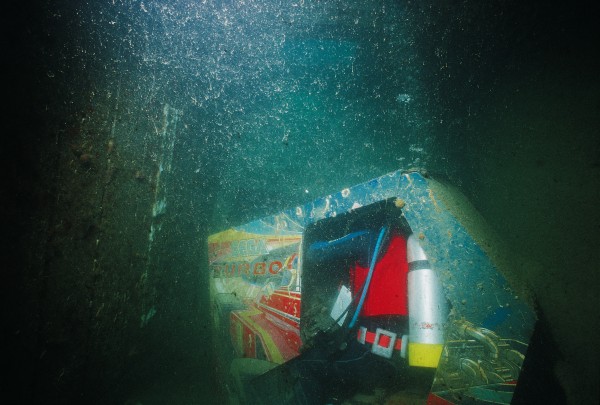
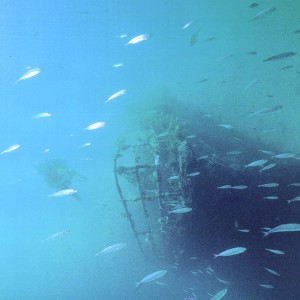
Moments before Mikhail Lermontov slipped beneath the waves, a navy inflatable checked the area for survivors. Uncertainty over the passenger manifest meant that boats continued to scour the bay for hours after the ship had sunk. Officials feared that many dozen passengers were not accounted for, but in fact only one life was lost, that of a Russian refrigeration engineer who had been working in a part of the ship close to where it was holed.Charts marking the location of Mikhail Lermontov carry the warning: “Diving on the wreck is very dangerous. Contact a dive club for information.” The ship has claimed the lives of three divers, and panic-inducing moments of disorientation are reported by most who enter her cavernous bulk. In 1990, when these photographs were taken, the hammer and sickle on the funnel (below) was still clearly visible and a diver could indulge in a pretend game of Space Invaders. The wreck is now in a much more advanced state of decay.
Inside the wreck, the visibility was often so bad the divers had to work by feel, groping their way through the maze of passages and stairways. Even if they could see, they often chose to work with their eyes closed; it was good training for days when you could not read the face of your watch.
The divers, wearing full-face masks not unlike the old brass helmets, were connected to Little Mermaid by their umbilical cords—industrial strength lifelines providing air, hot water to fill the wetsuits and communication cables. From Mermaid’s control room, where the dive coordinator sat in front of a large-scale plan of the wreck, came directions and encouragements:
“Diver One. Go along that wall. Turn left. Go down the staircase. Left again. There should be a door.”
“I’m scared.”
“I know, but you have another 20 minutes. Can you see the door?”
And later: “Diver Two, Diver One has oil all over his mask. Cannot see. Repeat: cannot see. Has to be escorted out. Diver Two, do you copy?”
The salvage team remained anchored over the wreck for three months. They recovered a safe in which the casino and duty-free takings were soggy but intact along with several items of personal bric-a-brac and a case of champagne that turned out to be undrinkable. And they successfully drilled through the hull and tapped the fuel tanks. The tanker Pacific Explorer was summoned and, like a giant mosquito, siphoned off all of Lermontov’s bad blood. An environmental catastrophe averted, residents of the Marlborough Sounds could sleep easy again, and the ship was left to her fate.
And she still lies there today, broken like Mother Russia herself, her infrastructure collapsing, her once-proud hammer and sickle prised off by a souvenir hunter. The crescent-shaped leather couches in the nightclub are still soft, and six-packs of fizzed-out Coke float dreamily above the bar, but otherwise she is an empty carapace gathering silt, a hideaway for fish, a destination for divers.
*
The diveboat sandpiperis a piece of floating Kiwiana, built like many of the vessels that took part in the rescue, slow but solid, with a big icebox up for’ard and a dive platform aft. Her skipper, Frank Carre, wears a T-shirt proclaiming that “Beauty is in the eye of the beer holder,” and promptly shows me a photo album documenting his and Sandpiper’s adventures. There are pictures of monster crays wearing sunglasses, a pile of wild pig carcasses, each with a carry rope through its snout, proud snapshots of men in Swannies and rolled-up balaclavas holding short rods and large fish, gaffed sharks bleeding on the deck.
A Wellington dive club has chartered Sandpiper for a scuba cruise, and her sides are lined with a palisade of tanks. There are about a dozen divers—builders, software consultants, teachers, a couple of scuba instructors, Malcolm Blair is here too—a hardy bunch wriggling into their wetsuits, filling them with hot water against the bone-chilling southerly and the 13-degree sea. It’s a long weekend, a chance to get away from the city, to bring home some crayfish and scallops. Mikhail Lermontov will be the highlight of the trip.
I buddy up with Ross Marett, a Karori builder, who offers to show me around the wreck. From the buoy we drop down along the anchor line and follow the row of windows towards the propellers. After the heavy spring rains the visibility is so bad that at times all I can see are Ross’s fluoro-green flippers wagging in front. It’s dark down here at 30 metres below, and fuzzy shapes appear out of the murk just before you can touch them. The wreck feels like the graveyard in Great Expectations: swathed in thick fog and concealed menace.
Our second dive takes us to the bridge, where Jamison issued his momentous “Port 10” command and where a previous team of divers has rigged up a penetration line. Because the ship lies flat on her starboard side, visiting the bridge resembles swimming up a chimney—that is, if you can convince yourself to enter its narrow “fireplace” end.
For a long while I float outside this rectangular black hole, wrestling with fear. Once inside, there is no visibility at all, and so it makes no difference whether you keep your eyes open or squeeze them shut. There is only the gurgle of exhaled bubbles, faster now than ever before, and the rope leading up into the gloom.
At 30 metres underwater, claustrophobia and blindness are a nasty cocktail. You hover on a constant threshold of panic, where fear dries your throat into a rasp and the mind escalates the slightest snag into a certain death trap. Groping around obstacles, moving upwards in a tight spiral, you pull yourself along, tugging at the rope as if to sound an invisible bell.
For whom would this bell toll? Perhaps for Pavel Zaglyadimov. Maybe for Erica Low, a Wellington diver who in May 1987 became disorientated and drowned, and whose body was not recovered until over a year later. Or for 40-year-old Barry Evans, who swam away from his guideline and was later found floating unconscious in the restaurant area. No amount of first aid would resuscitate him. Lastly, though probably not finally, for a 19-year-old Blenheim youth named Martin Greig, who one July day in 1989 was looking for artefacts in the nightclub with his buddy Deane Armstrong. The silt rose around them, thick like a sandstorm, and when they could no longer see they signalled each other to swim back to the surface. They had no guideline, and on the way up they became separated. Only Armstrong returned to the boat.
“Greig must have ascended at a slight angle, and instead of the roof he hit the entranceway, and followed it, looking for a window,” Kevin Bailey, owner of a Blenheim dive shop told me. “Thinking that he was getting out, he was in fact swimming further into the wreck. Deep inside the water is still and often clear. At that depth he wouldn’t have much air left. Maybe he saw sunlight coming through one of the windows, and bolted for it like a bat out of hell.”
But most windows still have glass in them—thick, solid glass, unbreakable for a diver with nothing but a knife. What desperate panic must have gripped his mind in those last moments?
The following day, Bailey returned to the nightclub and made his way to the entranceway, which leads to a huge spiral staircase. Police divers continued the search inside the wreck for two more days, and reported carpets floating off the floor and curtains poised like fishing nets—one of them had to cut himself free when he became entangled. Greig’s body was never found.
Out through another window, the rope leads me back into the open, where Ross Marett waits, hovering like a ghost. We fin back to the anchor line and up to where, at five metres below Sandpiper’s bow, a safety-stop dive tank rigged with regulators is bobbing up and down like a caricature squid. The closer to daylight, the friendlier the sea becomes. Only later do we learn about a drama that took place behind us.
Kirsten McGhie, a 24-year-old parliamentary clerk, stands on the deck on trembling legs while friends help her to de-kit from a tangle of dive gear. On the way to the bridge she got stuck in a narrow swim-through, snagged by her regulator hose. She had a sudden surge of panic, but managed to fight it off. Her buddy, Anna Barker, was holding her hands, calming her down. Still, Kirsten had bitten off the rubber mouthpiece of her regulator. Now her voice breaks, and a sobbing laughter shakes her body, releasing suppressed tension. The shape of the diving mask is still imprinted on her face, and big tears roll down her cheeks. Or maybe it’s just salt water.
*
As the day ends, we steam towards the shelter of the Sounds, and like many divers before us, we try to solve the riddle of Lermontov. What possessed Don Jamison to take the ship through the gap at Cape Jackson? “He was really tempting fate out there,” I recalled David Baker saying. “You know, you can take a ship through the passage—there is enough water there—but the fit between the pinnacles is impossibly tight. It was like playing Russian roulette with three bullets!”
Why didn’t someone stop him—countermand his order? Did the whole bridge crew, like a pod of pilot whales, experience a collective lapse of navigational reason?
Many who knew Jamison said that he was just too good a pilot to commit such a blunder, and this, combined with the tail end of Cold War paranoia and the governmental hush-up that followed the sinking, only fuelled air-headed speculation. Was the sinking an insurance job? Was Lermontov a spy station disguised as a cruise liner? Did the pilot, in the end, do us all a favour by cleanly chopping off a tentacle of Soviet communism creeping into the South Pacific? If so, he did a thorough job of it. As it was quipped at the time, New Zealand was the only country in the world to have sunk a Russian ship of that size since the end of World War II.
Only Jamison knows the truth, and he’s not telling. Since making his written statement to the preliminary inquiry, in which he claimed his “sudden decision” was the result of mental and physical exhaustion through over-work, he has gone silent, refusing to comment or explain. But can you blame him? Over the past two centuries some 2200 ships and boats have foundered in our coastal waters, splintered on rocks and reefs, pounded by heavy seas after grounding on shifting sandbars—a hefty price for settling and living on oceanic islands. Of all these, Mikhail Lermontov was the largest, the luckiest (in terms of passenger rescue) and the most avoidable, and consequently Jamison has become a kind of antihero, the butt of bar-room jokes. In a maritime nation that wins the America’s Cup and the Whitbread race, where kids learn to sail before they can drive, where how you back the boat trailer down a launching ramp still speaks more of your manhood than any amount of sea-dog braggadocio, it must be hard to be Don Jamison. Especially now that, instead of piloting cruise liners in some of New Zealand’s most scenic waters, he skippers a livestock carrier between Picton and Wellington for a living.
A monument to human error, the decaying hulk of Mikhail Lemontov rests at the bottom of Port Gore. The gashes in her side bear mute witness to a transgression against the mariner’s first law: Don’t play dice with the sea.
It is oddly ironic—prophetic, even—that the lifetime work of Lermontov the writer was the book A Hero of Our Time, its last chapter entitled “The Fatalist.” It is a tale of duels, intrigue and kidnapping set against the lofty panorama of the Caucasus. Lermontov never quite made it to the top of the Russian literary echelon. His prose was still too crude and stuttering; even his translator Vladimir Nabokov, the author of Lolita, called it dry, drab and inelegant. But he had potential. He had the élan, the gift. After Pushkin was shot dead in a duel, Lermontov was heralded to become his literary successor.
never did. One July day in 1841, in the spa resort of Pyatigorsk, as if re-enacting a scene out of his novel, he became engaged in a trivial argument with a fellow officer and challenged him to a duel. Lermontov was shot dead from a distance of six paces. He was 26 years old. Like the sinking of his namesake vessel oneand-a-half centuries later, it was an act of avoidable and nonsensical waste.
Inside Queen Charlotte Sound the water is smooth, and as darkness falls lights begin to twinkle in the windows of homes scattered along the shore. Gathered on Sandpiper’s deck, we are toasting life, reliving our dives, making plans for the next day’s adventures. What we don’t know is that we will not dive Lermontov again—not on this trip. The following day it will be gusting 50 knots in Cook Strait, prompting MetService to issue a storm warning. Cape Jackson will be out of the question.
Later, with characteristic sea-dog machismo, Frank Carre tells me that, of course, he and his boat would have handled the conditions just fine, but for us passengers it would have been miserable. Deck hosing material. No one is arguing. On the one hand, Carre has to live up to the size of the crays in his photo album; on the other, he doesn’t want to turn his boat into another diving destination.
Around here, humility is a mariner’s greatest virtue.