A century ago, in a human frenzy for oil, hundreds of thousands of blue whales died. Can our blues ever recover? (more…)
More by Bill Morris
More by Caroline Morton



The blue whale is an apparition, a water-ghost. We know it best as the biggest creature that has ever lived on Earth—about twice the weight of the largest dinosaurs. But the blues are also fast, and shy, quickly slipping away from the approach of a boat. We know astonishingly little about them.
In a career spent watching the sea, I have seen these whales only twice—once, very briefly, off the coast of Australia, and again in the waters of Chile. There, on a still, fine day, against the snowy backdrop of the Andes, I watched from a small boat as the whales fed. The stupendous animals, nearly twice the size of a city bus, would break the surface to breathe, then, with an arch of a steely grey-blue back, they would vanish for 10 minutes, only to pop up a kilometre away.
Trying to keep tabs on them, as the scientists I was with were trying to do, was extremely difficult. Staring out at a mirror-calm sea, I could only imagine the underwater acrobatics going on beneath us; the whales manoeuvring their bodies towards clouds of krill, opening their aircraft-hangar jaws, swallowing chunks of ocean.
The speed and evasiveness of the blues kept them safe from humans, even while slower-moving whales were hunted by whalers hurling harpoons from sailing ships and rowboats. But at the end of the 19th century, two inventions changed everything. First came steam power: the chaser boats could suddenly keep pace with a blue, and maintain that speed as long as the coal held out. Mounted on these boats were harpoon guns. These devices fired an explosive-tipped harpoon which detonated on impact, shattering flesh and pulverising organs. Now, even the fastest whales stood little chance.
There was no end to the demand for whale oil. It was used to lubricate everything from sewing machines to rifles, and was turned into cooking oil, soap and margarine. Blue whales, bearing the biggest payload, were soon being decimated across the northern hemisphere. As those populations waned, the whalers went in search of new hunting grounds.
*
After that day watching blues off the coast of Chile, local scientist Rodrigo Hucke-Gaete handed me a copy of George Small’s 1971 book, The Blue Whale. I read for the first time about Norwegian mariner Carl Anton Larsen, the man who, perhaps more than any other, would determine the fate of the blue whale in the early 20th century.
Deeply religious, scientifically curious, a formidable sailor and inspirational leader, Larsen was the son of a sea-captain in Vestfold, Norway, the epicentre of the world’s modern whaling industry. He went to sea at the age of nine, and cut his teeth hunting bottlenose whales, but it was his explorations of Antarctica that would make him famous. A ship he captained was crushed in ice while trying to rescue a shore party. Larsen and his crew spent 14 days ice-hopping to a tiny island, where they overwintered for eight months, surviving on penguins and seals. There is an ice shelf named for him; he collected plant fossils that changed our understanding of the planet’s history. His Antarctic exploits rival those of Shackleton, Amundsen and Scott, yet his legacy is more complicated, and darker. He opened up vast areas of the frozen continent to science, but he also caused unimaginable destruction.
Larsen was 32 when he first laid eyes on Antarctica’s whales. “Blue whale frolicked in countless shoals, as well as the humpback,” he wrote, during a recce to the Antarctic Peninsula. Hamstrung by a lack of proper killing equipment, Larsen had to watch the whales feed unmolested—their guttural exhalations sprouting in the cold air as far as he could see. God, he felt, had put these animals on Earth for man to harvest. That spouting sea would haunt him.
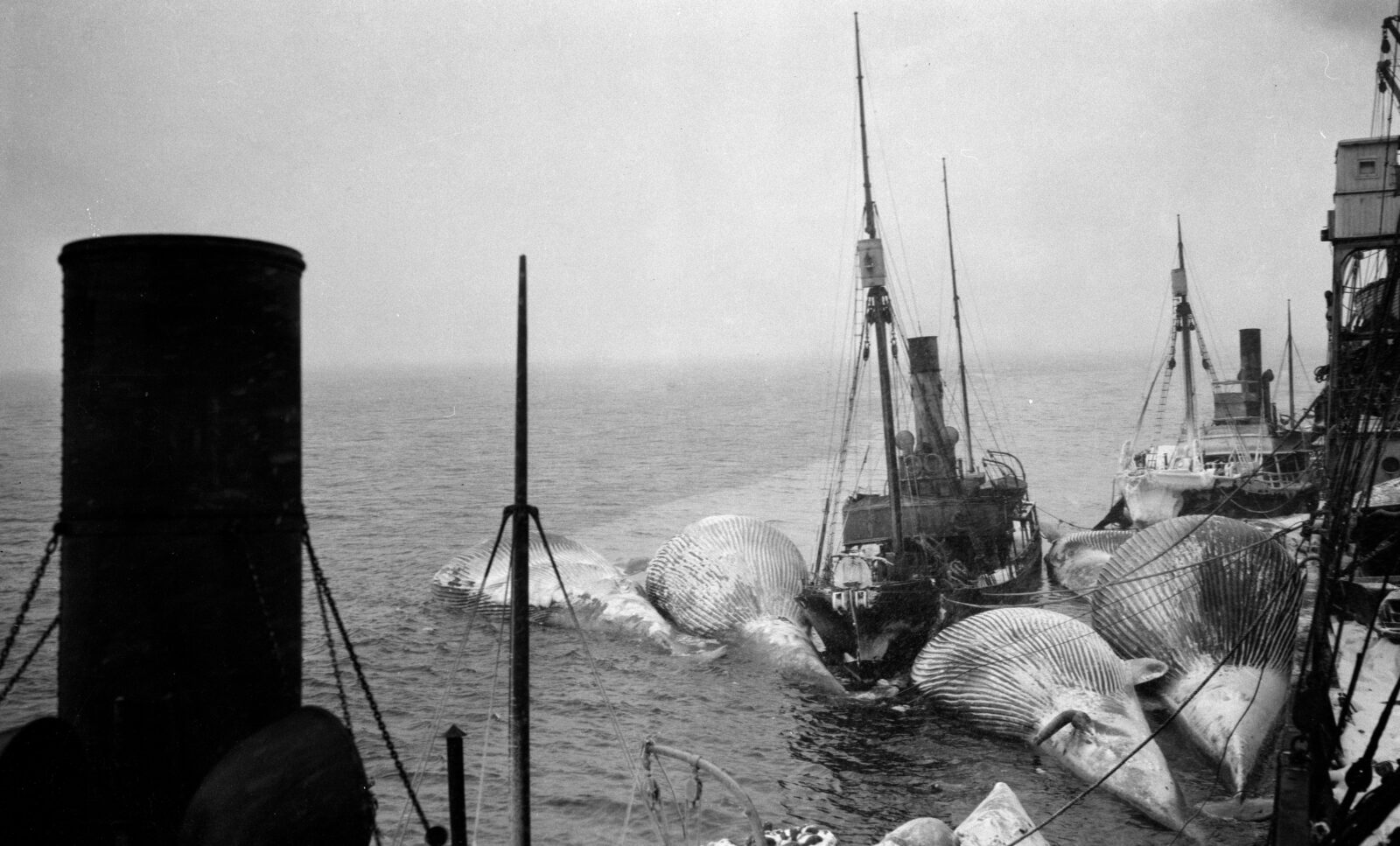
A decade later, in 1904, Larsen was back and ready to hunt. In the years that followed, he and his competitors, armed with steam vessels and harpoon guns, slaughtered whales in their tens of thousands. Humpbacks, fins and sei whales were all targets, but the greatest prize of all was the enormous blue.
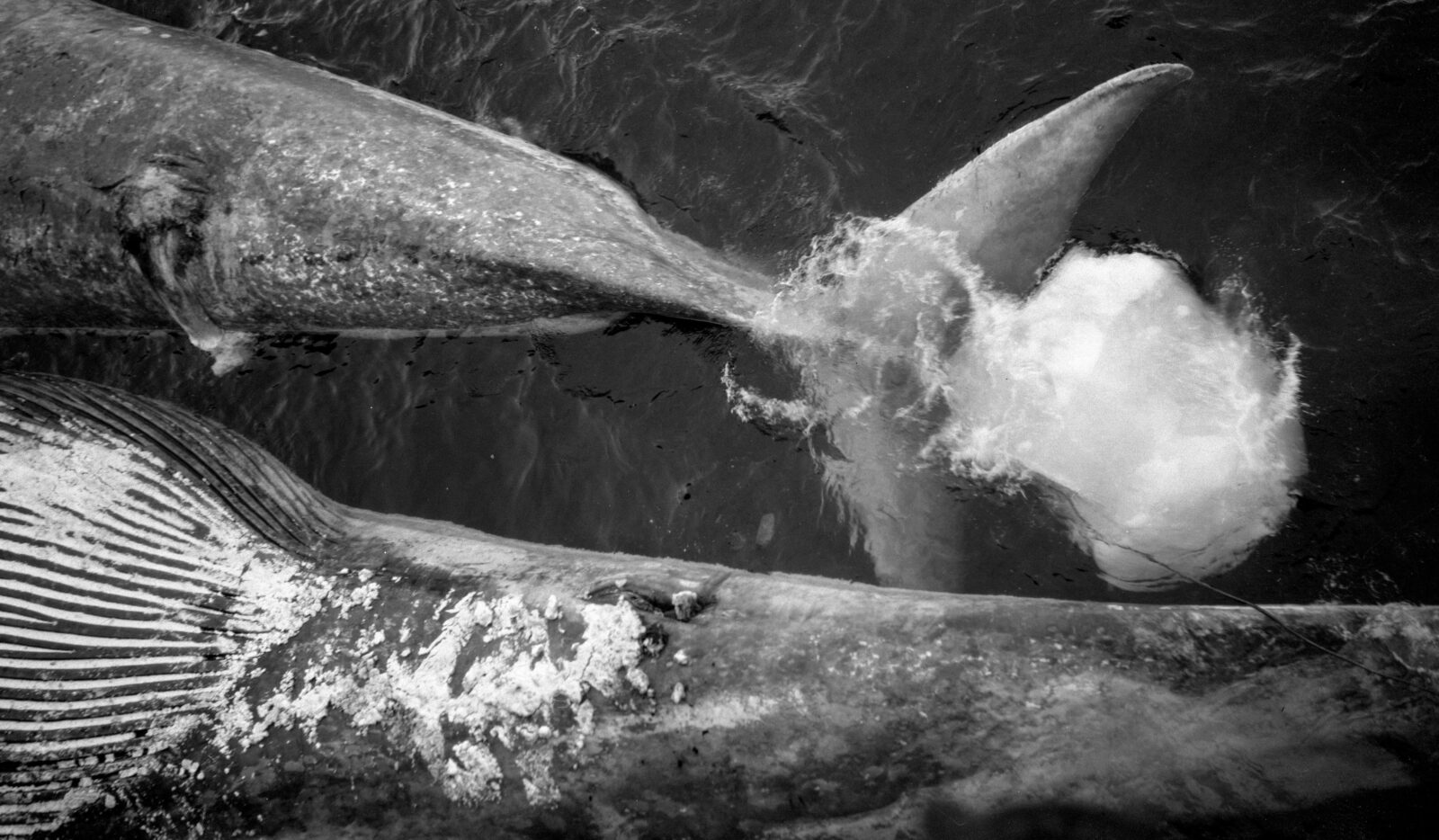
The whalers killed them like gamebirds, leaving braces of bloated carcasses littering the sea. They would pump each carcass full of air and stick a flag in it—to claim it as theirs—before moving on to other whales in the pod. Many carcasses were lost, either sinking or drifting out of sight. There were so many whales around that the hunters spent little time looking for those that were lost. It was more efficient to simply kill another. Thousands of blue whales—by one estimate, up to a quarter of those killed during this period—ended up sinking to the seafloor, having died for nothing.
Larsen was already thinking about what lay on the other side of Antarctica. South of New Zealand was a great bay, guarded by a dense, dangerous barrier of sea ice. This was the Ross Sea, the final frontier of whaling. Only a few exploring expeditions had penetrated it, and all had reported masses of whales. But it would take a master of the trade to crack this glittering prize.
*
Who ran the Ross Sea? Britain, perhaps. Ever the diplomat, Larsen applied for a permit. Britain passed that decision, like a hot potato, to New Zealand, racing to establish the Ross Dependency, a 450,000-square kilometre wedge of land, ice and sea that would now be administered by our Governor-General.
The Norwegians paid New Zealand £200 a year for the right to hunt these waters; about NZ$26,000 in today’s money. A single blue whale would cover that fee three times over. (The whalers also paid a very small royalty on every barrel of oil after the first 20,000.)
In 1923, Larsen sailed from Hobart aboard James Clark Ross, a cargo ship he’d had converted to a whaling factory. In attendance were five fast, deadly whale chasers—Stars 1, 2, 3, 4 and 5.
Young Australian writer Alan Villiers came along to document the voyage in the book Whaling in the Frozen South. After eight days shouldering through the pack ice, the ship “shuddering and quivering, vibrating in every rivet, shaking and groaning from truck to keel”, James Clark Ross limped into the Ross Sea region, towards the living bonanza Larsen had been eyeing for so long. Its chaser swarm fanned out in search of whales.
Villiers recorded the first kill. “With a boom and a roar, a deluge of flying, twisted pads, a reek of explosive, the great shell-pointed steel harpoon flew out, and in a flurry of boiling foam the stricken leviathan sounded deep into the depths, in a terrible effort to rid himself of the burning steel.
“Despite the explosion in his body… the great monster refused to die. As long as he could he remained below, struggling madly to free himself, but at length he was forced to the surface again for air. As he rose… the gun spoke once more and a second harpoon flew into the mountain of blubber and flesh. Scarcely two minutes later the great whale lay, a mountain of death, suspended on the harpoon line fathoms below the gently rippling surface.”
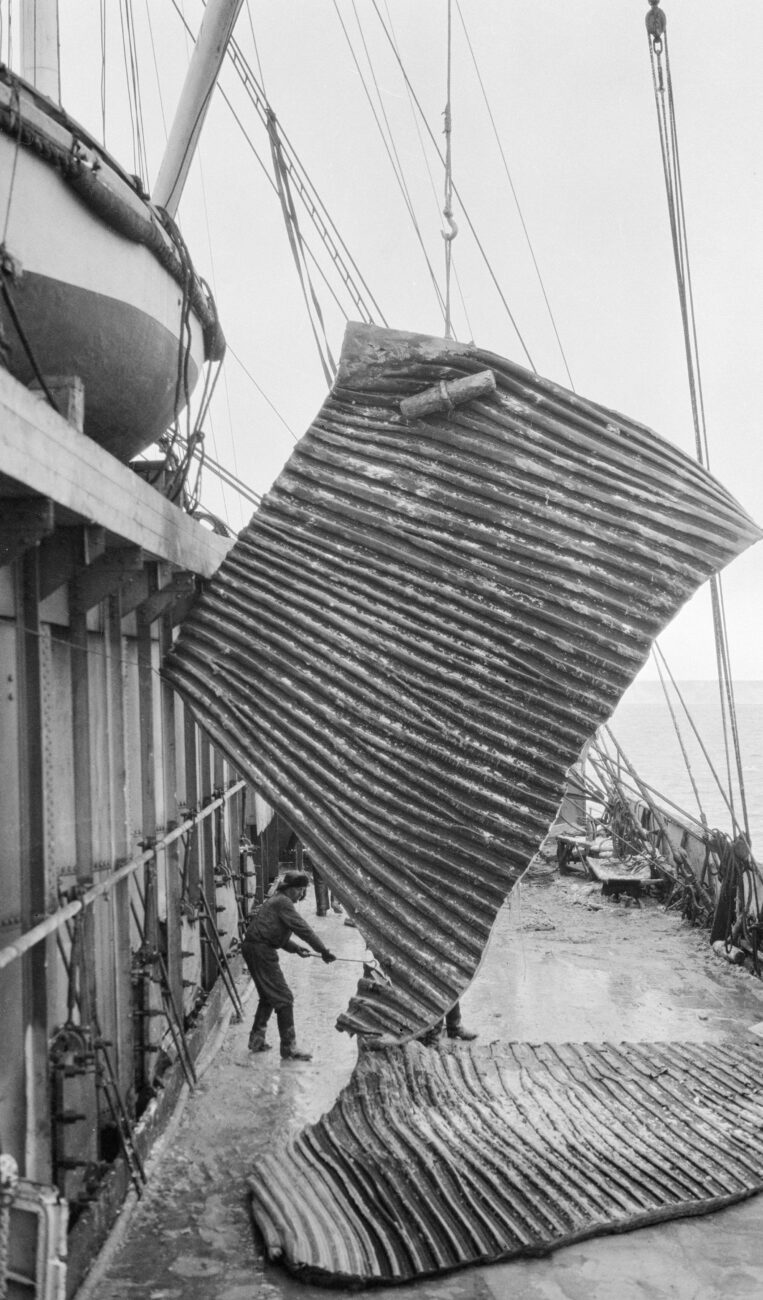
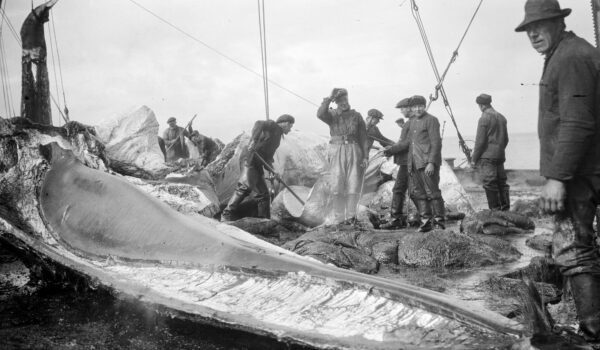
There was, Villiers recalled, little in the way of celebration. The stoic Norwegians simply got on with what they were there to do, flensing the whale and reducing it to oil. That was no easy task. Each carcass had to be cut up alongside the rolling ship, the men working from dinghies. It was hard, dangerous work in brutally cold conditions, sometimes down to -30 degrees Celsius. The blubber often froze as soon as it was pulled from the water. “The whales are as hard as wood,” wrote Larsen. In these temperatures, the flensing knives were useless; the blubber had to be chopped up with axes. At times, the crew refused to work.
The job of processing the slabs of blubber was continuous—a “strange wild scene”, according to Villiers. “The foredeck is a confused mass of creamy, gore-stained blubber, in the midst of which high-booted, canvas-clad men work, some slicing the big sheets of blubber into small, regular pieces, others dragging these across the deck to the chute down which they fall to be cut into a thousand bits by the keen-edged rotating knives.
“Aft, a huge carcass is on deck being stripped and riven from head to tail and fed into two great pressing cylinders until there is nothing left but grease.”
These blue whales were the biggest and fattest the whalers had ever seen. One 33-metre monster captured on this voyage is thought to have been the largest ever killed.
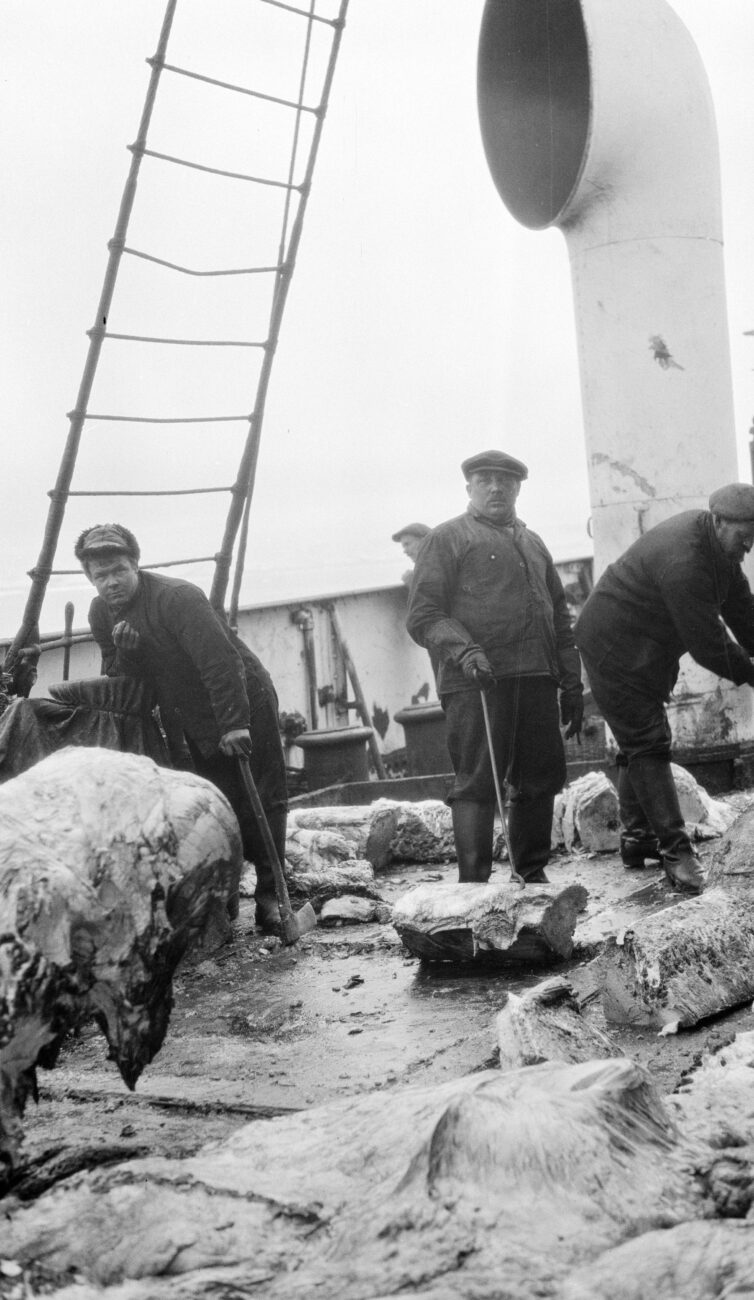
The permit said the entire carcass of each whale had to be utilised, but in practice, only the blubber was taken. “If whales are plentiful, who is going to bother to render down the carcass?” wrote Villiers. “It is easier, faster, more economical, more profitable to strip the blubber and let the carcass go.” Almost every female the whalers killed, he reported, was in calf.
That first voyage netted 221 whales, mostly blues. The following season, the Norwegians established a base in Paterson Inlet on Stewart Island/Rakiura—it was from here they departed in the spring of 1924.
Shortly after leaving, Larsen fell ill with heart pain. Somewhere south of Campbell Island, as James Clark Ross steamed resolutely into the Southern Ocean, the great captain died in his sleep. He was 64 years old. His body was embalmed and kept in his cabin until it could be returned to Norway. That year, there was no ice pack to navigate. The whalers entered the Ross Sea region easily, and in short order dispatched 407 whales.
*
Larsen’s vision was fully realised the following season, when James Clark Ross made a record catch: 28 whales in a single day. “Whales, huge, fat fishes, far too many of them,” a ship’s log records. “Masses of meat and bone were wasted in favour of boiling blubber.”
In the perpetual daylight of the polar summer, crews worked around the clock flensing whales. A typical shift started on the frozen deck at 6am and lasted for 12 hours, with stops for coffee, and meals of bread, tinned fish and whale meat. There were few days off. The voyages lasted until the holds were full of oil—which could take four months, by which time the bay was starting to ice over and temperatures were plunging.
As the Norwegians headed back season after season, Stewart Islanders joined the crews. One of these, Bill Hamilton, records in his diary the monotony of shovelling coal to keep the chaser boats going, the long hours, and the cold that “freezes our breath and forms icicles in our whiskers”.
“We are treated more like dogs than human beings,” he wrote.
In 1926, a bigger factory boat, named CA Larsen in honour of their erstwhile leader, was brought out from Norway to join James Clark Ross. This boat had a slipway in the bow, a great mouth through which whales were hauled aboard and processed.
At the end of the voyage, the motherships headed back to the northern hemisphere to deliver oil to market, but the chasers and many of the crew remained on Rakiura. Rest was not on the agenda—after months being beaten up by the ice, the boats needed extensive repairs and the men had to work frantically to get them ready in time for the return of the factory ships. Despite language difficulties, the Norwegians soon became an integral part of the island’s small community. Norwegian celebrations appeared on Rakiura’s social calendar and some of the whalers married local women.
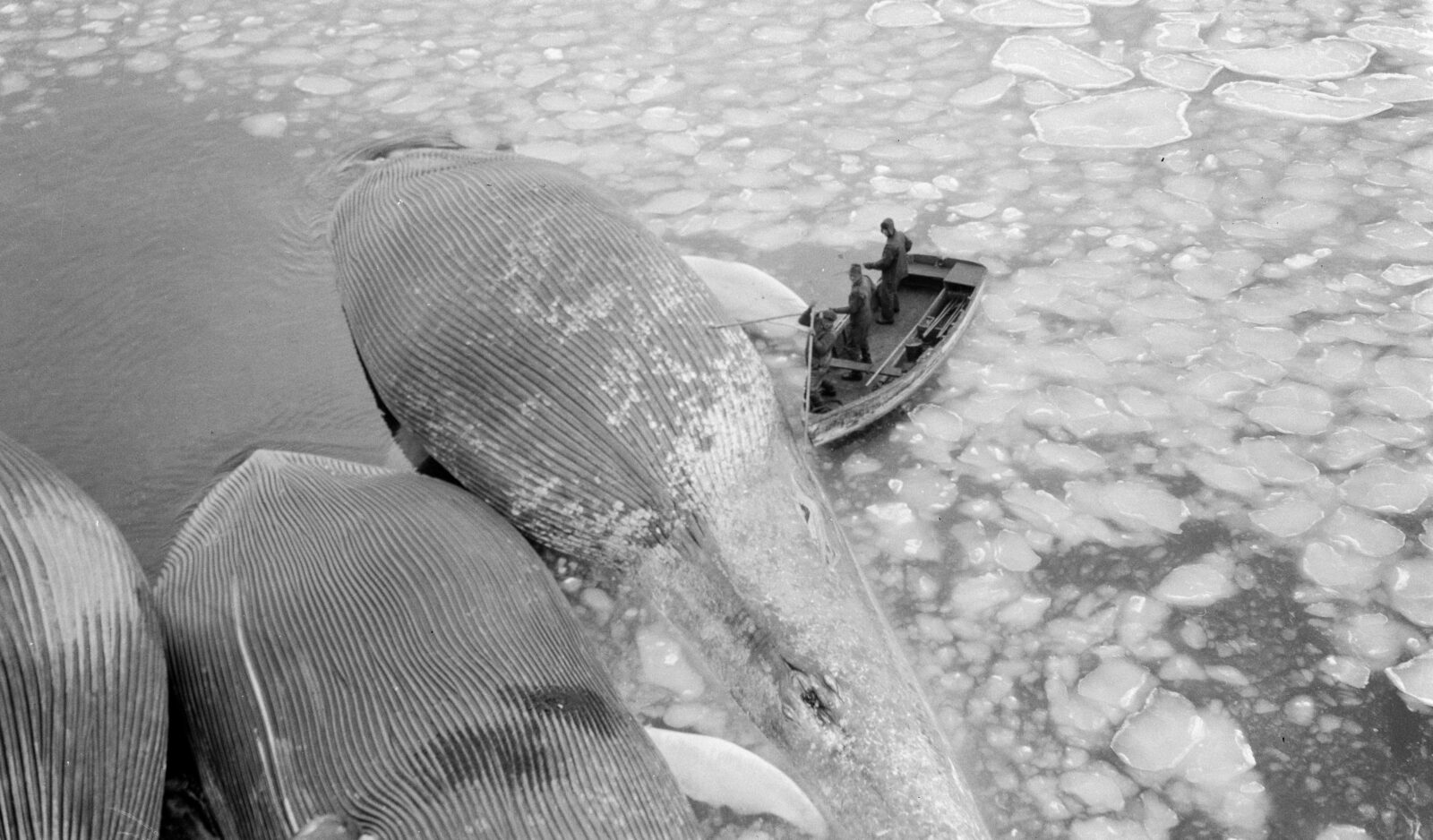
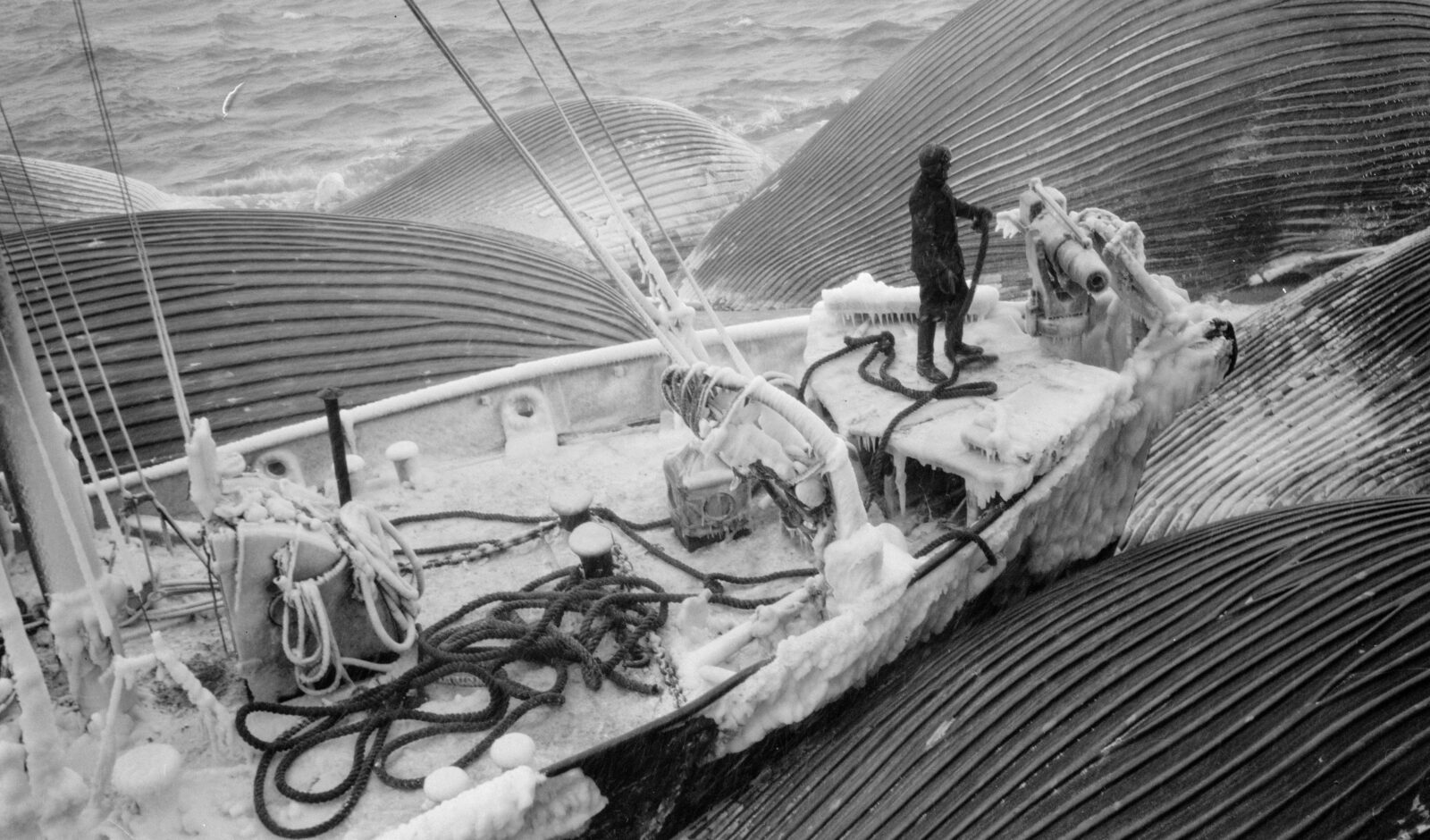
Jim Watt, a New Zealander who interviewed surviving whalers for a book about the era, is at pains to point out the whalers “were not, as some wish to believe, blood-lusting Vikings out to plunder Antarctic waters. On the contrary, they were ordinary men who were simply earning a wage to support their families at home.” The same could not be said for the oil company suits back home, who wrote their balance sheets with the blood of New Zealand whales.
Other whalers from Norway and Britain soon joined the frenzy. By 1929, says Watt, the region “was open slather”. Some of these new arrivals were unlicensed. Among them was the Norwegian Kosmos, the world’s first purpose-built floating whale factory, which boasted a crew of 327, a chaser fleet of seven ships and a spotter plane. This whale-eating monster took nearly 1000 blue whales out of the Ross Sea region in the season of 1929/30, then sailed brazenly into Wellington Harbour with 116,000 barrels of oil, a world record. In today’s money, this haul was worth at least NZ$64 million.
The New Zealand government, says Watt, was powerless to act. “We didn’t have a Navy big enough to do anything.” Attempts to get a local whaling company off the ground—to claim our own slice of the pie—came to nought.
*
In one terrible year, 1931, nearly 30,000 blue whales were killed in Antarctic waters. Most of these whales died to make margarine—at the time up to 84 per cent of the world’s whale oil was used for that purpose.
The whaling industry became a victim of its own success. A glut hit the market and dragged through three seasons. The Norwegians departed Rakiura for good, leaving, says Watt, a big hole in the fabric of Rakiura society. “The feeling was that the soul had gone right out of the place.”
There was no reprieve for the blues. George Small’s book charts with methodical outrage the further decline of the species and the abject failure of the global community to stop it. As the number of whales dwindled, the chaser fleets worked even harder to kill them. In 1946, the International Whaling Commission was set up to regulate the industry. But whaling nations, ignoring unassailable evidence that blue whales were headed for extinction, wielded what was in effect veto power, collapsing or weakening resolution after resolution.
In the 1950s, dwindling whale stocks around Antarctica forced whalers north, where the Japanese found a previously unknown group of blue whales in the Indian Ocean. These were slightly smaller than the Antarctic monsters, and it was decided they were a separate subspecies—the pygmy blue. The Japanese immediately got to work killing them.
By 1963, the Whaling Commission’s scientific experts were of the opinion the blue whale as a species was probably beyond recovery. Facing stern opposition to a total ban from countries like Japan and the Soviet Union, the Commission permitted the slaughter to continue in some areas. In 1965, a global whaling fleet of 15 factory ships, supported by 172 catcher vessels, was only able to kill 20 blue whales. Finally, writes Small, “whaling nations, with a kind of sanctimonious perversity, agreed to stop killing whales when there were no more to be found”.
Incredibly, and tragically, this was not the end of it. The Soviet Union had unleashed seven enormous factory whaling fleets and over the next two decades, these would stalk the world’s seas, illegally slaughtering any whale that crossed their path.
Mothers and calves, protected blue whales and right whales—nothing was off limits. The Soviet whalers raced to meet arbitrary and ever-increasing production targets that bore little relation to market demand. Catches were falsified and hugely underreported, so the true scale of the hunt would only come to light decades later. Sweeping into the Pacific, the fleets discovered more populations of pygmy blue whales, and massacred them. One of these was off the west coast of New Zealand. We now know Soviet whalers killed 400 blue whales in the Tasman Sea during those years. The species’ decimation was very nearly total. There are thought to have been a quarter of a million of these miraculous animals in the Southern Ocean at the start of commercial whaling. By the 1970s, there were probably just a few hundred left.
*
George Small wrote The Blue Whale as an epitaph to a species he thought was on its way out. It’s a fable of unbridled human avarice—and how powerless we are to stop it on the high seas. Reading it shocked me to the core, and I’ve carried a copy with me ever since. But his book is 55 years old now, and the blues are rallying.
Before we learned to kill them, the blue whale had just one predator—orcas. The whales developed a song of such low frequency that orcas can’t hear it. Neither can we, really. Only the highest frequencies of this song are audible to us, and these are more of an organ-shaking rumble than a melody. It’s thought blue whales can sing across hundreds, even thousands of kilometres. Perhaps, in the aftermath of whaling, it is this long-distance broadcasting that is allowing the last remaining blues to find each other again, and to breed.
In 2018, scientists dropped hydrophones into the waters around South Georgia, where Larsen started his hunt; they heard only one blue whale. Two years later, University of Auckland scientist Emma Carroll and her colleague Jen Jackson, from the British Antarctic Survey, did the same thing in the same seas and made an extraordinary discovery. They recorded the rumble of blue whales—dozens of them. A century after they were silenced there, the blues were coming back. “Superpods” of other whale species in the area—up to 500 in a group—are now delighting scientists and tourists. “The recovery that we’re seeing in multiple species is pretty spectacular,” says Carroll.
Blue whales—the Antarctic giants as well as the pygmies—have been seen, or at least heard, all around the New Zealand coast in recent years.
Far off the shore of Taranaki, the population of pygmy blues that was hammered by the Soviets appears to be doing well; there are now thought to be about 1000 animals parked there year-round, feeding in upwelling currents.
Eight years ago, Mike Ogle, a marine technical adviser with the Department of Conservation, was part of a NIWA team that spent just over a week whale-spotting in the region. They saw 16 blues and managed to attach satellite tags to two of those. (You get only one chance to get within tagging distance of a blue, their paper notes wryly.)
The team then watched, marvelling, as one of those whales circumnavigated the South Island in seven weeks. “It’s just phenomenal, the ground these large animals can cover,” Ogle says. “We’re truly privileged to have them.”
Like me, Ogle still remembers clearly the first time a blue whale surfaced beside a boat he was on. He shows me a map dotted with dozens of pins marking similar encounters: those breathtaking moments in which a reticent giant allowed us a glimpse.
Being a blue whale is an exercise in operating at scale. Efficiency is all. A blue spends most of its life swimming about 10 metres below the surface, deep enough to avoid the surge and chop of the surface against that huge body. Deep enough, too, to slide past a boat unobserved.
But blue whales, those apparitions of the sea, are coming into the light. Staff of Whale Watch Kaikōura are now seeing blues every couple of months; in the past few years, Auckland Whale & Dolphin Safari report, they’ve spotted more blue whales in the Hauraki Gulf than ever before. Pilots in small planes have the best seat in the house. Those flying between Tākaka and Wellington now frequently spot blue whales from the air, says Richard Molloy, who runs Golden Bay Air; the record for his company is five in one flight. “There’s no mistaking them,” he says. You know it’s a blue whale because it’s ultramarine, almost luminous, unlike anything else in the ocean.
More by Bill Morris
More by Caroline Morton
Subscribe to our free newsletter for news and prizes
3
$1 trial for two weeks, thereafter $8.50 every two months, cancel any time
Signed in as . Sign out