Some traits are so nice that evolution made them twice. Or thrice. Complex intelligence, for example, and caffeine. But is it true that everything, eventually, is going to become a crab? (more…)
More by Rebekah White
More by Kay Lawson



Mattias Krantz had always wanted to teach an animal to play the piano, and last year, he decided that the time had come. Which animal, though? Obviously a smart one.
And so he bought an octopus from a seafood dealer, figuring that eight arms could play some pretty impressive chords. He knew that each arm had its own form of brain, too, because an octopus’s neural cells are spread around its body, whereas most animals keep their brains in their head. “It’s like eight pianists in one body,” Krantz said.
Next, Krantz set about building an underwater keyboard that the octopus, which he named Takoyaki, could play. He rigged vertical pegs on the keys, figuring Tako would find it easier to wrap a tentacle around a peg and pull. He connected the keyboard to a speaker that transmitted vibrations, as octopuses don’t have ears. And he sat back to watch Tako perform.
But Tako did everything except play his piano. He sat on it, lifted it up, tried to pull it apart, and tasted it. Then he floated away, as though disappointed, and resumed his main occupation of staring into the void. Producing sound vibrations seemed neither fun nor existentially satisfying to the octopus.
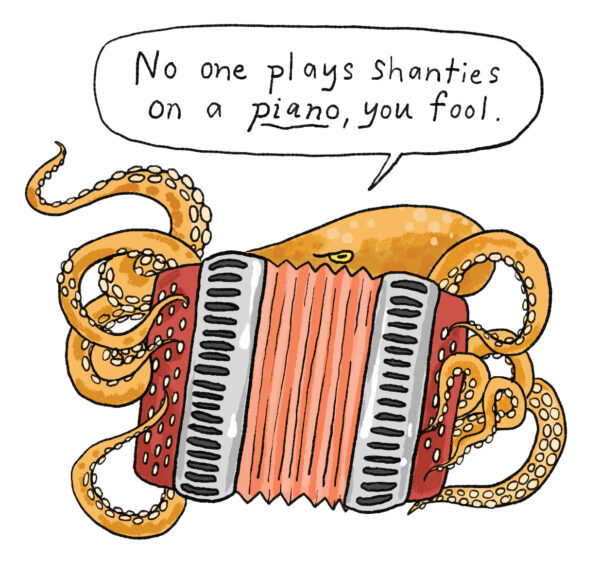
Krantz sought advice from a couple of scientists, and resolved to train Tako to play. First, he tried to make the keys more appealling—rigging lights to flash within them, or wiggling the keys in the hope of attracting the octopus’s attention with motion. Neither worked. Next, he began releasing tiny crabs—Tako’s favourite snack—into the tank whenever the octopus successfully played a few notes. That was more successful. After six months of crab-based training and engineering tweaks, Krantz was finally able to pull out his guitar and strum an accompaniment as Tako plonked away.
Krantz isn’t a scientist; he’s an engineer and YouTuber who builds bizarre musical instruments. His video about Tako and the keyboard demonstrates that while the octopus is smart, Tako is driven by a totally different set of priorities and compulsions—and it’s very hard to figure out what those are.
*
Perhaps we’ll never understand what an octopus finds important, or what Tako is thinking about when he dangles in the water, slowly changing colour. The brainpower of an octopus is absolutely different from ours. We have less in common with them than we do with every other animal considered to be intelligent, like crows, parrots, elephants, apes, dolphins or whales.
That’s because the human and octopus family trees split apart a long, long time ago. You have to go back 600 million years to find our last common ancestor: a small, squashed-looking worm that lived in the sea.
To understand the distance between octopuses and us, imagine the children of this worm. One line of descendants develops backbones and evolves into birds, mammals and humans. Another line eschews the internal skeleton and evolves into molluscs, like snails and shellfish, and cephalopods, like cuttlefish and octopuses.
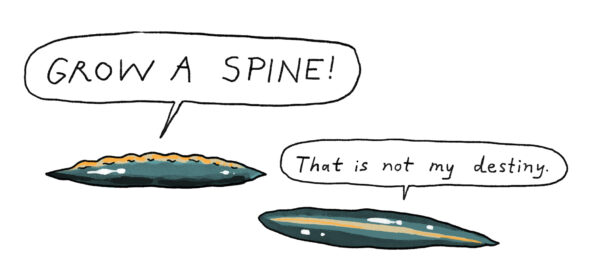
Our branch of the family tree contains all the other animals we think are smart, from kea to chimpanzees. But the cephalopod branch is full of species like oysters and snails, which are not exactly known for their genius. Somehow, alone in this group, octopuses evolved very large nervous systems, the ability to recognise people, and the ability to deceive them. They are very weird for intelligent animals, points out science writer Ed Yong: most smart animals are long-lived, since it takes ages to grow a large brain, and they mostly live in large communities. (One theory holds that their brains got so big partly in order to keep track of everybody.) Octopuses, though, are famously antisocial, and barely make it to their second birthday. So why did they get so smart?
In 2019, a group of scientists suggested that octopuses evolved complex brains so that they could lead complex lives. Octopuses don’t have a safe home in the form of a shell or a crevice or a school of fellow cephalopods to defend them from predators; in fact, they totally lack protection. (One octopus researcher, Mark Norman, describes them as “rump steak swimming around”.) Instead, they live by their wits.
“They did this on an entirely separate evolutionary path from ours,” writes the Australian science philosopher Peter Godfrey-Smith in his book Other Minds. That makes octopuses “an independent experiment” in big brainpower, he writes. “Evolution built minds twice over. This is probably the closest we will come to meeting an intelligent alien.”
*
Some evolutionary traits just make common sense, and so they’ve developed more than once, like the same discovery being made by different scientists in different parts of the world. Complex intelligence, at least in the form we recognise, hasn’t turned up all that often, but some other traits have. Birds and bats both evolved flight. At least four different groups of fish evolved the ability to generate electric shocks. Jellyfish and mammals both evolved eyes that function like cameras, with a lens that projects an image onto a retina. The hummingbird hawk-moth can hover, just like its namesake, and sip nectar from flowers: it looks like an AI mashup of a bird and an insect. Extremely organised societies, where every member has a specific role in the colony, evolved in animal families as diverse as bees, termites, and naked mole rats (there’s even a naked mole rat queen).
This is called convergent evolution: the same invention occuring more than once. Of course, evolution doesn’t actually “invent” anything; animals look or act the way they do because those features gave them a survival advantage in some way. It’s helpful to be able to fly when your enemies are on the ground. Just as, in the deep sea, it’s extremely advantageous to grow a body shaped like a torpedo so that you’re faster than the competition. “Mako sharks and marlin and tuna and swordfish, they’re all very distantly related to each other, but they’ve all evolved the same body form,” says Clinton Duffy, marine biology curator at Auckland Museum. “You could almost say they’re on either side of the evolutionary tree. Bony fishes and sharks diverged 450 million years ago, so they’ve been apart a long, long time, but they’ve all evolved the same body design.”
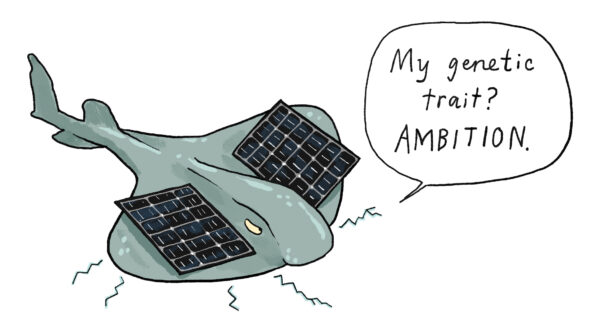
Tuna also evolved warm-bloodedness—and for a different reason from us. Mammals and birds are warm-blooded because it allows us to be active at all hours of the day: we don’t have to slow down as the sun sets, like reptiles do.
Tuna are warm-blooded for reasons of speed. Heat accelerates the chemical reactions that take place in the cell, says Duffy. “It speeds up all their physiological functions, so they’re able to swim faster than their prey. It just allows everything to happen quicker. It allows them to generate more power from their muscles and increases their reaction times. It just gives them that edge over the things they’re chasing.”
And then there are crabs.
*
When Robert Falcon Scott set out for Antarctica in 1910 aboard Terra Nova, he had an extravagantly named zoologist on board: Lancelot Alexander Borradaile. On the frozen continent, Borradaile busied himself collecting animals, including a number of pale-coloured hermit crabs from the genus Porcellanopagurus. Or, at least, they looked like crabs. But Borradaile knew they weren’t true crabs. They were, rather, “one of the many attempts of Nature to evolve a crab”, he wrote in 1916, never to learn that this statement would set off a flurry of internet memes more than a century later.
In 2017, scientists reported that crabs have evolved five separate times. Their features are just too useful: a flat profile, handy for hiding in rock crevices; two ginormous front arms, officially called chelipeds, to defend that crevice from intruders. “Everything on the reef wants to eat you if you’re a crustacean, you know,” says Duffy. “Crustaceans are tiny and tasty little morsels.”
Borradaile named the process of evolving these traits “carcinisation”, which essentially means “crabbification”. The true crabs, the first to nail the format, turned up during the Early Jurassic period around 200 million years ago. Since then, four families of false crabs have emerged: king crabs, porcelain crabs, hermit crabs, and hairy stone crabs (which look exactly how they sound).
Between 145 million and 66 million years ago, crab diversity boomed. Today, there are crabs with long, hairy arms, crabs which look like rocks, crabs which look like frogs, crabs the size of a pea, purple crabs, blue crabs, green crabs, decorator crabs, and giant spider crabs four metres wide, which would certainly not be able to fit into your car, even if you wanted to take one home.
In 2019, a joke began to spread online that the crab is the pinnacle of evolutionary form, and this turned into a series of increasingly biologically inaccurate memes, claiming that everything, eventually, will be a crab, and that crab-form is humans’ eventual destiny. This isn’t true, fortunately—or unfortunately, depending on how you feel. (For starters, we have our skeletons on the wrong side of our body—inside, rather than outside.)
Crabs are not always the answer, says Joanna Wolfe, an evolutionary biologist at Harvard, in a Scientific American article. There’s also a phenomenon called “decarcinisation”—uncrabbification, more casually. We know from the fossil record that some crabs abandoned the shape, ditching their distinctively flat, compact forms and evolving longer bodies once again. For them, the crab wasn’t the pinnacle of success.
Just because crabs emerged over and over again doesn’t mean they’re the optimal crustacean form.
Evolution sometimes takes some weird pathways, says Wolfe, leaving animals with traits of questionable usefulness.
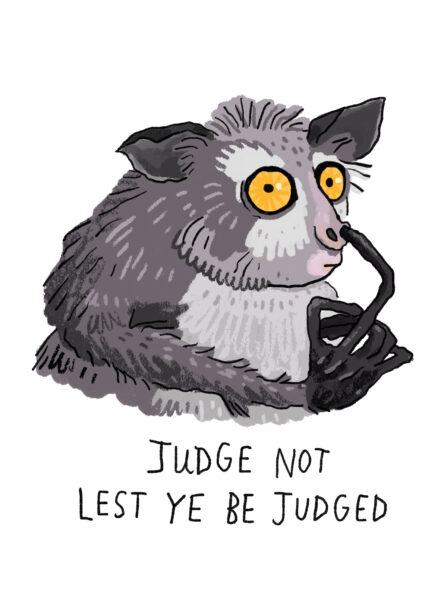
Take the aye-aye, which is a type of lemur: it has way longer fingers than any other lemur, but it appears to use them primarily to pick its nose, rather than for some task crucial to survival. “If the same adaptations were always optimal,” says Wolfe, “strange ones like this would not exist.”
*
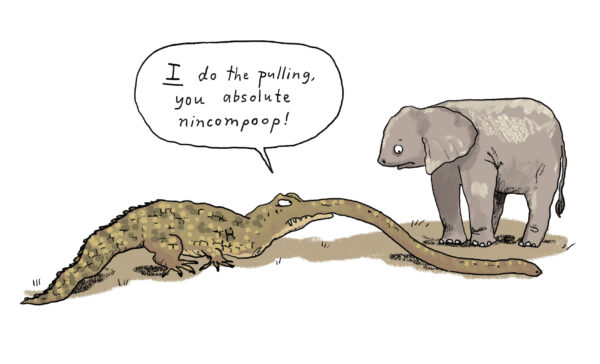
According to Rudyard Kipling’s Just So Stories, the inspiration for this column, elephants used to have small, stubby noses—until a young and overly curious elephant got too close to a crocodile on the banks of the Limpopo River. The crocodile seized the young elephant by the nose, the young elephant pulled back, and the resulting tug-of-war stretched his nose into a long, thin trunk. The young elephant, at first ashamed of his new look, quickly found his nose extension very useful, and before long, the rest of his family had trekked to the river to have the crocodile stretch out their noses, too.
The truth of this story is that elongated noses give their wearers a huge advantage—so they have evolved multiple times in different animal family groups, from tapirs to proboscis monkeys to elephants. The elephant’s trunk is a feat of biomechanical engineering: it contains more than 90,000 bundles of muscle fibre and can handle items both delicate and heavy. An elephant can pick up a potato chip without cracking it, or uproot a tree.
Speaking of trees, plants have one big problem to solve that animals don’t: spending a lifetime stuck in one place. You can’t move a few steps to the left to reach the sunshine if your neighbour has grown taller than you. And you can’t uproot yourself to run away from predators.
You can, however, fight them. Some plant defences are surprisingly popular: caffeine, for instance. “We know it’s evolved separately multiple times,” says ecologist James Brock, a senior lecturer at the University of Auckland, “because in different groups of plants there are completely different pathways to produce it.”
Plants from the cacao, tea, coffee, citrus and guarana families, for example, use different sets of enzymes to manufacture the same molecule. Why caffeine? “It’s a very effective drug,” says Brock. “It’s an insecticide—the caffeine in coffee beans is to prevent burrowing insects from damaging the seed.”
It’s also a drawcard for insects that plants do want to attract. Research suggests caffeine in the nectar of coffee and citrus plants acts as a reward for pollinators: bumblebees and honeybees have better memories of flowers with caffeine-laced nectar, which means that those flowers receive more pollination visits.
Other plants have convergently evolved other chemical—or physical—defences. Around the same time that cactuses were evolving in the deserts of the Americas, euphorbias were evolving in the deserts of Africa, and both families took the same route to dealing with water scarcity: they ditched their leaves, which lose water through evaporation, and expanded their stems to create storage space. But that turned them into living water bottles—a prime target for thirsty animals. Both plant families found the same solution: covering themselves in spines.
*
We think of plants as separate from other life on Earth, but a swathe of recent research shows they have more sophisticated senses than science has previously credited them with. Perhaps we have more in common with plants than we thought: “There’s chemical signalling that runs through tissues throughout plants, so they do have a nervous system of sorts,” says Brock. “They have a vascular system, exactly like ours, except it’s not pumped, it’s a continuous gradient of pressure throughout the plant.”
Research is uncovering more and more about how plants sense the world, as Zoë Schlanger chronicles in their book The Light Eaters. Plants can communicate via chemical signals with each other and with other species, too. They can tell themselves apart from other plants, which includes distinguishing who is and isn’t family; cress seedlings will avoid shading their siblings. Pea shoots can detect running water. Lima beans and tobacco respond to an insect attack by alerting those insects’ predators. And a flower from the Peruvian Andes can remember how often its pollinators visit. Where does it store the memory? No one knows.
It’s not quite what you’d call “consciousness”, but it’s something along those lines—and the question of how “intelligent” or “aware” plants are remains one of active debate as we better understand the systems underpinning the planet’s green life. A brain, writes Schlanger, “may be but one way to build a mind.”
More by Rebekah White
More by Kay Lawson
Subscribe to our free newsletter for news and prizes
3
$1 trial for two weeks, thereafter $8.50 every two months, cancel any time
Signed in as . Sign out