When life’s gone off the rails and the road home is hard, it helps to have a horse. (more…)
More by Connie Buchanan
More by 557777



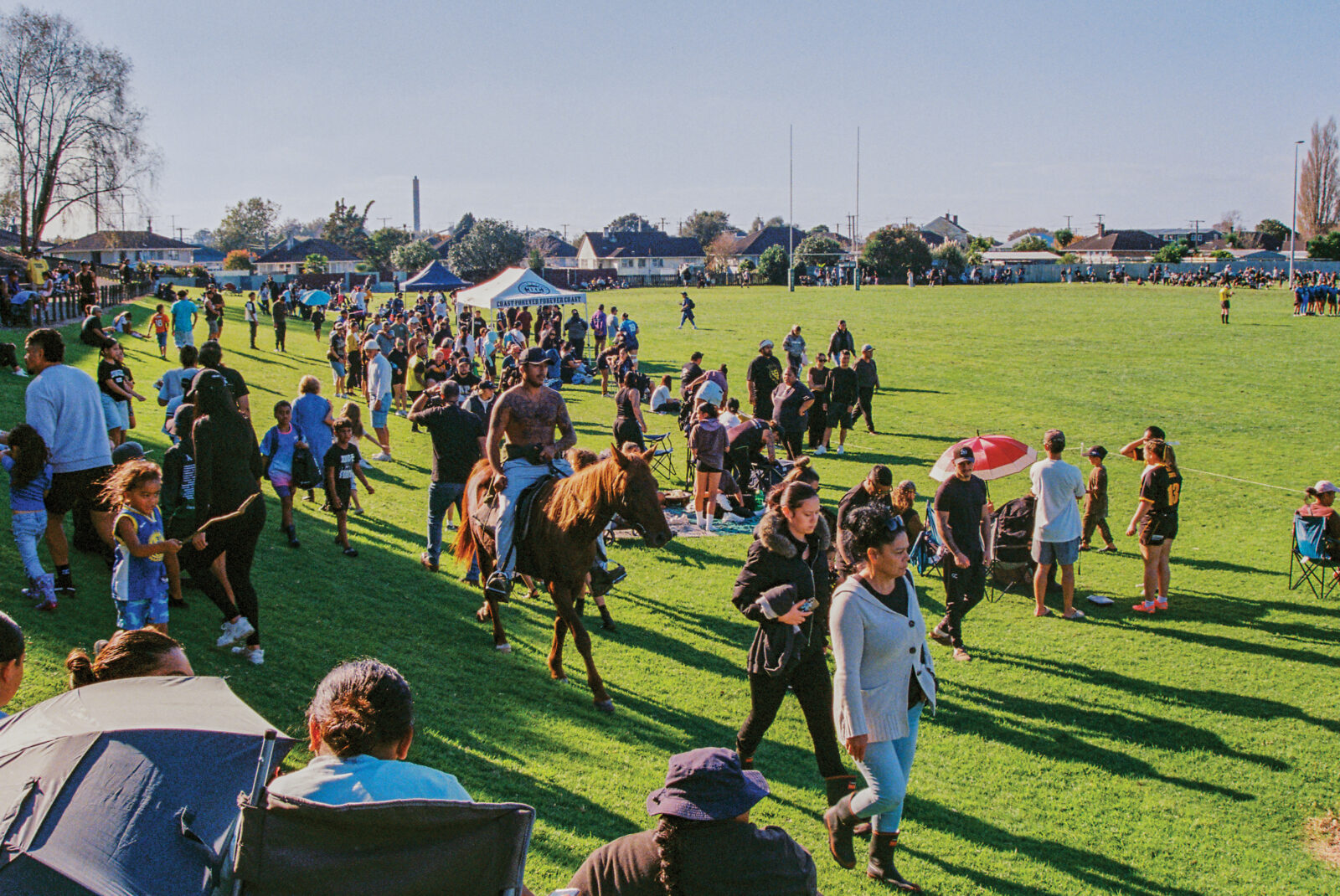
It’s a cloudless Sunday afternoon and the sidelines at Huntly Rugby Club are packed for the junior women’s first league game of the season. This is a family day out for the west side of town—the “shithole” side, the “rough” side, the “dark” side, if you listen to anyone who doesn’t live here—and it seems the whole place has turned up to cheer the girls on. Little kids zoom on BMX bikes, babies roll on blankets or are tucked inside jackets, and whānau settle in for the afternoon.
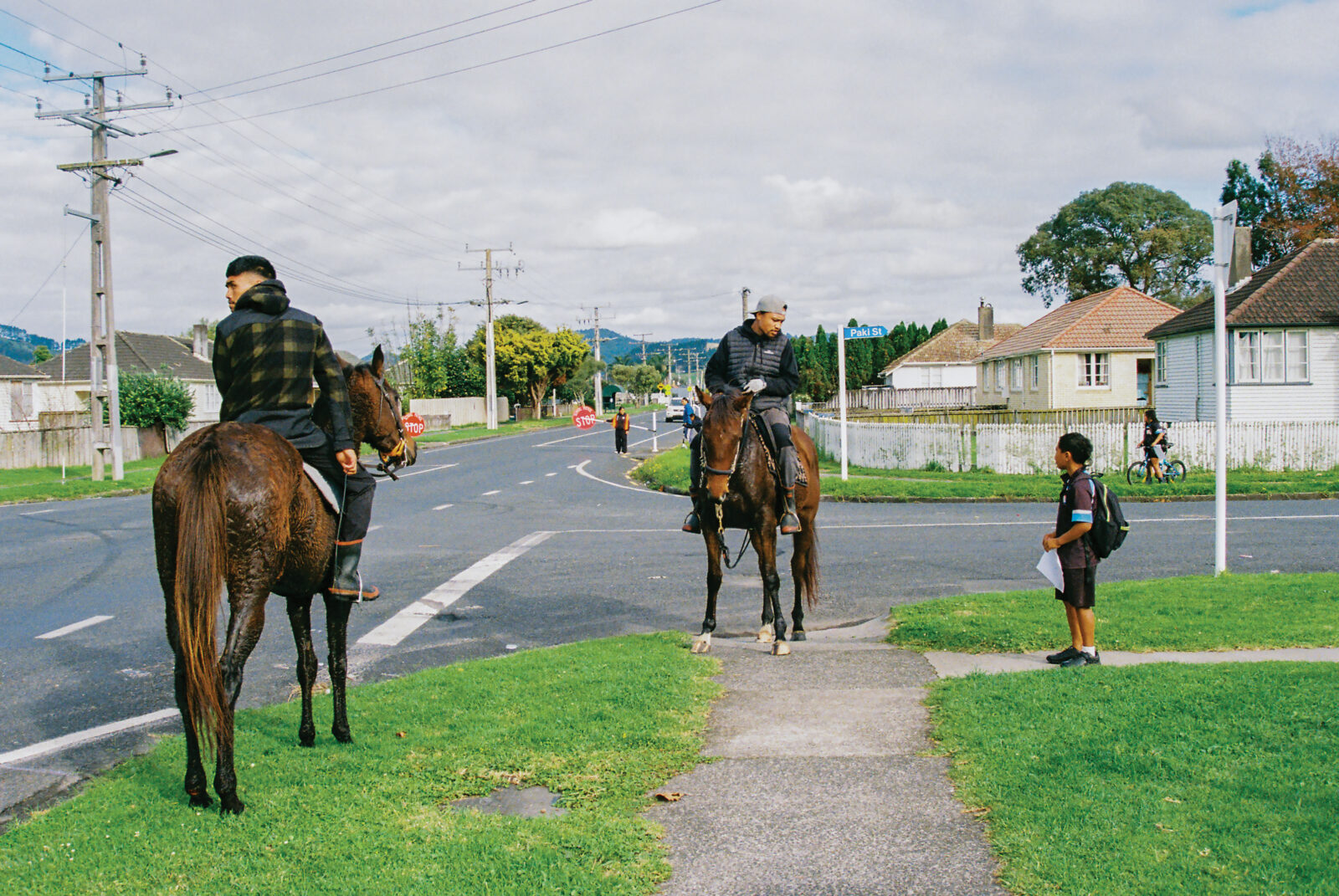
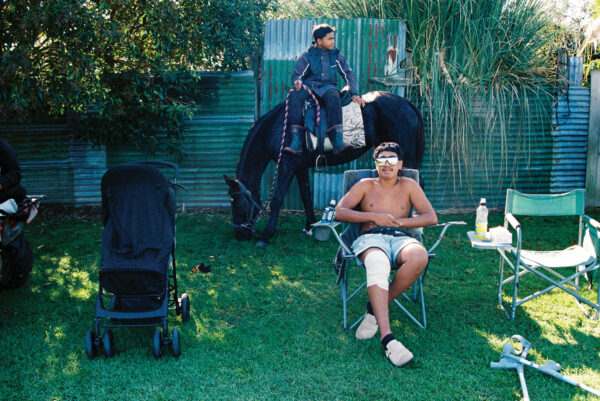
At one end of the field, against a corrugated-iron fence, a few young men monitor the game from horseback. They call advice when the line of play rolls close (“Run it, girl!”) and catch up with mates who appear from the crowd. The whistle blasts, the home team score in a frenzy of shouts, clouds of vape rise and dissolve, a four-wheeler chugs past, but the horses barely blink. Even Moko, a young chestnut stallion only two years broken in from the bush, keeps his cool in the crowd.
A giant of a man strides past, clocks our notebook and camera, wheels around and stops. “This about the horses?” he asks one of the riders. “Something positive?” When affirmative eyebrows go up, he flashes us a massive, relieved grin: “Hell yeah. Mean.”
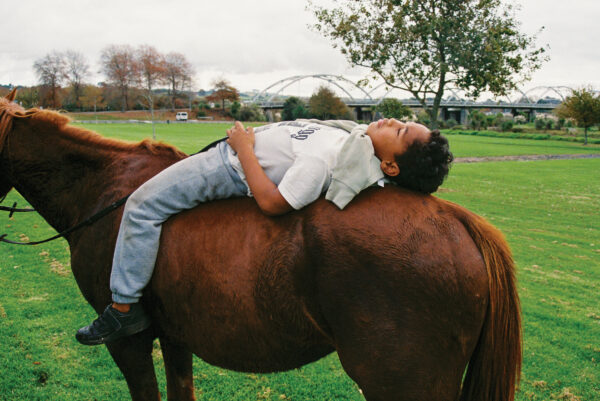
Seated on Moko is 24-year-old Huiarangi Walker, known as Googs. On his ankle he wears a grey electronic tag; on his neck, the birth and death dates of his sister, Elaine. Next is Taramaiwhatu Wilson—“Everyone calls me Tee”—owner of ex-racehorse Pray for Paris. Wilson is 10 months sober, trying to put his life together after a decade in and out of prison. The youngest on horseback today is a 12-year-old, who says a cheerful hello then lies down on a mare, elbows propped, to follow the action on the field. An uncle tells me the child lost mum in a car crash, says that dad is in prison, so five tamariki now live with another relative.
For each in his struggles, a horse is far more than just a seat for the game. Walker nods at Moko, who is patiently cropping grass, and puts it this way: “He’s been like a plaster for my pain.”
*
Huntly is a town split in two by the river. On the east side is the main shopping street, swimming pool, supermarket and fast-food outlets, museum, and civic services like the district court and Corrections office.
Over the steel arches of Tainui Bridge, on the west side, a skatepark tag pledges allegiance to the town’s much older name and its Waikato double vowels, Raahui Pookeka. Most interpretations say it refers to efforts by the rangatira Te Putu to more sustainably manage the local eel supply. The name is slowly regaining prominence over the one imposed in 1877 by James Henry, a district postmaster, who pined for his hometown of Huntly in Aberdeenshire, Scotland.
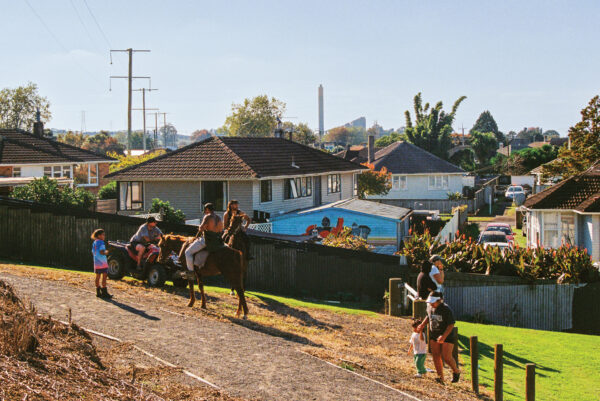
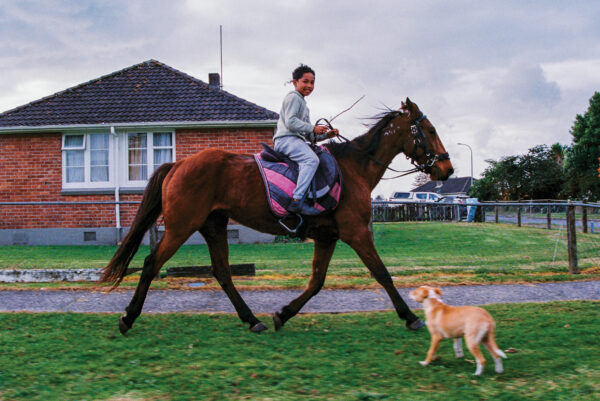
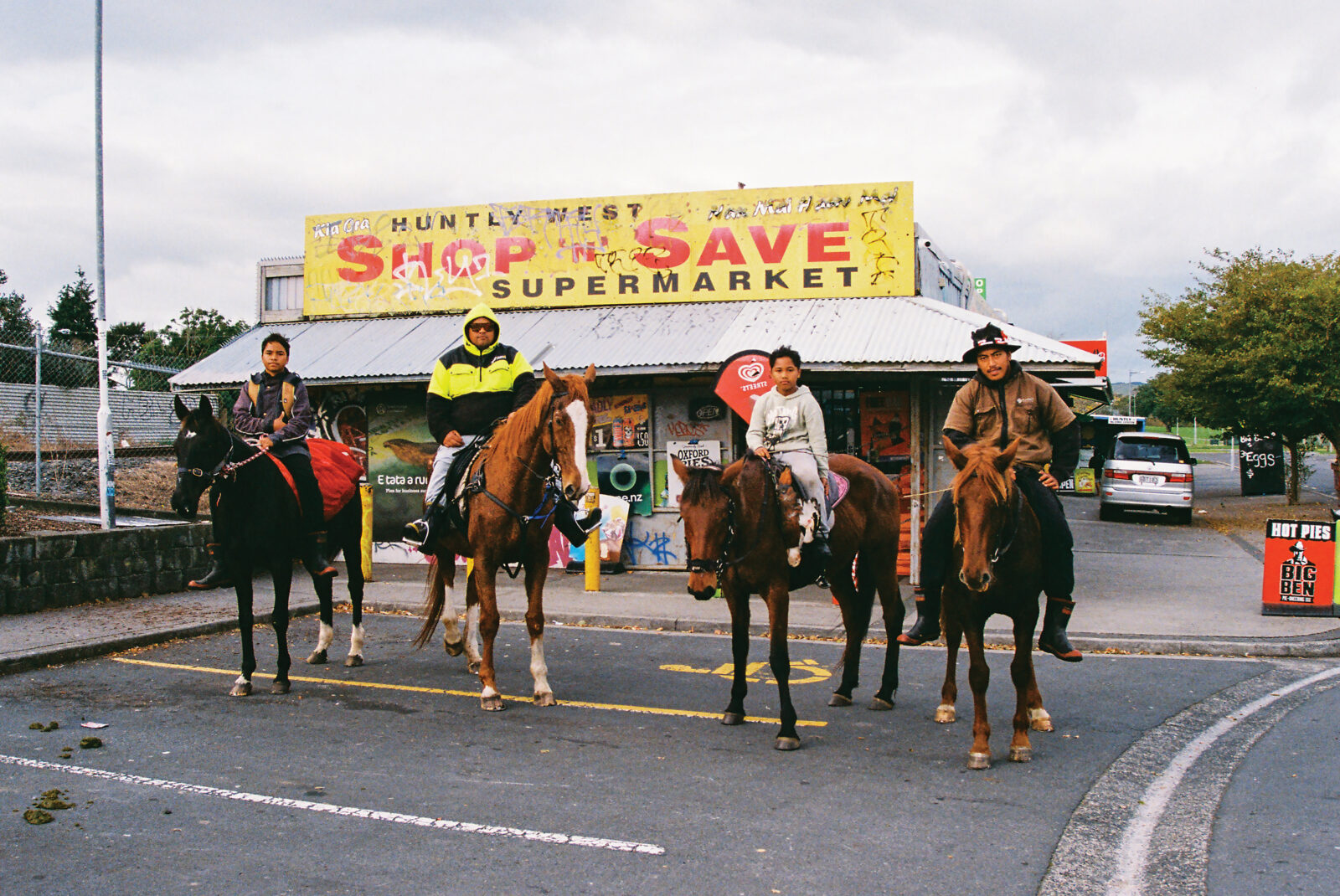
It’s the west side that house-hunters are warned on Reddit to avoid, and it’s here that horse riding has taken off among young men over the past year or so. You’re now just as likely to hear hooves clattering down the streets as the revving of dirt bikes. Horses graze on empty lots, are tethered to trees, or provide lawn-mowing services in backyards.
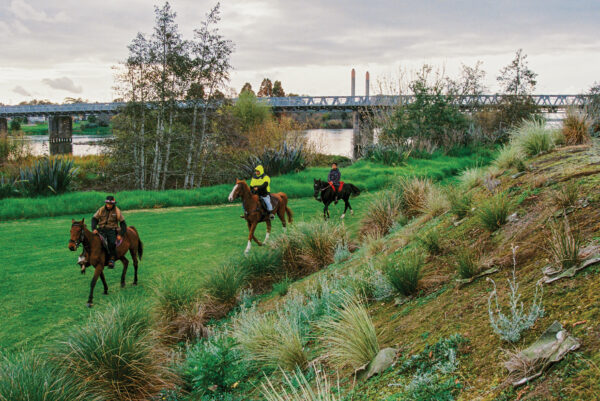
When word gets out there’s a ride on, 15 riders might show up, cowboy hats on, the flanks of some horses already crusted with sweat from coming in fast to the meeting point. They’ll head out through town, hit the trails around the lakes, ride up into bush, behind the old quarries and brickworks. They call this “hoof life”, refer to themselves as ghetto cowboys. Temu cowboys, I heard someone from out of town joke.
Point a camera when the riders go by and they’ll throw up reflexive hand signs, but “my only gang is the cowboys”, says Walker. The riders describe their backgrounds as “hard as”, “rough as”, and “not stable”. Back in the day, Wilson says, long-standing whānau gang affiliations would have prevented such free mingling among riders: “Now I’m like, ‘Hey, bro, remember when you ran me off the road?’”
Nothing about this group has been planned or organised by any agency. Horses turn up—some are industry cast-offs, broken down racehorses dumped for free, others are wrangled from the wild by whānau Māori like the Browns, who are widely regarded as old-school masters of the trade—and then it’s often Walker who informally sorts out an owner. He looks for boys who will keep the animal fed, care for it properly, not thrash it by riding too hard. Over the past 18 months, the cowboy count in Raahui Pookeka has gone up to the point that some in the community worry that pedestrians might cop it when a group barrels through, or an inexperienced rider can’t get a skittish stallion under control.
But as we spend time with these guys, the picture that emerges is less of young men wanting to cause chaos, and more of a group trying to find focus, and purpose, when their options are pretty limited, both by circumstances outside their control, and the consequences of their own past choices.
*
Pray for Paris is now in her Honey era. “She just got her teeth done,” says Wilson, as he rattles through the daily schedule of care he lavishes on the tall bay mare: a 6.30am feed, a regime of vitamins and vaccinations, visits to a farrier and vet, and repeated checks throughout the day, some of which require him to walk 10 kilometres from home to paddock and back again.
Wilson’s goal is to get Honey back to good health; track racing followed by breeding left her so depleted that no money changed hands when she ended up in Huntly. She’s battling the opposite problem to Wilson—it’s hard for her to keep the weight on—and he’s poured himself into her care. After dedicated months of effort, she’s still thin but on the mend, and he’s 30 kilos lighter.
The daily regime serves another purpose, too. It soaks up the time, money and effort that otherwise went into more destructive pastimes. “We were drinking ourselves silly,” Wilson says. There were a lot of drugs in the mix, too. He says available cash now goes toward feed, and riding gear.
“I’m always upgrading,” he says, gesturing at Honey’s tack. How much are we talking? “It’s probably into four digits. Yep, that much into this horse. But every penny is well spent. I’ve bonded with her more than anything in my life.”
When authorities got wind of the tall, thin thoroughbred in town, Wilson panicked. His first thought when the SPCA van rolled by: “Damn, coming to take my girl.”
It was a fair assumption from someone who grew up “around the criminal activity scene”, spent only a year in high school before getting expelled, and moved on to “boosting cars from dealerships in Hamilton”. Wilson was soon in Waikeria Prison for aggravated robbery. He credits his kids (eight of them who are “down the line” with their mother while he gets clean) and also Walker with pulling him free of the prison loop: “If I hadn’t run into my bro here with his horse, I would be really stuck.”
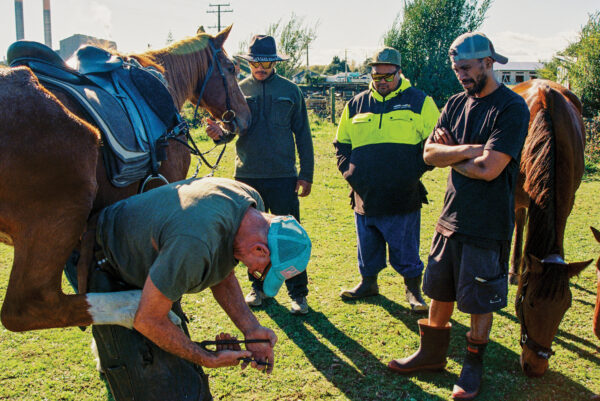
The SPCA van did not spell the end for Honey’s new life in Huntly. On the day we meet her, she’s saddled up in trim black, getting her hooves tended to by a cluster of cowboys who, under the guidance of a farrier, intently inspect the frog of her foot for signs of infection.
*
“They really love on their horses. They spend so much time on them. Far more than some actual horsey people do,” says Siobhan Millar. “I think the boys are amazing.”
Millar was the one driving the van that day. She’s been unofficially on their side ever since, doing what she can in her own time after work, offering advice and putting Wilson in touch with the various equine experts who’re helping with Honey’s health.
She’s happy to see horses in the community, but would prefer more of the “coastie” type breeds for residence in town; bush animals that have been mustered from the wild and broken in by whānau Māori, rather than those run down by racing. “The thoroughbreds are high maintenance. But the coastal ones can live on grass; they don’t need much,” she explains.
Millar lives with her own horses on a property near the Huntly power station. In her seven years here, she’s seen the town’s challenges. “For my work, I go into these properties and the poverty is absolutely horrible. They’re just naked houses; there’s nothing in them. Parents are suffering, so the children are suffering. Animals are suffering.”
Despite the material hardships, she says the way the west side is perceived couldn’t be further from her own experience. “It’s a proud community and I’ve always been treated with respect,” and is quick to note that her involvement is hardly one-way traffic. “I moved down from Auckland and I’m a single person living alone. So I’m craving a community as well.”
When Millar learned that some of the boys are “in recovery”, as she puts it, the revelation only reinforced her decision to help, rather than crack down. “When you’re with a horse, it’s like mindfulness; nothing else will enter your mind—that’s been my experience. You’re present to that moment. You’re not wanting. That’s something a horse can do. They can change your energy if you’re open to it. And these boys are open to that.”
*
Meremere is another village that’s invisible from the Waikato expressway but jammed right up against it, a cluster of cul-de-sacs, a school, and a few shops, hidden from highway view by an embankment and barriers. It’s not hard to find Tamarangi Brown’s house; turn down the first side street and there, in a small and ordinary front yard, is a saddled-up horse, looking a little twitchy, prancing on the spot.
I park across the road, say hi to a man who is managing to both walk a billy goat named Kava on a leash and spin a basketball on one finger (“F***, I’d love a ride on a horse,” he calls out, and you get the feeling he’d attempt all three activities at once) and head over to introduce myself.
Brown, who has whakapapa to Ngāti Maniapoto, wears a black cowboy hat and a pair of gumboots with spurs strapped to the heels. “I make the gears myself; I’m a bit of a Māori MacGyvers,” he says. The stallion he’s on is as yet unnamed; it arrived only two days ago from Pukekohe, fresh off the track. The 26-year-old Brown grew up in the saddle.
“We had to learn how to shoe them before we learned how to ride them. Learn to care for the animal before we owned one.” But he took up dirt-bike life for a while, going hard, he says, at all hours of the day and night.
Brown’s partner, Christle Mulligan, also 26 and of Maniapoto descent, appears. She offers coffee and one of their daughter’s homemade cupcakes, then nods at the new stallion. “If the trainers can’t make money off them, they don’t want them around.”
She explains that the whānau prefers to take on industry animals that have only pulled a cart, never been ridden: “Then we can teach them to amble, teach them how we want to ride.” She gives a technical explanation of ambling versus trotting, her face lit up by talking horse. We’re interrupted by a truck pulling a horse float into the driveway. It’s Brown’s parents returning the float they borrowed to move furniture. James Brown is an “old-school cowboy”, says Mulligan, making the introductions. “This fella can break a horse in without even riding it.”
The whānau is known for their skill in rounding up wild horses from bush at Kāwhia and training them to be bombproof in an urban environment. “Horses from the coast have never seen a white line,” says Mulligan.
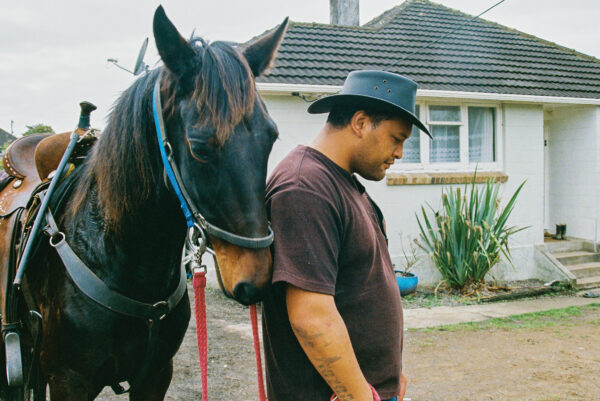
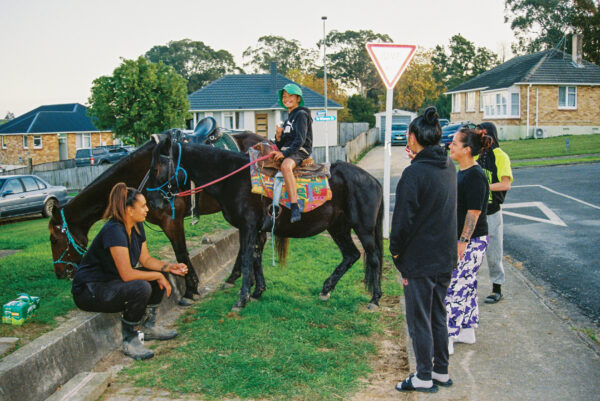
While Brown helps his dad change tyres on the float, she shows me around the garage. There are tubs of coiled rope, bins of feed, stacks of saddles, hooks loaded with bridles and tack, neatly packed shelves and drawers of other gear for hunting, fishing and diving. “I love this life I live,” she says. “I really do. Can’t beat it.”
It’s the Brown whānau who arranged for Moko to be sent to Huiarangi Walker, as well as the horse now ridden by the tamariki who lost mum in a car crash. When Tama Brown can travel, he heads down the highway to help the boys improve their horsemanship, develop skills beyond just going fast. “Those fellas like running,” he says with a smile.
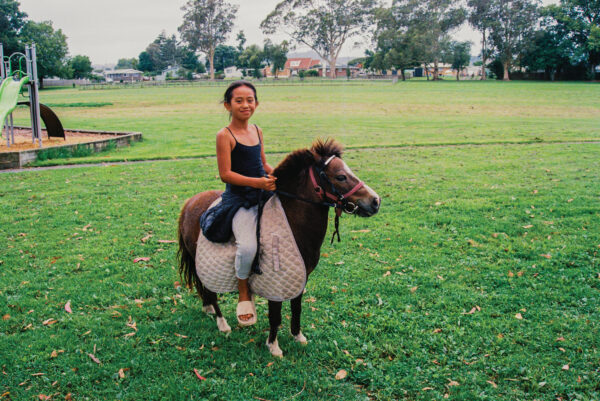
Before the couple moved to Meremere with the float in tow a year and a half ago, there were no horses in the village. “Everyone got a shock,” says Brown, but in a good way. Through their daughters’ ponies, they’ve met neighbours, given rides at birthday parties, and facilitated others to learn.
“If we can, we’ll give a horse, just to see more people riding,” says Mulligan.
*
As much as horselife in Raahui Pookeka operates around the edges and in the margins, there are various people who bend the system to accommodate what the boys are trying to do. Council people allow access to unused land for grazing, probation officers carve out conditions to allow horses to be fed and ridden for short windows each day, the police tend to direct their enforcement efforts toward dirt-bike riders, not equine ones.
“We were always getting chased when we were on a motorbike,” says Brown. “Now the cops just look at me on a horse and go, ‘Oh, yep.’”
But under one spurred gumboot, Brown, like Walker, wears an electronic bracelet. He’s also familiar with the inside of a cell, and when we visit Meremere, he’s on home detention. He’s allowed an hour and a half each morning to leave his property and go up the road to make sure the couple’s five horses are fed and exercised.
That little bit of leeway is helping the sentence to stick. Otherwise, Mulligan reckons, he’d be tempted to breach conditions: “If we didn’t have the animals and the horses to take care of, he’d be looking for every excuse to take off.”
*
Back in Huntly, at a house next to the council land where Honey often grazes, three men sit on the doorstep enjoying the sunshine. Kane Burns knows some of the young ones who’re now into horses; in their early teens, he got them over to his place for a talking-to. “I warned them that you get seven years for arson,” he recalls.
Burns could see the boys wanted to get their hands on what local life had to offer—a few beers, stuff from the shops. In those days, Burns’ pay packet for a 40-hour week came to $480, and he encouraged the teens to follow his example, to focus on being able to earn that sort of money for themselves. “I told them to imagine going to the bank machine with their own card, taking a hundred dollars out of the wall, buying their own beers and ciggies.”
A couple of them listened, he says. One got a job up at the rubbish dump, another went back to school. Burns couldn’t be more open and friendly as he relays this history. Despite the bright sun, he’s wrapped up in three layers of head gear—a thick beanie, then a hood and cap. The skin on his cheeks is smooth, unwrinkled, at odds with his talk about the olden days, when the 64-metre-deep lake we can see over the fence was an open-cast mine, and Clydesdales pulled the coal carts. “Huntly used to be full of horses,” he says. “I couldn’t pick out of the jobs on offer back then. I could go from job to job to job.”
And now? “There’s nothing. No mines work left, no more power station upgrades either. We’re surrounded by farms but the farmers hire their own families. The brickworks used to hire sixty of us at a time, but that got automated. If you want to work now, you have to travel out of town.
“When the jobs go, crime comes,” he adds, and gives the example of a relative who recently began “shoplifting in bulk”, got tackled, fought back, and is now in prison.
After the usual work dried up, Burns moved into industrial cleaning: “I loved working. Loved it.” Why the past tense? Well, a few months ago, Burns says, he felt a dizzying sensation in the side of his head. His next memory is of waking up in hospital, going to the bathroom, and seeing signs telling the chemo patients to flush twice. Chemo means cancer, he thought, and was right.
On the day we talk, he’s just out of hospital after five months of treatment for an aggressive brain lymphoma in his central nervous system. There’s still a long road ahead—no driving or working for a year, lots more check-ups—and he’s back on the bus to hospital tomorrow. The thick clothing, headgear and puffy skin suddenly make sense. “Life went funny,” he says, and shrugs. “But I’m home now.”
Before getting sick, Burns worked as a trauma cleaner, dealing with the aftermath of homicide and violent crime. While on a job up at Spring Hill prison, he saw a few of the boys he’d had round to his house. “Doing their lags,” he says. “All the things you don’t wish for them happened.”
But some of those boys are now out again, and Burns, for one, is delighted to see them on horseback: “I think it’s really healthy for them.”
*
“Huntly has twice been voted the shittest town in New Zealand,” says Joyce Maipi, who runs a community hub on the west side of the river. “Twice.”
When the Facebook poll result, organised by two guys hiding behind pseudonyms, first went public in 2019, there was plenty of chortling media follow-up. Comedian Guy Williams turned up on Huntly’s main street wearing a cream suit to shout at a camera about why the town was actually quite great. He kept to the east side, thrusting his microphone at startled locals and schoolkids.
The “shittest” label still stings. Nearly everyone I meet for this story mentions it. “They should of just come and talked to us,” says 31-year-old local Tu Taihoa, expressing the common sentiment on the west side.
After all, it doesn’t take much to leave the main street, cross over the bridge, wander down a few side roads, say hello to the people who’re sitting on their front steps enjoying the sunshine, and listen to their stories. It doesn’t take long, either, to realise that some of the things which might seem unsettling or mockable to an outsider have distressing cause.
But I’m glad the video crew didn’t spend time over the bridge. What if they’d bowled into the league park and bailed up a kid who’s trying to manage without either parent at home? Wilson says the child we met at the game is “always asking about Dad. So we just keep [them] busy. Make sure they go to school, do the horse.”
*
“We were once a community that was thriving and very articulate about our future,” says Maipi, who’s sixth generation on the west side. “But there’s been a huge change, going to a very vulnerable community, just in the last few decades.”
She points to the failure of Think Big stimulus projects, the loss of industry and jobs. But just because a community isn’t thriving economically, she says, doesn’t mean there’s nothing going for it: “We have all these pockets of excellence, in our sports clubs, our marae life, kapa haka, our gym, our māra kai gardens.”
Maipi and her staff, whose mission is to rejuvenate life in the west “street by street, and whānau by whānau”, take a cautious view of the impact of the horses.
“From our perspective, we love the community reclaiming this way of living. Bringing the horse culture back is a really good thing. But it’s happened quite quickly, and the other part of that is the safety of our streets and families. Some of them are not very experienced riders. And there can be a disregard for others on the road.”
She worries, too, about animal welfare. “Horses need a lot of care. But they’re just at a normal person’s house, tied up. There’s a lack of fencing.”
These concerns about space are shared by Siobhan Millar. “It would be awesome if they had some more land; most of the horses need to winter out in grass to stay fat. And some more space where the boys can do their bonding,” she says. “I would love to see them better set up so that they’ve got a little bit more security and mentoring. I think about it constantly—‘What else can I do?’”
In the first instance, to keep the community on side, Maipi suggests the riders could make more of an effort to pick up after their horses. “We don’t want to literally turn into the shittest town.”
*
It’s another brilliant blue-sky day on the west side. A few of the boys are on Harris Street, at a blue house with plywood for windows and sheets for curtains, where Tu Taihoa lives.
Taihoa lets the boys graze their horses, along with his own, on a block of whānau land. The grass here is already cropped short, interpersed with patches of blackberry, but Honey and Princess nibble at what they can. Soon, fresh feed in a bucket turns up, carried by ex-farrier Tim Bruce, who lives half an hour away on a lifestyle block with stables in Tahuna.
“I was on my way to waka ama training one day and noticed the horses looking a bit skinny,” he explains. “Then I saw the boys in the yard. So I came back with a bale of hay.”
He remembers driving up that first time: “They didn’t know me. Someone said, ‘Who invited you, bro?’ and I said, ‘I’ve got hay.’ And we went from there.”
The boys repaid the hay with a box of beers. Bruce repaid the beers with riding gear. And so it’s gone ever since. “He’s an angel. God sent him,” says Taihoa.
Bruce now regularly brings out his 60-kilogram anvil and farrier’s leather apron to replace shoes and teach the boys about hoof care. When they first insisted on paying for the shoes, he refused. So a group of them arranged a working bee on the lifestyle block in Tahuna.
They spent a day cutting gorse, repairing fences, picking up hay. This morning, there’s another exchange underway. “We can help you tomorrow mow your paddocks?” says Wilson. Bruce agrees, then looks over the grazing land and says he’ll hire a trailer and come back to deal with the blackberry. “They come out to my place and say, ‘Jeez, you’re untidy, bro,’” says Bruce. “And honestly, last hay time, I would have been f***ed if they hadn’t come out.”
Bruce grew up among horse people “in a very Pākehā world on the east coast”. When I ask Taihoa and the others about growing up in Huntly, they stick to their short descriptions. Rough as. Hard as. Dads, uncles, cousins in gangs. Lots of suicide. Bad shit. But family is strong here. People are strong here. Marae life is strong here—the boys all whakapapa to Waikato-Tainui. They admire a nan who’s battling for the return of ancestral land. They admire the new young queen, Nga wai hono i te po, and look forward to riding down to the annual koroneihana at Tūrangawaewae.
“There are lots of good people; you just got to get to know them,” says Taihoa. He and Bruce often text each other about horse stuff. “It’s given us something in common,” says Bruce. “It’s a nice thing.”
I ask his opinion of the horses’ condition. “A bit underweight, but they have a better quality of life than some professional riders’ horses that are boxed up and have metabolic issues from being covered and rugged.”
*
“They say Huntly is one of the shittest towns. But this is a beautiful place,” says Huiarangi Walker, as we sit by the river to talk. “What could be better than sitting here in the sun, by my awa?”
We’re looking across the water at a great gouged-out section of hill. Walker is talking about how the Waikato expressway pulled all the through traffic out of town, which has been hard on local businesses. He thinks the mine we can see across the way is for coal, but when I look it up later, it’s the quarry which supplied much of the aggregate that went into building the highway.
Walker’s personal story is complex. There was a move to Sydney in his early teens, “by myself”, to live with relatives and get away from entrenched gang affiliations in the whānau. “I didn’t want that for me.”
In Australia, there was high school, a promising start at a rugby league club, and a relationship that produced two children. Then things went south with the death of a much-admired older cousin. “My best friend,” says Walker. He returned to Aotearoa and bike life in Ōtara, quickly followed by criminal charges and prison. “I’ve done bad things in my life. Things I shouldn’t have done,” he says, as if he’s lived many more decades than his two and a half.
He’s reluctant to talk about the circumstances that landed him in jail, but says the case ended in a plea bargain. Five months in Mount Eden prison followed. He’s now got 275 days on a bracelet, then there’ll be six months’ community detention, then 12 months’ supervision. All up it’ll be a three-year lag, he says, most of it spent in a small cabin out the back of his cousin’s place.
Walker was still in Sydney when his older sister Elaine died from cancer. COVID lockdowns prevented his return for her tangihanga.
“Life’s a bitch, it’s tough,” he says. “So I just ride every day. I love riding around the lake by myself. That’s my favourite thing.”
Over the course of several afternoons with Walker, there’s one memory he mentions several times: “When I was a little kid, growing up here, in winter I’d see the hoofmarks on the grass in the frost.” The story stops there, with no conclusion, but the feeling I get is that the memory is precious for being so rare—a childhood longing fulfilled in adult life.
Unlike Honey, Walker’s bush horse Moko receives no top-up supplements. He gets by as a lawn-mower, shifting around backyards, with no special feed—“Otherwise he’d learn to rely on it,” says Walker—so while we’re talking, he takes the chance to get stuck into the long riverside grass, wandering untethered to eat his fill.
Walker’s plan, as it stands, is to see out the lag without breach and further penalty. “Just going to stay in my lane,” he keeps saying. After that? He’s keen to get out to the Coromandel and go diving for kaimoana. “And one day, I’d like to go and watch a horse race. Up at Ellerslie or somewhere like that.”
Suddenly, from across the road, we hear sirens spiral into the air. “Yep, that’s Huntly,” Walker sighs. “Cops everywhere.”
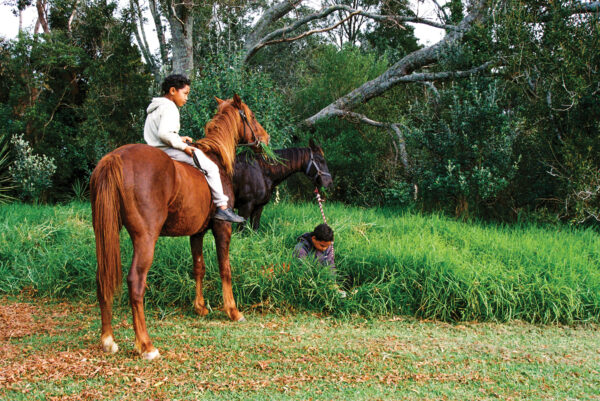
Later, a little girl of four passing by on the footpath becomes entranced by Moko. With her mum’s permission, Walker spends an hour teaching her the basics; they walk up and down the riverbank, he shows her how to sit on Moko’s back and hold the reins. She can hardly stop smiling.
If there’s a plan for the future, he hopes it looks a bit like this, trying to help others using horses. “Open my own horse stable. That’s the big dream. That’s the goal.”
The following weekend, after a tangihanga to farewell a mate, Walker and Wilson saddle up for a long ride. They take along two tamariki with struggles at home, and keep them happy and occupied all afternoon.
Back sitting by the river in the sunshine, Walker removes his shirt to reveal a tattoo of his eldest child’s name. He wants to get things fixed up to a point where he can see his own kids again, too.
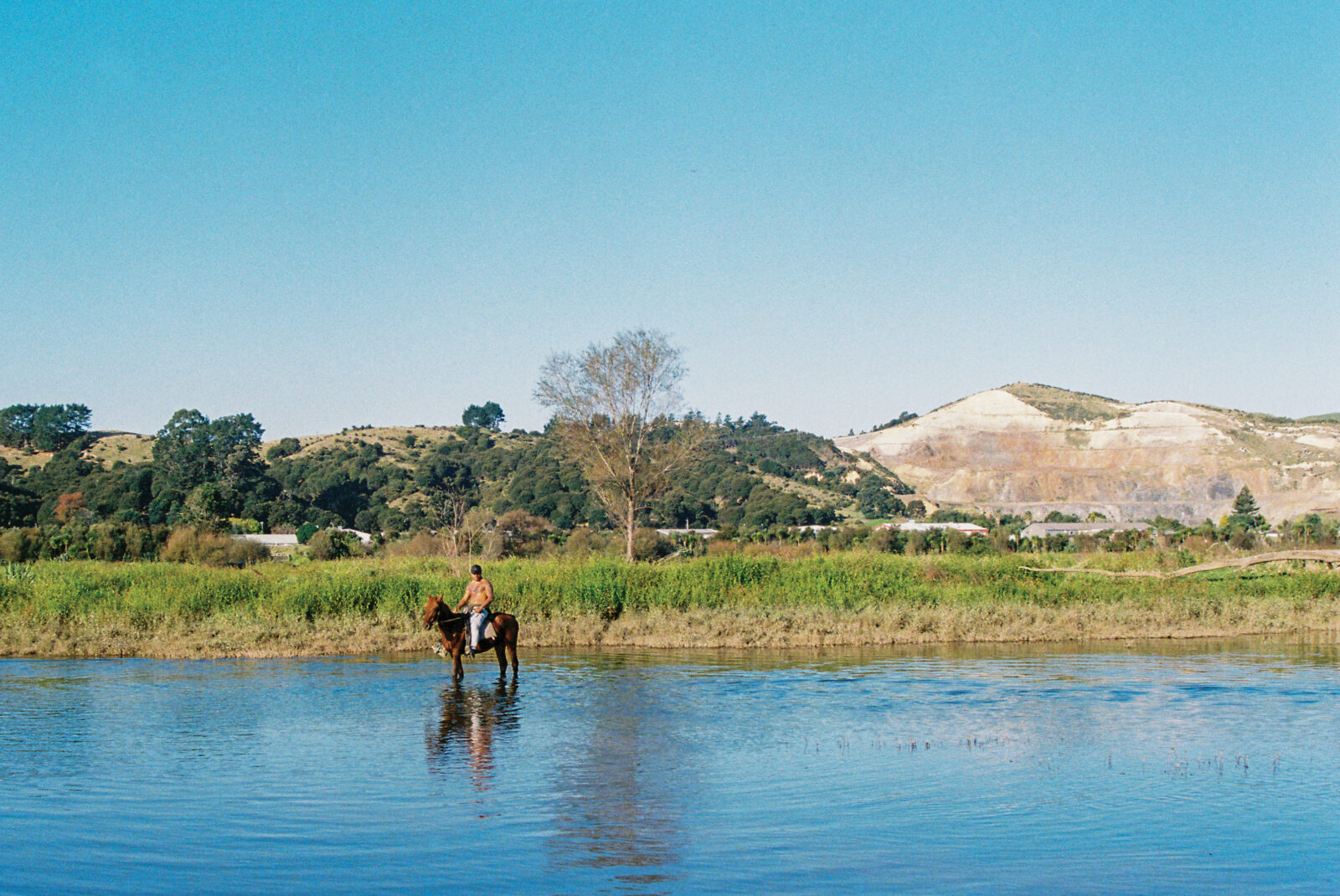
Across from where we’re talking, the river splits around a strip of land. Walker points to the high, green area. “Sometimes the boys get together, we do a big ride, then we take the horses over. We go sit out there and have a fish and chips.”
The water between where we are and the grassy picnic spot looks dark and deep. What’s the best way across? “You just go in,” he says. “And hope you make it to the other side.”
More by Connie Buchanan
More by 557777
Subscribe to our free newsletter for news and prizes
3
$1 trial for two weeks, thereafter $8.50 every two months, cancel any time
Signed in as . Sign out