Three hundred and fifty years after Abel Tasman and his sailors became the first Europeans to sight these shores, we go in search of Tasman’s legacy: the Dutch in New Zealand.
Soulful strains from his squeeze-box remind Dirk Ploeg of a homeland he left 20 years ago. Like many immigrants, he and his wife brought Holland with them, in the things they surround themselves with: paintings, knick- knacks and music. “New Zealand is now my home,” Dirk says, but when his fingers travel the keys his heart turns to Holland. Along with 140 other Dutch residents, the Ploegs live in Ons Dorp, a Dutch retirement village in Henderson. When Queen Beatrix visited New Zealand as part of the 1992 Abel Tasman Year celebrations, they lined the avenues of the village to greet her, calling out “Leve de Koningin!” (“Long live the Queen!”). They even dressed up the letterboxes for the occasion. “I feel that I’ve come to a little part of Holland!” remarked the Queen.Sinterklaas isn’t complete without the presence of Zwarte Piet (“Black Peter”). This character (a number of whom usually accompany St Nicholas) originates with the Moors who occupied Spain in the 15th centLIly. Spain in turn occupied the Netherlands, and Dutch children are still told that St Nicholas sails from Spain to Holland to bring them their presents.
Every year, when I was a child, Saint Nicholas would arrive on the fifth of December at Oma’s place in Christchurch with everything but the traditional white horse.
Flanked by at least two Black Peters, Sinterklaas looked fragile as hoar frost with his long white beard, white lace-trimmed gown and white gloves. A red bishop’s mitre emblazoned with a gold cross sat on his head, and his shoulders were warmed by a red and gold cape. A wooden staff, taller than he was, was always at his side. St Nicholas was an other-worldly, royal presence who moved, in keeping with his age and dignity, as if wading through oil, slowly and deliberately. But I felt well disposed towards him since he was the one with the presents.
It was the Black Peters you had to watch. The modern-day version of whips, they were there to judge your behaviour and mete out punishment. Older Dutch people say they were terrified of Black Peter as a child. I had my doubts about their real power, given Sinterklaas’s and Oma’s presence, but they looked scary enough with their shiny blackened faces, yellow teeth and obscene pink gums. Their legs were girded in black tights, and from their hips ballooned a comic pair of pants, the whole outfit set off with a soft black velvet beret and one over-large dashing feather. Sometimes they wore big silver earrings, and the effect was of a rather exotic pageboy.
They inevitably had a feminine form, since their numbers were drawn from my aunties. To the tune of “Zie de maan schijnt door de bomen” (“See the moon shine through the trees”) the entourage ceremoniously entered the room and began the interrogation.
In typical Dutch fashion, nothing was for nothing. You had to earn your presents. Your performance throughout the year was reviewed (“Have you been a good girl?”), and a performance on the day was required as well. A song, a rhyme, even a joke would have done. But we had already been infected by the Kiwi virus of reticence, and there were some who couldn’t, wouldn’t sing, and one who refused to even get out of the car.
In the centre of it all was Oma, more regal and demanding than any St Nicholas. Encouraged by one of her sons who was already in New Zealand, she emigrated here with the three youngest of her 13 children in 1956 at the age of 60. She never quite learned to speak English, and she always gave you the impression of being a displaced person. But on the one occasion Oma did return to Holland, she found she missed New Zealand, so this was now her home.
In any case, wherever she went Holland came with her. Oma had her own portable Dutch interior, to her the sine qua non of feeling at home. It consisted of a wooden dresser, a thick, bristling carpet the colour of dried blood for the table, some Delfts blauw plates and ornaments, silver spoons, blue-andwhite Chinese ginger jars, Dutch paintings in old gilt frames, a photo of her mother and the unmistakable scent of Eau de Cologne lingering in the air.
On this small Dutch stage, Sinterklaas was acted out with as much verisimilitude and enthusiasm as the range of imports could muster. We often had speculaas (a crisp cinnamon biscuit pressed into windmill shapes) and taaitaai (tough aniseed-flavoured biscuit), but we rarely ate pepernoten (spicy biscuits moulded into a tiny mound rather like a nut). The Sinterklaas tradition of making doggerel rhymes about one another had long been discarded, as had the ritual of putting out carrots in clogs filled with straw for Sinterklaas’s horse.
What we had was simply an abbreviated version of the full Dutch Saint Nicholas. Yet even if the occasion had been duplicated faithfully, there are some things which are impossible to transplant. The knee-trembling fear the older Dutch migrants remember, and the theatrical elements of the occasion, had been inevitably diluted in the 20,000km stretch separating New Zealand and the Netherlands. This St Nicholas looked rather like an antique imposter compared with the robust Santa Claus we Kiwi kids were waiting for on Christmas Day.
That was the 1960s. Today Sinterklaas is only celebrated if a Dutch Club organises it. The immigrants themselves are now Omas and Opas, and it is their grandchildren who are told “St Nicholas is coming!” More often than not, you can see this means less than nothing to them, and no wonder they’re bewildered: expected to sing in a foreign language, dance new dances and obey demands for a recitation sprung on them by a strange old cleric.
Years later, I asked my mother why they bothered with Sinterklaas. It wasn’t for us, she said. It was all done for Oma. Perhaps not surprisingly, then, the best Sinterklaas in New Zealand is still to be found where Omas and Opas reside, in the Dutch retirement village, Ons Dorp, in Henderson. Here Sinterklaas with all the trimmings unfolds to the delight of the residents, a delight so unguarded and spontaneous it seems to rejuvenate the occasion for their grandchildren.
Colourful though it is, this festive moment is one of the few visible expressions of Dutch culture in New Zealand, and even then it takes place in the domain of the elderly. The language, rituals and domestic observances which make up this culture have largely disappeared in New Zealand. For the most part Dutch immigrants have been at pains to assimilate, often announcing proudly in the thickest of accents that they are dinkum Kiwis. Nevertheless they were once the largest group of non-English speaking immigrants in New Zealand, a product of a wave of mass migration which occurred after World War II. Almost 40,000 Dutch people emigrated to New Zealand, and today there are 80,000 people of Dutch descent in this country.
*
Though a Dutchman first brought New Zealand to the attention of the world in the 17111 century, Abel Tasman never set foot here, and before World War II there were only 128 Dutch-born people in New Zealand. A number of these were “Christianisers”— churchmen and missionaries such as the Mill Hill Fathers, members of the English-based St Joseph’s Society for Foreign Missions. Others were adventurers or wanderers, many having lived in England before coming here.
A few names stand out in our history, such as the van Asch family who pioneered education for the deaf in 1880. Gerrit van Asch was a determined advocate of lip-reading, and abhorred sign language, but his greatest talent is said to have been his gift for imparting an understanding of language to his pupils. The van Asch school continues today, and grandsons of the founder are credited with pioneering aerial mapping in this country (Piet van Asch) and the daring Kiwi sport of bungy jumping (Henry van Asch).
In 1890 the van Asch family were host to another Dutchman who was to earn a lasting place in the history of New Zealand art. Petrus van der Velden was the first New Zealand painter to fashion his art from the natural world around him. He astonished locals by venturing outside to paint in the stormiest weather, but the result of these outings was works like the unforgettably grand expressionist series on the Otira Gorge.
“Colour is light—light is love—love is God, and when you understand this you are an artist,” he wrote. A true bohemian who lived in near poverty for most of his life, van der Velden believed in giving your all to art in a country where painting was regarded as a hobby. For this reason, if no other, he became an almost legendary figure in the first generation of New Zealand painters.
In Wellington a Dutchman, Rabbi van Staveren, became the spiritual head of the Jewish community, and in the 1870s the son of a Dutchman even became prime minister: Sir Julius Vogel.
But it was not until the end of World War II and the collapse of the Dutch East Indies colonial empire that emigration to New Zealand began in earnest. The war exacted a heavy toll on the Netherlands. Half a million men were carted off to German labour camps. Dutch Jewry was all but extinguished in the gas chambers. Eighteen thousand civilians died of starvation in the terrible winter of 1944 – 45.
Post-war recovery was slow. The Dutch economy was in tatters, and high unemployment, insufficient housing and rampant bureaucracy put intense pressure on an ever-growing population in an already overcrowded country. A survey in 1948 showed that a third of the Dutch population were interested in leaving their straitened and war-ravaged homeland.
The Dutch Government added its own voice to the chorus of dissatisfaction at home with a vigorous media campaign promoting emigration. New Zealand was just one of several choices of destination, though some links with the country had already been established.
Even before the war had started the Netherlands had dispatched five young carpenters to New Zealand on a pilot scheme, and in 1945 New Zealand temporarily hosted 2000 Dutch evacuees from Indonesia. Though only here to recover from their ordeal in prison camps, their reports about the country inspired a number of later immigrants.
New Zealand, with its booming economy and desperate shortage of labour, welcomed the Dutch—although they were not the first choice. British people were regarded as the most desirable, followed by Scandinavians (described as the “least alien of aliens”), with Dutch coming in third, but only those “fully of European race and colour and/or northern European extraction.” Dutch people of Indonesian extraction were barred, as were any others whose features deviated from the prescribed “look”. Naturalisation officers were trained to assess applicants on their “alien characteristics”—this in a country that boasted racial equality and freedom from discrimination.
On arrival, it was made clear to immigrants that they were aliens not just in name, but also in the eyes of the law. It was a label many bore with resentment. As well as suffering the indignity of being fingerprinted, they had to register with the police and notify them of any change of residence, occupation, name or marital status. They could not enter the armed forces or law, and were able to become a public servant only with the Governor General’s consent. Nor could they vote in general elections or own large tracts of land.
Even when they chose to become naturalised the Dutch found they had what many regarded as second-class citizenship. Unlike other New Zealanders, they could be stripped of their nationality for criticising the Queen, for being a traitor, for incurring a jail sentence of more than 12 months, or for living out of the country for more than six years. These requirements were eventually dropped in 1960, following years of protest by a number of Dutch people.
Many immigrants naturalised as a matter of course, feeling it their duty since they had chosen to live in New Zealand. Besides, remaining Dutch was frowned upon and actively discouraged in those days. In practice, any desire by the Dutch to hold on to their heritage or simply seek solace in one another’s company was stymied by the government’s settlement policy. To prevent them living or working in “a foreign cell” they were scattered the length and breadth of the land. For instance, the first planeload of 55 Dutchmen to fly directly from Holland to Whenuapai in December 1950 were immediately despatched to dairy factories all over the country. As a result of this policy the Dutch are spread more evenly through the country than any other recent immigrant group, and have suffered a higher rate of language loss.
For the Dutch migrant, used to close family and neighbourly ties, this isolation was often a recipe for loneliness. In his book Tasman’s Legacy, The New Zealand – Dutch Connection, author Hank Schouten paints a moving picture of the Dunedin express train chugging slowly through the Canterbury Plains. At various small stops a Dutchman clutching only his suitcase climbs off to start his new life.
One immigrant who came out as a child still remembers his mother’s sigh as the rural landscape unfolded before them on a similar journey. It was an intake of breath, he says, which seemed to go on and on.
New Zealand was undeniably beautiful. They had never seen anything like the preternatural green of the countryside or the aniline blue sky dotted with archipelagos of white cloud. What’s more, everyone had a washing machine and a fridge—a luxury in the Netherlands in those days. New Zealand looked quietly prosperous.
Yet for all its bounty, the country also had a curiously impoverished appearance. The poor quality clothing, the extensive use of corrugated iron, the ugly household furniture—these looked cheerless and cheap to the Dutch. Poet Riemke Ensing recalls her first day at school in Dargaville. On seeing the boys in their short pants and bare feet—in winter—and girls in plain gym frocks, she remarked to her sister, “This must be the most poverty-stricken place in the world.”
There was a startling uniformity to everything, too. Houses were painted in shades of oatmeal, and inside the decor was spartan. The ubiquitous mirror over the fireplace reflected nothing more than a vast expanse of wallpaper.
When Suzy van der Kwast started her coffee lounge in Wellington in 1963 she noticed that women wore pink hats with flowers, navy blue suits and gloves, while men wore monogrammed blazers, white shirts, black trousers, and carried tin lunch-boxes to work. She thought it quaint.
In Christchurch, textile engineerturned-wool buyer Karel Adriaens observed a predominance of grey in both men’s and women’s clothing, and was surprised that only solicitors and doctors wore suits. In 1961 he left wool-buying to enter the fashion business, trying his hand first with children’s clothing (he had a hit with children’s duffel coats) and then with women’s wear. The company he formed, Cotura Fashions, derived design inspiration from international fashion magazines, and sometimes Adriaens simply borrowed and copied the imported garments of people he knew.
Assisted immigrants (those whose passage had been paid by the Dutch and New Zealand governments) were obliged to accept jobs wherever they were assigned. Lawyers found themselves working as cleaners; nurses as housemaids. One person requested a job in dairying thinking he would be working on a farm, found himself in a dairy factory. In the New Zealand of 1950s the pressing need was for labourers, and for most immigrants their first work was literally by the sweat of their brow. In this 1951 photograph an immigration officer checks the papers of young Dutch men on the migrant ship Groote Beer.
But it was not only the design of clothing that struck the Dutch. Toni Enright, who was 20 when she arrived in Roxburgh, remembers the black coal ranges in the houses, and the stench of sulphurous coal. “It was like being in hell,” she said. After the unremitting flatness of Holland, Central Otago’s menacing mountain ranges brought on bouts of claustrophobia. “I couldn’t breathe. I was used to a huge expanse of sky, and in Roxburgh all I had was a little circle of sky above the hills. In winter, we only saw the sun for five hours a day. It seemed so gloomy.”
The towns were different too. With one long main street and nothing much besides, they bore no resemblance to the settlements they knew, with houses radiating like spokes on a wheel from the focal point of the church or cathedral. “I could just see a cowboy on a horse riding down the main street. It was how I imagined the Wild West to be,” says Suzy.
The people had a touch of the Wild West about them as well, and this rubbed off on a few of the newcomers. Father Gerrit van Beek, a Mill Hill missionary priest, became something of a legend in Auckland because of his unorthodox methods. John van Camp, son of chocolate-maker Antony van Camp, recalled his mother’s shock at seeing Father van Beek wandering down the road, sporting khaki trousers, a grubby shirt and a large beard. Beside him was another man in similar garb. Van Beek greeted the van Camps and introduced his scruffy friend—the Bishop of New Zealand.
“My mother was used to seeing priests in formal attire,” said John.
“The shock of seeing them like that was almost more than she could bear.
“In 1946 van Beek was still riding a horse down Queen Street. He used to shoot rats, too, and was famous for getting into fights about religion in the pub. Once, when someone didn’t come to church, he could hear him working with his circular saw, and knew he must be at home. So he went and got the blighter!”
Despite his eccentricities, van Beek was a key figure in starting a chain migration from Deurne, to the Waikato. A talk he gave in the Netherlands set the seal on the decision of John and Elizabeth van den Heuvel and their 12 children to emigrate in 1949. It was a startling move for the children, many of whom had never ventured further than their local school or church before setting off for the other side of the world. Even their first language was the local dialect, not Dutch. Today oldest son Antony, then 20, sometimes wonders what motivated his parents to endure “the hell they went through.
Their first house had no beds, and just a few apple crates for chairs. The walls were sawn off at the ceiling, with boards removed so that they looked like a picket fence. For three weeks the family slept on hay bales. Cow covers substituted as blankets, and the family caught rab bits for stew. Antony’s mother and oldest sister bawled their eyes out, and said they would have crawled home on their knees if they could have.
Local Catholics came to the rescue with clothing and furniture, and before long the family was sharemilking on another farm, working towards owning their own land. Though it took 10 years before this was achieved, their experience resulted in the departure of more than 30 families from their village to “little Deurne”, a name which is more an abstraction than a locality.
Not all migrants suffered such privations. After 1950 the Dutch and New Zealand governments agreed to jointly pay the passage of unskilled immigrants, and often arranged accommodation and employment for them. Some, like the Ensing family, even brought with them their own prefabricated houses, which could be erected without nails. Nevertheless, for many migrants the generosity of New Zealanders bringing them food and clothing not only made life easier but the welcome warmer.
Generally, the Dutch liked their new countrymen enormously, even if they complained they were never invited to their homes. New Zealanders were endlessly resourceful, and their willingness to “give it a go” soon won the immigrants’ admiration. New Zealanders, it seemed, could do anything: fix a car, build a house, farm, sew, cook a beautiful meal. Even their picnics were elaborate compared with the Dutch doorstep sandwiches. Sometimes their expertise was daunting, particularly for women encountering the Kiwi baking spread and knowing they could not reciprocate in the same way.
Furthermore, this Kiwi savvy cut across traditional Dutch class boundaries. Antony van Camp recalls his astonishment at seeing a doctor, dressed only in shorts, painting his house. Another immigrant, Pieter de Bres, recalls his family’s first meeting with the mayor of Takaka. His children were particularly excited. “They thought of a mayor as a very dignified person, formally dressed, living in a beautiful home and associating himself mainly with the ‘upper crust’,” said de Bres. “The girls insisted on putting on their colourful cotton and lace Swiss frocks, but were disappointed when they found the mayor working in his garden, stripped to the waist, and his wife cooking the meal herself instead of using a servant. The mayor was a blacksmith instead of the customary lawyer or other professional we were used to for a person in such a position.”
In the Netherlands people of this ilk would have been more concerned with appearing “deftig” than handy, and would never have been dressed so casually. In this supremely bourgeois society the concept of “deftigheid” carries great weight since it neatly synthesises in one word the qualities of dignity, respect, decorum and propriety. You only have to see a Dutch septuagenarian riding her bicycle in the most stately fashion to understand what deftig means.
The Dutch were used to a more restricted way of life, bound by the constraints of space, family and class, and reinforced by history and their Calvinist faith. Centuries of fighting back the ever-threatening sea and struggling to make ends meet have impressed upon these cold-climate people the sense that life is no frolic.
New Zealanders, by contrast, were “slap-happy”. You could always tell a Dutch farm, they said. It was tidier than a Kiwi’s. And no Dutchman would have gone to the pub once the day’s work was done—there was always something else to do for these industrious ants. The presence of the Dutch was a constant rebuke to the “she’ll be right” ethic and “go slow” tactics of the 1950s Kiwi worker. Their hardworking stance sometimes caused tensions in the workplace, and many migrants soon sought the rewards of self-employment.
Despite the occasional cultural clash, Dutch integration proceeded smoothly. A 1954 Internal Affairs department record noted approvingly: “The Dutch seem to have a positive and conscious drive to assimilate. Many even refuse decisively to read the Dutch newspaper or join a Dutch Club, lest it should affect their assimilation.” For those who still spoke Dutch, locals sometimes put the pressure on. Most immigrants can recall hearing the phrase, “Excuse me, it’s rude to speak a foreign language” at one time or other.
The Dutch absorbed the assimilation message so thoroughly that any identification with their culture was regarded as a failure. However, many immigrants say that they were only too happy to embrace the freedoms New Zealand offered. Even the Kiwi reserve had its advantages. “The Dutch always seemed so bossy and interfering, while New Zealanders left you alone. It was a relief.” “I could do what I liked, and I enjoyed that.” “I could never have tried so many things in Holland.” And a familiar rejoinder when a migrant is asked how they would like to live in Holland today is: “In Holland your life is lived for you.”
As an essentially literal people, the new migrants were often confused by local colloquialisms and practices. Nearly everyone can recall coming to a Kiwi function armed with an empty plate, thinking “they must be short of china if they want visitors to bring a plate.” Or their disappointment when they visited someone who suggested they “pop around sometime” but were dismayed when they did. Then there was the boy who went to school with a suitcase because his mother saw other children carrying them. He quickly learned that in New Zealand boys have satchels and girls have suitcases.
But if anyone grieved for the past, it was the women, who mourned the loss of traditional Dutch family life, sacrificed in the social meltdown. New Zealand families seemed indifferent and scattered, thrust as they are by their geography and culture outdoors and outside the home. Kiwis thought nothing of shifting house several times in their lives, while the Dutch tendency is to maintain a satellite existence which revolves around the family; and at its centre, the mother.
A Dutchman will hurry home from work to be with his family, so the New Zealand habit of playing sport in the weekends or going to the pub for the six o’clock swill seemed barbaric to them. Riemke Ensing’s father just couldn’t see the attraction. “Why on earth would I want to go to the pub? That cold, miserable place. I like to go home to see my wife and children.” The Ensing family marvelled at the patience of Kiwi women waiting outside the pub in cars ready to drive their inebriated husbands home.
Riet Hielkema has lived in Auckland since 1953, brought up four children here, and even tried once to go back to Holland. She is an energetic, vibrant woman actively involved in the Dutch community and a mainstay of numerous social events. Nevertheless, just talking about Holland can bring tears to her eyes, and she is not ashamed to say she has never felt completely at home in New Zealand. Riet is not the only Dutch mother to complain that one of the hardest things she had to deal with was the different concept of family in New Zealand.
“Here it is much harder to keep the family together. I often felt I was fighting the whole neighbourhood over my children. We had strict rules. For instance, they were not allowed to roam the streets. I remember when Harmen was 16 he drove up in a old bomb with a friend and said he was going for a fun ride. My husband said, ‘Out!’ Harmen felt embarrassed, but he came out. We didn’t want our kids to roam the streets with no purpose.”
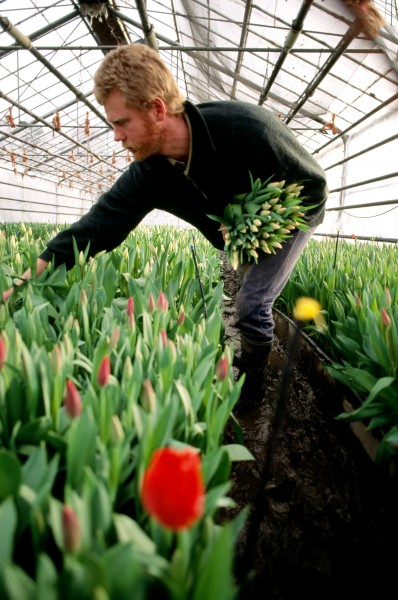
Ray Conijn’s father Cor looked on a map to find which part of New Zealand had climate characteristics most suited to the growing of tulips. He settled on Balclutha, and now, after 41 years in the country, he and Ray supply cut tulips and bulbs to the entire country. Ray enjoys the challenge of growing difficult varieties. Here he picks elegant pink buds, but the family farm also grows the more conventional reds and yellow.
Hielkema is not alone in her regrets. In many respects, the archetypal Dutch person is a tame, domestic animal obsessed with creature comforts. The Dutch identity does not draw heavily on historic achievements or a rich cultural heritage. On the contrary, to be Dutch is to make a fuss on a birthday, provide good coffee and rich chocolates at morning coffee, make sure the furniture is well-polished and the table covered with little carpets. It means decorating your walls with chiming clocks, petit point pictures, paintings of ships in heavy gilt frames and Delfts blauw plates, and placing rows of plants in brass pots in a window fringed with a half-curtain.
Being Dutch is remembering your relative’s 12-and-a-half years wedding anniversary and marking birthdays on a special calendar pinned to the toilet door. It is sitting and talking after the meal is finished without worrying about clearing the plates, or it’s provoking an argument for the sheer love of stirring things up.
Being Dutch is to have a penchant for, literally, the little things in life. This might be expressed in the printer’s drawer full of miniatures on the wall, or simply adding “je” to everything to make it a diminutive. This suffix acts rather like the English “ie” or “ey”, so a “muis” (mouse) becomes a “muisje” (mousie), and a “huis” (house) becomes a “huisje” (housie). Children’s names often fall prey to this linguistic trick, and some children never grow out of being called names like “Pietje” (Petey) instead of Piet (Peter), or “Hansje” for Hans.
The tendency to reduce everything to infant size extends to food, which can often resemble nursery fodder. For a start, it’s gloriously indulgent. Chocolate hail on sandwiches is not a treat, but virtually a national meal, not to mention brown sugar, speculaas or even a slice of ginger cake on bread.
Lunches are usually simple affairs consisting of bread with cheese or cold meat from the delicatessen, or, if you prefer, one of a huge range of children’s toppings, starting with chocolate hail and moving on to muisjes (a pink and white aniseed mix) and vlokken (dark, milk, white or all of the above types of chocolate in the shape of cut-up ribbon). Any one lunching with a Dutch family should remember that such a sandwich is eaten open, with a fork and knife.
Main meals continue the nursery theme in that many of the national dishes are simply vegetables mashed with potato: there is “hutspot” (carrot, onion and potato), “zuurkool” (pickled cabbage mixed with potato) and “boerenkool” (curly kale mixed with potato). Most food is cooked on top of the oven, so meat is usually fried.
Puddings are equally uncomplicated. You might be offered custard or chocolate custard (pap) or a fruity dairy product like quark or yoghurt.
On the surface, these totems of Dutch culture sound suffocatingly trivial and bourgeois, but underlying all the homely clutter and codified behaviour is the demotic social spine of a nation. For all their dourness, the Dutch are surprisingly sentimental, emotional people. The fuss over birthdays, frequent use of diminutives in the language and pivotal role of the family allude to this fact, but behind all these characteristics is a concept of critical importance to the Dutch: “gezelligheid”.
Gezelligheid is inadequately translated as cosiness. In practice, it stands for an atmosphere as palpable as the bonds which bind people in the Netherlands. A card game can be gezellig, so can a city, a house, a party or a bar. All succeed or fail in direct proportion to the degree of gezelligheid they impart. Against this background it is no wonder New Zealand families appeared sterile and callous.
And while New Zealand sanctioned a freer lifestyle than the Dutch were used to, in other respects it seemed startlingly repressive. The Dutch were struck by the social acceptance of hitting children, the covert nature of sex education and the way Kiwis socialised—men and women always in separate camps.
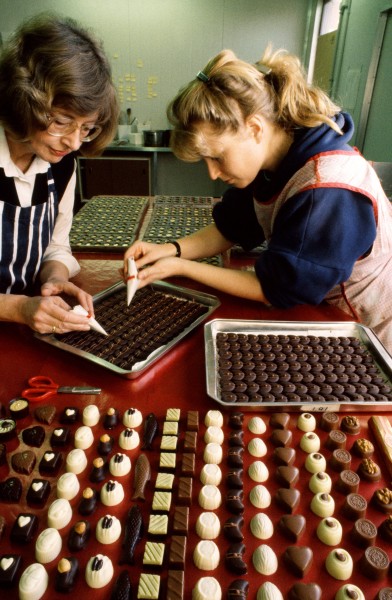
Marjan Hoorens van Heyningen (left) emigrated with her husband Louis eight years ago, tried various jobs. then decided thai what New Zealand needed was good Dutch chocolate. Marjan returned 10 Holland to learn the techniques. and now their Christchurch company produces a wide range of tempting centres. Like many of the more recent immigrants, the van Heyningens moved for the sake of their children. “We wanted them to grow up in a nice, clean environment, and to go 10 a good school where the children don’t take drugs.” With Marit Veken. Marjan pipes decorations on to a fresh batch of “van H’s best”.
While they may have observed such incongruities with puzzlement or mirth, most people will tell you they were too busy to think about themselves. The drive was simply to get on and get ahead as inconspicuously as possible, and for the most part they succeeded. Those who went into farming have done particularly well, despite the fact that they had less education and were less proficient in English than their urban counterparts.
The Dutch form a significant proportion of New Zealand farmers because they are virtually the only recent immigrants to have entered the field in appreciable numbers. According to Henri van Roon, who in 1971 wrote his thesis on Dutch agricultural migrants, the Dutch brought a state of mind to New Zealand farming, rather than a transfer of skills. The Depression and the War left a lasting impact on these young immigrants, and, backed up by a long established Dutch tradition of frugality and hard work, galvanised their determination to do well. “We live more thriftily than New Zealanders,” said one. “For instance, we eat bread and cheese intead of a cooked lunch, and eat even bloated meat, and we don’t have meat every day. We stick to Dutch habits.”
Occasionally, the scepticism of Kiwi colleagues gave them an extra impetus to succeed. One Dutch farmer, nicknamed “the Mad Dutchman” by his neighbours for buying a run-down farm just south of Whangarei, had the last laugh when he bought out both his neighbours within five years. That farmer was the shy but quietly determined Tony Hoebergen, another import from Deurne to “little Deurne”.
Whangarei, had the last laugh when he bought out both his neighbours within five years. That farmer was the shy but quietly determined Tony Hoebergen, another import from Deurne to “little Deurne”.
Hoebergen came to New Zealand in 1949 on the trail of his girlfriend, Miem van den Heuvel, and they were married in 1950. Today they have three sons on farms, and are proud to say they are “very comfortably off’ thanks to years of thrift and hard work. Both Miem, as the eldest girl of 12, and Tony, as an assistant in his father’s trucking business since the age of eight, were used to hard work. “I knew what it was like to carry 100 bags of coal on my back before I left school at 12,” says Tony, while, as a teenager, Miem remembers looking after the whole family for weeks on end when her mother was in bed following the birth of one of her brood.
“Dad didn’t want me to get married. He said I was Mum’s right hand. I knew he was right, but I wanted my own life, and for me life was a lot easier when I was married. I didn’t have all my brothers and sisters to look after.”
But family was not forgotten. The night before he married Tony Hoebergen gave all his savings, some £300, to his mother, urging her to take it since he and Miem were young and could start again.
Like many migrants, Tony and Miem realised that sharemilking offered the best opportunity to buy their own land. In return for milking the cows and tending stock they received a percentage of the milk cheque, which increased if they took on farm maintenance or had their own herd and implements. The aim was to set up as 50 per cent sharemilkers as quickly as possible. By putting in extra hours at both ends of the day the Hoebergens achieved this goal in five years. They then moved north, and within two years were milking 300 cows.
Unlike local farmers, Hoebergen wintered his stock in barns, a hangover from his Dutch upbringing where animals are indoors all winter. Not all Dutch ways, however, could be transplanted so readily to New Zealand. Tilly and Jacques van Eeden spent nine years trying to acclimatise tulip bulbs to Invercargill conditions, and lost many in the process. They finally succeeded, and now crowds flock to see their display paddock of tulips blazing with colour and variety.
[Chapter-break]
To consider how the Dutch have altered New Zealand beyond the farm gate we have to go back to the concept of Dutch domesticity. It follows that their influence will be felt around the dinner table, be it at home or in a restaurant.Though, on the whole, Dutch haute cuisine is unlikely to inspire imitators, the Dutch were used to better quality smallgoods and delicatessen food than were available in New Zealand in the 1950s. The Dutch style of socialising—drinking strong coffee, spirits or a beer in one of the many small, local cafes and bars in the Netherlands—also had an impact on the New Zealand social scene.
Looking back on their early years in New Zealand, many Dutch migrants will sum up their impressions of the country with the statement, “You know, when we came we couldn’t even get a decent cup of coffee,” spoken with utter incredulity, as if to say, “Barbarians all!” The coffee they encountered was more often than not a bottle of chicory syrup and a tin of condensed milk, though the comment also refers to the absence of cafés where people could meet and talk.
Suzy van der Kwast, then Bekhuis, was one migrant intent upon changing this dismal state of affairs. She was 21 when she arrived in Invercargill in 1960. Suzy told the authorities she wanted to serve people, and since there was a shortage of waitresses at the time, her wish was easily granted. But this tall, slim blonde had grander ambitions, and after 18 months of saving hard she was able to start a coffee shop called the Windmill in Wellington. A split with her partner and the arrival of her husband-to-be on the scene resulted in the establishment of a new Suzy coffee lounge in 1963.
Though there were other coffee shops in Wellington, Suzy’s tiny premises were “gezellig”, specialising in her own blend of coffee, buffet salads including delicacies such as crayfish, and luxuriously rich cakes made by a Dutchman. Suzy’s fast became an institution, in part due to the fact that the shop kept long hours. Suzy opened the doors at Gam, and within an hour the place was full. You could have crayfish salad for breakfast, and some people actually did. For years she closed her establishment at midnight, although she eventually tired of the persistent late-night violence and started closing at 10pm.
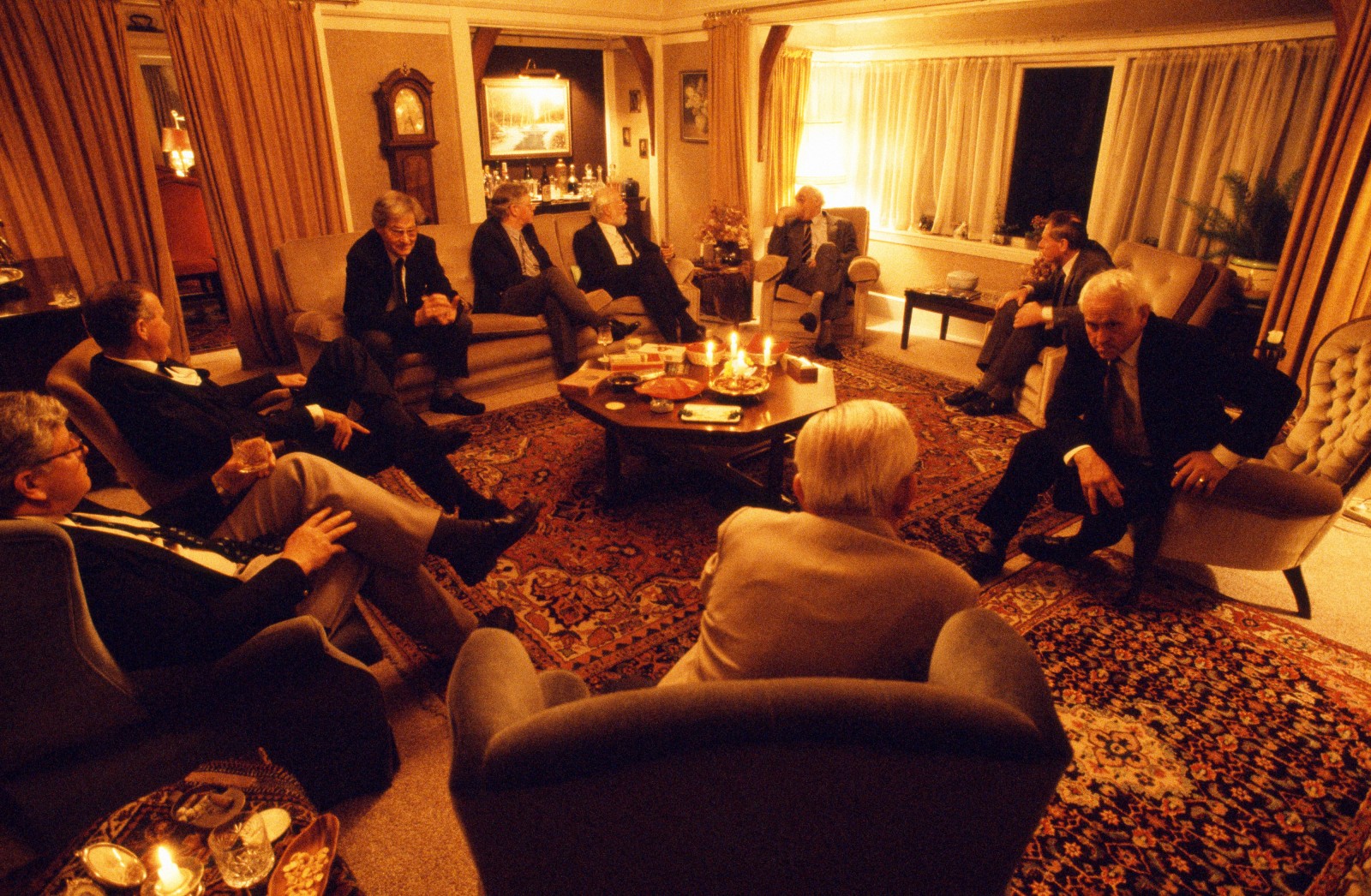
Christchurch’s Borrel Club started meeting so that Dutch businessmen could swap notes about how they were faring in commercial life. The club meets monthly in the homes of its members, where the men enjoy a barrel (drink), a hapje (snack) and a cigar or two. More than this, they crave discussion-heated discussion. Says club member Karel Adriaens, “It’s hard to find people you can argue with in New Zealand. They take things too personally.”
But it wasn’t just the fare and the high standards that lent Suzy’s a continental air. It was Suzy herself. She loved to dress up, and in her finery, her long red nails clamped around a coffee jug, and her face momentarily obscured under her dashing hat, she was an unforgettable sight.
Suzy’s was razed in 1986 after 23 years of continuous operation, and the first lady of the coffee bar scene announced she was in retirement. But four years of jet-setting and relaxing later she was bored, took another plunge and opened a Thai restaurant. She is also a part owner of another café, and when her thoughts wander she says she would like to start a cabaret or nightclub “op zijn Holland’s” with antiques, carpets and the whole gezellig works.
Around the country other Dutch migrants were also making their presence felt in the food arena. In Auckland Otto Groen introduced dine and dance evenings and exotica such as goulash and spaghetti, with varying degrees of success. Han Klisser gave us Swedish Milk Bread, fresh Sunday bread and Swiss-recipe high fibre Vogels bread, while at Mt Ruapehu Dutchman George Mulder was transforming the Tourist Hotel Corporation, raising standards and introducing small Dutch touches like removing the dark blinds and replacing them with Dutch-style white curtains.
Though yoghurt was available here, it tasted vile to the Dutch, and it took De Winkel yoghurts to give us that milky tangy flavour New Zealanders now eat so happily.
Tasman the explorer
The link betweenNew Zealand and the Netherlands was forged 350 years ago this December in less than auspicious circumstances. Abel Janszoon Tasman, with two ships, Heemskerck and Zeehaen, and a crew of 110 men, had just discovered Tasmania, and was attempting to explore the south-east coast of Australia when strong winds pushed his ships off course. He had no choice but to run with the gale eastward across the passage of water that now bears his name.
On December 13, 1642, a mountainous coastline came into view. It was the West Coast of the South Island, just south of Westport. Tasman approached the coast, but was unable to land because of heavy seas. Sailing north, he rounded Farewell Spit and, on December 18, found a calm anchorage in Golden Bay.
That evening local Ngati Tumatakolciri paddled out in canoes to investigate. Tasman’s journal records that they “called out to us in a gruff, hollow voice, but we could not in the least understand any of it. However, we called back to them.”
The Maori also delivered a number of blasts on a conch, described by Tasman as sounding like a Moorish trumpet. Tasman ordered buglers on both ships to blow a suitable reply, but in one of the earliest cases of cross-cultural misunderstanding, the Dutch gesture of goodwill was translated as a call to war.
Next morning, a party of Ngati Tumatakokiri attacked a small boat sailing from Heemskerck to Zeehaen, ramming it with one of their canoes and killing four of its seven occupants. Taken by surprise, Tasman ordered his ships to weigh anchor and sail eastward, towards Cook Strait. A further attack as they left the bay was repelled by Dutch artillery.
“We could not expect to make here any friendship with this people, nor would water or supplies be obtained,” Tasman concluded.
During the five days leading up to Christmas Tasman tried to explore Cook Strait, but unfavourable winds and his ships’ poor tacking ability kept him well to westward. Although the direction of the tide led him to suspect there was a passage through to the open sea, he chose not to investigate further, and mapped the area as a bay, giving it the name Zeehaen’s Bight.
After Christmas the expedition sailed north along the west coast of the North Island, around Cape Maria van Diemen (named for the Governor General’s wife) and on to the Three Kings Islands. There Tasman tried again to land and reprovision, but wind and tide thwarted him. Again, the sailors noted the presence of Maori on the clifftops—a sight that probably did little to stimulate their desire to make landfall.
On January 6, 1943, Tasman put the New Zealand coastline behind him and headed north, discovering Tonga and Fiji on his way back to Batavia (Jakarta)—his point of departure 10 months earlier.
Abel Tasman received little recognition for his discoveries, either in his own time or subsequently. In New Zealand, apart from the geographic features named after him (Tasman Sea, Tasman Glacier, Abel Tasman National Park) his name has been largely eclipsed by that of James Cook, while in the Netherlands he is given little regard.
Born in 1603, Tasman rose through the ranks of the Dutch East India Company at a time when the Netherlands was establishing itself as a global superpower. The East India Company, Tasman’s employer for 20 years, was the largest commercial undertaking in the world. With a virtual monopoly in Asia, it dominated international trading, and had tremendous powers of its own. The company’s charter gave it a virtually free hand in the entire region east of the Cape of Good Hope. Within this region the company’s agents could not only administer justice, but even declare war and conclude peace treaties.
Voyages of discovery were an essential part of the company’s ambitions to dominate world trade. Unlike Cook’s voyages, which were scientific in purpose, or those of the great early explorers like Columbus, Magellan and Vasco Da Gama, which were for the glory of God and King, these expeditions can be compared to a modern business investing in research to keep ahead of competitors.
For Tasman, a career in the company offered a chance of rapid advancement—partly because of the high death rate among sailors at that time. On the voyage from Europe to Batavia, the company’s base in the East Indies, it was not uncommon for up to half the crew to die from scurvy and intestinal diseases.
A ship’s surgeon, writing in the 1640s, described the effects of scurvy in graphic terms: “It was as if the plague was in the very Ship, and the men were tormented and half-crazed . . . Teeth simply fell out of the mouths of many . . . and their gums were so swollen, blackened and rotted that we had to cut and wash away the flesh every day.”
The main purpose of Tasman’s voyage of 1642 was to find a southern trade route to Chile. The Dutch East India Company, envious of Spain’s dominance in South America, hoped that Chile might provide it with rich gold deposits, as well as a base for attacking Spanish bullion ships. What the company needed was a quicker way to get there—one that didn’t require ships to round Cape Horn.
Tasman’s instructions were to voyage south from Mauritius to between 52 and 54 degrees of longitude, then to turn east. If he was blocked by the “unknown South Land”, a hypothetical landmass extending from what is now New Guinea to the South Pole, which scholars believed must exist as a counterbalance to the continents of the northern hemisphere, then no southern route to South America was possible. If there was a passage then the Dutch had a secret weapon with which to surprise their competitors.
Ferocious gales at longitude 50° forced Tasman to plot a more northerly course than the route set by the company—and just as well. Had he followed their instructions he would have missed New Zealand entirely, and would probably have ended up in an empty expanse of the Pacific Ocean somewhere near Tahiti.
Instead, his route took him to Tasmania, which he named Antonie van Diemen’s Land, and New Zealand, which he named Statenland. The significance of these discoveries was considerable. It showed that Australia was not part of “Terra Magellanica”, the unknown South Land, and that a probable route to Chile did indeed exist. However, Tasman was mistaken in his use of the name Statenland. He thought that the mountainous coastline he had just found was the western side of a large southern continent extending across to South America. The eastern flank of this supposed continent had been called Statenland by the Dutch explorers Schouten and Le Maire.
A year later, one of Tasman’s contemporaries, Hendrik Brouwer, showed that Tasman’s Statenland was really an island. The name was promptly changed to New Zealand, after a Dutch province in which the East India company had its chambers.
Despite Tasman’s fulfilment of the main objective of the journey by finding indications of a navigable route to Chile, his superiors were far from pleased. By comparing his records with those of his first mate they found Tasman had failed to map the entrance to Cook Strait. (Perhaps if they had known how treacherous Cook Strait can be, especially for such flimsy, unwieldy ships, they might not have been so critical.) They also accused him of not tracing coastlines carefully enough, and failing to look adequately into trade opportunities.
In 1644 Tasman disappointed the company once again, when he failed to find a channel between Australia and New Guinea. (The Dutch were unaware that the Spanish explorer Torres had navigated the passage 38 years before.)
But he must have pleased someone, because he also received a pay rise, his appointment as commander was renewed and he was appointed to the Council of Justice, the company’s highest court in Asia. This meant he was now regarded as the company’s leading nautical authority in Asia.
In 1648 Tasman’s career took a plunge. He was found guilty of trying to hang an innocent man, was stripped of his rank for 13 months and ordered to pay costly damages. From then on, his reputation was progressively undermined. As a result of the court case he was suspended as an elder in the Reformed Church, and later fell foul of the authorities when he became embroiled in a duel with a Frenchman.
By 1653 he had left the company’s employ, and became joint owner of a small trading vessel. He remained in the East Indies with his wife Joanna and daughter Claesjen, and apparently retired a wealthy man, owning over 100 hectares of land in Batavia. He died in 1659 at the age of 56.
Despite the blemishes on his record, Tasman deserves lasting recognition for putting New Zealand, Tasmania, Fiji and Tonga on the map, being the first European to sail the Tasman Sea and circumnavigate Australia, and disproving the theory that a giant continent covered the southern portion of the globe, with New Guinea as its northern tip.
But Nieuw Zeeland was largely forgotten by the Dutch for almost 300 years. It was not until the collapse of the Dutch East India empire that Dutch migration to the country Tasman first saw took place. Tasman would doubtless have appreciated the irony.
In some respects the Dutch have simply hastened the internationalisation of New Zealand. Although they may not be directly responsible for introducing vegetables like Brussels sprouts, curly kale, witloof and endive, their popularity with the Dutch has been a spur to their acceptance by the wider community.
Think of a lunch you might eat.Cumin cheese, gouda and edam grace the table next to delicate slices of rosbief and salami, rookworst (smoked sausage) and leverworst (liver paste). The bread is Vogels, and you’ve managed to buy a loaf of onbijtkoek (dry spicy cake) from your local delicatessen. You wash all this down with good coffee, and then dare yourself to sample the van Camp and van H chocolates your friend has kindly brought. Perhaps, if you’re healthy, you will clean your teeth with a crisp Royal Gala apple, developed by Bill ten Hove at his Matamata orchard.
You’re sitting, of course in the yellow pine glow of a Lockwood home—the brainchild of two Dutchmen, Jo La Grouw and Jan van Loghem—but you’d be surprised if someone told you that your Ralta electric blanket was named after the van Raalte brothers, who started the business. Your finely tailored Rembrandt suit in the wardrobe alludes to a Dutch influence, too: the company is run by a Dutchman, Paul Veltman.
So that’s business. Everyone knows the Dutch are merchants at heart, but what about sportsmanship in this sports-mad country. The Dutch tend to think of sport as the preserve of children, and not to be taken too seriously, but they’ve produced some of the finest soccer stars (Arie van Rooyen and Frank van Hattum), runners (Dick Quax), scullers (Eric Verdonk), skaters (Anje Kremer) and cyclists (Jack and Stephen Swart and Tino Tabak) this country has ever had.
A love of small things is part of the Dutch identity, and a printers box with miniatures is almost universal in Dutch homes. A more sizeable statement of Dutch identity is made by Martin van Doorn in his home in Howick.
Only a few years ago you could have paid a visit to the National Art Gallery in Wellington and maybe bumped into its then curator, Luit Bieringa. You might also have been struck by the startlingly dramatic canvases of van der Velden or been lucky enough to see some of Theo Schoon’s work. Schoon was fascinated by Maori art, and spent years in the 1960s living as a hermit, going from cave to cave copying Maori rock drawings. He also revived the lost art of gourd decoration, and worked on greenstone, pioneering new styles. This formidable Indonesian-born Dutch artist also worked in ceramics and design before he died in 1985.
Having saturated yourself in Schoon, you might be confronted next with some of Ans Westra’s images. This Dutch photographer has captured striking images of the Maori, as well as the landscape and the effect people have had on the land.
Some of these names are just as memorable for the controversy they aroused as for their achievements. Take Otto Groen, scourge of the politicians for his blatant flouting of the law prohibiting alcohol in restaurants, and Ans Westra, criticised by the Maori Women’s Welfare league for her series Washday at the Pa, which, they claimed, focused on the poor living conditions of rural Maori. And let’s not forget all those outspoken Dutchmen, be they bosses or workers, who have offended the unions.
Fortunately for the Dutch, they love an argument, and are not easily daunted by conflict. If only their New Zealand friends and relatives felt the same way! Listen to this lament from a New Zealand spouse. “When I first met my husband I used to go with him and sit and listen while he played cards with other Dutch people—bridge, usually. It must have been love, because I couldn’t understand a word of Dutch, and all the magazines around the house were Dutch too.
“I’d watch them as they played. Sometimes one would stand up and abuse his partner at the top of his voice, and then at the end of the evening they’d all be roaring with laughter. I coudn’t work it out. Still can’t, sometimes. It’s taken me years to get used to that.
“Sometimes my husband will go into a situation and say something he doesn’t even believe just to stir things up. I listen amazed, and can’t believe he’s done it.”
What this New Zealander is trying to come to terms with is the Dutch sense of humour, which thrives on insult and rebuttal, all acted out as loudly and vigorously as possible. A sensitive Kiwi is likely to get scalded in the process, but the Dutch know it’s good fun, even though they might have just abused your family, called you fat and are about to start on where you live.
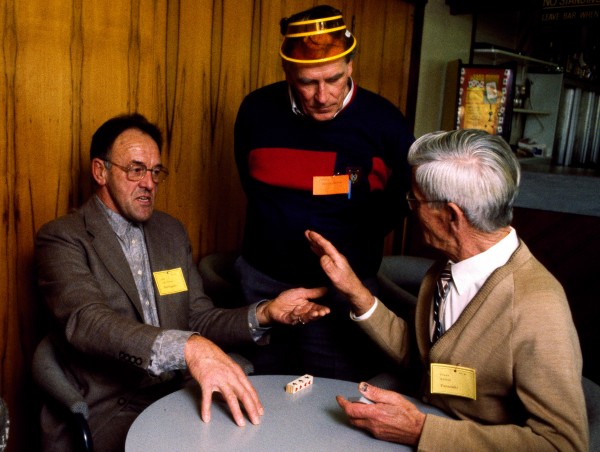
So it is at the national Klaverjas (Dutch card game) tournament in Wellington. Heard at one table of four players:
“Where are you living now?” “Auckland, Torbay.”
“Oh, I know some people who live there—the van Daalens.”
“Sure I know them. They used to live in Birkenhead before they moved there.”
Disgruntled player from Christchurch chips in.
“Yes, yes, now we know you’re both from Auckland. Nice for both of you. I’m sure you’ve got very good addresses. But it hasn’t improved your playing. Look at that card, will you!”
That’s just the beginning. In the corner of the room of 108 people another table are having a dispute about points. They forgot to write the points down, so a compromise, which involves averaging out the numbers, is suggested by a mediator. Three at the table agree, but the fourth insists his side has done better than that, and refuses. He’s a nuisance, but everyone accepts his right to object and, if they were honest, would admit to finding it rather amusing.
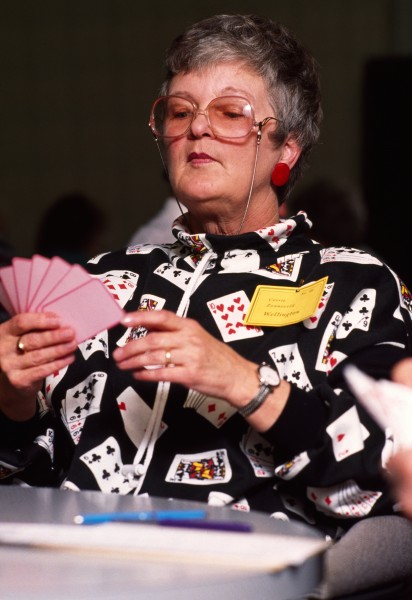
Corrie Zonneveld made a card sweater especially for the occasion.
The noise level in the Klaverjas room is rising. Even though this is a national tournament with cups, prizes, winners (and a booby prize), the purpose is primarily social. The hubbub in the room, even while the game is on, shows that players are making the most of the opportunity to catch up on old friends around the country.
On the whole, though, Dutch immigrants profess to despise gatherings of their countrymen. Dutch clubs have only ever attracted a smattering of immigrants, and among the second generation the retention rate is lower than with clubs serving other ethnic groups.
Some of the responsibility for this state of affairs must rest with the assimilation programme, although the antipathy towards anything Dutch also reflects the state of the country they left so many years ago. Factional differences, either of class, region or religion, were rife at the time, and were transported virgo intacta to New Zealand. Reasons given for non-involvement in the clubs range from “it was too full of noisy Catholics”, “uppity Protestants”, “rowdy Brabanders” or “nice, simple folk we have nothing in common with”. There are often two Dutch clubs in one city—one for the hoi polloi and one for an elite. Even Klaverjas is played two different ways: Rotterdam’s and Amsterdam’s.
Still, 108 people is a good turnout for the Klaverjas game, and even drinks at the ambassador’s house can pull a crowd of 400 these days. After a lifetime of hard work, many older migrants are now turning back to their past, reverting to their language and yearning for the emotional aspects of a culture they left behind. They look back to their years in Holland with a delectable nostalgia, and try to balance what they have gained with what they have irretrievably forfeited.
As a rule, the Dutch aren’t big on sports… but they are serious card players. At the 1992 Wellington Klaverjas tournament a stormy Dutch argument was sparked when one player forgot to keep score. Geny Wekenborg (standing) tries to mediate between Cris Wissen (left) and Frans Rutten.
It was out of this back-to-the-future shift in perspective that Ons Dorp in Henderson was created. Bill Verryt, a building contractor, firmly believes that despite all assurances to the contrary, the Dutch remain Dutch and will often seek out fellow Dutch people as they grow older. His dream of establishing the first ethnic retirement village in New Zealand was born out of a concern about elderly Dutch migrants he had seen who had forgotten English altogether. Able only to speak Dutch, they were suddenly isolated.
Thanks to Verryt, the village, complete with community hall, care centre and geriatric facility for the frail, was opened in 1984. The streets are cobbled and the roofs are like those of a Dutch farm house, and with the neatly curtained windows and profusion of flowers, Ons Dorp looks like a piece of Holland in New Zealand.
For others, the yearning is so strong they decide to make the journey home. There are no recent figures on the numbers of Dutch migrants going back, but one study in the 1970s showed a 30 per cent return rate. Some in the Dutch community say this could now be as high at 50 per cent. Verryt is not sure what the future of his village is, whether it can always continue to be a haven for elderly Dutch folk, given that there are fewer Dutch immigrants these days.
But there are signs that the younger migrants are at least interested in continuing to socialise with a group of Dutchies. Club Amsterdam in Auckland is a little more than a year old and thriving. The group, aged between 35-45, meet monthly at the Birdcage Tavern, although they eventually hope to have their own premises. They can order tea, coffee or Heineken, speak Dutch, smoke, be more relaxed with members of the opposite sex than New Zealanders are, and engage in a little blunt Dutch banter.
“Hey you, you shouldn’t be drinking,” cries a woman sticking a sharp finger into her male friend’s stomach.
“What do you mean?” he replies patting his belly contentedly. “It’s cost me a fortune to get it like this, and it’ll go on costing just to keep it in shape.”
The mahogany-stained and heavily mirrored room at the Birdcage is as rich as a Rembrandt painting, and at the end of the evening the air is thick with good humour and smoke (the Dutch have yet to embrace the non-smoking message). What’s more, everyone is sober.
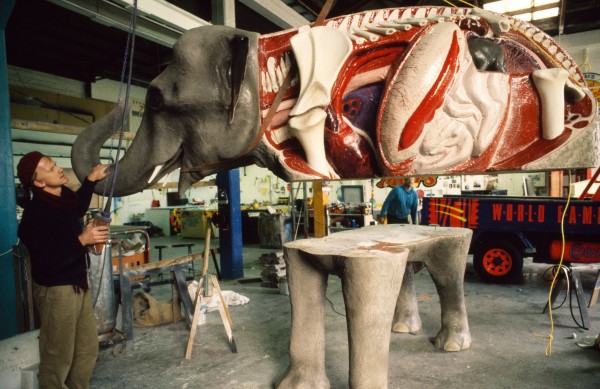
Harmen Hielkema, a second generation Dutch New Zealander, feels the pull of two cultures, and isn’t sure that he fits neatly into either. One positive legacy of his Dutch background is a love of urban art-“of decorating the town.” A recent commission by the Auckland Zoo has enabled him to explore this idea on an elephantine scale.
These newcomers have none of the complaints of their predecessors, though New Zealanders still mystify them a little. They never follow through with invitations, are hard to get to know, and the men are boorish.
But for these people, their decision to emigrate was more of a positive choice than the government-driven migration of the 1950s, and it shows. Unlike their predecessors, they were not escaping the problems of poverty, but those associated with excessive materialism, such as urban congestion and pollution. Some simply wanted escape from a highly regulated society.
Most Dutch migrants’ children, however, would find little to interest them in Club Amsterdam. To all intents and purposes they are indistinguishable from any other New Zealander of northern European extraction. Yet for some, the conflict of cultures has left an indelible impression. The drive to be like New Zealanders, and thus different from their parents, has created a rift in some families, while others have actively rejected their parents’ obsession with work. A few, like Harmen Hielkema, have felt the tug of two cultures strongly in their own life.
Hielkema’s parents are from the Friesian-speaking area of the Netherlands, and so he speaks Friesian, Dutch and English. They were one of the few “foreign” families in Torbay 30 years ago, and this redheaded son has strong memories of feeling different and isolated.
His mother’s yearning for home prompted the family of four children to pack their bags and leave New Zealand for good in 1971. Harmen was 13, just the right age to explore the emerging youth culture of Holland at the time. He soon fell in with a group of friends, whipping around the narrow streets on mopeds, all wearing corduroy jackets and trousers, enraptured by rock music.
But even here Harmen was a curiosity. He was handier than most children his age, and good on a bike and a boat. Yet he spoke an old-fashioned form of Friesian which had changed during his parents’ time away. When he spoke in shops, the person behind the counter would invariably eye him askance and ask where he came from. Given the strange ring to his Dutch, they assumed New Zealand must be somewhere in Holland.
For Harmen it was the visual difference he remembers most vividly, even now. The skinny fillets of houses hard up against one another, the multi-level perspective, seeing a train running across the top of a dyke with a ship at eye level, all viewed from your car.
Lacking qualifications, his parents found it harder to get work than they expected, and three months later they returned to New Zealand. Back home again, the newly sophisticated Harmen felt more isolated than ever, and though the feeling wore off, the experience left its mark.
Dr Robert Leek, a Dutch lecturer in English at Auckland University, agrees that many Dutch New Zealanders would no longer feel at home in the Netherlands. “The Dutch of the 1990s are very different people from those who emigrated in the 1950s,” he says. “They are less traditional in their culture, and more international in their outlook. After seeing the Netherlands today, visiting Ons Dorp is like stepping into a time warp.”
While Harmen Hielkema feels somehow “between cultures”, he says his own children love their Dutch background. New Zealand has changed too. “They’re not having as much trouble with our surname as I did.”
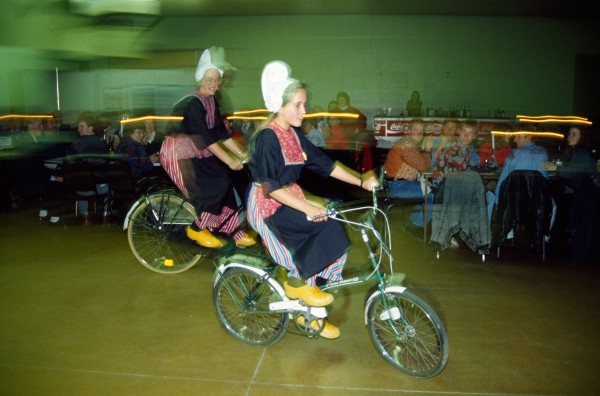
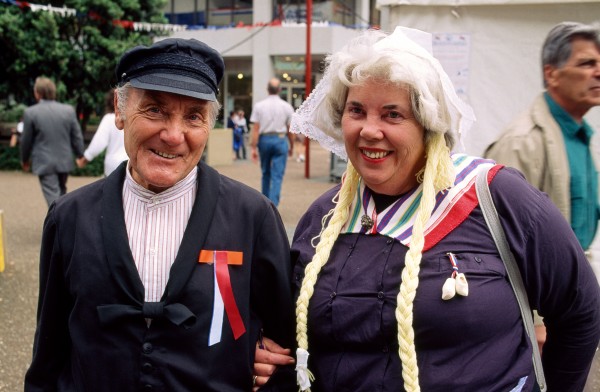
For the Dutch, 1992 has been a year of “coming out”. Whether that means attaching cotton braids to your hair or cycling in clogs and full costume, the country has enjoyed the spectacle. Geweldig!
Hielkema may have put his finger on the true inheritors of the Dutch tradition: the third generation. Thriving folk-dancing groups in Hamilton and keen interest shown in the new Dutch course at Auckland University indicate that the third generation may be more interested in their grandparents’ origins than their parents were.
That’s often the way. The further you are from the Dutch, the more interested you are in them. Dutch husbands notice their New Zealand-born spouses are often more enthusiastic about their heritage than they are.
Since the Dutch wave of immigration, a multitude of newcomers, mainly from nearby Pacific Islands, but also from, South Africa, England and Asia, have arrived in New Zealand to change things once again, bringing the same hopes, arousing the same prejudices, and settling into the nation’s microcosm just as naturally in the end.
Mind you, any self-respecting Dutchman reading this is bound to add the rider, “Yes, but we make the best immigrants.”