Though the age of electronics has robbed bells of many of their traditional roles,there is a world of ringing that has remained unchanged for 300 years.
Hear the mellow wedding bells, golden bells! What a world of happiness their harmony foretells!”
So wrote Edgar Allan Poe, and, indeed, few sounds are more beguiling than bells—especially since telephones and alarm clocks stopped ringing and began chirruping.
Every week, dedicated people from all walks of life gather in seven New Zealand churches to take part in a 300-year-old ritual. They meet in the porches or climb narrow stairways (in Wellington Cathedral, they take a lift) to the ringing chamber, to spend two hours pulling on ropes.
It is an extraordinary practice—a combination of music and mathematics that demands teamwork, timing and concentration. It also has a language of its own, and one which has enriched the English tongue with its images.
Bell-ringers call it “the Exercise,” though it is not physically demanding—in England, where it originated, a few pints follow every practice. All connection with religion was broken by the Reformation (ringing was strictly forbidden on Sundays) and only formally restored in the late 19th century, though “secular” ringing had continued in the interim.
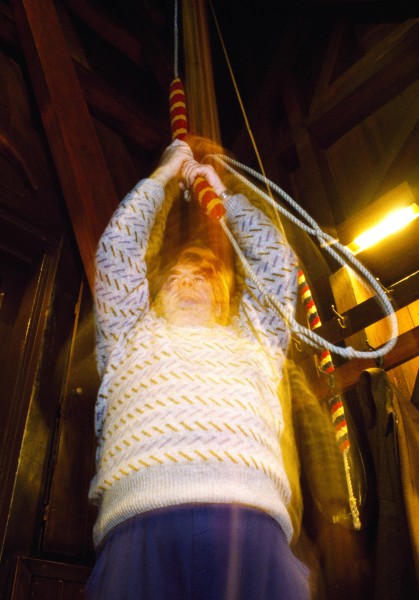
Graham Rogers, one of the ringers of Old St Paul’s, Wellington, gets into full swing.
What bellringers do is “ring the changes”—that is, ring their bells in sequence, starting with downward scales (“rounds”) to set the rhythm, then working their way systematically through different sequences of all the bells until they return to the original rounds.
Change ringing must not be confused with the playing of tunes, which is what happens on carillons and chimes. Change ringers always “ring”the bells, never “play” them.
Gerald Mcllhone, a Wellington engineer, has been ringing since he was seven and could barely reach the rope. Like many of this country’s best ringers (there are no prizes), he learned in England. To him the language of bells is second nature: he can easily sing changes, describe them numerically, or speak them, after the fashion of Dorothy Sayers’ novel The Nine Tailors:
“Tin tan din dan bim bam bom bo! Tan tin dan din ban bim bo born! Tin tan dan din bim barn born bo!”
That, he tells me, is the beginning of Kent Major. Kent is the name of the “method,” or system of changes; Major means it is rung on eight bells.
Other numbers of bells have equally intriguing titles:
4 Minimus
5 Doubles
6 Minor 7 Triples
8 Major
9 Caters (from the French quatre, 4)
10 Royal
11 Cinques (from the French for 5)
12 Maximus
The names for the odd-numbered methods refer to the number of pairs of bells that change places at each change. To add to the confusion, triples, caters and cinques (pronounced “sinks”) are actually rung on the next (even) number up; the lowest bell, the tenor, sounds at the end of each change, providing a steady tolling throughout, and is not counted.
All ringers have their favourite changes. “Grandsire Triples” is popular , but “Double Norwich Court Bob Major” has its ardent advocates, too. A full peal of Double Norwich has been rung only once in New Zealand, at St Matthews-in-the-City on June 22, 1991. It took just over three hours to ring.
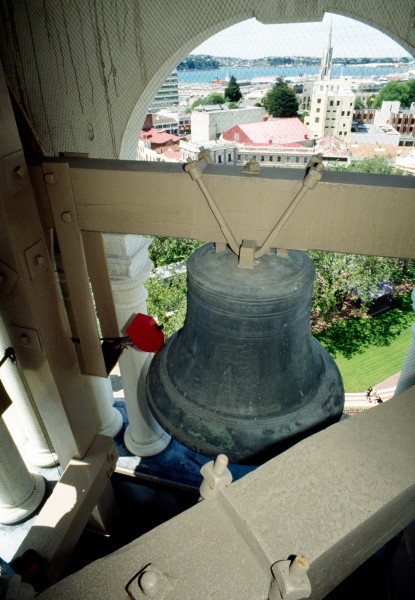
Before the evening’s ringing begins, Gerald Mcllhone leads me up another flight of stairs to Wellington Cathedral’s bell chamber where the 14 bells hang, safely “rung down,” with mouths downward.
When in use, the bells swing in a full circle, from upside down to upside down and back again. A wooden stay sticking up from the headstock pushes a slider back and forth so that both inverted positions are stable. The stay is designed to break and be easily replaced if an inexperienced ringer uses too much force. An old rhyme says: “If a bell you overthrow, ’twill cost you sixpence ‘ere you go.”
Ringers speak of bells having good “go,”—jargon for good balance, firm mountings and smooth bearings. Until the advent of ball bearings at the turn of the century, ringers had to use footstraps to help them pull—and it helped if the ringers were well lubricated internally.
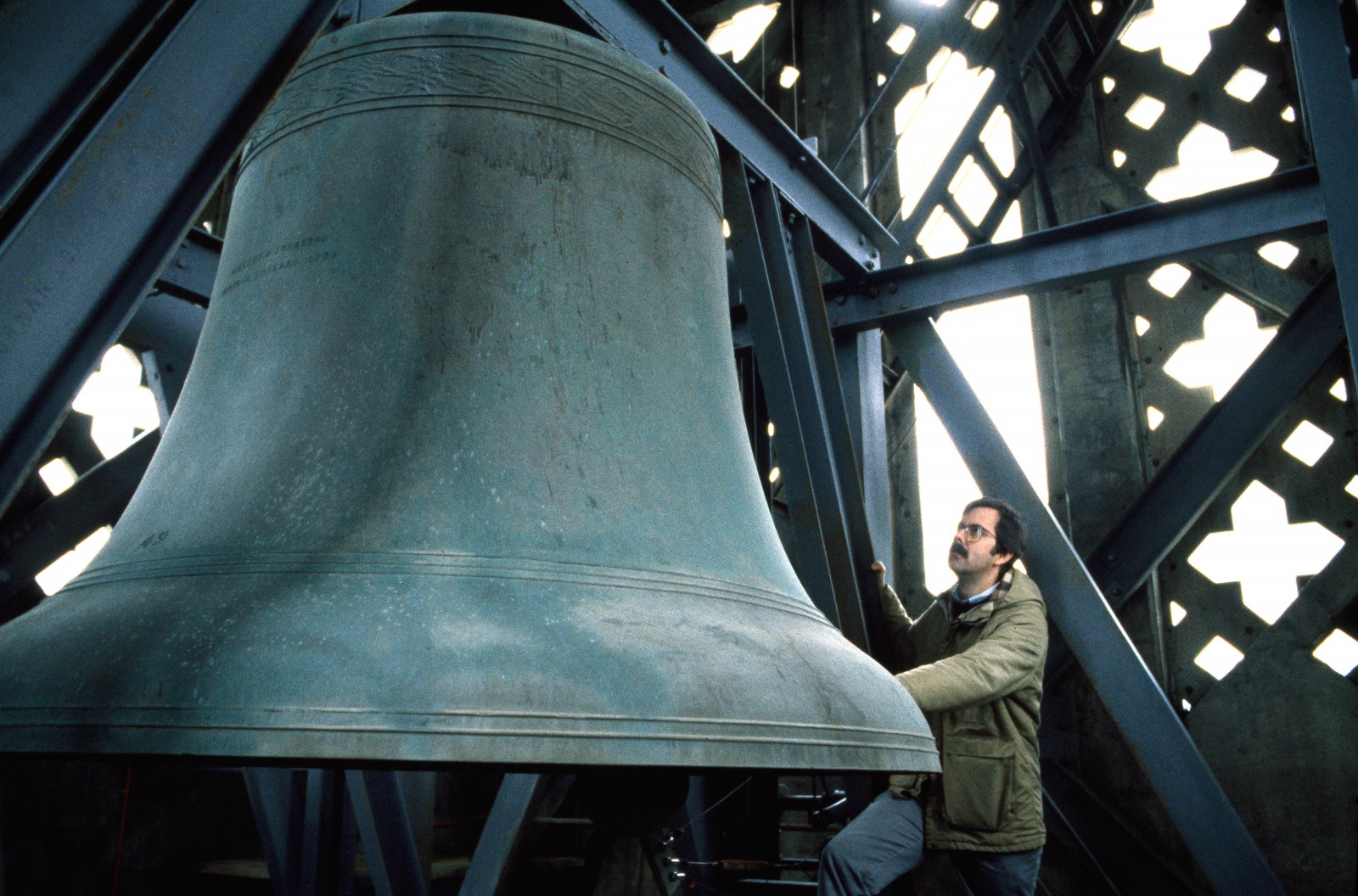
The bell chamber is a dangerous place when the bells are “rung up”—mouth upward, waiting to ring—or when they are literally in full swing. Four of New Zealand’s swung bells weigh a tonne or more, but these apparent giants actually come nowhere in the size stakes.
Big Ben weighs 13 tons newt. Great Paul in St Paul’s Cathedral is even bigger, at 16 tons 141/2 cwt. The biggest bell in the world is the Tsar Kolokol (Tsar Bell) in Moscow, a whopping 180 tonnes. It was broken by fire in 1737, two years after it was cast, and has never rung.
Bells are occasionally made of steel, but normally an alloy of copper and 13 to 25 per cent tin is used. The tin makes the alloy brittle, so bigger bells have less. Small amounts of other metals may be present, but that has more to do with sentiment than acoustics—the gold coins that are sometimes thrown into the melt dissolve almost immediately. The alloy actually improves with remelting, so old bells are rarely thrown away.
Casting occurs in a two-part mould consisting of the “cope,” which defines the shape of the bell’s exterior, and the “core,” which gives the interior shape. Both parts are lined with “loam,” a mixture of clay, sand, straw and, traditionally, a little horse dung to improve the texture. The loam is shaped by a template and then baked until hard.
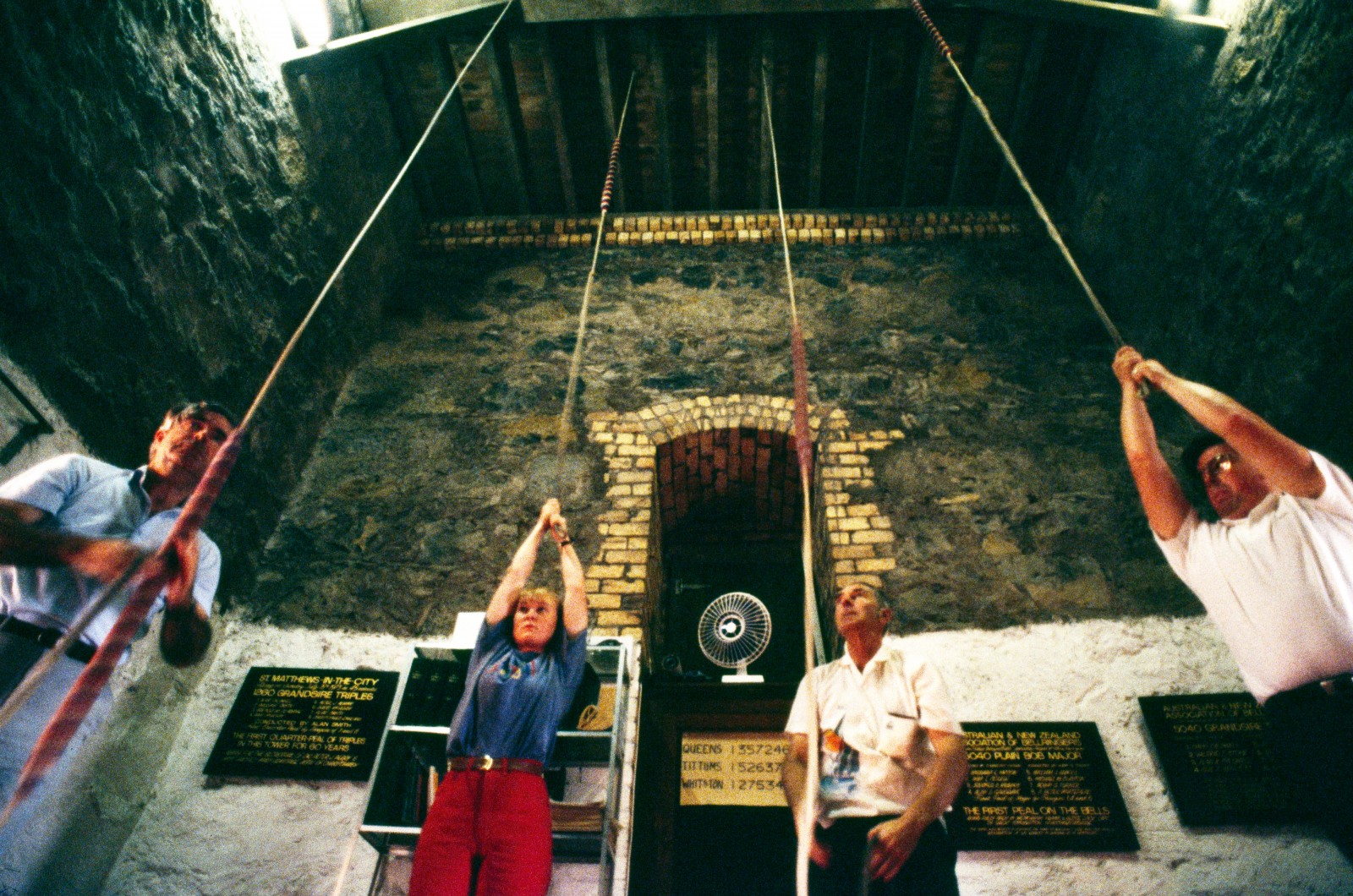
Plaques recording memorable peals hang on the walls of the St Matthew’s ringing chamber, inspiring the ringers to greater efforts.
After the two halves of the mould have been fitted together, bell metal is poured in at a temperature of around 1100°C, and “tamped in” to drive out bubbles. Cooling is carefully controlled to prevent the buildup of stresses,and large bells are usually buried in sand for several weeks until they have completely cooled. The outcome is unpredictable: the saying “as surprised as a bellfounder” reflects the fact that a bell rarely comes out of the mould in tune—but it does happen.
A bell is thickest near the rim and at the top. The clapper is designed to strike the rim at a point of maximum vibration—called an antinode—but spaced equally around the rim, and running up the sides of the bell, are zones of no movement at all—the nodes.
When struck, the whole bell divides itself into segments which move in different directions, with the nodes in between. This bulging and bellying produces a complex acoustic behaviour which results in not just one note per bell, but a series of harmonics or “partials,” many of which are discordant.
A good tone in a bell comes from the balancing of the harmonics to produce a pleasing sound, and this is achieved in the foundry by paring metal off the interior surface using a vertical lathe.
Tuning of the partials is a recent phenomenon; before this century bells were rung the way they came out of the mould. It was only when the techniques used in Belgium and the Netherlands to tune chimes were adopted in England that change-ringing bells were given this extra tuning treatment. Even so, only the first five partials are tuned.
Because bells vibrate in complex ways, their sound varies with the listener’s position. At the moment the clapper strikes a tower bell, many untuned partials are heard, giving a metallic clang that dies away almost immediately. The upper partials can then be heard. The prime and the octave above it (called the “nominal,” because some people hear it as the main note) are strong and sustained, but it is the hum note, weak at first, that outlasts them all, like the smile on the Cheshire cat.
Clappers are designed to wear away, rather than wear out the bells. The clappers of chimes and clock bells swing only a short distance, and are much heavier than those for change ringing, which traverse the bell mouth once during each swing.
A ringer has control of a bell only at the very top of its swing. Through the greater part it is swinging freely, and all a ringer can do is slightly advance or retard the moment each swing begins or ends. This can be disconcerting for a beginner: once you get out of time all you can do is stop and hope to come in again at the right place in the next sequence.
A session begins with “ringing up,” swinging the bells in wider and wider arcs until they are inverted. This results in an inevitable clangour before ringing proper begins. When a bell is not in use, one of two distinctive knots is tied in the rope to show whether it is rung down or rung up—safe or dangerous. Anyone caught in the dangling loop of a bell that was rung up could hang in it when the bell pulled the rope from floor to ceiling, though that has never happened in New Zealand.
When the conductor has decided what method to ring (based on the number and skill of the ringers), the person ringing the treble, the highest bell being run, calls “Treble’s going!” and as the bell begins to fall, “Treble’s gone!” or “She’s gone!” (All bells are female.)
The most experienced ringer usually takes the low note, the tenor, which is the heaviest bell being rung and the most difficult to make changes on.
*
Modern bells have their origins in the Italian province of Campania—hence the name campanology for the subject of bells. But it was England that made change ringing its own, and earned the title “The Ringing Isles.”
The principles of change ringing are generally regarded to have been laid down by Fabian Stedman in 1668, but rudiments of the Exercise had existed for at least half a century before that. Ringers continue to compose new methods, frequently with computer assistance, and nowadays they are often published as computer printouts, with a bell’s path marked by a blue line.
Strictly speaking, a “change” is what happens between pulls of the ropes, but colloquially a change is the order in which all the bells are rung once; when written down it is called a row.
Judith Bailey literally “learns the ropes” from Gerald McIlhone, the most experienced bellringer at Wellington Cathedral. The main challenge in change ringing, apart from the mental effort of remembering hundreds of different ringing sequences, is to get the bell to sound exactly when you want it to. In all bells there is delay between when you pull on the rope and when the clapper strikes the bell.
A bell may not sound twice in one change, and a change may not be rung twice in one method. There is also a shorthand to describe different changes, and some of the most melodious rows have their own names: the familiar 13572468 is called Queens, and 15263748 rejoices in the name of Tittums. Whittingtons—12753468—is often used at weddings.
To ringers, a peal is not just any joyful ringing, but a certain number of changes to be rung. For example, with seven bells or less, tradition decrees that there be 5040 changes rung. That number neatly exhausts the permutations of seven bells (5040 changes = 7 factorial, or 7 x 6 x 5 x 4 x 3 x 2 x 1, and is called the “extent” of seven bells).
On fewer than seven bells, changes must be repeated to complete a peal—seven times on six bells, 42 times on five. To avoid the monotony this might cause, different methods are used throughout the peal. On more than seven bells, any number of changes over 5000 is acceptable.
Ringing a peal is a memorable event, to be recorded on a plaque or in a ringers’ magazine. A “touch,” part of a peal, is rung much more often—before church services or at weddings, for example.
So, how difficult is it to learn bell ringing? According to Wellington ringer David Murray, “In the beginning it’s hard to get the rhythm, the feel of the bell, because the rope’s rushing by so fast. But once you get used to it, it seems really slow. It’s not that hard once you’ve mastered it: at any given moment you either can ring or you can’t.”
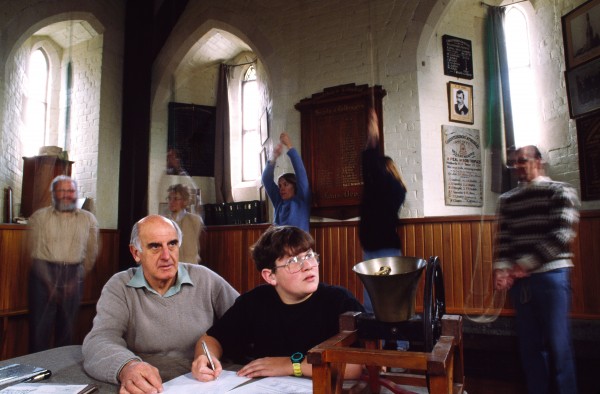
One of Christchurch Cathedral’s up-and-coming ringers, John Clayton (age 15), watches the changes intently while referring to a manual of ringing methods. Bob Bennett supervises.
Beyond the maths and the memory required, there is an added difficulty: the clapper does not hit the bell until well after the rope has been pulled—nearly a second on the larger bells—while the “strokes” of a change are at a rate of several per second. A ringer must constantly anticipate his place, using both hearing and “rope-sight.” The brightly coloured woollen “sallies,” like bullrushes woven into the ropes, give the ringer something to focus on, and help him keep the rhythm.
Wellington Cathedral’s ringing chamber is large but comfortably nondescript, with the well-used furniture typical of the side rooms of most churches. Only the circle of ropes coining through grommets in the ceiling, and a chart of the cathedral’s bells on one wall betrays its purpose. Plaques from St Edmunds, Northampton, source of seven of the bells, commemorate peals and their ringers, and a 1000-piece jigsaw puzzle on a table in the corner occupies anyone who is not ringing.
Pleasance Purser, a librarian at Parliament, is Master of the Bellringers. (The Exercise is more emancipated than its terminology, and more and more women ring.) She is often the conductor, the ringer in charge of a peal or touch. She calls “Go London!” (or whatever the method is called) to start, calls the changes during the more difficult methods, or “Rounds!” if things go wrong. “That’s all!” is called when the last method is about to end, and “Stand!” stops all ringing. The conductor makes each call one handstroke and one backstroke (“one whole pull”) before it is carried out.
When practice with the big bells finishes, the ringer of Wellington Cathedral turn to handbells. Clockwise from top-right corner are Jane Marshall, Pleasance Purser, Brett Young, Jean Murphy, Gerald McIlhone and Tim Pink.
Surprisingly, the bells are far from deafening in the ringing chamber. The ceiling is so soundproof that a hatch has to be opened, or a speaker-system connected to microphones in the bell chamber turned on, to allow ringers to hear the bells properly. Furthermore, the ropes, rollers, stays and sliders, and even the rocking of the mountings themselves, make a variety of low thumps, unheard outside the tower, that make the ringing chamber a less than ideal place to listen.
An old hand like Gerald Mcllhone can ring on autopilot. “You can fall asleep while ringing,” he remarks. “The shock is when you wake up and don’t know where you are—especially if you’ve been conducting over a long period, and 11 other people are relying on you to get them safely to the end. It’s like driving, when you suddenly realise you have no memory of the last 40 kilometres.”
The journey metaphor is appropriate. Unlike a musical performance with subtleties of loud and soft, light and shade, pauses and changes of pace, with bells you are literally “going like the clappers” the whole time.
A late starter like Tony Greaves has to give it his full attention: “I’m desperately following my blue line-7 8, 8 7 … It’s 100 per cent concentration as far as I’m concerned.”
A retired priest who uses ringing to keep up his connection with the church, Greaves looks the part with his bushy RAF-style moustache. “I’m a shocking ringer,” he confesses, “but they put up with me. I love the people and I love the art.”
Like many others, he appreciates the variety of people who ring, and the way the Exercise cuts across social classes. Across denominational lines, too. At Dunedin’s First Church, the bellringers’ secretary Elizabeth McLennan says most of them are not Presbyterian: “At five to ten most of us drop the ropes and race across to the (Anglican) Cathedral on the other side of the Octagon. One races to another Presbyterian church at the other end of town, and one’s a Salvationist.”
New Zealand’s largest bell, the 5.5-tonne Reo Wairua (“the Spirit’s voice”) hangs along with 64 others in the 51-metre tower of the Wellington War Memorial Carillon. It plays a booming A-flat.
By contrast, Wellington Cathedral ringer Brett Young, Tony Greaves’s son-in-law, confides that “at 10 o’clock most of us are out of here—we’re not religious types!”
Sixty-eight-year-old Aucklander Bill Lack displayed similarly apostate tendencies in his youth: he began ringing with his father at the age of 15 to get out of Sunday School. He’s highly regarded in ringing circles as an expert on the mechanics of bells, and was the main person responsible for bringing the bells of St Matthew’s-in-the-City back into play in 1972. Lack describes himself as a “grey eminence” in ringing—more of a belfry mechanic, with long absences from the ringing chamber.
He agrees that ringing is addictive, and ringers “certainly a little bit mad.” For some people, he says, ringing can be an act of worship. Others have a more intellectual approach.
Ringers are organised into societies and guilds. Most are members of the Australian and New Zealand Association of Bellringers, which in turn is affiliated to the British-based Central Council of Bellringers, which makes the rules.
Because neighbours who do not appreciate the nuances have a limited tolerance for bellringing, especially when ringers are inexperienced, practices may be held with the shutters in the tower closed, or with bells muffled, sounding only the mysterious hum notes and forcing ringers to rely on rope-sight. (At Wellington this happens monthly, because practices regularly clash with a cathedral meeting. Even so, Pleasance Purser says the dean and vestry are “highly ringable.” “Unringable vicars” are the bane of bellringers’ lives.)
A very different effect is that of ringing the bells “half-muffled:” a leather damper on one side of the clapper quietens the bell on alternate strokes, and because the alternate strokes stay in step, whole changes are alternately loud and muffled—a mournful echo effect.
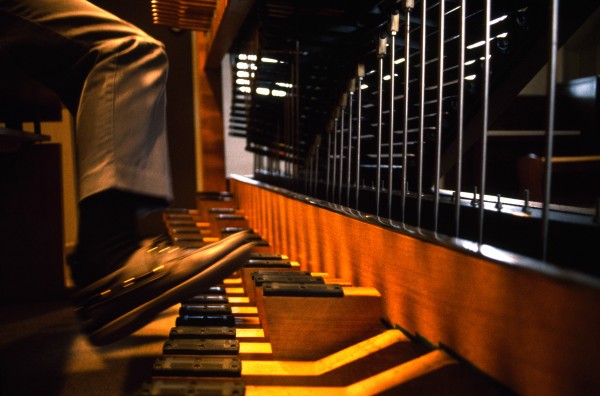
Wellington’s carillonist Timothy Hurd gives a recital, using both fists and feet to sound the bells.
Half-muffled touches were rung for 30 minutes before and after Billy T James’s memorial service in St Matthew’s-in-the-City.
(Those for whom even muffled bellringing is a musical pestilence might care to quote the following piece of doggerel to their local campanologists. It was penned by the Parish Clerk of St Peter’s, Norwich, who was objecting to 6am practices: “Ye rascally ringers, inveterate foes, Disturbers of those who are fond of repose, I wish, for the peace and quiet of these lands, That ye had round your necks what ye pull with your hands.”)
When ringing is forbidden altogether (after 9pm at most churches) many ringers continue on handbells. There is now no need to anticipate, but ringers hold two or even four bells each, just to keep it from being too easy.
Handbell ringers may sometimes practise in silence without bells, using only their thumbs—and mystifying any onlookers.
Change ringing is strongest in Britain, the Commonwealth (both present and former) and the United States. In Canada, Britain and Australia, several Roman Catholic churches and cathedrals have rings of bells, and in some countries schools, universities, town halls, post offices, and even, in Massachusetts, the Perkins Institute for the Blind all have ringable bells.
Ring in the true
Several churches have chimes: bells hanging downward, with a hammer or clapper arranged to strike when pulled by a cable from a central keyboard. But only seven churches have bells hung for change ringing.
Auckland’s St Matthew’s-inthe-City has eight bells. The tenor, E-flat, weighs 20 1/2cwt (1.05 tonnes).
It was Sarah Harriet Selwyn, the Bishop’s wife, who raised most of the £1000 cost of “Bishop Selwyn’s bells.” They had been cast for the London Exhibition of 1862, and were then brought to Bishopscourt in Parnell. There they were hung not far above ground level, and rung or chimed from above using an arrangement of pulleys, or alternatively chimed by a machine like a huge music box.
They were moved to St Matthew’s in 1906, but some time after the First World War they fell into disrepair. Ropes were attached to the clappers to chime them by “clocking”—an activity ringers deplore because it wears one side more than the other, putting the bells out of tune, and risks cracking them.
The bells were restored and the tower strengthened in 1972. One bell had indeed cracked, and was recast with the inscription “Dean Martin Sullivan named me PEACE.” Only two weeks after their rededication, another bell (already recast once in 1883 for reasons unknown) cracked in a freak accident: a broken stay flew up and jammed between the bell and its frame. It was recast again with the inscription “Dean Gilbert Thurlow named me JOY.” After seven trips between here and England, Joy is thought to be the most travelled bell in the world (not counting ships’ bells).
Since 1972, 13 peals have been rung at St Matthew’s, only three of them entirely by the resident ringers. The sesquicentennial was celebrated with a “spliced peal” comprising some hundreds of changes each of “Papanui,” “Christchurch,” “Cambridge,” “Hamilton,” “Silver Fern” and “Wellington,”—all of which are “Surprise Major” methods.
The year 1990 was rung out on New Year’s Eve with a “date touch” of 1990 changes.
Hamilton’s Cathedral Church of St Peter the Apostle has eight bells. The tenor (sounding E) weighs 20 1/2cwt (1.04 tonnes). When the Archbishop of Canterbury, Geoffrey Fisher, visited the church in 1952 his entry in the visitors book must have pleased the parish ringers: he advocated that an extra verse be added to Psalm 150: “Praise Him upon the well rung church bells!”
Wellington is blessed with two sets of ringable bells. The Cathedral Church of St Paul, just along from the Beehive, has 14 bells, two more than are needed for the biggest method, Maximus. One of the extra bells (C-natural) enables a change of key from D to G; the other, a change of range. The tenor, the People’s Bell (paid for by public donations), is the heaviest swung bell in the country, at 27.75cwt (1.41 tonnes). It sounds in D. Only two other churches in the world (the National Cathedral, Washington, DC, and the Anglican Cathedral in Liverpool) have lifts to the ringing chamber.
Old St Paul’s, a lovely wooden building designed by Frederick Thatcher and consecrated in 1866, has five bells (plus the Shaw Saville bell, which is not part of the ring). With a tenor (E-flat) of only 4cwt (203 kg), the ring is deliberately light to protect the tower, which still creaks and sways during ringing. The treble is inscribed with the annual toast of the Ancient Society of College Youths, Britain’s foremost bellringing society, founded 1637: “To the Fragrant Memory of the Masters of 100, 200 and 300 years ago.”
Old St Paul’s was never a full cathedral, but it has never been desanctified either, and the bells are often requested for weddings.
Christhurch, too, has two rings of bells. The Cathedral has13 bells, the tenor sounding D, and weighing 25cwt (1.25 tonnes). When eight people or fewer are ringing, the thirteenth bell is used to change the key, so that only the upper eight bells need be rung, lighter bells being easier.
The tenor carries the inscription: “Through all the Roads of life, the best, We’ll strive to be your guide, And let our notes do your behest By tolling far and wide.
“We’ve crossed the seas to this fair land To do God all the Honour; From clime to clime we’ll ring our chime And tell of Rhodes the donor.”
Sir Robert Heaton Rhodes gave eight of the first ten bells, which were installed in 1881. The original tenor weighed 32cwt (1.6 tonne). The present ring of 13 was rung first on Christmas day, 1978. The bells were cast from metal that came mainly from Holy Trinity Church, Coventry, and they are often compared in tone to the bells of St Paul’s Cathedral, London.
Fifteen ringers, aged from 14 to 86, are active in the Christchurch Cathedral Society of Bellringers, and in 1984 the society rang 5055 changes of Stedman Caters, taking three and a quarter hours to do so. Pity Ronald Stevens, who rang the tenor: his work was to ring 5055 times at exactly the same place (the end) in every change.
Another St Paul’s, in the Christchurch suburb of Papanui, holds the first bells in New Zealand to be used for change ringing, and the only ringable eight bells in a wooden tower. John Matson paid £285 for the original ring of five bells in 1878, but the first set was lost at sea off the Cape of Good Hope. Fortunately, the bells were fully insured.
The bells are light, with a tenor of only 6cwt, to protect the tower,but even so they were unringable from 1903 (when ringers were warned by the 2.7-metre cross falling off the tower) until 1926, when a frame of 23cmsquare oregon beams was built inside the tower to support the bells. Though safe, it was springy in summer and made ringing difficult, so it was replaced by a steel frame in 1981. A sixth bell had been added in 1970, and two more were added in 1983. Of the latter, one bears the inscription “Ego sum panis vitae” (I am the bread of life) and the other “Te Rongo Pai” (The Good News). The tenor (A-sharp) carries the inscription “We sing the Lord’s song in a strange land.”
Dunedin’s First Church of Otago (Presbyterian) has eight bells in the key of B, and four others which are hung for chiming. The tenor weighs nearly 7cwt (355kg). First Church is New Zealand’s only non-Anglican church with a ring of bells, the gift of Harold Richmond in 1975. Richmond worked as a storeman for Guthrie Bowrons, opposite the church.
The bells of First Church (latitude 45° 53′ S) are the southernmost fully swinging ring in the world, and many overseas ringers visit it for that reason alone. (But all of Britain’s many rings are more than 450km further from the Equator, and the several in Presbyterian churches—all in Scotland—are more than 1000km further.)
New Zealand has two unringable “rings” of bells—our wooden churches, though faithful replicas of English stone, are nowhere near as strong.
In 1879, when the bells were first rung at St Peter’s, Wellington, the tower swayed so alarmingly that the ringers fled, and the bells have never been rung full circle again. Recent renovation has shown that the tower foundations are also too fragile to allow it. The bells are now chimed by an arrangement of ropes and levers invented by a clergyman who disliked ringers on account of their drinking habits.
The Whitechapel foundry has suggested an ingenious and cost-effective recasting, in which the bells would be lightened, and the spare metal help pay for the work. The bells could be rehung lower in the tower on a self-supporting framework, like the one at St Paul’s, Papanui.
At present, the vestry has decided that restoration work on the church building has a higher priority.
St Andrew’s, Cambridge, has a peal of six steel bells which are still rustless after 108 years (installed 1884). A roof above them now prevents some from being rung full-circle, and they can be chimed only by swinging, like the bells shown on Christmas cards.
Ringers pity the benighted Europeans, who think bells are to play tunes on, but that scorn doesn’t deter Timothy Hurd, resident ringer of New Zealand’s most popular set of bells: the War Memorial Carillon in Wellington. (The French pronounce it “kariYAW(N)”; we compromise with “kaRILyon.”)
With its 65 bells it is the largest carillon in the southern hemisphere. The bells range from one of 10kg up to “Reo Wairua” (the Spirit’s voice) at 5.5 tonnes, easily the biggest bell in the country. It bears the inscription “Ana! Te tangi aroha” (Hark! The lament of love).
There is room in the tower for four more large bells: carillonist Timothy Hurd bemoans the fact that without them he can not play a fifth of all modern pieces. The biggest would weigh 12 tonnes, and the four would cost about $1 million, but installing them would be relatively easy; the front door would admit them all, and trapdoors are in place all the way up the centre of the tower.
Hurd gives five 45-minute recitals a week from a console called a clavier, which has all the visual charm of an electric chair. The player hits its finger-shaped wooden keys with his or her bare fists, or sometimes two at a time with fingers and thumb, often with breathtaking speed. The bottom 27 keys are coupled to pedals, enabling three or (rarely) four widely spaced bells to be played at a time.
Surprisingly little force is needed; the cables run straight up to the bell cranks, from which other cables pull the clappers. The clappers weigh up to 180kg, but they are counterbalanced by springs and move only about five centimetres.
Carillons are transposing instruments; the bells of Wellington’s instrument play in B-flat, one whole tone lower than the keyboard. Reo Wairua sounds A-flat from a B-flat key and pedal.
Not only is the music of carillons completely different from change ringing, but, as a solo activity, it is socially quite different: bands of ringers visit each other’s towers to ring their bells, but carillonists hold international conventions and competitions. Bellringers share the experience, but carillonists have little contact with their audience.
Tower clocks employ electrically-driven hammers to sound the quarters. Most play the Westminster Chimes, but the clock in Dunedin’s Municipal Chambers plays a variation on five bells, instead of the usual four.
Hurd’s standard repertoire is by Belgian and Dutch composers, with some transcriptions of other music,but Hurd himself composes. The harmonics of carillon bells suit minor keys better than major ones, he says.
On Marsland Hill in the centre of New Plymouth stands New Zealand’s only other true carillon. (A carillon must have at least 23 bells—two chromatic octaves, less the expensive and rarely played two lowest flats. Fewer bells are called chimes.)
The Kibby Carillon was given to the city in 1971 by heel- and toeplate manufacturer G. C. (Jack) Kibby, who lived near the hill. Its 37 Dutch-made bells are struck by electrically driven hammers, controlled from a keyboard or a punched plastic tape player in a small room nearby. The carillon is played automatically at 9.30am and 4pm daily. Vandals sometimes throw stones at the bells, damaging the solenoids that drive the hammers.
The 19 chimes in Napier’s Clive Square have a keyboard, but they are seldom, if ever, played manually. They play automatically four times a day, and their harp-shaped frame stands in the centre of a pool of water, which Parks Manager Don Bell says is an excellent way to keep vandals away.
In Wanganui, near the Sarjeant Gallery, is a set of 16 Dutch-made chimes that play tunes under electronic control at 15-minute intervals during the day. A keyboard is used on special occasions such as Christmas.
Nearby, on the museum roof, are the eight dome-shaped Burnett bells, bought in 1904 by Cornelius Burnett.
A ringer has to climb a ladder into the museum attic to chime them by ropes, and after two attempts they have remained silent.
Peter Adams, Master of the St Matthew’s Society of Bellringers, is all concentration during a ring.
Most New Zealand tower clocks that chime play the Westminster chimes, or a close approximation. They consist of only five bars, repeated (see above). Oddly, most people, if asked for the tune of the Westminster Chimes, will sing the third quarter.
The bells on top of the art deco MLC building (now Robert Ellis House) in Wellington’s Lambton Quay can easily be seen playing the Westminster Chimes, because they hang in a frame behind the clock tower.
So similar are they to the chimes of the British Houses of Parliament that they were used before the nine o’clock radio news broadcasts during the Second World War, and no one was the wiser.
The hour bell was donated by philanthropist Sarah Anne Rhodes (nee Moorhouse) in memory of her husband, William Barnard Rhodes, seafarer, runholder and Member of the House of Representatives. (Sir Robert Heaton Rhodes, who gave the bells of Christchurch Cathedral, was his brother.)
The bells were first installed in the old Wellington Post Office in 1889. (The previous set melted in the fire of 1887 and the metal was stolen.) They were removed after the earthquake of 1942, and installed in the MLC Building in 1954.
The mechanism of Ashburton’s town clock (which features in the District Council’s logo) was installed in the imposing brick and stone Post Office in 1904. When the Post Office was demolished as an earthquake risk in 1946, the parts languished along with a heap of tractor spares in the borough council yard for nearly 30 years. Ralph Crum, who had helped demolish the tower, worked with Lions Club members for 600 hours over 12 months to restore the mechanism, then offered it to the county council, suggesting a new tower as a centennial (1976) project.
A chime of bells in Greymouth is silent since the Murchison earthquake of 1929 felled the Post Office tower where they hung.
The bells of the clock in Dunedin’s Municipal Chambers are unique: the quarters are played on five bells (four chimes and the 1.52-tonne hour bell, using a second hammer) instead of the usual four. The additional bell gives the tune a special flavour.
The tune was composed by A W McArthur, foreman of John Hislops, the firm that erected the clock in 1880. It took nine months to install the mechanism because Mr McArthur, it is said, took frequent breaks at a nearby pub. At the opening, John Hislop predicted the clock would last 200 years, and so far it has shown astonishingly little wear.
If protected from corrosion and misuse, bells, too, can last a very long time. The oldest church bell still ringing is “Jhesus” at St Rombouts Cathedral, Mechelen, Belgium, dated 1480.
Perhaps that’s just as well, because in this country’s present economic state it is doubtful whether we will be able to afford any more for a while.
We will just have to use the ones we have to cast their special magic—in Poe’s words, “the tintinabulation that so musically wells, From the bells, bells, bells, bells . . .”