





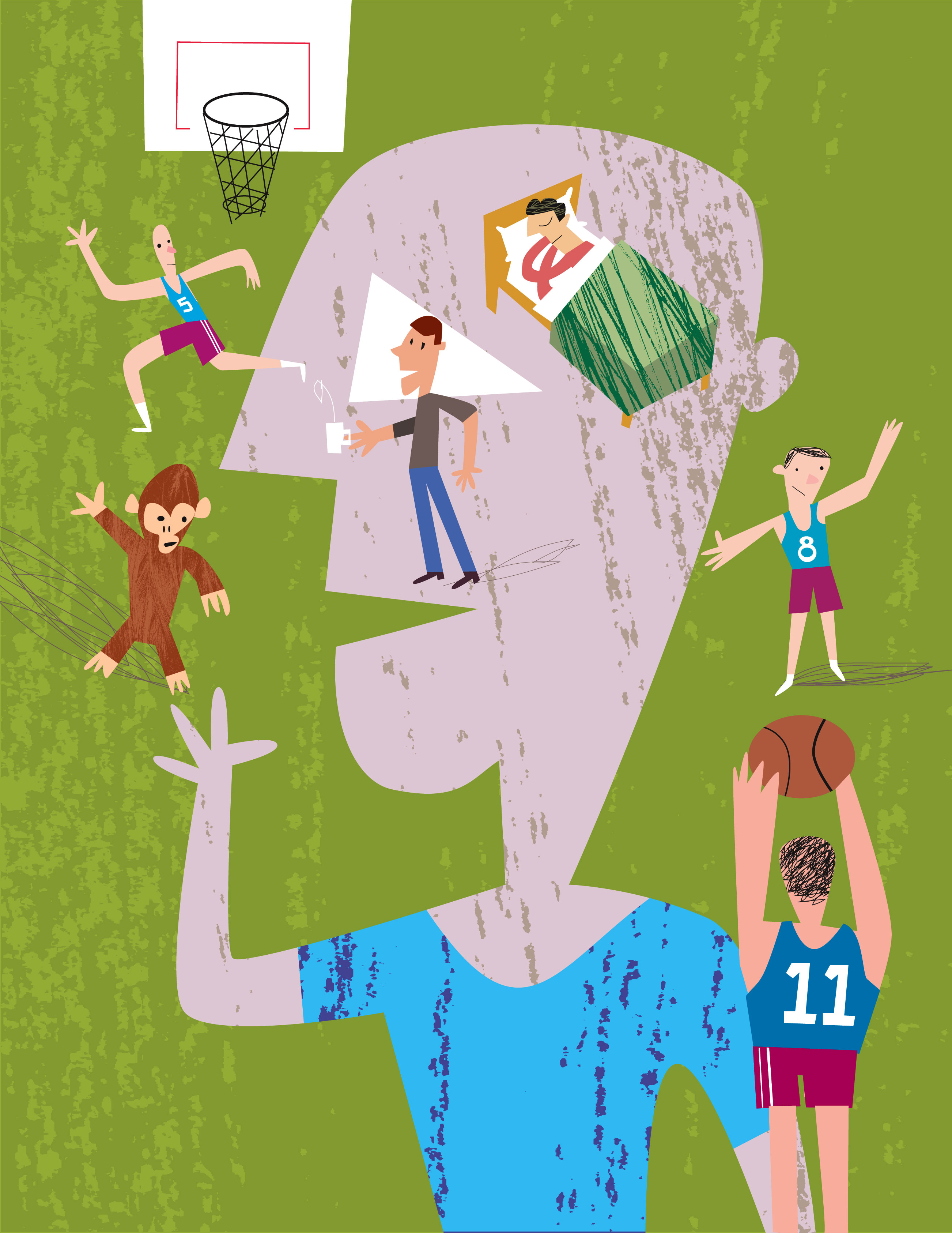
We live in a world of bewildering complexity, and there is generally far too much going on around us for us to be aware of everything the sights, sounds, smells, tastes and touches that constantly harass our senses. Our brains have therefore evolved to select some aspects of the world for mental processing, and ignore the rest. That selection process is what we call attention.
Its selective nature is easily demonstrated. In one famous example, people are shown a moving clip of a basketball game, and are generally so intent on watching the players that they fail to notice a gorilla that has wandered onto the court. If you play messages via earphones simultaneously into each ear and ask people to listen to one of them, they generally fail to pick up any information from the other, even though it’s equally loud. This proves that attention can be operated internally, by the mind, and not simply by orienting the ears. Visual attention, however, generally depends on where the eyes are looking. Even so, it is possible to look straight ahead and yet pay attention to events out of the corner of the eye a device that can be used by rugby or netball players to trick the opposition. Or by school teachers, anxious to detect mischief makers.
Nature has equipped us with automatic mechanisms to capture events that might be important to survival. Loud noises, sudden movements, brilliant flashes of light these all divert us from what we are doing, in case they signal danger. So does extreme pain. Alarm systems are typically loud and jarring, although we may also be tuned to more subtle events. A mother may be especially alert to the sound of her baby crying even from a distance, and all of us are sensitised to the sound of our own names being spoken, even if whispered. In Shakespeare’s Richard II, John of Gaunt observes “…they say the tongues of dying men enforce attention, like deep harmony”.
However, we are not slaves to the environment; attention can be controlled voluntarily, as when we choose to read a book, listen to a lecture or a piece of music, or solve a crossword puzzle. To a degree, then, we can filter out most environmental distractions, although not all. In his poem The Canonization, the poet John Donne famously exclaimed, “For God’s sake hold thy tongue, and let me love.” Attention is not always directed to the external world. We can beam it inwards, as when we are lost in thought or reverie.
Attention requires a fine balance between concentration on the task at hand and awareness of the environment. We cannot be so intent on solving a Sudoku puzzle that we fail to observe the conflagration around us, nor can we be so easily distracted that we fail to complete any task requiring sustained concentration. Sometimes the balance is disturbed, as in some cases of brain injury, or in what is called attention deficit disorder. In general, boys seem more prone to this than girls. In a hunter-gatherer society, it was probably the males who did the hunting, and this required constant attention to danger and opportunity.
The human brain is curiously asymmetrical in the way it controls attention. The left brain attends to the right side of space, the right to both sides, albeit with some bias towards the left. Damage to the right side may therefore cause the patient to lose awareness of events on the left, a phenomenon known as hemineglect. The patient may eat from only the right side of the plate, dress only the right side of the body, ignore those who address them from the left, and are easily beaten at chess by an attack from the left flank. A famous example is the German artist Lovis Corinth (1858–1925), who suffered a right-brain stroke in 1911 but continued to draw and paint for the next 14 years—much of his work shows a neglect of the left side.
Just why the brain should function in this asymmetrical way is not clear. Perhaps it’s because in most of us the left side of the brain is largely taken up with language, and so loses some of its capacity to direct attention to space. Left-brain damage seldom results in neglect of the right side, or does so only transiently, and there is no evidence that nonhuman animals show a similar asymmetry. We are the lopsided ape.
More by Michael Corballis
More by Scott Kennedy