


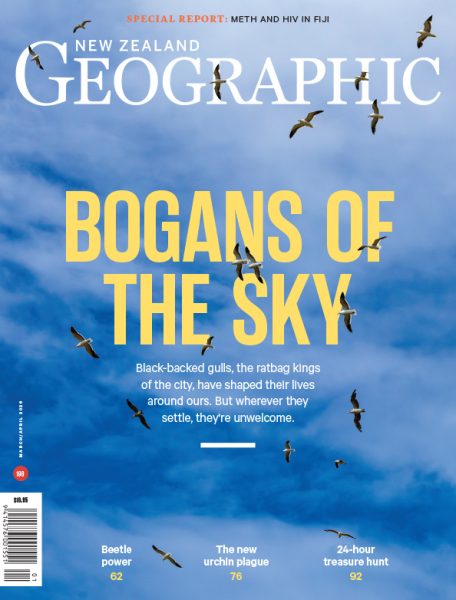
Black-backed gulls, their messy city lives, and the people entangled with them.
“It’s like the white noise of smells down there,” my friend Tom said. “It’s everything all at once, every nice smell and every bad smell you’ve ever smelled.” He shook his head and picked at the couch. “It’s worst when it’s just been raining, and then the sun comes out and warms everything up.”
I sipped my tea and nodded. I knew what he was talking about. For most of my life, I’ve also lived within smelling distance of Wellington’s Southern Landfill, and on certain still, pink evenings a thick, sticky aroma clings to my street and the surrounding hills. It wafts up from the tip face—that gully being steadily filled with Wellington’s waste—and it’s not bad necessarily, just sickly sweet and dense. To me, it marks the edge of my city: a few minutes down the road from the tip a tiny pebbly beach called Ōwhiro Bay looks out over Te Moana-o-Raukawa and Wellington finally stops.
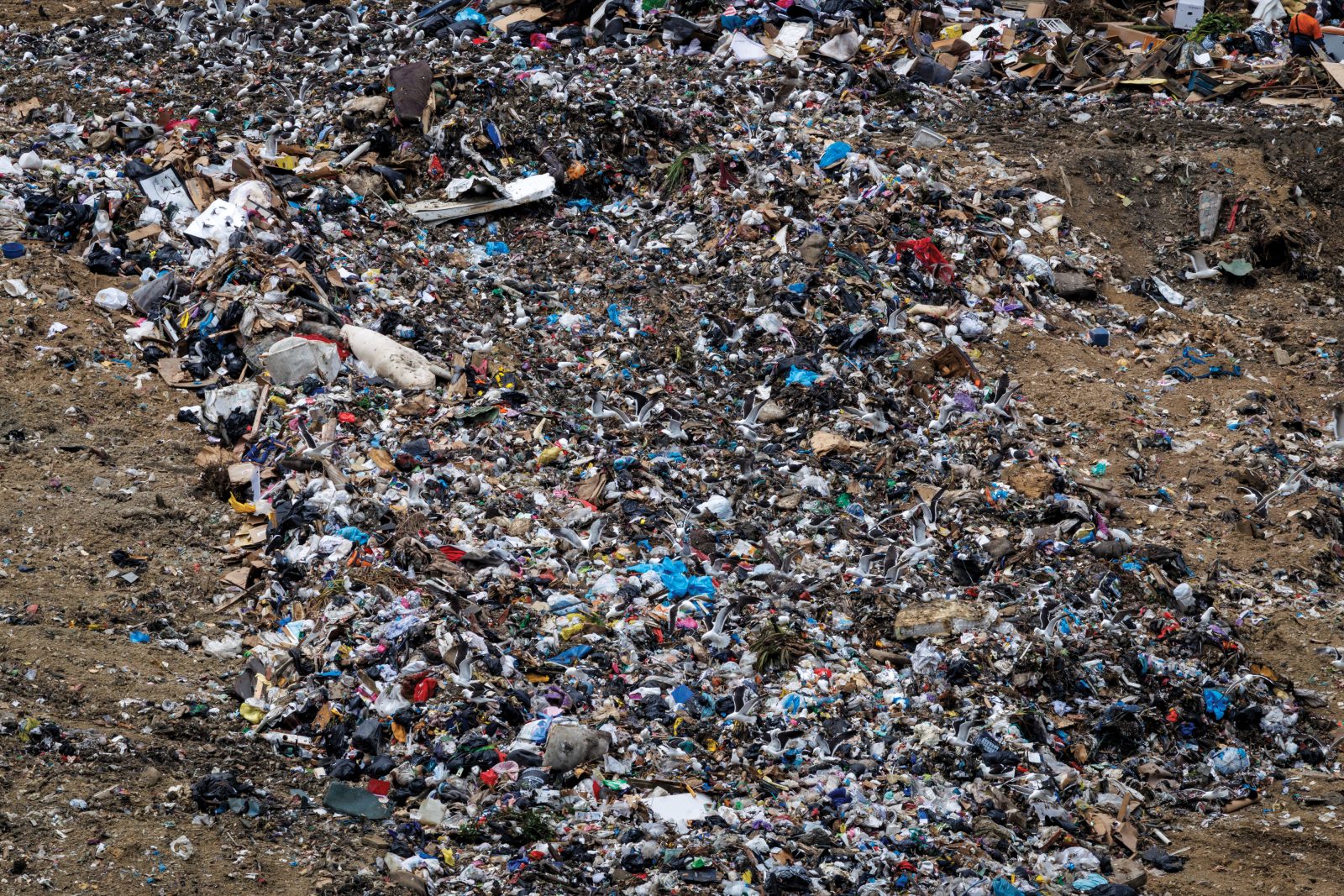
This smell is how you know you live near the tip face, because the tip face itself is nearly impossible to see, even once you’re inside the Southern Landfill complex. It’s nestled at the end of a deep valley, concealed around bends and spurs, away from people dropping bottles at the recycling centre or reversing a trailer up to the concrete bunker where we throw everything else. Only commercial users are allowed to drive their trucks directly onto it: building firms, landscapers, private waste companies, the city council itself. Tom, a gardener, fits this bill. Every week, he drives out there and stares straight into the raw centre of the landfill process. He can breathe it in on those wet, warm days.
A few years ago, Tom’s work drop-off coincided with what he now calls “Meat Day”, a random afternoon when the tip face bulged with supermarket waste, plastic-wrapped mince and chicken.
“It was like the apocalypse,” Tom whispered. “The birds, they blocked out the sun.”
Above Tom’s truck, the usually serene seagulls turned feral. They dive-bombed towards the rubbish, screeching. They tore mince from one another’s bills. On the ground, hundreds of gulls strutted about, dangling bits of half-eaten raw flesh.
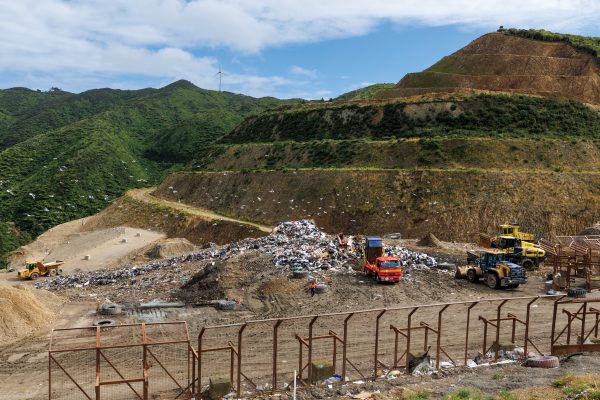
“Usually seagulls look so beautiful and clean,” Tom said, “but they were all covered in blood.”
“Do you… like seagulls?” I asked.
Tom sounded indignant. “Of course,” he said. “They’re the bogans of the sky. And what are they doing, after all? Eating our trash and pooping it into something biodegradable? Sounds like a favour to me.”
A caw interrupted us and we looked out the living room window at two birds skimming above my street. Seagulls live to 20 so I must have seen many of the same birds, year after year. All of us, observing one another’s little lives along the same coast, near the same tip.
*
True bird people, I notice, don’t say “seagull” because all gulls are technically seabirds. They also know that “seagull” is a catch-all bucket used to describe three very different native species. In English, we index animals by their physical attributes, so these gulls are all named for their beaks and backs: the black-backed gull, the red-billed gull and the black-billed gull. In te reo Māori they’re called karoro, tarāpunga and tarāpuka, names that whakapapa to each bird’s home inside coastal ecology. I won’t say more about tarāpunga and tarāpuka here, though, except to acknowledge that we owe these two an urgent debt of care. No: this essay is about karoro, who has authored a much stranger story.
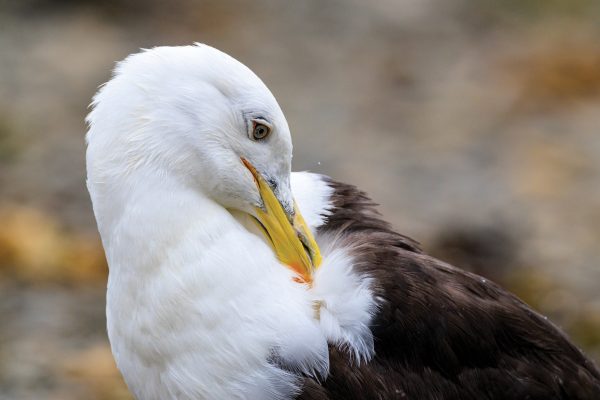
Karoro, the black-backed gull, was birthed from the union of Tangaroa and Papatūānuku, a child of unsettled sea and sturdy earth. He can, after all, drink fresh water or salt water as he chooses. In other accounts, he is the son of Paraki and Hinehau, a long-winged glider using his wind-given birthright to travel kilometres out to sea on updraughts. His strong, long wings give him plenty of lift. Whoever his parents may be, karoro’s sisters will always keep him tethered to the shoreline: tōrea, the stocky wading oystercatcher, and te ākau, the coast. Up close, karoro’s black wings and back, enveloping his big white body, can give the impression of a tuxedo. From a bus stop on Lambton Quay recently I watched a solo karoro patrol the awning of the CityLife apartments. The gull toddled among the air-conditioning units stuck on the side of the building. He puttered this way and that with the fastidious energy of a busy concierge. “What are you up to, smarty feathers?” I muttered. But my bus arrived and I never found out. Whatever his ordinary bird business, it was opaque to me and my human eyes. Bird-book authors use adjectives like sommeliers when they describe karoro. They are “vigorous”, “bold and conspicuous”, “loud”, “persistent”. Karoro, they assert, are “particularly abundant at landfills”, and it’s easy to imagine these birds strutting about the tip face on their bright yellow legs. But they haven’t always been a nuisance: karoro were once kept with clipped wings as garden helpers. They pottered about nibbling slugs, keeping the kūmara plants pest-free. Useful, perhaps even pet-adjacent.
*
The acting manager of waste operations at the Southern Landfill used to be Robert Hon. When I spoke to him, he had been working at the tip for seven years, and he estimated the attendant gull flock contained over 500 karoro and tarāpunga.
“It’s hard to know, though,” he added, looking quizzical and leaning back in his chair. “We can’t really count them.”
Hon wasn’t flustered by this because, luckily, he’s fascinated by the many problems landfill presents, both practically and philosophically. (He has since migrated to manage solid waste disposal in Central Hawke’s Bay.) The exact number of gulls wheeling in the sky above the tip is just one more fickle variable. As we talked, he used his hands to demonstrate the ideal pitch of a hillside, cleared and sculpted to give the tip face maximum space without it crumbling back on itself or tip staff.
Hon trained as a civil engineer but almost brushes off his early career. “Retaining walls, roads, bridges, all that stuff,” he said. “You really only need a spirit level.”
Landfill, on the other hand, will always be a huge complex system, constantly grinding and spinning. Humans, machines, waste, wildlife, all tangled together. On behalf of Wellington, the tip staff are filling an entire gully—Carey’s Gully—with rubbish, bag by bag, day by day. In a year, they receive 125,000 tonnes of domestic detritus, food scraps, building waste and green waste: sticks, branches, leaves, chairs, mattresses, glue, concrete, metal, mandarin peel, dog poo. They build the tip face in a spiral formation that climbs upwards. It’s the most mathematically efficient shape, Hon said.
It’s food waste that lures the gulls. The flock flaps in around 10.30 every morning, when they know the trucks start to arrive, each one packed with the morning’s kerbside rubbish collection. The gulls wait on the cliffs above the tip face while each truck raises its tray and gushes waste onto the ground. A bulldozer then flattens each load, driving this way and that for a few minutes. Then the flock dives forwards.
Hon observed the birds every day and admired their smarts. “They’ve learned to wait until the rubbish is flattened, because food is actually only available after the bags are ripped by the bulldozers,” he said. “We see them bringing juvenile birds, too. We wonder if they’re teaching their young about the landfill.”
The closest I’ve come to spotting the tip face is walking in the hills surrounding the landfill. Up there everything seems natural. The hebe grows densely, the taupata tall. It’s quiet except for the criiick criiick of cicadas and your feet crunching on the dry, rocky track. You glance down and there it is, a slice of colourful, grotesque trash mountain snuggled in the very back of a valley; wilderness and wasteland mashed together.
“It was surreal, seeing something so gross from somewhere so beautiful,” I said to Hon.
He shook his head. “It’s really not a coincidence.” He explained: the landfill repulsed the usual urban interests and, left alone by property developers, the hills around it flourished.
Every day, the tip flock flies off when the landfill closes at 5, Hon told me. “They lift off into the sky and we don’t see where they go. Some south, most north, I think.”
From where he lives Tom can also see the tip flock rise into the sky and flap away out of Carey’s Gully. “Where are they going, do we know?” he asked.
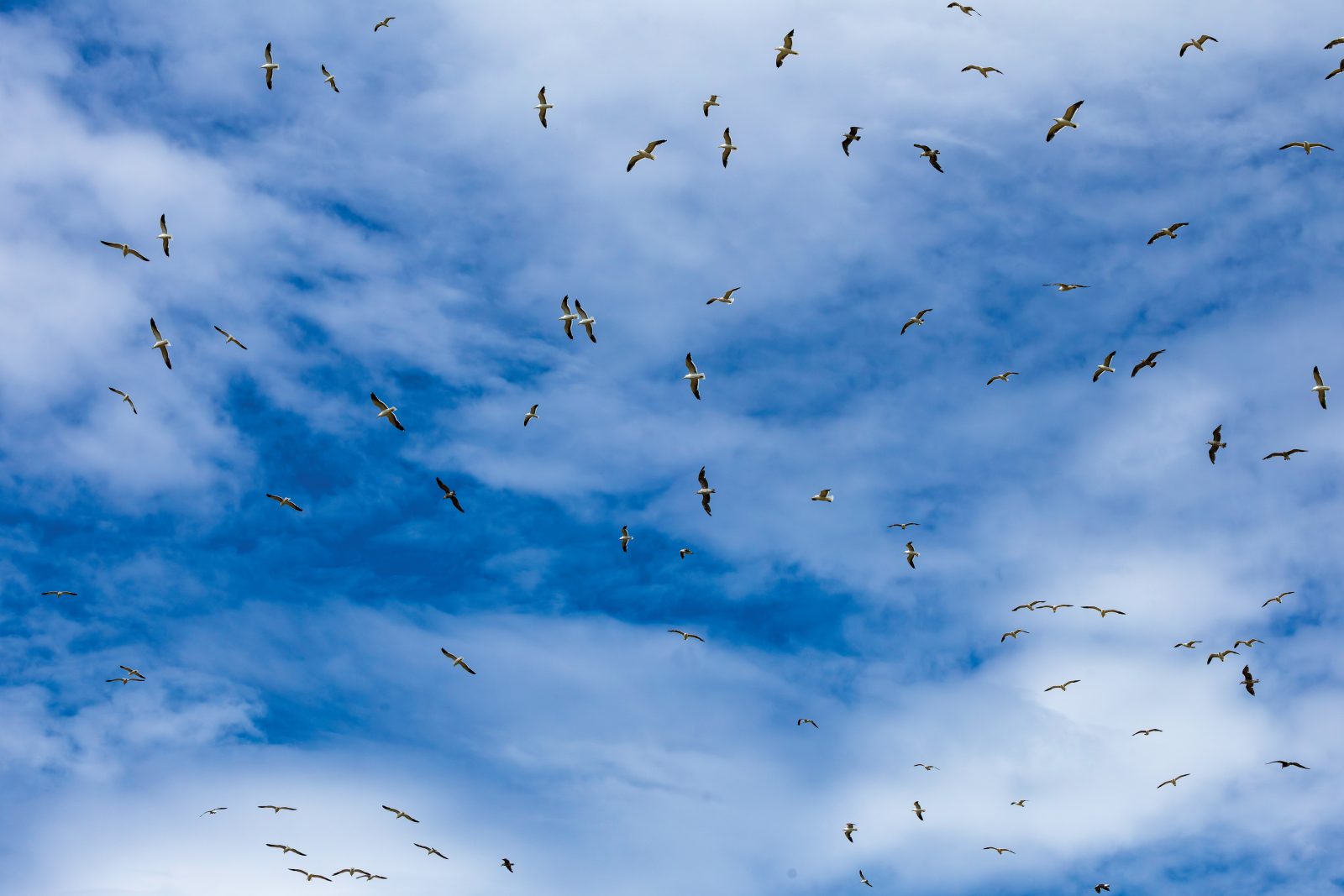
Tarāpunga are probably flying to their cliffside roosts further along Wellington’s south coast or heading to a colony north of the city. Karoro fly to colonies by the airport, where they nest at Breaker Bay and Moa Point. Regardless of where they sleep, hundreds of gulls cross the city every day on the wind roads they’ve been flying for thousands of years. What does the sky taste like up there now? I wonder. I imagine the old smell of damp soil, leaf mulch and salt erased by smoke, petrol and hot concrete, maybe a whiff of Pantene Pro-V in the morning, rising from the public servants who move in schools down Lambton Quay.
*
Long before the city discarded its dinner scraps at the Southern Landfill, it was a place for growing food, not rotting food. Te Ātiawa named the area Kaipakapaka and it was a large ngakinga, with good soil for potato crops.
During a public talk, the Te Ātiawa historian Honiana Love gestured at the map of Wellington displayed behind her, pointing at a large area just over the hill from my house, between the city and the sea.
“Kaipakapaka was a garden out where the landfills are,” she said. “The name, we understand, refers to the processing of fish. It’s not far from the coast and it’s not far from the kāinga that spread themselves along the south coast.” It was only one of many immense gardens in the area. “They were working across the whole peninsula, right across over into Seatoun,” Love continued. “These ngakinga didn’t just produce food for one pā but for the whole region.”
After Love’s talk, I tried to imagine Kaipakapaka as it once was, before it was alienated from Te Ātiawa. I see row upon row of potato plants in the sun and a solo karoro, who wanders through the leaves pecking at bugs. Nearby, people chat while they scale fish, placing each one to dry in the afternoon heat. I like to imagine someone threw karoro the odd fish tail. After all, he was doing the garden a favour.
*
I asked Graeme Taylor, a marine bird expert for the Department of Conservation, if gulls are considered smart animals.
“Of course,” he said. “They’re hunter-gatherers. And they’ve always fed on food that’s not necessarily easy to find. I’ve seen them work in pairs to rip up a big fish carcass. They definitely display what some people call ‘avian cunning’.”
I paused in my frantic notetaking to appreciate how Taylor’s phrasing observed the small potential gap between “bird” and “how people interpret bird”. He used the gentle habits of a long-time science communicator in our whole conversation: ideas felt contingent; claim and counterclaim were calmly evaluated; moral categories were evaded at every turn. In Taylor’s telling, gulls don’t “scavenge for trash” but rather, “some populations have learned to associate human behaviour with diverse food sources.” Their natural scavenging zones (beaches, shallow bays) have simply expanded inland (the tip, picnics, Cuba Mall). They’ve turned their formidable brains towards the richest food source possible: human waste.
Thanks to trash, their population has blossomed—or exploded, depending on your perspective. In some areas, karoro are so unnaturally plentiful they actually threaten conservation ecology and get in DOC’s way: as they flap back from landfill their droppings plop invasive seeds into nature reserves; as effective “aerial predators” they eat the chicks of much rarer birds, an unforgivably ruthless snack by human standards.
The outsized population means that our relationship with karoro is defined by hostility or, at best, by what I’d call “reluctant responsibility”, which seems like a unique dynamic for native birds, when usually we give them names and breeding programmes. (Every single kākāpō and takahē has a name.)
Karoro are now one of only two native bird species given no legal protection under the Wildlife Act 1953. Karoro (and the spur-winged plover) are currently excluded alongside a list of invasive pests, pets and the animals we eat. It’s possible for a person to spend five years in prison for harming or possessing any of the other 394 native birds, as well as all the mammals, reptiles, amphibians and invertebrates we know we need to treat like treasure if they’re to survive.
Who knows how things will change for karoro. In July 2023, DOC announced that the Wildlife Act would be replaced, declaring it no longer fit for purpose. Its press release listed the Act’s limitations, recognising that it doesn’t incorporate mātauranga Māori and stating that it doesn’t “have a clear purpose”. The release even noted that “not all native species are currently covered by the Act”, though it didn’t list which ones might be added. DOC is still working on a public consultation document for this overhaul, but in May 2025, an unrelated update weakened the Act regardless. The Wildlife (Authorisations) Amendment Bill, passed under urgency, legalises the “killing of wildlife that is incidental to carrying out an otherwise lawful activity”. This means that DOC can now authorise the killing of any protected species if they become a “nuisance” to economic projects, like building roads and windfarms. A piece of legislation ostensibly intended to protect native species now also provides the scaffolding for killing them, just because they might not have the same business interests as we have.
Whatever happens to the Act, and even if karoro remain outside the next iteration of it, “they are still protected by the Animal Welfare Act”, Taylor reminded me, “so you can’t torture them—but you can kill them. If birds are harassing flocks of sheep, putting sheep at risk, a farmer can shoot the gulls.”
As an organisation now inadvertently responsible for hundreds of karoro, the Southern Landfill has agreed to “maintain” its flock, to monitor and manage them.
“Is this because the birds present a big health-and-safety risk to staff?” I asked Hon.
“Of course we’re concerned about how birds impact the staff,” he said carefully, “but let’s put it this way: the guys out on the tip face are working with huge machinery and toxic waste. They have more important things to think about.” The Southern Landfill is the only local agency that accepts commercial construction waste. Tip staff empty skip upon skip of industrial trash into the ground. Concrete, plaster, metal rods, all mashed together.
“We also process the solid portion of Wellington’s sewage,” Hon continued. He raised his eyebrows. “Just think about that for a second.”
The tip is managing many more species than just the gulls. Hundreds of pigeons, starlings and sparrows hop about the tip face, too, cooing or chirping at staff. Every day, thousands of rats burrow into the rubbish, which in turn lure as many or more feral cats. The landfill’s boutique food waste centre, which processes restaurant scraps, entices wild pigs from the hills. Wild goats and deer filter down, too, grazing on rubbish. The place heaves with animals. A whole city farm ambles about the tip face, pushing their beaks and muzzles into ripped bags, sidestepping bulldozers on hooves or paws.
“Wow,” I said. “Why does anyone go to Zealandia? Seeing animals is way cheaper at the tip.”
Hon nodded. “Right? We’ve got some keen deer hunters on staff and we’re always joking about this being a great place to hunt.” He paused for a second and let out a small sigh. “No—we do bird work because seagulls fly into the flightpath of planes.” Then he laughed. “But, I mean, when you build an airport near the sea… you’re gonna get seagulls.”
Ah, so here we have the rub. Karoro vs planes.
Apparently, the heaviest burden karoro hand Wellington is that they are “an extreme threat to aircraft”. The birds, wheeling around as normal, get sucked into plane engines and chewed up. The passengers might hear a BANG! A plane might have to make an unexpected landing. In a very unlikely scenario, karoro could even cause a plane to crash. These are the stakes you can’t ignore.
In the airport’s official report on bird strike, the gulls make the top of a long, thorough list of avian threats. They’re colour-coded fire-engine red. In the report’s identification photo, a karoro stands on a rock piercing the choppy sea. The bird gazes back at the reader, yellow feet firmly planted.
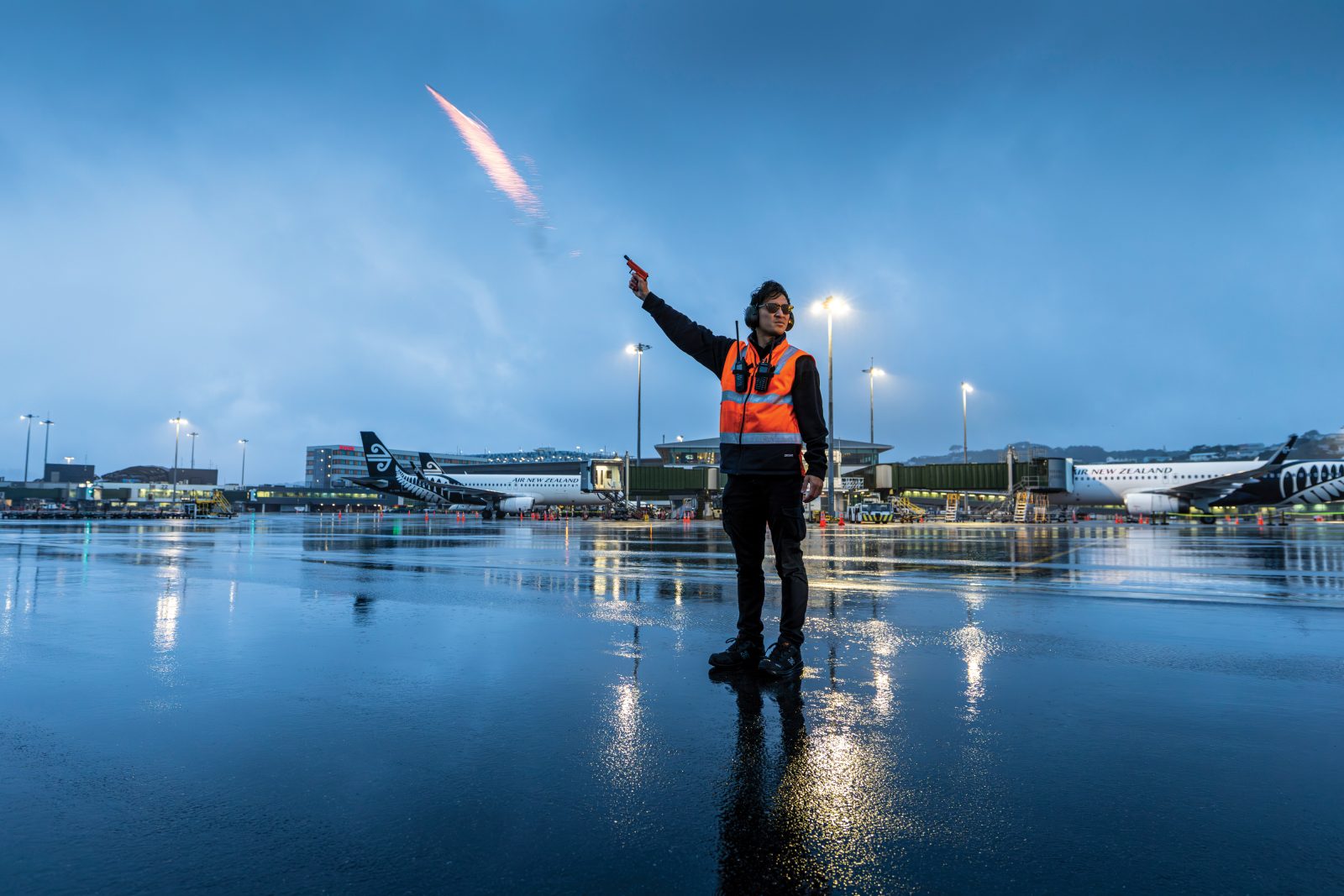
The airport’s wildlife officer, Jack Howarth, explained to me that karoro had been responsible for “60 to 70 per cent of all bird-strike incidents at Wellington Airport” over the past five years. Karoro from the Southern Landfill pose the highest risk of all. Six years ago, the airport commissioned a team of scientists—and a water cannon loaded with food colouring—to spray each of the region’s tip flocks. Blue dye for the Silverstream tip, red for Kenepuru, orange for the Southern Landfill. Colourful karoro flapped around the city for weeks but it was almost exclusively orange gulls gliding across the flight corridor. Karoro’s commute to the Southern Landfill bisected the runway.
Now, airport staff work harder than ever to mitigate the threat.
“It’s not about reacting to the birds,” Howarth said. “It’s about predicting their behaviour and using that data to help us manage their impact. Airside crew report on the wildlife every single day.”
Binoculars and clipboard in hand, they document flight patterns, numbers of juveniles, and where the birds nest, feed and mate. Every piece of information is loaded into a database from which strong patterns emerge. Like, unusually large flocks of karoro seek out the tarmac under two specific conditions: for shelter during winter’s southerly storms, and as it gets dark in the long summer twilights.
“The tarmac retains the heat and they’re looking for somewhere warm to sit, like anyone,” explained Howarth. “Black-backed gulls don’t have a set routine but we’ve learned their preferences inside out.” I smiled at this. For some reason I hadn’t expected such an earnest effort to document karoro’s likes and dislikes.

“People like to divide the world into ‘human spaces’ and ‘animal spaces’, but they completely overlap, everywhere, all the time,” Howarth continued. “That’s just how it is. And anyone who gets into this kind of work does it because they love animals—so at every single airport, non-lethal seagull management solutions are always preferable.”
Wow, I thought, what a mouthful. Non-lethal seagull management solutions.
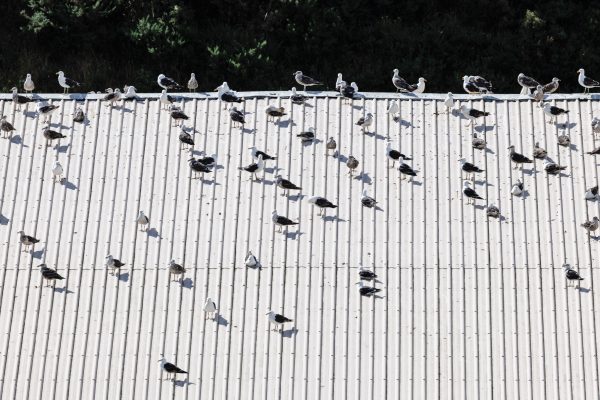
The most passive strategies for dissuading smart karoro from the airport and Southern Landfill are diffuse, environmental. They rely on karoro associating the area with subtly hostile experiences. Plant flax on nearby cliff faces: it becomes harder for karoro to roost comfortably. Plant special Avanex grass around the runway: it’s genetically tweaked to harbour a certain fungus and if karoro eat it, they experience what experts call “post-digestion feedback”. When iron-willed karoro inevitably persevere through a tummy ache, raise the stakes. Employ less naturalistic strategies. Freak them out. Airside crew, observing too many birds napping on the tarmac, blast recordings of a gull’s distress call from speakers on the main terminal roof (“audio-based disruption”). The gulls scatter into the air.
“But they’re so incredibly smart, they tend to fly back five minutes later,” Howarth said. “They’re habituated; they know how long the audio runs for.”
Everywhere, strategies have to shift to keep up with the gulls. At the Southern Landfill, Hon preferred what he calls a “pyrotechnic solution”: when the gulls seemed too numerous, fireworks—loud and dazzling—were set off around the landfill. It seemed to be effective.
“But again,” Hon said, “we’re relying on our best estimates here. We drive onto the tip and look up… sure, seems like fewer birds.” He shrugged.
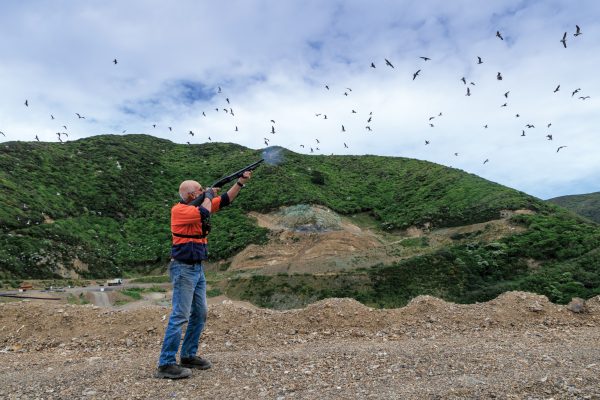
Another strategy was to fire a shotgun into the air. Hon found that karoro quickly learned to steer clear of the digger that had the gun tucked behind the seat, so these days a contractor with a shotgun patrols the tip face (which is not open to the public). He shoots at karoro, taking down the birds he can, and deterring others.
For a time, at the airport, the contest extended to macabre theatre.
Until a few years ago, they used effigies. “Gull decoys that provide a visual warning,” Howarth said. “You place them in off-putting unnatural positions—one wing bent out of shape, that sort of thing. The pose depends on whether you want to replicate a wounded or dead gull.” The effigies were supposed to deter karoro by creating fear of local predators, but airport staff found they weren’t impacting bird presence at all. Clever karoro wasn’t frightened. The effigies are now in storage.
I was touched by just how much attention Howarth and his team paid to karoro, how much they knew about karoro’s life. Their scrutiny had qualities I associate with caring relationships: diligence, curiosity, and admiration.
How sad, I thought, that it’s karoro’s opponents who know him best. Our relationship with karoro provokes a strange tension: in order to banish him, we have to know him extremely well. We spend all that time and energy, just to get rid of something.
*
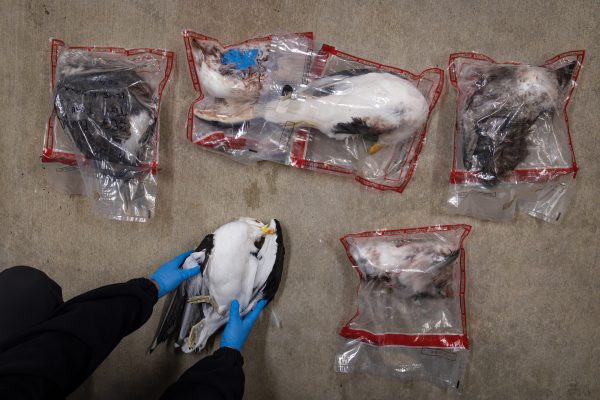
In 2023 and 2021, the karoro population near Moa Point rose above a threshold deemed safe for aviation. The colony had to be culled.
Howarth was solemn. “This isn’t something people like doing. The last cull before [these] was in 1993, 94.”
The humane way to kill karoro uses narcotics, Taylor told me. You lace butter with a chemical solution called Alphachloralose and slather it over slices of bread. Left near nests, karoro eat the easy treat and pass out quickly. It’s not the Alphachloralose that kills them but heat loss. It’s humane because the karoro don’t notice when they die, and any “non-target” species who have accidentally eaten the bread can be collected and revived, warmed up in incubators. Left outside overnight, the karoro die of exposure.
Hon said staff had only once tried to cull karoro at the Southern Landfill. “In the nineties, we tried to poison the birds here, too,” he said. “But apparently the dosage was incorrect and some stayed awake long enough to fly away.”
I picture hundreds of drugged-up karoro lifting off into the twilight.
“It wasn’t long before they started falling from the sky,” he continued. “Apparently one landed in the playground at Ōwhiro Bay School. It really upset the kids.”
I haven’t found this story on the official record but, whatever the truth, the Southern Landfill never poisoned the gulls again.
When I spoke to Taylor about culling karoro, he seemed philosophical about its necessity within conservation, though he also added, “They’ve been here much longer than us—they have every right to stay here.”
*
I asked Taylor if we knew how living off landfill impacted karoro. Did we know how they were doing out there, aside from growing their enmity with planes?
He shook his head. “Quite honestly, we don’t. No one studies them like that.”
This disconcerted me. I like thinking that there’s always an expert who knows everything I don’t.
“Is it safer for them to feed at the tip, do you think?” I pressed on. I’d read a Greenpeace article about seabirds starving to death after eating plastic out in the ocean.
Taylor was much more comfortable with ambiguity than I was. “That’s a really good question,” he said, “and another one we don’t know the answer to. We don’t know what exactly they’re eating down there, let alone what that food does to them.” He seemed drawn to this question now. “How are they processing it? How are their bodies adjusting? It’s not high quality.” He looked down at his hands and then up at me. “At a colony near Lake Rotorua, I once saw a chick regurgitate an entire string of sausages. An entire string.”
Karoro’s life leaves us with many questions. But a study published last year does let us glimpse the shift in their diet over space and time. Gulls regurgitate whatever they can’t digest, packing shards of bone and other tough bits into pellets. Over five years, researchers from Auckland Museum and Unitec picked up hundreds of these “naturally air-dried in situ” deposits from around Auckland.
From the pellets, the researchers put together a portrait of a great opportunist. No matter where they live, the birds coughed up a buffet: chicken bones, and the bones of songbirds, rodents and sheep; fish, shellfish, snails. These birds are definitely eating KFC, roadkill, and the scraps from tourists’ lunches. Unsurprisingly, birds that nest on Rangitoto and Tiritiri Matangi islands ate much more kaimoana. City birds, on the other hand, regurgitated loads of plant material and insect bits, plus the odd bit of glass.
The scientists also analysed leg bones and feathers collected from dead gulls on Rangitoto and compared them to the museum’s collection of study skins and mounts. They found that the ancient karoro, which did not know humans or landfill, fed further up the food chain. They were eating fish, and tearing into dead whales, dolphins and sea lions.
This research can’t show us absolutely everything modern karoro eat, like any potato and gravy, or other digested vegetable matter. And it can’t answer Taylor’s questions about how karoro might be physiologically adjusting, but it lays important foundations. Matt Rayner, a senior researcher at the museum, wondered aloud to me about how you might study the impact of diet on karoro’s wellbeing. You could, for example, compare colonies that have different diet profiles, and examine each colony’s breeding success.
*
Hon is curious about the tip flock’s future. “What will be most interesting is what happens when tips stop receiving all food waste,” he said. In the past two decades, the Southern Landfill has diverted 26 per cent of food waste from being buried and he expects that to increase. It’s an urgent task if we’re going to reduce greenhouse gases: organic materials—kitchen scraps, leftovers, unopened meat trays—generate methane when they degrade underground without oxygen. For the planet’s sake, hopefully we’ll soon have landfill without food—just construction waste and biosolids, which don’t generate methane and neither of which seagulls can eat. Hon and Taylor both speculated that without their main food source, the tip flock might migrate to landfills that still accept food or find other food sources in the city. Maybe their population will shrink. We don’t know.
I’ll miss the tip flock if they disappear. I have the tip face to thank for the stray gulls I see from my kitchen window playing in the wind. They catch updraughts and bounce off the hills for fun.
“What will happen to the tip itself?” I asked Hon. The current tip face is nearly full and its consents expire in December 2027. The council is building a new landfill within Carey’s Gully, on top of an even older site. This one should last until 2031. But what happens when there really is no more room in the gully?
“Once it’s full, it’ll get capped and then permanently monitored,” he said. “Capping” landfill means flattening the waste, spreading thick layers of dirt and topsoil on top, then planting turf. There are dozens of these sites in Wellington.
“Here’s a thing,” Hon said, suddenly. “Where do you live?”
“Berhampore, near Newtown.”
“You know Macalister Park? That’s capped landfill.” He thought for a second. “And the soccer field by Toi Whakaari? Also, ex-landfill. It’s ironic, but often we only get public parks thanks to landfill.”
Flat land has always been at a premium in Wellington, so gets gobbled up quickly by commercial development. Only old landfill—potentially toxic and unreliable to build on—is worthless enough to be left for social purposes. In the city, if you find yourself in a flat, open, public, green space, it’s almost certainly ex-landfill. The signs are obvious if you know how to look, Hon said: Central Park, Tawatawa Reserve, the Botanic Garden, all of Houghton Valley. Even the airport is built on ex-landfill.
So, eventually, even the Southern Landfill will go quiet. It will become an improbably flat, green, open space among Wellington’s hills. People will walk their dogs or play sports. And, when it rains, puddles will form where the ground gently buckles over our rubbish.
*
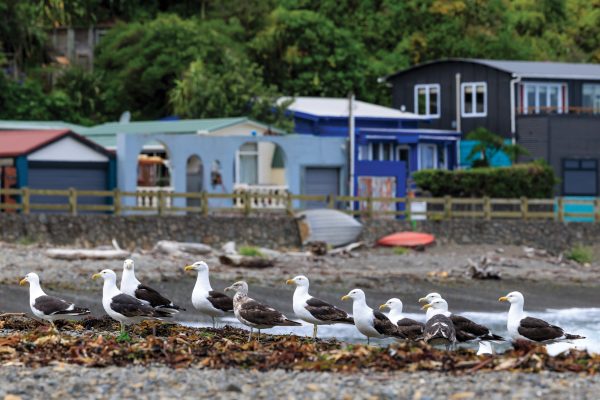
Near the tip, at the small stony beach where the Ōwhiro stream meets Te Moana-o-Raukawa, hundreds of tarāpunga and karoro gather in the sun. They bob on the ocean or swirl above it in a magnificent, cawing cloud. You can see them almost every day.
“It’s the perfect place for gulls,” Taylor told me. “They probably get a bit grubby at the landfill, so at Ōwhiro Bay they can wash in the stream, have a bit of a drink, get something more to eat and continue home.”
That’s how I choose to think of the tip flock now, splashing about in brackish water, ridding themselves of human muck and flying home, full.
More by Sam Soh
More by Richard Robinson