



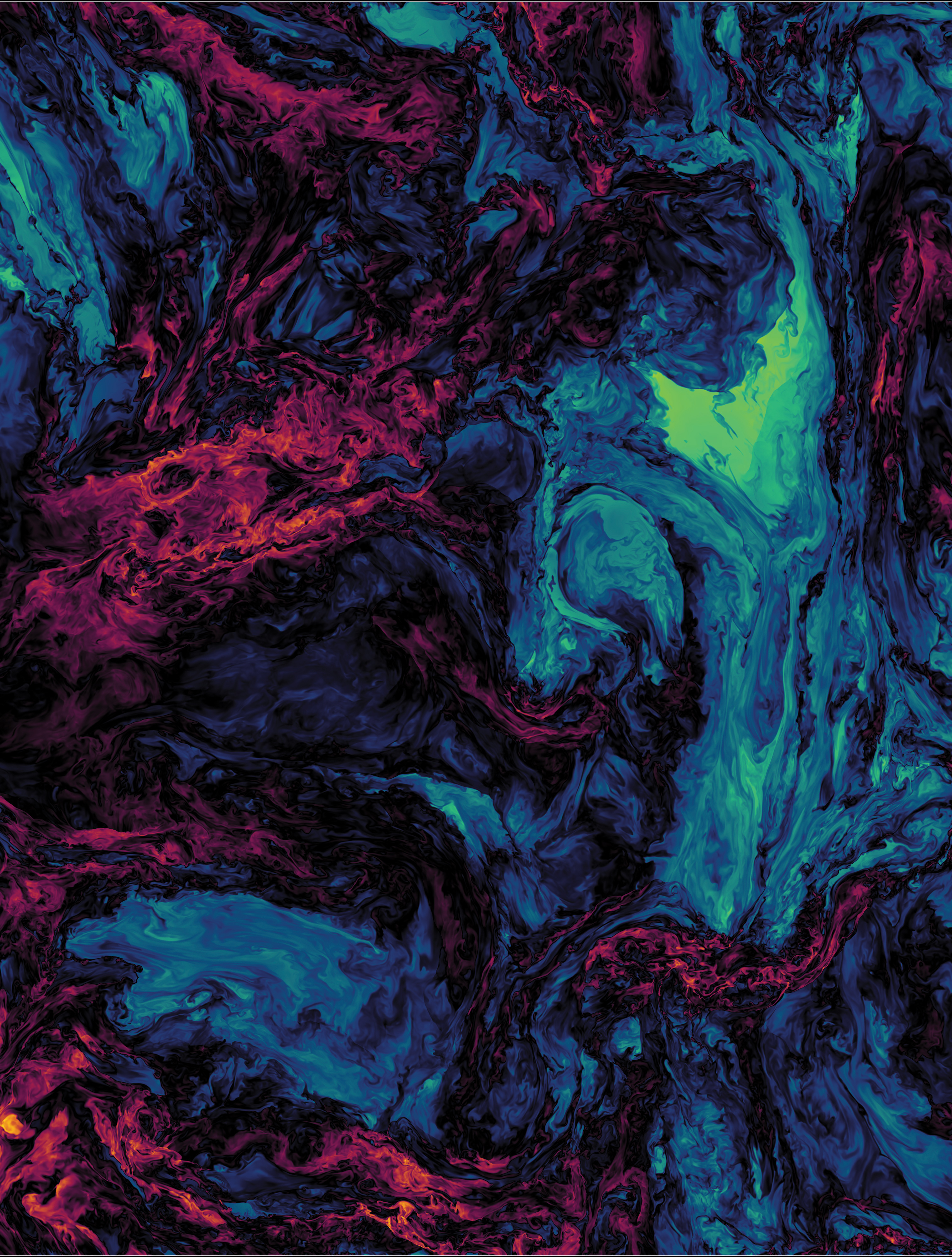
What you’re looking at is a slice of the roiling, chaotic stuff between stars—the magnetised dust and gases that make up the plasma of our Milky Way, modelled on a supercomputer at unprecedented scale and detail.
Bright red and cyan indicate “shock fronts”, says project lead James Beattie, where the plasma is most dense and may give rise to stars. Blue and green mark spaces of lower density, called “rarified voids”.
The scale of the project, which was recently outlined in Nature Astronomy, is difficult to comprehend. This cross section, says Beattie, “is just a tiny fraction—less than 1/10,000th—of the full 3D model, which spans over 1 trillion computational cells.”
Beattie, an astrophysicist based at Princeton University, has said that his fascination with turbulence stems partly from its universality—it looks essentially the same in space as it does “in a cup of coffee or in Van Gogh’s ‘The Starry Night.’”
More by Catherine Woulfe