




First came the kina, hordes of them taking down kelp forests in shallow waters. But they were a warm-up act. Now, on the deeper reefs, a much bigger, hungrier urchin is going rogue—and once it’s eaten everything that lives on the reef, it starts scraping away at the reef itself.
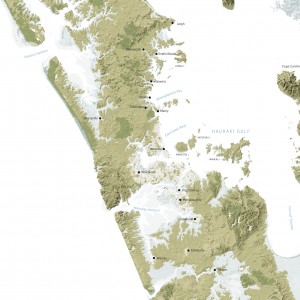
Something is terribly wrong in Matauri Bay. Not that you’d know it at the campground, where I park my car and step into the heat of an early Far North summer. A heavy surf piles onto the beach; holidaymakers rearrange camp chairs and sun umbrellas, oblivious to the slow disaster unfolding beyond the breakers.
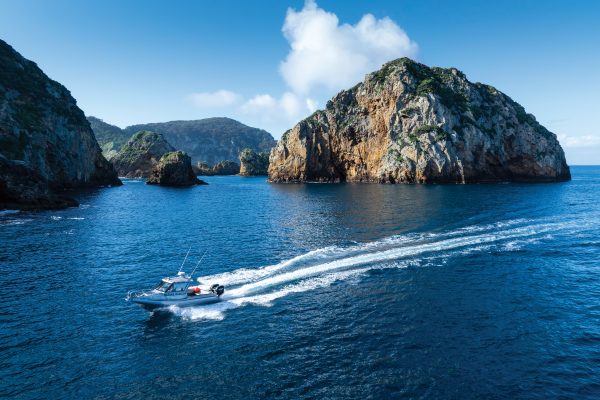
Craig Johnston, the owner of Paihia Dive, has brought me here to show me his world unravelling. He and his son, Toby, prepare their seven-metre inflatable boat for launch. Normally, Johnston would be charging thousands of dollars for a solo charter like this, but I’m barely covering his fuel costs today—that’s how determined he is to get the word out about what’s happening here.
Johnston grew up in Northland and has been in the water all his life. “Diving,” he says, “is my everything. I don’t go out, I don’t do drugs, I don’t drink. I go diving.”
He takes his clients out to visit some of the jewels of the region’s underwater world, including the wreck of Rainbow Warrior, which now cradles its own reef ecosystem in this bay. He loves the work—every day, he gets to see people having some of the best experiences of their lives. But as everywhere, the ocean is changing rapidly, and no part of New Zealand is feeling the heat like Northland.
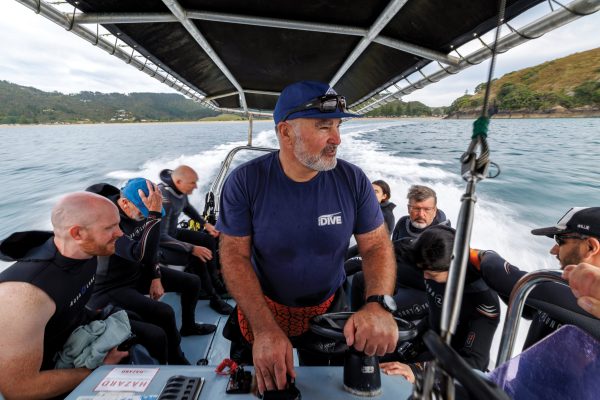
Launch conditions are marginal—as we wade in, the surf threatens to throw the boat back on the beach. Picking his moment, Johnston leaps aboard and guns it through a set. After a few bone-rattling drops over the rollers, we clear the break and race out to sea.
This entire coast is bathed by the East Auckland Current, a flush of warm water that crosses the Tasman and brings with it bewildered visitors, including sea snakes and turtles. It’s also brought the floating larvae of Centrostephanus rodgersii, the jet-black long-spined sea urchin commonly found in the mild waters of southeastern Australia. Unlike those other vagrants, this one has made itself at home.
Northern New Zealand is a great place for the urchin commonly known as “centro”—there’s plenty to eat, lots of rock to hide in and only one known predator—crayfish. A big cray will flip a centro over, break its hard shell and devour its innards.
Centrostephanus rodgersii is now considered native, because it’s been in Northland since before anyone was taking notes. The earliest record is from 1897. It was here when the pioneers of New Zealand’s dive scene started exploring our spectacular underwater world with rudimentary equipment. It was here through the crayfish boom of the 1960s and 1970s, when tens of thousands of tonnes of crays were hauled out of the sea, as the crayfish gradually disappeared. And when, as a result of human-induced climate change, the ocean around New Zealand started to warm, it seized its chance.
*
Johnston drops anchor in the lee of Horonui Island, a few kilometres offshore. He points out the bare expanse of white rock gleaming beneath the bow. Five years ago, he says, this reef was clothed in a thick forest of Ecklonia kelp, sheltering smaller algae and countless fish, crustaceans and other invertebrates.
Johnston has watched in horror as centros took over. He first noticed the urchins about 20 years ago. “But you’d just see the occasional one… Reefs like this have really started being impacted in the last three or four years. It’s just taken off.”
In Australia, scientists have watched the urchin expand its range from New South Wales into Victoria and Tasmania, where it’s devastated kelp forests. Now it’s doing the same here.
Unlike kina, which spawn in spring and summer, centros spawn in late winter. At the moment, centro larvae hatching here can survive only when the water is warmer than 15 degrees Celsius, and for the past 25 years, Northland has obliged. The sea was particularly balmy in 2022. Centrostephanus took full advantage.
The urchin is now found in huge numbers across the top of the North Island, right down to the eastern Bay of Plenty. In the past 15 years, its average density has more than tripled in northern New Zealand. Offshore islands such as Horonui tend to be especially thick with centros, because they’re exposed to that warm easterly current.
Johnston and I haul on dive tanks and roll into a salpy soup. Sucking air from my regulator, I follow his stream of bubbles to the bottom. The otherwise naked reef is studded with centros, their blackness sucking at the pinky-white brightness of the rock. They’re everywhere, the big, pineapple-sized balls manning the outer battlements of the reef and smaller ones tucked down into the cracks. Moving around on tubular feet that suck to the rock, each centro carves a radius of destruction around its “home scar”. They’ve demolished the kelp forest and created their own stark world here.
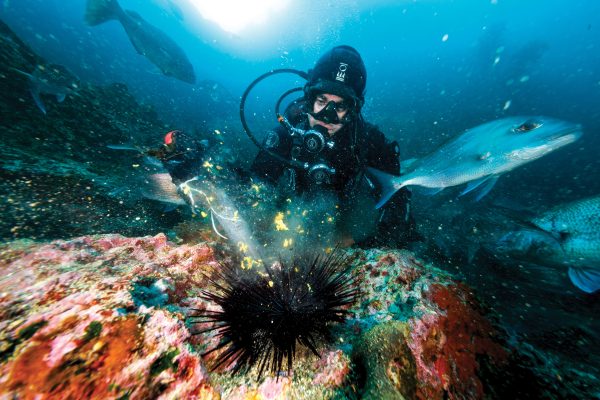
Johnston plunges his knife into one, releasing a plume of guts and roe into the water. It seems like an act of frustration more than anything—one down, innumerable millions to go. A moray eel threads out of a rock crevice and sucks the viscera from his hand. Smaller fish race to the fray, stabbing their mouths at the floating bits.
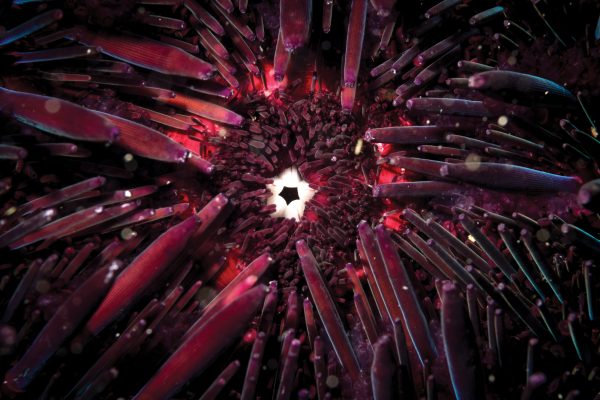
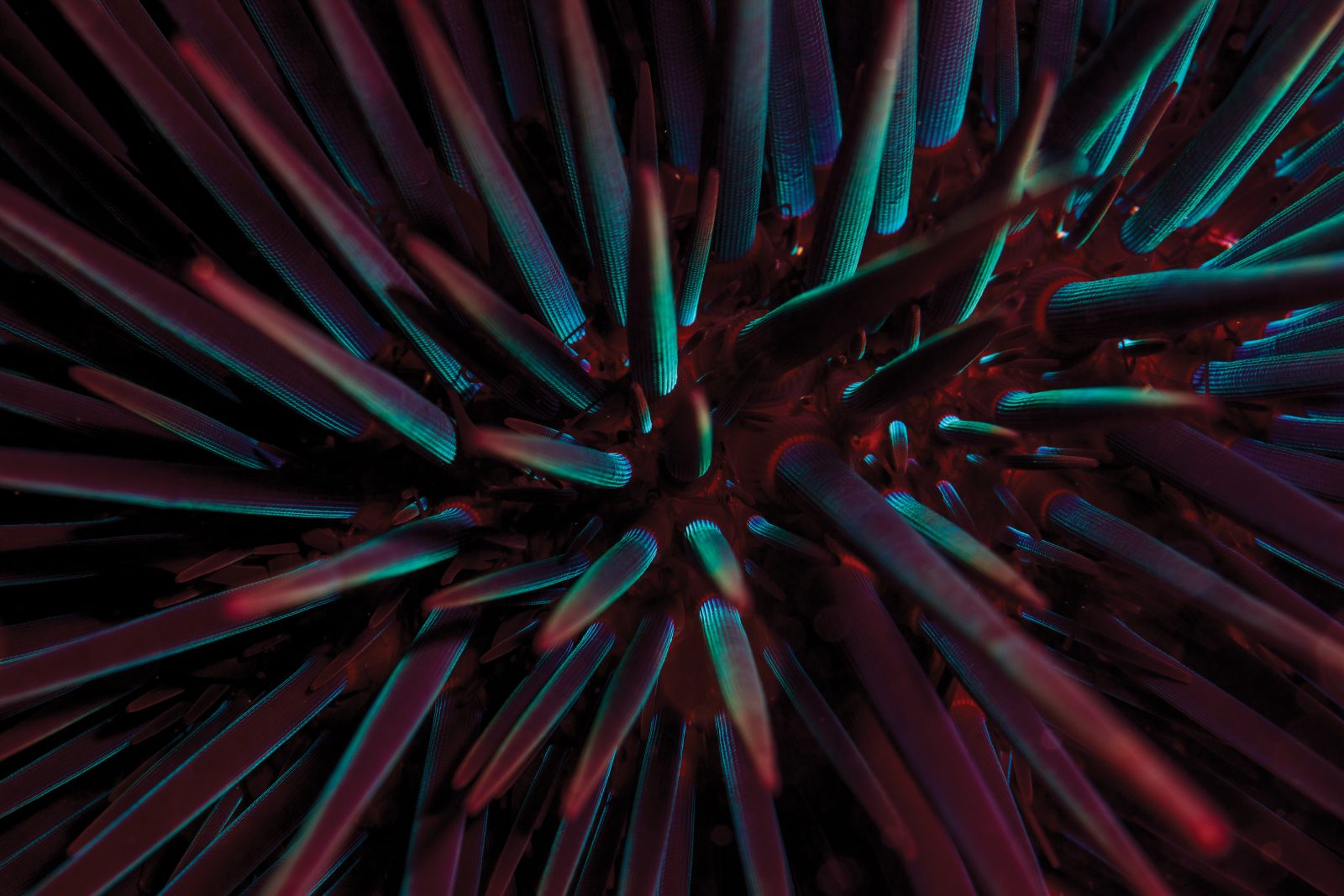
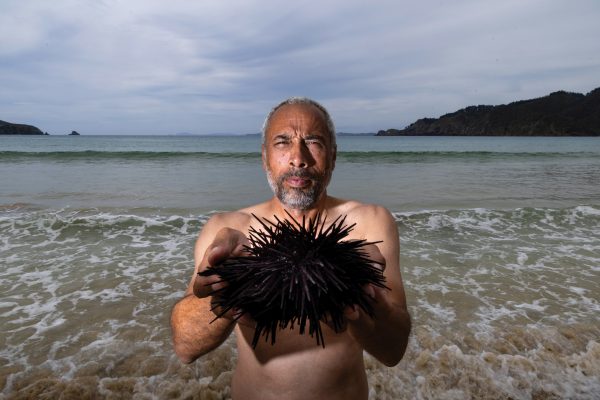
I pick a centro off the reef, taking care not to jab myself. The blackness of its spikes is that of outer space—total, velvety. Gazing into its structure, I’m shocked at the vivid purple-blue of its interior. Part of me thinks I should kill it, but lacking a suitable weapon, and being somewhat reluctant to destroy such a graphically beautiful thing anyway, I put it back on the rock and carry on the dive.
We slip through an underwater archway, surprising four large boarfish in a spawning group. Johnston nearly spits out his regulator with excitement—he tells me later that in all his years of diving he’s never seen that before. We move on across a jumbled boulder-field where a single packhorse crayfish crawls out in the open, challenging me with its waving antennae.
Kina, New Zealand’s most common native urchin, are here, too. They’re the scruffy, short-spined urchins familiar to anyone who’s spent time in the water around New Zealand. Kina are much smaller than centros, and generally less hardcore. But they, too, have caused problems. The overfishing of their predators—primarily crayfish and snapper—has allowed them to become superabundant in some areas, creating “barrens”, just as centros do. But kina typically only form barrens shallower than about 12 metres and graze mostly on seaweed. Centros will eat anything they can get in their grinding maw—sponges, algae, sea squirts, the lot. And they push much deeper than kina, bottoming out at about 50 metres. When Centrostephanus takes over a reef, little else survives.
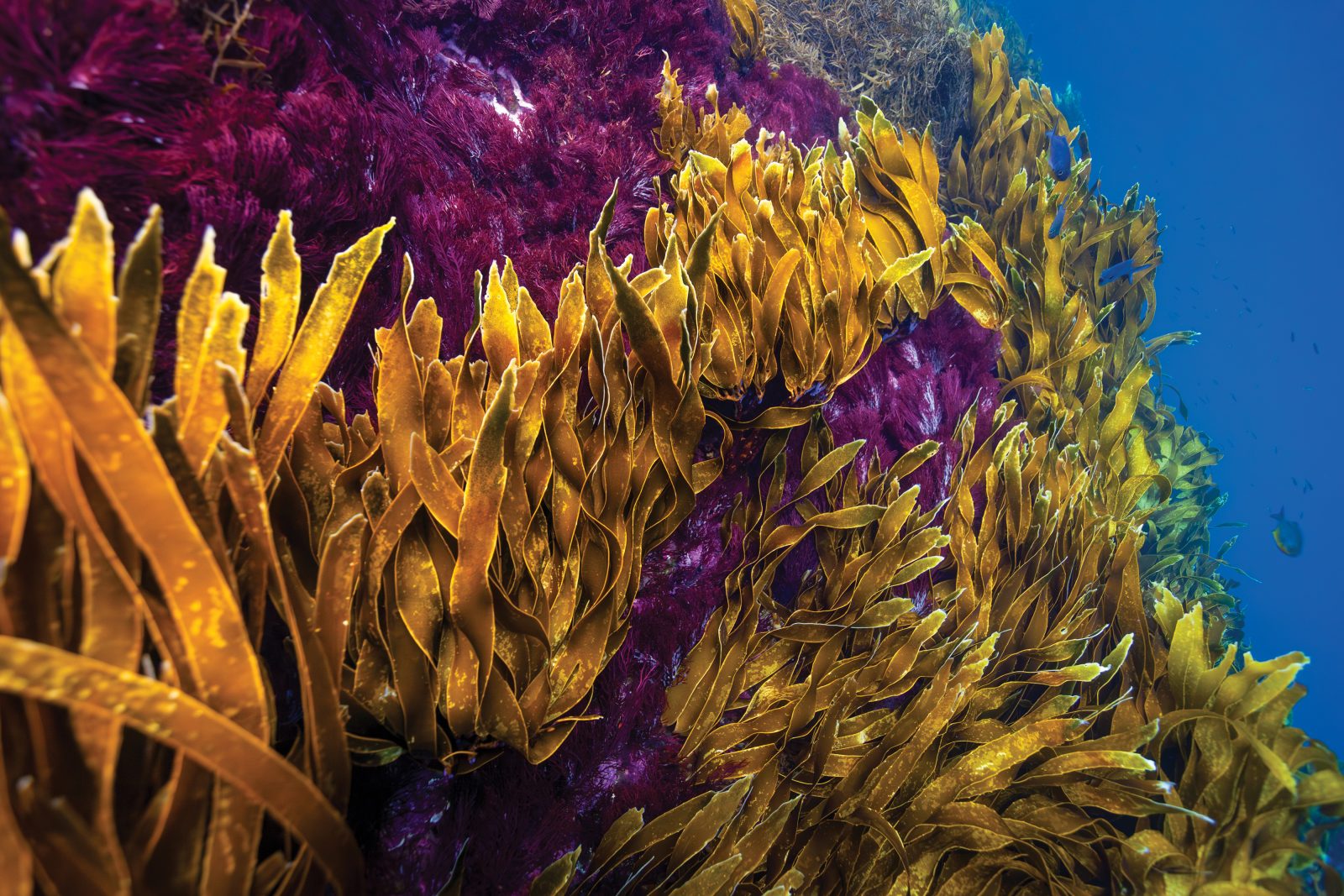
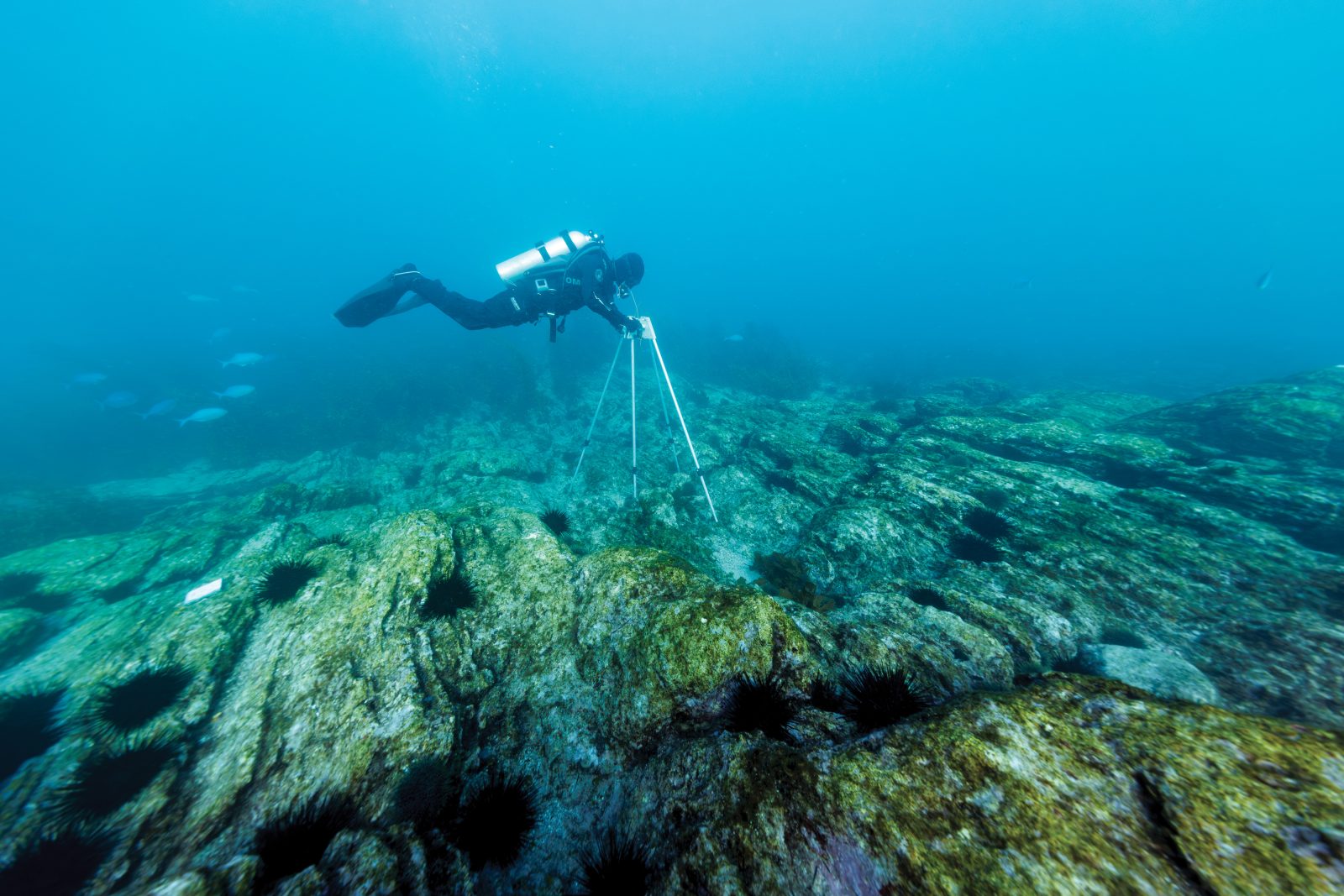
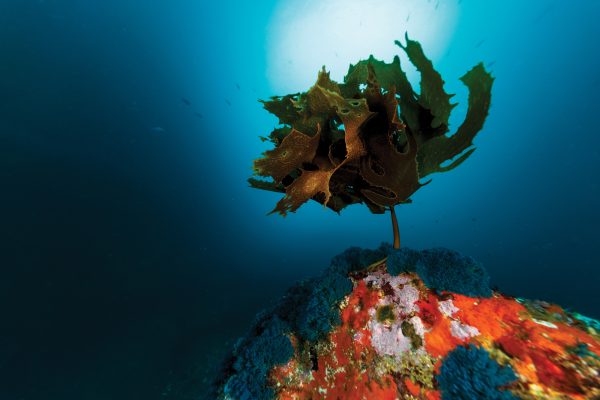
On this reef, Ecklonia is still hanging on in places, but it’s just the big trees. The forest doesn’t look right. There’s too much open space beneath the wave-battered trunks. Centros and kina have mowed through the understorey and left only the big kelps standing. Eventually, those, too, will go.
Back on the boat, Johnston tells me that while his clients are still thrilled by their dives out here, they don’t know what it was like before. He does, though. “It’s heartbreaking,” he says, “seeing the impact and knowing that if something doesn’t get done, my kids will never see it as how it was originally.”
We head back to the beach, where Lavern Anderson of local Ngāpuhi hapū Ngāti Kura is ready with the tractor to pull us out. He and his uncle Edward Hill, he tells me, are out freediving in these waters constantly, gathering food for the hapū. With decades of experience between them, they know the reefs intimately. They know when the kina are ripe to harvest, and when to target other species instead.
Anderson has a background in food research and thinks more people should be eating Centrostephanus—it’d help put the brakes on, at least. He says the black urchins, which he calls “Aussie kina”, are good to eat, and at certain times of year even better than regular kina. But he’s found there is a cultural resistance to collecting and eating centros—“they’re scary-looking”. He and his uncle are the only members of their hapū who regularly gather them.
Centros, says Anderson, are now so common in the bay that they’re even muscling out their own predators. Big centros will dominate rock cracks, leaving no room for the smaller crayfish, which can’t eat them—but could, given a chance to grow up. He and his uncle regularly throw centros out of the cracks. Come back a week or so later, he tells me, and a crayfish will have scored that spot.
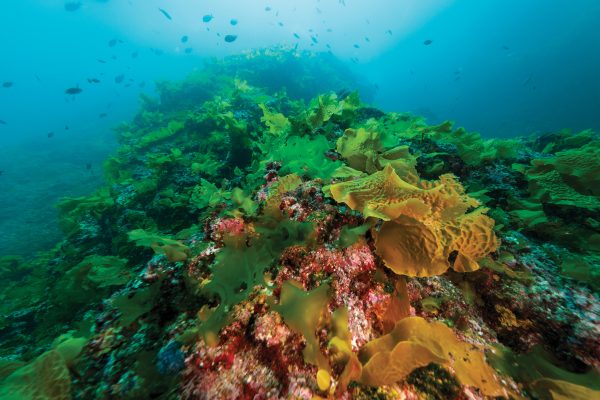
Johnston and his guides also systematically control centros at a dive site east of Paihia by breaking them open and feeding them to fish. The work keeps urchin numbers down, while giving their paying divers an up-close experience with big wrasse and snapper.
It’s not ideal, says Johnston, as it alters natural fish behaviour, and he’d rather not be killing a native species on the reef. But by keeping pressure on centro, other sea life soon returns.
“Biodiversity on that reef now is way better than it used to be.”
The first dives after winter, when the team haven’t been out much, can be dismaying—the urchins have inevitably rebounded, and it takes a couple of months to knock them back again. “It’s not sustainable,” says Johnston. “As soon as people stop diving in those areas they’ll be as barren as everywhere else.”
*
“A kina on steroids” is how University of Auckland marine biologist Arie Spyksma describes Centrostephanus rodgersii. I’m with him and his colleagues on the university boat Te Kaihōpara, anchored in the lee of Tawhiti Rahi, one of the Poor Knights Islands.
The islands are ablaze, pōhutakawa on the cliffs just coming into flower. The sea around us boils with cruising schools of trevally. In the distance, a huge flock of seabirds is feeding, curtains of birds flexing in the breeze.
Sitting just off the Tutukaka coast near Whangārei, the Poor Knights host a panorama of sea life unparalleled in New Zealand—lush kelp forests and steep rock walls encrusted with a dazzling array of sponges, bryozoans, soft corals and algae. Huge schools of fish circle the entranceways to underwater caves. Big predators like kingfish, snapper and sharks abound, and in late summer, manta rays and other tropical visitors arrive. Jacques Cousteau famously described the Poor Knights as one of the top 10 dive sites in the world.
Locals fought for decades to have this place protected. In 1981, it was made a marine reserve, only the second place in New Zealand to receive that level of protection. The ecosystem, once hammered by recreational fishers as well as commercial operators, has recovered spectacularly. But crayfish have never really come back. Great news for centro, which, with very few predators around, now has this precious place in its spiny grip.
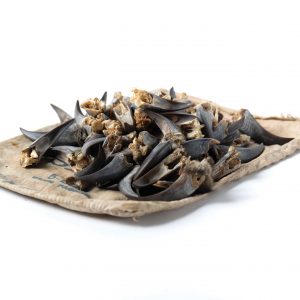
The team pulled a couple of centros up during a recent dive. Spyksma turns one over to show me its fearsome “Aristotle’s lantern”, a cutting, munching, feeding apparatus that, as we watch, writhes and grinds, hunting for something to pulverise.
Centros eat so voraciously that once they’ve chewed through every living thing on a patch of rock, they start scraping away at the bare rock itself, trying to get any last bits of algae.
The team regularly drop hydrophones into the water and listen to the unnerving sound of thousands and thousands of centros grinding away at the reef, dismantling the Poor Knights one mouthful at a time.
Auckland University associate professor Nick Shears has been keeping an eye on centro for two and half decades now. When he first started monitoring reef life at the Poor Knights in 1999, the urchins were just starting to become a problem in Australia. Shears knew the Knights could well be next in line. “In 2006, we were getting suspicious there was an increase,” he says. “By 2015, it was obvious. That’s when we raised the alarm bells.”
The urchins have now increased nearly 10-fold here since 1999, and the islands’ kelp forests are under attack. “Kelp doesn’t live forever,” says Shears. “When they’re four or five years old, they die. Normally, when that happens, you get regrowth, like in the forest—the young ones underneath grow up and replace the adult plants.” Centros scoured out that understorey. “So we’re not going to get a recovery.”
That, says Spyksma, is a disaster not only for this place, but also for marine ecosystems more broadly. “Because kina typically only graze down to 10 or 12 metres, there was always this deeper kelp that was a refuge. So if a die-off happened in the shallows, you had a source of new kelp spores close by. But with centro grazing down to 30 or 40 metres you’re losing all that refuge as well.”
In Australia, scientists found that when centros reach a density of 2.2 urchins per square metre, a tipping point is reached, and kelp forests collapse. At the Poor Knights, the average density is about one per square metre. But on the worst-affected reefs there can be eight urchins in that space.
Once they’ve made a barren, the centros can survive on almost nothing. Like other urchins, they throttle back their metabolism and can shrink their shell—calibrating their body size to cope when food gets scarce. So there’s no classic boom-bust cycle here—the centros just win, end of story.
To restore a kelp forest, you have to pretty much clean out every urchin and let the reef start over again. Given such a reprieve, University of Auckland researchers discovered, kelp and invertebrate life recovers substantially within a year.
Based on those findings, the Department of Conservation resolved to take unprecedented, and controversial, action here at the Poor Knights. In collaboration with the University of Auckland and local hapū Te Whānau a Rangiwhakaahu, they’re trialling large-scale removal of Centrostephanus.
In 2025, teams of divers systematically smashed 130,000 centros at five sites around the island. These spots are being closely watched to see how the kelp and other plant life recovers—and how quickly the centros come back.
Sarah Meadows, DOC’s manager of marine ecosystems, acknowledges that legislation sets marine reserves aside for the study of natural systems, free from human interference. However, we’re looking down the barrel at a complete loss of kelp at these islands within a decade. “It’s a lot [easier] to catch something before it goes over a tipping point, versus having to try to restore a system.” She stresses the removal should not be seen as an attempt to control urchins at the Poor Knights, but as a contained and carefully considered scientific study to see if more widescale removal would
be feasible.
“The decision to trial the removal was not taken lightly,” Spyksma tells me. No one, he says, wants to be meddling with the Poor Knights’ ecosystem, but as he points out, the centro boom itself is “far from natural”.
I pull on my snorkelling gear and follow Shears into the water to get a glimpse of one of the sites. Popping up between breath-holds, Shears explains what we’re looking at. The first site we swim over is the “natural” area. Here, centro dominates a barren rockscape.
Further around the rock wall, we reach a patch where all the centro has recently been culled. The kelp here is coming back thick and strong. I dive down and pull myself in among the Ecklonia trunks. The rock shimmers with bright blues, pinks and purples—the wall life returning in force amid the sheltering embrace of the kelp. Catching movement behind me, I turn to see a huge school of trevally swim past, a kingfish slicing through them. Below me, a shimmering school of pink maomao lights up the depths. This is what divers travel from around the world to see.
Urchin removal, it’s clear, is a powerful tool for restoring the health of the kelp forest, but sites like this will likely require ongoing maintenance, forever. Centrostephanus, like all urchins, are broadcast spawners, releasing massive numbers of eggs and sperm into the water. A single female centro can carry over a million eggs. Fertilised eggs can travel for kilometres before settling on new rock. “Everything’s connected by currents, and totally fluid,” explains Shears. “So by just removing Centrostephanus out of one bay, you’re never going to get them all.”
It all seems a bit futile, but Sandra Hawken, who works with the centro removal team, says these islands are just too precious to give up on. She is Ngāti Wai, of Te Whānau a Rangiwhakaahu; she grew up on this coast, and for generations her ancestors have cared for the Poor Knights. “As a young person you just expect it to be there forever,” she says.
Watching the marine environment deteriorate, and losing key kaimoana species, has been tough. “As a kid growing up, I remember my father commenting on the overfishing of crayfish,” she says. “They saw it back then.
“I know families who live off the ocean because they can’t afford to do anything else. Their pantry is the ocean. They go out and get dinner for a couple of nights, or for the old people. But that’s getting harder and harder to do.”
Hawken feels impelled to help. And, like the others, she feels a terrific urgency. We need to put our heads down and start working on these problems now, she says, because “there’s not going to be a solution in five minutes”.
*
Just how bad could it get in New Zealand? Sea urchin takeovers are happening globally, and offer a chilling glimpse into a barren future. In California, for instance, the purple sea urchin population increased 10,000 per cent in five years, wiping out bull kelp forests. In the Juan Fernández archipelago, 700 kilometres off the coast of Chile, a close relative of our urchins, Centrostephanus sylviae, has quadrupled since 2014, devastating reefs in this UNESCO biosphere reserve.
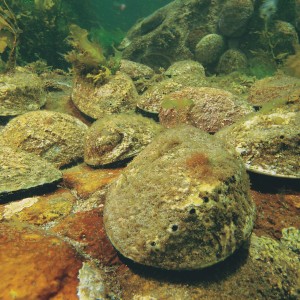
Closer to home, Tasmania’s centro boom is threatening livelihoods as abalone, a commercially fished species, loses its kelp forest home. It looks like we might be clobbered even harder. Back in 2012, the urchins in Northland were level-pegging with those proliferating along the east coast of Tasmania. But in this dismal race, we’re now far outstripping the Aussies—and our urchins are only just getting started. Sterling Tebbett, a marine ecologist with the University of Tasmania, says that whereas Tasmania’s cooler waters have helped keep a lid on centro’s spread there, northern New Zealand is warmer, so “the rate of increase looks like it’s just going to go quicker now, to a higher ceiling level”.
If you live in the lower North Island or the top of the south and think this isn’t going to affect your favourite dive spots, think again.
At the moment, Spyksma explains, New Zealand centro seems to need waters warmer than 15 degrees in winter—but that could change. After all, the same species is happily breeding at 12 degrees around Tasmania. If the centro larvae here adapt to that chill—and there’s evidence they can—the urchins could soon get quite comfortable around much of the North Island. With the seas warming in a changing climate, all bets are off as to how far south they could eventually get.
Tebbett has also studied the impact of crown-of-thorns starfish on the Great Barrier Reef. In their proliferation, as well as the urchin plague, he sees symptoms of human-induced changes in the ocean so massive that we cannot comprehend them. “The extent and frequency of climate-related disturbances now is surpassing expectations,” he says. “I think we find it hard to grasp how much we have changed these systems.”
In an attempt to slow centro, the Australian government is now subsidising a commercial fishery for Centrostephanus in Tasmania. It’s early days, and the industry is yet to prove its long-term commercial viability, but already, the systematic removal of the urchins has had a positive impact on reef health.
Surely we could do the same here? Maybe. As Spyksma says, “We’re already well behind the eight-ball in terms of getting that infrastructure in place. Then we would have to compete with the entire Australian market.” He doesn’t think it’s a practical solution—at least not at this stage. Something has to happen at this stage, though.
“We know that the problem is going to be so much worse in 10 to 15 years. We really need to be acting now and getting on top of it.”
Ideally, we’d outsource this fight to centro’s natural enemy: crayfish. The closure, on April 1, of commercial and recreational fishing for spiny rock lobster along the eastern coast of Northland may go some way towards bringing balance back to the ecosystem, although the commercial boats, I’m told, had long since abandoned this coast anyway. Catches were already so low as to make fishing uneconomic.
For Craig Johnston, protecting the crays is “a start”.
“It’s doing something. It should have been done 10 years ago, when numbers were actually starting to drop, rather than now, when they’re all gone. Unfortunately, it seems to be the way things are with the ocean. It takes a calamity before things start to get talked about.”
Packhorse crays, like the one we saw on our dive in Matauri Bay, are slowly recovering in Northland. Johnston just hopes recreational divers can restrain themselves now that the smaller, tastier spiny rock lobsters are off-limits.
Meanwhile, he, like so many others watching these urchins, is making a conscious choice: refuse to despair. He focuses on the extraordinary life he still sees during every dive, like that school of boarfish. He reminds himself the sea is constantly changing, resilient, and full of surprises. A few weeks ago, he was leading a group of divers on Rainbow Warrior when, to everyone’s astonishment, a humpback whale swam past.
More by Bill Morris
More by Richard Robinson