Every year, the finest sheep dogs and handlers in New Zealand and Australia compete for the prestigious Wayleggo Cup. The air is thick with expletives, the sheep are ready to bolt, and every second matters. (more…)
More by Greg Bruce
More by 553889



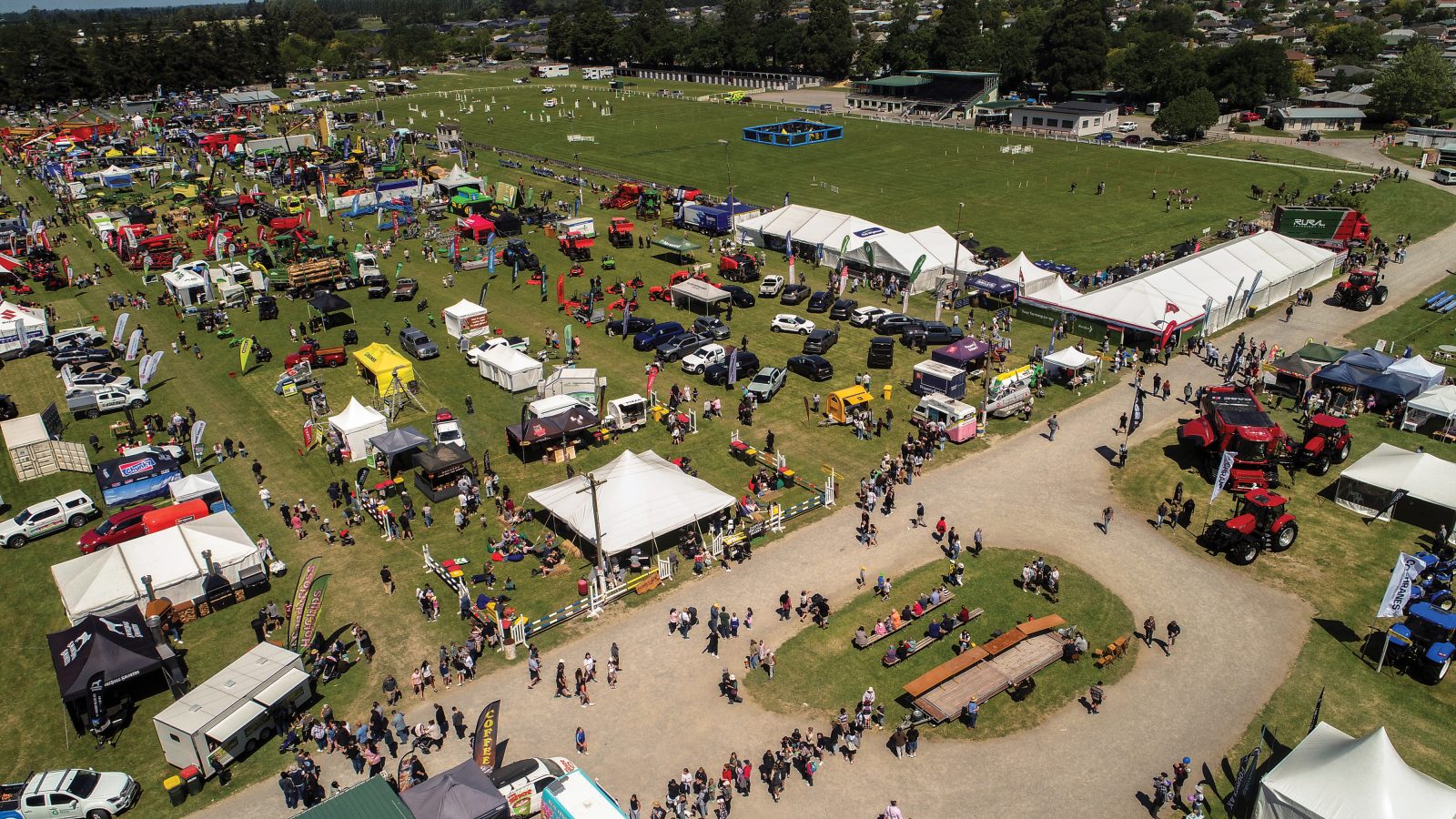
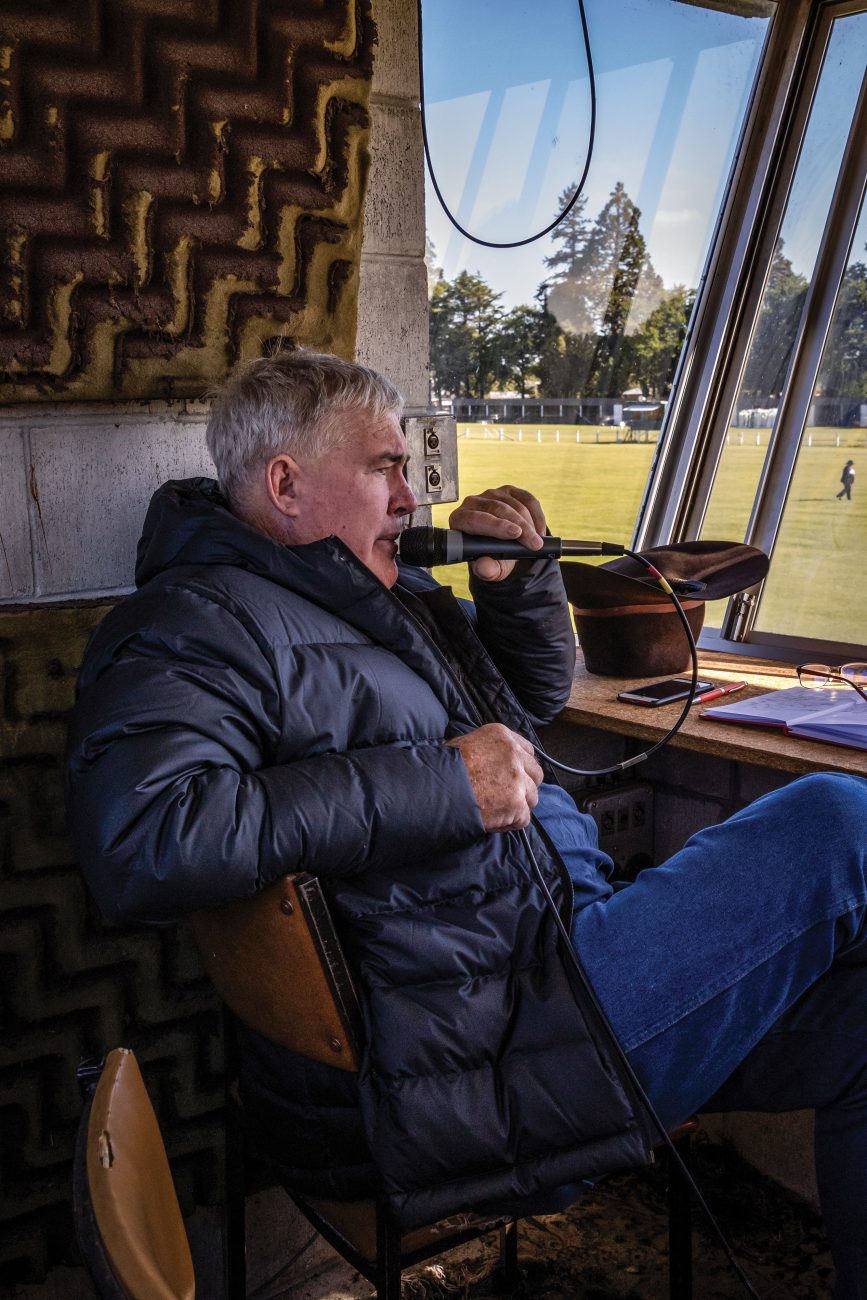
At the Ashburton A&P Show, the woodchopping competition is entering its frantic final moments: “Round they come! Blow for blow!” the commentator yells. Meanwhile, 73-year-old Lloyd Smith and six-year-old Code are standing absolutely still in the middle of the arena next door, waiting for three purebred Romney hoggets to be released, or “liberated”, as they say in the sheep dog world. The two speeds of farm life in the glorious late-afternoon sunshine.
It’s the first run of the second and final day of the Wayleggo Cup and tension is high, but if he can hear the excessive effusiveness of the shearing commentary (“Give him a hand! What a great shear!”), Smith is unaffected.
He is a man who knows struggle. His first farm was a 2800-hectare hill-country property in Roxburgh, about halfway between Cromwell and Gore. He describes it as a “cold, hard place”. He and his wife, Linda, had four kids and they had to borrow heavily to buy and develop the property. Money was often so tight they would have to sell their dogs to buy Christmas presents or even just pay the bills.
He is a man who knows success. Since his first trials in the 1970s, he has been selected in the New Zealand team three times, and twice more as reserve. He’s won five New Zealand titles and six South Island titles. He’s been placed 69 times in South Island and national championships. He had multiple appearances on that legendary television programme of the 1970s and 80s A Dog’s Show.
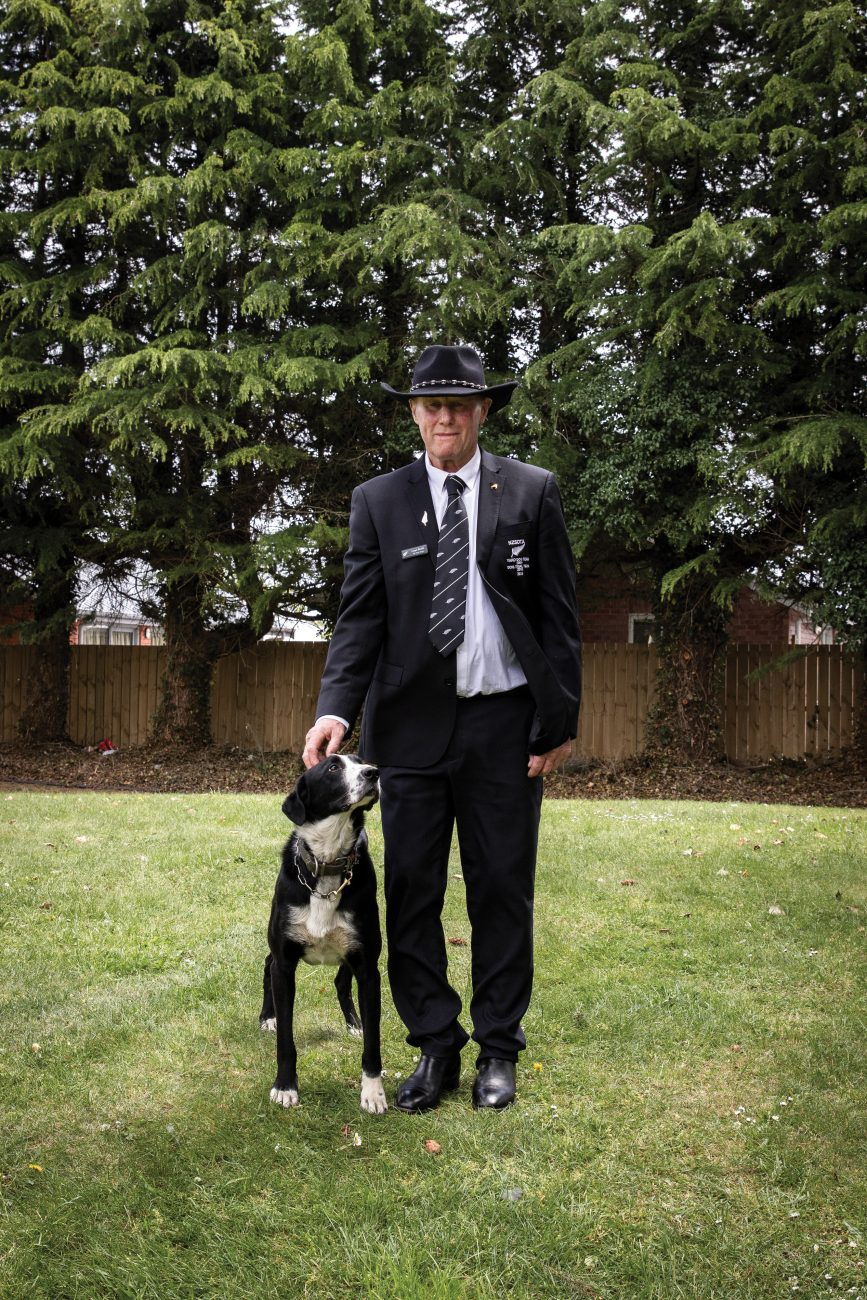
On February 23 this year, one week after their 50th wedding anniversary, Linda, his best friend and soulmate, died. He is a man who knows loss.
Someone calls time, Smith gives a signal, and Code is gone, full speed, full stretch, out to the right-hand fence and all the way to the far end of the arena, just beyond the sheep, at which point he goes from full sprint to dead stop. The sheep, who had heretofore been looking down the arena at Smith, now turn to face the dog.
This is the critical moment: two species locked in silent combat; a cold war vis-à-vis who is about to do what to whom and with how much vigour and, potentially, violence. If the dog doesn’t establish its authority, chances are the run will end in disaster. In these next taut seconds, the balance of probabilities will tip toward success or failure.
Like all the New Zealand dogs in this competition, Code is what’s known as a heading dog. Unlike its fellow sheep dog the huntaway, the heading dog does not use its bark to control stock; it uses its eyes. In Smith’s words, “it mesmerises”.
From behind the fence it is impossible to tell how the deadlock is playing out.
Soon enough it will be clear.
*
Six hours earlier, at the Ashburton farm of New Zealand captain Mark Copland, Australian team manager Mick Hudson climbed out of a rental van and blew a snot rocket onto the grass. He would go on to hock up a couple of loogies and also take a leak: the organic, biodynamic embodiment of the trans-Tasman bond and our entangled earth.
Hudson is a man who believes most sentences are incomplete until adorned with at least a f*ck or two. He calls it how he sees it and he plays to win. He has come to New Zealand to beat the Kiwis and he has come to Copland’s farm to get his team and their dogs f*ckin well ready to do so.
Although he isn’t competing this year, Hudson is a legend in the Australian sheep dog world, one of the greatest sheep dog triallists his country has produced. His father was Pip Hudson, also one of the greatest sheep dog triallists his country has ever produced. Mick’s skills were honed from childhood near Cobar in central New South Wales, 300 kilometres from the nearest city. His dad was instrumental in starting the trans-Tasman competition that became the Wayleggo Cup and he represented Australia three times. He also once appeared on A Dog’s Show, an achievement that saw him followed, simultaneously, by a crew from Australia’s current affairs show 60 Minutes.
“My old man was a real character,” Mick Hudson says. “They loved him over here. He was a f*ckin real bushie. A real Aussie.”
First-time Australian representative Jess Kimpton, 32, grew up in the cafe-strewn white-sand suburbs of Sydney’s northern beaches, sometimes called the “insular peninsula”—far from the sprawling farms on which most dog triallists cut their teeth, and nowhere near any sheep. But she was an animal lover from an early age and was training dogs for agility competitions as a teenager when she was given her first working dog. She was hooked immediately.
Stitch, with whom she will be competing in this year’s event, is part of the family.
She says it’s fine and even important to love your dog. “Your dog should love you. A dog that wants to work for you is going to give you so much more than a dog that’s doing it because you’re telling it to.”
Stitch lives in the rural house Kimpton shares with her husband and six-year-old daughter. She sleeps on Kimpton’s bed. To say this is unusual in the sheep dog world is an understatement.
Mark Copland, when asked if his trial dogs live in the house, replies with five “no’s”, and a single “never”.
“How do I put it?” he says. “These aren’t toys. That’s the first thing. I’ve never had a toy dog. They live in the dog kennels, they do a bit of everyday work, exercise, and so forth, and relax, chill out between doing any work and whatever. Yeah, they’re just working dogs.”
*
Lloyd Smith wrote the book on training sheep dogs in New Zealand. It’s called Pup Pen to Paddock and is now in its second edition. In it, he writes that “wayleggo” is the single most important command in the training of a sheep dog, the foundation on which all else is built. Any champion triallist in this country, human or dog, knows the importance of wayleggo. According to lore, it’s derived from the command “Come away and let go”, which basically means “Leave the sheep alone and get back here.”
The Wayleggo Cup has a legitimate claim to be the most important event in the world of sheep dog trialling. Australia and New Zealand have the world’s third- and 14th-largest sheep populations respectively, and the sport was invented here —the world’s first recorded competitive sheep dog trial took place in Wānaka in 1867. By 1870, events were being held around the country. A year after that, in New South Wales, Australia held their first event in the sport. To no one’s surprise, they would later claim they invented it.
To some extent, New Zealand’s economy was built on the back of sheep dogs. Even in our technological age, dogs remain the most efficient and preferred method of managing and moving stock on large farms. They’re still prized for their skill and their ability to read sheep and adapt to rapidly changing situations. They also work in all weather and don’t need batteries.
Smith says: “You do hear of drones and that, but I don’t think anything is up to the standard of a good work dog. Drones have their place—I’m not against them—but I don’t think they’ll replace the good work dog.”
New Zealand was the first, and so far only, country to turn the sport into top-rating televised entertainment. A Dog’s Show screened on Sunday nights from 1977 to 1992 and consistently rated higher than every television show that wasn’t the 6 pm news.
Trans-Tasman competition began in 1985, but it was 1995 before the Wayleggo Cup formalised the arrangement. New Zealand has dominated the event, particularly in recent years. Prior to Australia’s win in 2022, the New Zealand team had won six in a row.
Because Australia and New Zealand have different rules for their sheep dog trials, the Wayleggo Cup operates on its own, hybrid rule system, which has evolved over the years and has sometimes led to confusion and occasional mutterings of dissent from those involved. A couple of hours before the start of this year’s event, at an outside table next to the greened-over pool at the Hotel Ashburton, the teams hold a meeting to iron things out.
There will be two “Australian carries” and two “New Zealand drives”, which are both ways of getting sheep from A to B. In a New Zealand drive, you are allowed to wave your arms around as much as you like, but in an Australian carry you might have points deducted for scratching your arse. Sometimes the sheep can be miles away from you and sometimes they will have to be within nine (NOT 10) metres. Sometimes you will be penalised for changing the speed at which you walk. There are rules about unwinding and crossing; there are casting pegs and pre-work areas.
On and on it goes, but the guts of it is as follows: Each team will have four competitors and each competitor will get two runs over the competition’s two days. Each run will require handler and dog to move three sheep up and down the arena, through and around a series of obstacles and eventually into a pen. They will have 15 minutes to complete each run, after which judges will score its quality out of 100. All individual scores will be added together and, after the two days of competition, the team with the higher total will win the Wayleggo Cup.
*
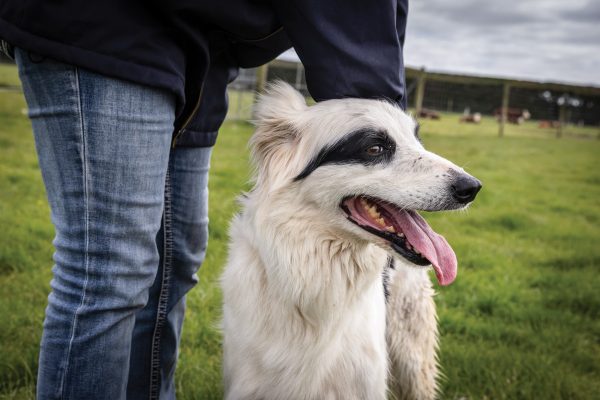
Among the eight dogs in the competition, Stitch stands out. For one thing, she is mostly white. This is seen by some in the sheep dog world as a liability, because they’re perceived as weaker. “When you’ve got a weak white dog, you’re pretty stuffed,” Kimpton says. She says she’s had trials where the sheep will run directly at Stitch. “They go, ‘What on earth is that?’” Because she is such a strong and confident dog, Kimpton says, Stitch will just stand there and stare them down, with a look that says, “Oh really?”
The other thing is her energy. She appears to have more energy than all the other dogs put together. Maybe too much energy. At the Australian team practice prior to the second and final day of competition, Hudson, watching Kimpton and Stitch from a distance, is worried. He says, “She needs to get into that dog.”
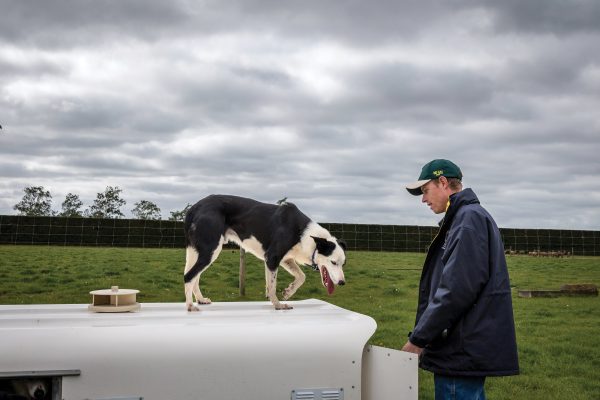
But he is also concerned about putting Kimpton under too much pressure. “I’ve got to be careful,” he says. “You know what I’m sayin’? People are different, like f*ckin dogs.”
He tells her to give Stitch a rest, then, half an hour or so later, after the rest of the Aussie team have given their dogs a run, he asks her to bring her back out. This time, he asks her to have Stitch stand still, right in front of the sheep, looking them in the eye. He wants her to test the dog, to see that Stitch can contain herself, and stand still. He wants to make sure she is able to handle the pressure.
“It’s f*ckin good seeing dogs work up the front,” he says. “Close to stock, on the head of the stock. Anyone can walk up to their arse.”
As Kimpton comes off the paddock, Hudson says, “Well done. That was good for her, Jess, to make her come off and wait.”
“She’s full of herself,” Kimpton says.
“Yeah, but that’s good,” Hudson says. “That’s what we’re out here to do, mate. Tune her up.”
“The dog probably needed a blowout,” someone says.
“It bloody did,” Hudson replies. “F*ckin out of control, that dog, this morning.”
*
In Pup Pen to Paddock, Lloyd Smith writes of the importance of forming a good relationship with a pup at an early stage in its life. He advocates getting the dog to accept the human is in control. He does this by pushing the dog down on its side until it submits. It’s critical, he writes, to talk to the dog during this process, to reassure it that it is not being punished. Too many trainers, he believes, fail to sufficiently praise their dogs. “They growl when things aren’t going right but never acknowledge the positives, or progress made.”
Code has never been easy. When the dog was younger, Smith says, he could be “arrogant”, backing himself rather than listening to his owner, which led to some confrontations. Smith says most were resolved peacefully.
Some other words Smith uses to describe Code: “Very firm”, “aggressive”, “doesn’t take a backward step”.
But then: “Most top sportsmen have a bit of arrogance, don’t they? They’ve got to be prepared to back themselves.”
As with all relationships, Smith says, there are occasional arguments. “We all have our moments, don’t we? Sometimes you’ve got to take a stand and put your point across.”
*
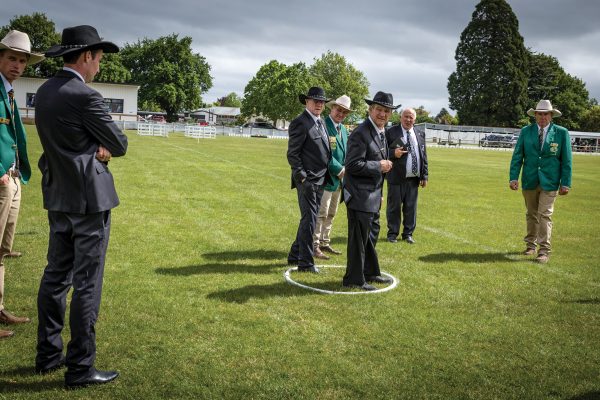
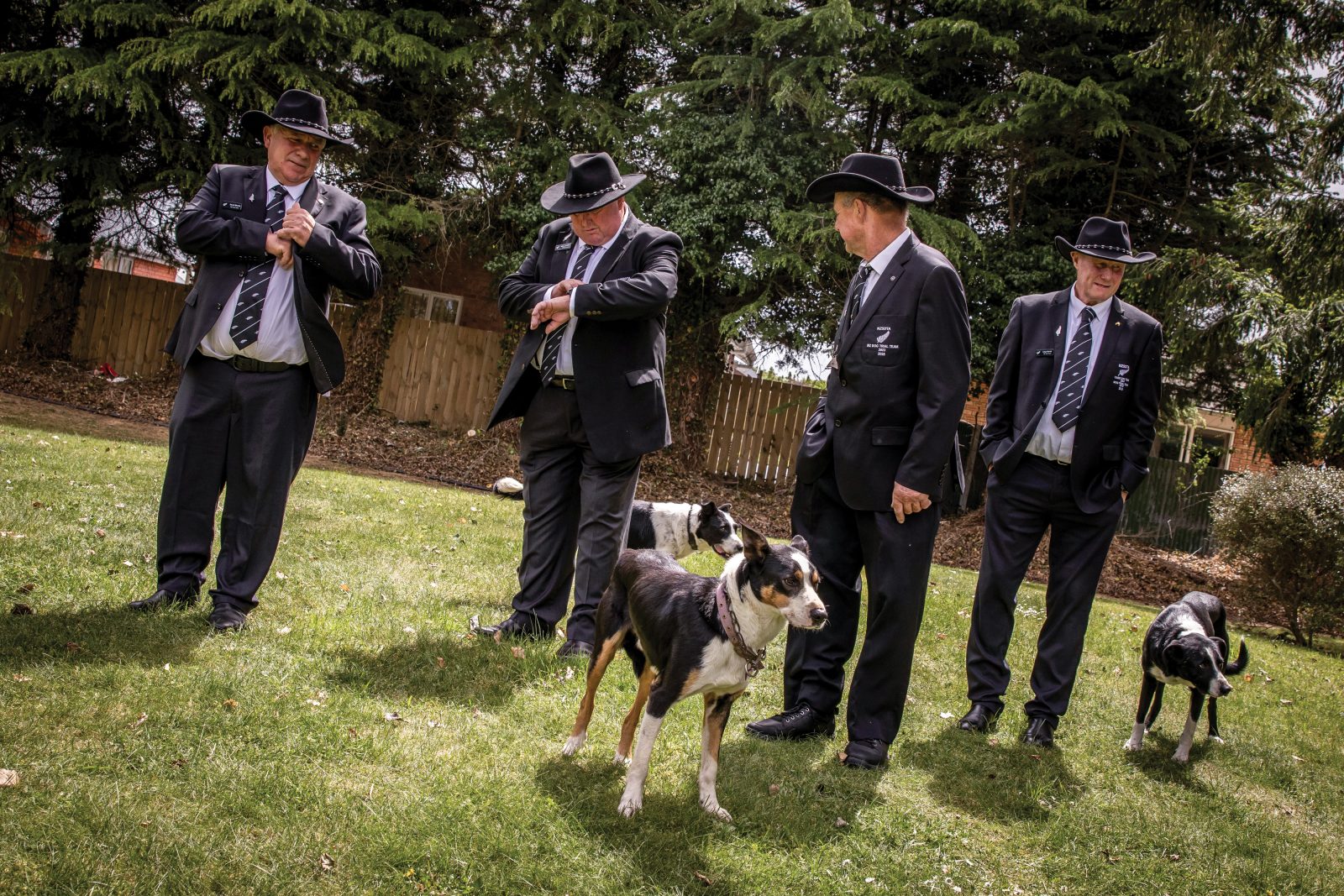
The teams stand in front of the electronic scoreboard, waiting for the music for the national anthems. They are dressed in their number ones. Over their blazers, they hold their wide-brimmed, team-issue shepherd hats. Earlier, someone asked the New Zealand team if theirs were from famed Australian brand Akubra. Team member Ben Millar flipped his over and discovered the brand was Wallaby, made in China.
There hasn’t been any physical or even verbal manifestation of the tension between the two teams, but you can feel it close to the surface. There has been gamesmanship. At the pre-match welcome dinner at the Hotel Ashburton, the dessert was pavlova.
But there is also an overlay of respect, dignity, and old-fashioned etiquette. At the same dinner, each side presented the other with gifts and each captain spoke magnanimously about the qualities of his team’s opponents.
More by Greg Bruce
More by 553889
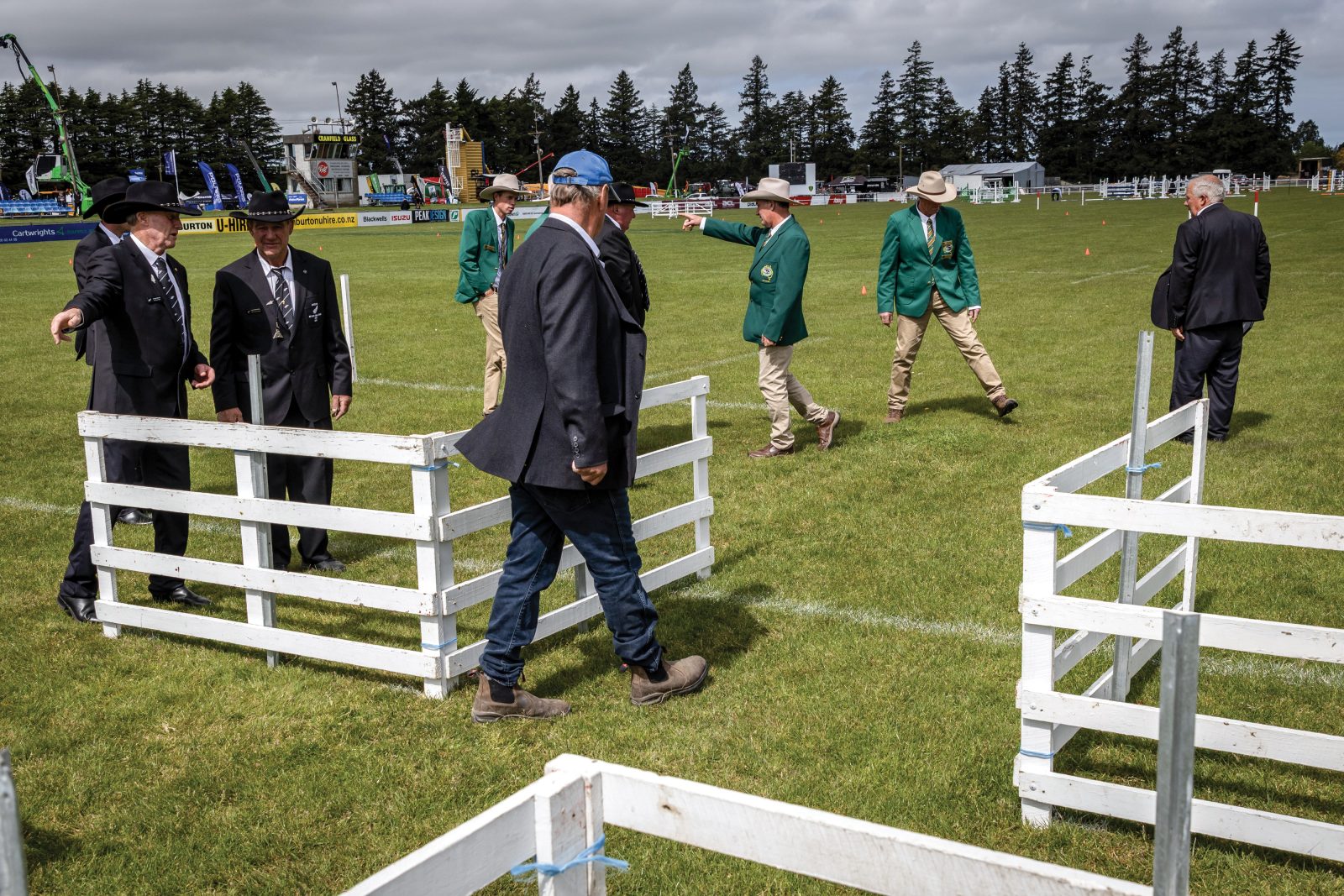
The teams stand waiting for the music for a minute or so before Hudson decides it probably isn’t happening and takes it upon himself to perform ‘Advance Australia Fair’ a cappella in his strong, cigarette-rasped bass-baritone. The rest of the team join in and it is quite moving, but then the music starts, albeit very quietly, and they have to start again, which somewhat ruins the moment.
Shortly after the New Zealand anthem begins, someone turns up the volume and ‘God Defend New Zealand’ blasts around the showgrounds.
“Didn’t do that for the Aussies,” Hudson mutters.
And so the scene is set for the unofficial world championship of sheep dog trialling.
*
Before beginning his final run, Smith says: “There’s always a bit of nerves but you’ve just got to enjoy it, I suppose. You never know how things are going to go.”
The start of the run is tense. After the initial staredown, the sheep are difficult to move, but once Code gets them going, the run is textbook. He guides them through the draw, into the first Aussie carry, through the gate, through the more diabolical obstacle called a Maltese cross, down to the bridge and cleanly over it.
They are now on the final leg—a short Aussie carry requiring Smith to walk at a steady pace in a straight line to a set point, while keeping the sheep in a corridor marked by orange cones, staying within nine metres of him at all times. Three minutes remain—not a huge amount, but enough.
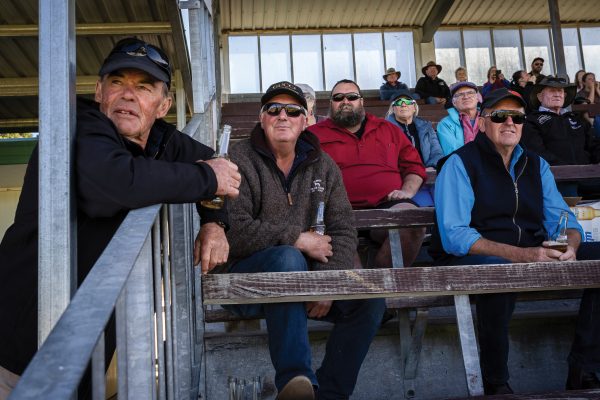
From the outside, it’s easy to think the line of control between sheep dog and human is unidirectional: the human commands and the dog obeys. But that’s not how the best of the best describe it. Instead of “command”, Brian Dickison, one of New Zealand’s top triallists and reserve for this year’s Wayleggo Cup team, uses the word “ask”. Smith uses “suggest”.
“They’re on the spot,” he says of his dogs. “They can read it sometimes better than you can.”
Smith sets off walking down the course at the consistent, steady pace required of the Aussie carry, with the sheep close behind. Everything is working as it should until the sheep take a hard left and start heading towards the cones. Code gets around behind them promptly and stops them, but because Smith has to keep walking, the gap between him and the sheep is rapidly approaching nine metres. He needs them to start moving, or he will have points deducted. That is to say: things are delicately poised.
And then it happens. So slowly and with so little fanfare that if you didn’t know what you were watching, you might think it no big deal. But you would be wrong. It is a very big deal—it is a disaster.
What happens is this: With extreme casualness, and for no discernible reason, Code walks between Smith and
the sheep.
In many competitions this act, known as a cross, is an automatic disqualification. In the Wayleggo Cup, it’s an automatic deduction of 30 points, which is as near as dammit to the same thing. Short of the dog attacking the sheep, this is the worst thing that could happen. It is a fall in the Olympic figure-skating final or George Gregan caning you on the try line when you’re about to win the Bledisloe Cup. A cross in a Wayleggo Cup means you’re pretty much stuffed.
Smith, possibly stunned into forgetting he is in the middle of an Australian carry, stops walking and turns to face his dog.
“Keep going, Lloyd,” Mark Copland calls from the sidelines.
Code now has the sheep heading in completely the wrong direction. It is as if the cross has ruptured the laws of sheep dog trial physics, or at least his sense of them.
“Keep walking, Lloyd,” Copland says.
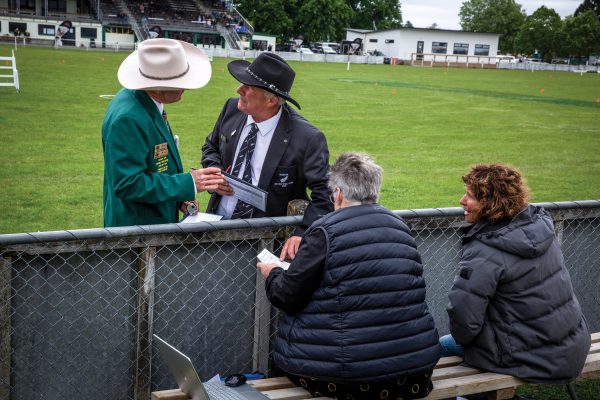
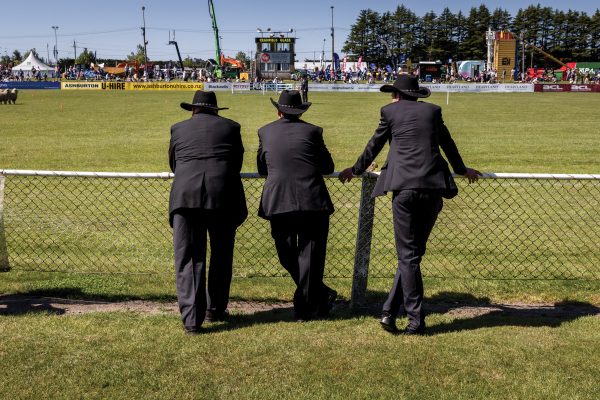
Finally, Code catches the sheep and seems to bring them back under control, but then he loses them again and this time they take off at a full sprint. By the time he catches them, they are almost back to the far end of the arena, where they’d begun roughly 13 minutes prior.
Smith whistles furiously at Code, to no effect.
“A little bit of drama here,” the ground commentator says.
The dog is running around doing god knows what and the sheep are doing the same. After 15 minutes, time is called, still with no creature other than Smith anywhere near the pen. Seven of the eight competitors are still to complete their second run, but in this moment the Wayleggo Cup is as good as gone.
Walking out of the arena, Smith says to no one in particular: “Well, that didn’t go too good.”
Later, after he puts Code back in the ute, he is approached by his granddaughter: “Oh well, Granddad,” she says brightly. “It’s better than zero, isn’t it?”
He gives a wry laugh. “Not much better,” he says.
*
Jess Kimpton and Stitch are the second Australian pairing to go. After an early mistake, they are almost flawless, scoring 88 out of 100, the day’s equal-third-best score, behind only Australian captain Bernard McGlashan’s 90 and Ben Millar’s 89.
Kimpton says the morning practice had been helpful for both her and Stitch. She says it settled them, helped them “stop trying to make it happen, and just let it happen”.
Once she was in the arena, she says, the nerves and everything else melted away, as they always do: “It’s just you and your dog.”
After Kimpton and Stitch, New Zealand’s Leo Jecentho and Jake fail to complete the course.
Australia wins easily, with a total score of 688.25 to New Zealand’s 626.75.
*
Reflecting on his performance in the carpark afterwards, Smith says Code’s heart wasn’t in it. He says he is disappointed with their score, more for the team than for himself. He says: “You get some highs, you get some lows.”
As he stands talking, he is approached by a couple with a young daughter. The girl is keen on dogs and interested in getting into trialling, her mother says. The girl says hello shyly, and Smith spends several minutes talking with her and the family.
After a while, he seems to think of something and he walks them over to his ute, where Code is safely back in his kennel. He opens the door, reaches in, and pulls out a copy of Pup Pen to Paddock.
Subscribe to our free newsletter for news and prizes
3
$1 trial for two weeks, thereafter $8.50 every two months, cancel any time
Signed in as . Sign out