All around you, animals are building, burrowing or stealing dwellings for themselves and their families. For others, home is a state of mind. (more…)
More by Rebekah White
More by Kay Lawson



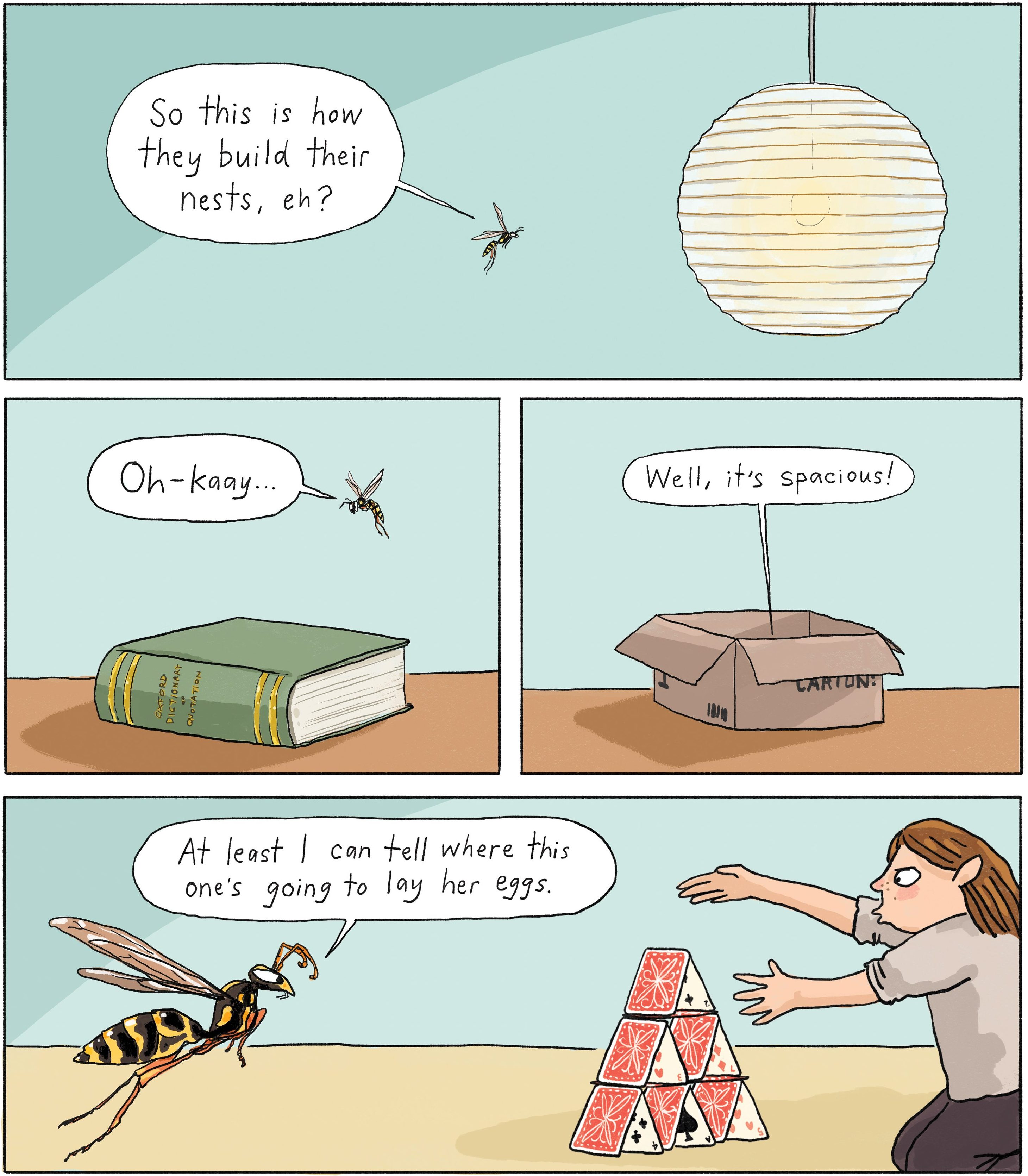
What do wasps, book publishing and bureaucracy have in common? (Actually, this isn’t the start of a joke.) Around 2000 years ago, a Chinese royal servant, Cai Lun, was chilling in his garden in Leiyang when he noticed wasps flying back and forth. Idly he watched one, then another, nibble a mouthful of tree bark.
So this was how they constructed their nests, he realised. The beautiful swirling patterns on the outer casing was layer after layer of wood pulp and wasp spit.
You could write on that wasp stuff, thought Cai. It would probably be cheaper than silk, and it would definitely be lighter than bamboo, which is what people were making books out of in 1st-century China.
Cai started experimenting, and demonstrated his cheaper, lighter paper to the Eastern Han court in 105AD. It revolutionised the transmission of knowledge, and gained Cai both an aristocratic title and a job in book publishing. (Empress Deng suggested that, since he was such a genius, he could project-manage new editions of five important Confucian texts.)
The only part of this story that maybe isn’t true is the part with the wasps. Cai’s paper was made with tree bark, just like paper-wasp nests, but there’s no proof that he plagiarised the wasps’ construction methods—only legend.
We do know that several other people throughout history have observed paper wasps and thought, “Great idea!” The French scientist René Antoine Ferchault de Réaumur wrote a letter praising wasp paper in 1719, and later that century, the German scientist Jacob Christian Schäffer experimented with wasp-inspired paper-making. Today, paper is manufactured even more similarly to the wasps’ method than it was in the past—in principle if not execution.
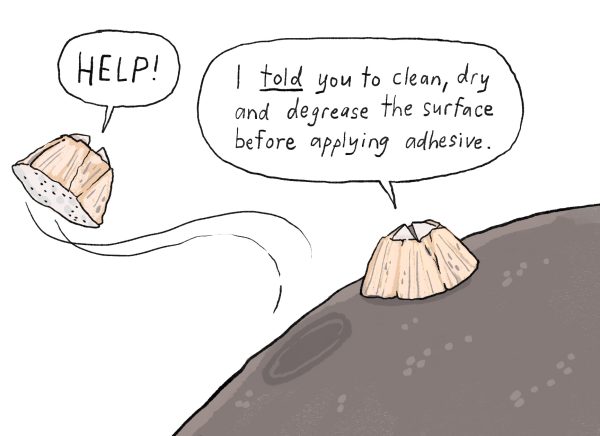
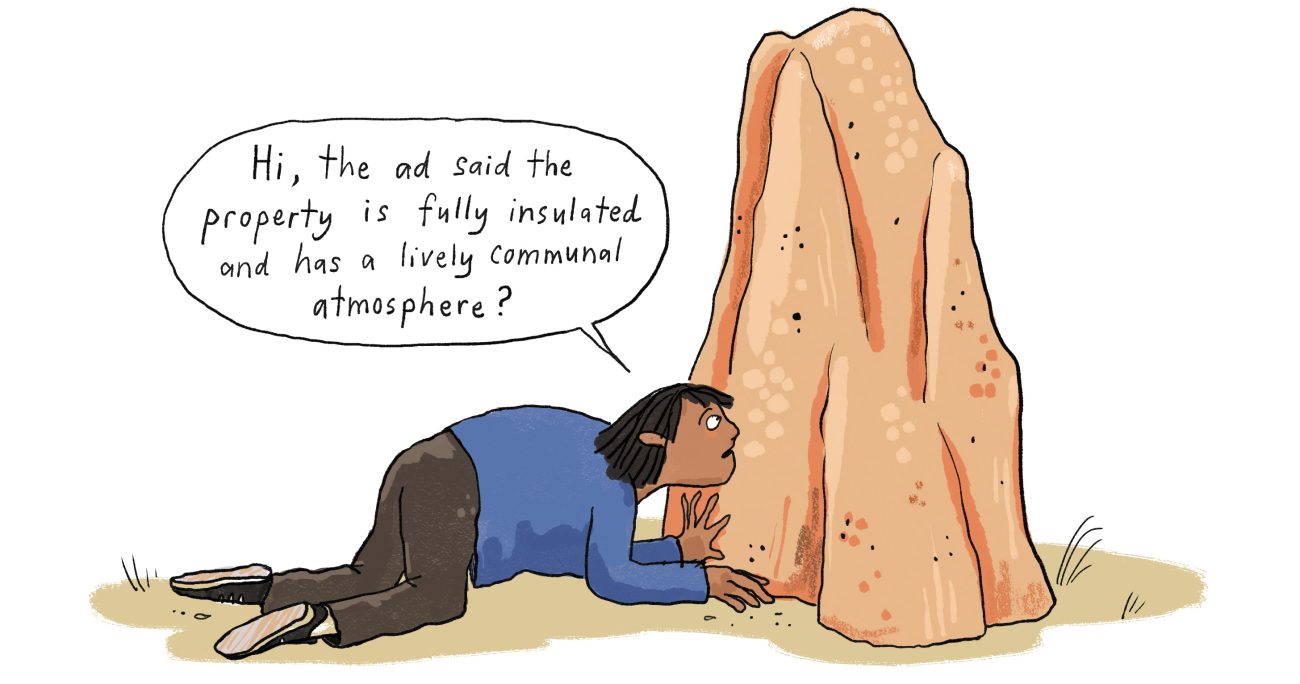
Stealing ideas from the natural world is called biomimicry, and animal homes are so innovative that humans continue to plunder them for materials and construction techniques. Mussels and barnacles glue themselves so firmly to rocks that they’ve inspired new forms of adhesive. Termite mounds in the Australian desert don’t overheat because they’ve been cleverly structured to self-ventilate, meaning that termites invented passive cooling several millennia before humans did. Sociable weaver nests feature thatched exteriors and apartment-style living for several hundred birds. Weaver ants create nests by stitching together leaves with silk in a mosaic-like manner that anticipates Hundertwasser. And these ants work together so effectively that they’re being studied as examples of efficient teamwork with a view to programming robots.
But why do all these species build homes? What’s the point of a home—especially considering that animals don’t need somewhere to put up a Christmas tree, store their clothing and their Crown Lynn tulip cups, or carry out endless renovation projects?
*
For many animals, a home is fundamentally defensive: it stops others from eating you. It protects your eggs or young while they’re vulnerable. It gives you a safe place to sleep that’s camouflaged or locked tight or dangling thrillingly over a river.
We humans might not worry about other species eating us, but our homes share many of the same functions as other animal dwellings. Homes store food for the future, keep out the weather, and impress potential partners with our good taste. Sometimes, they double as vehicles. The paper nautilus, a type of octopus, would struggle to travel at will without its egg case, which acts as an air-trapping device, meaning that it can control its buoyancy as it jets around the high seas. Male paper nautiluses don’t make egg cases, and can’t control where they go at all; they’re simply carried by the ocean currents in the hope of striking a female (literally).
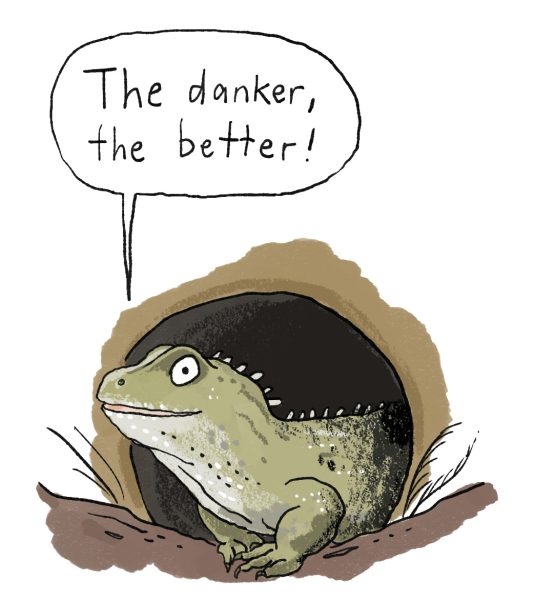
Many animal homes are constructed in order to allow their occupants to remain at the right temperature—one way in which animal construction frequently surpasses human efforts, in New Zealand at least. Tuatara dig burrows which act a little like chilly bins, keeping them cold and hydrated. “There’s definitely a microclimate in a burrow that’s very helpful to tuatara—it’s cool, cooler in general than the outside environment, and it’s moist,” says University of Otago emeritus professor Alison Cree. “Both of those things together means low water loss through the skin.”
Cree and colleagues have observed that during the peak of summer, tuatara tend to stay home. “On offshore islands, which don’t often have standing water, if there’s a drought period of several weeks, tuatara will often not be seen out at night very much. So they’ll reduce their nocturnal activity and their daytime basking and they’ll tend to stay in their burrows until it rains.”
Burrows can also protect animals when disaster strikes. In Australia, wombats create extensive networks of burrows, and after the Black Summer bushfires, many small birds, lizards and rodents sheltered in them.
Even in ordinary times, squatters are common: when researchers observed southern hairy-nosed wombat burrows for a 2015 study, they found more black-footed rock wallabies using them than wombats themselves. Little penguins, tiny marsupials and skinks also popped in.
It helps that wombats have more than one home: and so do tuatara. “They don’t always stick to the same burrow throughout their life—they move around a bit,” says Cree. “They might have a few that they regularly use.”
Of course, digging a burrow is an effort, and sometimes tuatara will simply move into seabird burrows rather than excavating their own. Māori knew to be wary of unexpected occupants when gathering chicks from seabird burrows. “Getting bitten by tuatara is not something to be taken lightly,” says Cree.
So the trick when harvesting chicks (at least in northern regions) was to poke a forked stick into the burrow to trap them, or a piece of bracken fern, which would tangle in their downy feathers and hold them in place, as University of Auckland PhD student Sarah Rewi (Ngāi Tāhuhu, Ngāpuhi, Te Kawerau ā Maki) learned during her master’s research alongside Te Kawerau ā Maki.
Rewi recorded knowledge from her ancestral area on the west coast of Auckland about harvesting ōi/grey-faced petrels: “Knowledge around what the birds should look like, their behaviours, what kind of techniques are adapted to make sure [people] collect the correct birds and not take them too big or too small.”
Seabirds and humans were close neighbours, so the ancestors of Te Kawerau ā Maki learned the subtleties of ōi habits. “Some people talked about how the taste of the wind changed because there’s a specific wind just before the setting of the sun. They said that that was the wind that the birds foraging at sea would travel on to come back.”
Rewi also discovered that the ōi had moved to a better spot in the neighbourhood. While their burrows had been on the mainland in her ancestors’ time, the colony had since moved across the water to Ihumoana Island, an ancient pā site. The hapū living there had been kicked out, so the island was free of humans—as well as other mammalian predators filtering through the Waitākere Ranges. And so the birds pockmarked a new slope with burrows.
“They were displaced from their traditional colonies and found a new home,” says Rewi. “Humans aren’t the only ones who have that practice. Birds follow the same practice, too.”
*
Some animals don’t construct physical homes, but that doesn’t mean they don’t have them. Sometimes, a home is simply the result of powerful internal programming. New Zealand sea lions return to the same spots every year, and so do possums, bats, sharks, whales, bears and deer, even though there’s nothing in those places except memory—not even last year’s nest.
This instinct is called philopatry, and it’s harder to find an animal that doesn’t have it than one that does. Even limpets have a homing instinct. You might say that some species have their own kind of tūrangawaewae: a place their ancestors have occupied for generations, a place that makes them unique.
It feels like a bit of a stretch to call a fairy tern’s scrape a “nest”—fairy terns create a small depression in the sand to hold their eggs—but they’ll return to exactly the same spot of beach year after year in order to lay eggs in the same indistinguishable place. New Zealand dotterels, shore plovers and wrybills also nest in scrapes, but hiding in plain sight isn’t a technique that works for them any more.
Birds are broadly philopatric, returning to the general area they were born in when it’s time to produce the next generation. Often that applies to only one sex—meaning, say, the male stays home while the female leaves the area for good—which keeps the gene pool swirling.
*
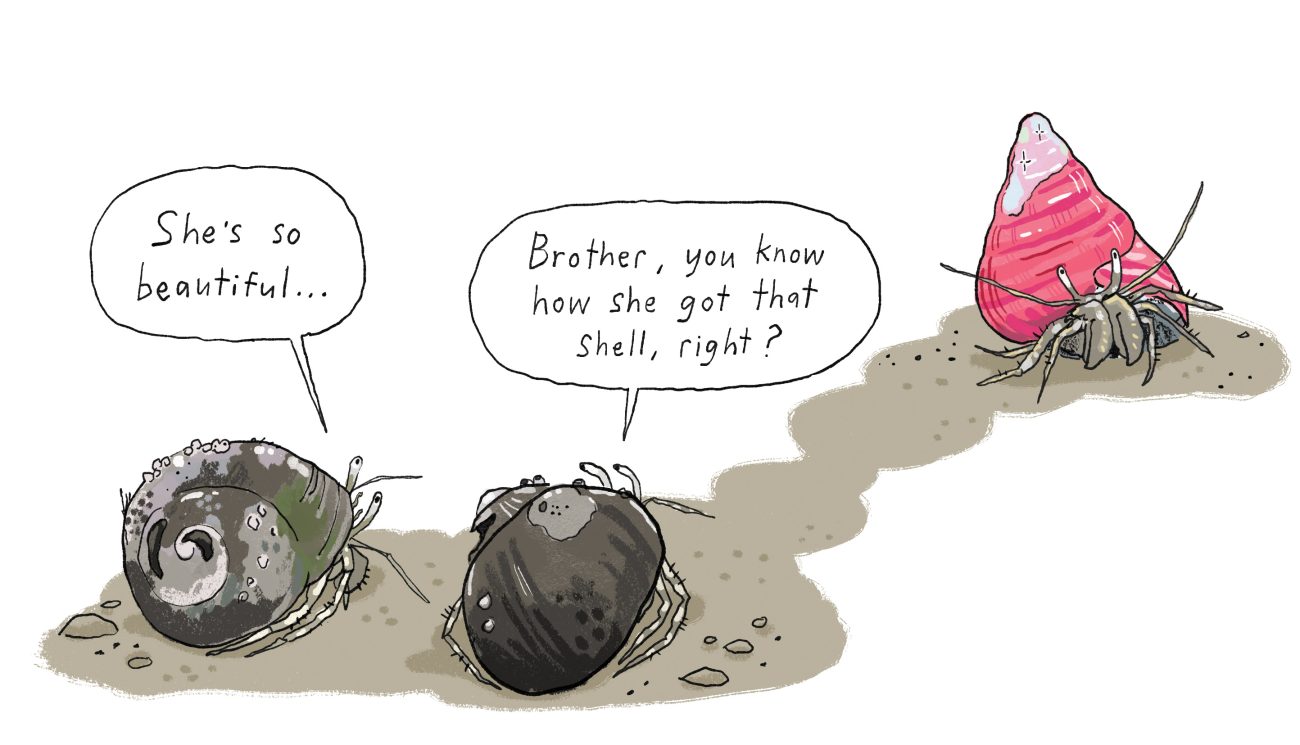
Others not only live in elaborate homes, they decorate or renovate them, too. Social hermit crabs remodel shells they find by hollowing them out, sometimes creating homes that are all too desirable—meaning that hermit crabs also invented the concept of eviction.
During a “shell fight”, one hermit crab bangs on another’s shell, or rocks it violently back and forth, in an attempt to dislodge the occupant. Sometimes, the aggressor simply rips the incumbent crab out of the shell, often tearing the loser apart in the process. (“Shell fights are an ugly part of hermit crab nature,” notes the international Hermit Crab Association.)
When it comes to decoration, caddisfly larvae turn out to have an eye for detail—even though they probably can’t see very well. Adult caddisflies look a lot like moths, but they grow up underwater. Their larvae live in streams all around the world, including throughout New Zealand—in fact, they’re an indicator that a stream is healthy—where they protect their bodies by building cases for themselves out of whatever materials are at hand. Using silk secreted from special glands, they glue an assemblage of rocks, leaves, shells, sticks, or other items into a sleeping-bag-shaped tube, which they live in. Using materials from their environment means they’re well camouflaged. Most of the time.
The French artist Hubert Duprat has spent his career “collaborating” with caddisflies: he supplies larvae with gold leaf and precious stones, and the larvae create intricately bejewelled cases out of opals, turquoises, pearls, and chunks of gold. Rather than being a haphazard mix, the larvae appear to have a real flair for colour and texture—though science has yet to look into the extent of their artistic discernment.
Speaking of stylish design, the evolutionary pressures facing the Montezuma oropendola have led to the creation of some of the world’s most dramatic nests. (The Montezuma oropendola is a type of bird, though it sounds like it could be basically anything.) Its body is brownish-black, and its beak is very shiny, with red tips, like lacquered chopsticks. Female birds create hanging nests that dangle from trees like Christmas stockings or pendulous light fixtures. It’s all to avoid their predators—Montezuma oropendolas choose flimsy branches to fix their nests to, the idea being that the branches won’t support the weight of the monkeys who prey on them. The nests dangle far enough that monkeys can’t reach them from more secure spots.
The baya weaver takes the flimsiness defence even further, often creating its dangling nests over water in order to increase the consequences for predators. A bright-yellow, sparrow-shaped bird, the baya weaver is perhaps the superior artisan, plaiting grasses together so smoothly that its nests wouldn’t look out of place in a high-end furniture store. Folklore has it that baya weavers even glue fireflies into the walls of their nests with mud to create natural fairy-lights, but, sadly, this isn’t true.
*
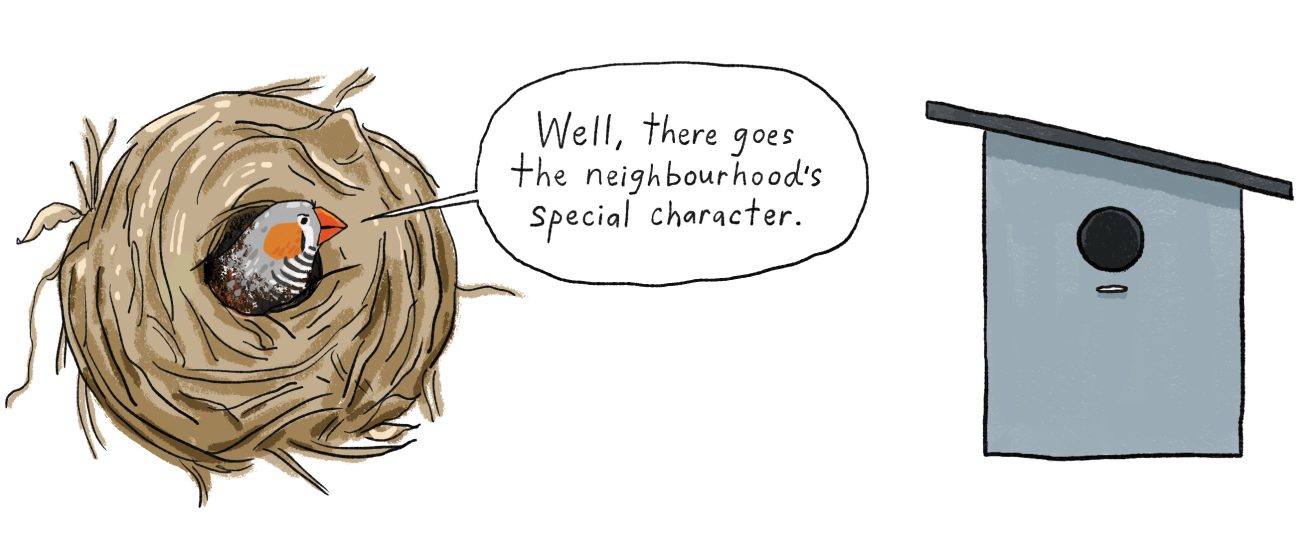
Fairy-lights and fairy terns aside, animals do infuse their homes with personal taste. Zebra finches make different nest shapes depending on, as far as we can tell, their own inclination. And University of Otago senior lecturer Jenny Jandt is regularly surprised by how different wasp nests are when given access to the same resources.
Jandt moved from the US to New Zealand precisely because we have so many wasps. Too many wasps. She finds wasps fascinating, admirable, delightful, and impressive, though she knows it’s a hard sell (the existence of parasitic wasps upset Darwin to such an extent that he doubted his belief in God).
Once, Jandt gave her captive paper wasps coloured cardboard—a different colour each day—in the hope of demonstrating how their nests are constructed. One wasp produced a nest of rainbow stripes, showing how each day’s effort corresponded to a thin layer of nest wall. But other wasps in her lab refused to build nests. “When we look at a colony we see all of these individuals and we just kind of blur them and imagine them as all clones of each other,” she says. “Even though, in some cases, they may be genetically identical to one another, behaviourally they’re very distinct. Within a nest you’re going to have individual preferences for what type of pulp they’re going to visit.”
Jandt says no one should attempt to remove a wasp nest without proper training, but anyone in Dunedin who has unwanted wasp neighbours can notify her (email wasp.nest@otago.ac.nz). If Jandt is in need of nests for research, she’ll collect them.
In fact, excavating nests might be her favourite part of the job: that glimpse into an other-than-human city. “One of the things I love the most about studying insects is that you can peek into a bush or a shrub or under a rock and discover a whole world. It’s almost like this whole living, breathing city underground.”
More by Rebekah White
More by Kay Lawson
Subscribe to our free newsletter for news and prizes
3
$1 trial for two weeks, thereafter $8.50 every two months, cancel any time
Signed in as . Sign out