


Some of the most powerful moments in this job are when I open up a new gallery a photographer has sent in. It’s a story on screen, right in your face—gorgeous, gutting, often both at once.
See: everything shot by Lottie Hedley, especially her warm, disciplined set on marching teams, published in Issue 193, and her work documenting the heartbreaking cyclone clean-up in Hawke’s Bay, in Issue 186. See: everything shot by Richard Robinson, most recently the feature about Tokelau, or chasing hāpuku in Fiordland. It is deeply unreasonable, as I told him recently, to point a photographer at a few muddy footprints and expect them to come back with magic. But check out the feature he shot on moa prints.
The value of photojournalists extends far beyond the page. At this magazine, photographers drive our stories just as much as the writers do: often it’s the photographer who finds the angle that sings, or the people who turn out to be vibrant main characters.
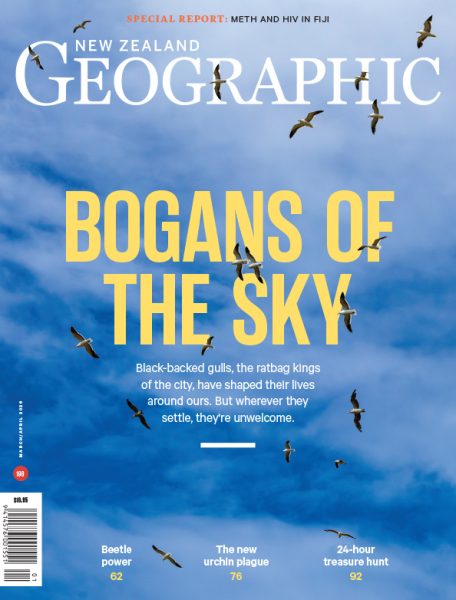
Occasionally, a photographer just turns up with a complete set of images so terrific they demand words to go with—that’s how our cover story, on lightstruck seabirds, happened this time. (See page 36—and thank you, Simon Runting.) It is a gift, for a writer tackling a big story, to have a photographer invested in the nuance, too.
When I was a cub reporter at the Hawke’s Bay Today and Herald on Sunday, it was the photographers who taught me how to tell stories. Every job I was sent out on—a fatal car crash, a golden wedding anniversary, an A&P show—the photographer beside me had been shooting a version of it for decades. He’d know the cops and the backroads and every base that needed covering; he’d pep talk me on the way, deploy chirpy chit-chat during awkward interviews, help me figure out the best angle on the drive back to the newsroom. (I am saying “he” because they were almost all men.)
On the roughest jobs I’d be shaking before knocking on a door; photographers are made out to be a callous breed but I suspect as a collective they’ve been the shoulder to cry on for every journalist in the country. The best ones know to keep tissues and biscuits in the glovebox.
All of this was normal. It was just how writers got good. The number of times I have been saved by a photographer jumping in and asking the obvious question! (This does not run both ways. Only recently, two decades into this work, have I felt that I know enough about pictures to be able to nudge the photographer and say, ‘Hey, would that make a good photo?’)
The past 10 years have been devastating for press photography. All over the world photojournalists have been cut from newspapers, their images replaced by stock photos, reporters’ snapshots and free tat from social media. Flicking through newspapers and websites now, I register these pictures as absences—an opportunity for better storytelling, lost. It’s not just the images that have been ditched, but the teaching, the nous, the institutional knowledge.
One of the big pulls of New Zealand Geographic was the opportunity to work closely with photographers again, both in the field and in putting stories together. Some of those who showed me the ropes now shoot for this magazine; others are regularly named finalists in our Photographer of the Year competition. I’m always chuffed to see their names come up—glad that at least some are still in the job, still documenting those moments that need more than words.
I have never worked with Iain McGregor, the career photojournalist who took the top prize this time, but we could not look away from his images. In these days of chaos and conflict, of so many meaningful stories waiting to happen, long live the photojournalist.
More by Catherine Woulfe