



From fossils to boulders, heritage precincts to glacial moraines, the Waitaki Whitestone Geopark rocks.
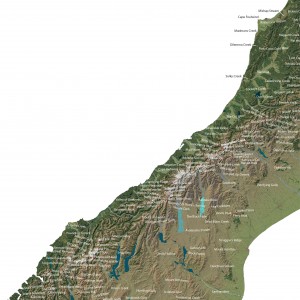
Situated on the east coast of the South Island and straddling the line of the 45th parallel South, Waitaki is bordered by mountains and sea. The Waitaki Whitestone UNESCO Global Geopark spans the entire district and showcases the geological forces that created the landscapes we see today.
Ancient volcanoes and eroded sea floors reveal evidence of prehistoric marine sea creatures, and glacial carved valleys tell the story of the formation of the continent of Te Riu-a-Māui/Zealandia.
According to one Kāi Tahu tradition, the land was formed when a great waka overturned, captained by the ancestor Aoraki and his brothers. The waka became Te Waka o Aoraki—the South Island. The brothers became the highest peaks of Kā Tiritiri o te Moana, the Southern Alps, which retain their names today.
Kāi Tahu found an ara tawhito (traditional travel route) along the Waitaki River where it became home to kāika nohoaka (seasonal settlements) and kāika mahika kai (food-gathering sites).
In the 1860s and 1870s, Victorian settlers set up shop in Ōamaru and surrounding villages and constructed grand buildings out of limestone extracted from local quarries.
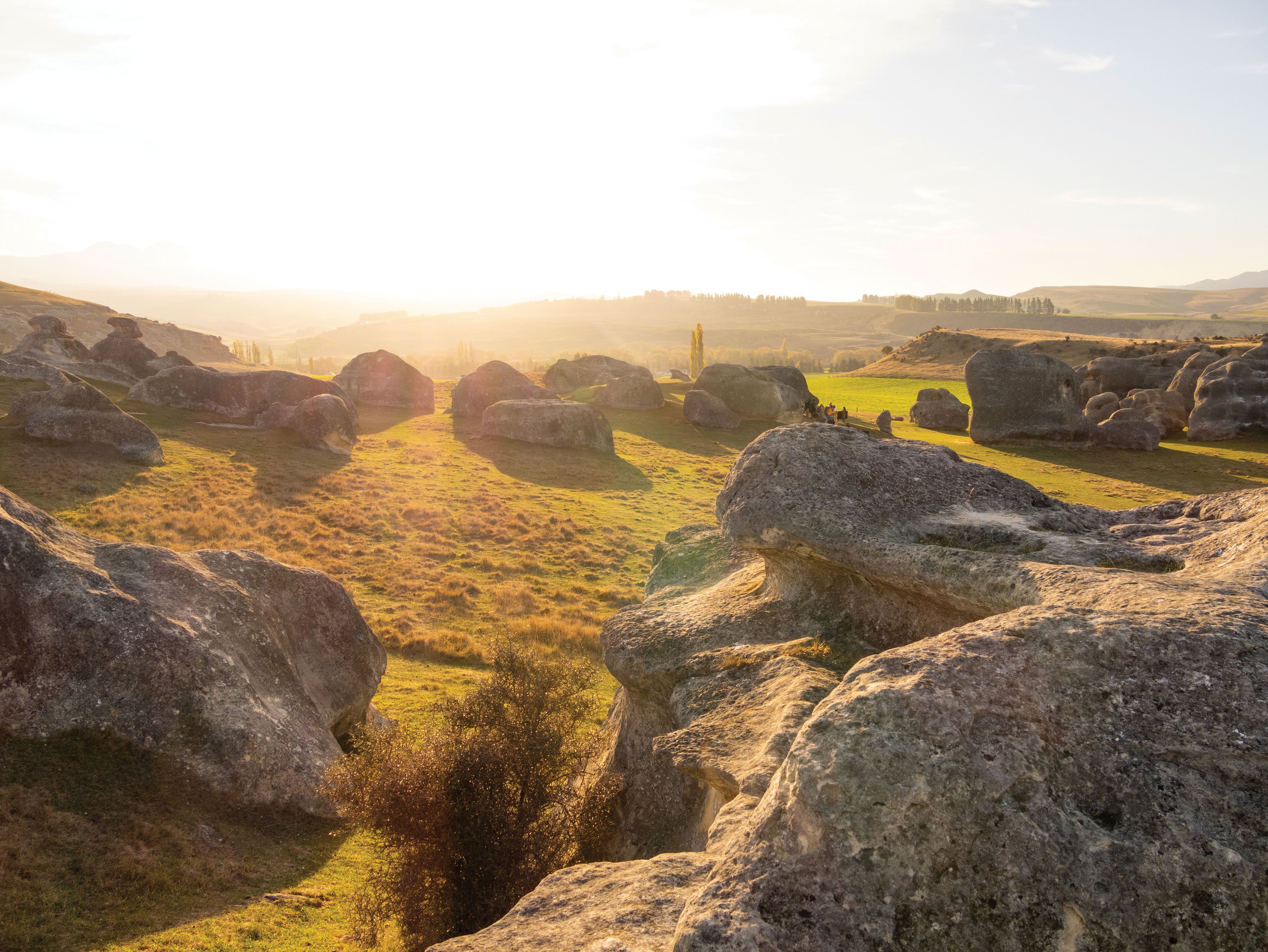
The Waitaki Whitestone UNESCO Global Geopark—the first and only place in the country to earn this moniker—has geological and geographical features unlike any others in New Zealand, from the giant Elephant Rocks to the Valley of the Whales and Moeraki Boulders.
Other sites of interest include the glacial moraines of Lake Ōhau, the ancient volcano of Palmerston, and the heritage precinct of Ōamaru.
Visitors can explore using the Geopark map and app or spend time reading the interpretation panels at many of the key Geopark sites. Users of the app are encouraged to dive into a selection of different itineraries tailored to their interests, including driving routes to take you to a variety of landmarks significant to the Geopark and the Waitaki story.
At Ōamaru Penguins, visitors can experience an interactive Storymapp Box and a new movie that tells the story of prehistoric penguins, the fossils of which have been found in the Geopark.
The Vanished World Centre, in Duntroon, is an easy drive from Elephant Rocks and Anatini. It houses an impressive display of fossils from the Geopark, as well as a dedicated space where visitors can dig for their own fossils from twenty-five-million-year-old limestone.
Nearby, visitors can discover Māori rock art sites at Takiroa and Maerewhenua. The limestone escarpments contain charcoal and ochre rock art that date back long before the arrival of Europeans.
Another geological drawcard is Te Kaihīnaki/Moeraki Boulders. These 60-million-year-old large concretions are culturally significant to Kāi Tahu whānui. In Kāi Tahu tradition, the giant spherical rocks are the round food baskets and hue (gourds) washed ashore from the famous Araiteuru waka.
“The Waitaki Whitestone UNESCO Global Geopark is dedicated to capturing and preserving our region’s geological and cultural history so that sites can be enjoyed and stories can be shared for generations to come,” says Lynley Browne, the General Manager of the UNESCO Geopark.
For more information, visit
www.whitestonegeopark.nz.
More by NZ Geographic