






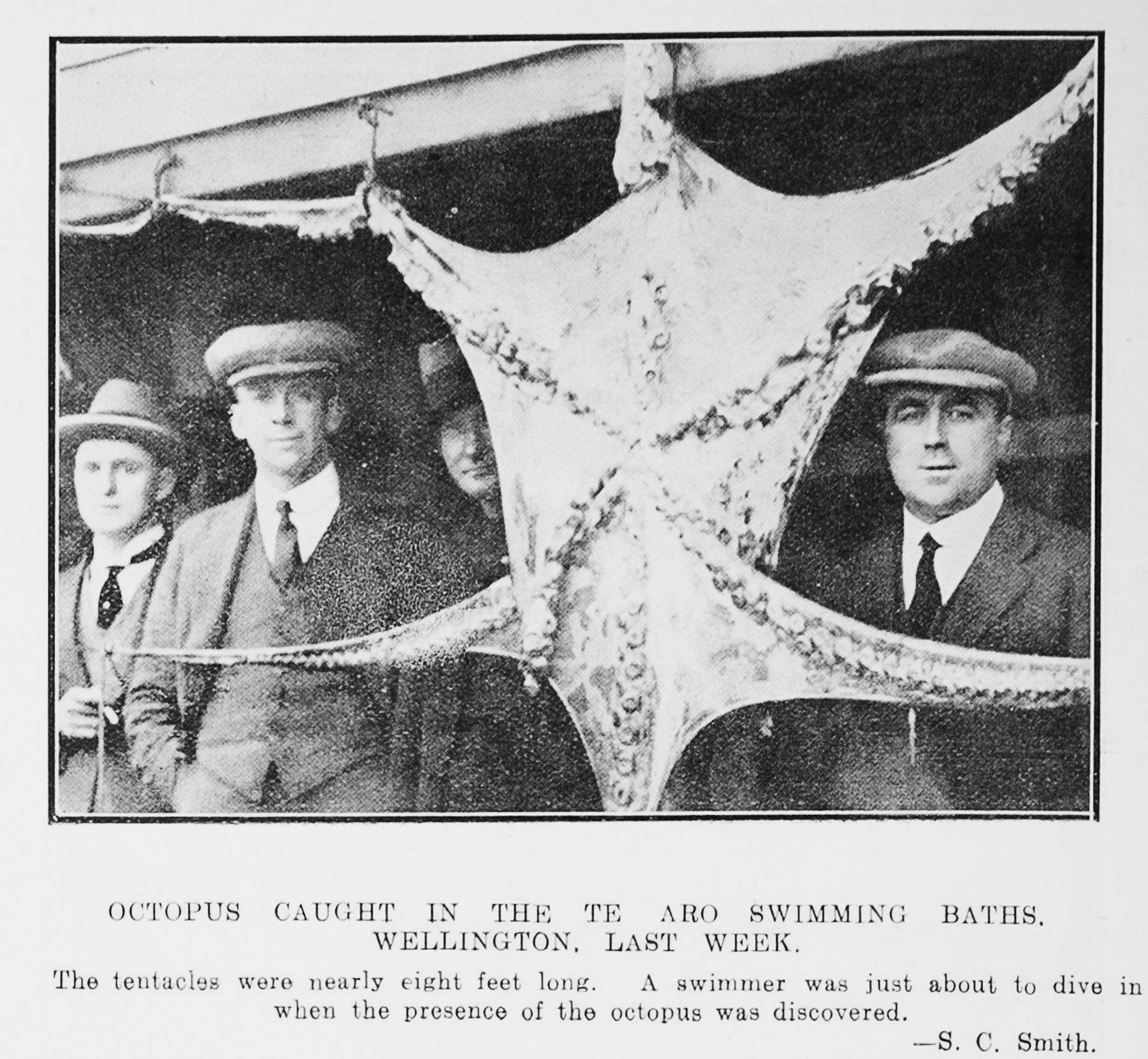
Man versus beast, in a public swimming pool.
On the morning of June 17, 1925, a certain Mr Horne—telegraph operator and “ardent swimmer”—was shivering on the diving platform at Te Aro Baths in Wellington’s Oriental Bay. As he teetered on the edge, about to leap, he happened to glance into the pool’s salty depths. Something was down there, “writhing and squirming about on the bottom of the baths”, as the papers later reported.
Regaining his balance, Horne peered from the platform. There, swimming lazily like it owned the place, was a gigantic octopus.
Horne went to get the caretaker, and the two men set out in a punt, armed with a forked pole and a boathook.
It was a “ticklish and difficult job”, the Otago Daily Times’ Wellington correspondent reported, but the pair eventually managed to impale the animal, haul it poolside, lop off two six-foot tentacles, and finally kill it.
They strung the octopus up on a changing shed, and reckoned it was perhaps 17-18 feet in diameter—about five metres tentacle tip to tentacle tip—and the body alone was so large, the ODT said, that “a sheet of a daily newspaper would not cover it”.
The adventure made the news all over the country. The killing was celebrated and the unfortunate animal variously maligned as a “devilfish”, “ugly monster”, or “hideous brute”, entirely unwelcome in a public swimming pool.
Te Aro Baths no longer exist—a storm carried part of the structure out to sea in the 1960s, and the (indoor, freshwater) Freyberg Pool and Fitness Centre now sits on the reclaimed site. But a century ago, the baths—separated into men’s and women’s pools—simply enclosed part of the harbour, with iron grids and a two-inch mesh theoretically keeping nature at arm’s length. “The baths are securely protected from the visits of sea monsters,” swimmers were promised in 1897. (Still, cleaners in the 1930s caught kahawai, spotties, and a large moki in the baths, which presumably entered as juveniles through the mesh and were trapped as they grew.)
In 1925, people were mystified as to how such a large octopus could have invaded the swimming spot. Did it climb over the high walls? Did it wash over in a storm, or was there a hole somewhere? How could it have squeezed that huge body through such narrow mesh?
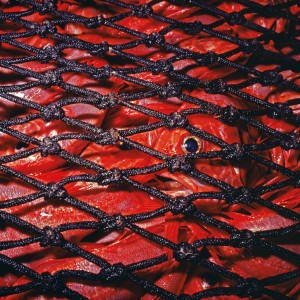
We now know that octopuses can steal through any gap smaller than their only hard part, their beak. In 2016, “Inky” escaped from Napier’s National Aquarium into Hawke Bay—it’s thought he climbed out of his tank, crawled across the floor and slipped into a drainpipe. Other octopuses have been filmed compressing themselves through holes the size of coins. The Northern Hemisphere’s giant Pacific octopus, which can reach more than six metres across, has a beak the size of a human palm—almost small enough to get through a five-centimetre mesh.
The Te Aro “brute” was probably a common reef octopus or wheke. The largest inshore octopod in Australasia, a few individuals have been recorded reaching two metres in length from mantle top to tentacle tip—roughly the size of the Wellington specimen, allowing for the traditional exaggeration of fishermen.
Today, awed by their intelligence, blue blood, nine brains, and colour-changing camouflage, we no longer think of octopuses as monsters. Were one to appear in a pool today, it might get a rather different reception.
Or perhaps not. Where we once used the language of fear and mythology to justify hunting octopuses, we now speak of rights and economics. Killing an octopus recreationally remains entirely legal. There are no size or method restrictions when it comes to wheke—you can catch up to 50 of them in a day if you like, and pose as proudly as Horne and co a century ago.
More by Kate Evans