Why stick with being male or female your whole life when you could have a go at both? (more…)
More by Rebekah White
More by Kay Lawson



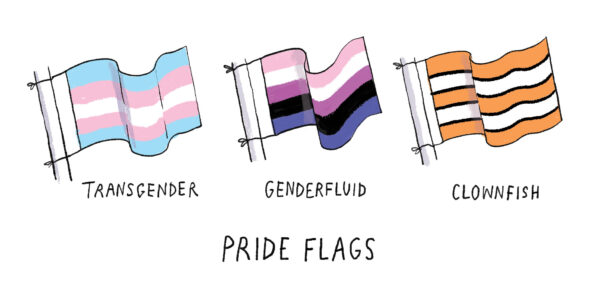
At the beginning of the animated film Finding Nemo, two clownfish parents, Marlin and Coral, are living happily in a sea anemone. Coral has just laid hundreds of eggs, and the couple are looking forward to welcoming hundreds of baby clownfish. Then a barracuda attacks. Coral vanishes and all their eggs are destroyed—except for one, which Marlin is left to raise alone.
It hatches—it’s a boy! Of course it’s a boy. All clownfish begin life as male. And in real life, this solo-parenting set-up would play out quite differently. Upon Coral’s death, Marlin would promptly switch sex and become Nemo’s mum.
Clownfish form monogamous pairs to breed, but if something happens to the female, the male will change sex and assume her role (Coral herself must have switched earlier in her life). So, Marlin would become Marlina, and Nemo might grow up to switch sex, too, perhaps even lay some eggs of his own. Clownfish really do have it all—they can be both mum and dad, depending on the whims of passing barracuda.
*
For hundreds of species, most of them under water, it’s simply common sense to switch sex partway through life. Some, like clownfish, swap when there’s a gap in the social order. Others switch when they get to a certain size, when they’re looking for a mate, when the weather is hot, when the environment is polluted, or when they’re stressed. Among the 500-odd marine species known to change from male to female, or vice versa, are oysters, limpets, corals, gobies, wrasse, shrimp, angelfish, starfish and scallops. Several species don’t decide on a sex at all until they grow up, like eels.
(I’m going to use the word “sex” rather than “gender” because they have different meanings. “Sex” refers to whether you’re male, female, both, or neither. “Gender” refers to all the cultural expectations around how you behave based on your sex.)
Some plants also swap sex. They might grow male reproductive organs—male flowers—one week, then female flowers a few weeks later. One recent study of a sex-changing tree, the striped maple, found that being mean to it—aggressively damaging it by cutting branches off—made it turn female. Let’s not linger on plants, though: they’re all over the place sex-wise. Many produce male and female flowers at the same time, just to keep their options open.
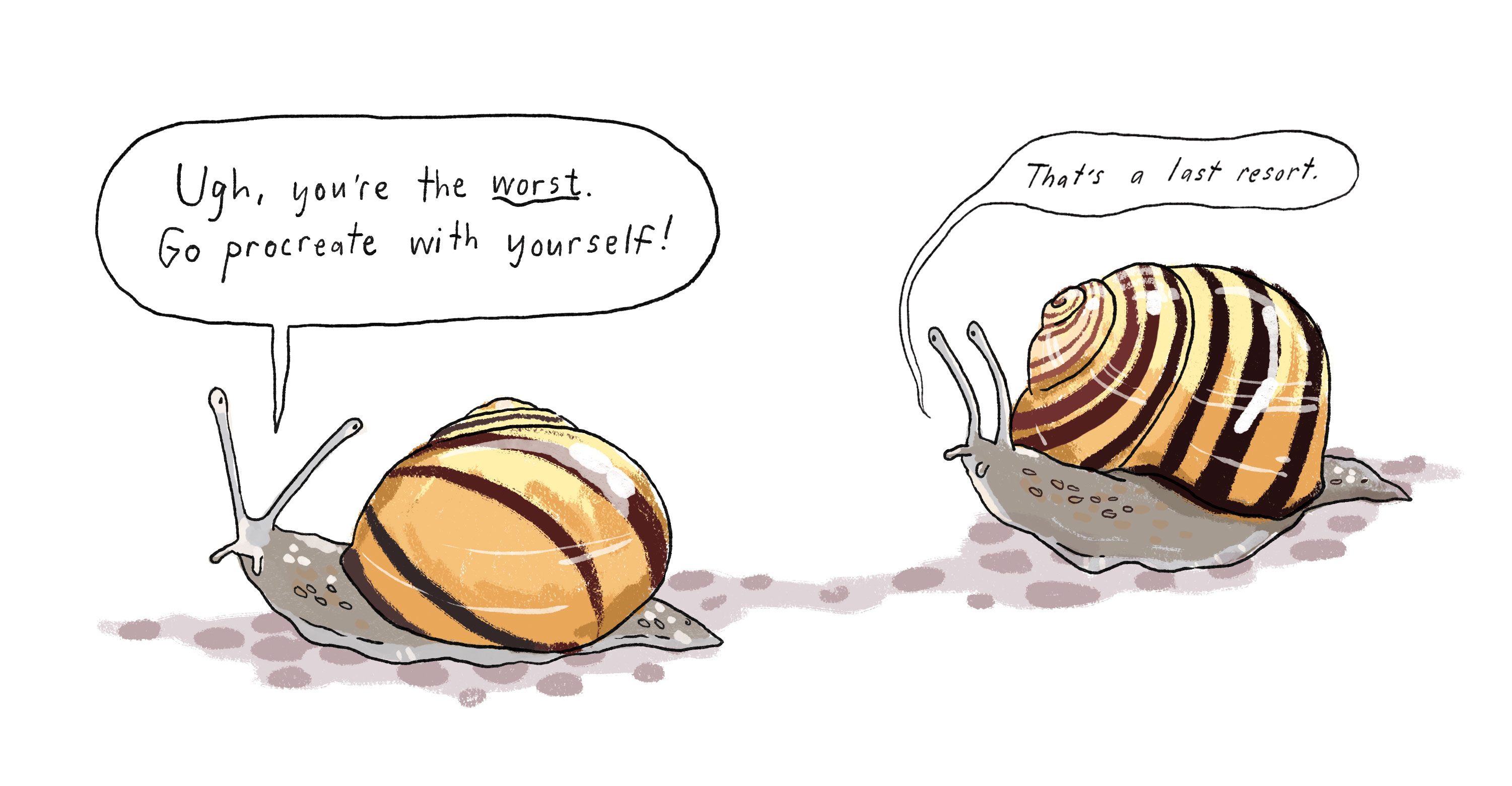
Species that have both male and female reproductive organs at the same time are called hermaphrodites, and some branches of the animal kingdom have gone all-in on this approach: all earthworms are hermaphrodites, and so are all slugs, many snails, and many other worms. Yes, it means they can mate with themselves, but that’s always a last resort: they usually try to find a partner. Sometimes, both partners leave the encounter pregnant, but not always: pregnancy costs a lot of energy, so most species would rather just supply the sperm, thanks. That’s why flatworms compete for the role of inseminator by fighting each other with their penises.
But back to fish. How do they swap over? And, more importantly, why?
*
Growing up in the Hutt Valley, Neil Gemmell would cycle to the wharf at Days Bay and spend hours fishing for kahawai, tarakihi, snapper. Something worth putting on the table. What he caught were spotties. Drab little fish. Back home, he’d devour books about the underwater world, and dream of joining oceanographer Jacques Cousteau on his research vessel Calypso. Spotties weren’t much to look at compared to the fish in Cousteau’s documentaries—they were greenish-brown, with black splotches. But then Gemmell read something super weird about them. Spotties could change sex partway through life, females transforming into males. It blew his mind. It still does. “This ubiquitous little fish that most kids are catching off of wharves and not really appreciating does something quite extraordinary in terms of its biology,” he says.
Later in life, when Gemmell received funding to start his own genomics research lab at the University of Otago, he decided to pick up the question of how fish swap sex. He started by studying one of the world’s best-known sex-changers, Caribbean bluehead wrasse.
These tropical fish usually start life as females, and develop bright-yellow backs and white bellies. Until they decide to change sex. The first sign this is happening is that a female’s behaviour becomes more aggressive. Within days, her ovaries have degraded and transformed into testes, and after a couple of weeks, she starts to change colour, developing the distinctive blue head and black-and-white stripe that the species is famous for. “It’s amazingly fast,” says Gemmell. “This is a whole-body degradation and then regeneration of a tissue. Imagine if we cut ourselves; how long does that cut take to heal?”
But how does a female know when to switch sex? It all depends on the dominant male vanishing. If he’s no longer in sight, a female will immediately begin to transition.
Gemmell and his team wanted to figure out which gene was responsible for the wrasse’s sex change. Where was it programmed? It was a gruesome process: they dissected bluehead wrasse at each stage of their transformation and meticulously catalogued every change that was occurring. But it worked. “We figured out that there’s this key trigger, there’s a gene called aromatase,” says Gemmell. “It basically breaks down oestrogen and makes it into testosterone. What turns aromatase on, we’re still trying to figure out. We’ve got some ideas.”
Trouble is, it’s not possible to keep Caribbean bluehead wrasse in tanks—you have to observe them in the wild. And they flip sex so quickly that it’s easy to miss the different stages.
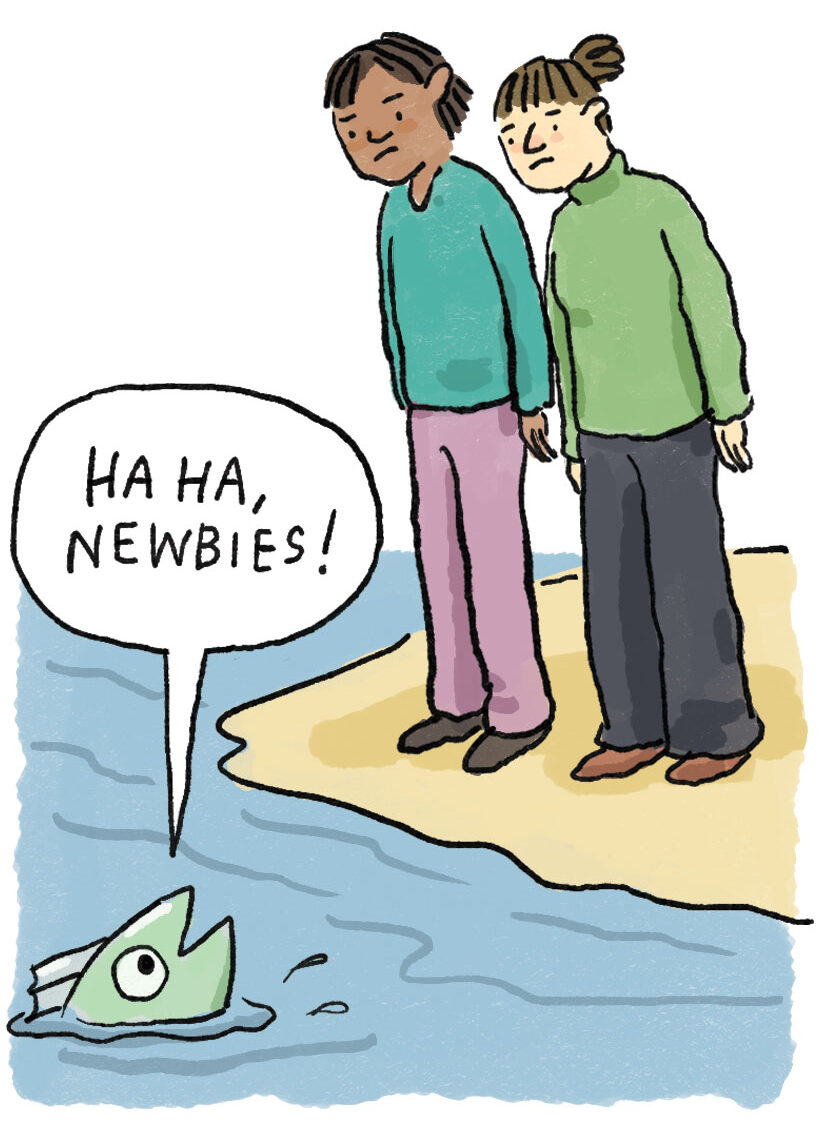
Gemmell realised he had a fish right at home that he could study instead: spotties. You could keep them in a lab in Tauranga, as opposed to in coastal waters near Belize. And they change sex across months rather than weeks.
Gemmell and others are still untangling what’s happening in spotties’ brains, but PhD student Haylee Quertermous recently spent a lot of time watching them to figure out how a group of females determine which of them gets to change sex. Quertermous found that when the top fish disappeared, the second-place spotty wasted no time showing the others that she was their new boss. Within minutes, her behaviour became more aggressive: she began charging at the other fish, forcing them to swim away. “I was really surprised with how fast some of them changed their behaviour,” says Quertermous. “It was pretty crazy to see.”
*
It’s actually surprising that more fish don’t swap sex, concluded one group of scientists. In evolutionary terms, changing sex doesn’t cost much, and the benefits are massive: more chances to have offspring. That’s because it’s more useful to be male or female at different life stages, depending on what type of fish you are.
For some fish, it’s better to be female when they’re bigger, because they have more energy and resources for producing eggs, which are much larger than sperm. For other species, it’s better to be male when they’re bigger, because they need to compete for a mate. Either way, if you get to play both sides of the field, you might end up with more heirs than if you’re stuck with one sex for your entire life.
Why don’t mammals change sex, if it’s so great? One theory is simply that fish have had longer to figure it out. They’ve been on the planet for 500 million years, compared to mammals’ 200 million—twice as long to get weird.
Also, whether an animal can change sex depends a lot on what determines its sex in the first place.
For humans (and other mammals), our sex is decided by our sex chromosomes, which are strings of coiled-up DNA. There are two sex chromosomes in every cell of your body. One is always an X. If the other is also an X, you probably have female reproductive organs. But if it’s a Y, then you’ve got a set of genetic instructions that programme your body to develop male features instead. (A very small number of people have three sex chromosomes. Or just one. Or a mix—some of their cells might have XX and others XY. These people are intersex.)
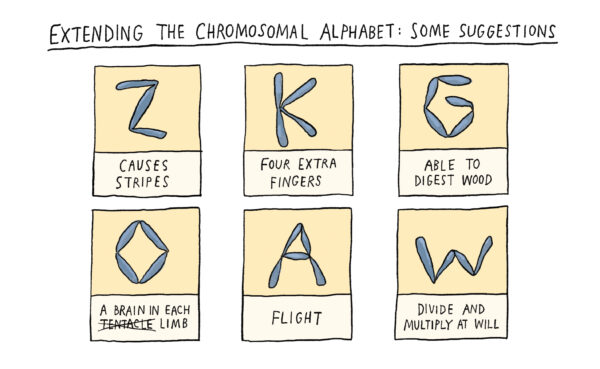
Caribbean bluehead wrasse, like most fish, don’t have sex chromosomes. Instead, they hatch with cells that can become either male or female. Other fish, such as gobies, which switch back and forth, hang on to both sets of cells.
Even so, sex chromosomes aren’t destiny, and it’s possible to overwrite their programming. Frogs have sex chromosomes, but in 2015, researchers found that male tadpoles living in highly polluted ponds in the US often developed into females. This is called sex reversal: even though a frog’s chromosomes have programmed it to be male, something has triggered it to grow female gonads instead. Synthetic chemicals are one reason this may happen: ponds laced with the herbicide atrazine tend to have more female than male frogs, even if there’s only a minuscule amount of it in the water. In August, Australian researchers announced that up to six per cent of the wild magpies, kookaburras, lorikeets and pigeons they’d been studying looked like one sex but had the genes of another. Almost all of the flipped birds were genetically female, but had male reproductive organs. The researchers think this might be driven by elevated stress or endocrine-disrupting chemicals in the environment.
But such reversals may also be a natural phenomenon, as happens in other animals which are known to reverse sex without chemical triggers. Chickens, for example: if a hen’s egg-producing ovary is damaged, she’ll start acting like a rooster, crowing and standing taller. She’ll even develop a comb and wattles.
Australian bearded dragons flip their sex in response to temperature. Bearded-dragon eggs contain embryos programmed by sex chromosomes to be male or female, but in very hot conditions, male eggs will develop into females. In 2015, evolutionary biologist Clare Holleley found that these revamped females laid more eggs than genetically female dragons.
“So, in a way,” Holleley said at the time, “one could actually argue that dad lizards made better mums.”
*
Temperature is a pretty big factor in determining sex for several reptile species. Tuatara, for instance: they don’t have sex chromosomes, but rather, the temperature an egg is incubated at determines whether its embryo becomes male or female. (The average temperature, that is—tuatara eggs incubate for more than a year.) Warmer years produce male hatchlings, and that means climate change isn’t good news for population equity. Already, one of the 45 remaining tuatara populations around the country skews male, while a modelling paper from 2008 predicts the species’ functional extinction by the end of this century: the fatal version of too many mates, not enough dates.
For one population of green turtles that forage around the Great Barrier Reef, this has already happened—except for these turtles, heat means females. In some places, the sand has become so warm that 99.1 per cent of juvenile green turtles are female, according to a 2018 study. In fact, one of the biggest green turtle nesting sites on the planet has been producing only female turtles for the past couple of decades.
*
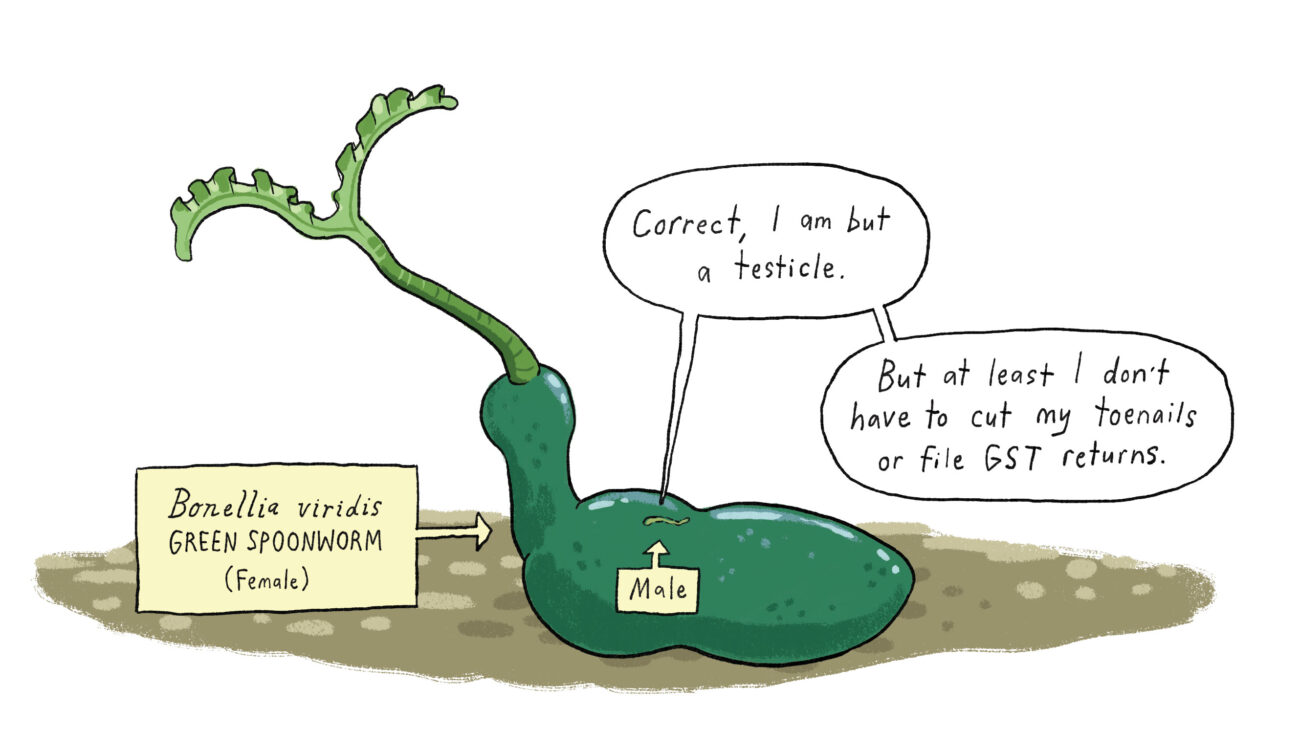
One animal, just to be completely bizarre, determines its sex by the first thing it touches. When a green spoonworm is a baby—or rather, a larva—it floats through the water column, looking for a home. It’s neither male nor female: just a blob. Its fate will be determined entirely by where it lands. If it strikes the seafloor, it will become female and burrow into the sand, leaving only a bulging green tentacle—actually its mouth—above ground to grab food as it floats by. It’s green due to a neurotoxin in its skin that it uses to stun prey. But this poison has another use: if another spoonworm larva lands on the female, that new larva reacts to the neurotoxin and becomes a male. He remains tiny—he’s nothing more than a “living testicle”, according to Trond Roger Oskars from Norway’s Møreforsking Research Institute—and is absorbed into her body.
*
Sometimes, animals just fake which sex they are. Some female white-necked Jacobin hummingbirds take on male hummingbird colours in order to avoid being harassed and chased away from nectar by the males. And some male cuttlefish adopt female colouration, also to avoid aggressive males. These molluscs can dramatically change the patterns and colours on their skin, and in 2012, behavioural ecologist Culum Brown from Sydney’s Macquarie University noticed a courting male displaying a “two-faced” look. On the side facing a female, it showed pulsating stripes, while the side facing another male displayed mottled camouflage, a more feminine look.
Brown was so surprised he went back through photographs of courting groups of cuttlefish. Almost half of the pictures contained a two-faced male cuttlefish—but only in circumstances where there was only one female and one other male. Perhaps the deception was too hard to maintain if there were more males, speculated Brown.
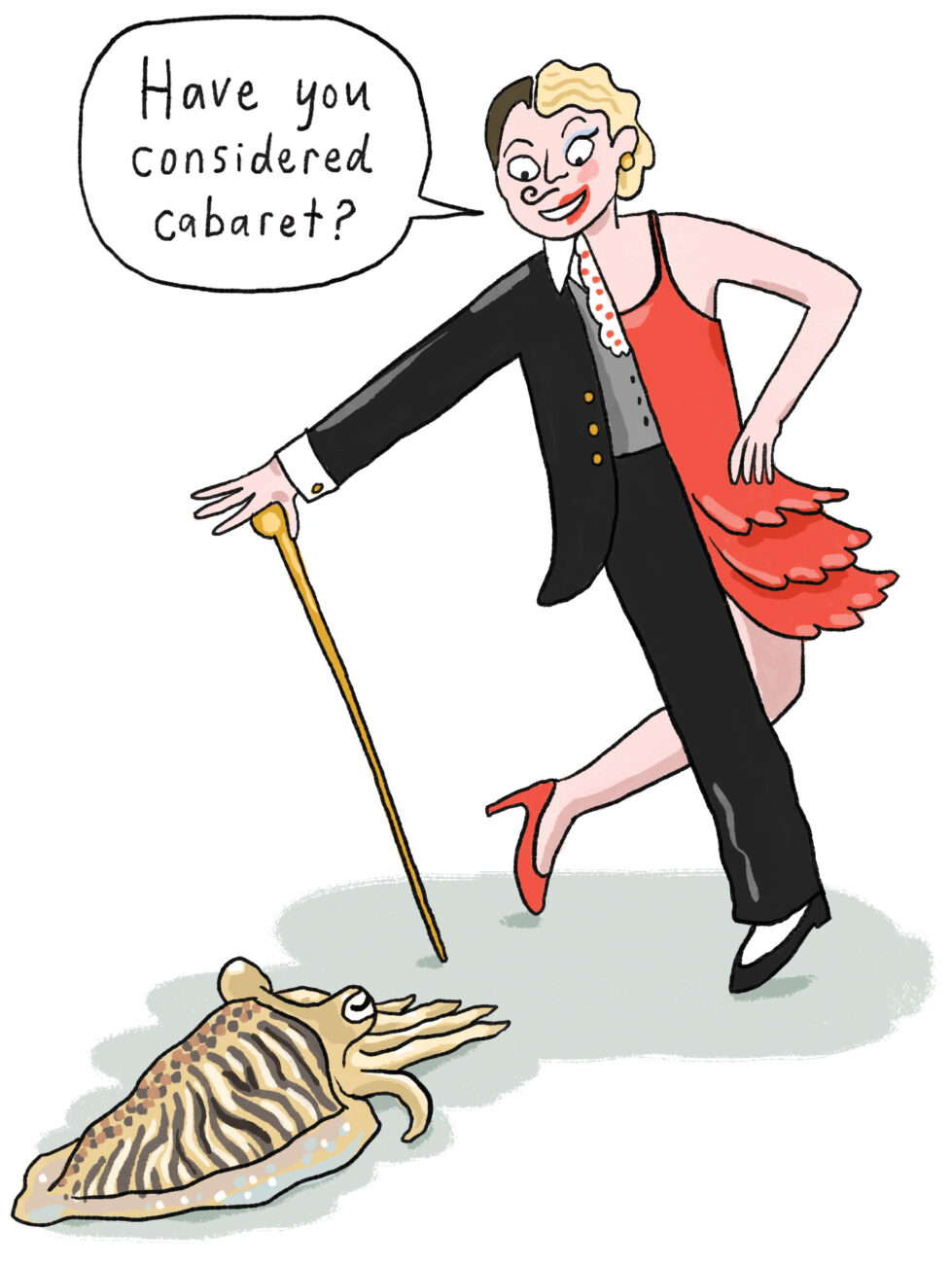
In a way, cuttlefish are mimicking a real phenomenon. Some animals are gynandromorphs—a rare mix-up of sex chromosomes resulting in animals that are half-female, half-male, as though a line has been drawn down their centre. It’s most obvious in species such as birds or butterflies where males and females look different: gynandromorph butterflies have differently coloured wings, while a bird may be one colour on its left side and a totally different colour on its right side. Pictures of gynandromorphs look computer-generated, as though someone has Photoshopped two animals together. The fact that they’re real is yet another reminder that the genetics of sex are strange, varied and full of exceptions to the norm.
More by Rebekah White
More by Kay Lawson
Subscribe to our free newsletter for news and prizes
3
$1 trial for two weeks, thereafter $8.50 every two months, cancel any time
Signed in as . Sign out