





Fifty-nine Christmases ago, 10-year-old Andrew Penniket unwrapped a snorkel, mask and flippers. It was a transformative gift. Now, in a memoir, Penniket recounts his adventure-filled career of underwater cinematography—and makes a passionate case for marine conservation.
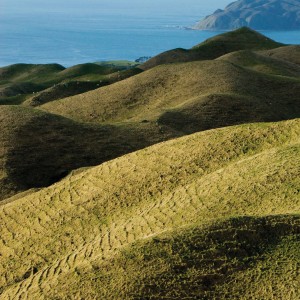
Andrew Penniket was brought up on a farm at Algies Bay, part of the convoluted Hauraki Gulf/Tīkapa Moana shoreline, and Goat Island Bay lay just to the north, where the gulf ended and the coast straightened against the open sea.
His earliest memories are of a wild sea that might throw treasures at his feet. His dad was a serious shell collector, and the Penniket family, togged out in oilskins and woolly hats, would search the beach in stormy weather, first to find whatever the sea might disgorge. His memoir Whales, Snails and Lobster Tales recalls vividly, too, the first time he snorkelled, in 1966 with his Christmas kit, at Tī Point. The “luxuriant kelps”. The “exotic-looking fish”. They were spotties, as he later learns, but no matter. “I was hooked from that very first moment.”
The following year, his dad drove north to discuss deep-sea shells with Wade and Jan Doak at Wellsford, and took Andrew along for the ride. The Doaks were pioneering scuba divers, and Wade was generating newspaper headlines, diving with Kelly Tarlton at the Three Kings Islands, surfacing with silver and gold coins from the 1902 wreck of Elingamite. This crew-cut god, Wade, who might, with a single encompassing glance, change your life.
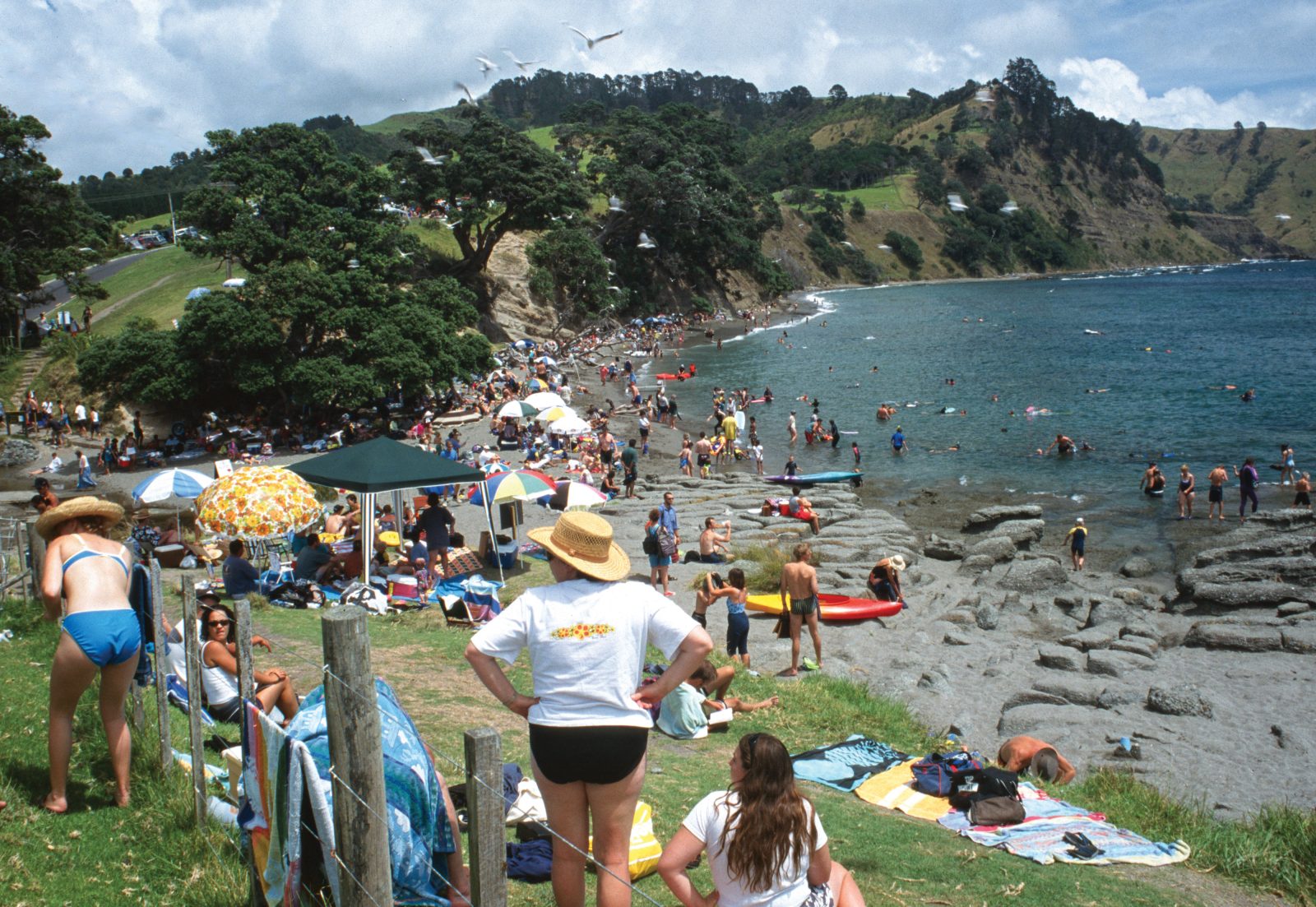
Seven years later, Andrew, now 17, waddles past the gawking beach population at Goat Island Bay, clad in the wetsuit, weight belt, and scuba gear he’s bought with his own cash from loading countless bales of hay onto truck-beds, and unloading the countless bales later into local barns. A home-made 10-pound leaden peace sign dangles from the centre of his weight belt as extra sinkage. He wades into the tide, takes his first sub-surface breath, watches baby goatfish and snapper rush away, then lies on the bottom, watching the underworld go by.
*
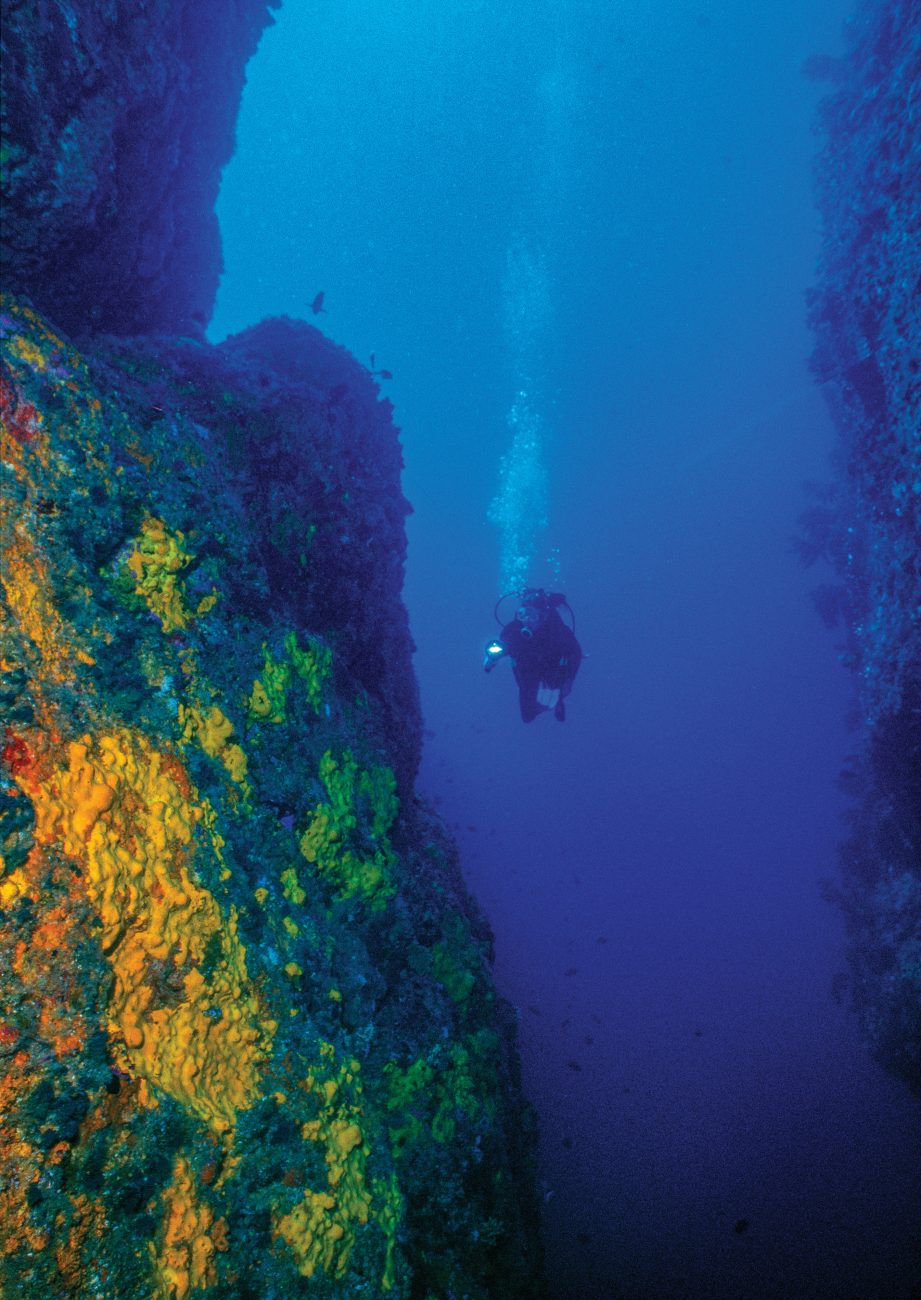
Andrew Penniket’s instinct was always to share. He first saw the undersea cliffs of the Poor Knights Islands falling away into the blue that same year, 1974, during the sea test for his scuba certification. “An intoxicating drug,” he writes, “hypnotic and entrancing, like mountains are to alpinists.” In subsequent dives Penniket will fin his way into the Northern Arch, entering an undersea cathedral 45 metres high, its walls a brilliant multi-coloured tapestry of filter-feeding animals—the wafting green bryozoans, the maroon fern-like crinoids, the reds and purples of gorgonian sea fans alongside yellow and orange sponges. Further out, highly coloured schools of subtropical fish patrol the great spaces of the nave, and cleaving through all of it like some weightless angel comes the scuba diver, flying. Taking pictures. Penniket needs to share this amazing world with friends and family, and he’s put away the speargun of his snorkelling childhood, and is carrying instead a Nikonos underwater camera.
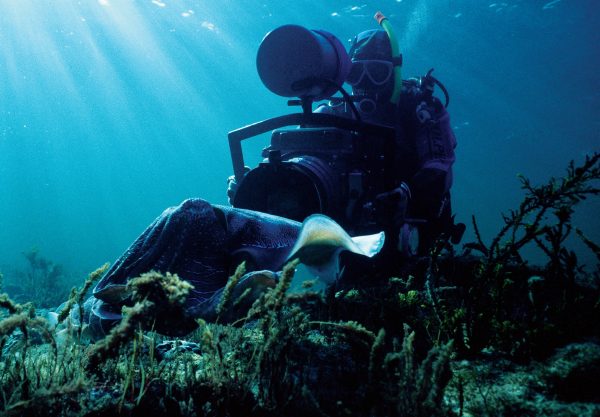
Ten years later, in 1984, Penniket is in Dunedin, holding a Swiss-made Bolex 16-millimetre movie camera with a Hugyfot underwater housing. Up north, the stretch of sea where he made his first dive has become New Zealand’s first marine reserve. The University of Auckland has built a lab on the cliff overlooking Goat Island Bay; Penniket has been helping out there.
He has completed a master’s degree in zoology and married Sue Bryant, also a master’s scholar, and the two have landed good science-oriented government jobs in Wellington. Their most recent annual holiday, though, has been spent helping the New Zealand Wildlife Service monitor kākāpō in rugged country on Rakiura/Stewart Island, and in 1983, they are offered jobs as researchers for TVNZ’s natural history unit.
Acceptance would entail a huge change for the couple—as well as the career swerve, they would be moving to Dunedin—but Penniket knows the Wild South documentary series will soon pivot from threatened bird species to marine animals. He sees a gap in the unit’s skill set, and feels the tug of a distant possibility.
There’s no job description at the unit for underwater cameraman, but he buys the Bolex and its housing himself, and quickly manages to scale up from researcher to gopher, odd-jobbing for ‘Snares—Gift of the Sea’, a 1984 documentary about the rugged islands 100 kilometres south-west of Bluff. Far from head office, where there’s prescribed specialist training for cameramen, union enforced, there’s nothing to stop the gopher, if not otherwise busy, slipping into his scuba gear and heading, Bolex to hand, for the shallow inlet where Snares crested penguins are building up speed for their deep-water entry. Much of the gopher’s 20 minutes of film will prove useless, but there’s sufficient footage to warrant his first credit: Underwater Photography by Andrew Penniket.
The next Wild South doco, ‘First Born’, explores the large fur seal colony at Taumaka, an island off the coast from Haast, and focuses on the seal pups learning to swim and feed. The documentary gets great reviews and Penniket knows his underwater footage has been critical to that success. He’s sure now he’s on the right path and that “I had in my hand a powerful, wonderful tool—my trusty Bolex camera, with which I could capture the beauty of the sea and communicate with millions of people”.
*
In 1986, he and Sue are in Leigh, the town closest to Goat Island, for a wedding celebration amidst friends from student days at the Auckland University Marine Lab. One of those friends, Alison MacDiarmid, takes him aside and says her research at what’s now popularly known as Goat Island marine reserve shows the big crayfish are back. She’s recording little-known behaviours of a wild cray population: big males actively fighting, crays venturing at night beyond the reef, not just carrion eaters, but active foragers of wild food, scooping up dog cockles and taking them back to their lairs as a work-on. Best of all, she’s expecting a September reef-edge spectacle of females “in berry”, who stand on their forelegs just before dawn, lift their tails high and shake loose onto the tide, 10,000-fold, their larvae.
Penniket realises he’s been gifted a documentary subject. Many people will remember the excitement of the cray fishery’s export bonanza of the late 1960s and 1970s, supplying crayfish tails to high-end restaurants in New York and San Francisco. A classic Kiwi boom-and-bust extractive cycle.
The film Penniket directs in 1986 includes footage of the boom years. Choppers lift crates of crays straight off the boats, and deliver them directly to busy production lines where tails are reamed off, cleaned, and tossed into bins for export. Time has turned the footage macabre. Later in the documentary, Penniket’s multiple night-time dives light up the armoured world of a protected cray kingdom going about its business—macabre, too, in its own way, but beautiful. A pivotal central sequence shows a female cray shedding her immense September load of larvae. That’s filmed, as the book tells you, within a research tank, but it’s highly dramatic nonetheless, and the first time it’s been filmed. (A decade later, Penniket and his team stake out Tāwharanui Marine Reserve and secure a world-first recording of the event in the wild.)
*
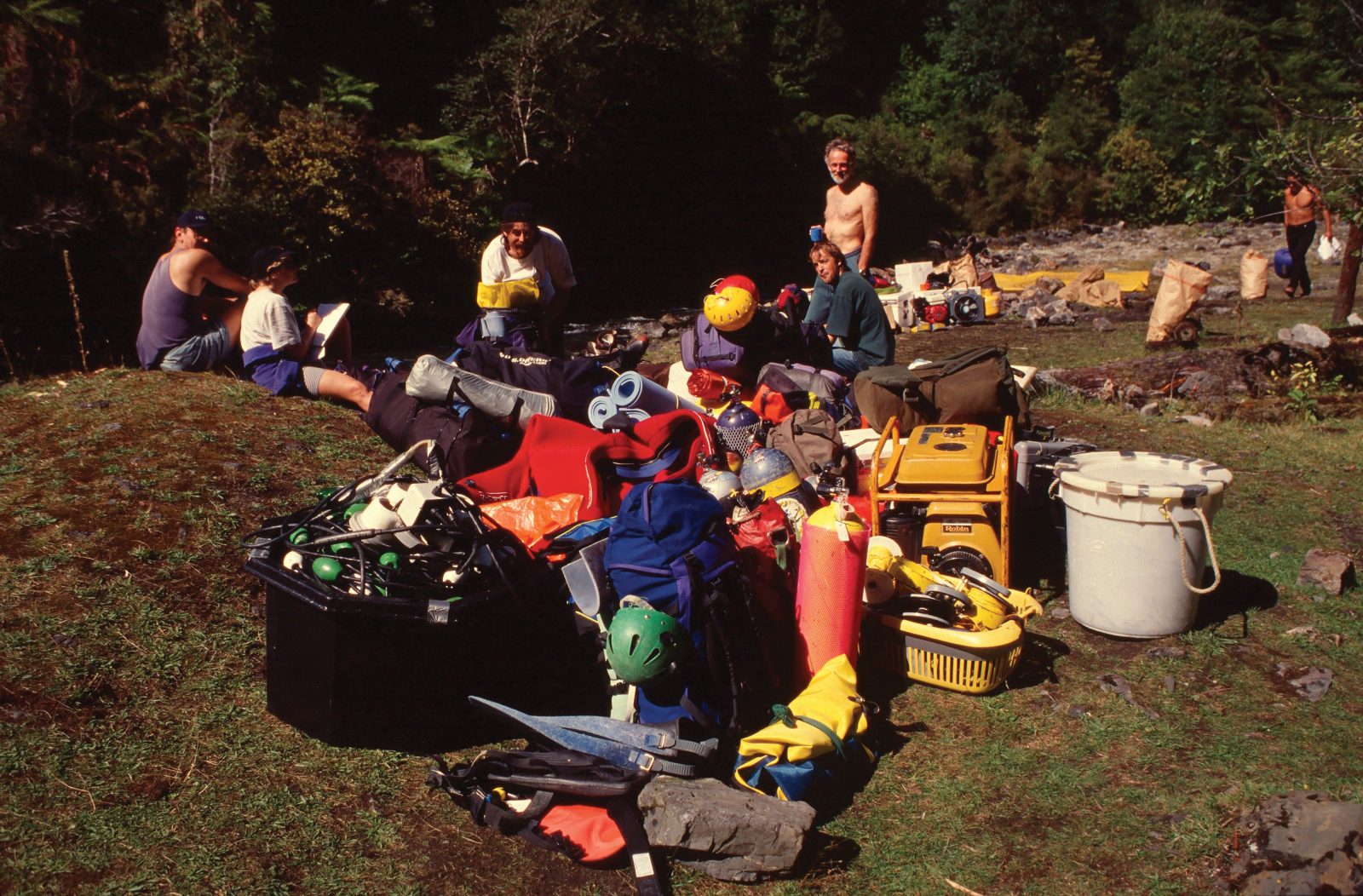
Tale of the Crayfish leads on to important contracts with overseas natural history broadcasters. Penniket’s TVNZ unit has by now been spun off as Natural History New Zealand Ltd and the new company gifts its employee the unspeakable luxury of an Arriflex 16-millimetre camera. He now has a 10-minute underwater filming capacity and, pushing the boundaries as ever, suggests the team takes the lead role for the first-ever documentary of undersea Antarctica.
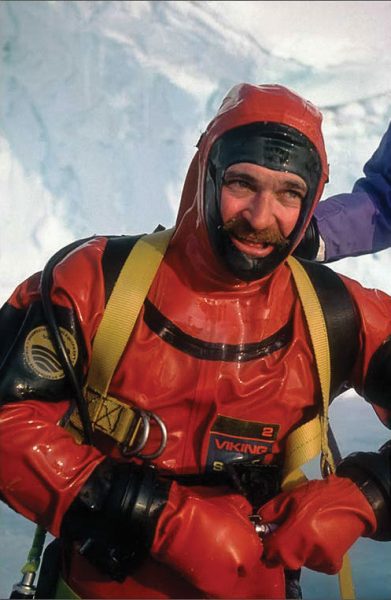
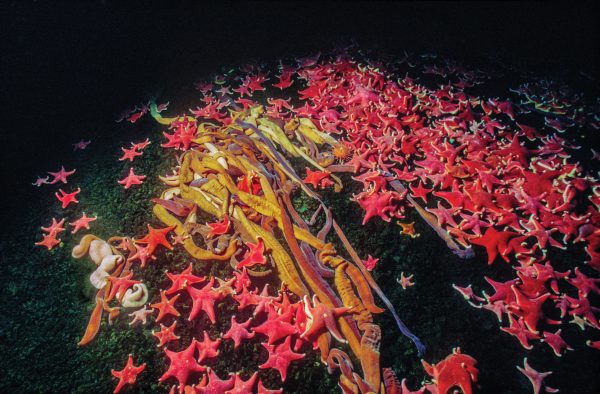
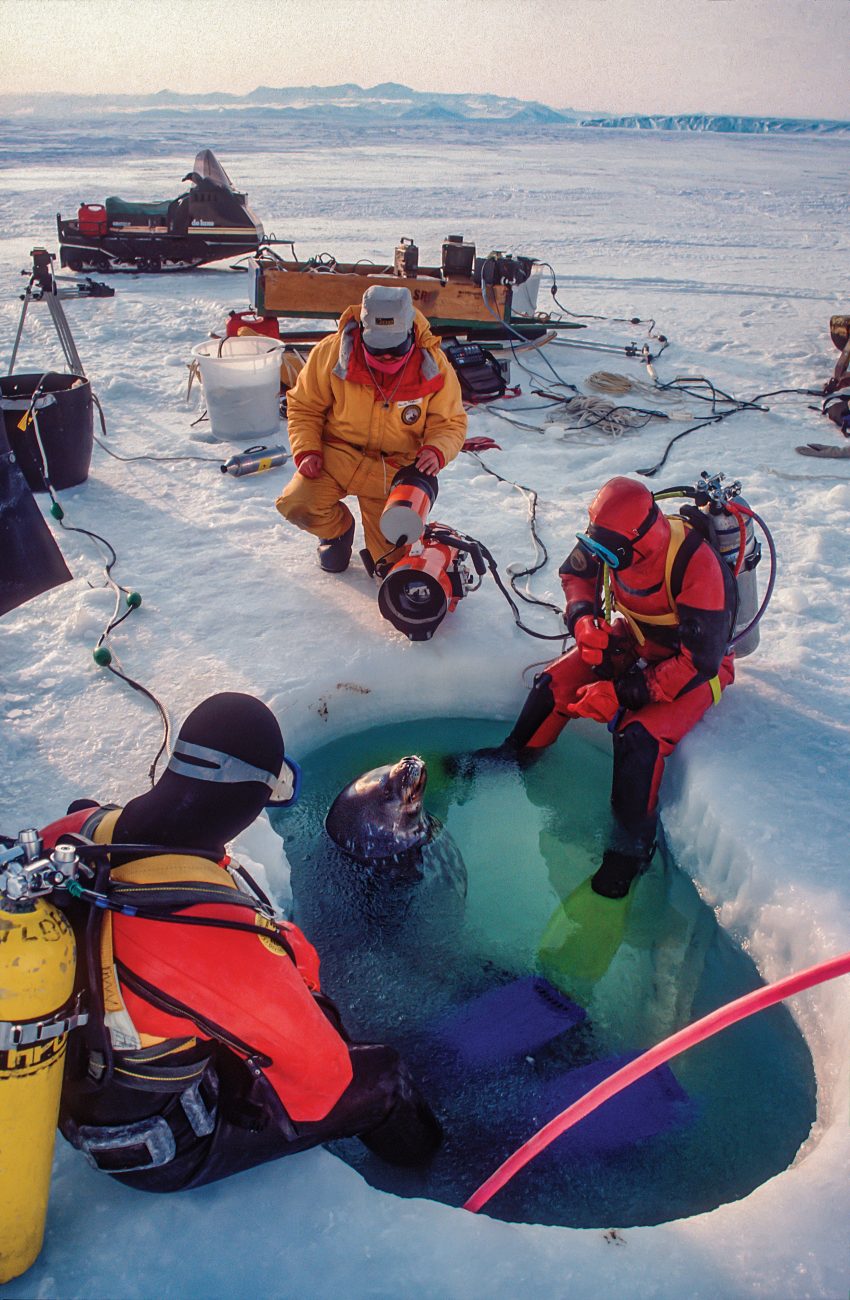
Penniket drops through a hole in the ice into the plankton-free Antarctic seas in late October 1987. He can see astonishingly far, maybe 200 metres, and writes of “flying through a huge building with no walls, to a floor which was crowded with sponges, soft corals and giant sea anemones”. Hand-sized sea lice creep along like giant fleas, and sea spiders the size of saucers are slow-walking the benthic zone “like the imperial walkers from Star Wars”. A huge building with an ice ceiling where Penniket, enterprising as always, can stand upright in his dry suit, and turn the inhabitants of the zone into a ceiling decoration.
More by Geoff Chapple
He visits Antarctica four times to help complete three separate documentaries. He makes more than 100 dives, including with Weddell seals, four-metre animals as round as barrels and so powerfully vocal that their click trains, directed at you when face to face underwater, will physically impact your chest.
The best of times, the worst of times. On his third trip to Antarctica in 1991, a dive under the ice below Mt Erebus yields unexpectedly beautiful soft corals and pretty hydroids. He stays under longer than planned, and fins back to the exit, but is stopped five metres short of the hole. His safety rope is entangled around a large brine stalactite 50 metres back. “Quietly” and “breathing as little as I could”, he goes back to untangle the line, and emerges finally with a “very low” tank pressure. The book is clinical in its description, but in an email, Penniket writes, “My scariest moment? Thinking back, it was in Antarctica when I couldn’t quite reach the exit hole and was nearly out of air. That was definitely not good.” Antarctica left him also with a legacy of circulation troubles in his fingers during sub-zero weather.
*
By the year 2000, Penniket is basically a freelancer, and the phone always rings. He’s the lead diver for the Australasian sections of three BBC series, The Blue Planet, then Planet Earth, and Life, all narrated by David Attenborough. He contracts with NHNZ again for its Our Big Blue Backyard series, filming at the Auckland Islands, Kaikōura and the Kermadecs.
It’s a great life, but Penniket went into documentary work expecting it might change people’s attitudes to the aquatic world. That hope, he tells me, was often stymied by television’s gatekeepers.
In 1993, his film Reef Fish—Where Have They All Gone? was an attempt to highlight New Zealand’s barren underwater reefs, crowded now not with fish but herds of kina, roaming starfish and octopuses. “The new underworld order,” as he described it to me, which moved in as the keystone predators—crays, blue cod and snapper—were fished out. TVNZ put it out on a Saturday afternoon against the attractions of cricket and the summer beach—“Hardly a soul saw it.”
The BBC was no different. Blue Planet’s last episode was titled ‘Deep Trouble’, and Penniket provided the images of protected reefs in the Philippines blown apart by dynamite fishing. He mimicked, with milk, the widespread criminal practice of squirting cyanide into reef water to catch more reef fish. The international aquarium market pays a premium for these highly coloured fish, and dodgy Philippine exporters serve the market with fish that look okay but may succumb to nerve damage later.
‘Deep Trouble’ was meant to cap the Blue Planet series but BBC producers headed it off, with a different time slot where the watching audience was low. Penniket enquired as to why, and was told it was a ratings decision, that “people don’t want to watch that stuff”.
“The viewing audience will see wonder and abundance,” he tells me. “They’ll see a shot of a marlin, but no-one is going to say it took two years for the cameraman to get the shot because there are hardly any marlin left.”
“Partly,” he tells me, “that was the motivation for the book—to say what we couldn’t say in the films.”
He wanted, as well, to celebrate the 50-year anniversary of the Goat Island marine reserve—that beloved patch of blue that he was watching rejuvenate, even as other areas declined. “As we came closer to that date, I made a big effort to finish the book off.”
*
Near the end of the book, he assesses the overall progress New Zealand has made in those five decades. As of 2025, New Zealand’s 44 marine reserves total 9.5 per cent of the country’s territorial sea—close to the long-held goal of conservationists that 10 per cent of the sea and its creatures should be protected as no-take reserves. (Scientists are now calling for 30 per cent by 2030.) But the percentage is misleading, Penniket writes, as all but a skerrick of the reserve area is located around remote island groups. Just 0.28 per cent of the sea along New Zealand’s mainland coast is fully protected.
No matter how we divide it up, there is no ringfencing the ocean from climate change or exotic interlopers. In 2024 Penniket headed back to the Poor Knights with his daughter Charlotte in tow. It was “a lovely dive”, he writes. Charlotte enjoyed it. “But just quietly, I was shocked at the change.” The kelp was all but gone, eaten by big subtropical urchins Centrostephanus rodgersii*. There were fewer little fish. He watched one large snapper cruise the bottom. This was a marine reserve of 40 years’ standing. He came away dismayed.
But he also knows there is reason to hope. In October 2025, new legislation created 19 new marine protection zones in the Hauraki Gulf, and almost quadrupled the size of the marine reserve at Goat Island.
Andrew recently went back to this home patch of sea, and borrowed some dive gear from Jan and Wade Doak’s son Brady. The ravenous crowds of kina were gone, replaced by kelp. There were red moki everywhere. A handful of crays, where previously there were none at all. “I made the mistake of turning over a rock,” he writes, “and was pushed aside by a frenzy of snapper eager for whatever might be underneath.” Visibility was great—eight to 10 metres—and what he could see, after a lifetime of watching decline, was a comeback.