




For a fleeting spell each winter, ponds and dams across Central Otago freeze—and the chase for wild ice begins.
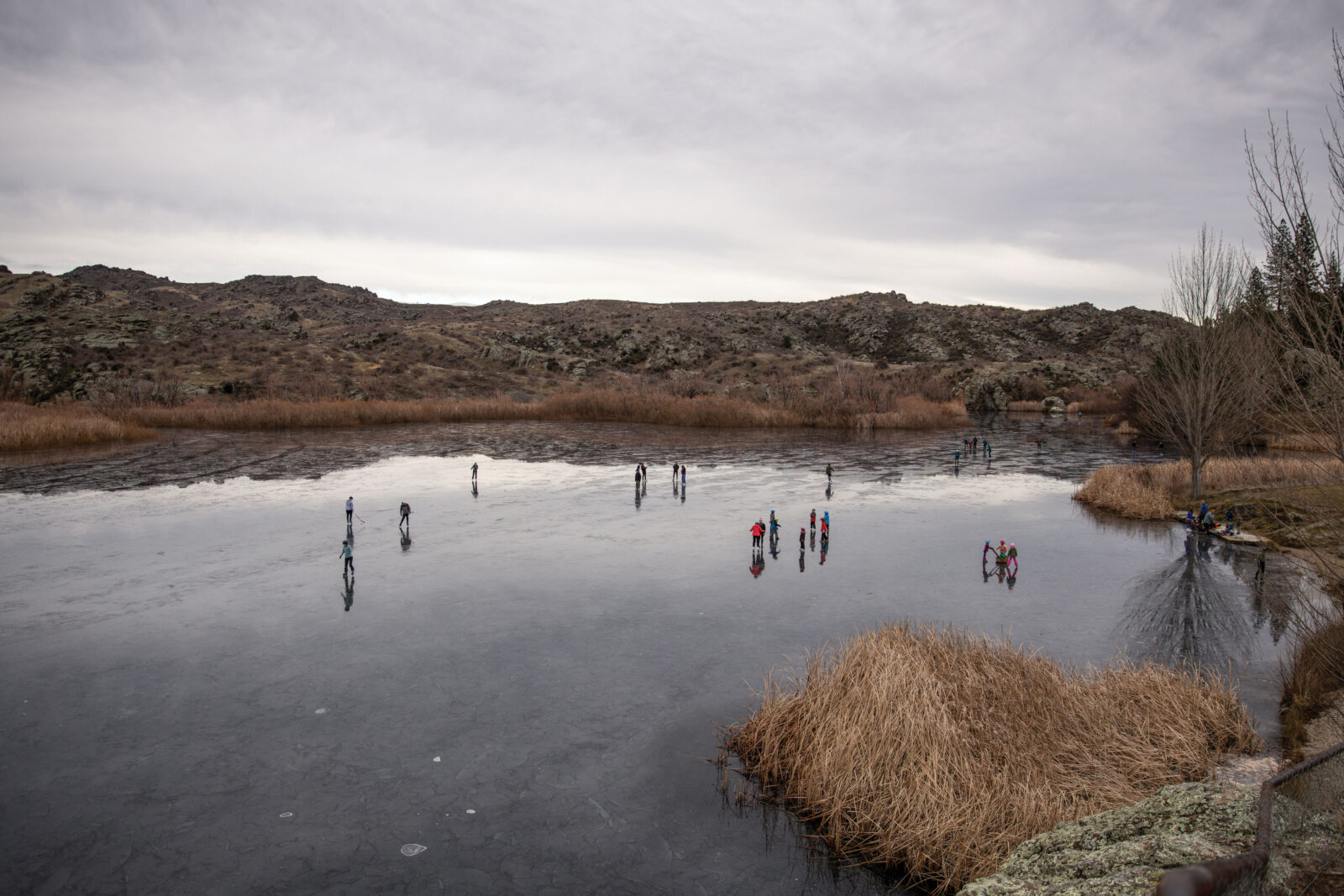
A peachy glow illuminates the schist-spackled hills. It’s 8am, a still winter dawn near Alexandra in Central Otago. The Lower Manorburn Dam is a mirror. Its skin rings with a hollow flute-like hum and the rhythmic knock of steel on ice.
Two skaters slice the frozen surface with arcing strides. Wearing long blades designed for speed, they glide from one end of the basin to the other, where they disappear behind a curtain of raupō.
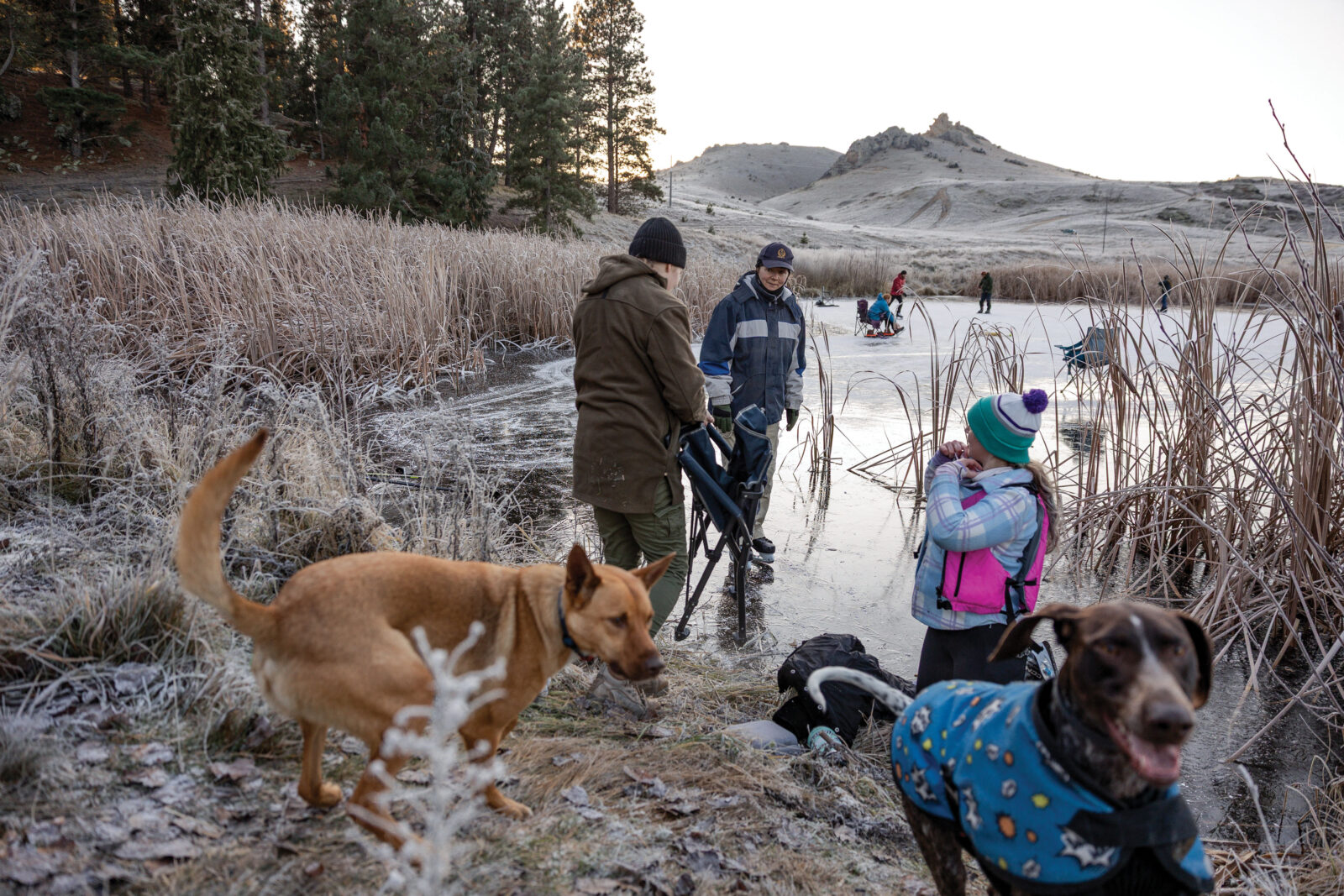
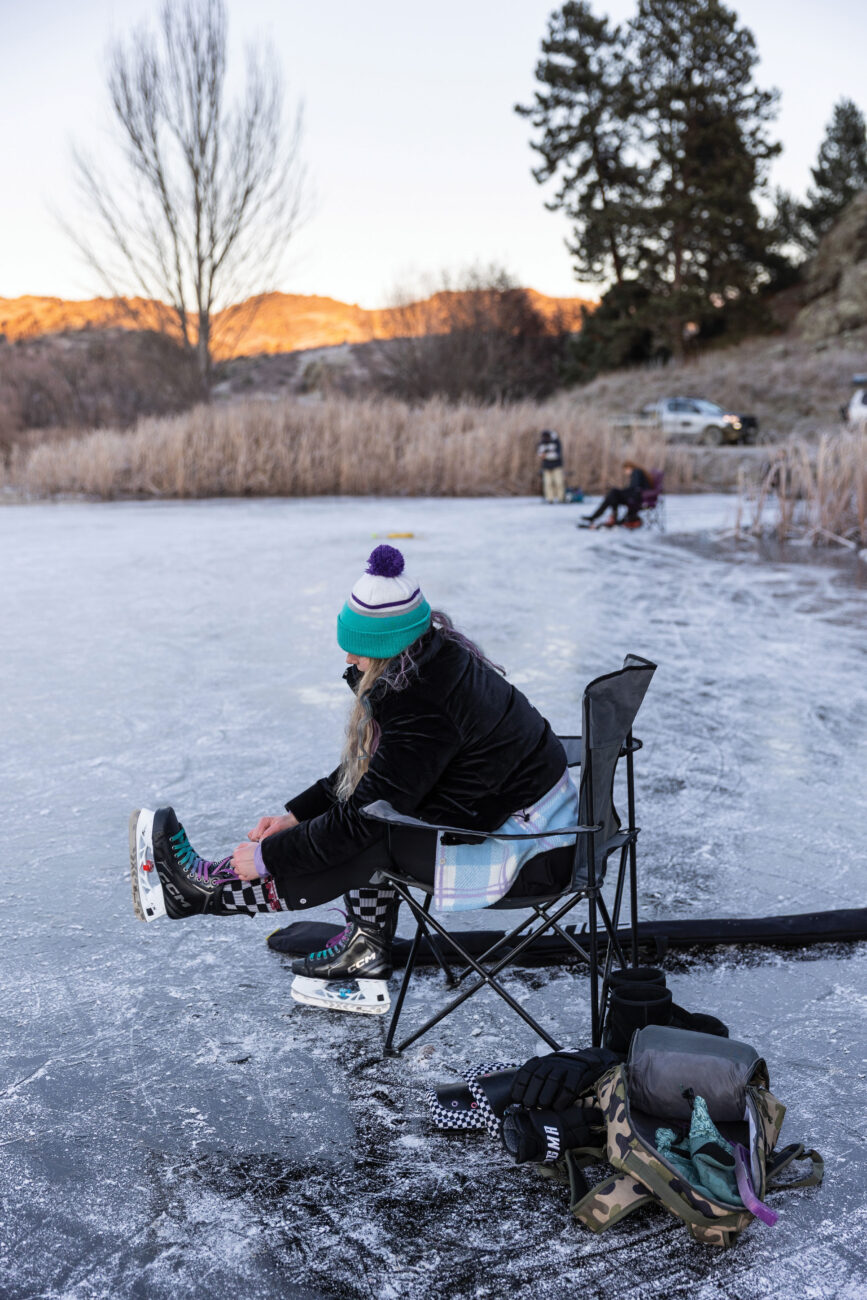
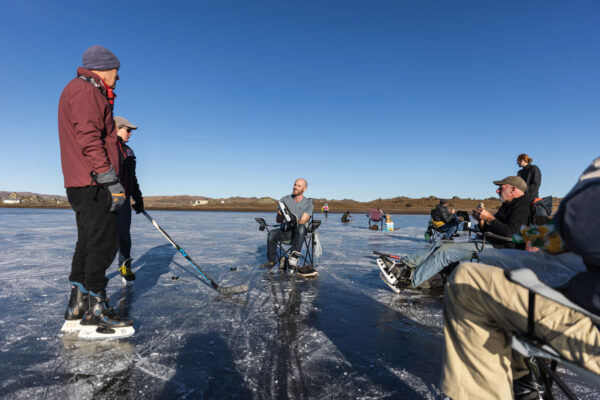
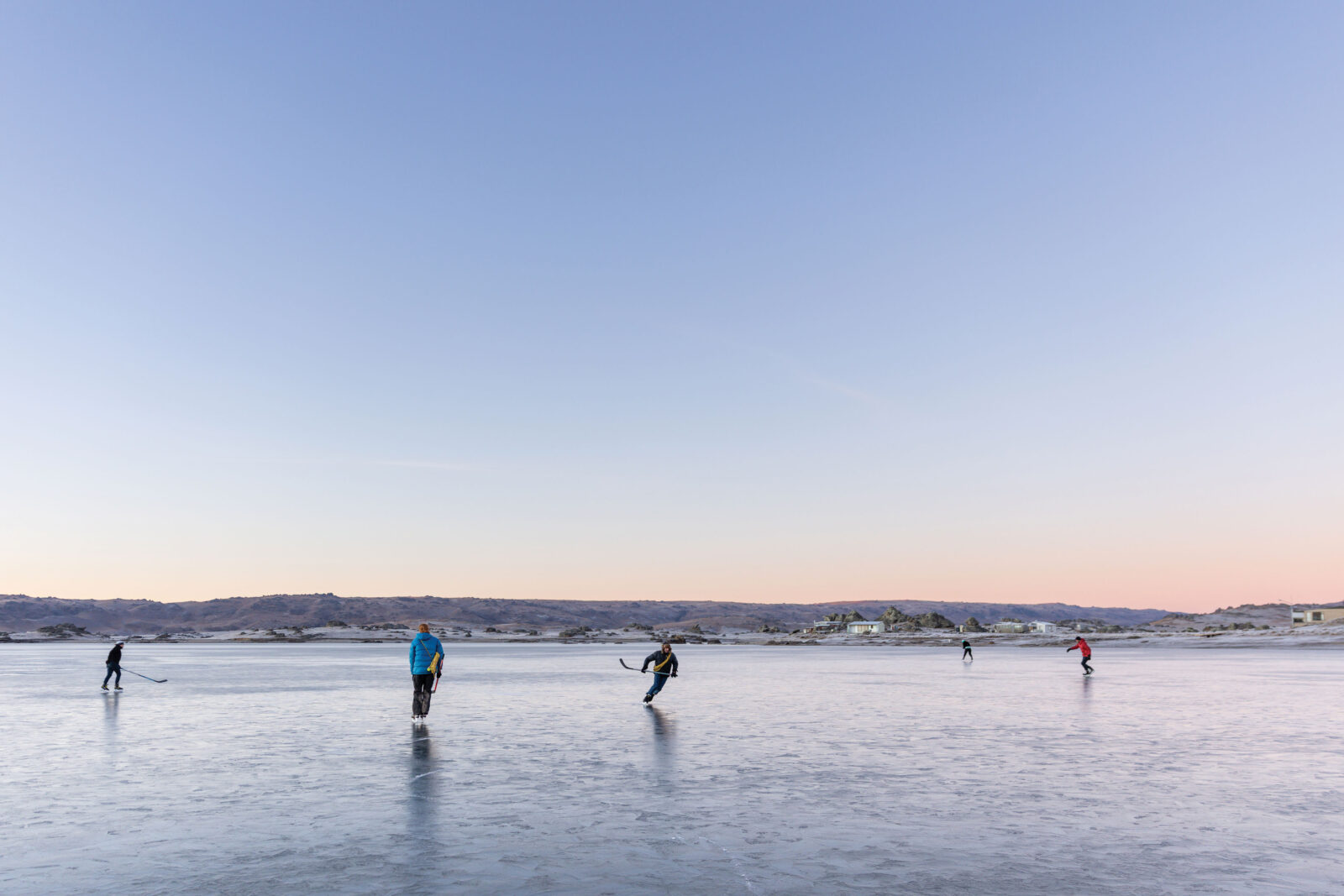
As the sun lifts, a steady parade of vehicles crunch down the gravel road to the dam. People in beanies and puffers tumble out of cars to the frozen edge of Rushcutters Bay. Soon, the ice edge is littered with sneakers and camp chairs, thermoses secured in cup-holders. A few dozen skaters and at least three dogs disperse onto the ice. Sharpened skates strike up an otherworldly chorus: muffled marble-bounces and laser-pops and wineglass-plinks and whale-song vibrations.
It’s the busiest day of the winter on the Lower Manorburn. A week of -5°C frosts has solidified the water’s surface into an icy playground.
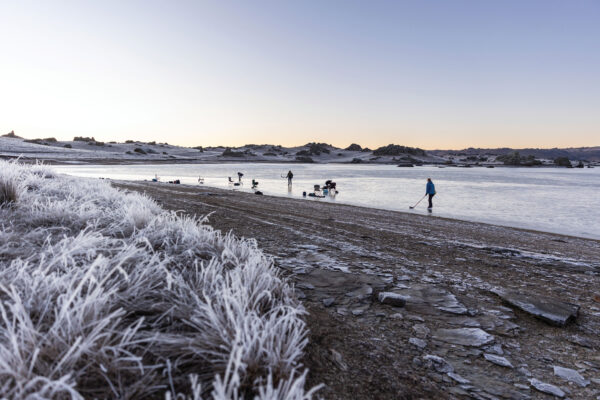
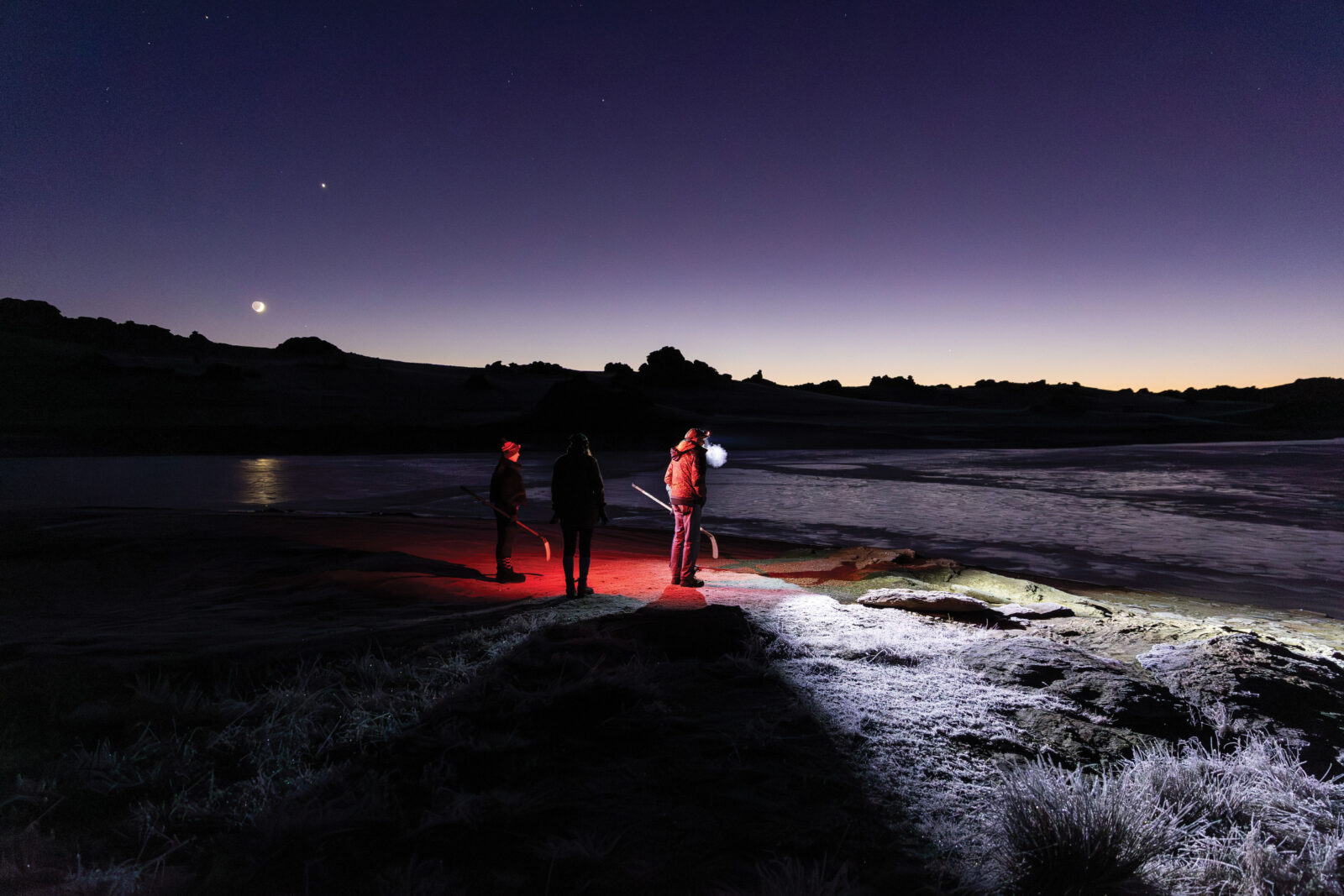
Joshua Starling tests the ice by stamping his foot. Solid as. He’s here with five friends—they’ve been making an icy pilgrimage for five years now, and call it the Winter Express. The group carry hockey sticks, thwacking the ice as they drift further from shore.
Some skaters carve circuits around the entire basin, picking up discarded bottles and rocks that pose trip hazards. “We call them death cookies, because if you trip on one, you’re going right over,” says Michelaé Reeve. “I’ve fallen over and made a big star-shaped crack like a cartoon.”
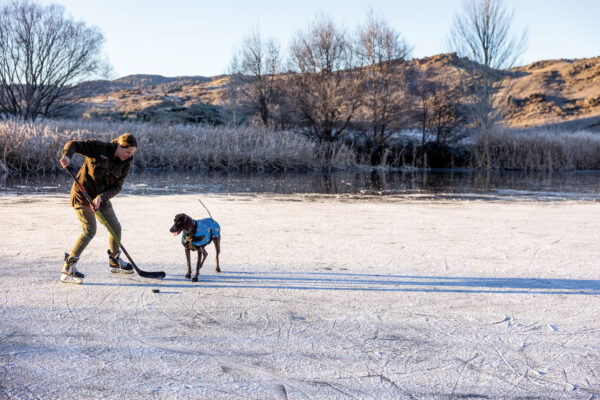
Others lazily hit a hockey puck back and forth, their sticks kicking up splashes of surface water. Children wearing bright bike helmets buzz in a swarm near the shore. One tows a mini wooden sled bearing a soft-toy monkey passenger.
“There are not many places in New Zealand you can do this,” says Mark Willyams, an Alexandra local of 30 years who has come down for a skate with his dog Ted. “But it’s not as good as it used to be.”
*
The Lower Manorburn Dam, built for irrigation, was completed in 1934. That winter, the new lake—with a surface area of around 26 rugby fields—transformed itself into a huge skating rink. The Alexandra Winter Sports Club set up shop in 1935, hosting competitions for figure skaters and speed skaters, and bonspiels for curlers. The club put in electric floodlights for night skating, and a building for skate hire and refreshments.
In 1939, 400 motor cars carrying more than 2,000 spectators gathered at the dam for the inaugural New Zealand ice championships. An Otago Daily Times report documented the spectacle: “From the rocky crags forming a natural grandstand, the spectators looked across a basin of sun-drenched ice, on which, between events, about 1,000 skaters wove an animated pattern full of colour, the skates flashing in the sun.”
Annual winter ice carnivals quickly became a fixture on the Alexandra social calendar. A grainy black-and-white video clip of the 1946 carnival shows locals in fancy dress joining a conga-line, leapfrogging and waltzing around the ice. “If winter comes, the motto here is: to the dam!” the voiceover proclaims.
*
Keith Dickson, 79, remembers the first time he went to the dam. It was 1956, he was nine, and he held his mum’s hand as she led him onto the ice. “She was a good skater, my mum, back in the 1920s,” he says. Dickson is a good skater, too—he took up competitive figure skating at age 60, travelling around the world for competitions.
Natural ice has a trampoline quality that appeals to figure skaters, Dickson says, especially compared to the chalky hardness of rinks, which are typically underlaid with concrete and sand.
“That doesn’t have any movement,” he explains. “But when water is underneath the ice, you can feel, it has a spring to it.” Dickson has skated on natural ice nearly every year since that first 1956 foray—including several celebratory birthday skates in his birthday suit.
By the 1950s, skaters were rolling up at Manorburn by the busload, travelling from Dunedin and Invercargill. The natural-ice season stretched from mid-June to the beginning of August—but was sometimes broken by insufficiently frosty spells that thinned the ice. So, in 1969, construction began on an outdoor rink next door to Rushcutters Bay, designed to guarantee skating and perhaps extend the season into September.
Local volunteers spent thousands of hours preparing the foundation: cleaning, painting, welding, and laying four miles of one-inch pipe, filled with brine, in a grid. A three-ton freezing plant helped make and maintain the ice through fluctuating temperatures. And ahead of every skating season, a team of volunteer “ice-men” would spend six long, frigid nights spraying a thin coating of water across the grid and waiting for it to freeze, building up the rink’s surface in consecutive layers.
Palaeontologist Mike Pole, who grew up in Alexandra in the early 1970s, recalls on his blog that skating at Manorburn was “the family thing to do”. Day and night, locals congregated on the dam and at the rink. Pole was impressed when a Massey-Ferguson tractor was driven onto the ice.
*
There are no tractors at Manorburn this morning. No buildings, skate hire or artificial rink. The throngs of thousands have thinned, the skating season contracted. “Now, you’d be lucky to get 10 days in July,” says Willyams. You used to be able to skate out of the dam’s middle basin, down a channel to the lower basin and all the way up to the dam face, where water cascades over the concrete lip, he says. Not so now: the ice in the channel, underlaid by fast-flowing water, is too thin this morning. On the lower basin, more exposed to wind and sun, the ice peters out and gives way to open water. Skateable conditions are less frequent now, too, he says, and people are less interested.
The shift away from natural ice began in the early 1990s. Facing costly upgrades to the dam-side rink, and busier families finding it difficult to even get out to Manorburn, the winter sports club opted to relocate into town. An Olympic-sized outdoor rink was opened in Molyneux Park in 1993.
But a few people still feel called to the wild hills. They prefer the xylophone clonks as the natural ice breathes beneath skates. The thrill of the pursuit for perfect ice.
*
“Generally, it takes three good minus-five days with clear skies to get anything,” says Dave Young, an ice enthusiast based in Outram, near Dunedin. “Wind is a biggie, too, you know: what the wind is doing.”
Because he can’t just pop down to the Manorburn to see if the freeze is under way, Young relies on an assortment of weather maps, models, and sensors, looking for patterns in the data. A negative temperature on a road sensor that rarely dips below zero. Clear night skies on Central Otago’s weather cams, or a dusting of snow on the hills around Alexandra. Plus, he’s come to know the characteristics of the different spots—how sheltered they are, their elevation. It all adds up to a strategic gamble: should he try Poolburn, or Coalpit? What about the pond closer to home?
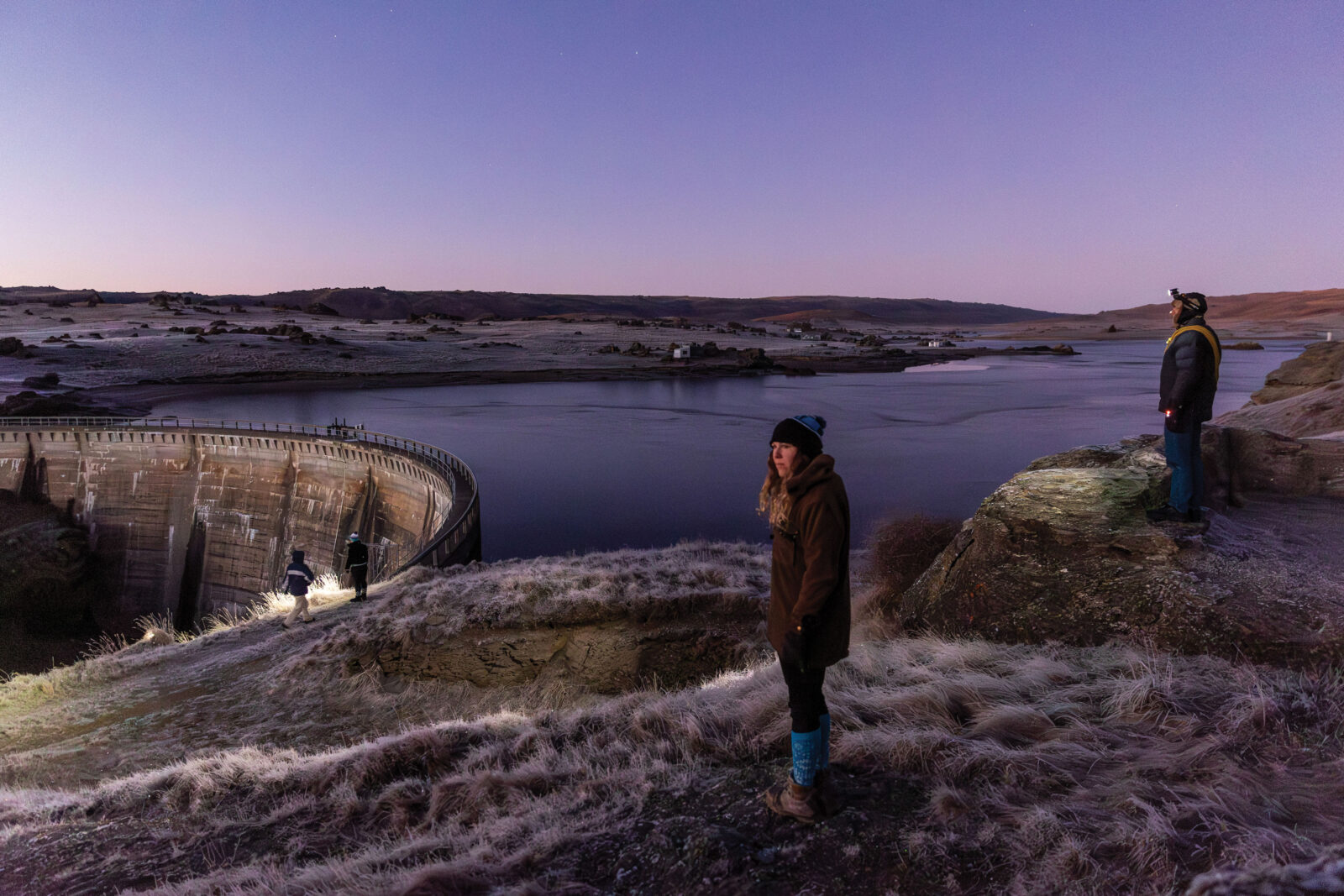
As the sun rises, the Winter Express crew (including Heather Rockell, centre and Jeff Peacock, right) are already at Poolburn inspecting the ice. Another of the group, Aqua Reekie, suspects disconnection from nature is steering crowds away from spots like this. “Everyone’s so addicted to the comfort, opening up the phone, scrolling, going on the internet, opening Netflix. It’s suffocating our humanity.”
Young’s obsession began in the early 90s, when he visited Manorburn and was “blown away”. He moved from the North Island not long after, when a big freeze blanketed the region. It was so cold he could skate on the frozen flooded school grounds, and the deep chill sparked something in him. “It’s like, why climb a mountain? It’s something that speaks to you,” he says. “It’s elusive and it’s risky. I love the sound—like hand-planing wood—and the curve side-to-side.”
Others keep tabs on the ice through a frosty grapevine. A Facebook group, moderated by Young, has become a hub for keen ice enthusiasts across the South Island to swap info. Clive Murphie, organiser of the Winter Express road trip, also curates online ice reports for the Aardwolfs Ice Hockey Club. For 20 years, he has crowdsourced conditions and location tips, and drawn together a troupe of skaters with a wild side.
Every year, the Winter Express ventures south from Christchurch to find ice in Central Otago—usually in the last week of July, the best skating window. But at the mercy of the weather, the group are ready to drop everything to skate at the first signs of frost. “We don’t have friends in winter. No plans. Not committing to anything,” says Julia Egan, Murphie’s partner. “Lake skating comes first.”
*
Ice in the wild can be cloudy and white, grainy with grit, prickled with air bubbles, or like a patchwork quilt of sheets hanging together with frozen seams. Snow ice—where snow settles atop the ice and freezes into it—is lumpier, sometimes dangerously soft. More like sandpaper, or skating over the surface of an orange peel.
But the best type of ice is black ice, crystal panes unrippled by wind that allow for smooth, fast skating. “With black ice, you know you’re alive,” says Egan. “Stepping onto ice you can see through for the first time is kinda terrifying. That heart palpitation thing, it’s thrilling.”
Aqua Reekie, another ice roadtripper, remembers the first time he skated on black ice, at Lake Ida in Canterbury. “It’s these massive clear glassy windows,” he says. “You can see down into the lake, see rocks a couple of metres under the water. But it’s like there’s nothing between you and the rock. You start flying. There’s the sound of the ice popping beneath you, and beyond that, silence.” Sometimes you might see creatures suspended in the ice—a fish, a bird.
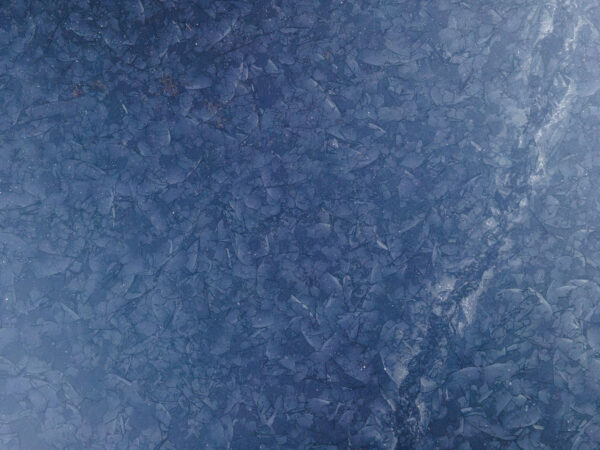
Lake Ida is nestled in a high-country valley, where cool air funnels down from the snow-dipped mountaintops. The lake is sheltered from wind and sun, creating an ideal environment for reliable ice. Like Manorburn further south, Ida was once the epicentre of a vibrant skating culture. Thousands would flock there on a winter weekend, with morning radio announcing whether the lake was open, like ski reports do now. Murphie first visited Ida in 1982, catching a 6:30am bus from the city on a -5°C day. A safe area of the ice had been marked off for skating, and you could purchase a hot pie for lunch.
Today, the buses and pies are long gone. Instead, access to Ida is via an hour-long hike along a track that can be muddy, snowy, and slippery. “Sometimes we wear micro-crampons, otherwise it’s like an ice-skating rink when you’re trying to walk to the actual ice-skating rink,” says Reeve. The tinkling calls of korimako signal you’re getting close; these bellbirds have adopted melodies that imitate the cracking of the ice. “Like Star Wars blasters,” says Reekie.
Every winter, Murphie arranges a night skate at Lake Ida. Fifty or sixty skaters descend on the ice in the pitch dark, toting headtorches and boots adorned with colourful flashing lights. “On a full moon, the light is so bright you don’t even need a torch,” says Egan. It’s like wheeling across the silver surface of the moon, carving craters with your feet beneath a night sky frosted by the Milky Way. Skating at night is somewhat safer, says Murphie, as the plunging temperatures—sometimes as low as –12°C—keep the ice firm and thick.
*
Knowing which ice is safe to skate on is a skill sharpened through close observation and experience. As a general rule, the thicker the ice is, the stronger. Starling uses a drill and tape measure to check the ice thickness at Manorburn—110 millimetres in shady Rushcutters Bay, and 65 millimetres on the far side of the dam. Plenty thick.
But the quality of the ice also plays a role, and many longtime skaters forgo drilling and rely on their senses.
Murphie goes by sound and feel. “When the ice goes boom, bop, that’s safe. But the fracturing glass sound, crackle crackle, is when you really have to be careful,” he says. “Higher pitch means thinner ice.”
Murphie and the Winter Express skaters hit the ice with hockey sticks, looking for fast cracking, water seepage and whether the underside of the ice layer, closest to the water, blows out and crumbles. The top layer might stay intact. Still, says Murphie, “You turn around and go back if it does that. It tells you that the ice wasn’t very strongly attached to what’s above it.”
*
Last July, Young was skating on a stretch of ice on the Manorburn known as “the neck”. Here, the dam narrows into a channel and the water flows a little quicker, thinning the ice.
The air was warm—warm enough that Young couldn’t hear the spiderweb cracking under his skates before he went through it. Submerged up to his waist, he spun around towards the safe ice he’d just left and tried to hurl himself on it. But his bulky puffer jacket was snagged. “Shit. I’m not gonna get out of here,” he thought. A beat of breath. The water was shocking. Focus. Young snatched the ice claws from around his neck, dug them into the stable ice and levered himself out. “This was a reminder: don’t keep pushing it,” he says.
Just a couple of days earlier, former Olympic speed skater Andrew Nicholson had also fallen through while skating on the neck, drifting just a couple of metres off designated “safe” ice. He went in over his head, and without any safety gear, had to spread his arms wide, float his legs up, hook a foot over the ice and wriggle out. After a change of clothes, he was back skating—on thicker ice—for the rest of the day.
Murphie, too, has succumbed to the dodgy thin ice of the neck—20 years ago, in front of half a dozen onlookers holding a safety rope, just in case. “I bobbed up, put my leg over the edge and rolled out,” he says. “By the time they had the rope ready to pull me out, I was already halfway to the car to get changed.”
The possibility of the ice giving way is a constant spectre for natural-ice skaters. Young has fallen a total of three and a half times over 30 years—the “half” was, he says, a mild dampening rather than a soaking. The worst scenario would be falling into flowing water and getting dragged under the ice. (Most skateable locations in New Zealand don’t have major currents.)
The risk is part of the thrill for some, but also demands common sense and personal responsibility, Murphie says. These are “calculated risks, like any other outdoor adventure hobby”.
You check the ice. You go prepared, with a self-rescue plan. You never go alone.
“It is deadly,” says Reeve. “If you fell in and no one was there to pull you out, you would die.” But she points out that the drive to Alexandra in the car was probably riskier. Reeve is wearing a lifejacket over her teal-and-pink jacket, and pulls out two ice spikes from her pockets. These look like screwdrivers, with short, sharp metal prongs. If she falls in, she will thrust them into the stable ice to get leverage to pull herself up and out. Someone in the group carries a rope to fish skaters out, too.
*
If Manorburn is the welcoming neighbourhood introduction to natural ice, Poolburn is the wild backcountry stadium. Constructed during the Great Depression for both irrigation and job creation, it’s now a remote mecca for the most committed skaters. After bumping along a rocky four-wheel-drive track for 10 kilometres, Young, Inge Diks, and her kelpie Stone emerge into a Lord of the Rings landscape of tussock and tors, bathed in pre-dawn blue.
“I’ve seen the most amazing sunrises of my life up here,” says Young. He first ventured to Poolburn in 2009, and was “gobsmacked” by the ice he encountered. “I couldn’t even drill through it,” he says.
Young uses a walking pole with a sharp metal end for testing the ice. He stabs it three times (if the pole breaks through, the ice is not skateable). He notes how much air is in the ice, its colour, and transparency.
Diks, a grape grower from Alexandra, looks for pattern changes and a sheen that indicates the age of the ice. “I want at least an inch before I even start thinking about it,” she says, wielding an ice axe—if a swing of the axe pierces the ice, it’s a no-go. “But Dave goes first on the ice anyway. He’s the guinea pig.”
Diks retrieves a wooden stool, Young a fold-up camp stool fitted with custom steel brackets on its feet. Every skater has their preferred apparatus for helping them get into their skates and onto the ice.
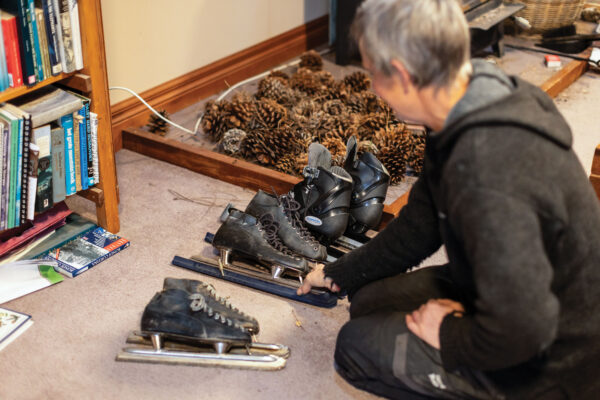
Diks has speed skates—the favoured style for most folk of Dutch descent—with blades that protrude beyond the heel and toe, fitted to a ski boot. They’re comfy and warm and glide perfectly—especially compared to her childhood skates, lace-up leather that would leave your toes numb. Young has detachable Nordic blades that strap onto the bottom of his hiking boots, sharpened with a round file. He also has a pair of hockey skates, which are shorter for tight turns and quick manoeuvrability. Others might opt for figure skates, which feature jagged teeth on the front to help with fancy footwork, jumps and spins.
A full circuit around Poolburn is about 20 kilometres—much more expansive than Manorburn—giving skaters the space to open up, loop around islands and curve with the contour of overhanging cliffs.
“When you trust the ice, you just go, go forever,” says Diks. She rediscovered her love of skating after moving to Alexandra in 2011, awakening childhood memories of skating along the canal near her home in the Netherlands. “When it froze up, we would get time off school,” she says. “There would be music and lights at night. People would sell pea soup with spicy sausages.”
Diks is worried that natural-ice skating will become a story recounted to grandchildren, rather than something experienced first-hand. Her nieces and nephews back in the Netherlands have never skated. There’s no ice.
The season here in Aotearoa is shrinking and splintering with the climate, and now hinges on narrow cold snaps. Climate projections sketch a future with fewer frosts—perhaps up to 15 fewer per winter by 2040. By the end of the century, properly cold nights here could be down by 70 per cent, with daily minimum temperatures creeping higher. In other words, there will be fewer chances for ice to form, and to stick around.
“Looking back, Poolburn used to be well frozen by the end of June,” says Young. “Now, we’ve noticed the freezing’s coming in different ways: later, shorter periods.” He’s kept a running record of his ice adventures since 2009, via a blog called A Chip off the Ice Block. “I think in the future, if you want to skate, you might have to go high.”
Dave Patchett, another keen natural-ice hunter, scours maps for promising ice on shady south-facing tarns. But reaching these far-flung ice spots can involve multi-hour treks, traversing windswept ridges in the snow—a far cry from the Manorburn.
Murphie is philosophical, having watched good and bad ice years wheel along through two decades. “No matter how much I worry, it doesn’t make it better or worse,” he says. “It’s going to happen whatever.” The hunt for perfect ice will glide on.
*
It’s the day after the busiest day at Manorburn. There was no frost overnight. No ice on the windscreen this morning. The dam’s hard skin, criss-crossed with skate scars and shimmering with a film of meltwater, is silent. But the hope of a hard frost lingers. And when it hits—maybe tonight, maybe not till next winter—the ice will sing with skates once more.
More by Ellen Rykers
More by Becki Moss