



Split open a chunk of agate and a broiling world of ancient colour emerges. Collecting the stuff is addictive. But with the old rockhounds fading, what will become of the last great hoards?
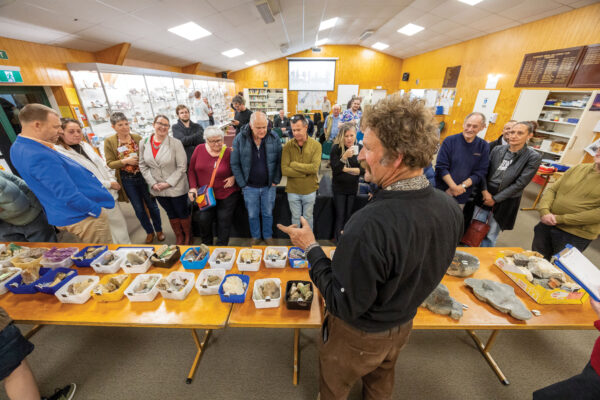
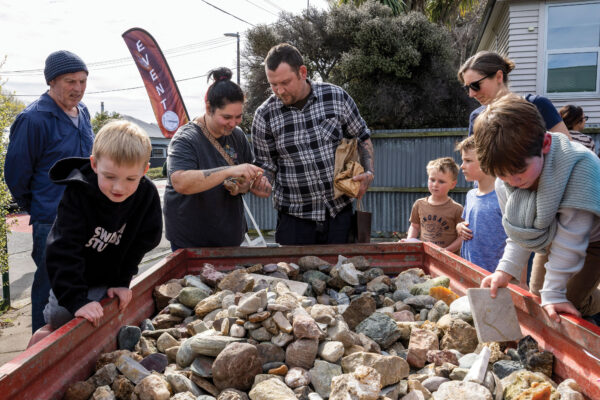
In a floodlit clubroom deep in the eastern suburbs of Christchurch, rockhounds are circling. Their attention is focused on a table that creaks under the weight of ice-cream containers full of uncut agate—dusty, dull, shapeless hunks of rock. The members of Canterbury’s Mineral and Lapidary Club know better, though. Hidden beneath those dirty exteriors are the colours and patterns of an ancient world—Earth dreams entombed for tens of millions of years, just waiting for a screeching saw blade to reveal them.
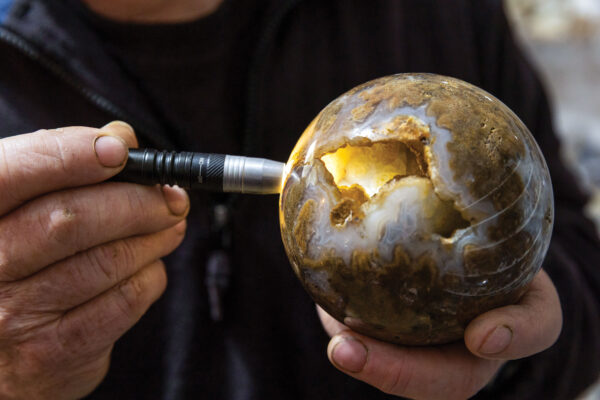
Agates are gemstones formed in volcanic rock. Lava boils like porridge, and in certain types, bubble-like openings fill with silica-rich fluids. As this liquid slowly crystallises, chemical impurities create spectacular layers and colours. Sometimes a cave forms inside an agate, encrusted with crystals: purple amethyst.
Agates are very hard, so as the rock they form in weathers down to gravel and clay, the agates remain as nodules. The whole lot slowly washes down towards streams and rivers. As the surrounding material disappears, the agates settle together in dense jumbles, buried in the ground or exposed at the surface.
Today, enthusiasts seek out these sites with the fervour of old-time gold miners. Many of the agates they find are brought back to this Christchurch club, where they’re admired, envied, traded, and sometimes sold.
*
Tonight’s auctioneer is club stalwart John Taylor. Six foot four, his neck and wrists bedecked in metal pendants, he’s an astonishing, piratical presence in the room. His voice, as big as his personality, dispatches each container to its new owner with thunderous decree.
At a glance, Taylor can tell which famous collecting ground each of these rocks has come from. He reels off the names of these places, all in the mid-Canterbury foothills of the Southern Alps: Gawler Downs, Malvern Hills, Whitecliffs, Mount Somers, Barossa—names that have reverberated through generations of New Zealand rockhounding. This is the most important agate collecting region in the country, and arguably one of the finest in the world.
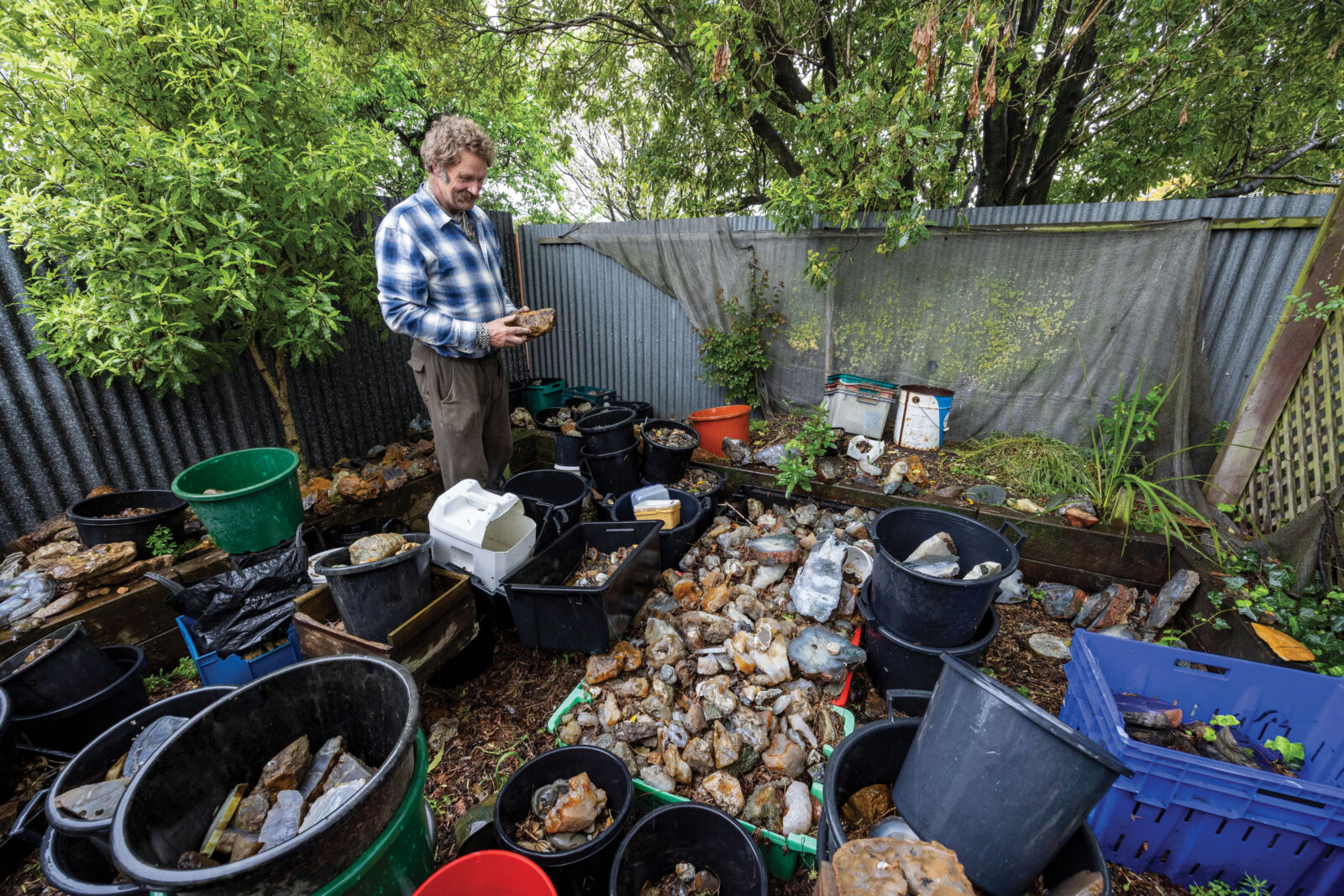
Taylor wins one lot himself. It costs him $10—he tells me most of the rock in the container is rubbish. There’s one piece, though, that’s caught his eye. He’ll take it home, polish it up and, if he’s happy with what is revealed, add it to his enormous collection. One room of Taylor’s house and an entire double garage are full of agates. “The obsession is pretty strong with me,” he says.
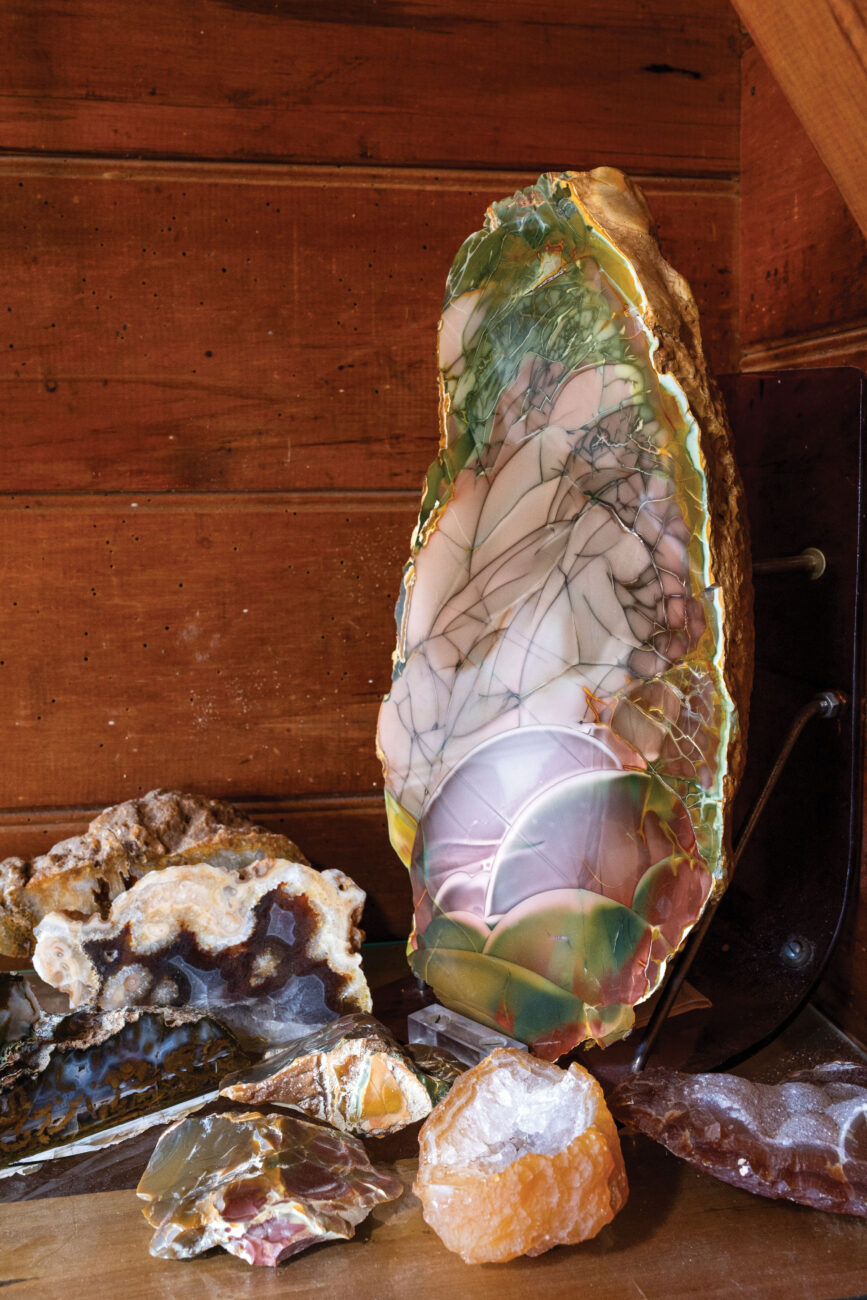
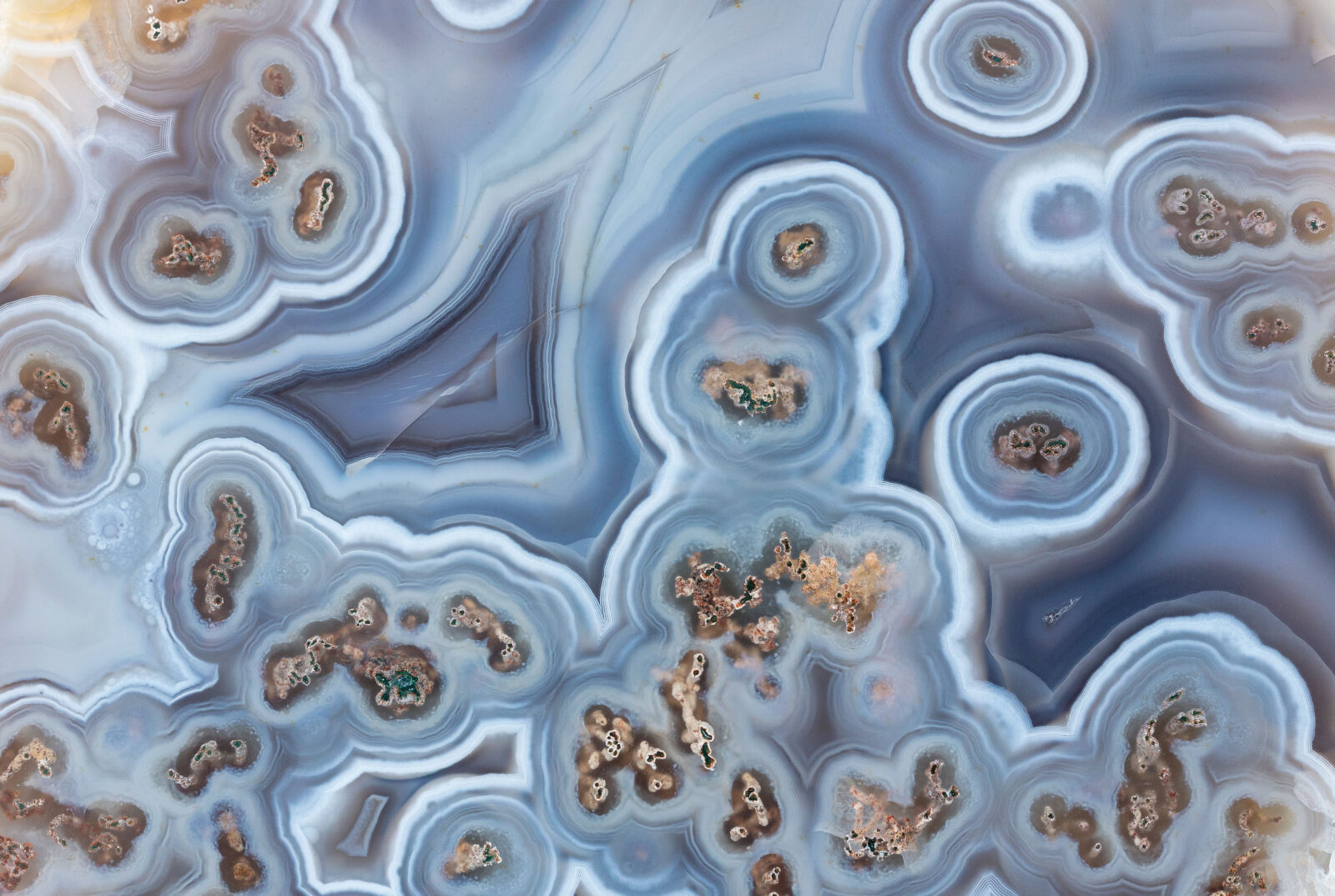
Auction over, the rockhounds disperse round the room. I mingle with them, admiring the agates on the “Bring and Brag” table, and in the cabinets around the room. It’s hard to describe the variety and brilliance of these stones. Agates are an infinity of colour and shape. Stripes, concentric rings, clouds, bubbles, and crystalline fireworks. It’s like staring at a Rorschach ink blot; the mind conjures maps of undersea mountains, Arctic ice caves, storms on the surface of Jupiter, a cross-section of the human brain.
Some have mysterious smoke signals of green mineralisation known as “moss”. I begin to learn the terminology. Fortification, the structures on a cut agate that look like a medieval fort, viewed from above. Parallax, the bizarre rippling effect some agates have as you turn them across the light. New Zealand agates, I’m told, are not as vivid as some from overseas, but what ours lack in vibrancy, they make up for in diversity of form and colour.
Club president Tessa Mitchell-Anyon didn’t know much about agates before she moved to Christchurch and was “indoctrinated into the agate sphere”. When she first joined the club, she tells me, she was astonished at how the senior members could pick the origins of each piece. “I was like, ‘How the hell do you know that this is a Whitecliffs agate?’ Now that I’ve been here five years, I know what a Whitecliffs agate looks like.”
For Tyler McBeth of Kaiapoi, who splits his rockhounding time between finding agates and prising fossils out of the North Canterbury coastline, it’s the dopamine hit of cutting open a good agate that keeps him hooked.
“Every single one is distinct. You know there’s only one in the world that looks like that. They’ve each got their own personalities.”
Agate hunting is a Canterbury tradition that goes back decades. Some of the most avid rockhounds have amassed vast, spectacular collections, and many post their most gorgeous finds on social media. The hobby has rapidly grown in popularity, and for Morne Mamlambo, whose fossil-and agate-hunting YouTube videos are watched by millions, that’s a good thing. He now fields constant inquiries from parents looking for something to do with their kids outdoors. “Agates are a great gateway into science,” he says, “because the question of ‘How did they form?’ gets you into volcanology and geology.”
The rise in popularity of agate hunting has brought problems, however. Most of the good agate sites are on private land, and farmers have tired of the ever-increasing numbers of rockhounds flocking to their properties. They’ve restricted or shut down access, and with most public land effectively out of bounds to collecting, it’s now almost impossible to gather agates in situ in Canterbury. Rockhounds are now mostly restricted to large riverbeds, where access is public.
After any heavy rain, McBeth tells me, enthusiasts descend on the region’s braided rivers en masse to see what’s been unearthed. “It’s just nuts. There’s a lot of competition between the rockhounds to get the stuff.”
Collectors, he tells me, usually hit the rivers a day or two after a flood peaks, “when it’s still dangerous”. The pressure on sites, says McBeth, increases the scarcity value of agates and has brought an unprecedented level of competition and secrecy to the game. Moving around the room, I hear talk of agates from “Area One” and “Area Four”—codewords designed to keep the best spots secret, even from other club members.
It’s not really about money—agate is not especially valuable. It’s not scarce in the way that diamond, sapphire or ruby is. It lacks the cultural prestige of pounamu. And while a polished agate may look stunning, you can’t use it for much other than a paperweight or doorstop. So while a nice Canterbury specimen might fetch a few dollars online, the time and expense involved in collecting and preparing it are likely to negate any profit.
Finding it is always a thrill, though.
*
I head into agate country with Marcus Richards, a geologist with Tūhura Otago Museum. It was Richards who tipped me off to New Zealand’s agate craze—he’s a rockhound himself, a paid-up member of the Otago Rock and Mineral Club. While he admires the beauty of agate, he finds it hard to relate to the fervour they inspire. But Richards is always up for a rock-collecting mission in remote country, and that, at its heart, is what agate hunting is all about.
The two of us leave Geraldine on a still-fine morning, meeting up with photographer Paul Daly and our guide, Ashburton rockhound Robin Hall, before heading inland. As we drive into the maw of the Rangitata Valley, Richards explains the geology around us.
During the Cretaceous period, when New Zealand was mashed up against the side of the supercontinent Gondwana and still being trampled on by dinosaurs, a string of volcanoes sprouted up along one edge.
It was in their lava flows that Canterbury’s agates were formed. Whole trees were also buried in ash and these, too, were “agatised”—their trunks and branches slowly replaced with silica-rich liquid that petrified to agate, memorialising the shape of wood in stone.
That layer of volcanic rock was tilted by the rising of the Southern Alps, then covered by the vast amounts of gravel eroding off them. The agate-rich layer today juts out in a narrow band along the foothills of the alps around Mount Somers. The rest of it is buried deep under the Canterbury Plains.
More by Bill Morris
More by Paul Daly
The forecast today is for high winds, and we’re hoping to beat them. But as we head inland, we see a column of river dust rising above irrigators and shelterbelts—a violent nor’wester playing merry hell in the Rangitata. The wind slams into my car, wrenching the steering wheel out of my hands.
By the time we reach Gawler Downs farm, the wind is howling so loudly in the pine trees that it’s hard to hold a conversation. We check in with station owners Harley and Neroli Davies before heading towards the back of the property.
This kind of access is rare today. Once upon a time, farmers in the area opened their gates to rockhounds without question. Like many farmers, however, the Davies got fed up with the sheer number of requests, and the behaviour of some of those they did let on. They now restrict access to a few trusted old-timers, like Hall. “We’re not being selfish,” says Neroli, “but gates were being left open, and if anything happened, the first people you’d blame was a bloody rockhound.”
I hear rumours of what Richards calls “dragonlust”—rockhounds sneaking onto properties, altercations with farmers, even illegal dynamiting. David Acland, of Mount Somers Station, says while he’s had no such problems, rockhound requests for access “suddenly became every other week”. Like other farmers, he finds it easier simply to say no to everyone.
*
Hall has been coming to Gawler Downs for 25 years in search of agate. “It’s an addiction,” he says. “You’re always looking to find a better one.” Hall offers landowners pieces of the agates he finds. “Some cockies are quite happy to get a nice piece of stone sliced up and polished,” he says. “It’s giving back, for all the times I’ve been let on.”
Hall has a relatively modest collection—just one double bedroom full (plus more in the garage, of course; rockhounds always have more in the garage).
Many of the agate types in his collection, he says, can no longer be collected, as access to those spots has been cut. And it’s not just farmland that’s been locked up. Some of New Zealand’s greatest agate-collecting areas are deep in the Canterbury high country, on Barossa and Stew Point stations.
Agate-rich parts of these runs were added to the national estate under tenure review, meaning they are now under the control of the Department of Conservation. It’s illegal to dig for rocks in these areas without a mining permit, which can be prohibitively expensive.
While Hall totally supports farmers roping off their land, losing access to the public fossicking spots “makes your blood boil”. It takes hours to walk into these places, he points out, and it’s rugged high country that only the most ardent collectors would bother tackling. “There’s bloody square miles of stuff that people aren’t even going to visit,” says Hall. “So what’s the harm of having a scratch around?”
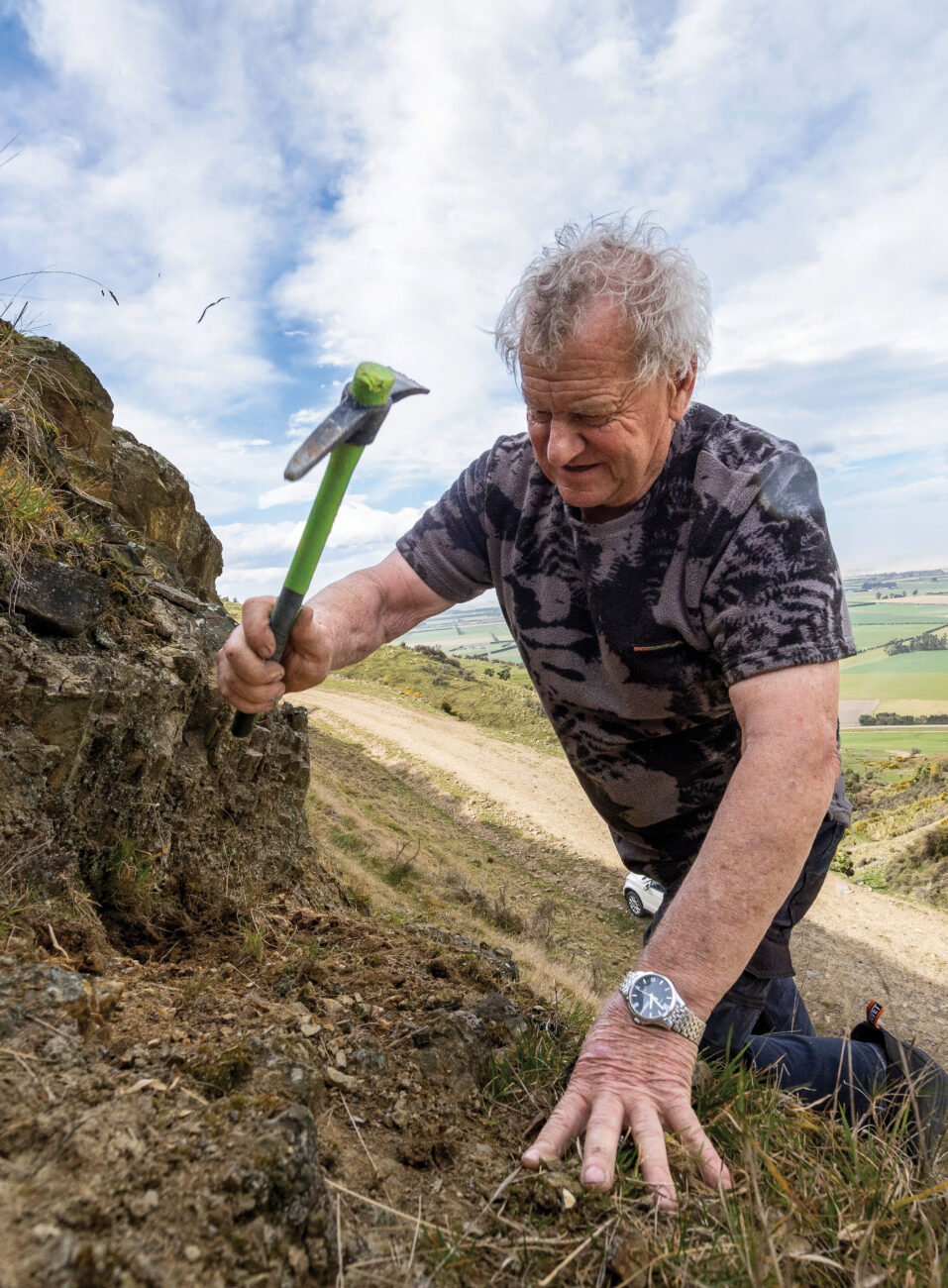
He leads us to an outcrop on a bend of the track that affords a grand view of the mountains. As we step out of the cars, the wind smacks the car, peppering it with grit. Hall hammers away at some rocks on the road cutting, prising bits of agate out of seams exposed amid the brown clay. I watch Daly battle to stand up, let alone photograph, as horizontal shards of rain splat his camera lens.
Hoping for shelter, we move to a spot further down the valley. Here, though, the wind is even more extreme. I nearly lose the car door getting out. The wind grabs me and propels me forward until I dive over a bank for respite. From here I can see the Canterbury Plains being torn to shreds, entire paddocks lifting skyward in boiling towers of dust, tons of topsoil heading out to sea.
Scrambling back to the road, I hastily convene with Daly and Richards. Perhaps we should call it off? Too late—Hall’s off, scrambling up a cliff in search of more agate.
He’s here today for our benefit; he wouldn’t usually come out in weather like this. But in his bloody-minded determination to find a spot to dig, I glimpse the tenacity and drive that make a good rockhound. It is, after all, the volatility of this environment—the relentless, violent erosion of wind and rain—that produces agate from the ground. If you’re going to come in search of the prize, you’d better be ready for the elements.
Daly follows Hall up the cliff. I watch, a bit worried, as the pair teeter high above me. The wind is so strong I’m relieved when they both return more or less safely, having levered a couple of fat, brown agates from the seam.
Bruised, dusty and grazed, and with our hair standing on end, we return to the homestead.
We meet Harley Davies coming the other way in his ute, a grin stretched beneath his hat. He’s been laughing at us ever since we left the homestead. “Any milk left in your tea?” he quips.
In the sanctuary of the farmhouse kitchen, Hall unwraps a gift he’s brought for the couple. It’s the trunk of a 100-million-year-old agatised tree recently found on Gawler Downs. Hall has painstakingly cut and polished it to reveal its stunning mottled black and white interior. The rim is the distinctive deep green peculiar to agates from this station.
Neroli lights up. The discovery of the tree, she tells me, was a turning point in the family’s relationship to their property. Previously, they’d had little interest in agates, but they’ve now become far more curious about the treasures buried beneath their pastures. “It’s precious,” she says. “I’m in awe of it.”
*
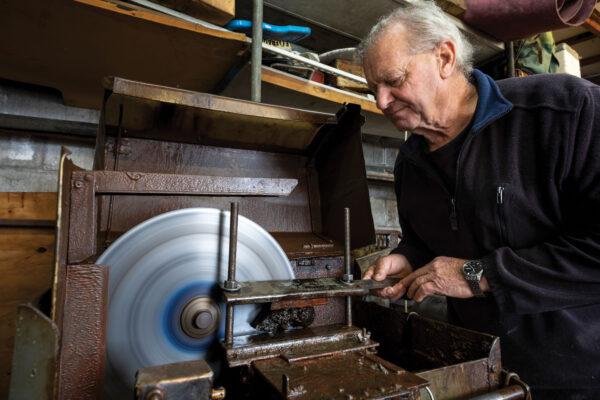
The Hakatere river intersects with State Highway One at Ashburton, carrying to the sea its load of agate-rich gravel. Here, in a little shed near the riverbank, you’ll usually find Malcolm Luxton hard at work cutting and polishing gemstones. He spends about 20 hours a week in this shed.
Luxton is the doyen of the New Zealand agate world. He produced the book on New Zealand agates, a gloriously photographed project that celebrates our very finest specimens. A former meat inspector, Luxton worked two years past retirement age to fund the book, learning the necessary photography techniques by trial and error.
His tiny shed is cluttered with machinery, tools, and rocks. It smells of the diesel used to lubricate the saw blade, machine grease, and rock dust.
The agates are split with a diamond saw. It’s impossible to predict what each rock is like on the inside, and finding a keeper is a thrilling moment.
“For some people, it’s euphoric,” says Luxton. “They jump up and down. I don’t think I’ve ever been known to do that, but I’ll sometimes race inside to get my phone and send a photo to my mate.”
He pulls out a halved agate the size of a basketball and passes it to me. Cupped in nondescript grey is a crystalline cave of glittering purple amethyst, a secret world hidden for a hundred million years. “I got a nice surprise when I cut that one open,” says Luxton.
Once cut, the agates are placed face-down on an oscillating sanding machine, along with special grit. Electricity does the rest. Luxton usually has four of these machines running constantly, night and day. It can take five days to polish the face of a single agate.
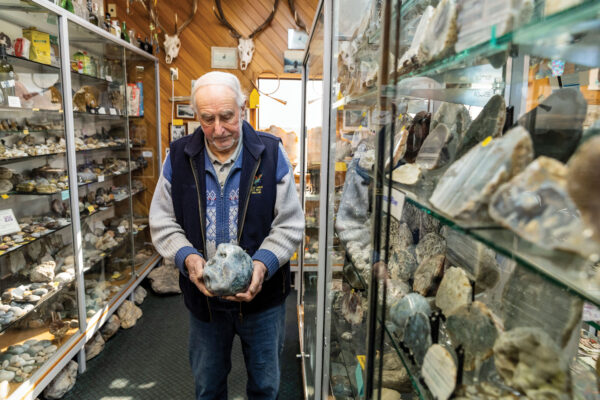
He takes me to see his “agate orphanage”, a one-room unit built to house his collection. Inside are more than 4000 pieces, each one polished to reveal a tiny, flamboyant ocean of quartz.
Seeing people’s jaws drop when they walk through the door is “the best part of this whole business”, he tells me. He never tires of looking at agates. He compares it to snorkelling on a coral reef for the first time—that sense of wonder. “They’re like another world,” he says.
The orphanage holds one of the finest gemstone collections in New Zealand. It’s taken Luxton all of his 50 years of rockhounding, cutting, and polishing to amass. “I’ve had amazing opportunities,” he reflects. “I’ve been healthy and able to visit all these mountainous places.”
Luxton has cancer. His children take an interest in rocks, but even so, it’s likely his huge collection will be broken up one day. That doesn’t bother him. The fun has been in the collecting and sharing, not in hoarding. “I’m just a custodian,” he says. “I’m just here to look after it for a while.”
*
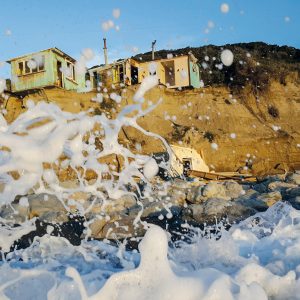
Sun-bleached plastic buoys, whale ribs and driftwood—all these bits of the sea wash up at Birdlings Flat, on the southern side of Banks Peninsula. The currents travelling up the east coast of the South Island dump everything on the stony beach here.
Vince Burke’s Gemstone and Fossil Museum, positioned right on the beach, has a crab claw that originated in Otago Harbour 250 kilometres to the south, and chunks of pink rhodonite, a rock that has travelled even further. There is a piece of driftwood that has carried, in the woody grasp of its roots, a boulder of granite from the West Coast.
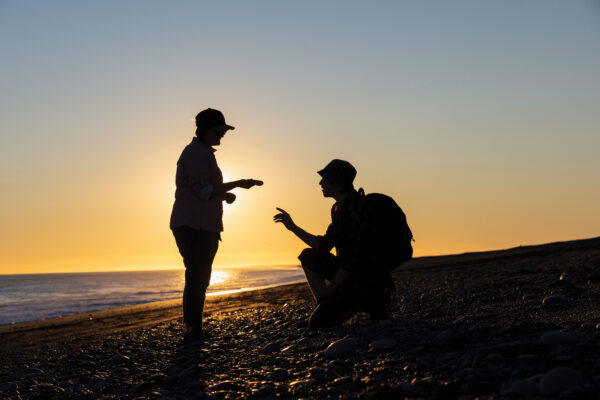
But mostly, this museum is about Burke’s passion—agates. Canterbury’s agates naturally come to rest on this beach, having been spewed out the mouths of rivers and carried north on the currents. By the time they get here they’ve been ground down to glassy, egg-shaped cobbles. For Burke, it all started when he was a young man fishing, and noticing colourful nodules amid the mass of greywacke.
A lifetime in the hills, hunting deer, then, later in life, agates, saw him build up this enormous collection. The array is stunning. Burke favours larger stones than those Luxton prefers, great hunks of moody colour, geological storms. Like Luxton’s, this collection faces an uncertain future. Burke is in his 80s. His wife is in full-time care, and the house and museum are on the market.
He says he has offered to gift the collection to both Te Papa and Canterbury Museum, but they don’t have the space for it. Agates are neither scientifically interesting nor precious enough to be worth most museums’ time and resources. Overseas, there might be a large geological museum willing to house them, but we have no such facility here.
Letting go. All collectors must grapple with this at some stage in their lives. Another enormous collection in Southland—the work of Jack Geerlings, a dairy farmer known for his masterful polishing work—was recently auctioned off in the wake of his death. Geerlings was partially colour-blind; for him, agate was about texture. Seven tonnes of his treasures went at bargain prices, to be absorbed into smaller collections, or sold off by rock shops to tourists. Perhaps that fate awaits Burke’s collection.
Like Luxton, Burke is philosophical about seeing his life’s work dismembered. His priorities, he tells me, have shifted. “It’s an achievement I’ve made, and moved on,” he says. Given how difficult it is now to access the spots rich with agate, these are likely the last of the great collections.
I bid Burke farewell and head out onto the beach, hoping to find my own agate among the endless grey cobbles. He doesn’t reckon I’ll have much luck—the rockhounds have been out in force, and most likely picked the beach clean, at least until the next storm. I search for about 20 minutes. In the end I just sit on the beach for a while, watching the waves relentlessly grinding everything, slowly but surely, to dust.