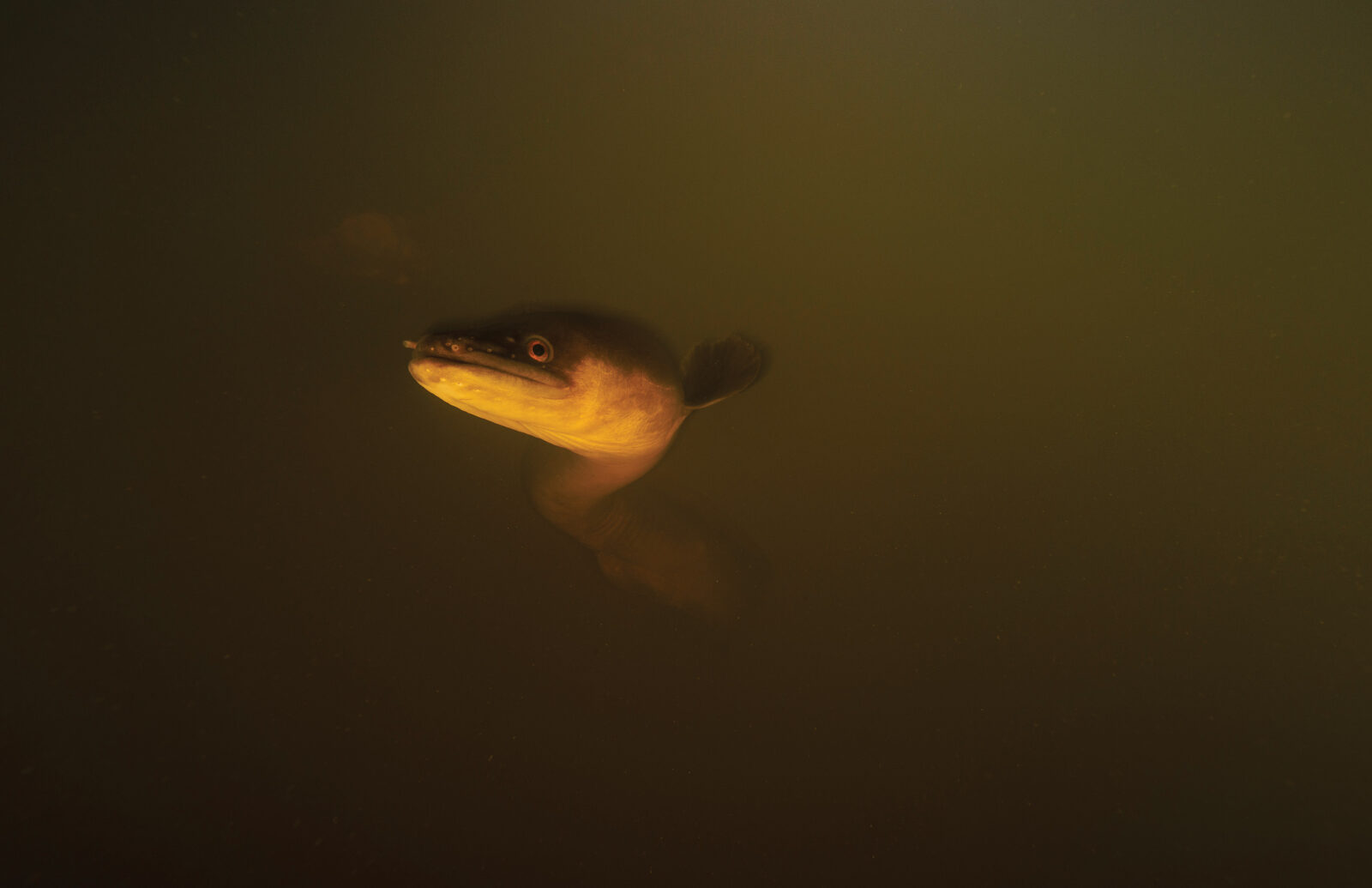



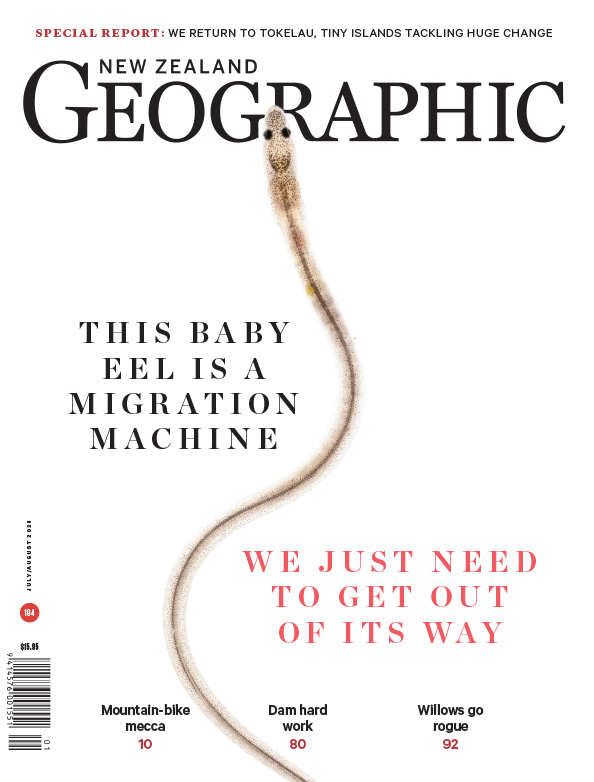
For millions of years, eels moved freely across the waterways of Aotearoa. But now we are strangling their rivers, draining their ancestral wetlands and running turbines that chop their elders to pieces. A few eels are carried around these deadly obstacles in buckets, but many more perish, or spend their lives trapped in backwaters, never breeding. It’s a failure that strikes at the heart of Māoridom, and mana whenua are taking a stand.
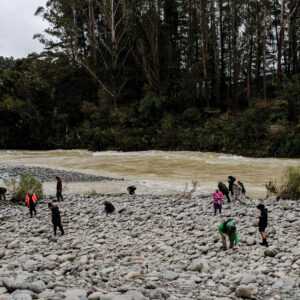
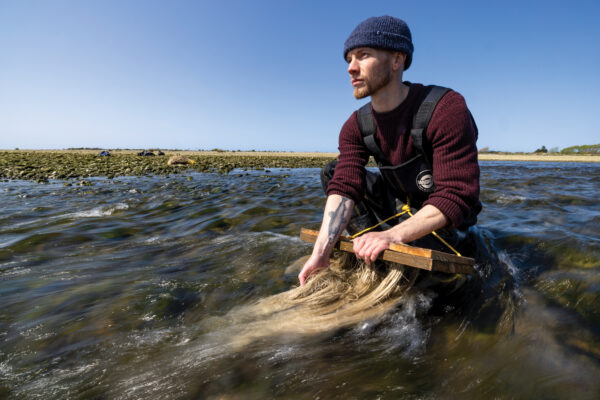
Just after dawn, a shrill spring easterly stirs up nesting terns on Canterbury’s Ashley River/Rakahuri. Brittany Earl, a Department of Conservation ranger, straps an electric fishing machine to her back and wades into the frigid water. She’s catching eels—really small ones.
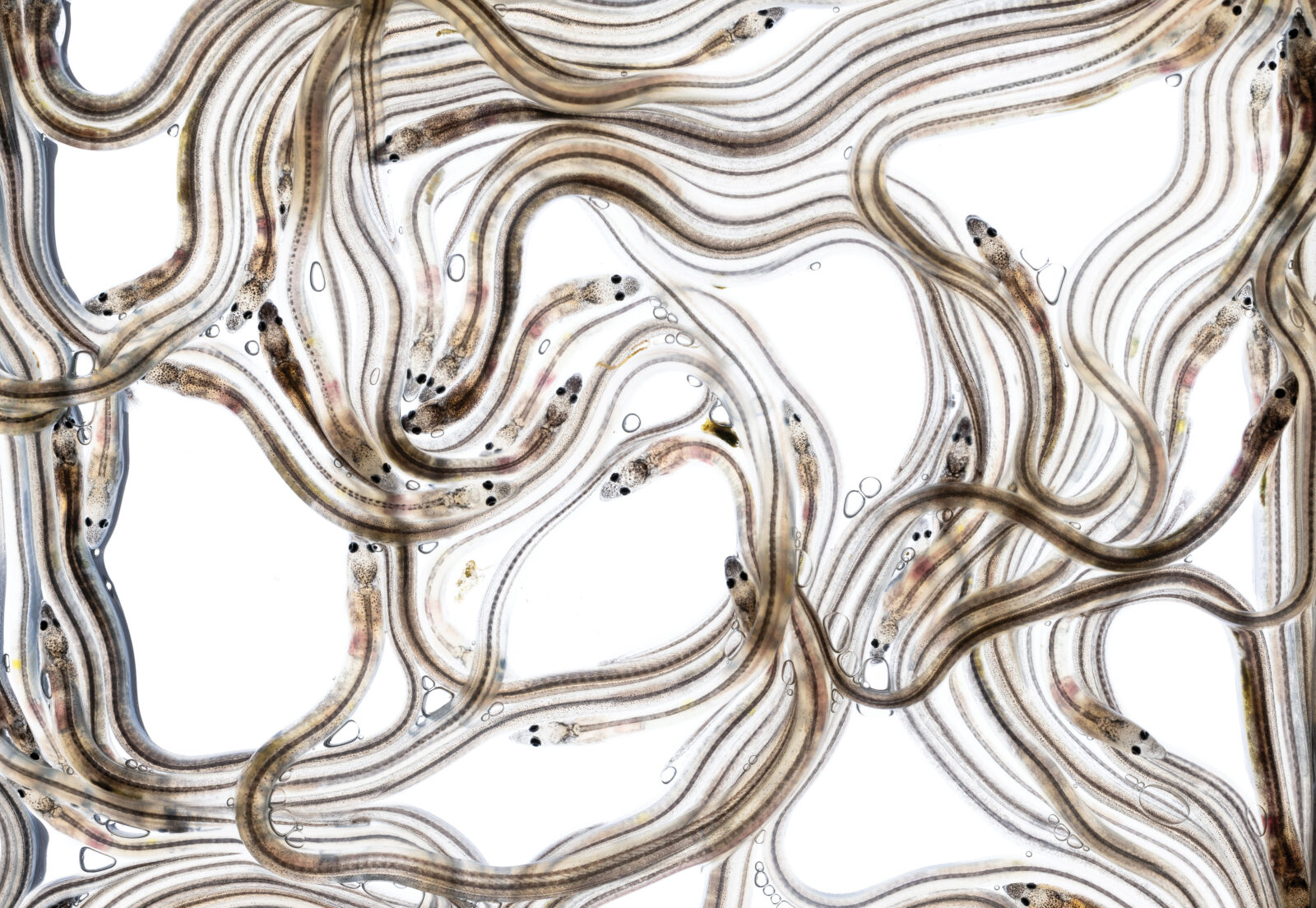
New Zealand’s eels begin their lives in the tropical Pacific as leaf-shaped larvae which drift for months before finally arriving around our shores. Tasting fresh water for the first time, they develop into tiny, transparent “glass eels” and cluster in huge shoals at the mouths of rivers, waiting for a high tide to ride in on. Often, it’s whitebaiters who see them first. There are old stories of streams of glass eels taking three days to pass. There are no stories like that now: the runs are short and sparse.
Earl is the latest in a series of researchers to monitor the migration here as part of a marathon DOC survey. After a big run overnight, the river is loaded with glass eels, clustered among the river stones, adapting to fresh water before starting upstream. She sweeps the wand of the fishing machine across the riffles, her backpack beeping as the wand emits a gentle pulse of electricity. Tiny eels tumble, stunned but unharmed, into a net downstream. We drive a bucketload of them to the National Institute of Water and Atmospheric Research (NIWA) headquarters in Christchurch. The eels will be away from the river for only a
few hours.
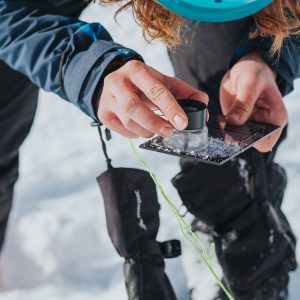
In a storage room at NIWA, Earl places each wriggling fingerling on a glass slide and peers at it through a microscope, noting down the species and how healthy it seems.
Most are shortfins, a species we share with Australia and parts of the South Pacific. Longfins are ours alone—as uniquely Kiwi as, well, kiwi. The Rakahuri study has been running for 30 years, recording about 10 times more shortfins than longfins entering the river. Numbers of both species have dwindled over that period.
Whether these are nationwide trends or patterns specific to this river is not clear—this is New Zealand’s only long-term glass eel survey, our only window into their inward migration.
Earl steps aside to allow me a glimpse at a baby longfin. Peering into the eyepiece, I see a body as clear as water. A prominent head, all jaw and dark eye. Backlit, each bone and organ is stunningly visible. And thumping away just behind the eel’s skull, a tiny, scarlet heart.
*
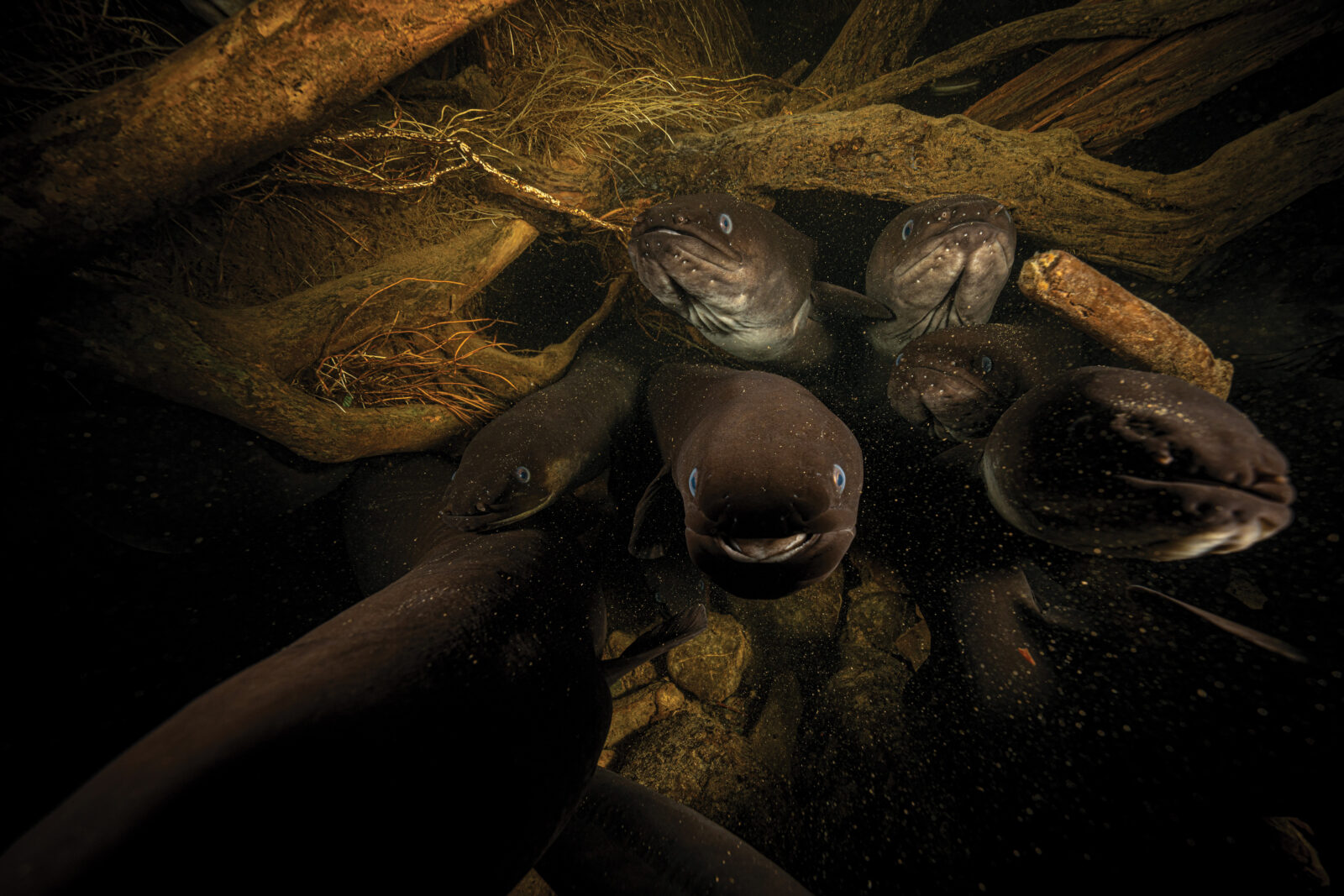
Eels are entwined in human history. Tuna, Māori called them generically, but Jane Kitson of Ngāi Tahu, Ngāti Mamoe and Waitaha tells me Māori had more than 70 names for them, depending on species, colouration and more. Eels were a cornerstone of Māori society, providing readily-available protein that could be preserved and stored for winter months, or traded for other commodities.
But they were, and are, much more than a food source. Kitson explains that tuna are relations and ancestors—the guardian creature that allowed Māori to establish and thrive in this landscape. “We have a responsibility to look after them.”
For generations, Māori connection to rivers, lakes and wetlands was forged through the harvesting of eels. The ancestors of Pākehā harvested them, too, points out freshwater ecologist Jack Wootton, who’s visiting from the UK to study our tuna. In the Middle Ages, the European eel was so fundamental to British society that it was used as a form of currency. But that species has experienced a catastrophic decline since the 1980s—a story repeated in North America and Japan, where the freshwater eels that sustained indigenous cultures for thousands of years also face extinction.
With the loss of a species, so, too, goes the cultural wisdom that surrounds it. In the space of a couple of generations, says Wootton, eel knowledge and awareness have largely vanished from European memory. Arriving in New Zealand, he was astonished to find how visible eels still are here. In towns and cities, there are information panels about them, sculptures and murals. There are even places, such as Christchurch’s Avon River/Ōtākaro, where the public can feed the eels, and touch them. “I think that’s a real beacon of hope for the future,” he says.
*
All over the world, when glass eels reach rivers they almost immediately run into danger. They’re so small that most fish screens can’t keep them out, meaning they can find their way into irrigation and water-supply intakes. Once inside, they quickly grow too big to escape. These eels are then doomed to spend the rest of their lives, which can span decades, in water races and canals, never reproducing. Other unfortunates get into water pumps, which slice them up with their metal blades.
Wootton wants to find ways to keep the water flowing while also keeping eels out of the intakes, and making sure the tiny, fragile younglings aren’t hurt during the encounter. These ones are about to have a swim in a flume fitted with a fish screen. He’s investigating different types of screen, and the way various eel species behave around them. If he can find common ground, he says, we’ve “maximised our ability to protect a whole group of species”.
Once in rivers, glass eels become more fully opaque, a stage at which they’re called elvers. In this form they are migration machines—longfins in particular can climb near-vertical rock walls and even skitter overland, briefly, to skirt rocky obstacles. But New Zealand’s waterways are strewn with barriers that they just can’t manage.
There are thousands of dams, including large hydroelectric dams providing more than half of the country’s electricity. Most of these were built with no consideration of fish passage (if anything, it was seen as a bonus that eels could no longer “infest” upland waterways, where acclimatisation societies were working to develop trout fisheries). Longfin eels like to push into the high country; hydro dams now cut off about a third of their habitat.
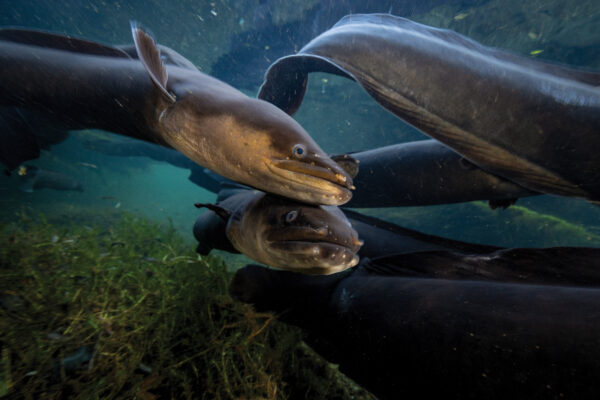
Creeks and rivers are also riddled with countless smaller obstacles such as weirs, which are like small dams, and perched culverts—pipes that emerge higher than the water on the downstream side, creating an impassable waterfall. At least half of our rivers and streams are upstream of some kind of barrier to fish migration, according to a 2022 NIWA study.
Swimming inland with the elvers are whitebait—shoals of īnanga and other migrating native fish that make up the bulk of the longfin diet. A single perched culvert on a creek might not stop all the elvers, but it will certainly block the īnanga.
An Otago hapū, Kāti Huirapa Rūnaka ki Puketeraki, has taken it upon itself to rectify the situation. In late summer, I catch up with the group’s environmental lead Matt Dale on the banks of Te Hakapupu, a small river that flows out of the East Otago hill country. He’s caught a couple of elvers for me to look at. Gone is the crystalline fragility of the glass eels I met on the Rakahuri—these are powerful, golden-brown string bullets with an insatiable hunger for movement.
We release the elvers on a recently installed fish ladder and watch them scurry up the sloped concrete like it’s a racetrack. For the first time in decades, īnanga are also swarming up this ladder, “turbo-charging” the entire upstream ecosystem, as Dale puts it.
Kāti Huirapa are working with the Otago Regional Council to replace every major barrier in the Hakapupu catchment with something fish and eels can easily navigate.
Achieving that on bigger rivers, though, is still a very long way off.
*
Power companies, too, face hurdles these days. They’re now obliged to consider fish passage when their resource consents come up for renewal. In most cases that means paying for “trap and transfer” teams which trap eels on one side of the dam and let them go on the other.
Moving elvers upstream in this way is relatively easy. It’s getting the big eels safely back downstream that’s the real challenge.
Longfin eels can live in their upland hideaways for more than a century, growing to enormous size. (The huge, 20-plus kilogram eels in the headwaters of catchments such as the Waitaki and the Mata-Au/Clutha almost certainly migrated up before the first dams were built, early last century.)
These giants breed once, at the end of their life, and to do so, they must travel thousands of kilometres back to the tropical Pacific seas they were born in.
When the urge to migrate hits them, their bodies change. Their heads become pointed, their fins bigger. Their bellies turn silver and their eyes grow wide.
On rainy autumn nights they move downstream, impelled, and completely unprepared for the barriers that now stand in their way. Hydro dams don’t just restrict passage—they suck eels into their turbines. They mash the tuna between blades and the tunnel, or chop them into little pieces. The turbines have been doing this, year after year, for more than a century. Paul Franklin, a fish-passage specialist at NIWA, says the trap-and-transfer programmes are better than nothing, but there are likely far more eels going through the turbines than safely carried around them.
“People know it happens, but it’s largely just ignored at this point.”
Bypass pipes and canals, designed to draw eels safely through or around a dam, have been installed in some places, with varying degrees of success. The problem is that migrating eels instinctually follow the strongest flow of water, which on a hydro dam is generally what’s going through the turbines. Getting an eel to choose the relatively small trickle draining off to one side is not easy.
Screening hydro intakes is massively expensive and can cause shutdowns when the screens become clogged. On bigger dams, screens just don’t work, because the water flow is so powerful —the eels get pinned to the screens.
Power companies can shut down turbines, or spill water over the face of dams on the rainy nights when eels are migrating. But they’re reluctant—both options pour revenue down the drain.
People have tried scaring eels away from the pipes and channels that feed dams—they’ve deployed light, sound, and electricity, with little success.
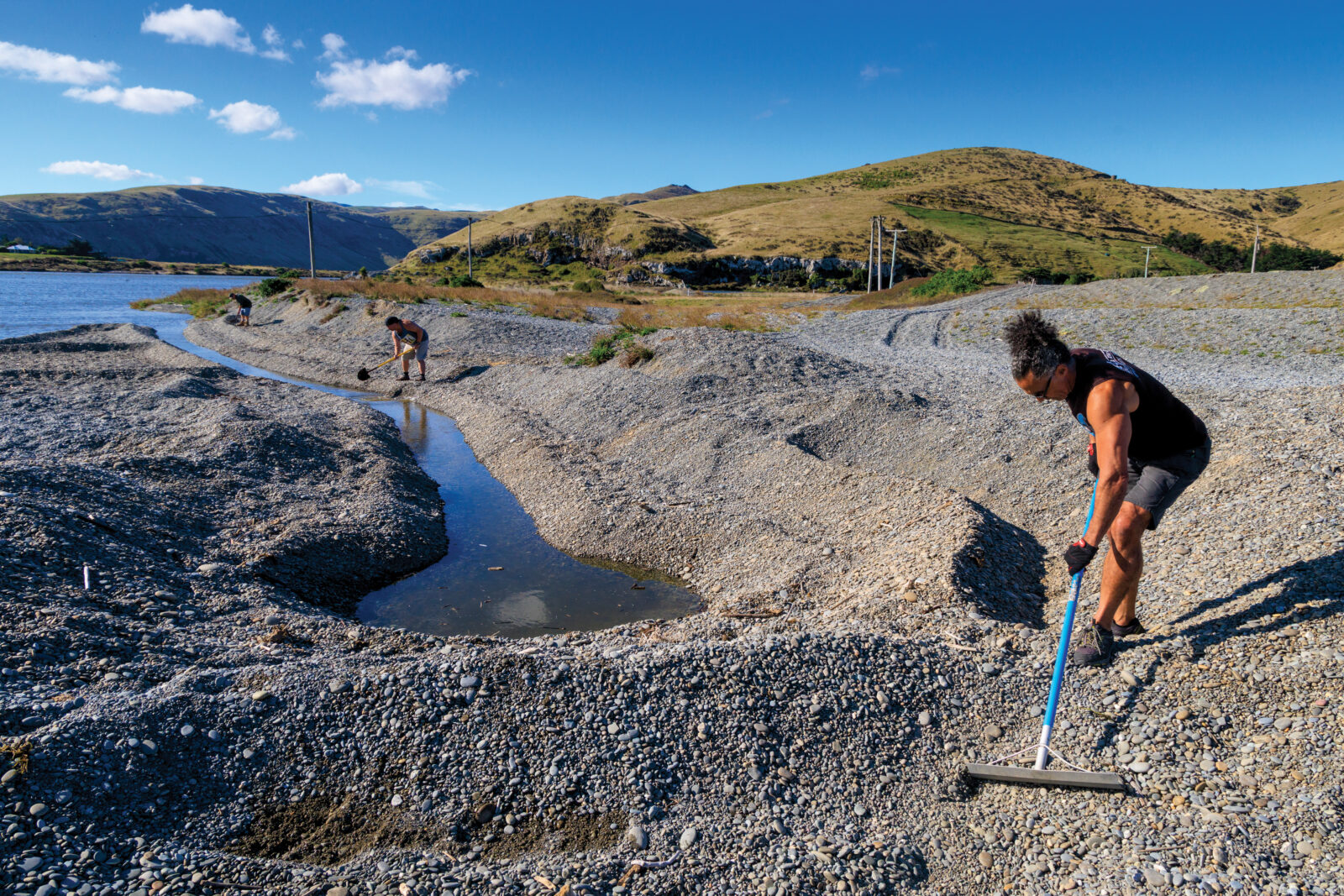
Modifying the turbines themselves offers some promise. So-called “fish-friendly” turbines have more rounded blades and no gaps between the blades and the turbine wall. They have helped northern-hemisphere eels, but these are much smaller than our longfins. At least in a New Zealand setting, the technology has a way to go before it does what it says on the tin. “I would call them ‘fish friendlier,’ or ‘less fish-deadly,’ says Franklin. The cost of turbine replacement is, of course, enormous.
Eel passage, says NIWA’s Don Jellyman, is “a very difficult issue internationally”, with no silver bullet.
The problem, says Wootton, is compounded by the fact that every hydro scheme is so very different. “It’s one of those impossible situations where you’ve got to solve the issue, but then also solve it for a hundred different types of abstraction.”
NIWA’s Jacques Boubee argues that to have a hope of finding a solution, we need to be pouring much more money and oomph into it—he points to Sweden and Ireland, where the issue has been tackled with far more gusto.
Meanwhile, demand for hydro energy is only going to increase. For New Zealand to reach its target of zero emissions by 2050, it is estimated we need to up our renewable electricity production by 70 per cent.
*
Autumn. The tuna heke is under way. Our biggest, oldest eels are on the move, pushing down rivers, seeking salt. At Birdlings Flat, near Christchurch, Kāti Irakehu and Kāti Mako whānau from around the country gather at their traditional homeland, on the shores of Wairewa/Lake Forsyth.
The eels are here, too—the lake sits right on the coast, and the tuna teeming into it are met with a final, natural hurdle: a huge gravel bar. For centuries, Māori fishers have used this to their advantage. They dig drains into the gravel, tapping into seams of running saltwater. Eels, smelling the sea, swim up the drains, where they can be hooked out with a gaff.
This annual harvest continues today.
For Kāti Irakehu and Kāti Mako, hapū member Matiu Prebble tells me, it’s important to have a steady supply of eels available for feeding whānau, as well as for tangihanga and other major events. Tuna is a delicacy for many of their older whānau, who can no longer fish for themselves. It’s also used for kaihaukai—exchanged with other groups harvesting prized kai such as tītī, muttonbirds.
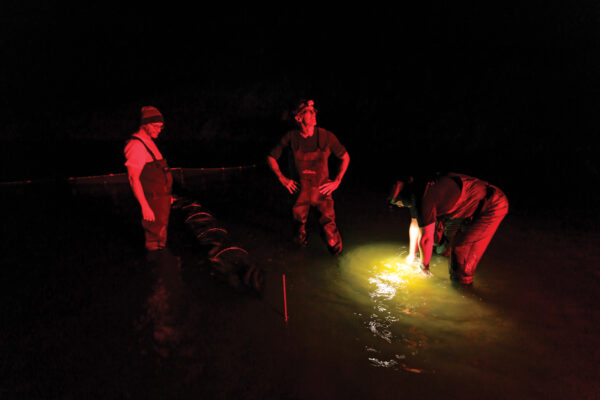
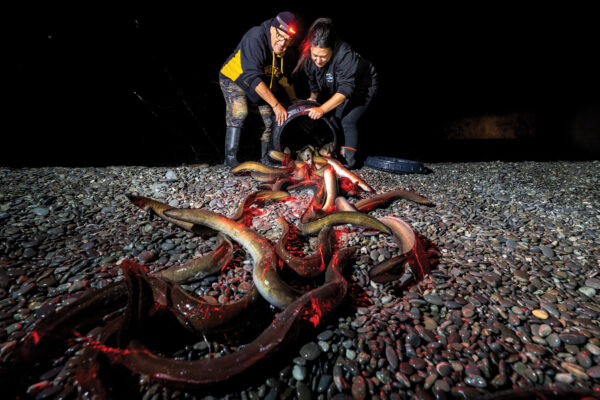
Up to a few thousand eels are harvested each year from the lake, but tens of thousands more gather at the gravel bar, trying to migrate. As a result of slow, natural, geological processes, there’s far more gravel here than there was a few decades ago, making it a lot harder for eels to get out. Christchurch City Council occasionally brings in heavy machinery to open the lake, at huge expense—but not necessarily at a time that’s best for the eels. The urge to get back to the ocean is fleeting, and felt only once. A tuna that can’t migrate will stay put and live out the rest of its life without reproducing.
So, at the same time as they’re catching eels, Wairewa whānau are also helping them escape.
On the night I visit, the crew set a couple of big hīnaki, car-sized traps, at one end of the lake. Within minutes, both are stuffed full of eels. I help load the creatures into barrels, wrestling as they squirm out of my grasp and flail at my feet. We fill two barrels at a time, loading them onto the back of the side-by-side driven by kaumātua Rei Simon. After he’s motored over the top of the bar we tip the barrels out on the gravel. Iaean Cranwell gives a karakia, then we stand in silent farewell as dozens of eels frantically wriggle down the face of the bar and into the sea.
We work into the night under a red and partially eclipsed moon, carrying about 40 barrels of eels across the bar. It’s hard work, and no doubt stressful to the eels, who need to be in peak condition for the huge migration ahead. Many more eels are left nosing helplessly at the gravel.
There’s no way to clear the whole lake by hand, so the rūnanga is working to get resource consent and money to build a fish pass—a long pipe that will tunnel under the gravel, hopefully allowing tuna to come and go as they please. In the meantime, whānau keep up this hard mahi throughout the heke, which lasts for several months. It’s part of their kaitiakitanga, or guardianship, of this precious resource. As we finish up, I catch Simon in a quiet moment, learning against the tray of the side-by-side. We’re both wet, cold and covered in slime. “Why do this?” I ask him. “It’s who we are,” he says.
*
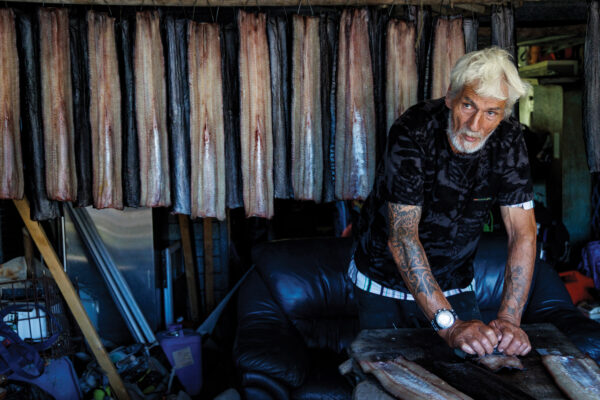
The following day, photographer Richard Robinson and I find Kāti Irakehu/Kāti Mako kaumātua Brent Ruru processing eels outside the lakeside bus he calls home. Fuelled on cold coffee and classic rock, he fillets eels at lightning speed, then salts them and hangs them to dry.
At night, from his bus, he listens for the big female eels gathering in the drains—they bark, he tells me, the guttural sound reverberating across the lake. Then, he goes down to fish. He takes only what he needs to feed himself and the whānau who depend on him. Days of processing follow.
On a wide slab of macrocarpa, Ruru rolls the fillets, massaging oil from the skin deep into the flesh. Such fillets can stay good unfrozen for months, even years. This was the food southern Māori carried on their long hīkoi through the mountains—packed full of protein, nearly indestructible. Ruru goes over to the smoker, which has been quietly puffing away all morning. He hooks out a couple of fillets for us to taste. The golden-brown flesh pulls away from the skin in long, greasy slabs. It’s rich and oily, delicious. Ruru tells me the old people all reckon his smoked tuna’s the best. He is intent on teaching others, as he was taught.
“We need to keep the tradition going,” he tells me. “Otherwise we can’t go out and gather our own kai. What’s left for the people? What’s left for the young ones?”
*
A month later, at the other end of the country, Robinson and I drive through rain to reach the Bay of Plenty forestry town of Murupara. This is the rohe of Ngāti Manawa, an iwi that for hundreds of years has drawn sustenance and identity from the Rangitāiki River.
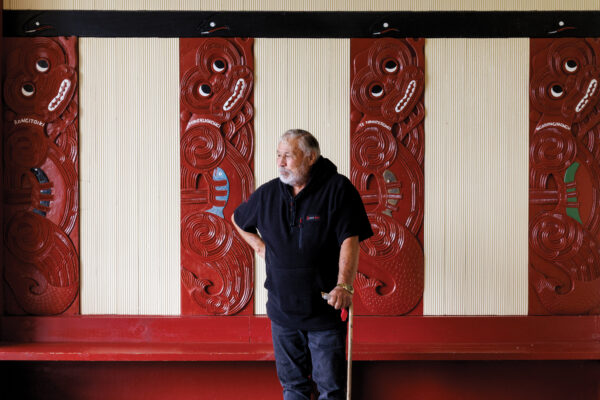
Eight kaitiaki, all in the form of eels, adorn their Rangatahi meeting house. Murupara is named after one of them. We stand beneath the carved entrance with kaumātua Maurice Toetoe. Eels, he tells me, are woven into the tribe’s waiata and karakia, some of which tell of the eels’ migration to their tropical Pacific spawning ground. The old people, Toetoe says, didn’t need Western science to know where those migrating tuna were off to.
A century ago, when each autumn’s heke started, tens of thousands of eels would gather in the Rangipō wetland, writhing and squirming in enormous balls, greeting each other in preparation for their departure. The tribe would go down to Rangipō to farewell them, the women wailing in their grief, sometimes for days. “They knew they wouldn’t see them again,” says Toetoe.
He grew up harvesting tuna and other kai from the river every day. Among North Island iwi, he says, Ngāti Manawa have always been famous for their eel, which is traditionally cooked in flax leaves. “If we didn’t have tuna for our visitors, we were useless.”
Back in the 1960s, when Toetoe was young, up to 60 forestry contractors operated out of Murupara, and the town was booming. Now, workers are bussed in from elsewhere, while iwi are shut out of traditional food-gathering sites by camera-guarded security fences. There’s little here for young people now, so they drift away—from their rohe, their river, and their ancient connection to tuna.
The Matahina hydro dam went up in 1967, barring elvers from the upper reaches of the Rangitāiki. The Aniwhenua dam upstream followed in 1980, while the Flaxy and Wheao tributaries were also diverted and dammed. Eel stocks dwindled until, Toetoe says, it was hard to catch even a feed.
“Our old people said to us, ‘If you guys don’t do anything, your kids, your grandkids and your great-grandkids aren’t going to have eel.’”
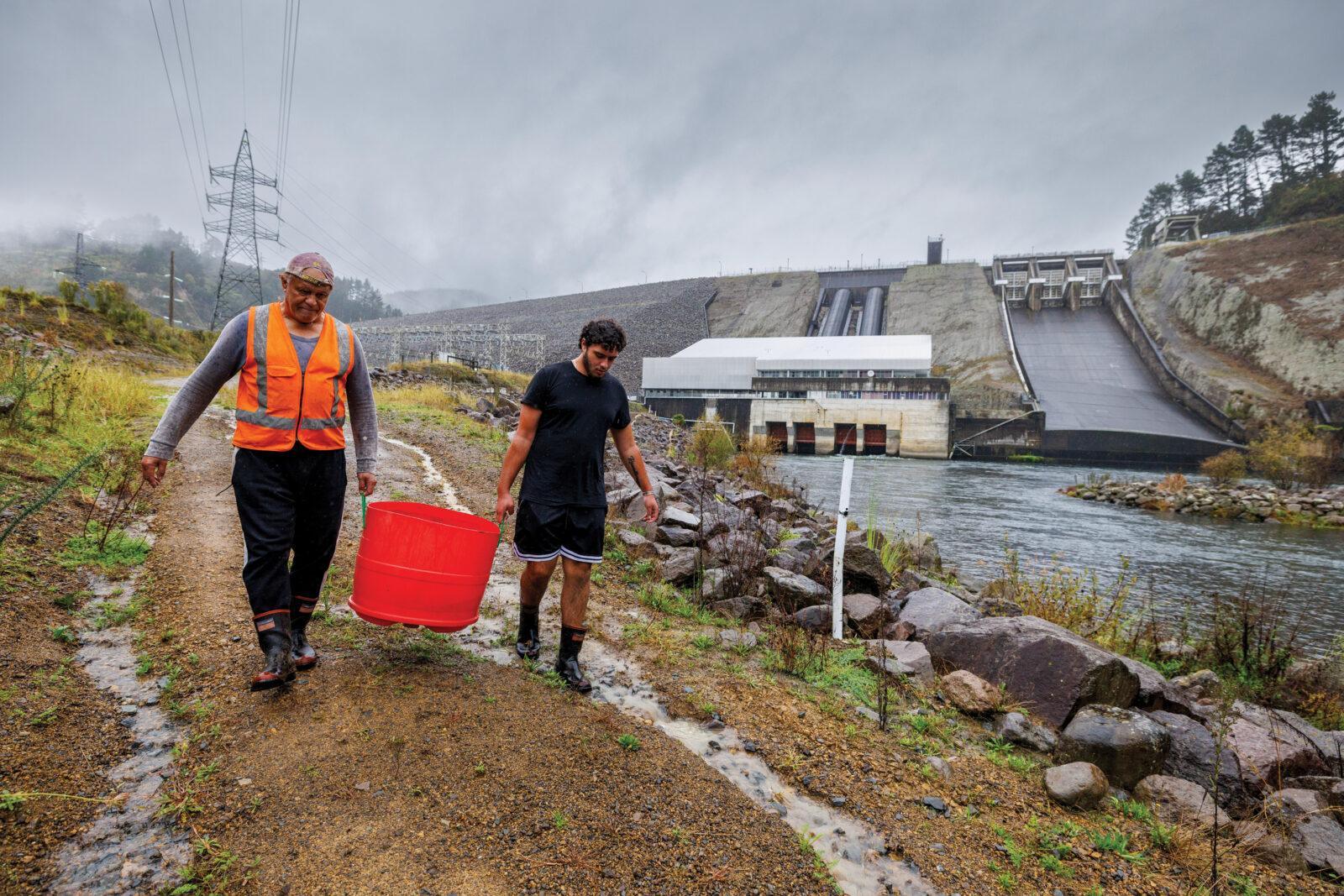
In the early 1980s, Toetoe and others started catching migrating adult eels and transporting them down past the dams. “We didn’t know what we were doing,” Toetoe says. They would set nets and sleep out on the riverbank to keep an eye on them. “That’s what the eel meant to us.” No one got paid in those early days. A formal trap-and-transfer operation, run in conjunction with power companies, bringing elvers up from below the Matahina and running adult eels downstream, was started by Bill Kerrison and Frank Mitai in 1989.
Kerrison died of a heart attack in 2020 while escorting a load of elvers upstream, a fortnight after he was appointed a Member of the New Zealand Order of Merit for his work with the eels. Toetoe is still going. His team, made up of Ngāti Manawa whānau, is funded by Manawa Energy (no relation to the iwi), which operates both the Matahina and the Wheao and Flaxy schemes, and by Pioneer Energy, which operates the Aniwhenua scheme.
Night falls. I sit outside my cabin and listen to the rain rattling the verandah. I think of the eels making their way down the bush-clad ramparts of Te Urewera, down farm drains and streams, seeking their river—their pathway to the sea.
The next day, we’re out early to check nets. Toetoe drives us across the Aniwhenua dam, which overlooks a sad trickle of water pooling in the dry, rocky gorge that once held the mighty Rangitāiki. The main flow is now diverted down a long canal that leads to a headpond above the power station. The water in the abandoned river channel looks lifeless and grey—like so many of New Zealand’s rivers, this one is contaminated by nutrient runoff and sediment. “It’s embarrassing to us,” says Toetoe. “The river is our ancestor. You don’t treat your ancestor like that.”
From a stream feeding the headpond, Toetoe hauls out a hīnaki. Even though the heke is well underway, it’s been a quiet night—there is only one eel in it, a shortfin. Toetoe loads it into a drum and we head out on the half-hour drive towards Matahina. “You can imagine how many times we’ve driven this road in 40 years,” he says.
In a good year, the team will shift up to 70 eels. In their worst year, they shifted only eight. It requires months of commitment—there are no weekends off when the tuna are running. I ask Toetoe if it’s all worth it. “Each one has eight to ten million eggs inside of it,” he tells me. “That’s why it’s crucial.” Whānau, he says, are finally reaping the benefits, with eel numbers in the river starting to rebound. But can they keep up the traps and buckets indefinitely? Should they have to?
The trap-and-transfer programme gives Ngāti Manawa team member Himiona Nuku several months of paid work each year, but for the sake of the eels, he says, he’d love to be done out of the job by “free-flow” fish passage on these dams. His brother William and sister Erena work alongside him. “Trap-and-transfer,” Erena tells me, “is a plaster.”
Karito Paul of Ngāti Manawa grew up with the Nuku siblings, who are his cousins. He is now heavily involved in freshwater management with the iwi. “I think there’s a real onus on power companies in acknowledging that trap-and-transfer is not the solution,” he says. “When power companies realise that, then they’ll start looking at the real solutions.”
Pioneer Energy recently installed a $120,000 siphon on the Aniwhenua power station. It’s designed to carry eels past the station, but at the time of writing, no eels have used it. Toetoe tells me he would like to see a bypass go in to skirt the dam, making use of an old stream bed that he suspects still holds the scent of previous eel migrations.
Ngāti Manawa are not sitting idly by—like other iwi around the country, they’re standing their ground, putting constant pressure on power companies to do things better.
The resource consents for the Rangitāiki’s dams are up for renewal. Ngāti Manawa’s tumu whakarae, or CEO, Eugene Berryman-Kamp, tells me the iwi will oppose those consents on principle, knowing they will almost certainly be granted anyway.
“As kaitiaki, we can’t condone something which actively prevents our taonga species from migrating,” he tells me. “What we can do is ensure adequate resource conditions are in place to ensure that we can fulfil our kaitiaki duty.”
That means continued funding of the trap-and-transfer system, as well as development of “passive” eel bypasses where possible.
“Times are changing,” says Berryman-Kamp. “[Power companies] are realising it’s much better if they can work with mana whenua rather than against us.”
The challenge, as Paul explains, is getting power companies to see tuna as more than just a slimy fish that causes them headaches—to see eels, and their epic migrations, through Māori eyes. “All of this is intrinsically linked to our arrival and our being,” he tells me. “It’s part of who we are and what led us here, part of what created Māoritanga and Māoridom… The species is an ancestor to us, a brother to us. It’s a mother to us and the livelihood of our people.
“How do we articulate that?”
*
On March 5, 2021, members of Northland hapū collective Ngā Kaitiaki o Ngā Wai Māori walked up to the Whangārei District Council offices and delivered a gift: tubs full of chopped-up, rotting eel. The eels had died in flood pumps on the Hikurangi Repo, a wetland that was once one of the biggest in the southern hemisphere. Chantez Connor-Kingi, of Ngāti Kahu o Torongare, tells me that for local hapū “enough was enough”.
Over generations, they’d watched most of the wetland drained and converted to farmland, some of Northland’s most productive. Keeping the water at bay are an array of antiquated, inefficient pump stations, each costing more than half a million dollars a year to run in electricity alone. Each, like the hydro dams, has a vicious turbine system inside.
The pumps operate more during high flows—which is also when eels are on the move. Vast numbers of tuna get minced up. “We need to change the way we farm and how we use these pumps,” says Connor-Kingi, “because we’re missing out on a whole generation of tuna that should have been here for the next generation.”
Last year, as a result of a decade of lobbying by the collective, the council finally removed one of the seven offending pump stations and replaced it with a fish-friendly gravity gate. It’s a big square tunnel that uses nothing but water pressure to deal with high flows and get water off farmland. It drains water faster, costs almost nothing to operate, and most importantly, doesn’t chop up eels.
While local farmers took a long time to support the idea, Connor-Kingi tells me, now that they’ve seen the gravity gate in action, “they’re just blown away”. After years of inaction, plans are under way for three more gravity gates, at around $180,000 each. As well, two pumps are set to be replaced by much more expensive tech that gently lifts fish from the water using a giant corkscrew. These machines claim to be 100 per cent “fish friendly” and are already cranking in the Waikato. The success, says Connor-Kingi, demonstrates how collective iwi-led action can bring about positive change for tuna and the ecosystems they live in. “We eat, sleep and breathe these fish,” she says. “It’s about the next generation being able to still fish [for tuna], and understanding that if these fish are not around, then we won’t be around.”
Incorporating mātauranga Māori, traditional knowledge, into management, she says, is crucial to overcoming the challenges our freshwater ecosystems face. Māori “know the lay of the land. We understand what it’s trying to tell us. It’s not witchcraft, it’s just in our DNA.”
*
Tuna are definitely in Willie Tai’s DNA. And on his skin, too. Robinson and I meet him at a canal on the outskirts of Tauranga, where the former rugby player with Eel King tattooed across his stomach has been rescuing migrating tuna for 25 years.
This canal connects Lake McLaren, at the base of the Kaimai Range, with a long pipe that leads to the Ruahihi power station on the Wairoa River. Eels coming down the canal get pressed up against intake screens. An automatic cleaner, designed to clear weed, periodically wipes everything off the grille—eels included. All of it is tipped into a heap, and if Tai wasn’t here, the eels would die a slow death on the concrete. But Tai isn’t about to let that happen. “I’ve always been obsessed with eels,” he says.
Tai, whose whakapapa is Whakatōhea, Ngāi te Rangi, Ngāti Ranginui and Ngāti Raukawa, grew up spearing, trapping, and diving for eels for food. “I’ve caught thousands,” he says. “It was time to give back.”
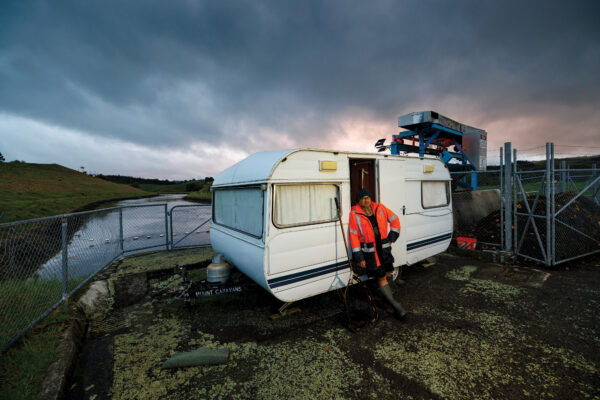
At first, he had to trespass, jumping the security fence to get to the tuna. Now, he’s employed by Manawa Energy, but says he’d be out here doing it regardless of the money.
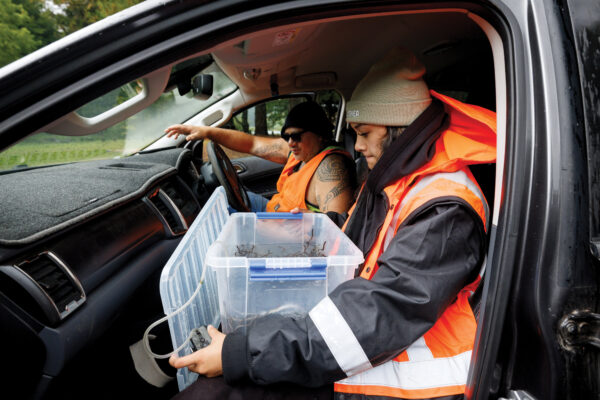
This is Tai’s second job—by day, he works at a sawmill. Every night during the heke, he’s on the canal, usually alone, grabbing snatches of sleep in a small caravan. Whenever the cleaner goes off, it wakes him, and he’s out the door to scoop up any eels it’s swiped, before driving down to release them below the dam.
“It feels righteous,” he says. “And besides, this is what I do best.”
Without Willie Tai, few migrating eels would escape Lake McLaren for the sea. (Manawa Energy acknowledges the shortcomings of this system and says it is working to ensure Tai is better supported.)
I gaze at the broiling wash of water around the intake. An eel appears in the lights and Tai clambers down to haul it out with a net. It’s a longfin, a pretty big one—maybe 10 kilograms. This eel might be 80 years old, or more. Her large size indicates she’s a female. She has survived decades of deteriorating water quality, fishing nets, and turbines.
Tai puts her in a tub and I lean in for a closer look. She is broad and brown, and to my surprise, utterly calm. She lets me lift her almost entirely out of the water to feel her weight.
Tai transfers the tuna to a barrel and we drive her down to the river. I watch as she slips into the deep water of the Wairoa. From here, she’ll find the sea, and head for her breeding grounds, 2500 kilometers away.
*
It’s late when Robinson and I finally roll into Auckland, the motorway slick with rain. I look out at the city of people, tucked up warm thanks to the electricity provided by the dams. When that big longfin first arrived in the Wairoa River as a glass eel, this motorway didn’t exist and trams were still rattling up and down Queen Street. By now she’ll be tasting salt for the first time in nearly a century, pausing to allow her body to adjust before embarking on the greatest journey of her life. Willie Tai, meanwhile, will be eating a can of baked beans for dinner and settling in for another long, cold night.
More by Bill Morris
More by Richard Robinson