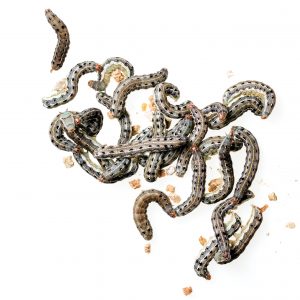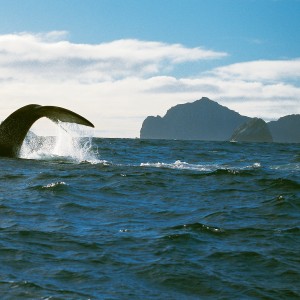




The bird with a big mouth. The bird who leads the flock. The bird who announces the day. The bird who sounds the alarm. The dark bird. The rare bird. The noble, silly, insomniac parrot we’re going to have to learn to live with, all over again.
Once upon a time—not that long ago, actually—people in New Zealand had pet parrots. They were good company. You could teach them to say a few words, not many. They were always so excited to see people that they were living doorbells: “Kāāā!” they’d shout. “Kā! Kā!” Once, a bunch of warriors sneaking around learned the hard way not to bring their parrots with them, which is such a good story that Ngāti Porou put it in a song.
Kākā used to be so abundant they were like fish of the air. Whole fleets of them cruised the forest, on the hunt for nectar and sap; people counted 40 birds passing, 60. Their colours varied: some were yellower, others redder, others darker. When they settled, they’d weigh down the branches of trees. The first Pākehā settlers used to throw things at them and count how many birds would scatter, like bowling.
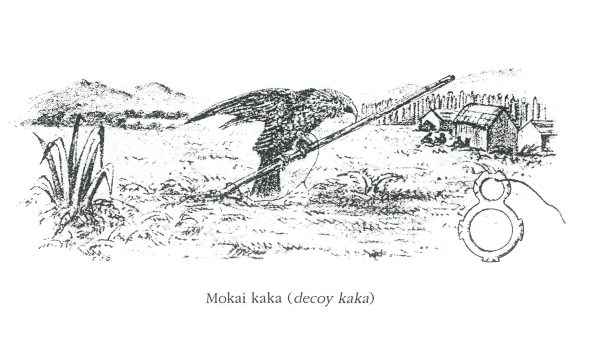
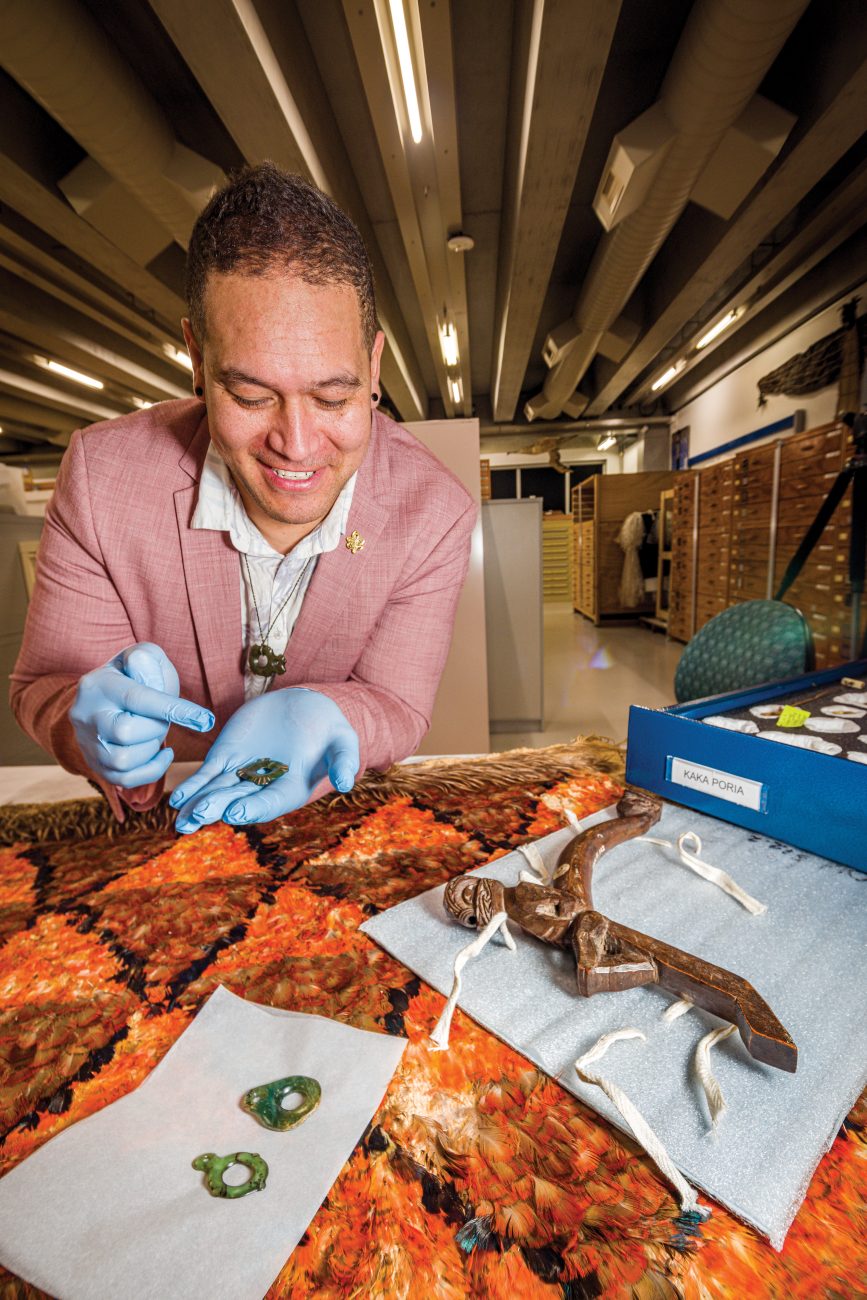
Isaac Te Awa’s great-grandmother Tuhikura Te Awa was the last of his Ngāpuhi ancestors to have a pet kākā. She trained it in the usual way: with a kākā poria, a piece of carved stone or bone that the bird wears as an anklet. There are two eyelets in a kākā poria, one big, one tiny: the young bird’s leg goes through the larger one, and a cord is tied through the smaller one. “You would use the cord while you were training them and teaching them and guiding their behaviour,” says Te Awa, who is Te Papa’s mātauranga Māori curator. “And then, eventually, you’d take the cord off.”
The bird would keep wearing the kākā poria, which denoted that it was part of someone’s family. Which Tuhikura’s kākā was—it had a daily routine like the rest of the whānau. “It would come in, it would have breakfast, and then it would go do its day things and then it would come back at night. There was a time in the afternoon where if everyone wasn’t home, it would go to the school, the sawmill, the shop, the pub, to round everyone up.”
Tuhikura’s kākā loved the family, says Te Awa, but it was also naughty. He remembers a long list of household items the kākā damaged: lawn chairs, jandals, toys. It would rip buttons off clothing. And it relished torturing the cat.
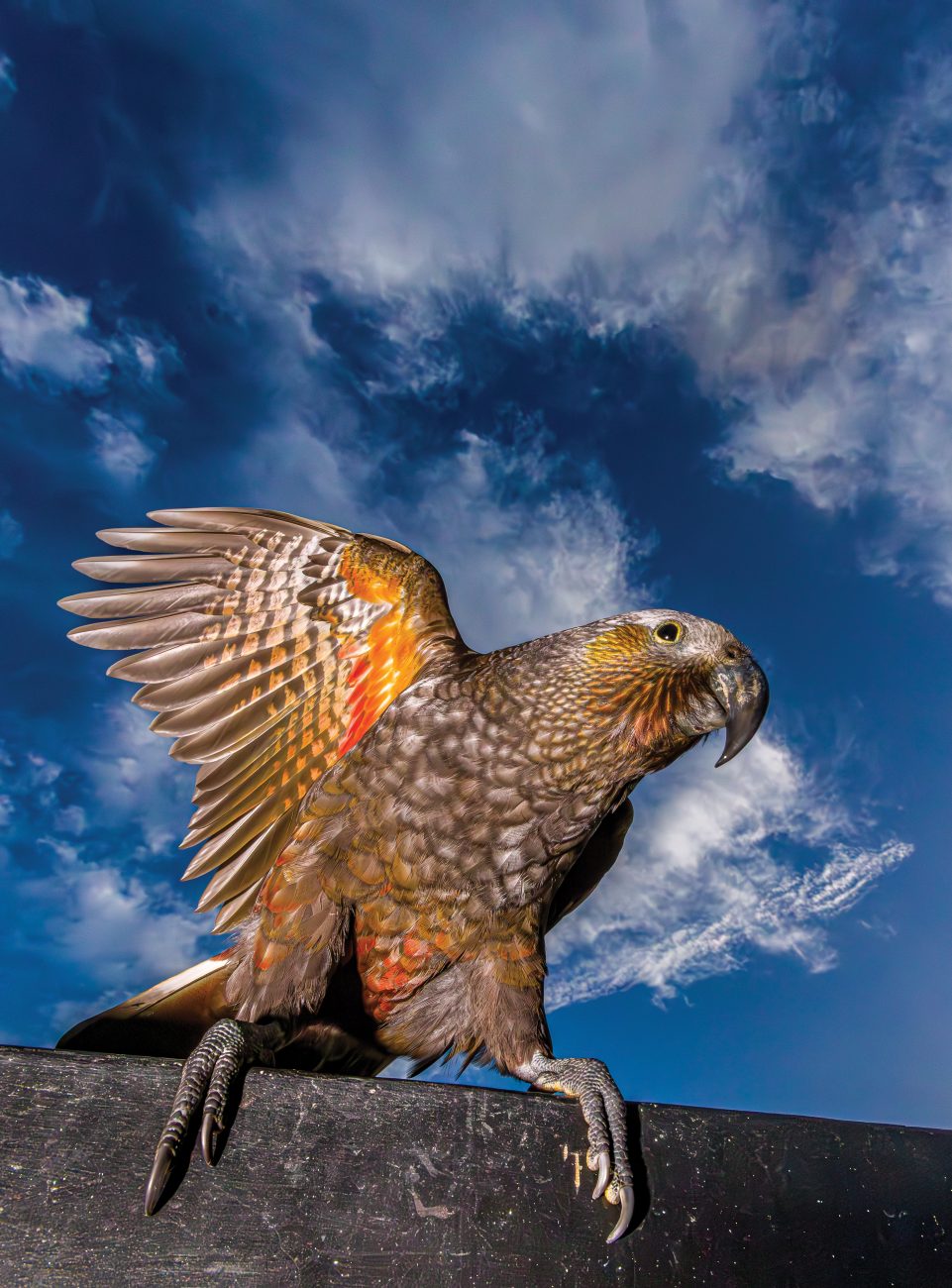
You could teach kākā sounds, songs, speech: they could recite karakia, prayers, and tauparapara, the openings of speeches, or give your pepeha for you—the formal introduction when meeting strangers. Tuhikura taught hers to recite part of her whakapapa, her genealogy. “It’s like the ultimate party trick when you’re in a hui,” says Te Awa.
The practice of having a household kākā disappeared along with the birds themselves. The usual predators—rats, stoats, possums, humans—wiped them out, leaving only their names behind. And so there are no kākā in Ruakākā, on the Tūtūkākā Coast, in the Kākānui range, or at Kākā Point.
But there’s one place they’re everywhere—not quite the superabundance of the past, but enough that kākā are affecting the human world again. What kind of relationship are we going to have with them this time around?
*
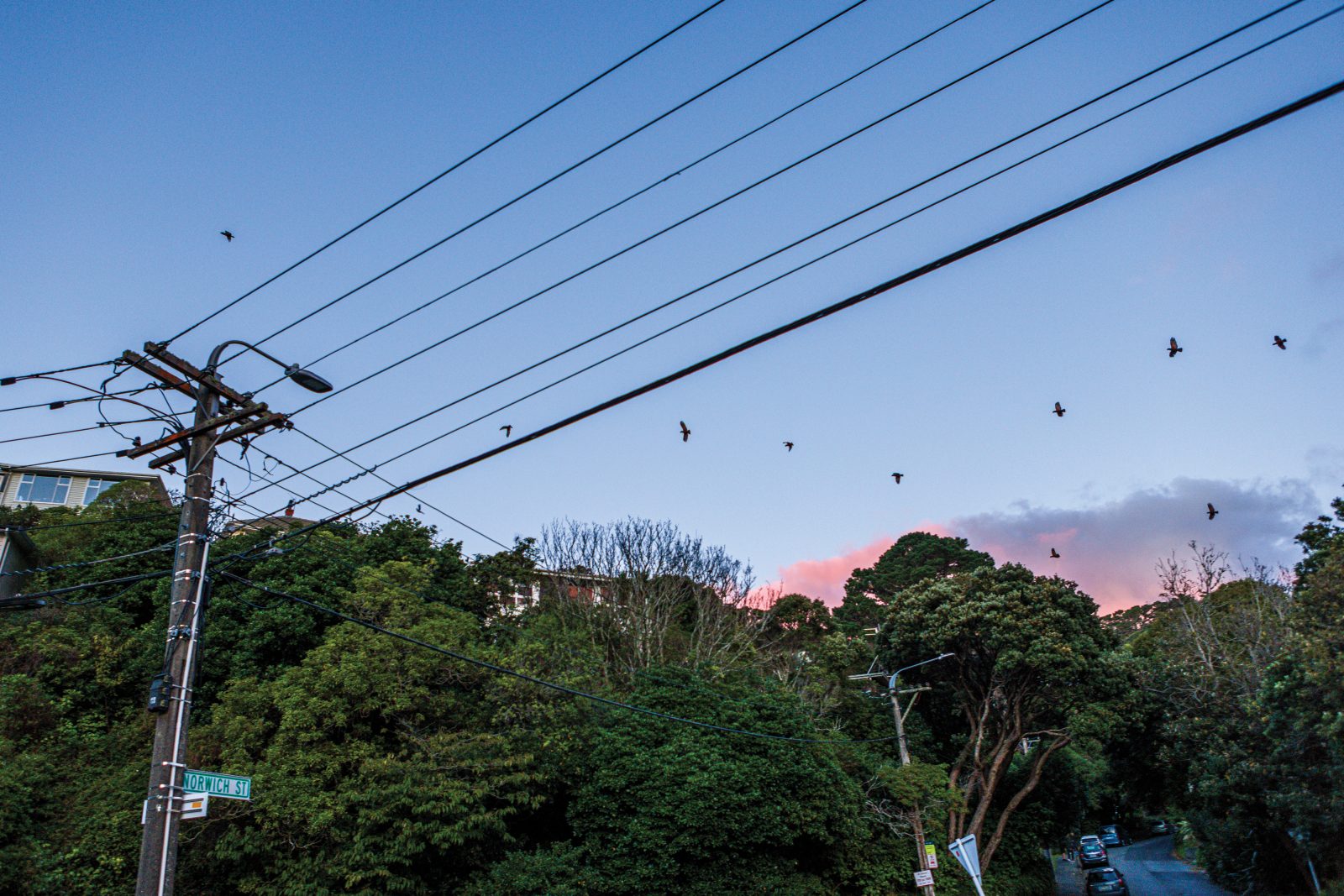
I’ve barely taken two steps off the bus from Wellington Airport when there’s a screech, and I look up. The bird is very high above me. At first, I wonder if it’s a kārearea—surely it isn’t this easy to spot a kākā—but it has the wrong moves for a falcon. Kārearea loiter, and this bird is on its way somewhere. It occurs to me that going to Wellington to look for kākā is a bit like going to the beach to look for seagulls.
Kākā were extinct in Wellington when the first fences went up around Zealandia, a gully dividing the suburbs of Karori and Brooklyn. A small group of kākā were translocated to the sanctuary in the early 2000s. Fifteen years later, there were 750—and those were just the banded birds. Zealandia has become a bird factory, issuing kākā and kererū to roam around the city. All they’d needed was a safe place to grow up.
“The one thing Zealandia has shown us is that it’s all about the predators,” says Te Papa ornithologist Colin Miskelly. “I think it’s just such a powerful lesson that you just walk through a gate and a fence, and it’s like stepping back in time. And you can see it’s pretty rubbish forest. You know, barely a podocarp in sight. All the big trees are pine trees.”
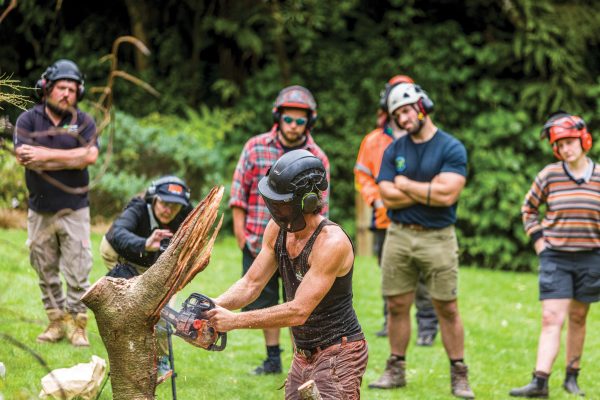
The fact that kākā have spread so widely throughout the city, though, is due to previous efforts that set the scene. A decade before the first kākā arrived, Wellington carried out its first possum purge in an attempt to protect the old-growth forest at Ōtari-Wilton’s Bush. (Possums graze on trees as well as eating eggs and chicks.) “They killed so many possums at Ōtari that it was the only time it’s been closed, because it smelled so bad from all the rotting carcasses,” says Tim Park, who manages the reserve. “That kind of protection of this old forest has allowed those birds, when they’ve spilled over from Zealandia, to find safe places to exist and nest and basically produce their own families.”
Zealandia’s bicultural engagement lead ranger, Terese McLeod, feels a sense of responsibility to the birds which are growing up and leaving home. “We’re exposing them to a city environment now,” she says, “and we don’t know where they’re going in the city. Are they doing okay outside the fence or are they not?”
McLeod really wants to know what they’re getting up to. She’s part of a new project aiming to surveil Wellington kākā using facial-recognition technology. If artificial intelligence can track individual humans by catching a glimpse of our faces, surely it could learn to track parrots, too?
I meet the project group at the mouth of the path into Zealandia. There’s animal cognition expert Rachael Shaw and AI researcher Andrew Lensen, both from Te Herenga Waka—Victoria University of Wellington. Zealandia conservation lead ranger Ellen Irwin brings on-the-ground expertise: she’s a pro at finding lost kākā chicks by mimicking adult calls and listening for the chicks’ answer. (Irwin wouldn’t say she speaks kākā very well: just enough to raise the birds’ curiosity.)
They’ve been filming kākā in Zealandia, gathering footage in order to teach a neural network—a computer program that can learn—to tell birds apart. So far, it involves a lot of old-fashioned work: keeping track of the kākā visiting various cameras, identifying them by their bands, in order to confirm that the AI correctly recognises individual birds. “It’s not just like, ‘Oh, easy, computer does thing, now we know the answer’,” says Shaw. “You still need hundreds of hours of people sitting there doing the tedious work of IDing.”
Surveilling kākā has other challenges. The birds tend to lick the camera lenses, leaving them foggy with spit. “One of them actually was able to lever the whole camera out and chuck it down a hill,” says Shaw.
Or sometimes the birds go straight for disembowelment. One day, Shaw went to check a camera only to find its parts strewn across the leaf litter. “They had managed to open it, remove the seal that keeps it waterproof, take out every single battery, scatter it around, take the SD card out and chew it into pieces,” she says.
“‘We want no evidence of our crime’,” says Irwin, laughing. She’s still trying to design tracking tunnels that kākā won’t destroy.
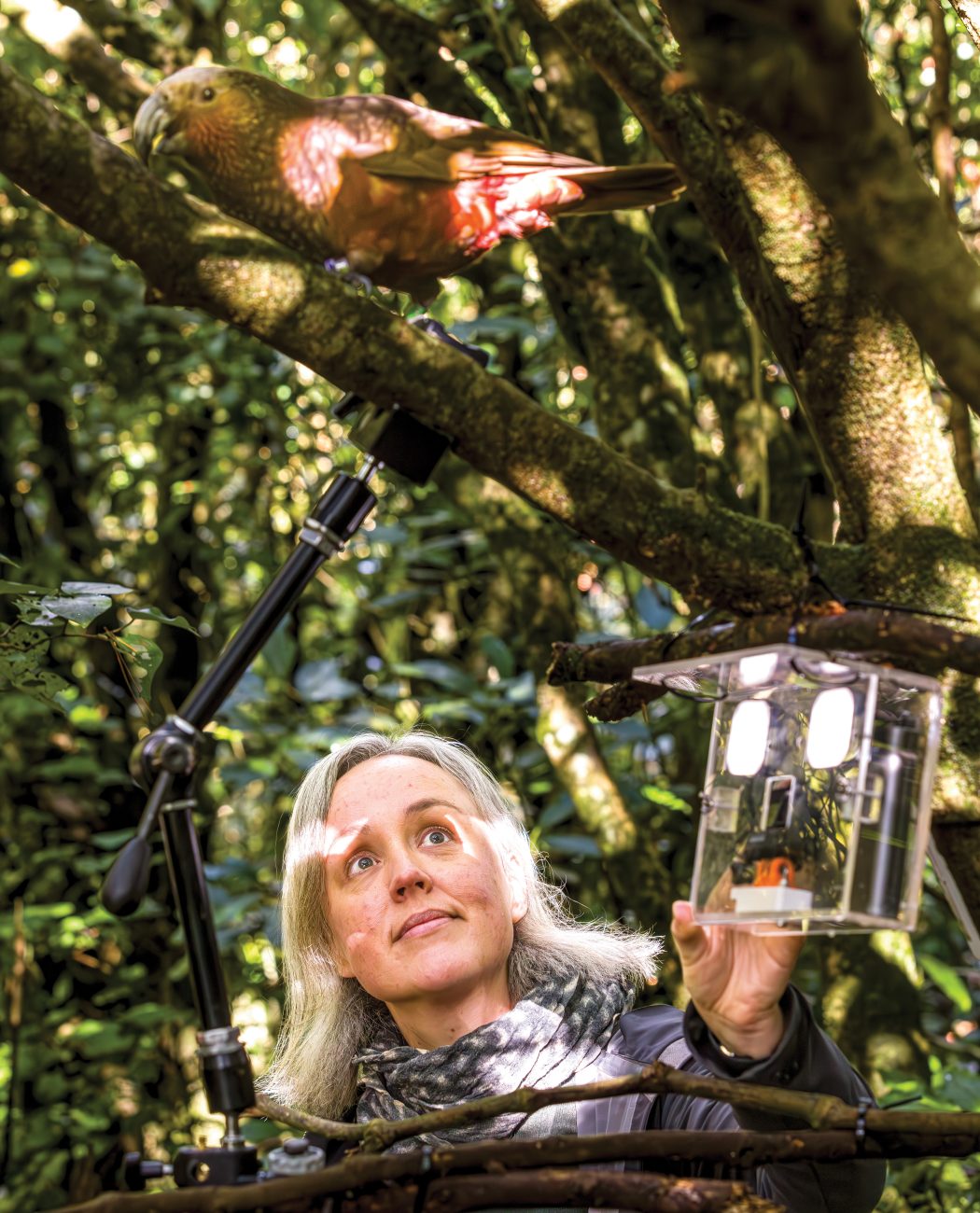
If the facial-recognition project works, it’ll transform the way we keep track of species. Instead of sending people to look for birds—to spot leg bands or to pick up radio signals from transmitters—cameras could film them near feeding stations or other popular spots, and software could identify individuals. Video surveillance for birds.
All of that is a big “if” for Shaw and Lensen; so far, they’ve only proven the concept in this contained setting with a small group of birds.
But if it does work, it would allow the Wellington public to become involved in the work of kākā tracking. Shaw’s ambition is that, eventually, someone will be able to take a picture of a bird, drop it into an app and immediately find out its name and where it was last spotted. “That would be the ultimate dream. In a city, there’s a really good kind of opportunity to harness the fact that people have devices and there’s many, many eyes that can see the birds.”
*
It’s been a rough start to this second crack at human-kākā cohabitation. In 2016, a study revealed that Wellingtonians were killing 80 per cent of kākā chicks being monitored in the city, though people almost certainly didn’t know they were doing it.
The trouble was, people had started feeding the kākā: typical bird stuff, nuts and seeds, crackers and bread. Those birds regurgitated it for their chicks, but human food poisons young kākā: the nutritional balance is all wrong. Chicks’ bones become spongy, their beaks don’t form properly, and they die before they can fly, their bodies unable to support them. Sometimes, rangers found fledglings which had broken every single one of their bones.
“It’s really awful,” says Irwin. “And the feeders don’t see the consequence of that. You think you’re just doing a good thing by feeding the birds.”
More by Rebekah White
More by Rob Suisted
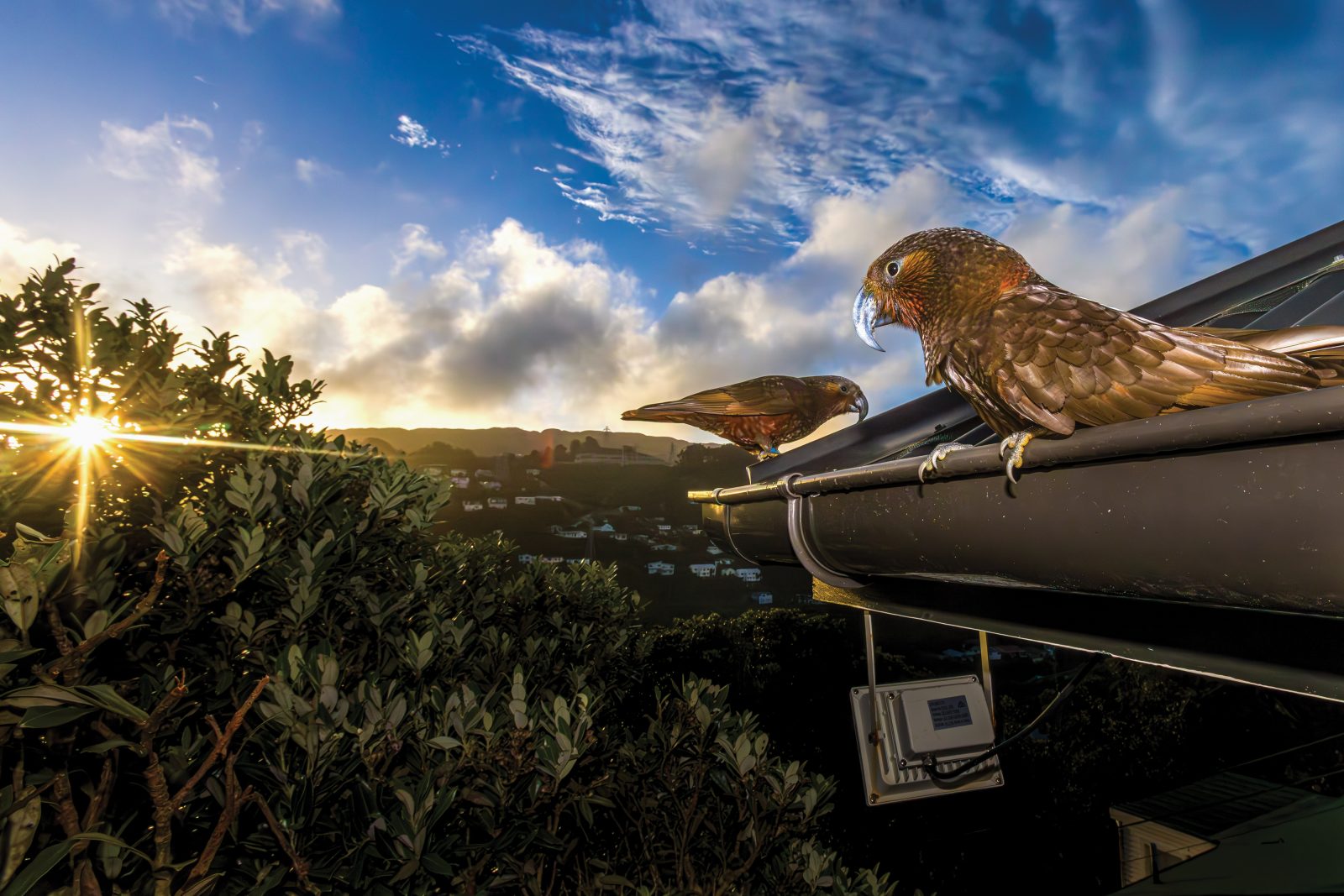
Another part of the problem is that where one kākā goes, others are sure to follow. “As soon as you start feeding one,” says Irwin, “they’ll tell their friends, and so we’ve had people who have, like, 70 kākā turning up to their property a day.”
Irwin gets phone calls from people asking what do about the kākā chewing on their roof flashing or their prized walnut tree. “There’s no kākā deterrent,” she says. But she does tell them to keep an eye out for whether anyone nearby is feeding the birds. A 2018 study found that people whose neighbours were feeding kākā were much more likely to have had their home or garden damaged. Idle birds make trouble, says Irwin. “Normally they’ll spend most of their day foraging for food. And so if you give them, essentially, a sugar rush all in one go, then they are like, ‘Well, I don’t need to spend that time foraging. What else can I get up to?’”
*
What kākā get up to is a question that Neil Fitzgerald from the Bioeconomy Science Institute has been working on. Back when he was a student at the University of Waikato, he’d notice birds turning up around Hamilton in the winter and then disappearing in the summer. “We were interested in where they were going,” he says.
In September 2020, he started the first-ever kākā-tracking project, fitting GPS and radio transmitters to 25 mostly young and female birds near Morrinsville and Hamilton. As spring progressed, the birds left the Waikato, and all of them went north—except one. They travelled to the Coromandel, to islands in the Hauraki Gulf, and coastal areas north of Auckland. One exception flew, inexplicably, from Hamilton to Kaitaia, equalling the kākā record for the longest trip:
400 kilometres.
The next question Fitzgerald is tackling is why these birds are travelling such long distances. Have some kākā always done this, while others stay home? Or is it because they’re not able to find enough winter food in the north? Fitzgerald suspects this might be the case: lowland forests are the ones that contain winter-fruiting trees, like kohekohe, and they’re “pretty much gone”, he says.
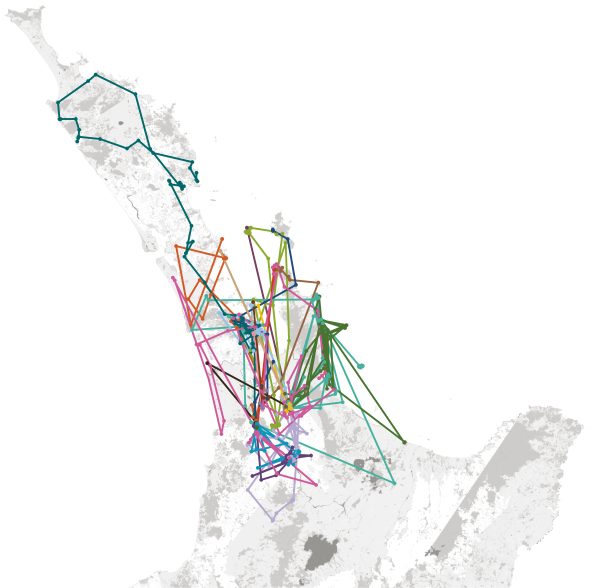
Certainly, Fitzgerald’s birds seemed to be doing it tough. “We had a couple of our birds that were picked up and taken into care. They were just run down. There seemed to be nothing particularly wrong with them—I think it’s hard going for them.”
In the Waikato, kākā essentially spend the whole winter on the couch. They find a random garden or a group of scraggly trees in a paddock and stay there for months at a time, barely even going to the neighbour’s place. Department of Conservation kākā expert Terry Greene was taken aback when Fitzgerald showed him the places the kākā were choosing: they didn’t seem to have very good taste. “He was kinda blown away,” says Fitzgerald. “He didn’t believe that this was where the kākā were. He was, like, ‘This is not kākā habitat, this isn’t right’.”
Because the birds are not calling or flying, their presence remains concealed. “People often don’t know kākā are around,” says Fitzgerald. And they may not always be around: “I think we should consider kākā to be partially migratory,” he says.
If kākā are perfectly capable of flying hundreds of kilometres to leave a spot they don’t like, then the Wellington ones could ditch the city if they wanted to. Their presence isn’t an accident: they’ve chosen to live there. Why?
“There’s just so much food in the urban area because of the great diversity of plants,” says Miskelly. “All of the gardens have just got so many different species of trees that provide fruit and nectar year-round.”
The bulk of the kākā diet is nectar and sap, and introduced trees don’t stand a chance against a kākā’s beak. Macrocarpa, Lawson cypress, redwoods and Chinese elms all bear the scars, from the grounds of Parliament to the Wellington Botanic Garden ki Paekākā. “These trees haven’t evolved with kākā,” says Park, who is part of a team figuring out what to replace the damaged trees with. Native trees, like tōtara, are more parrot-proof. “You see the bark stripped off them here at Ōtari. I’m not worried about that. I know that the tōtara can heal itself.”
The kākā taste for sweet things also extends to fruit; they ate all the strawberries that Park’s daughters planted in the garden.
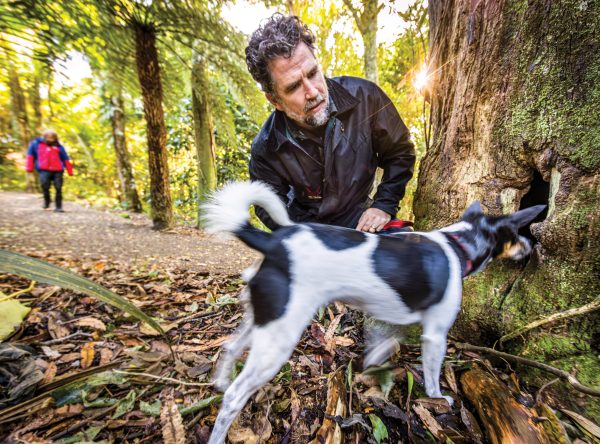
Miskelly has first-hand evidence that kākā prefer the city. He’s spending his weekends walking all the tracks in the Tararua Range, noting all the birds he hears. (It’s the kind of project you come up with when you’ve already done Te Araroa and recorded all the birds along that—see our story in Issue 193.) In the Tararuas, he might record one kākā a month. Back home in central Wellington, a couple of hours’ drive southwest of the range, he regularly sees flocks of 20.
The city is a safer place for kākā than the Tararuas, he says, partly because of its stupendous number of cats, which keep stoat and rat numbers down. While cats are bad news for lots of bird species, as well as lizards, they might be helping kākā in this instance. “If you look at a typical city, you’ve got something like 600 cats per square kilometre,” says Miskelly. “The density of cats is just phenomenal, and that has quite an effect on other predators.”
Anyway, kākā have always been in Wellington, Te Awa points out: the original name for the area around what’s now the botanic garden included the word paekākā: kākā perch. “It makes sense that they’re here,” he says. “They have a relationship to the place.”
*
In te reo Māori, the phrase for “dawn has broken” is “kua tangi te kākā”. The kākā has called. Time to get up. I wonder if it’s a bit of a joke, because kākā are renowned for staying up all night. Irwin describes hearing them in the wee hours of the morning: “Like, what are you doing at that time? It’s pitch black.” Shaw has a student studying the nocturnal habits of kākā at Zealandia, trying to figure out what they’re up to.
For the Pākehā explorer Charlie Douglas, who surveyed much of the West Coast in the 1800s, kākā were a constant companion. “In the still hours of the night they liven the place,” he wrote, “by whistling their national melodies with the power of a locomotive.”
“Kā” means “to screech”, whether you’re a parrot or not. “Whenever they’re flying over your house, they can’t stay quiet about it,” says Shaw. “Even if they’re by themselves.”
“Here I am, world,” says Irwin.
“I do think of it as, like, ‘Guys! Guys!’,” says Shaw. “Or, you know how toddlers are just, like, ‘Hey, mum, look at this, look at this, look at this.”
Park describes kākā as bogans: loud and inconsiderate. “You know the collective term for a kākā, right? It’s a ‘hoon’. ’Cause they’re hooning around like bogans.”
“They’re gangsters, really,” says Te Awa.
During the pandemic, Miskelly assembled a list of all the different names on record for kākā. There were more than 40. Māori named them for their moods, their qualities, and their colours: kākā kōrako, the albino kākā; kākā waha nui, the big-mouthed kākā. Kākā kura, the reddest kākā, or the chiefly kākā. Kākā parakiwai, the darkest kākā. Mōkai kākā, the bird that betrays its own kind.
There aren’t multiple names for kākāpō, kea, or kiwi—and that tells us a little bit about people’s connection to kākā, says Miskelly. “You’re not going to have a lot of names unless it’s something really important to you.”
*
Since kākā aren’t around much these days, we’ve mostly forgotten what they sound like. Their calls are so varied and unusual that people keep mistaking them for the South Island kōkako and sending recordings of them to Miskelly, convinced they’ve rediscovered an extinct bird.
There’s the famous raspy kraaak, and a whole repertoire of awful scraping sounds, but also pure song-like whistles, loud and high, or low and soft. Sometimes kākā sound like tape being torn off a box. Sometimes they sound like a door opening for the first time in years. Then there are rapid, soft, fluid warbles; they can make a sound like droplets falling into water, like a child blowing spit bubbles.
Victoria University PhD student Cathy Breed and I are looking over another of Wellington’s gullies. We’re watching a eucalyptus on the opposite side, which is the local party tree. Every so often, kākā issue from it in a burst, but others are always arriving, making wobbly calls—soft, pure melody, two notes back and forth.
I tell Breed that I’ve been reading whakataukī—proverbs, sayings—that mention kākā and that they alternately characterise the parrot as a showoff, as a laughing stock, and as deeply regal.
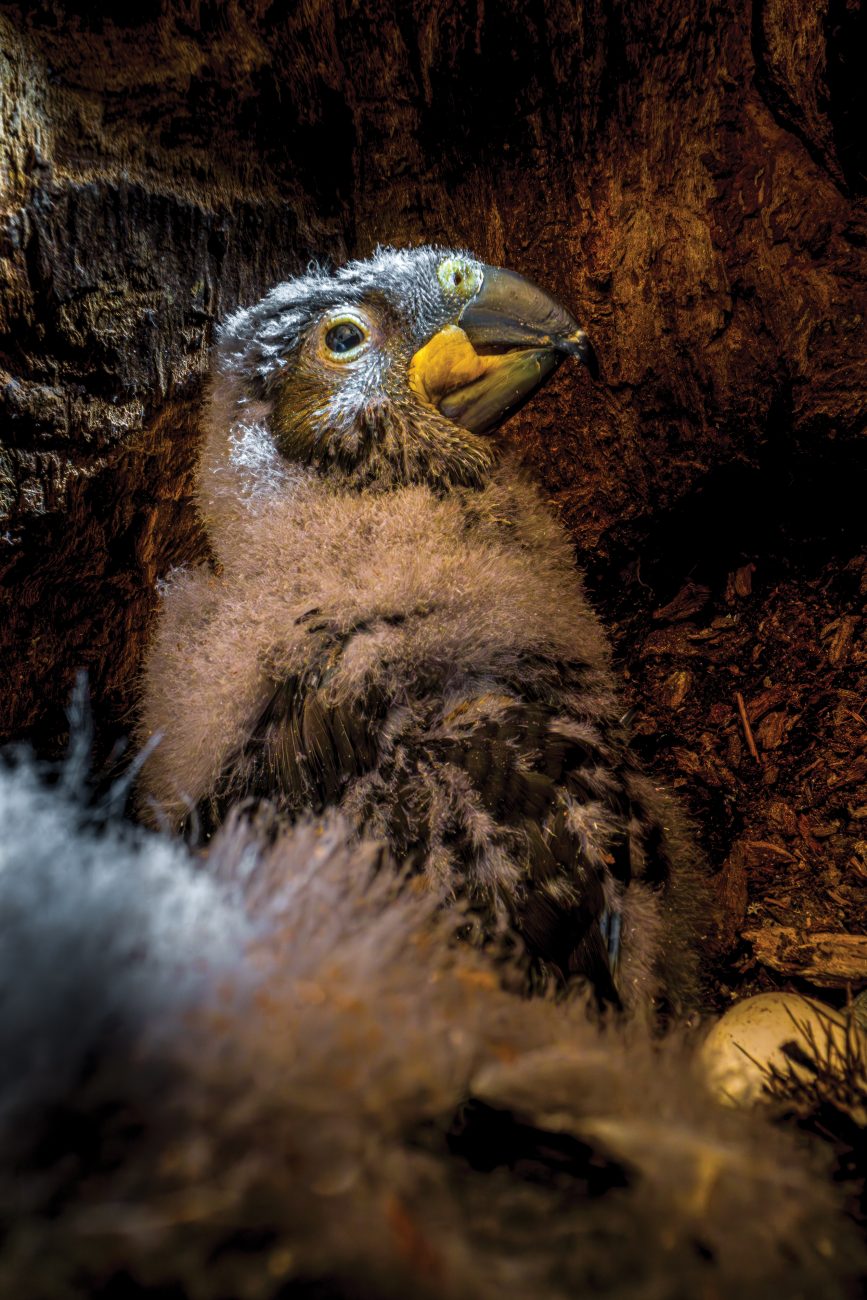
“Where does the idea that all kākā are fundamentally similar come from?” asks Breed. She wrote her master’s thesis on human-kākā relations. When she set out, she thought it might be hard to get people to talk about the birds. She could barely get them to stop.
Breed reckons birds are strangely similar to us in terms of how we experience the world, and that’s because we don’t navigate it through scent, like most mammals do. We use sight and hearing, like birds do. “And kākā, I think, because they are big, like, they work on our scale,” she says. “Like, they’re big guys. They have these incredible eyes and these incredible colours and these ways of being that sort of invite interaction from us, or, if you want, interpretation from us.”
Breed’s interviews found that people had the sense of being individually recognised by kākā. There was a knowingness to their gaze, like that of a dog.
“The thing that really struck me about kākā when I started studying them and meeting them is they’ve got a real aura about them,” says Breed. “They’re not just cute and cuddly. They’ve got real presence and it’s not like a friendly presence all the time. Sometimes it’s just very authoritative. Like, they feel powerful. If a kākā is nibbling at your roof, you don’t really feel like you can just go, ‘Shoo.’ They look at you and they’re like, ‘What?’”
*
Back when kākā and humans were closer, our lives were interwoven. We ate them, and on special occasions, we wore them.
One of the main roles of the household kākā was to hunt others of its own kind, which it did accidentally. A pet bird would be stationed on a perch in the forest, with snares set alongside it. If it called, other birds would stop by to see what was going on. They couldn’t help it: a kākā loves to meet another kākā. As soon as another bird landed on the perch, the hunter pulled the snare tight.
“Anywhere else in the world if a bird makes a distress call, they usually all gap it,” says Te Awa. “Here, they all come and have a look. And I actually didn’t believe that until we were at Ōtari a few years back and we banded a baby kākā there. And when it was out of the nest, it let out this scream, and there would have been 40 to 50 birds circling around us. And I was, like, ‘Oh, my god, that kōrero, it’s real’.”
A revival
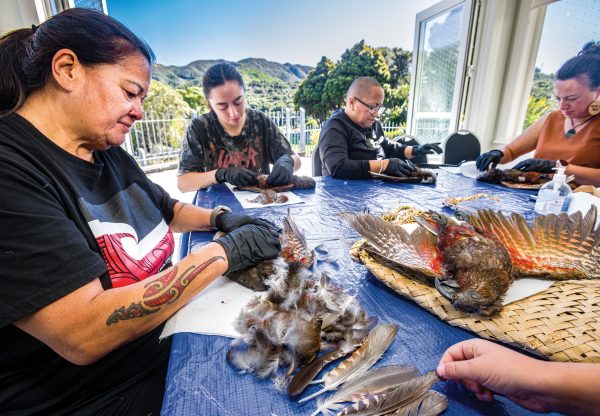
First, introductions. The wāhine pictured here are all cousins, with whakapapa to Taranaki Whānui Ki Te Upoko o Te Ika, a group of iwi that hold mana whenua in Te Whanganui-a-Tara Wellington. From left, the women are Lee Rauhina-August, Māia-te-oho Holman-Wharehoka, Ngahuia Wright and Leigh Andrews.
There are kākā shouting and bickering in the trees outside and six kākā in the room, too—they came from Wellington Zoo.
*
One year ago, these women found themselves with a freezer full of 48 birds—toroa, or royal albatross, kererū, ruru, tūī—and no idea how to handle them. “I think it’s fair to say that we were scared,” Rauhina-August says. “We were worried about doing the wrong thing.”
The women drove the defrosting birds to Whanganui, where another relative, weaver and artist Matthew McIntyre-Wilson, taught them the knowledge he had taught himself. Remember the manu have already died, he told them, and harvesting feathers and pelts is a mark of respect. It’s okay to make mistakes. And most of all: share these skills with whoever wants to learn. “He was so gentle in his approach with us,” Rauhina-August says.
Dozens of birds later, the women still defer to McIntyre-Wilson, but they are comfortable in the work, and more efficient. The group took two days to prepare their first toroa for washing. Recently, a similar bird took two hours. Rauhina-August dries the massive wings on the clothesline.
Every bird is a thread of connection. So is every new person the group teaches. “There’s now about 30 of us that can do this,” says Rauhina-August. “We’ve got mokopuna that come along with their nans, and they help out.”
There is much to do. Only people with a special permit are allowed access to dead native birds, and that’s a small pool of tangata whenua, artists and scientists. Many DOC and iwi freezers are full of birds awaiting attention.
In this photo the cousins are at Ōtari-Wilton’s Bush, working with kākā for the first time. Because the birds had been euthanised, the women had to wear gloves—they prefer not to—and could only pluck feathers, which will be used by the iwi in art and ceremonies, before giving the bodies back to be cremated.
Recently, Rauhina-August delivered a karanga at Kumutoto Stream. She held one of the feathers in her hand, and for just a moment, the kākā arguing in the canopy overhead went quiet.
There were seasons for hunting kākā, and seasons for leaving them alone, and so a big catch might be preserved in jars, packed in with fat. Everyone ate kākā, Pākehā included: when HMS Challenger visited Wellington in 1874, one of the crew noticed butcher shops selling kākā meat. One had a wheelbarrow full of the birds outside.
Māori prized the feathers of hunted kākā: a cloak made of red-coloured ones was the most valuable kākahu you could own. It was more prestigious than a cloak of kiwi feathers. “Red is a colour that’s incredibly precious through all of the Pacific,” says Te Awa. “Other than earth pigments, we don’t have a natural source of the colour red here. So it’s for high-born nobility. And you see it in Māori art with the red, white and black.”
Cloaks made of red kākā feathers are called kahu kura: it takes up to 120 birds to make one.
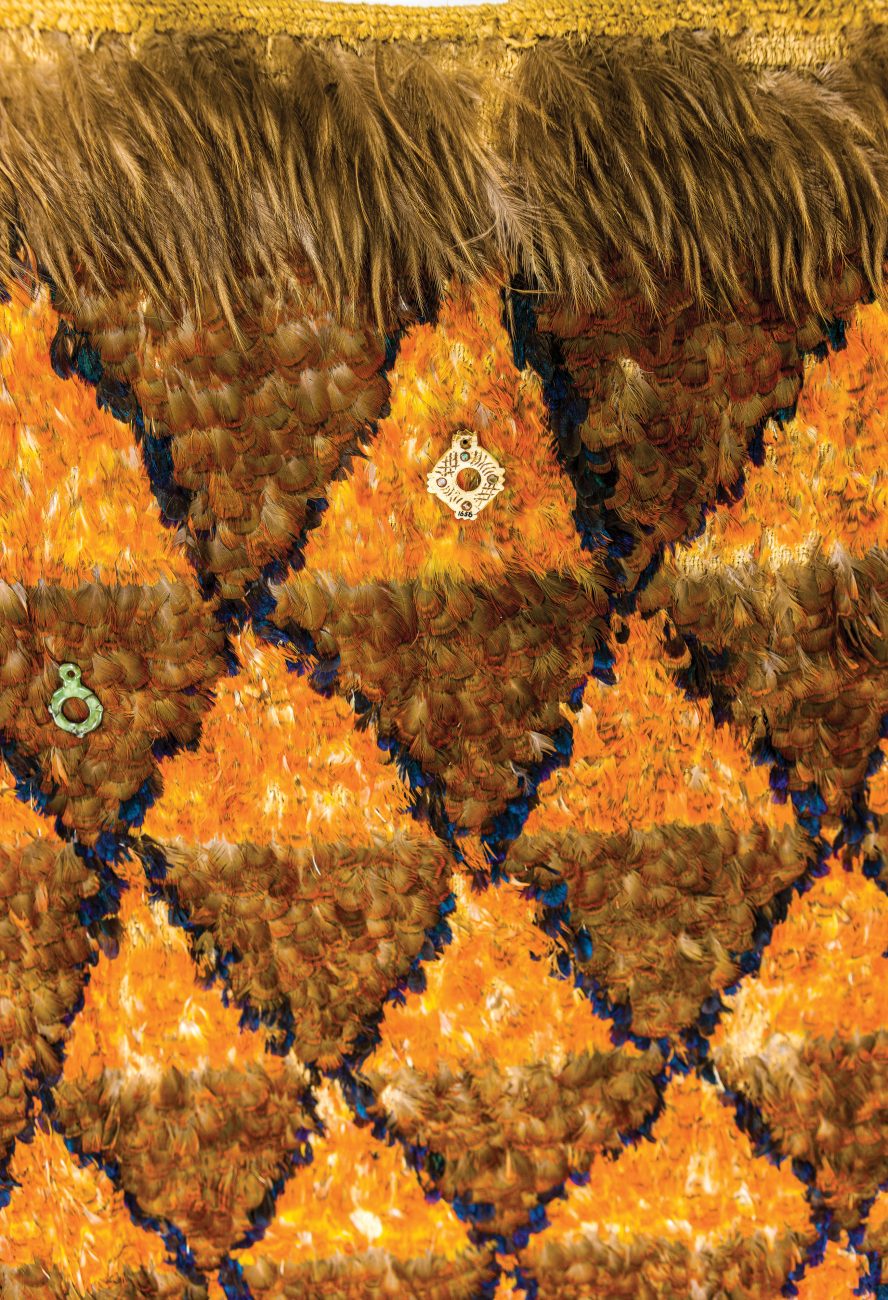
Te Awa learned to weave from his father and his grandfather, and lately he’s been teaching wānanga on preparing bird skins for use in traditional crafts—practical skills like extracting and cleaning feathers for use in cloaks, or preparing bones to become musical instruments. His materials: the corpses of kākā, albatrosses, weka, and others. “If you think that you need, like, a hundred manu to weave a cloak, well, you can’t have a hundred bird bodies in a freezer while you wait to get the right amount,” he says.
The sheer number of birds required indicates how many there used to be, and how regularly they were hunted. “There’s a lot of beautiful craft traditions that are dependent on these species,” he says. “We talk about these close relationships Māori have with the environment, but, like, no one really knuckles down on what the divorce of that relationship looks like.”
If people want to continue being able to make kākā-feather kākahu or albatross-bone kōauau (flutes), he says, then we have some catching up to do. “We don’t have the practical side of that relationship, whether it’s caring for the birds or hunting or eating them.
“Like, you just can’t abstractly care about something. There needs to be a working relationship.”
*
To prepare for having a kākā, a child would be given a pet seagull: an easy bird to start off with.
Seagulls were affectionate, and good for teaching children, Te Awa says, because after a year or so they’d simply fly off. “So you teach the practical skills of caring for something else, but then also that part of loss and letting go.” There’s no budging a kākā, though, not if it’s decided to stay. So perhaps, what we have to learn from this species is how to bend, how to adapt. How to wake up in the night to screeches, or relinquish a whole crop of persimmons, if those birds are so inclined. Sure, kākā can be trained; but you have to have a relationship with a kākā first, and relationships involve give and take.
“You cannot force a parrot to do something it doesn’t want to,” says Te Awa. “I remember my dad teaching me this: ‘Its will is stronger than yours.’”
It’s a relationship Wellington is going to have to grow into, that will stretch and change over decades. The city’s kākā population is still nothing like what it was historically, so Miskelly suspects we’re just at the start of the great parrot comeback.
“What will Wellington be like in another two decades’ time? Are we ever going to reach peak kākā? Or will they just keep going?”
He grins. “You know, I suspect those who are concerned about the damage to pine trees and things—that they haven’t seen anything yet.”