




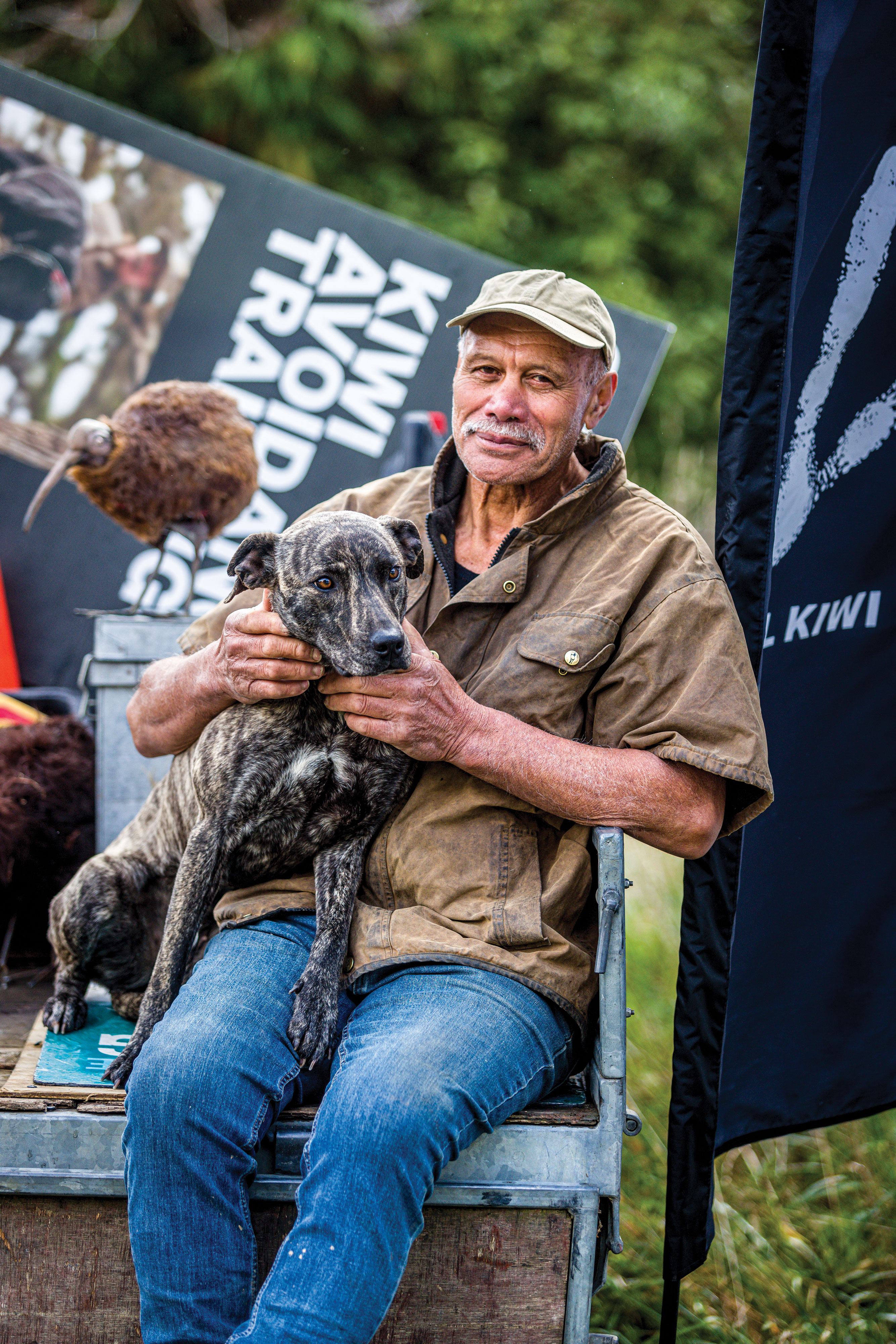
Because of Willy Marsh, hundreds of dogs are choosing not to chase kiwi and penguins.
It’s drizzly and windy, the kind of grubby spring Wellingtonians know as the Shitsville Season. But Willy Marsh is up early, planting kiwi decoys along a short forest track near Mākara. He’s expecting 49 clients this weekend.
First up is Rosie, a huntaway rottweiler cross and a “failed farm dog” with a strong bite and good nose. She’s a rescue. Her owners think she may have been abandoned and possibly mistreated, but today, Rosie arrives with tail wagging and eyes alert.
While talking to her people, Marsh looks down and gently rubs Rosie’s shoulder. She leans into him. He fastens an e-collar on her before moving towards the first brown-furred kiwi prop. It’s infused with the bird’s earthy smell and Rosie is keen, sniffing excitedly. But a short vibration signal makes her jump back. “That’s enough for most dogs,” Marsh says. (E-collars can also deliver a high-pitched tone or a shock, but Marsh says he usually doesn’t have to go beyond a minor correction.)
After this first encounter, Rosie follows her humans into the bush. When they step over the next kiwi prop, placed in the middle of the narrow track, she’s wary already, reluctant to follow but uncomfortable with the separation. Marsh is close behind. He keeps his eyes on Rosie as he gropes in the leaf litter for the string attached to the prop.
A sharp tug. The kiwi moves. Rosie startles. This reinforces the message, Marsh whispers, and with a calm voice encourages the owners to move up a slope. Rosie picks her way to them through a pile of fallen twigs, detouring to avoid the bird. By the time she meets the third prop—this time ringing with the call of a kiwi—she’s learned her lesson.
The sequence of scent, movement and sound is important, Marsh says. It stimulates a dog’s predominant senses to deliver the same message: don’t go there.
Next is Tāmati, an eight-year-old border terrier with a grizzled coat. He seems more nervous; he’s barking, scratching the ground and peeing as he navigates the training track. But he, too, learns quickly.
This weekend, Marsh is contracting for Capital Kiwi, the charity helping more than 200 kiwi-nui, North Island brown kiwi, reclaim their ancestral home along the southwest fringes of the capital. Wherever kiwi are, dogs should always be on a leash, Marsh says. But avoidance training is an insurance policy should a dog take off.
At 73, Marsh has the bandy gait of someone used to days in the saddle. He is Tūhoe, and grew up around Waikaremoana, always surrounded by dogs, always hunting pigs with his cousins and uncles.
He got his first dog at 11 or 12. There have been about 40 more since then. The first he trained himself was a placid bullmastiff cross named Gog (the “little girl next door couldn’t say ‘dog’”).
Gog could catch pigs on her own and was always “honest”, walking right past sheep or goats. “She just did pigs.”
Dog-whispering runs in the whānau. Marsh remembers watching a standoff between a big pig and his Dad’s pack of dogs. They were barking madly and the pig was grunting, mouth agape with huge tusks. “Dad could have shot it,” Marsh says, but instead let the animals work it out. Eventually, the commotion stopped, the pig and dogs held their heads down and walked away in opposite directions. “Animals do have that respect for one another.”
Marsh honed his skills over a lifetime of sheep shearing and pig hunting. He always kills a pig with a knife rather than shooting it.
His grandfather taught him that if you jump in with your dogs, you become part of the pack. “I’ve seen my dogs prepared to give their life just to hold a pig for me ’cause they know I’ll help them.”
Marsh started training other people’s dogs some 20 years ago “as a way of giving something back”. When he meets a dog for the first time, he checks for any shaking at the top of their shoulders to assess if they are timid or curious. To earn their trust, he trusts them. “Dogs will always do their best by you.”
Marsh’s mana is strong in the dog-training community and among dog owners. He has trained more than 250 dogs, both pets and workers, for the Capital Kiwi team alone. Some locals bring in their pets only because they’ve heard he’s remarkable. On other weekends, he works on beaches teaching dogs to avoid kōrora, little blue penguins. Or he heads out with deerstalkers to train their working dogs.
At home in Woodville, Marsh lives with seven dogs. Two are retired, one helps with the sheep and the rest are for hunting. When he and his partner go for a walk, the dogs come, too. “I feel a little bit lost without them,” he says. “They are like a shadow—and I can walk much further with a dog.”
More by Veronika Meduna