


Every autumn, hundreds of newly fledged Cook’s petrel chicks emerge from their burrows in the dark of the Hauraki Gulf and launch into their first big flight—a night trip across Auckland, heading to the rich feeding grounds of the Tasman. The tiny birds fly for 50 kilometres, 60, 70. Then they hit the city lights.
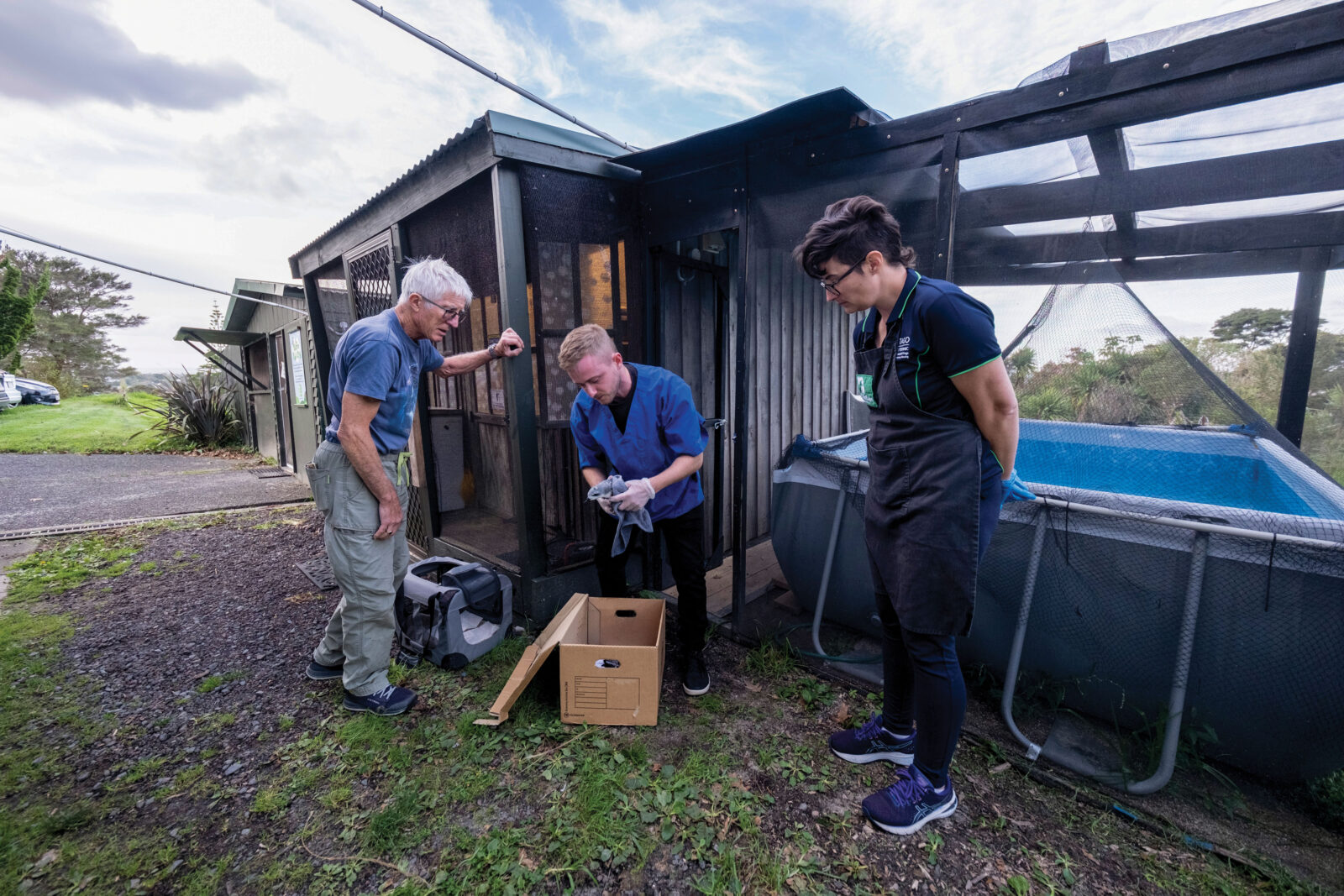
Jono Lambregts settles the petrel on the examination table. He waves his right hand slowly and deliberately, close, on either side of the bird’s head. Sometimes a petrel will hit its head on landing and temporarily go blind. “Can you see me?” Lambregts talks very quietly. He repeats the test. “I think he can.”
He settles a palm over the bird’s back and gently pinches the keelbone in its chest. “I’ll check the body score. How skinny he is.” This bird is in pretty good shape; it weighs in at 154 grams, about the same as a pack of cards. “He’s scared,” says Lambregts softly, tucking a towel around the tiny frame. “He’s shaking.”
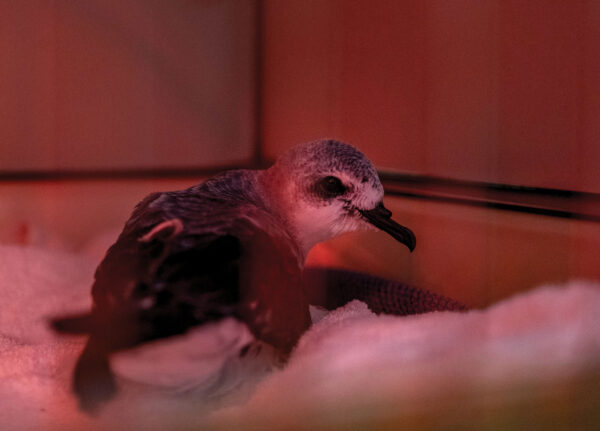
About three months ago, this Cook’s petrel, or tītī, hatched in a soft, dark burrow its ancestors dug into a tiny island in the Hauraki Gulf; most likely it was Te Hauturu-o-Toi/Little Barrier Island. A few days after its parents left, job done, this juvenile took off in the night, too, and with quick tick-tock wingbeats navigated across the dark sea to Auckland city.
Tītī have been making this trip for centuries. Like other seabirds, they use the moon and stars to find their way. But now, the city lights make this traditional flight path more like a hall of mirrors. Dazzlement is not the only danger, and nor is the fact that artificial lights look a bit like stars: certain lights attract the birds. The bewildered petrel crash-landed in East Tamaki, 80 kilometres from its island. This morning, a family found it, put it in a box and drove it 45 minutes to BirdCare Aotearoa, a hospital for native birds in West Auckland.
The petrel does not look like a creature equipped for such sagas, or for the more ordinary oceanic marathons to which it was born. It has a beak of finest wrought iron and perfect liquid eyeliner. Its wings, shaped like the Nike swoosh, are marred and bent at the tips. A seabird’s glamour erodes quickly when it’s stranded, scuffling, on land.
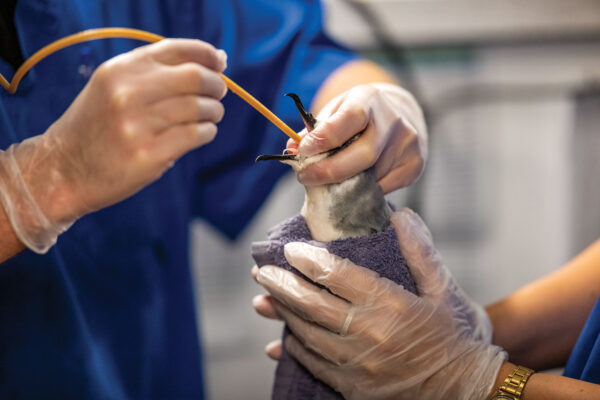
Lambregts picks the petrel up to inspect the feet. Left first. “There’s his little hallux,” he says with relief. The tiny thorn-like protrusion functions a bit like a human thumb and it’s even more important—it helps the petrel climb the trees which, on land, can be its only take-off points. A petrel that can’t climb can’t fly, either, or feed, or escape predators. So a damaged hallux can be existential.
Lambregts picks up the right foot and falls quiet for a moment. “That’s tricky,” he says. “That one’s only half a hallux. It looks like it’s broken off.”
He moves gently through other tests: looking in the petrel’s mouth to check the mucus membranes for hydration, spreading the wings to palpate for fractures, scanning for lice, wounds. The bird’s eyes are bright. Apart from that broken hallux, it seems fine. Lambregts, one of two hospital managers here, decides to admit the patient and seek a second opinion on Monday. He sticks one wing with a tiny needle on an IV line, and slowly squeezes in a couple of teaspoons of a solution that hydrates and replaces electrolytes.
“He’ll be cold now that I’ve given him fluids,” Lambregts says, tucking the towel back over the bird. A volunteer pops in to ask what she can do. Set up a cage for a new patient, he says.
“He can go in cage two, next to the other one.”
*
For six weeks or so every autumn, BirdCare cranks up a gear. Staff call it “Cookie Season”—the time in which juvenile Cook’s petrels and a scattering of other seabird species come crashing down across the isthmus.
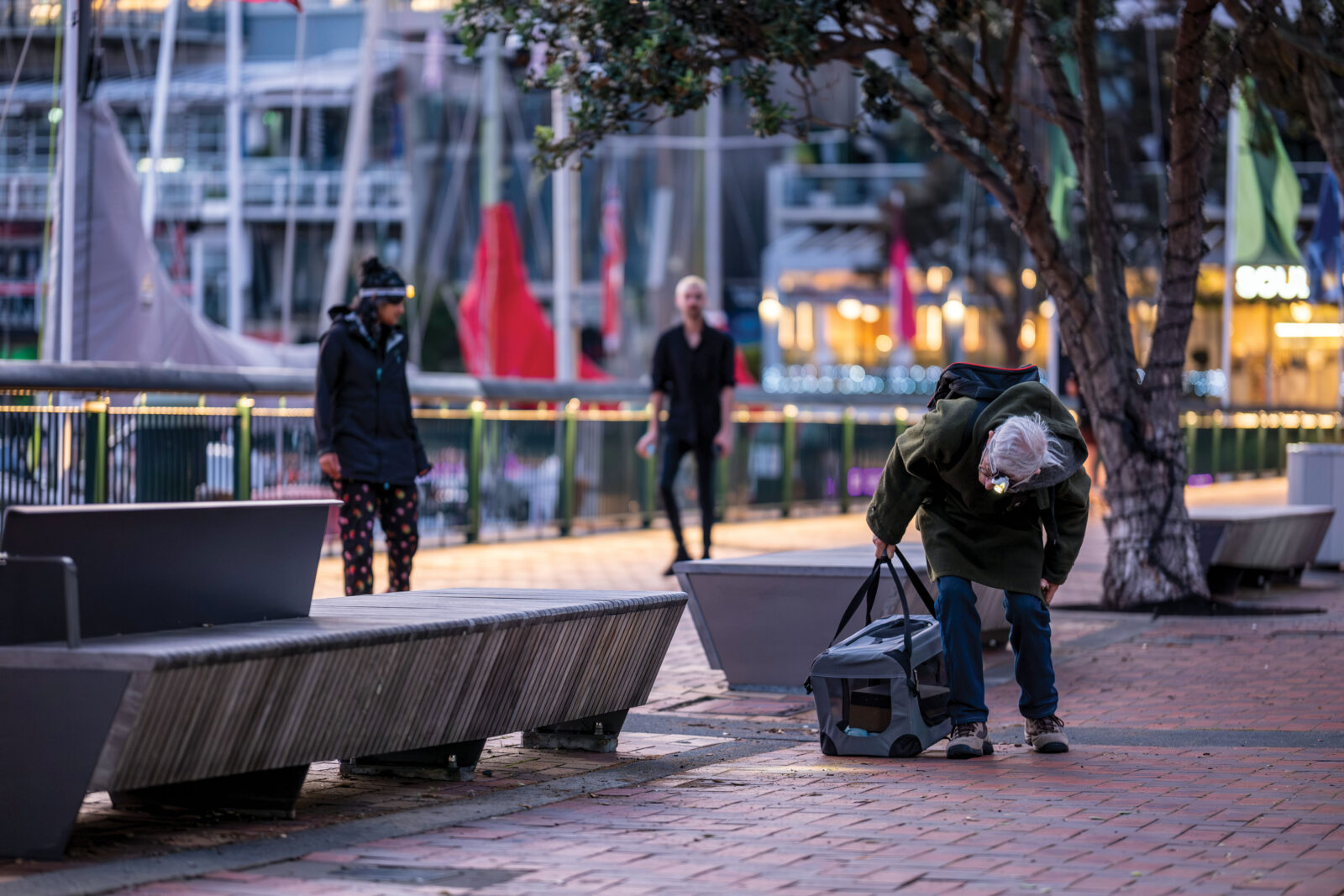
This year, the first grounded Cookie was found on March 26, in the central-city carpark where I park every morning. Then it was all on. The babies were flying, and they were coming to grief. Petrels were picked up under the Sky Tower—always a hotspot—and near the fancy shops and transport hub of Britomart, and in the suburbs, too, and even at the Mangawhai Surf Club, 100 kilometres north of the central city. Grounded, petrels are clumsy and dazed, easy prey; often, when people find one, they describe it as a small drunk seagull.
Each of these birds is a high-needs patient: seabirds stop eating and drinking in captivity, so they are tube-fed and IV-hydrated on a strict schedule, each round an ordeal for both bird and carer.
Often, the little petrels have been grounded so long that their digestive systems have stalled and need to be coaxed back online with a special fish stock. Once the birds are processing that properly—that is, pooing—they are weaned onto squid purée.
BirdCare’s fundraising manager, Rashi Parker, estimates that this season, the light-struck seabirds ate up 569 hours of staff overtime, costing the charity around $22,000 on top of its usual outgoings. Extra krill oil, pain relief, and supplements totalled about $1000-$1500; gloves alone cost about $2000.
On May 1, as the hospital admits its 118th crash-landed casualty of the season, Parker chairs a hui in the danger zone: the night sky of downtown Auckland. I shut my eyes as the glass lift on the exterior of the PWC Tower whooshes skyward and step out, wobbly, on the 37th floor. From here you get a splendid view of the city’s light-pollution problem. Towering grids of glowing windows. Logos, metres high. The Sky Tower, of course. Strings of fairy lights, lit-up bollards, traffic lights, cranes, the port, the bridge, the endless crawling rivers of brake lights and headlights—most of them those blinding, lightning-white LEDs. I imagine encountering it all with three-month-old eyes made for a lifetime at sea.
The next day, on a walk with my daughter, we talk about the ruru fledglings we found flattened under the brightest streetlight in the neighbourhood—three birds in the span of a few weeks. All living things, us included, take fundamental physiological cues from light. Near our house, an ornamental pear tree has grown up around a streetlight. Every autumn, I watch this tree as the leaves in relative darkness turn scarlet and drop away. The lit-up side stays green for weeks.
*
“I’m hearing them,” says Ariel-Micaiah Heswall, “but where are they?”
A research fellow at the University of Auckland, Heswall is looking for seabirds—well, she’s always looking for seabirds, but this evening, she’s looking for petrels, in particular. She stops midsentence, head cocked to catch a call that completely eludes me.
“That sounded like a godwit.”
Her husband, shorebird scientist Brian Wijaya, is listening, too. “Yeah, that’s a shorebird call.”
They hear it again.
Heswall yelps. “Oh, pied stilt!”
Wijaya: “Yep, that’s a pied stilt.”
The sun has just set on a clear, cold Saturday in Auckland. Heswall, Wijaya and two bird-nerd friends, Marina Newman and Oliver Kettler, have bagged the best bench at Westhaven Marina, with a prime view of the Harbour Bridge. Identifying calls is a side quest—the four are here to catch birds on camera. In the dark. To do so, they have two sets of gear roped to the railing and trained on the bridge: an infrared camera, and a thermal imaging one. This is Heswall’s project. She wants to study the birds on the wing, to try to understand how they behave around light. She’ll go back through the footage later and be able to discern from the wingbeats which of the white shapes are gulls—they have “a flappy flap”—or petrels, which do more of a… she pulls her hands up to her shoulders and flutters, fast and stiff.
“There’s one,” says Kettler, urgently, pointing at the infrared screen. “Check it out.”
I’m much too slow. All I see is the screen’s usual rainbows, the white skeleton of the bridge. But half an hour later, he pipes up again:
“There’s one! Oh, there’s a couple. One… two…” This time, I spot the dots just before they flutter off the screen.
This is the team’s seventh night watching the bridge with the cameras, and although they’re a long way off crunching the data, to Heswall it seems that perhaps its lights are actually helping the birds—“It’s sort of like they see it and then go underneath, so they’re avoiding the actual bridge.”
Scientists in Hawaii have shown that lighting up powerlines has a similar effect, she says. Why would lights help birds avoid some obstacles but entice them to thud into others, such as skyscrapers? We are just beginning to understand the way seabirds process light—the colours and contrast levels that attract or repel various species. We’re a long way from any light “recipe” that would minimise harm overall. To piece that together, Heswall hopes to set these cameras up on the Sky Tower, too, to scrutinise the birds’ flight paths there.
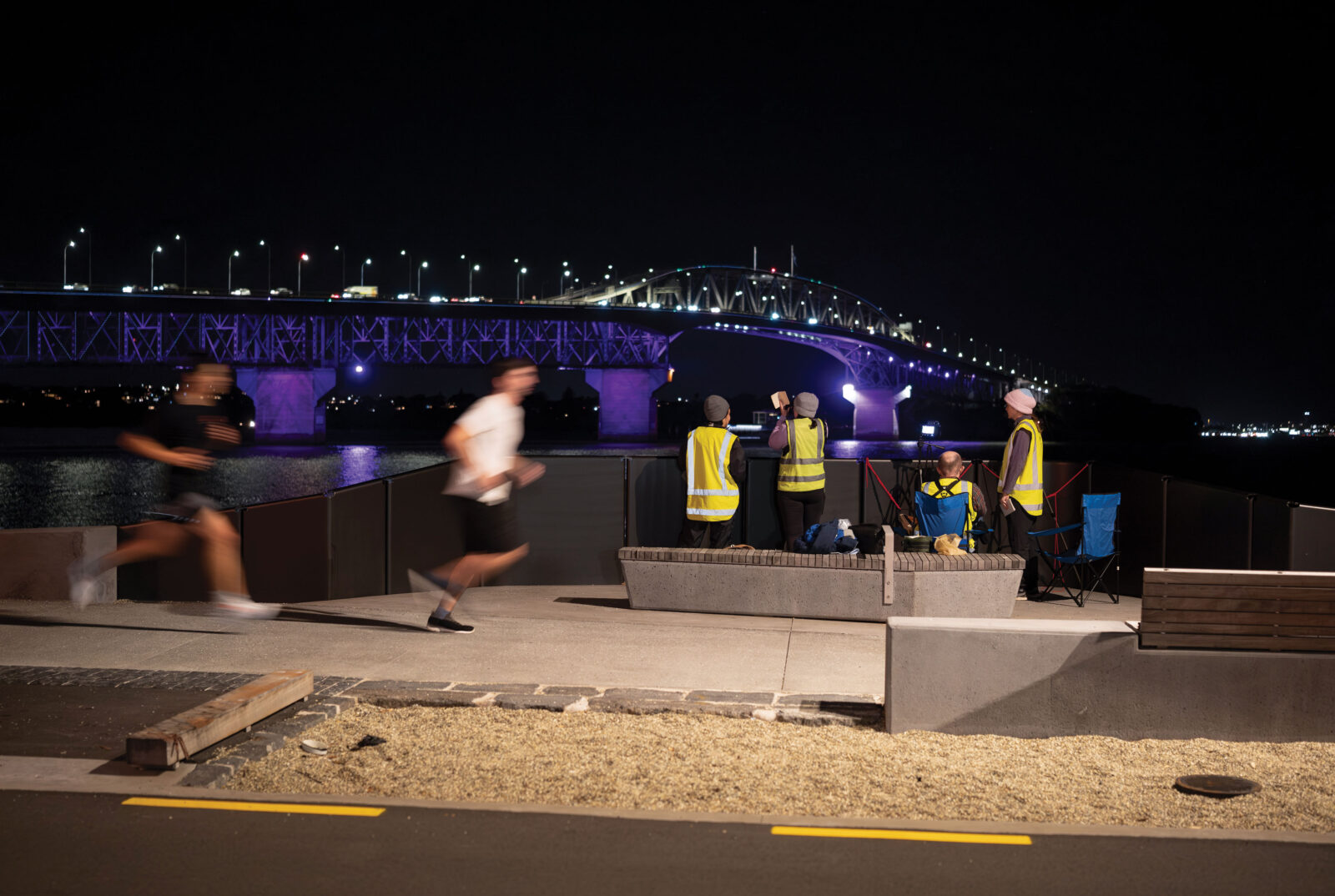
The tower and the central business district it punctuates are particularly dangerous places for seabirds, Heswall knows. For her 2022 PhD, she mapped the crash sites of 356 seabirds that were brought to BirdCare over three seasons. She also mapped the city lights, finding that their brightness correlated with bird crashes.
Other work has shown that more seabirds ground on moonless nights, especially rainy ones where artificial light bounces weirdly off clouds. Perhaps the birds are more easily confused without their celestial guiding lights? Perhaps the young birds coming blinking out of their burrows assume that our windows and signs and headlights are their guiding lights?
Kettler, eyes still glued on the infrared screen, gives a chirrup.
“Oh! Two! Three! Four!”
Heswall glances over his shoulder. “Yeah, they’re all gulls.”
At 8pm, jazz sax starts to drift from the yacht club nearby. The bony underside of the bridge is lit up bright purple. Against the glitter, we can make out a silhouette: two men, it looks like, fishing from a tiny unlit inflatable. Above the men, on glowing horizontal struts, perch dozens of red-billed gulls. As the tide changes, a group of the birds lift off with a flurry, circle the bridge’s great legs and start to forage in the purple water. “They’re supposed to be asleep,” says Wijaya. But all those lights will be attracting squid.
In the evenings, heading over that section of the bridge, I sometimes see the dark shapes of the gulls floating level with the traffic in the strange, jewelbox darkness.
*
In the 2022 season, Heswall began early-morning patrols of the city, picking up birds that had crashed in the night. That work, and her PhD data, spotlit the problem of light pollution for Auckland’s seabirds, meaning autumn after autumn of bad PR for the companies controlling the lights.
This May, as an exhausting Cookie season fluttered to a close, Parker met with SkyCity, which owns the Sky Tower, and with Vector Lights, which runs the Harbour Bridge light shows, to ask them—again—to please tone it down.
In particular, she asked them to avoid cool-toned LEDs—the blues and whites which most strongly attract and disorient migrating birds. No joy.
SkyCity did, however, agree to dim the tower for the last month or so of the 2025 migration, and are now promising more dimming and lights-off nights next autumn. The light shows on the bridge are already geared around the birds—they run at around two-thirds of their potential brightness, with a dip to 50 per cent over autumn, to cover the peak migration. From 2026, these shows will also be dimmed through spring, when the birds make the return trip to the Hauraki Gulf to breed.
Parker also asked for money, as charities often do when companies contribute to their caseload. She thinks she’s making headway.
*
Birds are instinctively stoical. Injured or sick, they will masquerade health for as long as they can to avoid catching the attention of predators. Three days after the seemingly strong petrel with the broken hallux is admitted to BirdCare, it falters. “Unable to keep up with tube-feeds,” say the notes. “No response to anti-nausea, noted undigested faeces. Today, open beak laboured
breathing.”
That trajectory, on top of the damaged hallux, is too much. The decision is made to euthanise.
*
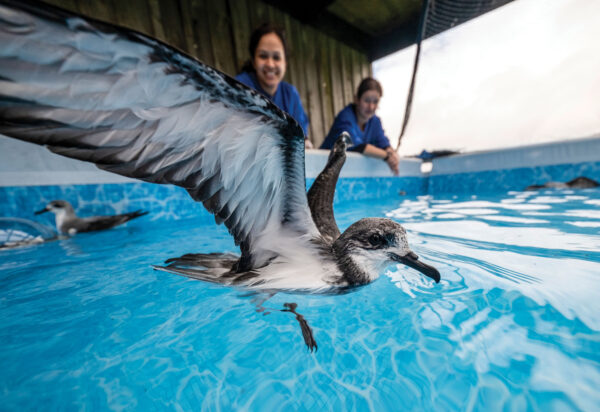
The luckier light-struck petrels are in and out of hospital in a matter of days. Before being cleared for release, each bird must pass a swim test.
Think witch trials, but benevolent: if a bird can float for 30 minutes, it’s ready to go.
“Immediately he looks pretty good,” says Lambregts, nodding at a single Cookie gently rocking on the surface. Lambregts has played lifeguard to dozens of petrels in this pool, and has learned to look for a certain posture, a subtle liftedness about the chest. This bird is five minutes in.
“See where the wing is dipping under the water, it’s kind of got a silver shimmer?” I do. It’s air, shifting over the feathers like mercury. “It shows that at least that part of the bird is waterproof.”
Exactly how feathers keep a seabird dry—and therefore warm and afloat—is a matter of some mystery. “Humans have been fascinated with [feathers’] form and function at least since the time of Aristotle,” write two University of Connecticut ecologists in a paper published last year in the Journal of Avian Biology. “We can, and should, learn still more about how they work.”
In slightly exasperated tones, the paper traces the history of waterproofing theories and experiments.
For many decades, those interested in feathers repurposed mathematical formulae used to predict the “wettability” of fabrics, based on the thickness of strands and the gaps between them. But a bird is not a bolt of cloth, and feathers don’t form neat grids: they taper, and puff, and grip one another with tiny hooks.
For a long time it was assumed the preen oil that birds produce from a gland near the tail was key, but when scientists surgically removed this gland, or blocked it, they noticed the waterproofing didn’t fail right away. The overall condition and structure of the feathers quickly deteriorated, however—and in that tatty state, the birds easily became soaked and could no longer swim properly.
Now, it’s thought the oil is merely a means to an end, a balm to maintain the angle at which one feather snicks into another; the curvature of feathers on the chest; the roughness of the barb; the precise gap between each of the barbules bristling out from those main trunks. All of this intricate geometry dictates how air can be held and water repelled. Perhaps our maths will never touch it.
Waterproofing, at BirdCare, is sacrosanct. When grounded petrels arrive, they’ve always lost it: too much shuffling around, mussing their feathers, picking up oils and muck. On admission, the birds get a bubble bath to get the grime out. “Not just any dishwashing liquid,” says Lambregts. “The rehabbers tend to use the Dawn stuff.” Then each bird is held carefully under warm running water to realign the feathers. “They start off looking like a drowned rat,” he says. “You rinse them until they are dry, which is a very strange concept to explain. You’re rinsing them and rinsing them, and the feathers get drier and drier, until the water’s just beading off them.”
*
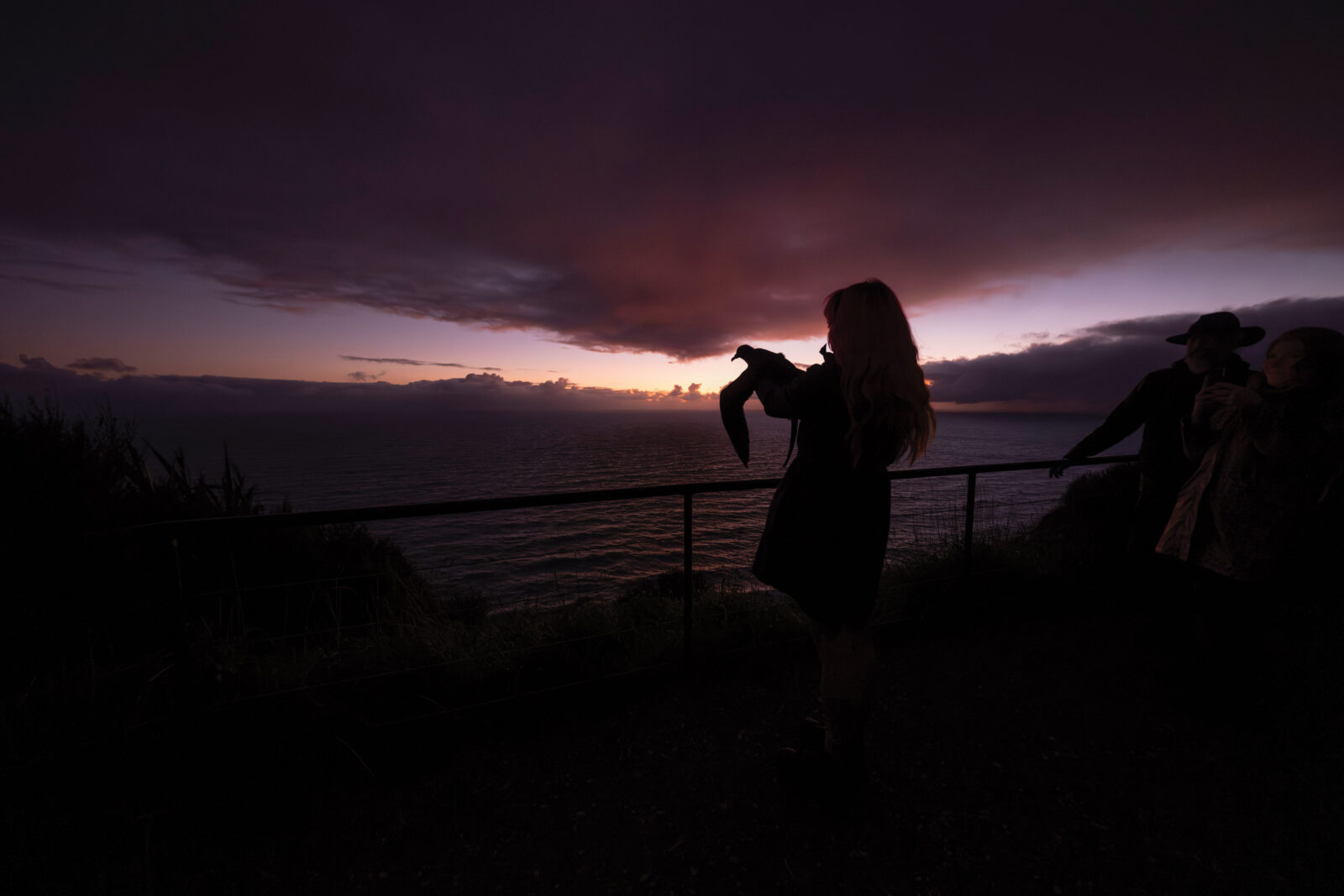
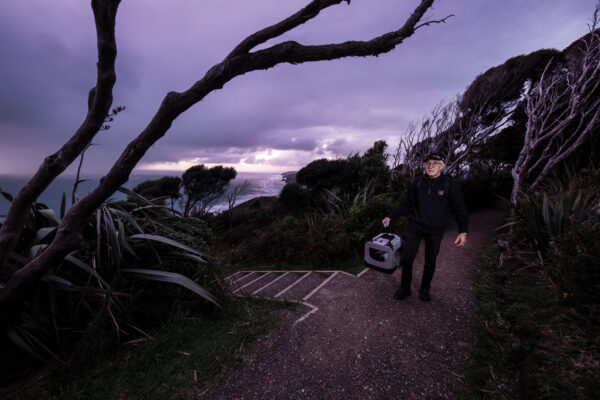
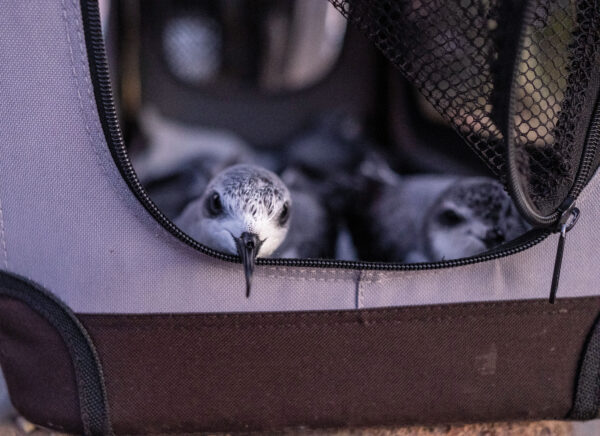
One Friday after school, we take the road to Piha and pull off at the Mercer Bay Loop Track. In the carpark, my daughter does roly-polies on the wet grass then lies on her back and watches sheets of rain blow over. “By the way,” she says, astonished, “you can actually see the wind.” We wait for the others: a handful of campaigners from the Waitākare Ranges Dark Sky Group; Parker with her daughter in tow; Kevin Ferguson, chair of the BirdCare board, with a boot full of petrels in carry-cages; a local family with three quiet, awed children. The dad is handed a carry-cage. His youngest boy bends low to see, gives the cage a pat, and potters down the track sucking his thumb, the soles of his light-up shoes flashing in the dusk. Eight birds are to be released tonight.
We walk through a thrashing tunnel of kānuka and ponga and māhoe. At the lookout we stop and stand quiet on the edge of the world.
Some nights, the birds are released into a violet horizon; this time there is only khaki sea and a line of bone-white breakers. At around the 100-metre mark the view is cut off by cloud so thick and uniform it seems solid. I stare at it and feel like I’m staring at a wall. The rain picks up.
My notepad swells and smears; my dictaphone gets wet and freezes on record. I know that when I listen back, all I will hear is wind. Baffled, I stop trying to take notes and instead blink out at the great blank grey, and think of Hone Tuwhare, who knew rain.
I should know you / by the lick of you / if I were blind…
The young petrels, in their carriers on the ground, know rain, too, and they know the sky, the void. They break their silent huddles to embark on restless laps of their cages.
The dark lies down flat. Long leaves of harakeke flail black at the edge of the cliff. Ferguson offers the first bird to the night.
More by Catherine Woulfe
More by Simon Runting