


For many Māori, archaeology has a bad name, with treasures removed to museums, stripped of context and spiritual care. Now, as rising seas threaten ancestral places, one iwi is leading digs themselves.
When the students wake in the dark, they are watched over, and they are watched. One by one they open their eyes into the half-light of the warm, still wharenui, and dozens of eyes look back. Portraits of Moeraki’s beloved dead hang on the walls, Tipas and Rehus and Hampsteads, aunties and uncles, hākui and hākoro, faces just like those of the people who live nearby, like those of the old people now buried in the many urupā along this coast.
For two weeks, these archaeology students from the University of Otago Ōtākou Whakaihu Waka have been here at Moeraki marae on the Otago coast, just north of Dunedin, in the hapū’s care. And when the students untangle themselves from their sleeping bags, pull on dusty work clothes, wander chatting through into the wharekai to eat cornflakes and tinned peaches and pack sandwiches into chilly bins, pile into their vans, drive the winding hill down towards the beach at Tūtakahikura, past the urupā where famous Kāi Tahu leaders lie, and when they’re joined at the gate to the site by two Kāi Tahu archaeologists and a half-dozen Kāi Tahu kaitiaki, there’s no mistaking whose whenua they’re on. Or why they’re here.
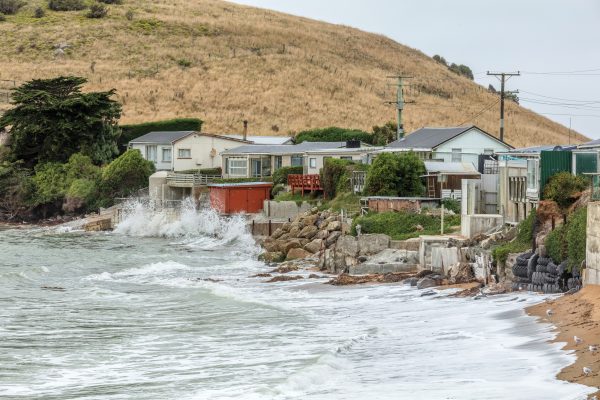
Tūtakahikura was once a seasonal fishing village, occupied by parties moving up and down the coast. But from the 1830s onwards, it swelled to become one of the main Kāi Tahu settlements on the eastern seaboard. When Te Rauparaha and his allies burned Kaiapoi pā, this kaik, or village, is where many survivors came. Multiple senior political and spiritual leaders brought their respective hapū here, says David Higgins, head of Te Rūnanga o Moeraki today. “They’ve been affectionately described in the past by our leading kaumātua as ‘the haka boys’”—the big dogs. “The numbers were huge.”
Each part of Aotearoa had its early hotspots for cultural contact, from Bluff in the south to the Bay of Islands in the north. In Otago, Tūtakahikura was a key place for the mingling of whakapapa, technology and ideas. Gardens and farms quickly covered the hills. Senior southern wāhine arrived to marry whalers operating out of nearby Port Moeraki. People explored new technologies—writing, photography, money, guns—in parallel with older knowledge systems. The rūnaka hall, Uenuku, sprang up in the year the Treaty of Waitangi was signed, and the people established a wharekura, a house of sacred learning, to pass traditions on. Christianity arrived with Wesleyan missionaries. And the beautiful little weatherboard church, which now sits up the hill, contains a stained-glass window depicting the man who truly put this place on the map.
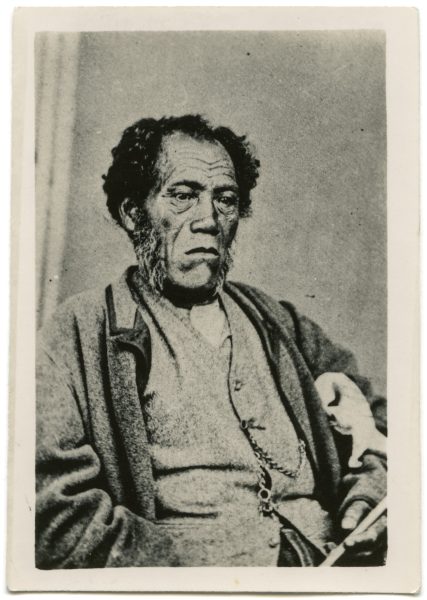
Back in 1849, Moeraki scholar and spiritual leader Matiaha Tiramōrehu sat down and wrote a letter to the lieutenant-governor, Edward Eyre. Less than five years had passed since Kāi Tahu sold tens of millions of acres in Otago and Canterbury, and the Crown had already breached the sale contracts by preventing the iwi from reserving sufficient land for their own use. Tiramōrehu wrote: “do you, Governor Eyre, think that I should tell [the Crown agent] to reserve for the multitude a piece of land only large enough for one man?” He ended his letter with a promise: “This [is] the commencement of our complaining to you… we shall never cease complaining to the white people who may hereafter come here.” That statement began the Kāi Tahu claim, and it was written here, on this land. It’s a significant site for the whole country’s history—a place to preserve, and understand.
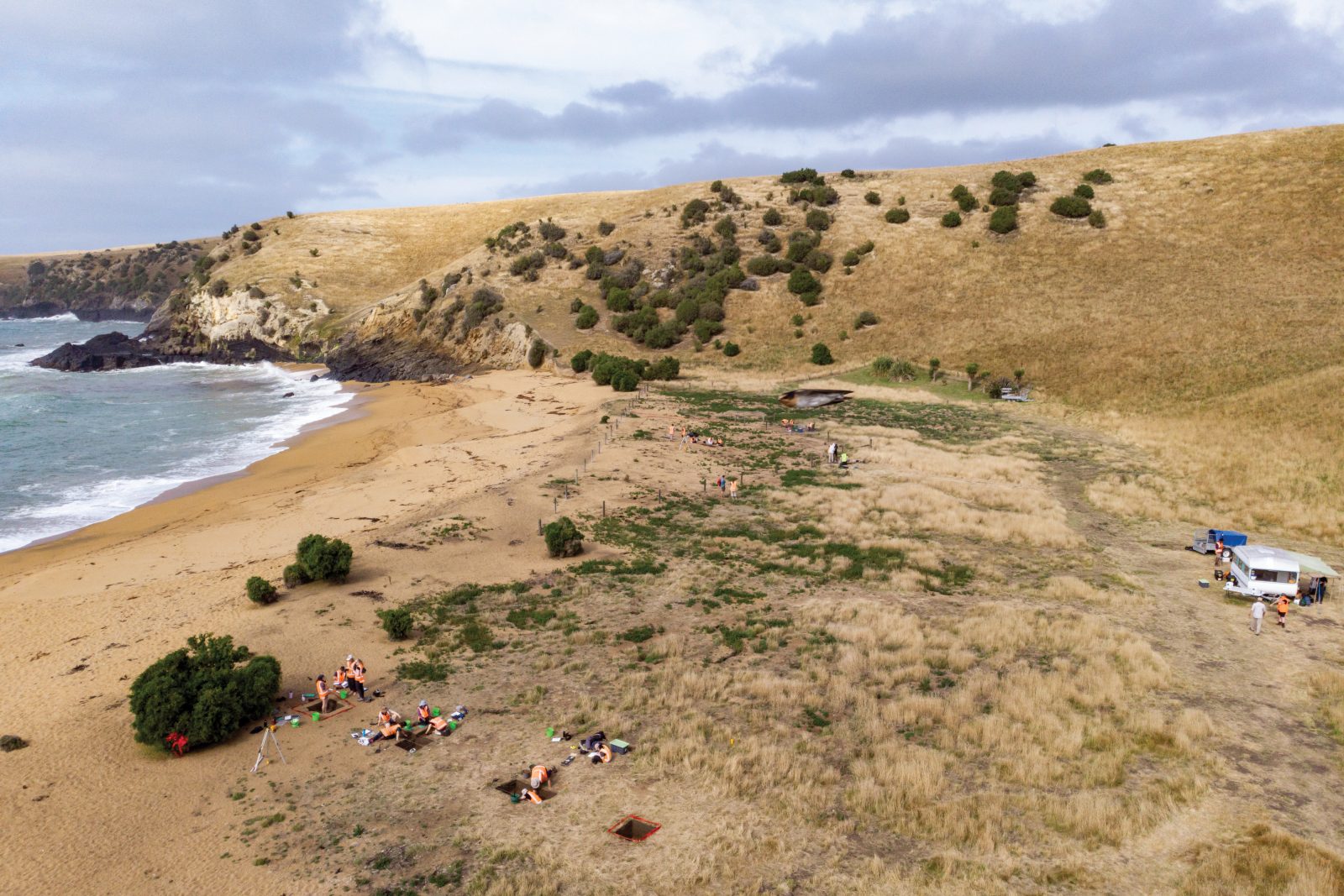
The morning is misty and cool, the pale bare hills dissolving into fog. At the gate to the grassy foreshore the students and kaitiaki remove their hats while archaeologist Gerard O’Regan (Kāi Tahu, and curator Māori at Tūhura Otago Museum) recites karakia to start the day. There are numerous urupā, burial grounds, in the area, and all work is done under tapu. At our backs, a pushy, belligerent northerly whips across empty grass flats and spirals round a few wave-battered cribs. Apart from the fences that mark the various urupā, there’s little to show for the thriving settlement that was here. But its history is still here in the ground—and that ground is under threat.
Every year, as sea levels rise, storm surges and king tides gnaw the top of the beach, pulling umu stones and midden material down into the waves. Higher up on the foreshore, rabbits are destroying the site as well, scraping away archaeological evidence and clawing taoka to the surface. Day by day, more of Tūtakahikura is lost. After a particularly bad storm cycle, Higgins says, the Moeraki hapū decided to call the archaeologists in.
The immediate aim here is to salvage taoka and knowledge from the site: what can we learn from those years of early contact when the old world shaded into the new? There are wider kaupapa at play here as well. For generations, archaeology has been something done to Māori communities, with countless ancestral sites ransacked against people’s will. Now, the hapū is embracing the discipline—and pushing archaeology itself to evolve. What does a dig look like when done by and for indigenous people? This is not an academic question. In times past, a huge number of kāik and pā were built at Takaroa’s door. Today, Takaroa is battering that door down. A recent survey by archaeologist Ben Jones found close to 2,000 coastal archaeology sites at risk from rising seas.
*
Karakia over, we pick our way through the grass towards the site, careful not to break an ankle in the dozens of open rabbit burrows. We stash our lunches far from the excavation site, in the shade of O’Regan’s classic caravan, a spot “to take time out, or have a taki [cry]”, he says cheerfully.
While the students branch off to their squares to the north, the kaitiaki cluster in the middle of what used to be a stockyard, about 30 metres from the beach. The air is salty, the day breathless, the mist close, the hills ghosts. We drop to our knees like worshippers around a rectangle cut from the turf, big enough for eight of us to work on at once. We take up small, sharp trowels and brushes.
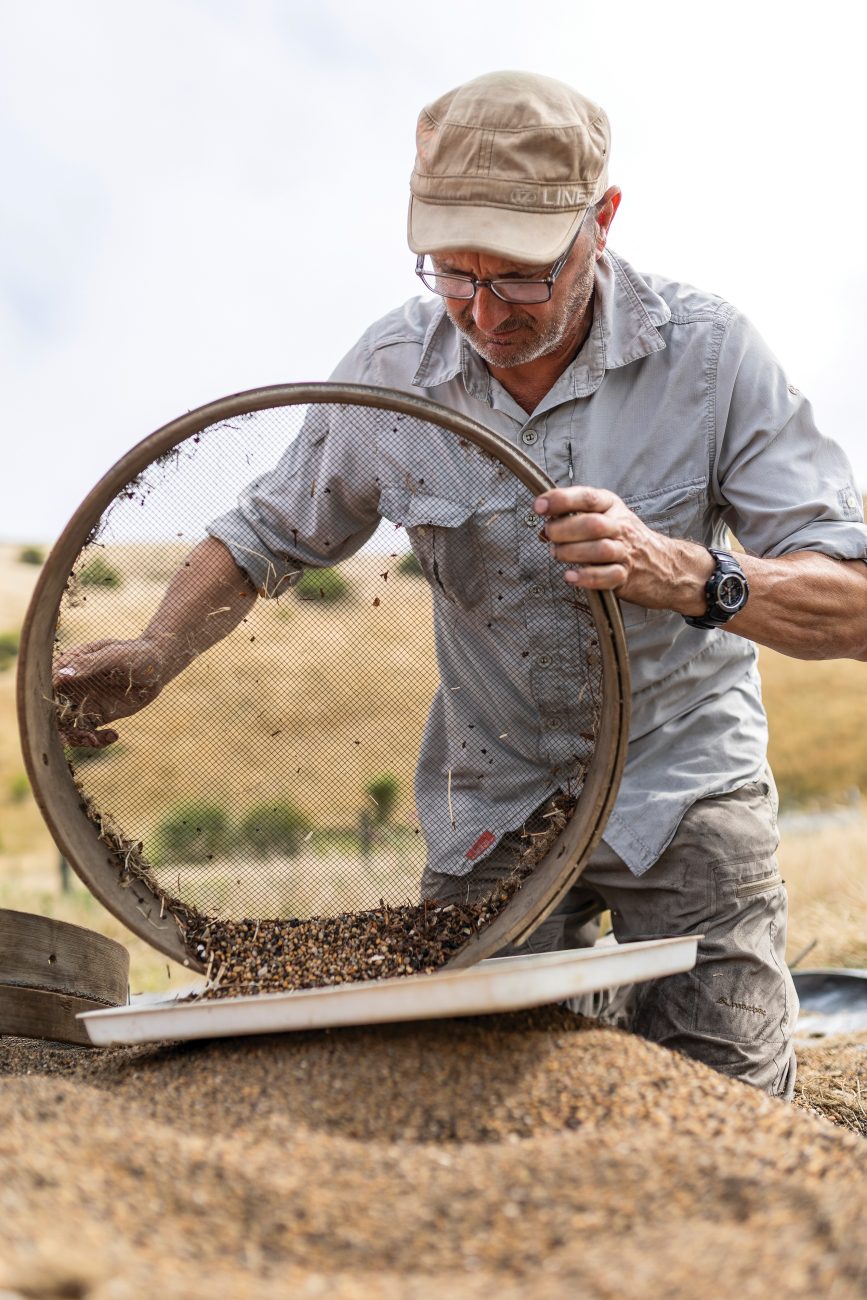
In my corner, an ancient rubbish pile—a midden—awaits. I’m tentative at first, probing the big spiked vertebrae of groper, prising them clear from a thick matrix of other bones. It’s my first time at an archaeology dig but this lot seem like old hands. Isaac Fahey (Ngāi Tahu) hands up a fragment of blackened stone. “Got a nice FCR here,” he says.
“FCR? What’s that?” I ask.
“Fire-cracked rock. Old hāngī stones.”
“How long have you been doing this kind of work?” I ask.
“Since yesterday, bro!”
Fahey works for his hapū, Ngāti Wheke, over the hill from Christchurch at Rāpaki. He looks after their marae and surrounding whenua, and speaks on their pae. Like many of the others here, he’s done cultural monitoring, standing by while the archaeologists work, ready with cultural guidance if anything significant comes to light. It’s a valuable addition to the discipline, but a bridesmaid’s role. These five days are designed to put whānau in the thick of it.
Kāi Tahu archaeologist Rachel Wesley is one of the “demonstrators”, showing us and the students how it’s done. Her moko kauae blends into tanned skin. She’s one of the tribe’s senior leaders, representing her hapū on the iwi’s governing council, but she also spends a lot of time outdoors. She’s down to earth and direct, and clearly stoked with her job. She’s also stressed: we’re like excited puppies, keen to dig, while she must ensure we work methodically, record everything, get the details right.
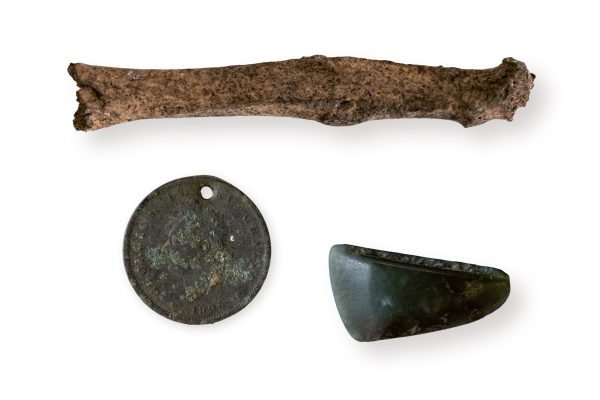
To the layperson, archaeology is perhaps akin to treasure hunting. But what professionals call context—the details of where and how every item, however mundane, is located, plus the layering, soil composition, surrounding geography and so on—is arguably just as valuable as the items themselves. Yes, the first worked artefact we find, a serrated fishhook point, is interesting in its own right. But because we know it’s been found close to the surface alongside kurī and seal bone, with no European artefacts, a story starts to emerge. It’s commonly thought that the old people quickly discarded bone hook points in favour of those made from metal nails; the presence of bone points suggest that, despite our proximity to a known 19th-century village, we’ve found a pre-European layer of the site.
The morning grows hot and humid; the sun burns the mist away to reveal a perfect half-moon of gritty red-gold sand, with headlands and urupā on either side.
The banter and catchups subside, and we lapse into a mood of intense focus. Waves boom ashore, gulls call.
There’s an intimacy with each other and with the earth, lying on our bellies side by side, reaching in, digging and sifting and sorting, watching the layers of the past emerge. I smell wet soil, cut grass, the sea.
We quickly become inured to fishbones and FCR, filling bucket after bucket to be sifted and analysed by another team. But every few minutes, something else of interest comes up. Tāne Tāmati (Waitaha, Kāti Māmoe, Kāi Tahu, Tūhoe), at the time curator Māori at the Southland Museum, finds a flake of mottled reddish-green conglomerate stone. We pass it round. It means nothing to me, but Wesley is excited.
“That looks like a bit of pudding stone!” she says, from the Otago Peninsula, where she’s from. “I always thought it was a rubbish local stone, but seeing it here, I like to think of it as one of my tīpuna coming here, or Moeraki whānau coming to visit us.”
Then a translucent green flake comes to light. It’s a fragment of a rare pounamu called takiwai. This time, those of us who whakapapa to Murihiku/Southland are excited. The main takiwai source is Ōhupokeka/Anita Bay, at the head of Milford Sound, in our hapū’s neck of the woods. I’ve found takiwai at the place where this flake likely came from, while Tāmati sits on the committee that manages access. The flake, though weightless in my palm, signals the dense networks of travel, kinship and trade between our different hapū—networks that are still alive and well among those of us at the dig.
Up the hill and along the ridge from Tūtakahikura stands Te Raka-a-Hineatea, the five-acre, fortified pā built by Taoka, who features heavily in oral histories from this coast. Taoka and his people undoubtedly visited this beach. One of Taoka’s direct descendants is Teitei, who came from Murihiku to Moeraki to marry a whaler. She’s buried at Tikoraki, the urupā a few hundred metres away, which is falling into the sea. Her direct descendant is Tā Tipene O’Regan, one of those who brought the Kāi Tahu claim to a close. His daughter Hana O’Regan, a leader of our language revitalisation, has written a heartbreaking lament about her ancestors’ bones falling into these waves. Gerard O’Regan, who’s led years of archaeological work at Tikoraki, is her brother, and he has the mana to lead this project at Tūtakahikura because his bones are in the land. All of us kaitiaki, the next generations down, are caught and held by this weave. And it’s the insights that this makes possible, as we sit under a baking southern sun, digging and yarning, that show the students around us what’s at stake.
*
As we settle into a rhythm, we start to relax. Wesley, however, must remain vigilant. She’s used to doing fieldwork on her own, not managing big groups. This level of whānau involvement is what gets her out of bed, but it’s also relatively new, and rare. There are few Māori archaeologists, and fewer still from Kāi Tahu. Which isn’t surprising, given the history. When Wesley was growing up, in her whānau, archaeology was a dirty word.
As a kid, she used to follow her pōua, her grandfather, around on their whānau land on the Otago Peninsula. He knew all the old ancestral sites. “He’d show me wāhi tūpuna that had been fossicked and ransacked by collectors in the past, where things had ended up in museums.” Something changed for Wesley when he showed her a cave at Pipikāretu. Diggers had taken kōiwi, human remains, which ended up at the university and museum. “I felt such a huge sense of injustice about it.”
That experience was common for Māori nationwide. Before 1975, it was perfectly legal to dig up sacred Māori sites and keep the finds. Appeals to the pursuit of scientific knowledge trumped all. Community groups also got involved for much of the 20th century, with amateur hobbyists and schools getting on the tools: great for involving people in their own history, less so when it means pillaging someone else’s. At Pūrau on Banks Peninsula, in Fahey’s backyard, a local landowner divided his section—a former burial ground—into plots and rented them out. Curio-hunters strip-mined them for artefacts, context be damned. Moeraki wasn’t immune, either. Behind us up the hill, Higgins tells me, the graves of Matiaha Tiramōrehu and another senior leader, Rāwiri Te Mamaru, were looted. To prevent further theft, these elders’ names were removed from their graves. But perhaps the most striking image of how archaeology was perceived comes from Wesley. To protect sacred caves from diggers, her people resorted to dumping putrid, rotting cow carcasses out front.
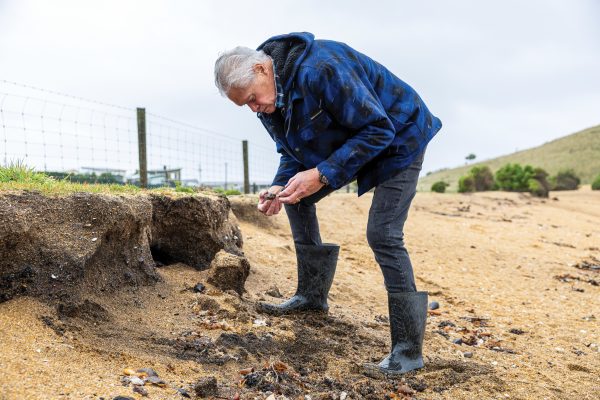
There’s still a long way to go, Wesley says, but some things have improved. The discipline has professionalised—today, you need a master’s degree in archaeology to organise a dig. A law change in 1975 means anything unearthed since must be registered with Manatū Taonga Ministry for Culture and Heritage, giving local hapū the right to make a claim. But the key change for Kāi Tahu came when the iwi began doing their own archaeological work.
The first excavation came in 1980 at Takahanga pā, where the Kaikōura marae now stands. Then in 1999, whānau in South Westland noticed a large midden eroding on their coast at Mahitahi—and decided to take matters into their own hands. Brian Allingham, an archaeologist who’s worked extensively with Kāi Tahu, got the archaeological authority to supervise the work, and rūnaka members got stuck in. School kids came to help sift and count. Once word spread, people started coming forward, “oh, there’s a midden here, a site there.” A box full of pounamu tools showed up. “That’s what happens when the community felt connected and involved,” Gerard O’Regan says.
Around the same time, hunters stumbled across an elaborately carved length of timber on a windswept beach near Te Oneroa/Mason Bay, on the west coast of Rakiura/Stewart Island. They’d found a tauihu, the prow of a waka, carved from mataī around 400 years ago, and a rare surviving example of a southern carving style. Though the area is remote today, oral histories tell of two separate expeditions there. Investigations by O’Regan and Atholl Anderson, the iwi’s leading archaeologist, alongside members of Kāi Tahu’s various southern rūnaka noted a wealth of material rapidly eroding out of the dunes along a 500-metre stretch of beach. Kōiwi had also been found, needing safe reburial—not removal to a museum.
Given the expertise available in Anderson and O’Regan and with funds available following the settlement of the Kāi Tahu Treaty of Waitangi claim, the iwi resolved to do the work themselves. Twenty people spent nearly two weeks camped at the site, zipping round on quad bikes, digging by day, hanging out by night. “It was hardcase,” O’Regan says with a fond smile.
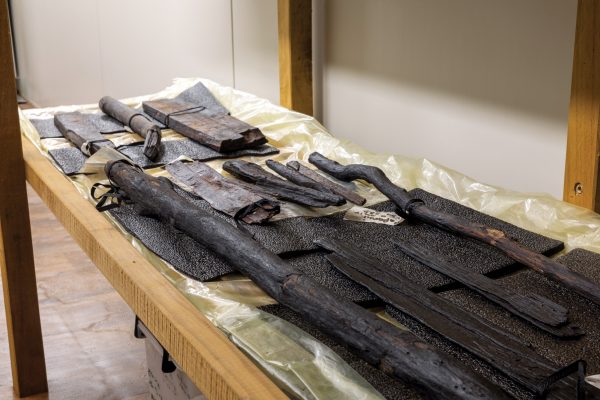
More recently, in 2014, the hull of a 15th-century waka came to light at Papanui Inlet, over the back of the Ōtākou Peninsula. Wesley and her hapū did the work themselves—including attaching whale floats to the hull and swimming with it across the inlet to the nearest place they could park a crane and truck. Local teenagers helped from start to finish, even donning wetsuits and helping float the waka across, “joking about how they’d be remembered in history as the captains of the great Papanui Waka”. The waka is currently undergoing conservation in a climate-controlled facility at their marae. The process, Wesley says, has re-engaged the whole hapū. “We’re making a stand for looking after our taoka, making decisions ourselves … For Ōtākou, that waka excavation was an absolute watershed moment for how the hapū felt about archaeology.”
Which brings us full circle to Tūtakahikura. When Matiaha Tiramōrehu and his followers settled here, life was hard. There wasn’t enough fresh water to support the population. As colonisation proceeded apace and settlers fenced and drained the iwi’s mahika kai sites, the injustice of the paltry reserves they’d been allocated sank in. Those experiences led Tiramōrehu to write his first letter, kicking off the Kāi Tahu claim. Fast-forward through 150 years of activism, and David Higgins, Tā Tīpene O’Regan and the other leaders of their era put the claim to rest with the settlement in 1997. That provided the resources and the confidence that allow Kāi Tahu to be here today, working to understand how Tiramōrehu and his people lived.
*
Lunch is scheduled for a reasonable hour, but no one wants to down tools. There’s rain forecast, and few days of digging remain. We’re vague with hunger but there’s something addictive about the process.
I start to wonder if archaeology might have something in common with gambling, because each scrape of the trowel is a roll of the dice. Maybe this time you’ll find something, and if not this time, maybe the next—and so on until the sun has set, you haven’t eaten in hours, and you’re still thinking: just one more.
In the end we’re dragged away to the caravan for kai. On the way, we pass a trestle table with a big white water container at either end. One is for filling water bottles; the other holds wai whakanoa, water for lifting tapu when leaving the site. It’s another thing the students have to learn.
Marie Dunn is a PhD student and another of the Kāi Tahu demonstrators guiding the undergrads. She feels a responsibility for her fellow students. She grew up living on her whānau’s ancestral land in the Catlins. Their whenua is full of archaeology sites, but her family framed them through stories about a river pā—“oh, this is where your ancestors parked their waka and had a kai.” She got into archaeology through her Nanna, who wrote accounts that connected their land with the people she’d known, going back to Dunn’s great-great-great-grandmother. Her Nanna also had an eagle eye and found numerous taoka on their land, which she took home to stop them from disappearing into museums. As a kid, Dunn thought it was normal for your Nanna to have a cabinet of your iwi’s taoka in the living room.
Today, she’s grateful the other kaitiaki have arrived. Although the field school is under the mana of Te Rūnunga o Moeraki, at times she’s been the only Māori person on site. “There’s a lot of pressure to make sure tikanga is being upheld and that everyone’s behaving appropriately, so when all those other Māori people arrived, I was like, ‘Thank god!’”
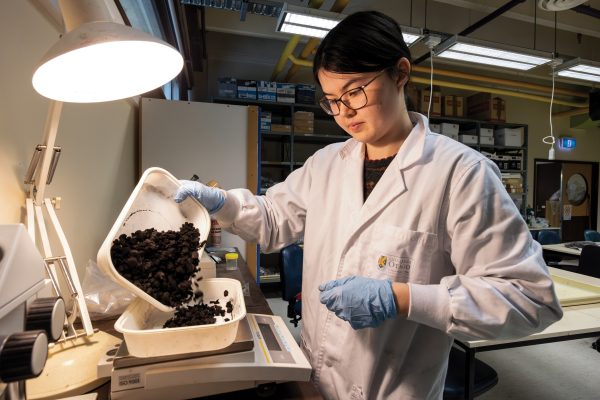
For many students this has been their first pōwhiri, their first time on a marae. “For some it might even be their first time meeting a Māori person,” Dunn says. “It is a lot to learn. You get growled at for breaching tikanga but you’re not entirely sure why. So it can be a bit overwhelming for the students but they’re really open and receptive to it.”
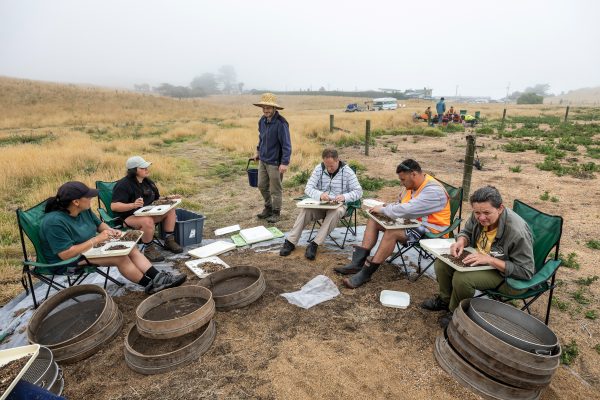
After lunch, I wander over to where the students are working. The find of the day is a small hand-blown perfume bottle, a fine and beautiful object, irregular, unique. As they walk me through their excavations, there’s an abstract professionalism to their language. Where the kaitiaki chatter about finding umu and the remains of delicious kai (one even goes pāua-diving on his lunch break), the students tell me about fire features and ash contexts and small mammal bones. But they also have a sense of awe. They tell me what a privilege it is to be shoulder to shoulder with whānau, how this makes their work meaningful and the history real. They’re also digging near an urupā, which makes everyone acutely conscious of what’s coming up. Earlier in the dig, they found something that brought the excavation to a halt.
In one of the squares, a student found textile fibres. Dunn went to look. “One of the students scraped back, and this metal square popped out, and I was like, ‘Hold the phone, don’t touch anything!’ I was pretty sure it was a photograph.” She was right. It was a plate glass photograph, face down, and once everything had been marked, measured and photographed, they gently worked it free. They could just make out a faint, ghostly image of a woman sitting posed at a table. The clothing and type of photograph suggest the 1860s or 1870s. “Everyone got quite emotional,” Dunn says, “because particularly for the students, it can be hard to make the connection between archaeology being a big time-scale thing and specific people, so I think it probably hit home. I think I went into the caravan and had a wee cry.”
It’s extremely rare for archaeologists to encounter the faces of those whose lives they are investigating. And in te ao Māori, “kanohi ki te kanohi” is an important concept, meaning “face to face”. Beyond practical skills, the whole point of this field school is for these emerging archaeologists to come face to face with the woman in the photograph’s likely descendants, and the other kaitiaki from the wider Kāi Tahu history sphere.
Australian archaeologist Anne Ford leads the field school on the University of Otago side. Part of her pedagogy is teaching students the relationship-building skills, and the sense of perspective, she wishes she’d learned at uni. As she tells her students, “you’re just a moment in these sites’ lives. You know, this is not about your field work, your field school, it is about effectively being a kaitiaki, looking after these collections and then making them available, with rūnaka permission, into the future.”
*
Tāne Tāmati, the young geologist on our team, studied some archaeology subjects at university and ended up at the Southland Museum, working with taoka recovered by Pākehā. This is his first dig. And when he first arrived, he felt his tīpuna giving him a nudge: You might want to look over there. Something green, glinting in the sand.
“I thought, ‘Oh, that looks like pounamu, but how can this be?’ Lo and behold.”
He’d spotted a small pounamu whao, a chisel, used for fine carving work. The kaitiaki had been on site for less than an hour and already there were tears. Happy ones, mind. Tāmati took it as a sign. At the time of writing, he has moved to Tūhura to work under Wesley and O’Regan’s wing.
“This is where I want to be, hands on in the field, digging, exploring the history of my tīpuna.”
*
Back over at the kaitiaki square, there’s a commotion. A dozen or so people crowd round, with more streaming over. I push into the scrum to find that another kaitiaki, Te Rauparaha Horomona (Ngāti Toa, Ngāi Tahu), has unearthed a coin in an area we thought was pre-European. It’s a penny from 1854, with a young Queen Victoria on the front and Britannia holding a trident on the back. The students take photos and search for details on their phones. Inevitably, an eBay link comes up. “Two hundred and twenty bucks!” someone says. Wesley grimaces.
So is the coin part of the midden, or did it work its way in there at a later date? This is where context matters.
If the coin was on its side, it could have cut its way down through the layers, perhaps being trampled in by stock. But a coin lying flat under other layers of midden material looks like it’s been found exactly where it was left.
“This changes the context,” Ford says, harking back to the bone fishhook points we’ve found. “The midden may be historic.” The standard story of technological development is linear, that Māori instantly threw away their tools when Europeans came along. “This is a racist argument: ‘Oh, they saw the superiority and grabbed it.’” But there’s been very little archaeology done of these early contact sites, and here at Tūtakahikura, we’re seeing continuity as much as breaks. Drawings of the settlement show traditional whare and raised whata, storehouses, and we know there was a church, too. The site has already given up traditional kai, fishhook points and stone tools, and a coin, and a photograph, nails, buttons, clothes. Then as now, cultural practices and technologies both persist and evolve. As O’Regan’s father Tā Tipene likes to say, paraphrasing cultural anthropologist Marshall Sahlins, “indigenous peoples use new technologies to become more like themselves”.
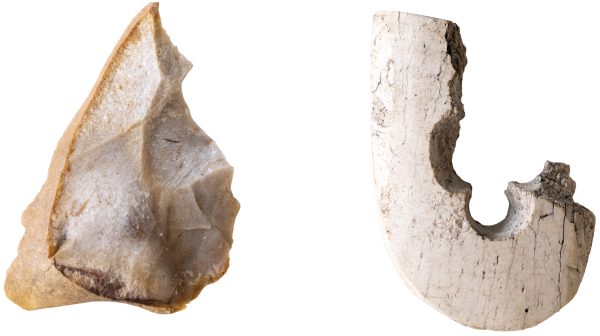
Soon after the coin, another kaitiaki brings up a heavy, fibrous bone. “No, no, no, you’re not meant to be finding that!” O’Regan groans, but you can tell he’s excited. It’s almost certainly moa bone. Then across from me, Horomona calls out, “Hey, is this eggshell?” Wesley and O’Regan and the students go mysteriously quiet. Something white and curved peeks through the dirt.
“Wow,” someone says.
What’s the big deal? I think.
It turns out only one type of eggshell survives in the ground: moa eggs. Finding moa bone doesn’t necessarily indicate the age of a site, because for centuries after moa went extinct the old people “mined” moa bones industrially to make all kinds of things. But finding moa eggshell is a good indicator that we’re dealing with a very early site, back when moa eggs were still on the menu. We’re incredulous. The needle shifts again on the age of the site. Horomona carefully works more of the sandy soil away with a brush. We cluster close. No, it’s a cook’s turban shell: evidence of a more recent meal. Everyone exhales.
While that mystery is easily solved, there’s still no decisive signature as to the time period we’re dealing with. The day is nearly done and the weather has turned. There’s rain in the air, the temperature is falling while the wind rises in fierce gusts. Where the sieving teams work, dark wraiths of charcoal dust fly out to sea. Our focus shifts urgently to finding something good to carbon-date.
“I want some dog poo,” Wesley says.
“I’ll take anything at this point,” Ford replies, climbing bodily into the square and sinking to her haunches. The easiest thing to find is small pieces of curved charcoal—the remains of burnt sticks. “Radio carbon dates when something dies,” she explains as she searches.
“So if it’s heartwood from a long-lived tree, you could be adding 1,500 years of built-in age. So we’re looking for small twigs from short-lived species without that built-in age. There.”
She finds and bags a fragment. O’Regan finds a couple of fine twigs over in the sorting area as well. Then, just like that, it’s time to go. We’ll head back to the marae to shower, cook and feast, then stay up well into the night in wānaka, learning about archaeology’s complex legal frameworks, but for now, the time has come to down tools. The students wrestle a tarp over the nearest square, grappling with the huge, shuddering rectangle that the wind keeps punching open like a sail. Dunn is neck-deep in her square, still working. We’re way past a sensible dinnertime. She can’t tear herself away.
I go for one last walk on the beach, energised by this day and the coming storm. With my eye now attuned I see there’s midden material everywhere, and a dark line of charcoal spanning the entire foreshore from old cooking fires. At the far end of the beach a sizeable block of coarse grey volcanic stone catches my eye. There’s a faint red flecking on one edge. We’ve already found fragments of kōkōwai, red ochre. Mixed with oil, the prized red clay was used to paint the body or tapu things like waka, whare or graves. I gently tilt the stone. I draw breath. The entire underside is red, stained with ochre.
Soon, I’m back with O’Regan and the others. We mark and photograph, then fully turn the stone. I was right: it’s caked with kōkōwai. I carry the block back to the caravan like a prize pumpkin, and we stash it in a tub, out of spitting rain. I’m feeling pleased with myself—but O’Regan is looking thoughtful.
It’s context, you see. I found the stone right on the surface, uncovered despite the loose sand dunes and stiff winds. The ochre is still vivid, and while there are ochre cave paintings more than 20,000 years old, this has been exposed to the elements. And there’s something in the back of O’Regan’s mind that eventually surfaces: there’d been a rakatahi hui, a youth gathering, at Moeraki marae not long ago. They’d been doing paintings and spent time at the beach. Had they been experimenting with kōkōwai?
We grin. I’ve discovered something that’s probably six months old.
Which is a win. For our young people to spend time where Tiramōrehu and his people lived, to be working with kōkōwai, creating links between those ancestors who used moa bones, those who first used pen and ink, those of us alive today—that’s the point of Māori archaeology. “It’s not always digging a hole and counting fish bones,” Dunn says. “It might be going onto places of significance and sharing stories, and that’s heritage practice for us.”
*
In the 20th century, modern life gradually forced whānau away from Tūtakahikura. The Pākehā doctor and grocer refused to visit. Daily life was hard, with scarce freshwater, ever-shrinking access to mahika kai and lack of other work. Yet some whānau clung on, and even when the last of them left in the 1930s, they stayed close on the peninsula. Growing up here, remembering his own grandparents’ struggle, Higgins always wondered why his people stayed so long. Was there something about the land itself?
When the last of the Tūtakahikura whānau moved away, Pākehā holiday-makers and farmers squatted on their land. But in the 1960s, Higgins remembers his grandfather hearing that a farmer was ploughing a particular area for the first time. His pōua acted swiftly, taking a group to the spot with shovels. They started to dig. Higgins and another boy were the only ones present from his generation, but it’s a moment he’ll never forget.
“He lifted the tapu, and it would be about three or four tonnes of pounamu, [including] some big pieces, all wrapped in woven mats.”
When Kaiapoi pā was attacked in 1832, a fortune in pounamu was removed to safety. Half was hidden near Kaiapoi. “The sibling, if you like, of that motherlode sits here at Moeraki,” Higgins says, brought south with Tiramōrehu.
“The uncles were just in tears when they saw it. It was removed to another area, and it’s still there, and it’s never been disturbed.”
Archaeology is often associated with digging up lost treasure. But the whānau here know where the treasure is. It’s stories like these which, though rarely shared, highlight perhaps the most important aspect of Māori archaeology: that our past, lying in the ground, is not abandoned. Māori archaeology sometimes means knowing when and where not to dig; Māori archaeology means knowing when to bring stories to the surface, and when to let the whenua be.