King’s Counsel Sally Gepp on the frustrating, high stakes, necessary work of environmental law. (more…)
More by Naomi Arnold






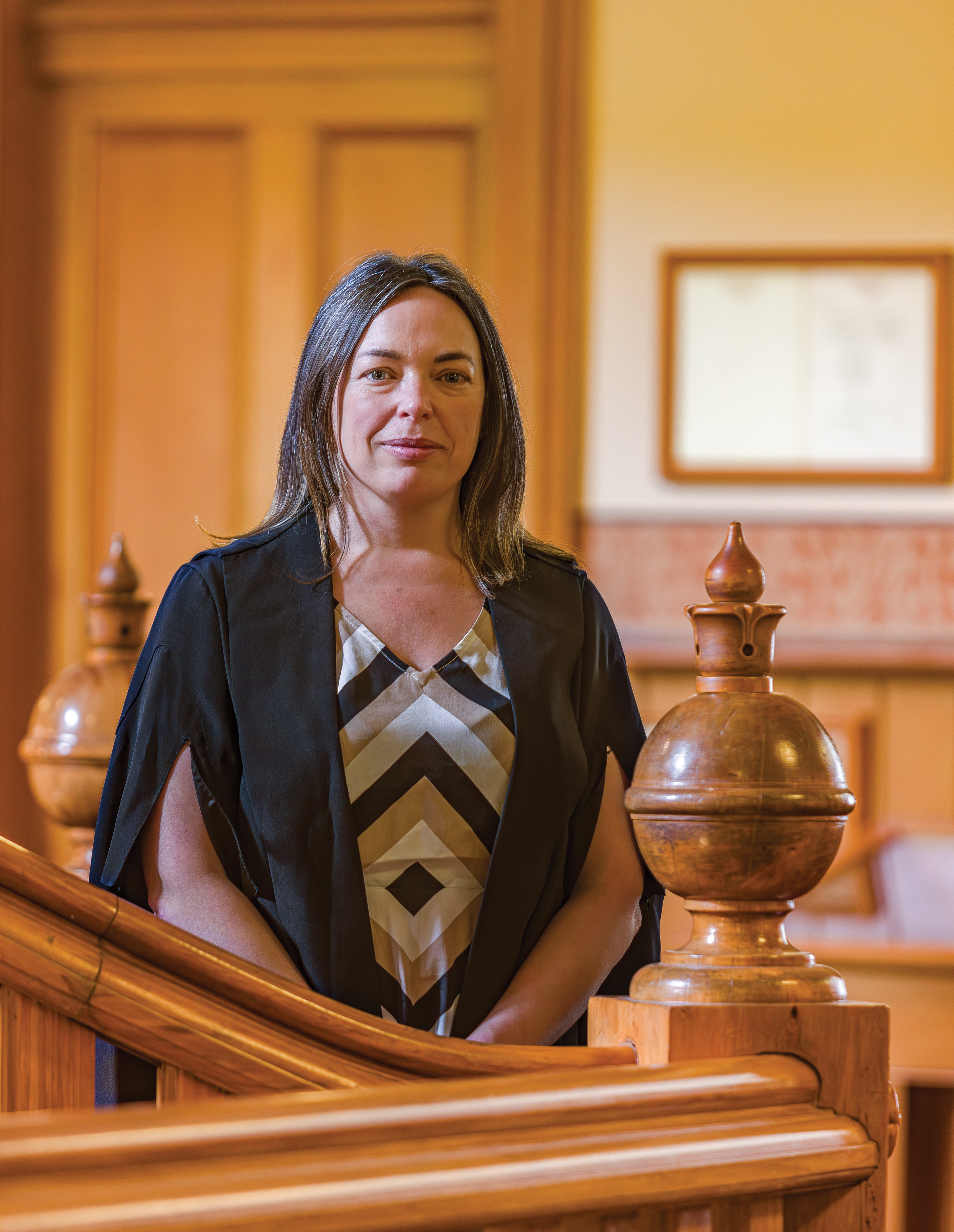
One morning in the Bay of Islands, Nelson lawyer Sally Gepp lowered herself over the side of a boat into the gin-clear waters of Deep Water Cove. She was snorkelling with her family, hosted by environmental groups Fish Forever and the Bay of Islands Maritime and Historic Park. She had worked with these groups and Northland hapū Ngāti Kuta on getting better fishing controls for the Bay of Islands, where overfishing had left many parts of the seabed barren.
In some places the ecosystem was recovering, and the ocean flashed with schools of snapper, blue maomao and other reef fish. It was a rare moment when Gepp could see the evidence of her work.
“To go back and be taken out on a boat and go snorkelling in that area, to actually first-hand experience the marine life, was a pretty awesome full-circle experience,” she says.
*
Unfortunately, a law change this year threatens the success that litigation can achieve, severely limiting the ability of environmental and Māori groups to seek these protections. Gepp is used to these swings and roundabouts. When she started at Forest & Bird in 2010 as an in-house lawyer, someone told her: “The gains are always temporary and the losses are always permanent.”
Accurate, she says, despite all the conservation work going on around the country. She’d love to see New Zealand become more bipartisan in its approach to environmental management.
“To de-politicise it a bit, to follow the science more,” she says. “It seems so straightforward that if there is an unacceptable environmental impact, we would change the way we as humans and our economy and our society are operating.”
Equally self-evident, she says, is the need to keep “trucking along doing our bit and trying to build community”. “If we’re not looking after people, they’re trying to meet their own basic needs and the environment gets shunted down the list of priorities.”
Resources Minister Shane Jones recently had a go at Gepp. In a September fast-track hearing over Trans-Tasman Resources’ application to mine the Taranaki seabed for vanadium, Jones intimated that she had a conflict of interest due to her nine years of work with Forest & Bird.
Gepp won’t comment on that. But since opening her own practice six years ago, she’s specialised in resource management and environmental law, acting for clients across the spectrum: property developers, a hydro-electricity generator, a quarry company, a marina developer—and New Zealand King Salmon’s open-ocean aquaculture application, a Cook Strait scheme Jones enthusiastically supports.
*
Seven women and 12 men were promoted to King’s Counsel status last winter; Gepp learned of her appointment in a Sunday-morning text message from Attorney-General Judith Collins. Women still make up only about a quarter of all practising KCs. A 2024 New Zealand Bar Association report found that although women’s overall representation in the legal profession is now roughly equitable, women disappear through the higher courts and are much less likely than men to appear as lead counsel. The report considers 12 years of data, concludes that it tells an “unambiguous” story, and asks why the problem is so intractable.
Gepp has thoughts. The private sector has “an annoyingly enduring trait” of opting for male counsel, she says. “The Bar Association’s data puts that beyond doubt.”
As well, certain judges are “more disparaging of women lawyers”, she has found; she knows several women who have been treated so badly they now avoid court work, or have even stopped practising law altogether. And court schedules still have a way to go in making sure lawyers who are parents can fully participate.
Gepp sees a deeper disparity at play, too.
“Litigation often means standing alone. I can only speak for myself and the people I know, but we were taught growing up to be good, polite, and kind. Saying, ‘No, I disagree with you and here is why’, is something that many young women are not taught to do.
“I definitely had to learn to do that, and I found it very uncomfortable. And often, especially if you’re working for an environmental NGO or similar, you might be the only person in the room who is saying black when 10 other people representing various industry groups are saying white.”
She remembers a lightning-bolt moment as a younger woman when she suddenly saw through “the intimidating façade of ‘the competent older man’”.
“I have a lot of respect for my colleagues in the profession, but there are a few who, when I was younger, appeared to be all-knowing but actually just spoke with confidence,” she says. “So then I had to learn to do the same thing until it became a part of me rather than something I had to just put on.
“It’s very empowering when you realise that those people who you were a bit intimidated by are not all that. Especially when they underestimate you.”
More by Naomi Arnold
Subscribe to our free newsletter for news and prizes
3
$1 trial for two weeks, thereafter $8.50 every two months, cancel any time
Signed in as . Sign out