Tokelau is one of the smallest and most remote island states on the planet. There are no airstrips—you need to fly to Samoa, then spend two days in a boat crossing open ocean just to get there. The three atolls are each another day apart. The people who live here have adjusted to rapid change, retaining a unique model of governance and a culture of quiet determination. Can Faka Tokelau, the Tokelau Way, survive another thousand years?
New Zealand Geographic and Heritage Expeditions are pleased to announce their second premium adventure, a journey through Fiordland with New Zealand conservation stalwart, award-winning author, photographer and natural history filmmaker Rod Morris....
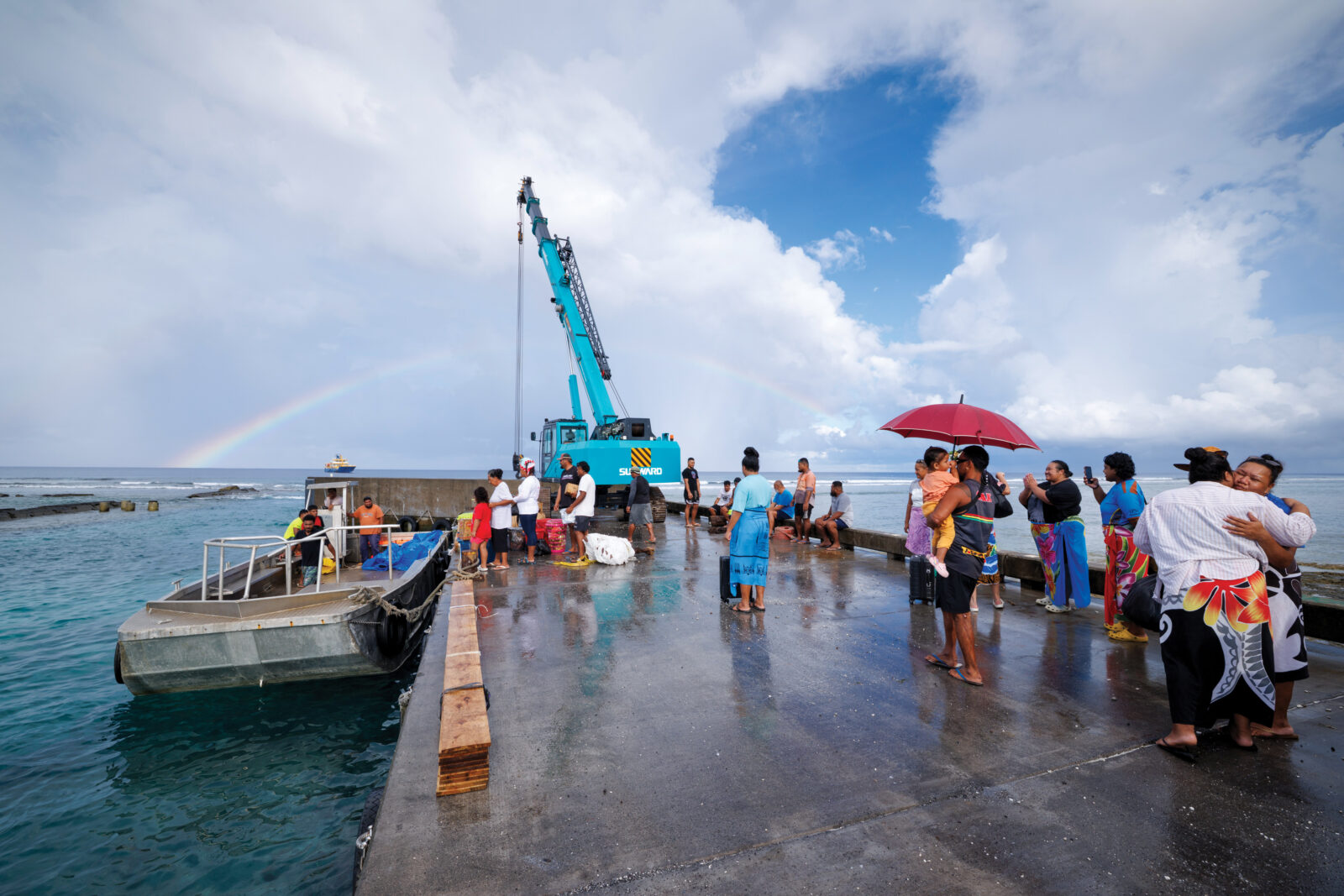
Everything to and from the outside world is taken by barge to ocean-going ships that stand-to at sea.
Atafu
The fans are going flat out in the fale. It’s 32ºC in the shade, and the leaders of each household are seated behind timber desks lining three sides of a square, facing the speaker, who is flanked by the twin flags of state: New Zealand and Tokelau—the latter features a vaka and the Southern Cross against a midnight blue sky.
We have just landed on Atafu, the most northerly of Tokelau’s three atolls*, on a Conservation International-led expedition with New Zealand Geographic. We’re here to develop environmental education programmes, gather biodiversity data and put new, high-tech environmental monitoring tools into the hands of the community, so that each atoll council—the Taupulega—is able to make decisions based on better data.
* Many Tokelauans recognise a fourth atoll, Swains Island/ Olohega, some 200km to the south. It was annexed by American Samoa in 1925 and though now uninhabited, is privately owned.
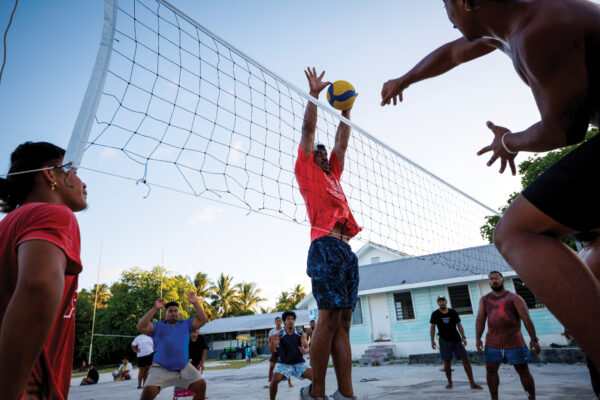
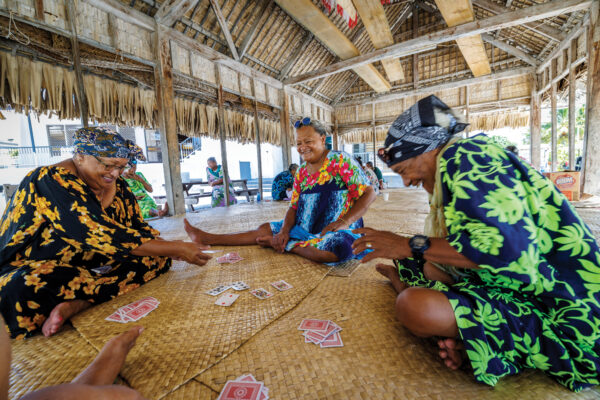
When the scorching sun drops towards the horizon, volleyball and touch rugby are the games of choice.Game on. In the heat of the day you want to find shade and company—for Tas Elia (left), Temisa Pelesa and Tasi Toloa, that’s cards or bingo in the Fatupaepae.
The oceans are warming rapidly, changing the environment that Tokelau depends on for its food, livelihood and security. With less than 1700 people, few natural resources, a vast marine estate, and an unavoidable reliance on New Zealand, it is a monumental challenge. In the past two decades, however, the islands have received new vessels, international revenue from fisheries, and have switched from diesel generation to a clean grid completely powered by solar—the first country to do so in the world.
“If the environment is healthy, the people are healthy,” says Kelihiano Kalolo, the leader of the council, summarising our presentation for us. Everybody nods. On a small island, the effect of every decision is felt almost instantly. Tokelauans have been living the fine balance of sustainability for a thousand years, but that balance may be getting harder to strike.
*
The water at the southern end of Atafu’s lagoon is luminous, and translucent rather than clear, like a glacier-fed lake in the Southern Alps. I roll over the side of the boat with a scuba tank and descend through the loom until the sun is a dancing halo above me. Even at a depth of 20 metres, my dive watch still reads 30ºC.
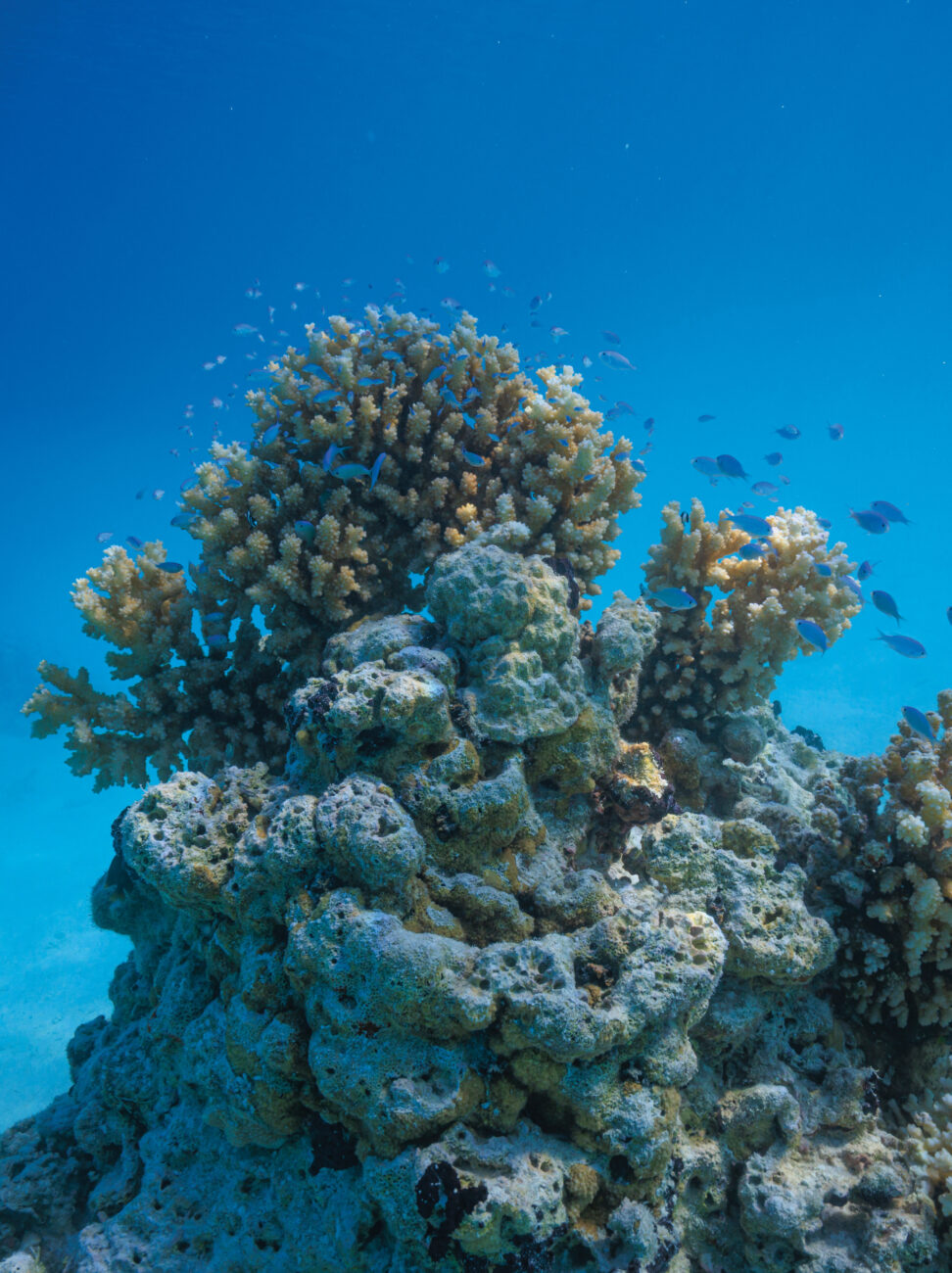
Great towers of grey coral rise up, as if I’m approaching a city of skyscrapers through fog. Each turret is four or five metres tall, stacks of irregular shapes—metre-wide plate corals, billowing cushions of massive corals, and broken fingers of ancient staghorn. Though some small corals are alive, most are deathly grey, like moon rocks. A pair of striped Moorish idols wend through the towers, nibbling filamentous algae from crooked branches.
It’s beautiful, in a way, like the eerie ruins of an ancient civilisation. And that is exactly what this is. Each tower was once thriving, growing up towards the light, one tiny coral polyp upon the shoulders of another. But some time ago, conditions changed, and the temperature inside the lagoon became too hot for many corals to survive. They bleached bone white, then were cloaked in algae, then died completely, taking on an ashen complexion.
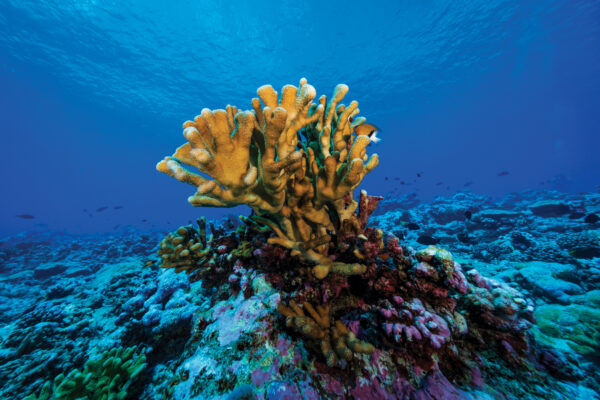
Some corals do better than others inside Atafu’s warming lagoon—here branching Acropora grows atop dead coral, attracting a constellation of blue Chromis fish.
Tokelau’s atolls are unusual in that they are perfect, unbroken rings of coral without any channels, cuts or penetrations that might flush the lagoon on each tide. As a result, they are effectively closed biological systems—each a fishbowl that rarely mixes with the open ocean. Warm water, sediment, and pollutants can’t flush out, and cool water from the ocean with its cargo of larvae rarely replenishes the aquarium within.
So temperatures rise, like a sauna with no door, and as the local community continues to fish from a finite breeding population, the catch quickly becomes unsustainable. First, the larger, fewer predator fish are depleted. Then, the smaller fish that clean algae from the coral are targeted. They’re more numerous, so the decline is harder to notice, but it has a dual effect: fewer fish, and more algae, reducing coral health and resilience at a time they are most important. Bleaching is accelerated, recovery from heat events less assured.
Testing the limits of life
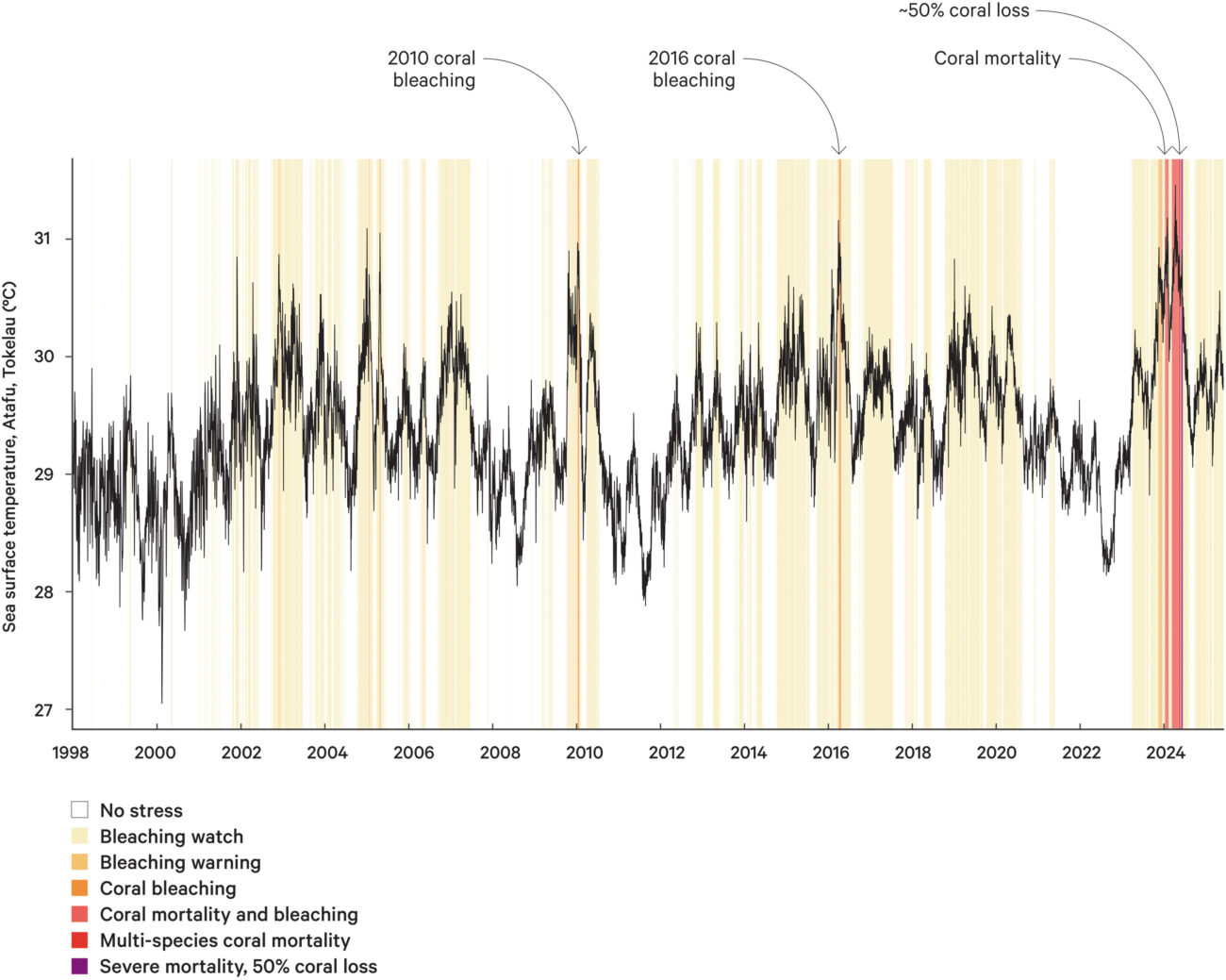
Coral heat stress events are measured in degree-heating-weeks (DHW)—not how hot or how long, but a combination of both factors.
On a scale devised by scientists from the Coral Reef Watch team at the United States’ National Oceanic and Atmospheric Administration, an event of 4 DHW means significant coral bleaching (that is, stressed coral polyps spit out the algae that help them thrive). Crack 8 DHW and the corals die.
The saw-toothed graph above shows the normal seasonal oscillations of sea-surface temperature, as measured by satellites, overlaid by the more ominous seesaw of temperature anomalies. Since 1998 the stress has been lapping over the watch and warning levels almost every year. You see the thermal stress result in coral bleaching in the first months of 2010 and 2016, and then in 2024 Tokelau’s reefs entered new and dangerous territory.
In October 2023, the satellites were recording sea surface temperatures of more than 30ºC, but this was just the beginning. The superheating was sustained. On January 13, 2024, temperatures surpassed the
8 DHW threshold that signifies coral mortality. The sea temperature peaked at 31.5ºC on April 10, but the event lasted until July 20—more than six months in the death zone.
At its peak, the waters of Tokelau surpassed 16-DHW, a level of thermal stress so unprecedented that the Coral Reef Watch team was forced to review its classification to include three new levels. Now, 12 DHW signifies multi-species mortality. At 16 DHW, scientists expect that more than half of all corals will die. At 20 DHW all but the weirdest, toughest 20 per cent of corals will perish—a future that was unimaginable when coral bleaching was first recognised in 1998.
In 2025, sea temperatures remain unseasonably high.
Tokelau’s atolls have endured at least three heat stress events since the massive El Niño of 1998 captured headlines.
The latest event in early 2024 not only bleached corals, but also crossed the lethal boundary that marks mortality, boiling the corals alive for six months straight.
We are sombre as we surface and haul gear back aboard the boat. We’ve just spent 45 minutes in an apocalyptic version of Tokelau’s future, where coral looks as dead as concrete, and we’re lost for words.
“The coral’s a bit better on the other side,” says Steve Hakai, apologetically, gesturing toward the waves crashing on the outer reef.
As we roar back across the lagoon, that apology weighs heavy on me. The people of Tokelau are not responsible for the warming that is superheating the seas around them, eroding their ecosystem, decimating their fishery and threatening to wash away their homes. And the waves from the West bring no apology.
*
Iuta Isaako might have a solution.
“Iuta, like Utah, the state. I’m not American. Not Mormon either,” he says, flashing a grin. He’s a barrel of a man, worked as a builder in New Zealand and still has the chippie accent and straightforward way of thinking. He grew up in Atafu, and like many, travelled to Nelson College on a scholarship, aged 15. Iuta met his wife, Tia, in Wellington, a third-generation New Zealand-born Tokelauan. They built a life there, and a family. “All girls,” he says. “I gave up on a son after the sixth one.”
In 2017, the family returned to the atoll where Tia, a registered nurse, served in the village hospital and Iuta ran construction contracts until COVID, when “everything stopped”. He got a government job as climate change manager for the Ministry of Oceans, Climate and Resilience—coordinating Tokelau’s response to rising sea levels, increasing water temperatures, and heightened storm events—which saw him through the pandemic, even though Tia and the children returned to Wellington for school and work. He also inherited a coral restoration project. This was an entirely new idea to him, and he was intrigued.
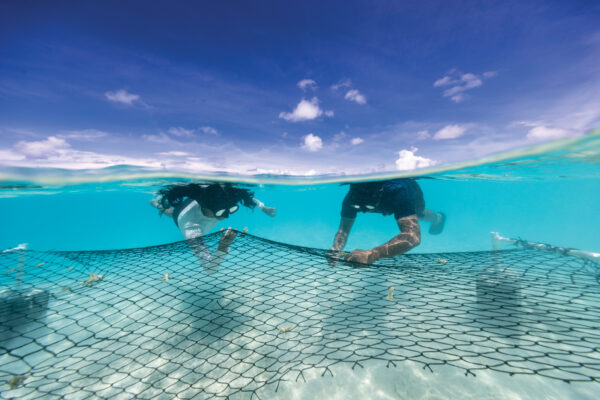
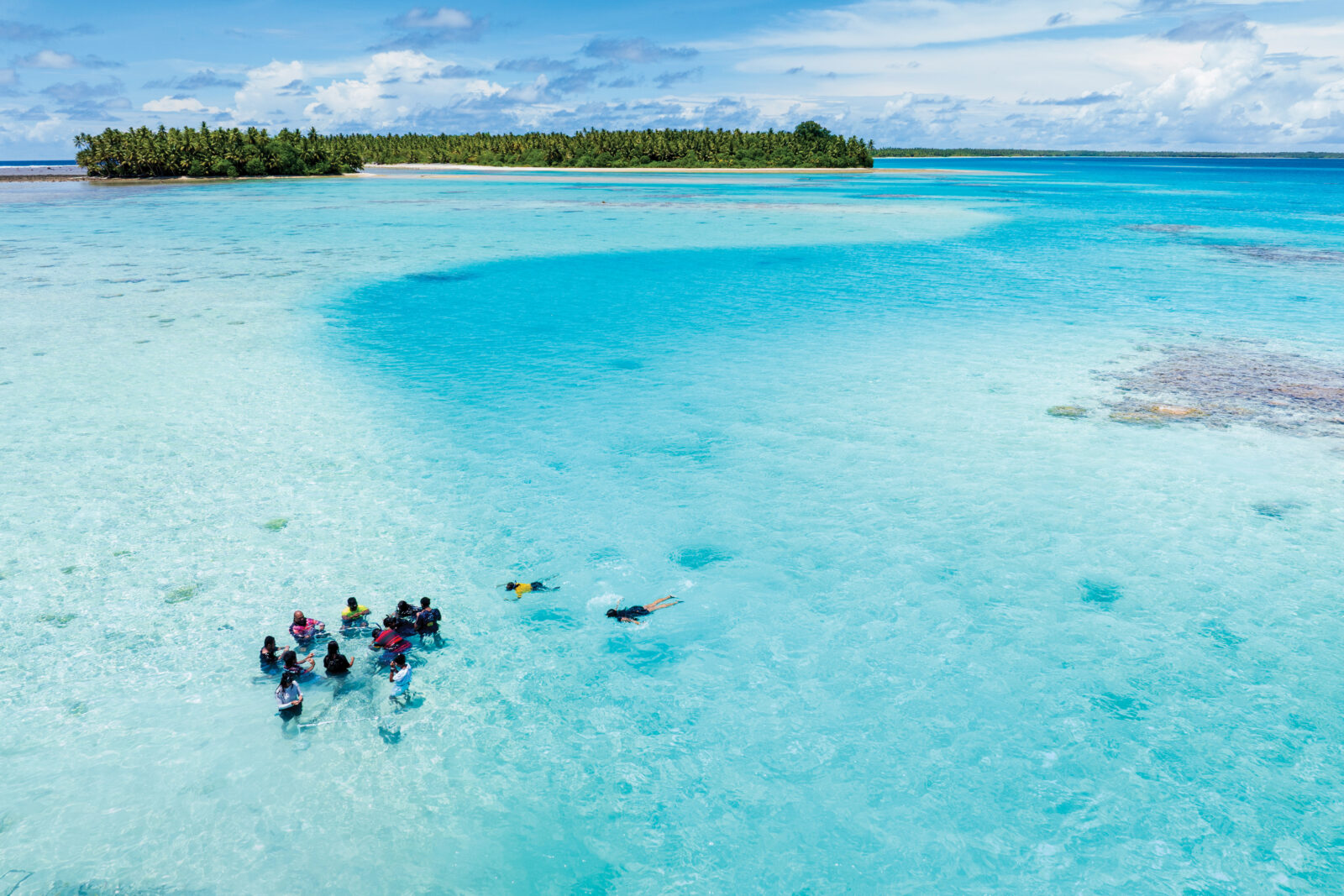
Today, we’re at the north end of the lagoon, in waist-deep water, gathered around an alloy frame. High school students are harvesting posies of live coral from nearby coral heads, and lashing them carefully with cable ties, according to Iuta’s instructions, to netting stretched across the frame.
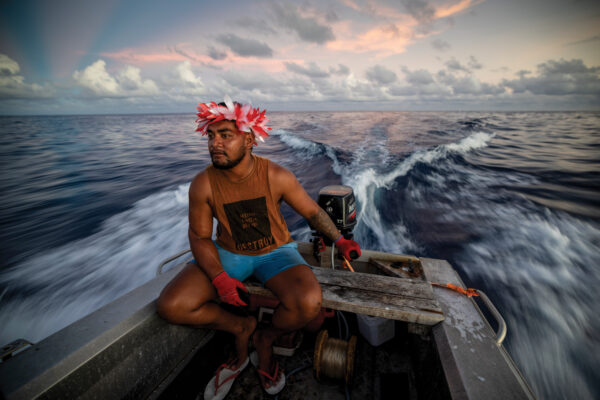
Tokelauans rely on their ocean estate for sustenance and survival. Students Philodendron Sirila and Josh Tana plant heat-tolerant corals on netting within Atafu’s lagoon.Fisherman Jasper Peau heads offshore at dawn. Aluminium boats and more reliable outboards have vastly increased the distance fishers can travel in search of a catch.
At this end of the lagoon waves bring a small quantum of cool water across the reef at high tide, easing the heat burden. These cuttings will grow into bouquets of new coral. Iuta and the students will be able to monitor progress using photogrammetry equipment provided by Conservation International and New Zealand Geographic, to detect which species thrive and which succumb to heat events. The most resilient corals will be transplanted back on deeper reefs and new ones selected.
Elsewhere in the South Pacific, similar projects have helped jump-start populations of coral after mortality events. Researchers are also moving more heat-tolerant corals from ‘hot reefs’ to cooler ones in deeper water in the hope that they, at least, might survive the heat to come.
At the northern end of Atafu’s lagoon Iuta Isaako, the climate change programme manager for Tokelau, summons students from Matauala School around an underwater frame. Their job: pick posies of live coral from the adjacent reefs and fix them to netting to grow. Surviving coral will be transplanted on cooler reefs, a sort of insurance policy for a warming world.
But most of all, it’s good to see things growing rather than dying. It’s good to be active rather than passive. And that’s especially true for Iuta. He visits his family back in Wellington every few months, but long periods away can be tough. A little like the corals he tends, escaping the heat can be helpful.
“You can go a bit crazy here by yourself,” he says. “You get into bad patterns, drinks after work with the boys. It’s not healthy.” On this trip back to Atafu he brought one of his twin daughters, Uaina, with him. Duties as a solo parent on the atoll helped to anchor him, he says.
Uaina loves it on Atafu, and has made new friends in the school, but they both “miss the family, every day, every night”, says Iuta. Uaina tells me they’re heading back to Wellington, back to school, back to Mum, “in 12 more days”.
*
NUKUNONU
The largest of Tokelau’s atolls is Nukunonu. Thirty islets form a thin green rim around a yawning lagoon that spans 98 square kilometres. Just two islands—connected by a footbridge—are inhabited.
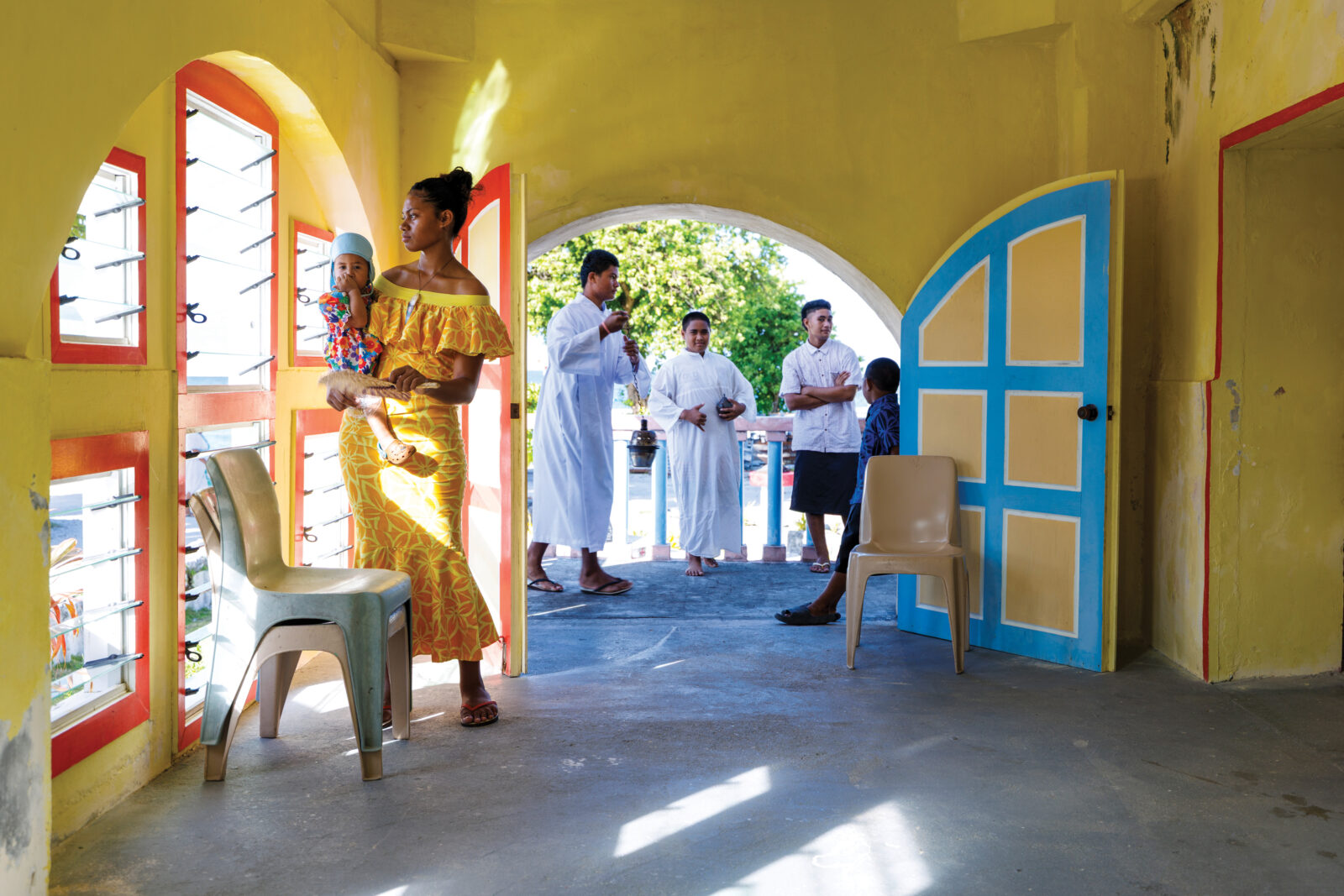
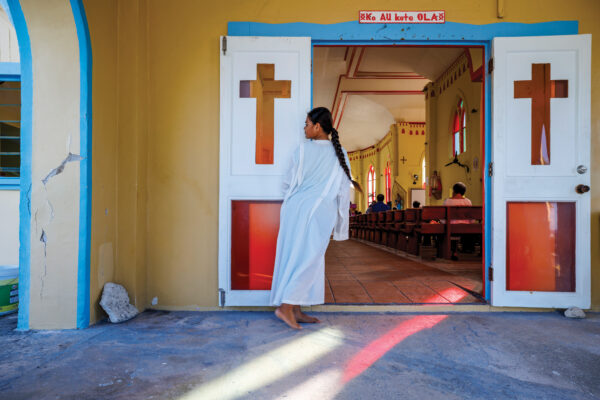
Vefa Fatia tells me she lives on the other side of the bridge. And it’s her 10th birthday. She’s wearing a white gown with long, flowing sleeves. Today, the fourth Sunday of Lent, is her turn to walk the candles into church.
Southeasterly trades blow through the louvred windows, lifting the smoke of Mass. The hymns are full-throated.
While congregations wither in the West, every household turns out for the service on Nukunonu. The joy and structure of Catholicism seem to match the conservative family values and collective responsibility that is baked into Tokelauan culture.
After church, we walk down the main road, coral crunching under our jandals. Past the empty hall, past the empty meeting house, past the empty Fatupaepae, the women’s house, to an indentation in the shore where the lagoon boats can load. We had expected to see a boat that would take us across the lagoon for a picnic at Tokelau Island on the opposite side. There are no boats.
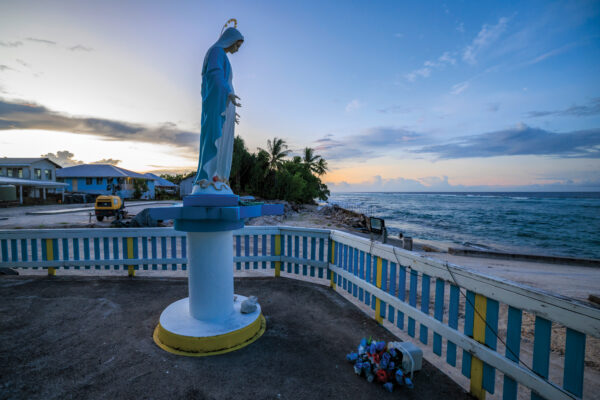
On Nukunonu, a statue of the Virgin Mary—shipped from Rome—looks over the reef passage that leads to sea, a welcome sight for those returning home.
So we wait beneath a breadfruit tree, watching the hands of a shadow clock move across the ground. Half an hour goes by without anyone raising an eyebrow.
Filipo Perez is getting frustrated with the delays. He works for the Government of Tokelau and is assisting us with logistics like these. He grew up between Apia and Nukunonu, and travelled to Sydney to study for a masters degree in employment relations and human resources.
“It was like being thrown to the sharks,” he says. “I was torn apart, but it was sink or swim.”
The dramatic change of pace is a shock for any Tokelauan heading south. Nowadays, the Department of Education sends promising young students on scholarships for the final year of school, where there is more support and structure, rather than into a freewheeling first year of university.
But the return to Tokelau can be equally difficult. “When I came back to Nukunonu, I was looking for a job,” says Filipo. “But no one wants a smarty-pants. You’re still in your place here, still have your duties to the community, to family.”
He looks down at his watch, shakes his head, and sets off to find out what’s going on.
An hour. No boat. People speculate, but this is too soon to get anxious. An hour and a half. The “petrol fullah” turns up and lifts a couple of 25-litre jerries of pre-mix from his truck. “Tokelau time,” he tells me, throwing his hands in the air in mock despair.
Asi Fangalua Halaleva-Pasilio sits on the seawall, wearing sunglasses fit for Beyoncé. She is not from Tokelau. Asi grew up in Lifuka, an island in Tonga’s Ha’apai Group, then did 7th form at Awatapu College in Palmerston North. Later, she “fell in love and married a Tokelauan man”, Tumua. She followed him home to Nukunonu in 1993, a Tongan in Tokelau, and revelled in the Tokelau Way.
“Life is so simple here. A funeral in Tonga costs an arm and a leg. But here you just pay your respects, gather together with family for a feast on the third night, and that’s it,” she tells me, waving her hand gently as if dismissing concerns. Asi still misses Tonga, but in Tokelau “there are fewer obligations and commitments. All I worry about here is my family. It’s a very simple life.”
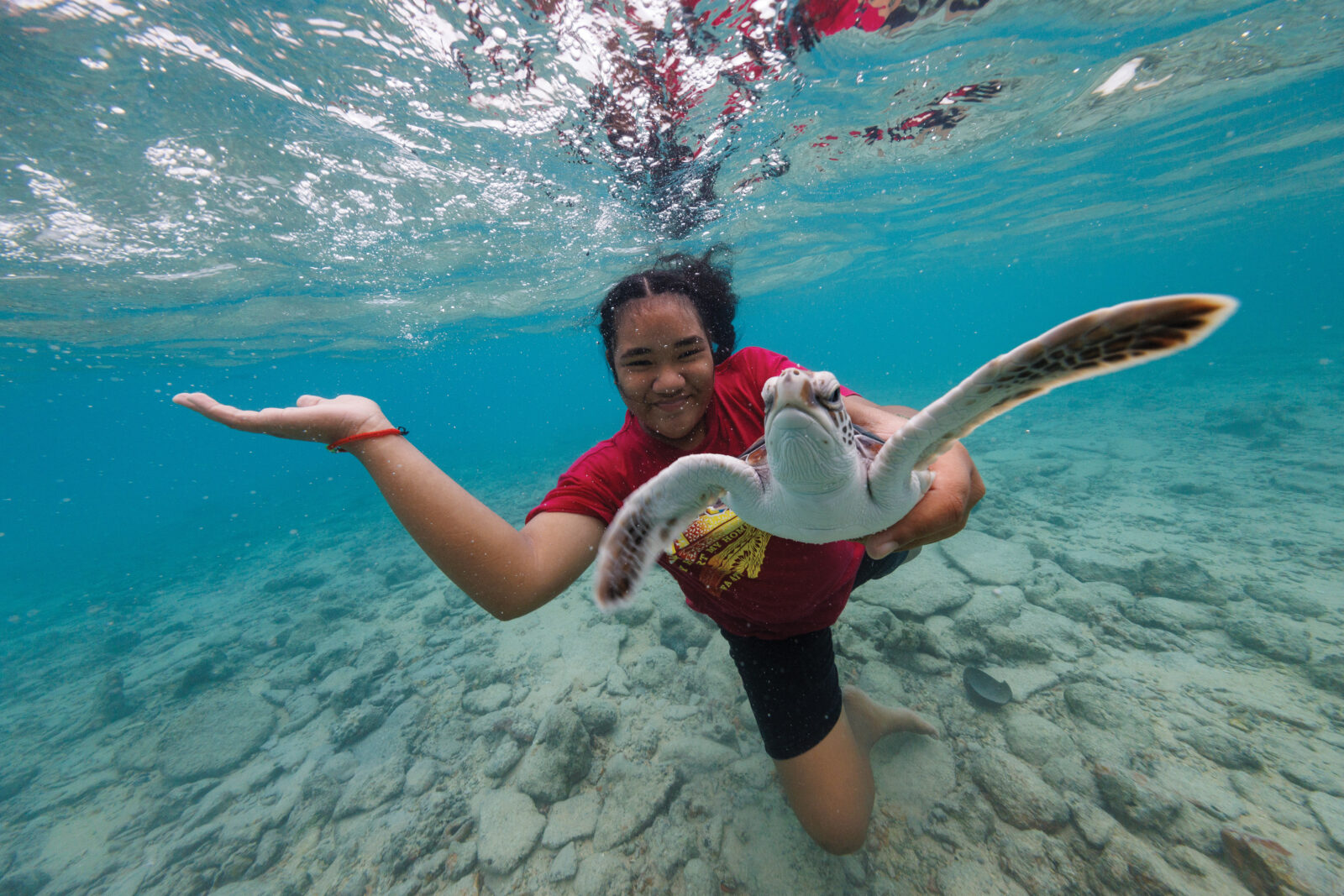
Ruisi Iosefa cradles her one-year-old daughter Tausala in the cool breeze at the back of the church while altar boys ham it up for the camera. Nukunonu atoll is Catholic, Atafu is Protestant, and Fakaofa hosts both denominations. In all cases, however, faith and church life is central to Tokelauan society, the conservative values and sense of community echoing the messages of Christianity.Luviana Pasilio swims with pet turtle Popo, which she is caring for while her sister is at school in New Zealand. A few days later Popo struck out into Nukunonu’s vast lagoon to fend for himself.
New Zealand Geographic first came to Tokelau a year after Asi arrived, in 1994. The feature in issue 24, written by Mark Scott and photographed by Arno Gasteiger, is a classic, an insight into Tokelauan life and culture on the eve of remarkable change. Mark lamented the trial of domestic life for women—cooking over an open fire, the lack of refrigeration, the manual load required to maintain a household. Everything was rationed. The generator ran only intermittently. All that changed, says Asi, with the arrival of propane, which replaced burning coconut husks for fuel, and transformed island life, for women in particular.
Since then there has been one revolution after another. Aluminium fishing boats replaced vaka. Powerful two-stroke outboards could travel further and faster to chase the catch. Women, who had been restricted to their home atoll for a thousand years, could now take the ferry to adjacent atolls, and an upgraded ferry from Samoa brought goods on a more reliable basis—diesel for the generators, instant noodles, beef, cigarettes, medical supplies. The village shop swelled with desirable things, and only cash could buy them, cash sent from the Tokelauan community in New Zealand, now numbering more than 8000.
By this time, Asi and Tumua were living in Sydney with a young family. They finally returned to Nukunonu for good in 2008. Her son, Paula, was two years old. “He was the happiest boy in the world; playing outside without needing to be called back,” she remembers. “He had the free life of the islands.”
Vefa Fatia, 10 years old today, waits at the doors of the Catholic church in Nukunonu. Later, the congregation—most of the population of the atoll—will sing her ‘Happy Birthday’.
Today, the islands have solar power 24/7. There are supplies at the shop. And there’s the Internet. “Life is easier for women here now. It’s like a luxury for us. Teletok changed everything,” says Asi.
Teletok, the Telecommunications Tokelau Corporation, was set up by the General Fono, a council that includes representatives from all three atolls. Satellite links and village exchanges were switched on, giving the atolls live voice circuits to New Zealand for the first time. The internet came to Tokelau in 2015, 4G in 2017 and proper broadband with the connection of the Southern Cross NEXT cable in 2022.
The one that got away
In the early 2000s, Tokelau became the subject of a global internet experiment. Dutch entrepreneur Joost Zuurbier, then a small-scale internet-service provider, realised that Tokelau’s .tk country code was unclaimed. Joost travelled to Tokelau to propose a deal: his company, Freenom, would provide reliable internet connectivity—a satellite uplink that would usually cost around $3000 per month—in exchange for exclusive rights to own and market .tk domains worldwide.
Tokelau’s leaders, lacking both technical expertise and capital, immediately saw the upside. The atolls acquired their first internet cafes and local schools received email-ready computers. But Freenom’s model—giving away most .tk domains for free and charging fees on the sale of premium names—was a big bet.
By 2005, .tk registrations had exploded. With more than 16 million domains under management it was the world’s most popular address, but the “free domain” promise drew spammers and other malicious actors seeking disposable web addresses. Within a few years, security vendors flagged .tk as disproportionately hostile and network operators began blocking .tk addresses.
Unlike Niue (.nu) or Anguilla (.ai), which built sovereign registry entities or trust funds to capture registry surpluses (amounting to tens of millions a year), Tokelau couldn’t control its digital asset—it was owned by Joost.
In November 2023, after a high-profile lawsuit brought against it by Meta and mounting compliance breaches, Freenom announced plans to exit the registry business, and its accreditation was formally terminated. Teletok has since entered talks with New Zealand’s registry to stabilise operations, but the decade-long loss of revenues can never be recouped.
Joost has since expanded Freenom’s portfolio to other underutilised codes
using a similar ad-supported model, and maintains that his Tokelau deal helped bring the internet to one of the most remote places on Earth.
“Teletok cards used to be $50 for 2GB. People started spending more on the internet than daily goods,” Filipo tells me. “Then one guy brought Starlink from Samoa, and boom, everyone got one. It was faster and cheaper. Some of them don’t even have passwords. You just sit under a breadfruit tree and have unlimited Starlinks to connect to. Some families have two!”
It’s made all the difference for Asi. Last month, she graduated with a masters degree in public policy from the University of Auckland, the entire programme conducted over the web. And now that her daughter is studying at Otago Girls’ High School in Dunedin—one of three from Tokelau awarded scholarships—she can chat over Messenger.
“We’re so far away, James. There’s no plane. But now we can chat on video. It’s borderless,” she says. “It’s so much easier than writing letters and waiting months for a reply. It’s brought us closer to the rest of the world.”
Tokelauans have adapted rapidly to the new tech. They chat on Messenger and post on Facebook, using a mix of English, gagana Tokelau and emojis. Without street addresses, locations are sent via Google Maps shortcodes—Iuta’s house is FF5M+JJP.
After two hours, an aluminium boat slips around the corner and comes alongside the concrete seawall. It’s Tumua. He’s rounded up the others, pulled a couple of pigs out of the umu and is siphoning fuel from the jerry can into the outboard tank using a technique I’ve never seen before. (The Tokelauan way is to blow hard into the siphon hose in the full tank, then drop the end sharply into the empty one—as the fuel sloshes back up the line, it overflows the bend in the hose and starts the siphon. I intend to practise this.)
Soon, we’re flying across the lagoon, the two-stroke singing, all memory of the long wait extinguished by the breeze on the face and the frisson of a speeding boat. Petrels flutter above us, their white bellies painted with the brilliant turquoise reflected off the water of the lagoon, as if they’re glowing.
Josef, the skipper—also the island’s welder, the barge driver, and member of the Taupulega—weaves between coral heads and skims over shallow patches with theatrical flair.
We cruise up to Tokelau Island, and then into Tokelau Island—a horseshoe shape, with a statue of the Virgin Mary on a concrete pile at the centre. She was fixed here after Severe Tropical Cyclone Percy, which struck the atolls with sustained winds over 200 kilometres per hour in February 2005. In a warming world, cyclones spin up further south, and islands close to the equator such as Tokelau may in fact experience fewer storms—but when they do, higher sea surface temperatures will make for higher wind speeds, greater rainfall and more devastating surges.
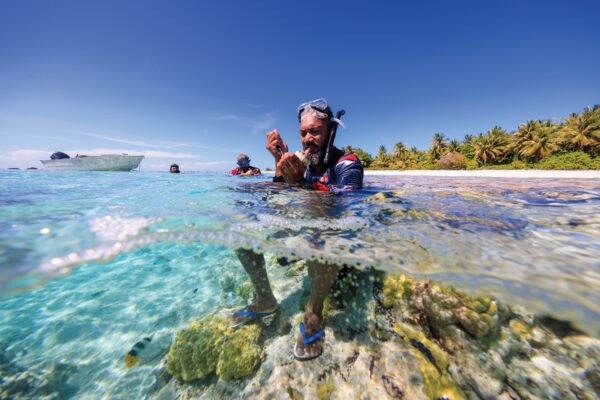
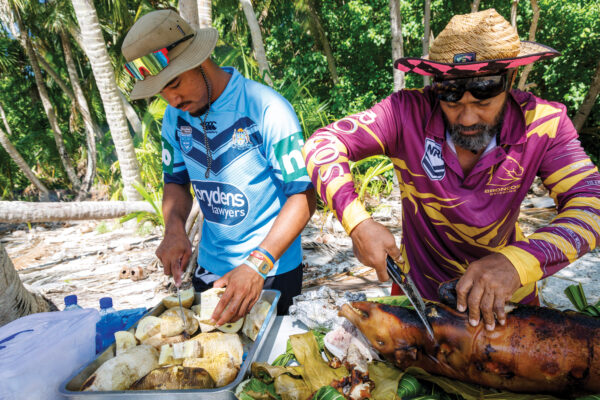
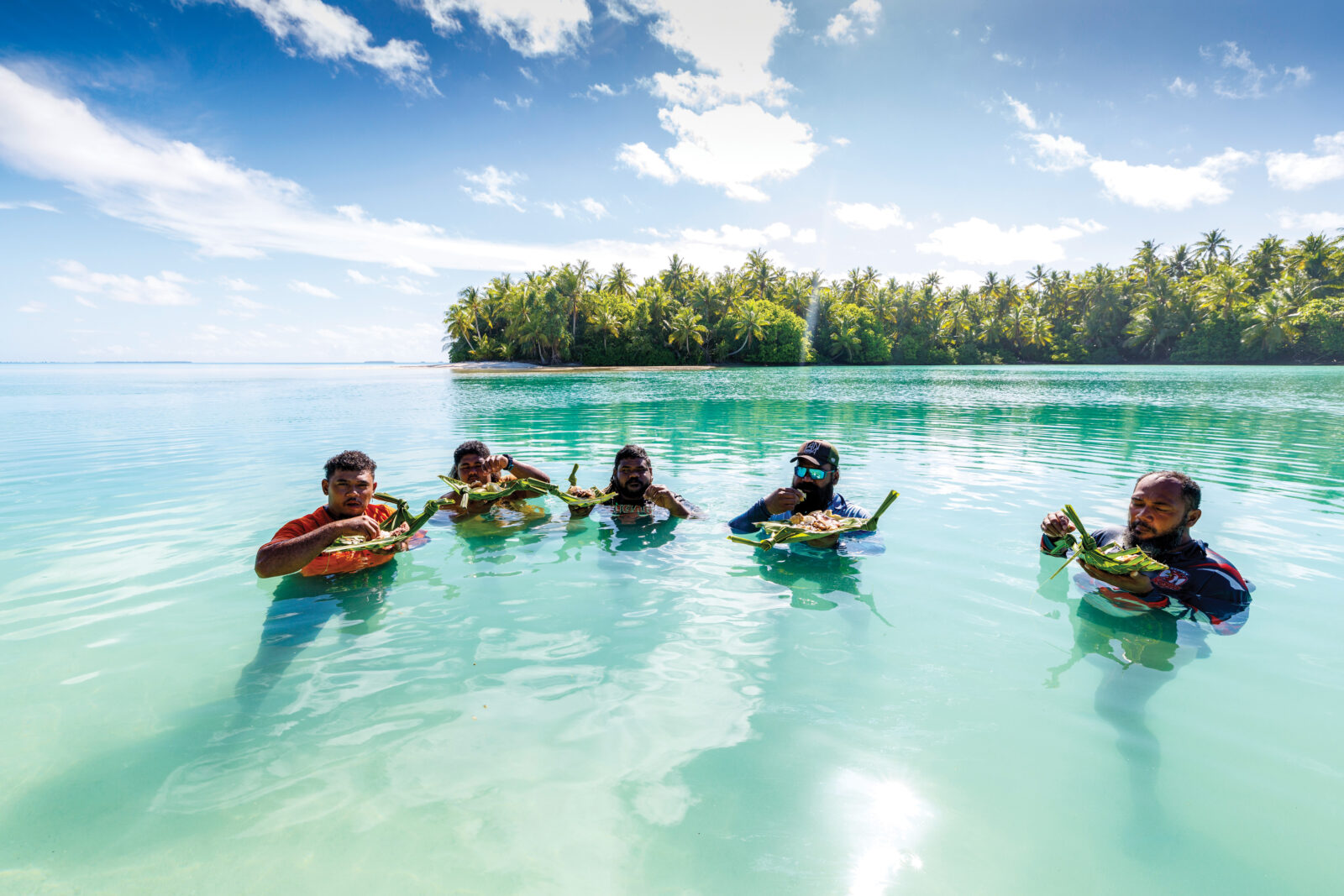
Sunday on Nukunonu is a good time for a picnic after church—say, at Tokelau Island on the opposite side of the lagoon. Josef pries a clam from the reef, Tupe and Nonu prepare a suckling pig and breadfruit from the umu, then all retreat to the cool relief of the water to enjoy the feed.
Time being somewhat limited now, we divide into three teams. One goes back out into the lagoon to search for clams. Another prepares the food we brought with us. My team—led by three capable young men—heads into the forest to look for coconut crabs. Troy William, Isaac Perez, Dominic Manuele; all three are in their final year of school and trying for scholarships at New Zealand schools this year, a Tokelau OE. “I am excited about New Zealand,” Dominic tells me, eyes shining.
By night, I am told, you just pick up the crabs off the forest floor. But by day, they are holed up in burrows under trees, barricaded behind pincers as big as your hands. Extracting them requires both craft and cunning.
Troy leads the way. Though just 15, he must be six feet tall and a couple of feet wide. Yellow T-shirt. Bucket hat. Above us, Pisonia trees form the vaulted ceiling of a green cathedral. Gogo, brown noddy terns, creak like rusty barn doors.
Troy tears out a couple of small bromeliads and scoops away some soil to reveal the shiny purple exoskeleton of a coconut crab. I’m struck by its dinner-plate dimensions. Troy leaps over the tree’s buttressed roots, digging in from the other side. With considerable effort he manages to haul the crab out backwards, his hand bridging the carapace like Steven Adams palms a basketball. He whoops into the air. Some distance away, Dominic whoops back, then Isaac. The lads fill a small postal sack with crabs, lashing the pincers with pandanus to avoid unnecessary violence.
Back on the beach Tumua scorches the crabs with a flaming coconut palm frond. The suckling pigs, still hot from the umu, are laid out, hunks divvied out on to plates folded from palm fronds. A lump of smoky breadfruit. A coconut crab pincer. Nonu Pio, who last year did NCEA level 3 at St Peter’s College in Palmerston North, demonstrates how to get into my crab pincer by smashing it with a coconut, the universal tool.
“There’s free food everywhere here,” he says. “Fish, coconut crabs. It’s too easy.” Nonetheless, Nonu is thinking about returning to New Zealand, but isn’t sure what to study, “maybe finance”.
We wade into the lagoon to escape from the heat, and float, consuming oily pork, sucking the meat out of coconut crab pincers, juices running down our cheeks. (The clam team, apparently, ate their catch as they caught it, none making it back to the picnic.) Here, on Sunday afternoon, beneath the gaze of the Virgin, it’s hard to imagine a more idyllic existence.
When you live in Tokelau, you work for Tokelau, and Tokelau works for you. Catch a fish, you surrender it to the community, it’s divided up, and you receive your share.
You rarely get paid for general work you do, but neither do you pay for ferry tickets, or school fees, or healthcare, or your power bill. No wages, no tax. You don’t pay for harvested food—along with your fish, other resources are apportioned using the inati system, an equal portion for each household.
There are honorariums paid for public posts, and roles such as teachers, nurses, police, clerks, mechanics, but these are modest. The country’s entire payroll amounts to barely $5 million a year.
The cost of aid
The New Zealand Government provides Tokelau with $15 million in annual budget support and some $5 million in other aid, in total representing almost half of Tokelau’s external revenue. Most of the remainder comes from selling offshore fishing licences. This makes Tokelau one of the most aid-dependent states in the world, but with few natural resources, no tourist economy—and no infrastructure to support one—aid is a difficult treadmill to get off.
The Cook Islands and Niue receive a similar level of budget support from New Zealand, but also have the option of tourism—a mixed blessing. The Cooks have flung open their doors, but the influx of visitors is straining the islands’ infrastructure and environment (see ‘The Tourist Trap’, issue 190). Niue has been more cautious, keeping tourist numbers low.
With no airstrip, options for Tokelau to expand its external revenues are limited: sell more fishing licences; develop a locally owned artisanal fishery and process high-value products onshore; renegotiate the deal around the .tk domain (see page 76); roll the dice on deep-sea mining; or develop blue carbon projects to sell credits internationally. End of list.
The Taupulega on each atoll, which serves as its council of elders, is made up of the head of every extended family, usually, but not always, male. Decisions are made by consensus on this council, and work on the islands—fishing, weaving, construction—is carried out by their instruction. Policy is also set at this level, as is public spending.
It’s a simpler system than capitalism, and perhaps the only means of managing the scant resources on these islands. In some respects this is the impossible promise of socialism, but at nano-scale on an atoll of some 500 people, it seems to work, even in the context of a parallel cash economy.
As increasing numbers of young Tokelauans are born or educated in New Zealand, they return to the atolls with different expectations around the free market, individual rights and gender roles. When everyone is equal, you can’t “get ahead” like you can elsewhere. There are mutterings about the unquestionable power of the Taupulega, the social obligations and processes that can seem arcane, the sense of structural confinement. But because the elders who serve on the Taupulega are embedded in the families they govern, compliance is high, if not complete. Generally, those who don’t like it, leave. Many times, they also return.
*
FAKAOFO
We leave for Fakaofo at sundown and spend the night punching into a south-easterly front; horizontal rain and a thrashing sea. The team is not well. By morning, the squalls pass, leaving a slick of glassy water, and in the middle of it, the tiny island of Fale, shaped like a heart.
At its tip is a barge landing with a channel to open ocean. The indentation at the top is a small boat harbour, packed with tinnies and two-strokes, opening to Fakaofo’s lagoon. In total it’s about as big as four rugby fields, with the meeting house of the Taupulega at its centre and homes packed in an efficient grid around it, divided by narrow walking lanes. It gives the impression of the old quarter of a European city, but for the tin roofs and coconut palms. The islet is home to some 355 people.
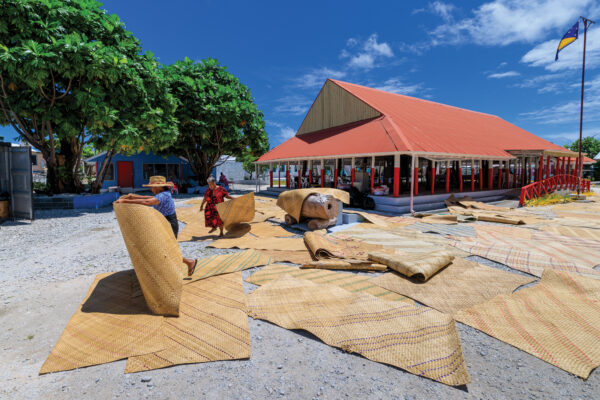
I catch Hina Kele outside the financial administration office, scratching through her paperwork for the next meeting of the Taupulega. We sit under a breadfruit tree, the mats from the meeting house laid out in the sun to toast dry before being stored for the next occasion.
Mats are dried in the sun outside the Taupulega house on Fale Island, Fakaofo.
Hina is the general manager for Fakaofo, a role almost like a chief executive, with the Taupulega as her board. She grew up here, and shares the same boomerang trajectory of just about everyone you meet in Tokelau: she left Fakaofo on an AusAid scholarship to study social policy in Australia… then a post-grad degree in foreign policy and international relations… then to New Zealand…
“Honestly, I planned to never come back home, but AusAid is very strict about their scholarships and they caught up with me eventually. I had to return.”
Hina has a calm, sincere demeanour. She focuses on the distance as she constructs her sentences, as if it helps lift her out of the confines of Fale to focus on a wider frame of reference.
The move back home, in the end, was well timed. The United Nations Development Programme had sponsored an initiative called the “Modern House of Tokelau”, which sought to facilitate a transition toward greater self-governance, while maintaining Tokelau’s unique cultural and communal structures—in particular the devolved authority of the Taupulega on each atoll.
A constitution was drafted and referendum set for February 2006. It failed, falling just short of the two-thirds required for approval. A second referendum was set for October the following year. It also failed, by just 16 votes.
“I thought it would go through,” says Hina. “But I thought wrong.
“There was a lot of influence from the Tokelauan community in New Zealand. It irks me that those people live on the outside and yet influence families and friends and the future of Tokelau.”
The exercise wasn’t wasted: the Taupulega was formally recognised as the highest authority, baking a traditional leadership structure into a modern governance framework. It also kicked off investments in telecommunications, shipping, and public services.
But the failure of the vote still eats at Hina. Her eyes narrow as she chews on the idea.
“February 2026 is the 100th anniversary of administration of Tokelau by New Zealand. But I don’t feel a sense of celebration,” she says.
“The relationship has been a sort of political struggle. For New Zealand it’s about resources and the financial sustainability of Tokelau. But for us it’s about survival.”
*
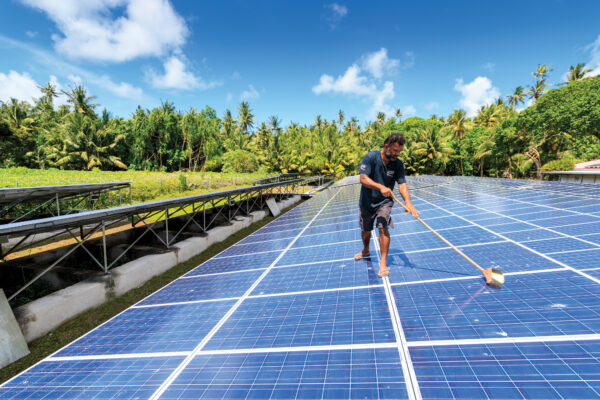
When New Zealand Geographic last visited, 31 years ago, Tokelau was powered by diesel generators, roaring away some 15 hours a day. It required 73,000 litres of diesel a year—costing nearly $800,000—shipped in from Samoa and offloaded by small boats. In 2012, with $7 million from New Zealand’s Ministry of Foreign Affairs and Trade, Tokelau embarked on a massive project to install a 300kW solar farm on each atoll. It became the first and only country in the world to run entirely on renewable energy—that one resource in profound abundance in Tokelau, sunlight.
The council makes all policy decisions on the atoll, including installation of the solar farm—here, being cleaned by Tala Tyrell—which has powered the island with clean, free energy since 2012.
“It saves a lot of fuel, reduces imports, and we can use free energy,” says Alfred Kaukinayau, the director of energy for Tokelau. He offers us a lift down the island to meet a ferry. We jump in the back of his electric golf cart and silently, swiftly, swish away. “It’s more environmentally friendly, less noise pollution, and you’re in control of your own power,” he says.
We pull into his office for a look—a clearing in the coconut palms with a sea of shimmering blue solar panels basking in the midday sun. In April next year, all three atolls will be replacing their ageing lead-acid battery banks with new lithium technology from Tesla, doubling the storage of each to 600kW.
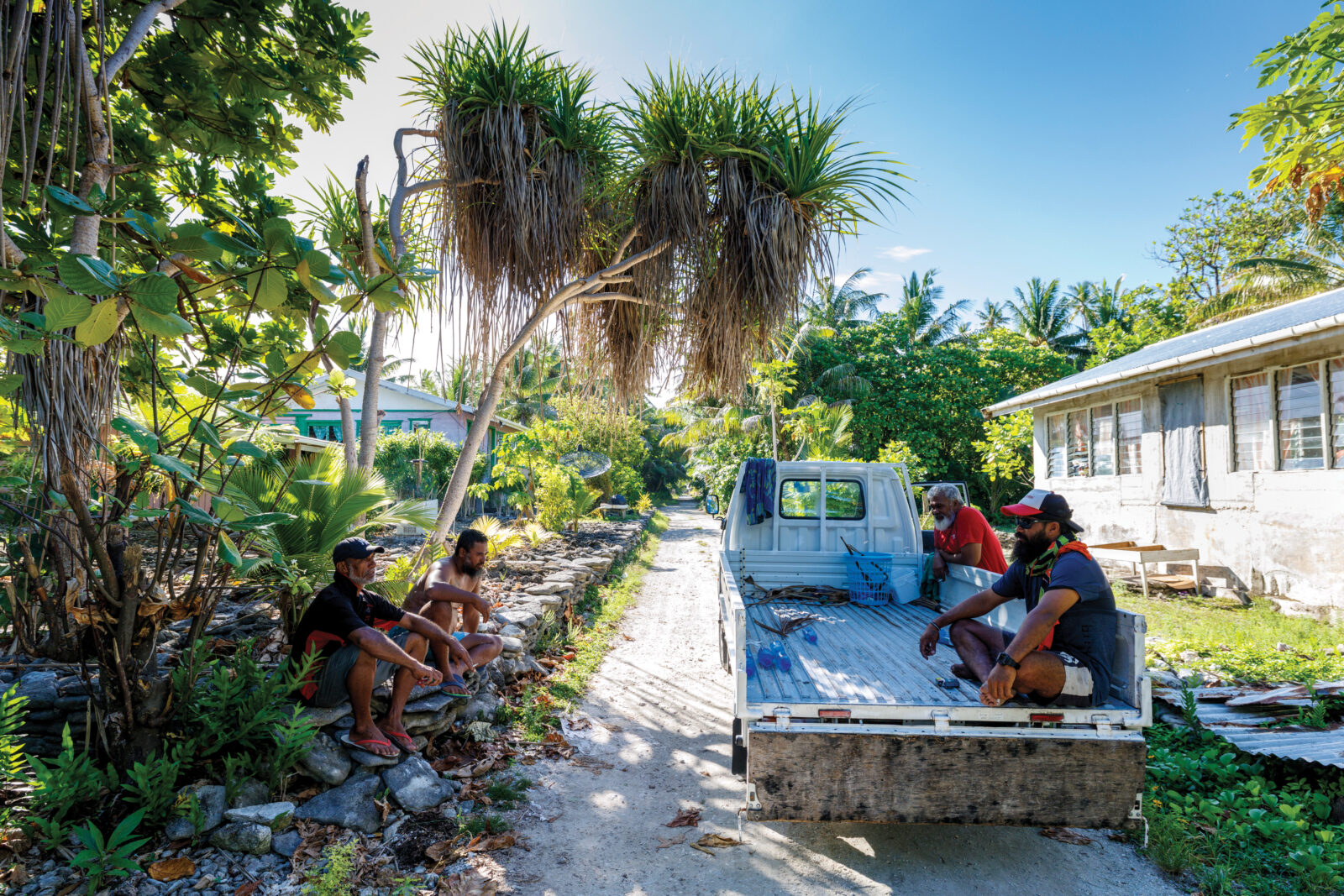
As on other atolls in Tokelau, progress can be slow on the coral roads of Fakaofo. Everyone feels like family, and there’s plenty of news to catch up on—Pita Makaholia and Jo Ineleo have just disaasembled the turbos on the interisland ferry, for instance. Plus, no need to rush. All heavy labour on the islands is carried out by the mens’ group, at the behest of the Taupulega. If something needs to be moved, chopped down, repaired or constructed, these are the blokes to do it. Obligations and benefits are shared equally.
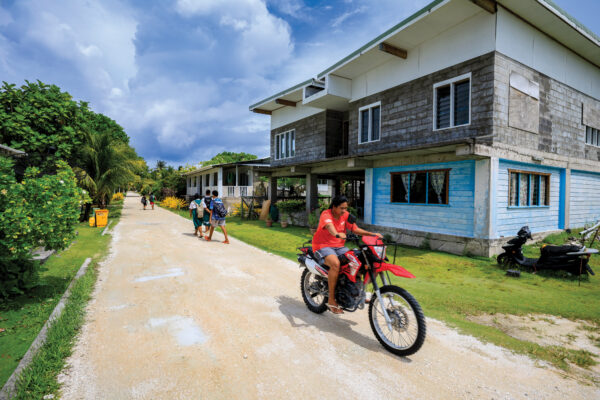
Tokelauans can be quick to adopt new tech and new ideas, but the role of social permission is strong. On Atafu, every other household gets around in an electric cart, as though the entire island is a tropical golf resort. But the other atolls have been slower to adopt the carts, says Alfred. “Tokelauans are culturally driven. On Atafu a few people got electric carts, then everybody got carts. That hasn’t happened on Nukunonu or Fakaofo yet, but it will.”
In other cases, the constraints come from the Taupulega. The solar farm that powers each island can produce only so much energy, and because no one pays for their power, the council ruled that here, in one of the hottest places on the planet, the import and installation of air-conditioning units is banned.
*
The southern end of Fakaofo is pinched into a wedge, with a long finger of coral that continues underwater, pointing in the direction of New Zealand.
Photographer Richard Robinson, Conservation International’s Schannel van Dijken and I freefall as if skydiving, towards the reef edge. A strong current flows south, directing our bubbles in contrails that disappear into the distance.
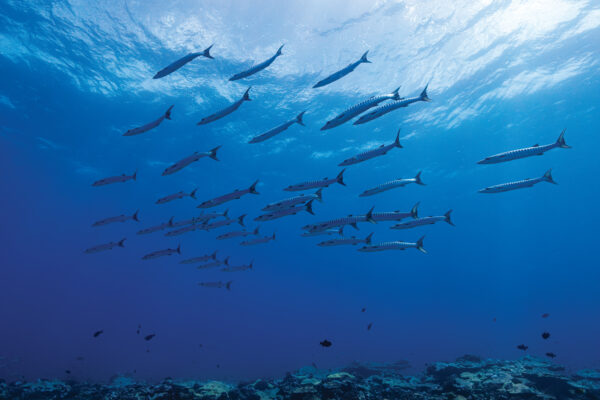
Trevally flutter out in the blue, while closer to the reef a squadron of bumphead parrotfish patrols the top of plate corals, one-metre-wide discs arranged like slices of apple. A reef shark cuts a jagged course across the platform, the body a silhouette, sharp lines catching the sunlight.
While a recent bleaching event has killed a lot of the coral, great swathes have survived. And between those, the rubble is painted with crustose coralline algae, the primer of the coral reef. This coating provides a hard, crusty layer—sometimes pink or purple, occasionally orange. As it grows, it secretes chemical compounds that are recognised by coral larvae as favourable sites to settle. They transform into polyps, and the cycle of the reef begins again.
A school of barracuda circle the outer reef at Fenua Loa, Fakaofo, a sign that fish life is in good health.Corals are recovering from recent heatwaves—the bright paintwork of coralline algae providing holding for new corals to grow on.
This is what a reef looks like in the early stages of recovery—an ecosystem primed and ready to bounce back.
“The whole island is under a traditional management system, which has meant we’re still seeing healthy numbers of fish and sharks,” says Schannel van Dijken. “Tokelau’s reefs will bounce back and thrive much quicker than reefs I’ve seen in Samoa and the Cooks where fishing pressure is more significant.”
Back on the boat, we motor back up the edge of the reef where breakers thump into ancient coral, a structure of tiny animals, eons old. Tana Kolouei leans on the throttles of the groaning outboards. He has a scholarship to attend school in Napier next year; his brother is already in New Zealand.
“I want to experience the New Zealand life,” he says. “It’s so different, I’m really excited.” The diamante stud in his ear catches the light. A scrappy teenage goatee, bright eyes. He’s a good kid, you can tell. If he leaves Tokelau, will he come back?
“I want to stay in New Zealand for a while. But I’ll be back,” he says. “Maybe for Christmas.”
*
I look back at Fale as we steam away. Night is falling, swell is thrashing at the reef, and the sky behind is dark with an incoming squall. Lights wink from the windows of the homes.
Tonight, 355 souls will set their heads down on the islet of Fale, and tomorrow they will get up, go fishing, tend to their families, and work together as a community to eke out a living on this ribbon of land at the centre of the biggest ocean on the planet.
The three thin crowns of corals that have supported this culture for thousands of years are being battered by the waves of the 21st century, but Faka Tokelau—the Tokelau Way—is made of more durable stuff than coral.
“Self-determination is about taking responsibility as a people,” says Hina Kele. “We have survived here for so many years. We need to help ourselves.”
This feature was produced in association with Conservation International. New Zealand Geographic also partnered to produce virtual reality experiences, environmental monitoring and conduct citizen science training in Tokelau, as part of a Conservation International initiative supported by a grant from the New Zealand Ministry of Foreign Affairs and Trade.
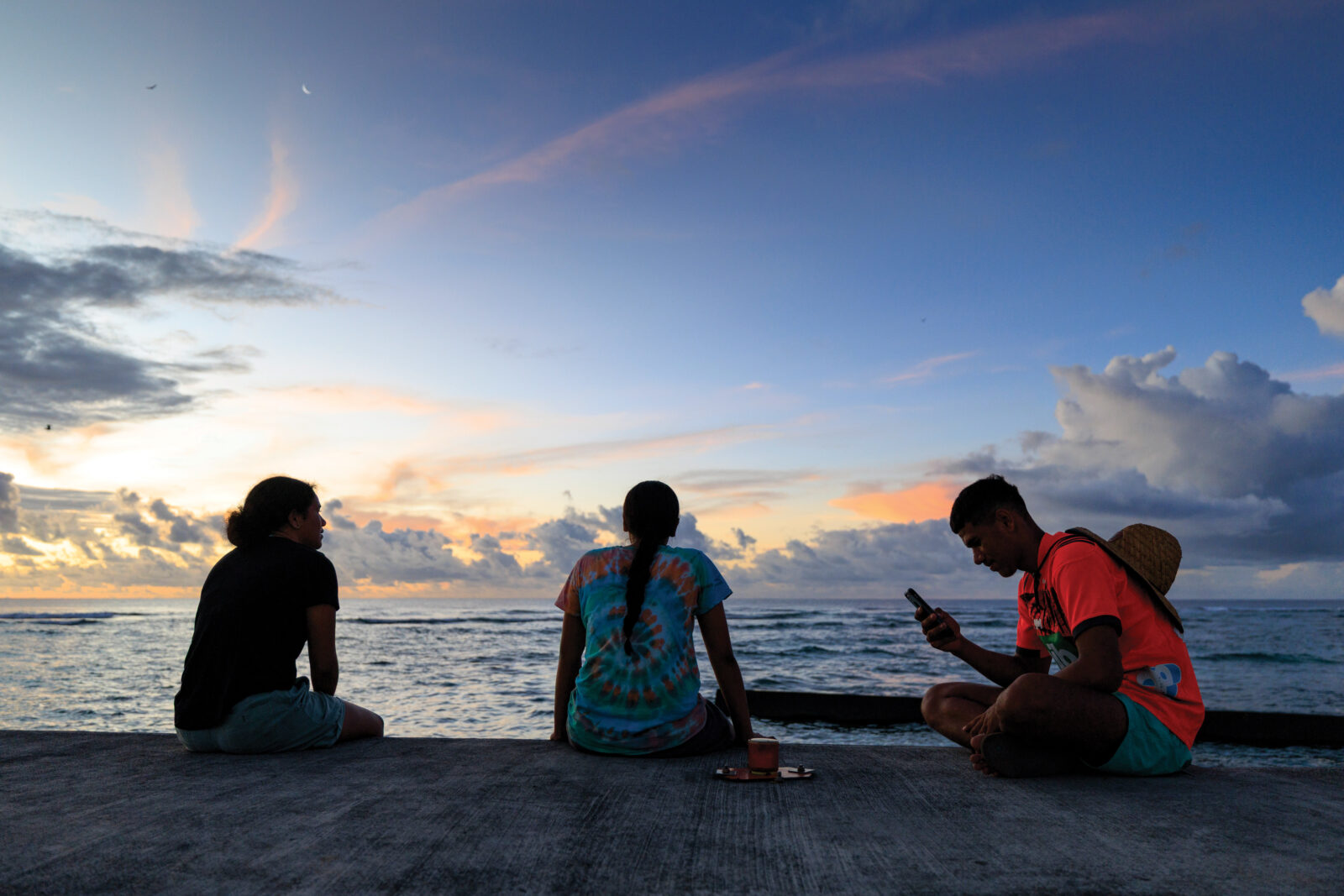
On Fenua Fala, Liana and Angel Netzler watch the sun set on another day with Raymond Vavega, who has started a building apprenticeship. Youth in Tokelau are forced to choose early between a trade or the final year of school in New Zealand—but Tokelauans are used to difficult choices.
Tokelau is one of the smallest and most remote island states on the planet. There are no airstrips—you need to fly to Samoa, then spend two days in a boat crossing open ocean just to get there. The three atolls are each another day apart. The people who live here have adjusted to rapid change, retaining a unique model of governance and a culture of quiet determination. Can Faka Tokelau, the Tokelau Way, survive another thousand years? (more…)
New Zealand Geographic and Heritage Expeditions are pleased to announce their second premium adventure, a journey through Fiordland with New Zealand conservation stalwart, award-winning author, photographer and natural history filmmaker Rod Morris....