





A story that proves we can change the world, one manky strip of city at a time.
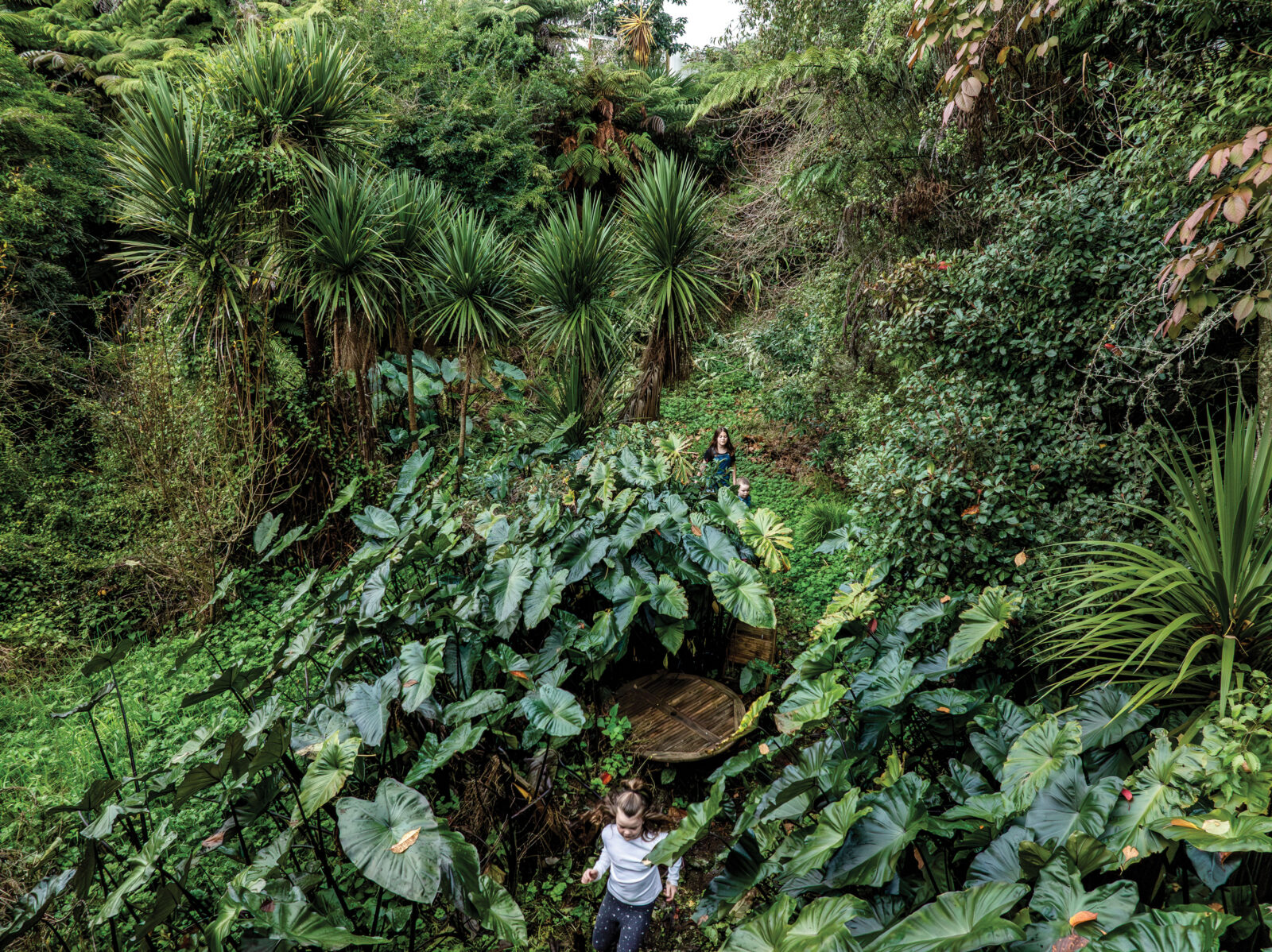
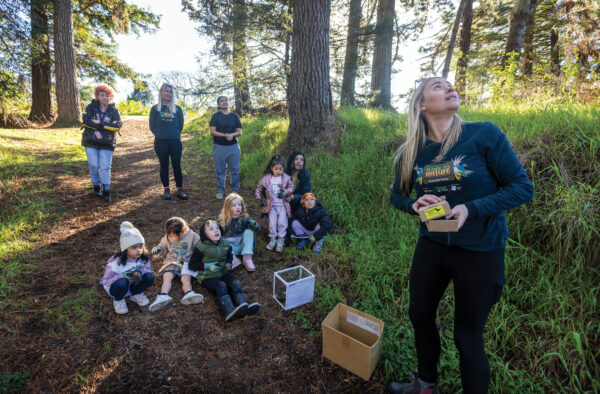
When 11-year-old Emily Aquilina has her younger cousins over to play at her house in the Hamilton suburb of Huntington, the girls often disappear into the gully out the back.
“I don’t know what they find to do but they come back covered in mud and happy,” says her mum, Diana Aquilina.
Down in the gully there’s a climbing tree, Emily reports. Plus a hide-out, spiky things, a secret path to her friend’s house, heaps of sticks, moss, mushrooms that she thinks are probably poisonous, berries that might be, too, although she ate one when she was five and didn’t die, plus there are eels in a stream, and another hut further along.
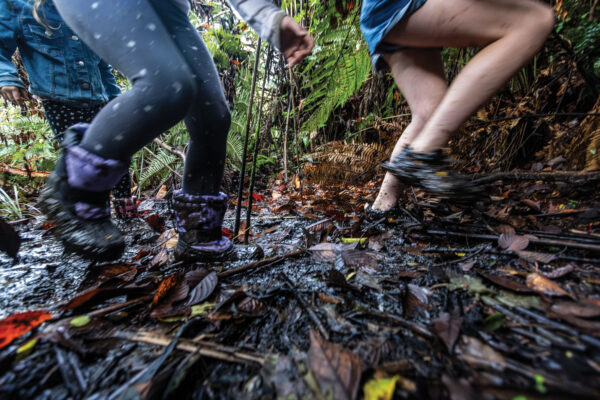
She shows us around and when the cousins step into a deep boggy patch, one shrieks. “But that’s what gullies are for, to get muddy feet!” admonishes five-year-old, Annabel Rolfe.
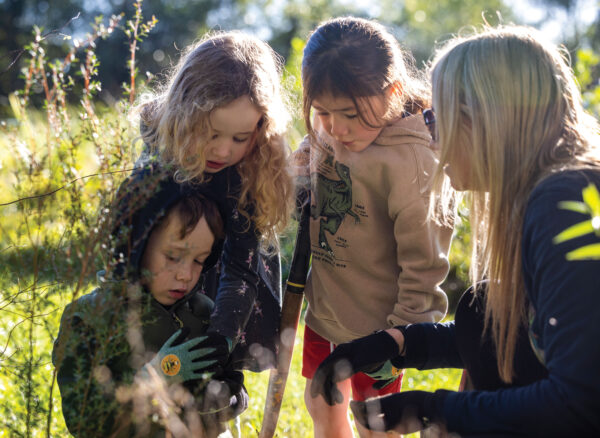
The Aquilina family moved back here, to Diana’s home turf of Waikato, after she’d spent 16 years away. “We landed in the Hamilton suburbs straight from city life in London, and I couldn’t get over the tūī in the backyard. Sometimes eight or nine in one tree,” she says. “I don’t remember them at all from before.”
The tūī are back, in part, because the gullies that thread through this city are being given new life—for decades, the people who live here have been quietly tackling weeds and junk and rats, together.
*
Stand anywhere high in Hamilton, on a tall building, or one of the few hills in town, and it seems as if distant ranges encircle the skyline.
The city lies in a 90-kilometre-long, 40-kilometre-wide oval-shaped depression known to geologists as the Hamilton Lowland. Within the lowland is the Hamilton Basin—a large alluvial fan, like a rimmed plain, that is cut through by the modern Waikato River.
The river’s course today is nothing like its ancestral path. In past lives, it meandered, braided, flooded and spread far beyond its present banks, flowing into the Thames estuary by way of the Hinuera Valley and the Hauraki Basin.
Following the massive Oruanui eruption of the Taupō volcano about 27,000 years ago, the river slowly began to choke on debris. It was eventually forced onto a new path, cutting through the Hamilton Basin.
Early Māori knew that the river had changed its course dramatically. Waikato iwi retain the details in a pūrākau about the relationship between Taupiri and Tongariro mountains. It tells how the two maunga redirected the river’s flow by awakening Rūaumoko, god of earthquakes and volcanoes.
And so, the mountains made Hamilton a city of gullies.
*
A popular put-down for Hamilton is that there’s nothing here. Apart from the bisecting river, the city seems flat and featureless. So desperate were past local authorities for something visual to promote, they squeezed a slogan out of a few man-made water features and marketed the place as Fountain City.
But live in Hamilton for a while and you’re likely to become acquainted with at least one gully. They carve behind schools, curl around back gardens, knit themselves into walking tracks and bike paths. Maybe you’ve dumped rubbish in one.
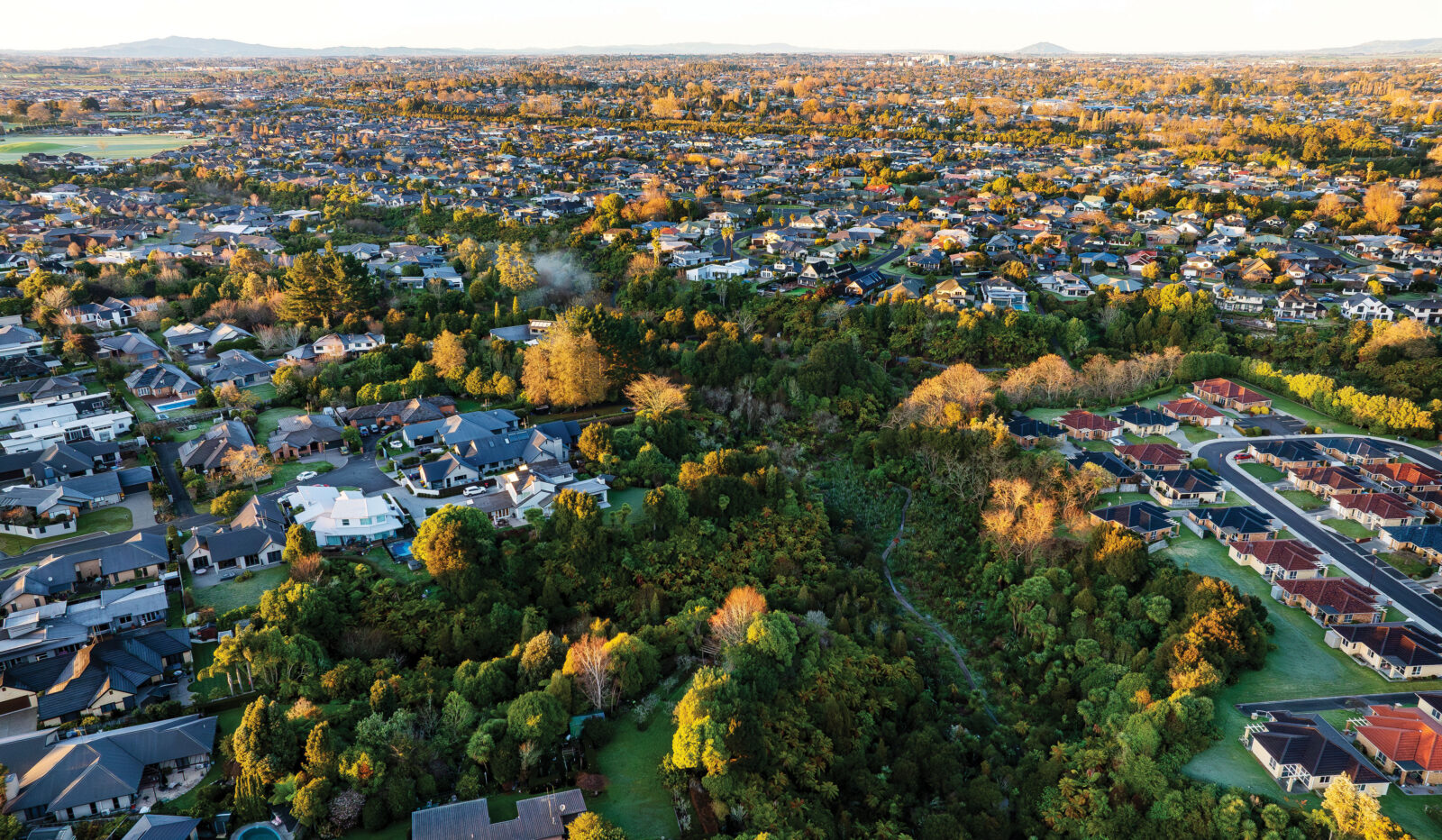
Mapped from above, the network of gullies looks like the bronchial tree in a lung. There are six main branches that spread fingers into even the most tightly compacted suburbs. The green gouges are too deep, too perpetually wet, to easily build on. Some have been filled in, but over the years of city expansion, most have been left largely alone. Of the city’s 767 hectares of gully, just over half are privately owned.
“They’re our hidden treasures,” says Bruce Clarkson, a science professor at Waikato University. “People think Hamilton is flat, but approximately eight per cent of the city is made up of gully.”
The characteristic Hamilton gully is much wider than seems logical—a steep-sided trench, often with just one skinny stream running through the bottom. Each was gouged out by the river, thousands of years after the eruption, cutting through volcanic material, exposing long-buried springs and causing slip after slip in a process called “spring-sapping”. “They were erosion events, basically,” says Clarkson.
His first gully was a classic: a damp mysterious presence out the back of a student flat in the 70s. “I thought, ‘Well, I’d better go and see what’s down there,’” he says, and found what you’d expect in a neglected 70s gully. Weeds, mainly. “I remember lots of grey willow,” he says.
Smothering even the weeds in gullies back then was the strata of human contribution: old car parts, shopping trolleys, tyres, construction debris, sheets of corrugated iron, slabs of concrete, empty paint tins, barbed wire, farm fencing, grass clippings; you name it, someone had biffed it into a gully.
Even the council used a gully or two as unofficial dumping grounds.
They were “despised as waste land”, wrote the earth scientist John McCraw in The Wandering River, his geological history of the Hamilton Basin. (The book was published just before his death in 2014, and is considered a touchstone.)
By the 90s, Clarkson had contacted the Waikato Times in passionate defence of these “undervalued ribbons”. He’d been inspired by a group of women fighting plans to formalise the status of their neighbourhood gully from a popular fly-tipping venue to a designated landfill.
“Hamilton City is an indigenous biodiversity desert,” Clarkson wrote to the paper. He pointed to a couple of minuscule fragments of kahikatea forest and the gully habitat as the only remnants of native bush. Back then, there wasn’t a tūī to be seen.
More by Connie Buchanan
More by Mike Scott
For a city that had lost 99 per cent of its indigenous cover, first to Māori burning and then to farming, Clarkson believed the green slivers were the last hope—to restore, retrofit and rehabilitate nature in urban life.
The newspaper didn’t find any of this interesting enough to publish.
Still, the women went on to win their fight, and today, the Maeroa gully they stuck their necks out for is an outdoor classroom for the local intermediate school, planted with natives grown in the school’s nursery. It’s supported by a city council which has acknowledged its past sins, introduced a suite of gully protection and restoration measures, committed to an ambitious “Nature in the City” strategy, and runs a nursery which annually dispatches more than 80,000 native plants to gully forever homes.
What happened between then and now is as braided and sprawling as the ancestral river itself.
*
Go looking for central command in the restoration campaign and everyone points in a slightly different direction. Bruce Clarkson and the university get a mention; so, too, do different folk in charge of plans and programmes at the council. There’s Keri Thompson and others with Ngāti Hauā, Ngāti Wairere, Te Haa o te Whenua o Kirikiriroa collective, the Waikato River Authority, pest controllers like Sam the trap man, commercial and volunteer-run plant nursery people, particular teachers at 28 different schools, and dozens of private-property owners and community organisers with names like Peter, Leo, Rex, Maggie, Maxine, Moira, Gerard and John, who in turn suggest still others who deserve credit, like the guy who really loves lizards, and the one who used to give free bus tours of the major gullies to raise awareness.
As with any decent guerrilla operation, there’s a pamphlet at the heart of it.
“This is the most significant document I’ve ever been involved in publishing,” says Clarkson, plucking a thin stapled booklet from his shelf of academic tomes. “Because people actually use it.”
First published in March 2001, Gully Restoration Guide is now in its third edition, with a fourth update under way. It does what it says on the tin—sets out a nine-step guide to Hamilton gully restoration, which includes plant identification charts and advice like “Don’t bite off more than you can chew.”
A map in the front section shows 20 gully branches under restoration, including those with entrances near a shopping centre, the showgrounds, a kindergarten, a retirement village, and multiple suburban homes.
“It spreads like a disease, which is what you want,” says Clarkson. “One person in a gully system will start—then neighbours look over the fence and ask what’s going on, and it moves through the catchments, then the schools join in.”
The map shows beginner projects and established ones. If you’re just starting out and need inspiration, then Peter from Gully 16 will give a guided tour to anyone who calls his home phone number.
*
On a Friday afternoon behind the playing fields at Hamilton Boys’ High School, teenagers with regulation haircuts start wandering down a path into Gibbons Creek gully. They strip off school ties and white shirts and change into old clothes pulled out of duffel bags. They’re unaccompanied by any teacher, here on their own time and under their own steam, as they have been every Friday after school for the past two and a bit years.
“We first came down here in class-time to practise a scene for drama,” explains Michael Crowther, who’s in Year 13, “and we saw trash everywhere. So we came back with rubbish bags and it kind of went from there.”
The boys convinced the school to get on board with a clean-up and planting plan. The council got wind of their efforts, and now there’s a full-on restoration under way.
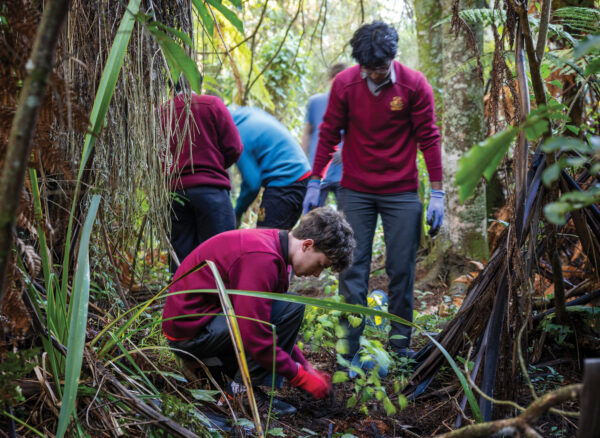
This afternoon, the boys will plant natives in areas that were recently cleared by young farmers vying for a national title—100 of them with chainsaws, ripping through the larger exotic growth that the students couldn’t tackle on their own.
“Follow me, before the rest of the boys get here,” says Aimee Nooyen, the city council’s community restoration advisor, who’s here to help direct planting. “You have to see this.”
She pushes through a narrow trail that leads deeper into the gully, pausing to rip out a privet. “Before I got this job, I used to go for a walk, look around and think, ‘Yay, green!’ Now I think, ‘Weeds!’”
she sighs.
She carries on, pointing out a mini wetland where she hopes mudfish might one day survive, and then stops. “Check this out. Isn’t it epic?”
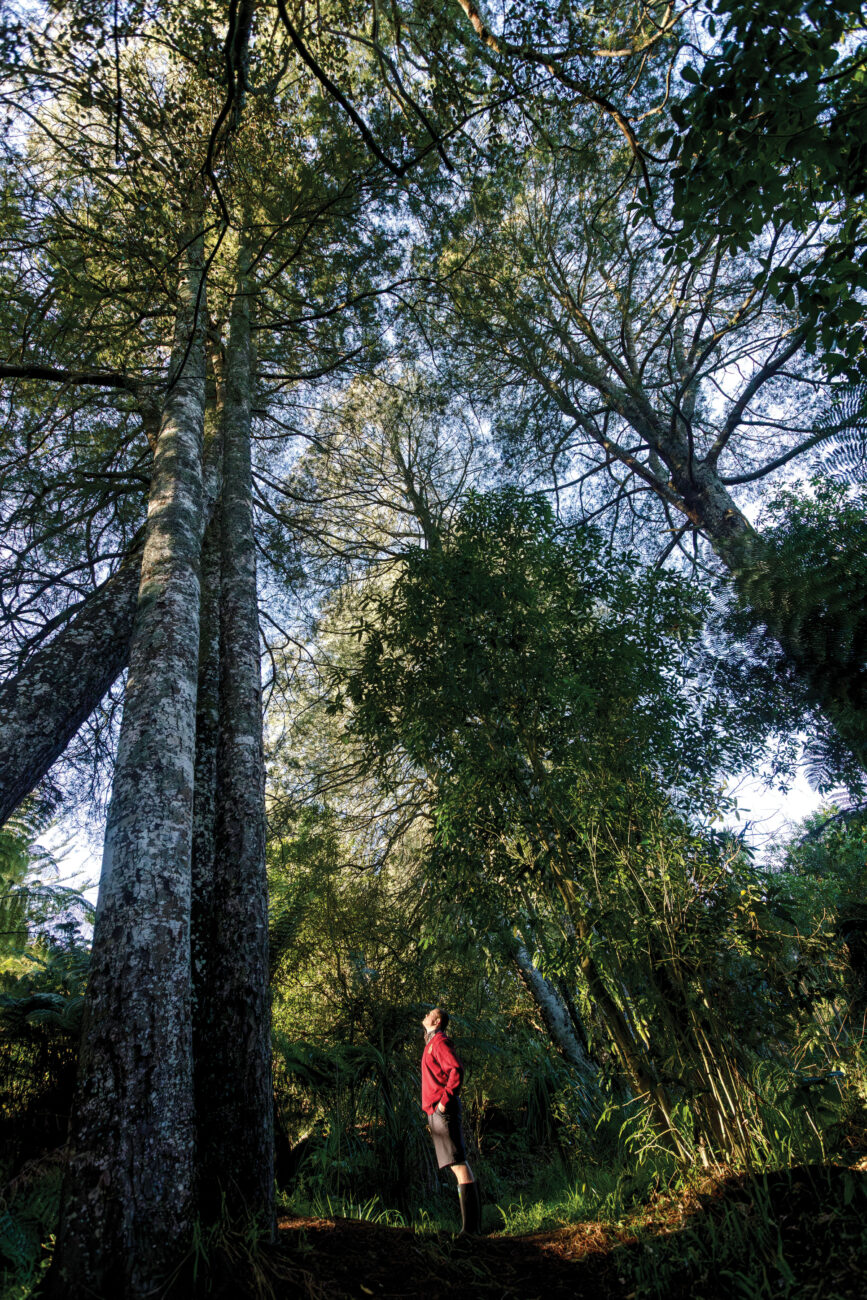
We’ve arrived in a small clearing. Before us rises a stand of towering kahikatea. Late afternoon sun drops in shafts through the crowns clustered high overhead.
Back at street level, you’d never know these giants were here. We’ve entered a strange and beautiful inversion, a sunken strip of birdsong, breeze and rustling leaves, while from above comes the faint rumble of a truck, a distant siren, a local bogan revving an engine too hard.
The boys appear among the trees, carrying plants and spades, talking to each other about science homework and the relative merits of rap versus classical. “As much as anything, this is a social thing,” says Kerem Yaprak, another Year 13. “It’s a chance to just hang out together.” Fraser Smith, who’s helping rid the gully of pests, turns up. He started out voluntarily trapping the possums he spotted on his kids’ riverpath walk to school, and has just got a council job in predator control. He immediately pulls his phone out to show us a picture of a falcon he spotted just over the way. “And my kids said they saw kākā fly over their school gully today,” he reports.
Tūī squabble and cackle in every direction. They’re the biggest success story of the pest control, plantings and restoration efforts so far, one that everyone hopes to replicate with other species.
Water sampling shows the presence of 14 native fish species in gully streams; lots of shortfin eels, with longfin eels and giant kōkopu the next two most widespread species.
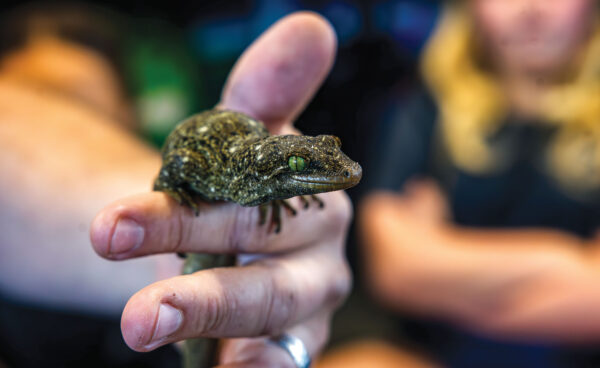
In one gully, there’s a rare skink, a beautiful native that no-one wants to talk about. They prefer to keep its location secret, hoping to give it every chance to settle in undisturbed. In Melville, there’s a flock of coal-black fantails. The kārearea, New Zealand falcon, has set up residence in central Parana Park, nestled between riverbank, roads and whorls of gully.
“People have said, ‘You’ll never get the bellbirds back,’” says Nooyen. “But they said that about the tūī, too.” She shows us a photograph of a fat korimako, New Zealand bellbird, its face purpled with nectar from a kōtukutuku flower. She took the picture herself, in a gully in the city suburb of Glenview.
*
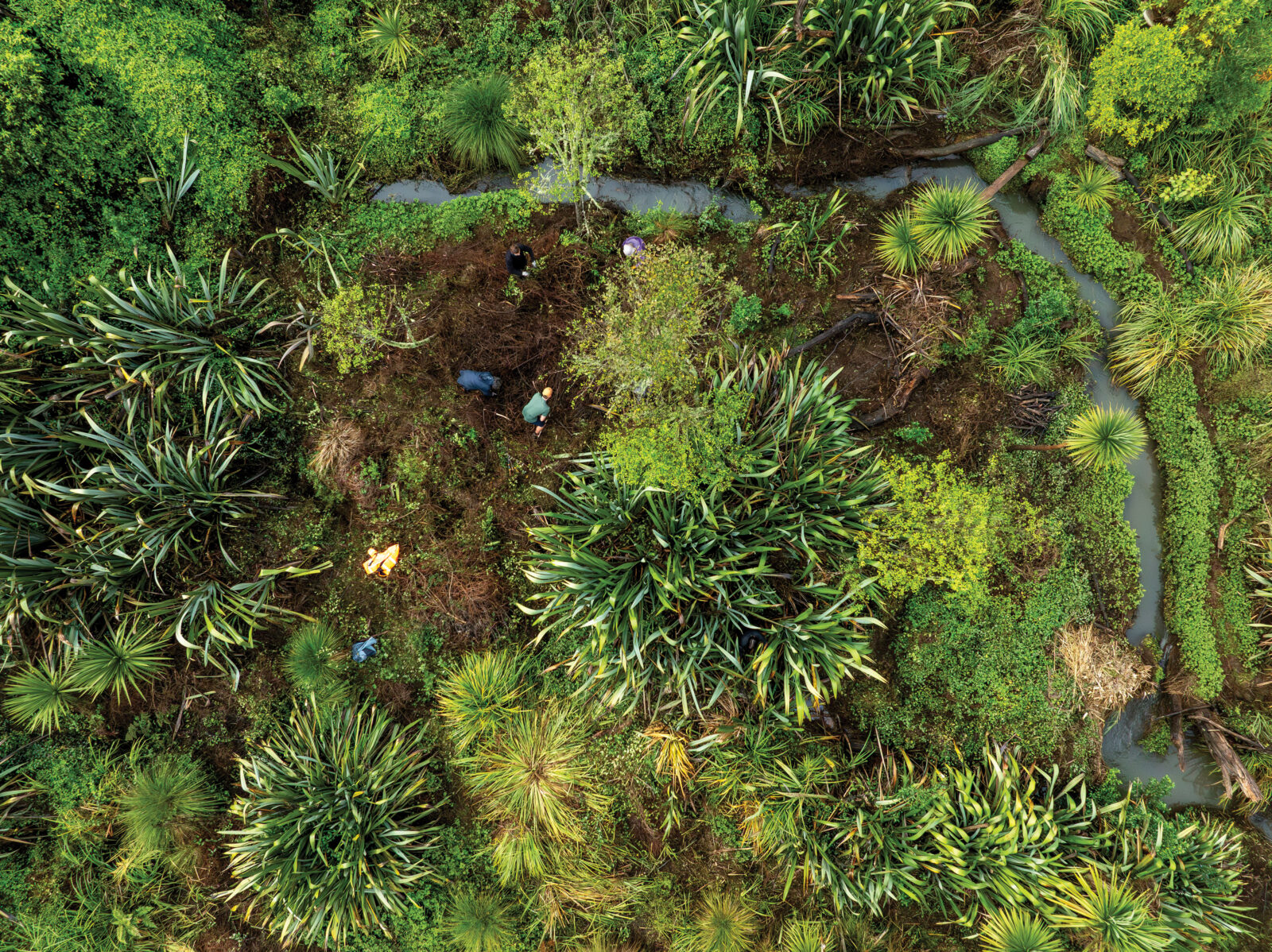
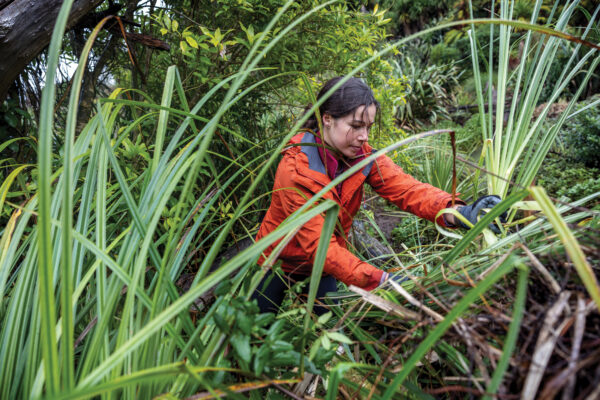
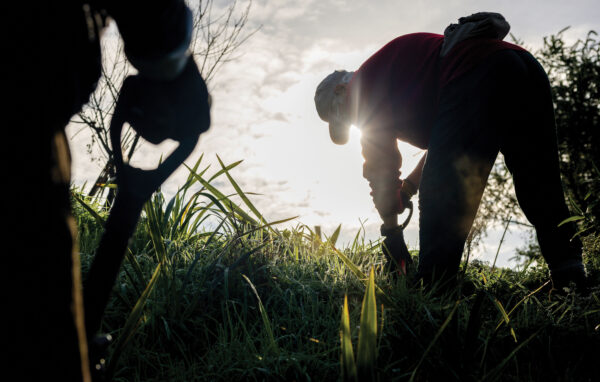
Nearly every Thursday morning in the Mangaonua gully that runs next to State Highway 26, Peter Dornauf organises half a dozen others to weed and plant. He stands on the lip of the gully and surveys the tops of tī rākau, mānuka and harakeke, some of the tens of thousands of natives planted over the past two decades. “At the beginning, we were pulling out bamboo for days and days. Blackberry taller than a person. And absolute truckloads of rubbish. Literally the kitchen sink. Teddy bears. Now it’s lots of weeding to maintain what we’ve achieved,” he says.
Today, they’re sorting out upper roadside borders that lead into the gully, where a three-kilometre out-and-back walking track, installed by Ngāti Hauā, now connects suburbs, schools, and residents.
“Nature is not a separate entity, out there somewhere else; it can be right here where we are,” says Dornauf, articulating the unifying philosophy of everyone involved. The goal is to merge urban people and natural places together for the health of both.
“We’ll never get back to pristine forest, but we can get a functioning forest,” says Maxine Fraser, when she can take a breath from dishing out instructions on which plant needs to go where.
Like the others, she’s doing what she can, getting on with things despite what many, including Clarkson, see as the war on nature raging higher up the chain, in Wellington, in Washington, in other places of power beyond their reach.
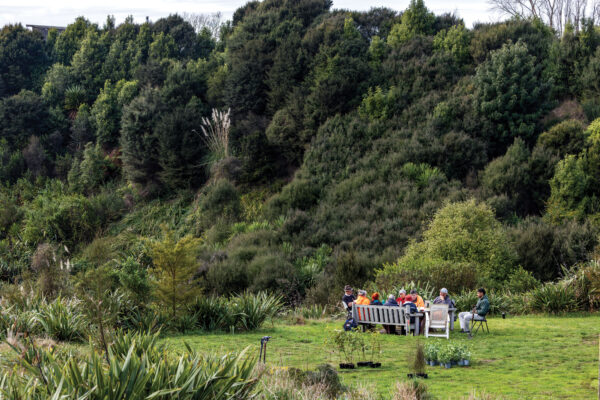
“If you think about the environment as this global problem then you can’t do anything. But if you go really small, then change does become possible,” says Diana Aquilina at home in Huntington. After work, she walks through the gully to decompress. “It’s so peaceful down there. And those eels we saw? They wouldn’t be there if it wasn’t for the gully. Little pockets everywhere is better than nothing at all.”
“We’ll keep chipping away,” says Dornauf. Behind him, Fraser carries the dappled-shade plants into the dappled shade. They won’t need much to take hold: a weedless space, a few hours of attention from this small crew, which today includes a guy trying to fill his time productively while he looks for a job, a young man with a disability brought along by his care worker, a woman who lives around the corner and whose eyes fill when she talks about doing something for the next generation.
They’ll tackle one section of one slope on one edge of this gully, setting out an understorey, and that will be the morning well spent.