







In New Zealand’s national parks and remote areas, conservation managers cull feral cats to save many bird, reptile and invertebrate lives. That’s not possible in urban nature reserves, where there’s a risk of extinguishing someone’s beloved pet. But these refuges are often significant habitats for bitterns, crakes, fernbirds, dotterels, penguins and kiwi—native birds that cats scare from their nests, or dismember and proudly display on doormats.
Searching for solutions, Manaaki Whenua/Landcare Research ecologist Sze-Wing Yiu and her colleagues set up camera traps over summer in six reserves—two each in Auckland, Wellington and Christchurch. It was a first step to see what neighbourhood cats were getting up to.
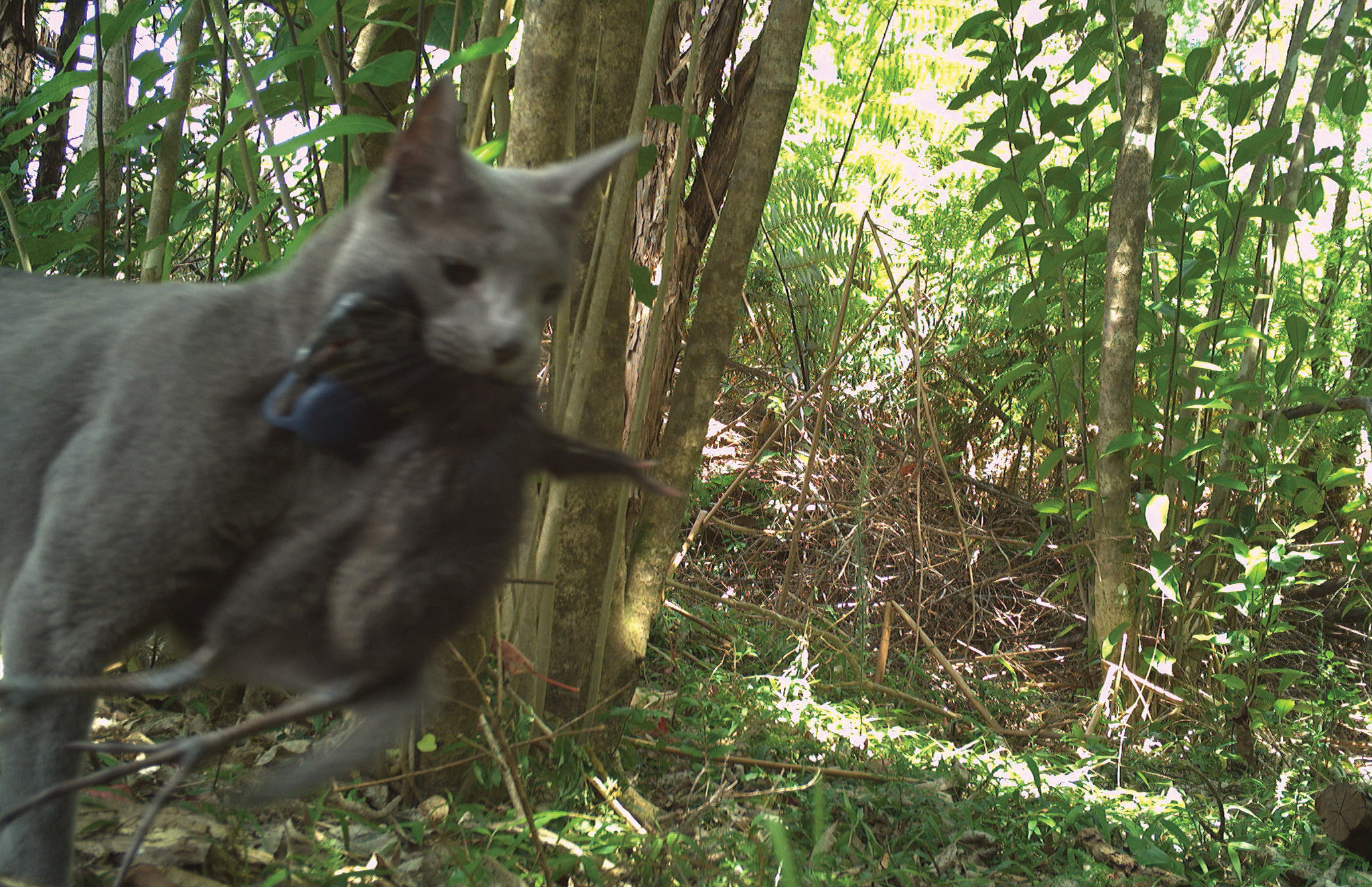
They found that while lots of cats visited the reserves—40 snapped camera-trap selfies in Wellington’s northern Miramar Peninsula, for instance—not all of them are killers. In fact, just two individuals were responsible for the four unequivocal kills observed during the study. One cat played for 25 minutes with a pārera, or native grey duck, in Styx Mill Conservation Reserve, Christchurch. And at West Auckland’s Harbourview-Orangihina Park, the cat pictured here—which appears to have a collar—carried off three pūkeko chicks one after the other (in broad daylight, implying that keeping cats indoors at night doesn’t necessarily save birds).
Then there was the cat that liked to walk at low tide around the predator-proof fence at the Omaha Shorebird Sanctuary, north of Auckland, to visit dotterel nests. The cameras didn’t capture any violence, but the nosy-parker freaked out the dotterel parents: the five monitored nests it visited all failed.
In theory, such feline outliers are actually good news, says Yiu—identifying and managing a few serial-killer individuals is probably more practical and socially acceptable than widespread control. (So far, for instance, it’s proven difficult to convince New Zealanders to keep their cats indoors; see ‘Our love affair with cats’, Issue 167.)
Yiu believes the Green Party’s proposed new law requiring cats be registered and microchipped is a crucial next step.
This study, she notes, is part of a wider project investigating whether cats can be deterred by recorded sounds, such as human voices or dogs barking.
“Change is totally possible,” Yiu says.
“We just need to push people to try new things.”
More by Kate Evans