Teeth are extreme: they evolved at roughly the same time as bones, and they’re the hardest thing in the human body. So why are our choppers so sensitive—and expensive? (more…)
More by Kate Evans
More by Kay Lawson




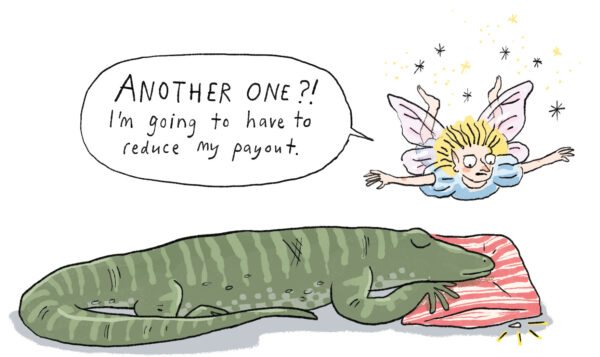
Do you remember the jagged thrill of your first wobbly tooth? Worrying the sharp underside, tipping the tooth as far from vertical as it’d go, sliding your tongue through the new, slippery gap? Dentists call our baby teeth “deciduous”, like autumn leaves, or “exfoliated”, like shed bark or dead skin, and they are the only parts of our skeleton expressly designed to fall out. Losing our teeth, starting at around six years old, is a rite of passage in many human cultures.
The Anglo-Saxon ritual of putting your tooth under the pillow for the tooth fairy dates back to the early 20th century, though many earlier European traditions also involve exchanging teeth for money or gifts.
In France, Italy, Russia, South Africa and Spanish-speaking countries, a mouse or rat is said to undertake the night-time collection. In other places, including Africa, Asia, the Middle East and the Pacific Islands, kids bury their teeth, or throw them away—into the hearth fire, high up into the sky, or onto the roof of their house. Many indigenous people of the Americas and Central Asia offer their baby teeth to animals, hoping the crow, dog, or mouse will bring them a shiny new tooth in exchange.
What’s unusual about the teeth of humans, and most other mammals, is that we get only one do-over with each tooth (hence the profession of dentistry.) Most vertebrates, including fish, amphibians, and reptiles, have teeth that continuously replace themselves before they get worn down or holey—think of a shark’s maw, bristling with row upon row of pointy triangles.
Mammals, however, are all over the place when it comes to dentition. Elephants and kangaroos continuously shed teeth. Manatees have an ingenious conveyor-belt system, where molars erupt at the back of the mouth, migrate forward until they reach the front, then fall out. Cats and dogs, mice and rats, and cows and sheep have two sets, like us. Platypuses, which always have to be different, have one set: they’re born with six temporary teeth in their duck-like bills, and lose them entirely as adults.
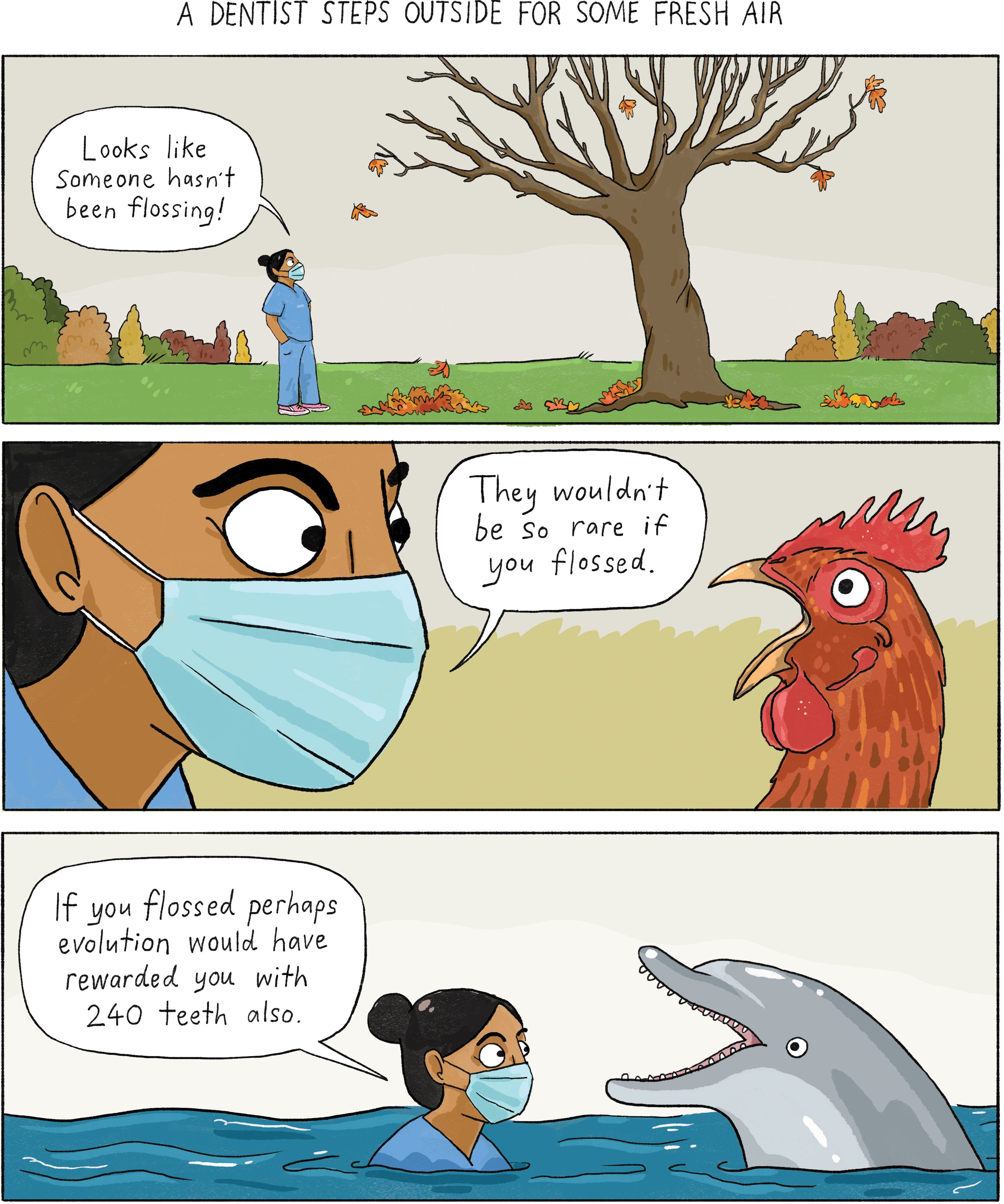
Carolina Loch Santos da Silva, an oral biologist at the University of Otago, specialises in the teeth of whales and dolphins, a group of animals that has really gone hard on dental diversification. The first whales all had teeth, a regular mammalian number—20 or so up top with a matching set on the bottom jaw. Millions of years later, bottlenose dolphins have between 80 and 100 teeth. The common dolphin can sport 240.
Other species got weirder. A sperm whale has up to 60 teeth, but they’re all on the lower jaw. Risso’s dolphins have between four and 14, also on the bottom jaw, and use them to grip onto squids before swallowing them whole. (This species is occasionally found in New Zealand waters—like Pelorus Jack, the dolphin that famously met and escorted ships across the treacherous French Pass near Cook Strait between 1888 and 1912.)
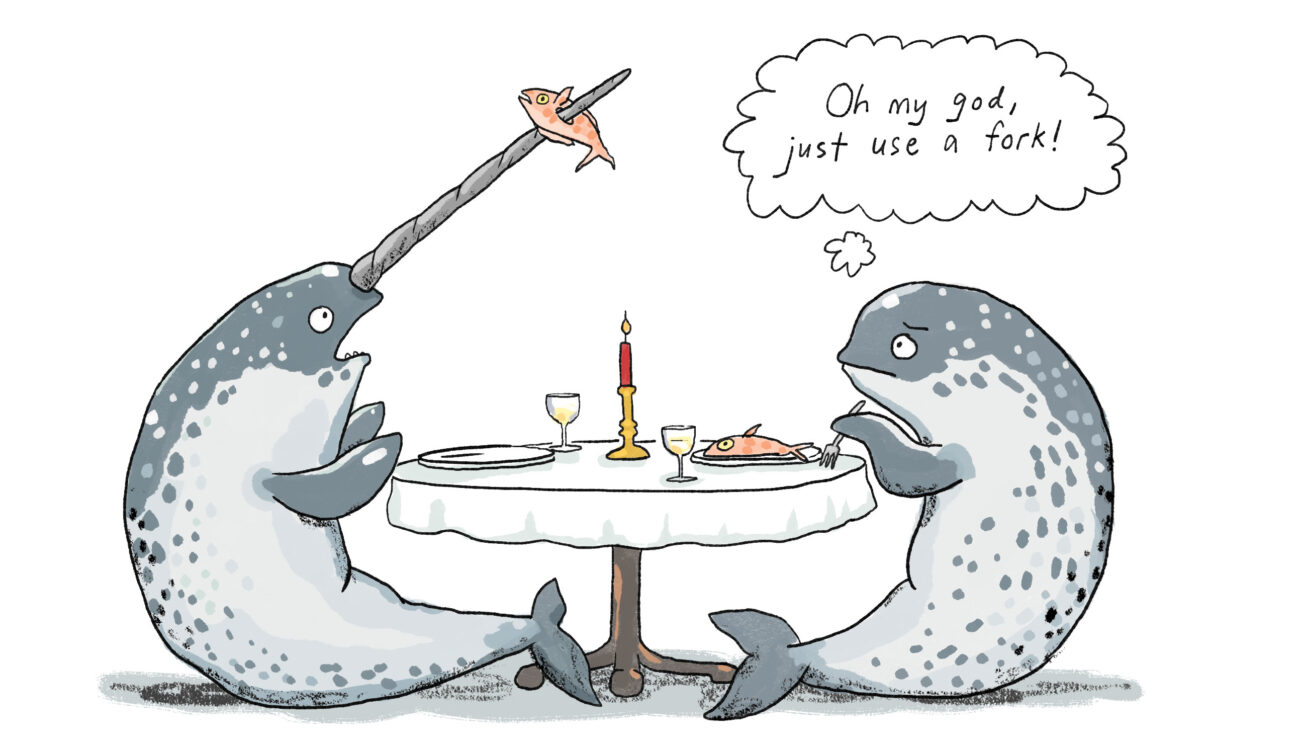
Narwhals make the most of their single tooth. The two- or three-metre tusk that inspired the unicorn myth is really an extremely overgrown left canine perforating the upper lip. Loch says because only males sport this spiralling tooth, it’s likely for fighting, impressing females—or perhaps simply finding them in the vast waters of the Arctic Ocean, since recent evidence suggests the horn has a sensory function. “If you have something that’s present in males and not females, that is a strong indication that it’s not useful for eating—otherwise all the females would be dead.”
Some whales, of course, have done away with dentition altogether. The embryos of humpbacks, blues, right, minke, fin and Bryde’s whales have tiny proto teeth, but these do not develop in the adult animals. They have baleen instead—stiff, comb-like plates made from keratin, which other animals use to construct wool, hair, feathers, scales, hooves and fingernails, but not teeth.
*
What makes a tooth, then? “It’s just an amazing design,” says Loch. Teeth have a pulp cavity containing nerves and blood vessels, surrounded by dentine—a hard, calcified yellow substance similar to bone. Then they’re crowned with enamel—the toughest tissue in the body. “If you don’t have a titanium plate somewhere, that’s the hardest thing you’ve got,” Loch says.
Certain animals’ teeth, however, get even more metal. Palaeontologist Aaron LeBlanc from King’s College London was “trying to be a palaeo hipster”, he says, and avoid studying dinosaurs, but he eventually succumbed and started comparing the crystal structure of their tooth enamel.
“Dentistry exists because enamel can’t regenerate, it can’t regrow, and it can’t repair itself,” he says. So evolution has engineered an unchangeable, unique enamel geared around each creature’s diet and lifestyle. “Its structure is very, very closely related to its function,” says LeBlanc. “An animal that grinds its food down will have a different internal structure to its enamel than an animal that cuts and tears meat. So there’s a lot you can learn about the biology of even extinct animals by looking at the shape and structure of their teeth.”
Mammals that must take care of one set of teeth for their whole adult lives also tend to have much thicker protective enamel than reptiles, with their never-ending supply of fresh nibblers, he says. “The enamel is like a thin veneer on most reptile teeth, even the big ones. You can take a tooth of a T-rex, which is the size of a banana, and a human molar has 10 times more enamel on it.” (What meat-eating dinosaurs had that we don’t, though, were microscopic adaptations between the serrations on their teeth that stopped cracks from spreading—meaning they’d likely have spent much less money on dino-dentistry.)
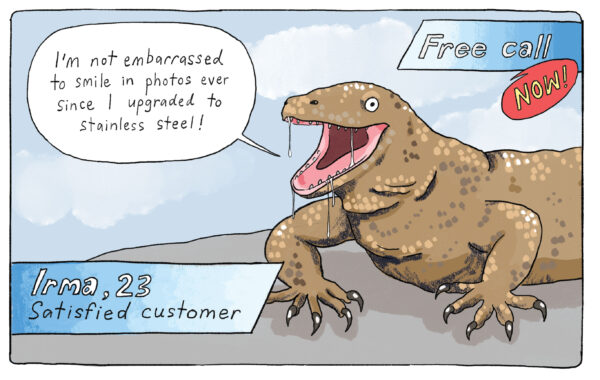
But analysing the chemistry of enamel is hard to do in fossils, LeBlanc says. When a tooth spends tens of millions of years in the ground, lots of different chemicals can seep into it and confuse matters. So LeBlanc got hold of the next best thing to a T-rex: the serrated teeth of the largest living predatory reptile—a Komodo dragon. “And that led, completely by accident, into discovering that Komodo dragons have iron-tipped teeth.”
When he first started working with partial, polished Komodo teeth, LeBlanc noticed they were an “orangey-gold colour”. Not a coffee stain, obviously, but perhaps the blood of the giant lizard’s victims, he thought. Then he went to London’s Natural History Museum to look at the Komodo skulls, and sent a text message full of excited four-letter words to his colleagues. “It looked like someone had taken a really fine paintbrush and put a stripe of orange along the serrated edges on the tips of every single tooth. They were all iron-tipped.”
It was unexpected in a reptile, but actually not unheard of in mammals. LeBlanc, a Canadian, knew that beavers also incorporate iron into their enamel—turning those distinctive, lifelong adult front teeth into rust-coloured, rock-hard chisels for cutting through wood. Komodos are just slicing through meat—but perhaps the iron tips help to keep the dragons’ teeth sharp throughout their short service, LeBlanc speculates, until they’re replaced by the next set waiting in the gums. Even in museum collections, these gnashers retain their keen edge: LeBlanc has sliced his own finger open while dissecting a dragon’s jaw.
*
Teeth and bones pop up together in the fossil record, around 450 million years ago.
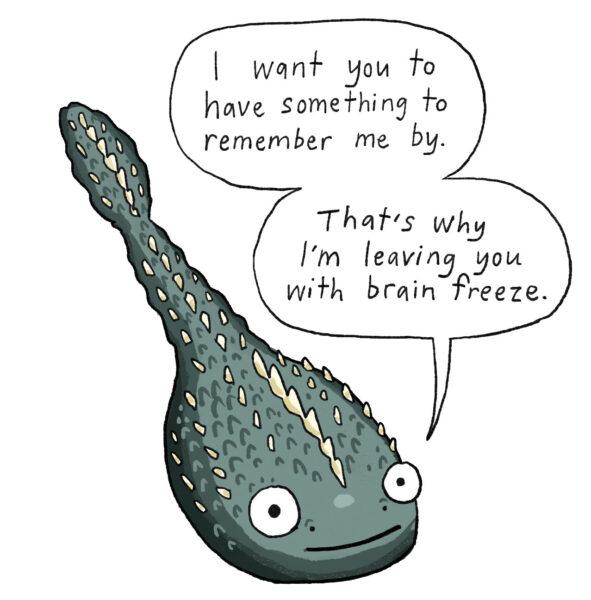
Those first teeth weren’t in a mouth, but all over the body of a bony, finless fish. “It looked like an armoured tadpole, basically,” says Yara Haridy, an evolutionary biologist at the University of Chicago. “Like a handheld vacuum with googly eyes on the end.”
Technically, scientists call these external teeth odontodes. Sharks have them on their skins. They’re not involved in eating, and are not shed like teeth, but they do have enamel and dentine and a pulp cavity.
Over millions of years, odontodes migrated into the mouth and became true teeth. We’ve found fossils at different points in this complex transition. One fish, Haridy points out, has odontodes in its mouth. “They kind of look like teeth, but they’re not being replaced. Do you call those teeth or not?”
A group of extinct eel-like sea creatures called conodonts took teeth in a different direction. Each conodont had a hole in its face bristling with row upon row of scissor-like blades, but no jaw to speak of, and pitiful muscles. Unable to exert any chewing force, they compensated by getting extremely pointy. “Dental tools of unparalleled sharpness,” a group of UK and Australian scientists wrote, after creating 3D models of the teeth based on fossils. The tips, they found, were one-twentieth the width of a human hair.
The part that’s even less clear is how odontodes, bones, and conodont mouth-spikes evolved in the first place. “We don’t really know how we got to have hard parts,” says Haridy.
While investigating that mystery, she stumbled upon another.
“Teeth are very sensitive today, and we really don’t understand why,” she says. “One thought is that it’s so you don’t bite yourself, or you don’t break them while you’re chewing. But another theory is that it might be a remnant of their past life as odontodes.” Perhaps, in the dark, muddy, primeval ocean, these pointy bumps helped creatures sense the world around them.
Haridy was surprised to discover that no one had ever checked to see if the skin-teeth of modern fish had nerves connected to them. Testing catfish and small sharks, Haridy and her team found their odontodes did indeed have the same type of nerves as teeth, and the pulp cavities had similar structures to those of early vertebrate fossils, suggesting those first teeth were sensitive, too.
Maybe that twinge when you bite into a Jelly-Tip has its origins, then, in “a sensitive little fish about 450 million years ago”, Haridy says. “I think in a funny way that sensitivity actually found a secondary function. On the outside, it helped these fish not get eaten, or sense the world around them. Now it helps us maintain our bites properly, and chew food properly, and maintain this one set that we get for most of our lives.”
*
But what if we could grow a third set? “Tooth implants are just a really poor excuse for teeth, because they’re not innervated,” says Haridy. “You don’t have that feedback. A nail holding a tooth-shaped thing in your jaw is just not the same.”
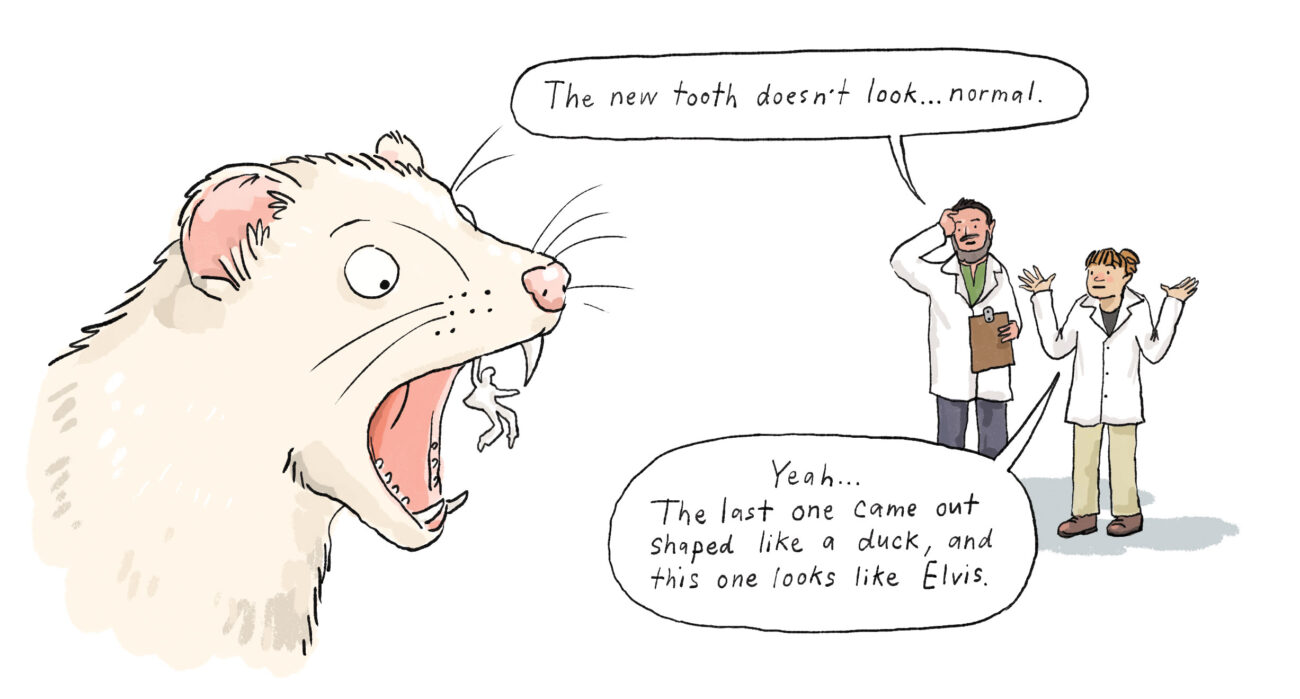
Japanese scientists are conducting human trials of a substance that prompts lost or damaged adult teeth to regrow—they’ve already proved it works in mice, ferrets and dogs. The new tooth “doesn’t look normal”, says Haridy, “but it’s still a great advance. It erupted, it works, it has nerves.” Other researchers are trying to regenerate enamel from stem cells, engineer replacement teeth from a combination of human and pig cells, and grow teeth in the lab.
In the meantime, we’re stuck with assiduously brushing, flossing, and visiting the dentist. The irony is, Loch says, that despite all the time and money we spend looking after our teeth while we’re alive, “when you die, they’re going to remain pristine for thousands, maybe millions, of years”. (It’s the microorganisms that flourish in a living mouth that cause tooth decay.)
Teeth—hard, sharp, enamel-coated or iron-tipped—preserve better than any other animal body part, so they’re a big part of the fossil record. Whole swathes of extinct mammal and reptile species have been described entirely on the basis of one tooth, often all we have of a particular animal. In a happy coincidence, teeth also encode vast amounts of information.
Scientists can “map out the topography of teeth”, says Haridy, and the intricate forms and ups and downs of the cusps, crowns, cingula and carnassials offer clues about what a creature ate. Tiny scratches and wear patterns can further refine our understanding of an extinct animal’s lifestyle.
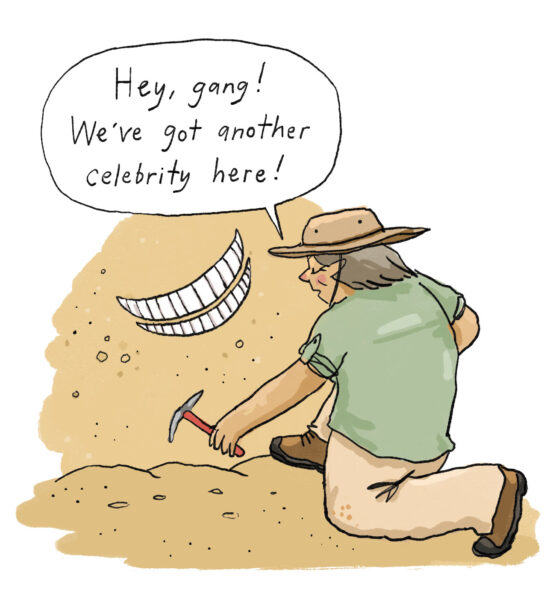
Protected by the coating of enamel, tubules in the dentine and pulp cavity are also excellent at preserving DNA. Some of the oldest genetic material ever recovered came from the molars of mammoths buried by permafrost for 1.2 million years. Colossal, the company claiming to have “de-extincted” the dire wolf, used DNA extracted from a 13,000-year-old tooth. Much older fossil teeth retain a record of the isotopes present in the food an animal ate. “The animal had to grow this mineralised tissue in its body, and it only had the certain types of isotopes that it was eating to make this tissue,” explains Haridy. “So we can see if a dinosaur ate crabs from its teeth.
“They become these little time capsules.”
Our own teeth tell the story of our lives in surprising detail, adds Loch. Periods of intense physiological stress are recorded in tiny layers inside them, similar to the growth rings of a tree. “There’s a line in the enamel of our molars that shows the day that we were born,” she says. Enamel continues to clock life events until adult teeth erupt from the gums in childhood, when our bodies stop laying it down. But our dentine never stops keeping the score—through periods of severe illness, pregnancy or breastfeeding. Just another facet of the miracle of teeth.
“From a single structure, you can learn so much about the life of an animal or a person,” says Loch. “They’re kind of like a black box—a bridge from the past to the present.”
More by Kate Evans
More by Kay Lawson
Subscribe to our free newsletter for news and prizes
3
$1 trial for two weeks, thereafter $8.50 every two months, cancel any time
Signed in as . Sign out