






Lots of spiders are very good at one or two things. Stalking, maybe. Setting traps. Biting. But Steatoda nobilis, the invasive spider now spreading in New Zealand, has an arsenal of tactics—including a neurotoxic venom that can make its bites debilitatingly painful. The bad news? Chances are it will be at your house soon.
I am in a garden in Porirua, and I am struggling. Spider stories have topped news sites for two days; we’ve just realised that Steatoda nobilis, also known as the noble false widow, has quietly settled in New Zealand—and that it’s already all over the place.
I have been reading toxicology reports and studies that warn how resilient this spider is, how fast it breeds and spreads, how much pain its bites cause, that it eats everything in sight. I’ve had a skitter through the British tabloids. “Spider bites put record number of people in hospital”—that’s the Telegraph. “SPIDER SHOCK!”—the Sun, yelling. “Dusting homeowner finds a noble false widow, Britain’s most venomous spider, living in a lampshade…then loses it at her house.” The United Kingdom was invaded decades ago. But the people there are still freaked out by the noble false widow. As I write, it’s spider breeding season over there, and experts are telling residents to close their windows for four weeks lest a roaming male S. nobilis crawls in. Every summer, a few unlucky schools and businesses are abruptly shut down while infestations are dealt with.
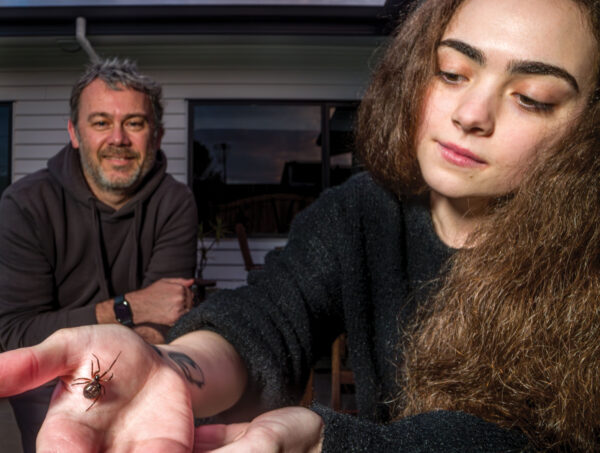
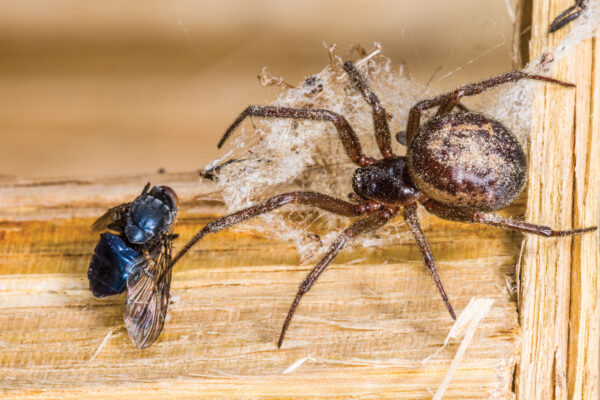
Now, here I am in the backyard of the Picknell family home, ground zero for the discovery of this eight-legged interloper in New Zealand. Alesha Picknell calmly watches as a female S. nobilis with a body the size of a large raisin crawls across her bare hand, each hairy leg probing gently against her skin. The spider scurries up her arm. When it gets to her elbow, Picknell raises her other hand and the spider steps on obligingly. As the 22-year-old science master’s student ducks her head down for a better look, a curtain of her long hair dangles tantalisingly close—or so I imagine, for a spider who enjoys the feeling of silk—but it’s not until S. nobilis crawls near the rolled-up sleeve of her jersey that Alesha’s father, Gavin Picknell, can no longer hold his tongue. “You don’t want it going up there,” he says, an urgency creeping into his voice.
Alesha hasn’t been part of the media flurry around this spider. The press release that started it all, issued by her university, did not name her as the person who was first to identify this species in New Zealand. But she was. And now, she would quite like to keep this specimen as a pet. “They’re more scared of us than we are of them,” she says, as the spider crawls off her hand into a jar. “We’re massive; they won’t rear up, like a white-tailed spider [would].”
True, but if wariness of spiders were a spectrum, Alesha would be at one end, an arachnophobe down the other, and most of us somewhere in the middle. When the lid is back on the jar, I breathe a little more easily.
*
These spiders are not considered aggressive towards people, but that’s really beside the point—studies suggest most bites happen when a spider gets into bedding or clothing, and the victim blithely rolls over in bed or pulls on a jersey.
And the bite of the noble false widow can be nasty. Over the past decade, as the species spread through Ireland, scientists at the Dugon Venom Systems Lab at the University of Galway pivoted resources and time to this spider. They analysed its venom, finding it significantly overlaps with that of its notorious cousin, the black widow. A bite from S. nobilis will initially feel like a wasp sting, and there will likely be swelling and sweating. But, partly because of the potion of drug-resistant bacteria the spider carries on its body and fangs, symptoms can progress fast, to skin tissue death and dangerous bacterial infection.
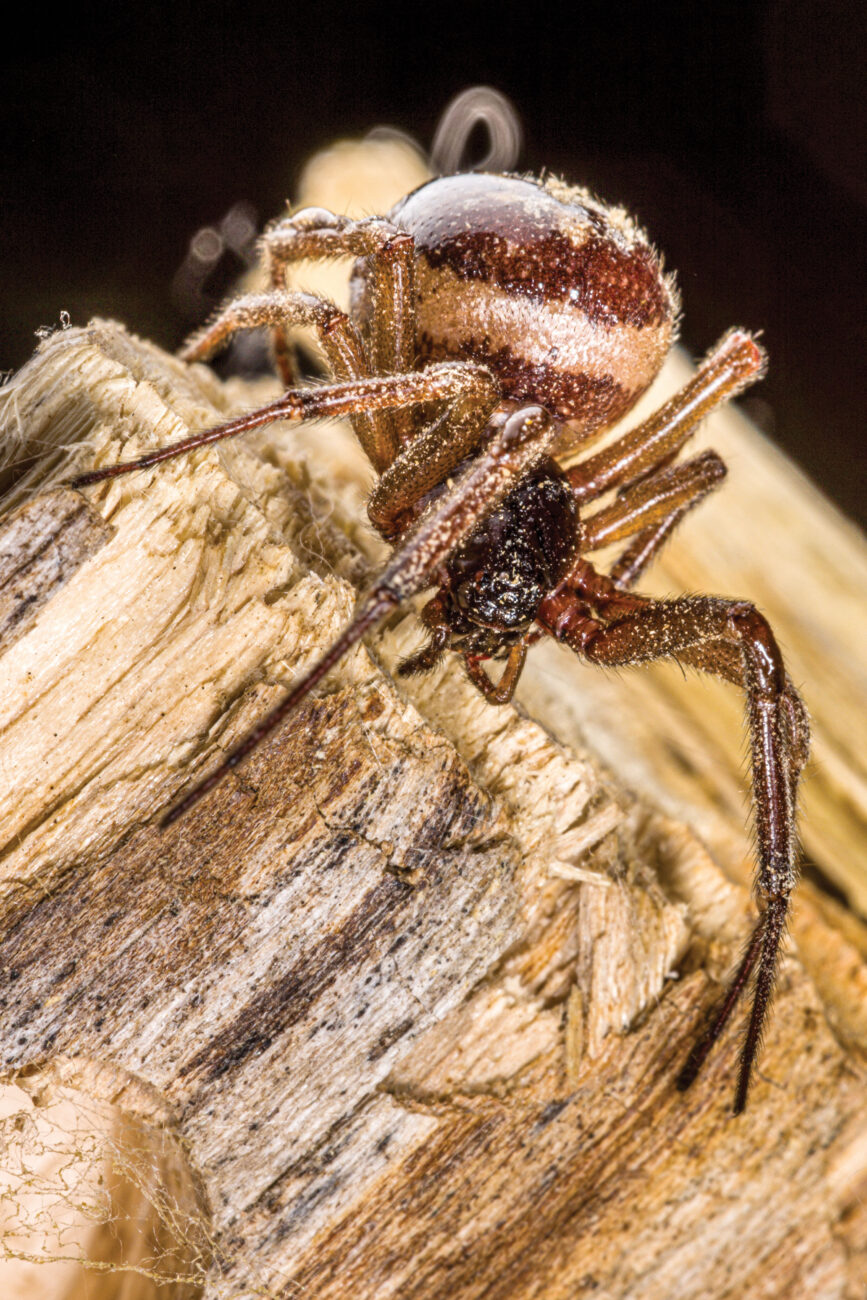
The venom lab also scrutinised 16 case studies—people who’d been bitten, who knew for sure it was by S. nobilis. More than a dozen of those bite victims reported complications including tremors, hypotension, nausea, and impaired mobility of the affected limb. “Severe debilitating pain was experienced by some victims,” the scientists write, pointing to the case of a 47-year-old man, bitten four times in bed, waking to “excruciating” pain that was not touched by the intravenous morphine or steroids he was given in hospital. A 43-year-old woman bitten by a spider in her trousers described feeling as if boiling water was being poured over her leg. By day six, she was in hospital with cellulitis and “10/10” pain; by day 95, she was fully recovered, but the bite marks were still visible. “Although relatively rare,” the paper says, “envenomations by the noble false widow Steatoda nobilis can lead to severe clinical manifestations”. Importantly, the scientists note that many bites will be going unreported because the spider flees the scene.
(In the media, descriptions can be more apocalyptic; in one article in the Mirror, a former personal trainer from Berkshire tells of falling unconscious after two bites thought to be from S .nobilis, saying that he passed out from the pain from the venom and later developed sepsis. “If anyone finds a false widow spider in their home, run away from them or kill it,” the man said, after his arm almost had to be amputated. “Don’t underestimate them.”)
The noble false widow, the venom lab scientists conclude, “deserves closer monitoring by both the scientific and the medical communities”—especially in places the spider has recently invaded.
Over Zoom, I talk with Michel Dugon, a zoologist who heads the venom lab.
“What should be of most concern, more than bites, more than the symptoms that it can produce, is the speed and the efficiency with which the spider can invade new habitats,” he tells me. “Within eight years, this globally invasive spider has become the most common household spider in Ireland, and that is really impressive. It has taken over these environments, and it has taken them over fast.”
Dugon reels off the evolutionary traits that give this spider a predatory advantage. It can operate at freezing temperatures, with a whip-quick metabolism that doesn’t slow down like that of many other spiders. It can reproduce at 10 times the rate of the average spider. “The noble false widow has a massive impact on primarily native spider populations,” he says. “It basically competes with native spiders, kills them or displaces them from their ecological niche.”
When it comes to fighting, the noble false widow has a particular set of skills. Dugon’s team arranged an arachnid fight club, and watched it make short work of five types of native Irish spiders. The noble false widow has evolved a resistance to the venom of other spiders, Dugon says. Its own neurotoxic venom was found to be 230 times more potent than most native Irish spiders, and it paralyses and kills with efficiency, using a process called venom optimisation—it calibrates its payload to the size of the victim, deploying just enough and saving the rest for later. Its silk is also incredibly strong, even by spider standards.
Perhaps most astonishingly, the venom of S. nobilis has adapted over time to target the central nervous system of vertebrates. One afternoon, I find myself replaying horrific footage captured by one of Dugon’s colleagues.
A noble false widow wraps a stunned pygmy shrew in silk—then hoists the rodent, roughly 10 times its own weight, up into its web.
The spider liquefies the shrew’s insides with its intestinal juices and spends three days eating, then drops the furry sack of skin and bone back onto the windowsill.
This species has been documented catching and eating a protected Irish viviparous lizard and a series of bats, using that same specialised hoisting technique. The noble false widow, Dugon says, “can do damage that other spiders cannot do”. He is urging scientists here in New Zealand to monitor it closely, measure its impact on native species and try to contain its spread—even before we know precisely what’s at risk. “You have an insular, very fragile ecosystem,” he says. And this spider “feeds indiscriminately”.
Our authorities are so far taking a hands-off approach. Neither the Ministry for Primary Industries (MPI) nor the Department of Conservation (DOC) plans to monitor the spread of this spider, instead relying on reports from the public and posts on citizen science site iNaturalist.
A risk analysis from MPI assesses the threat to human health as low—saying bites are uncommon, and most symptoms resolve within 72 hours—and to the ecosystem as moderate.
But there are some tangles and contradictions. At one point the risk analysis sounds a strange note of hope—that winter might wipe the spider out for us—while elsewhere stating that “climate is unlikely to be a barrier” and that this species can deal with temperatures as low as -8°C. (The optimism was misplaced; a few months later, scientists would realise the spider had already been here five years.) It lists some of the extraordinary traits that make this species such a threat, then repeatedly says there is “no evidence suggesting that the risk [to native biodiversity] is higher than that posed by other introduced spiders”.
Significantly for our endangered native insects, spiders and lizards, the MPI document acknowledges that while the noble false widow seems to prefer urban environments, favouring buildings and fences, overseas it has also been found in “wetlands, dunes, coastal cliffs, woodlands, forests, nature reserves, gardens and parks”. It notes that the new spider “could disrupt local food webs”, prey on endemic lizards, and eat or displace native spiders such as the katipō.
That sits uncomfortably with the statement DOC gave us, which says the department has “low concern” the noble false widow will impact native species, given the spider’s preference for urban areas. “We do not expect their effects on native species to be significant,” the statement says.
It’s too late to even attempt eradication, officials say. No one’s arguing with that. The noble false widow can travel, then, with impunity, settling wherever it finds a friendly nook—and munching whatever already lives there.
So it won’t kill you. But this is going to hurt.
*
The noble false widow is native to Madeira and the Canary Islands, and is thought to have arrived in Britain in about 1879. For over a century, the new arrivals stuck to the ports. But in the mid-90s, the spiders began a campaign of massive expansion. Dugon thinks it’s possible that during their long stint away from home, the fast-breeding species selected for some trait that enabled that spread. Now, S. nobilis is happily established, he says, throughout continental Europe, the northern part of the UK, Ireland, parts of the US, and the extreme south of South America. And, of course, here.
Dugon and his team started studying the species around 2015, as alarm about S. nobilis was erupting in the Irish popular press. They traced the spider’s spread over several years, calling for people to report sightings, while documenting cases of confirmed bites and analysing the ways in which those bitten were reacting to both the venom and the bacterial load the spider carries. “We got hundreds and hundreds of reports,” Dugon says, “and we could see that, with time, those reports were moving west, following the highways.” As we go to press, sightings of the noble false widow have been logged in Nelson, Christchurch, Wellington, Auckland and just north of Whangārei. Porirua, where it was first noticed and identified by Alesha, is a hotspot.
More by Michelle Duff
More by Rob Suisted
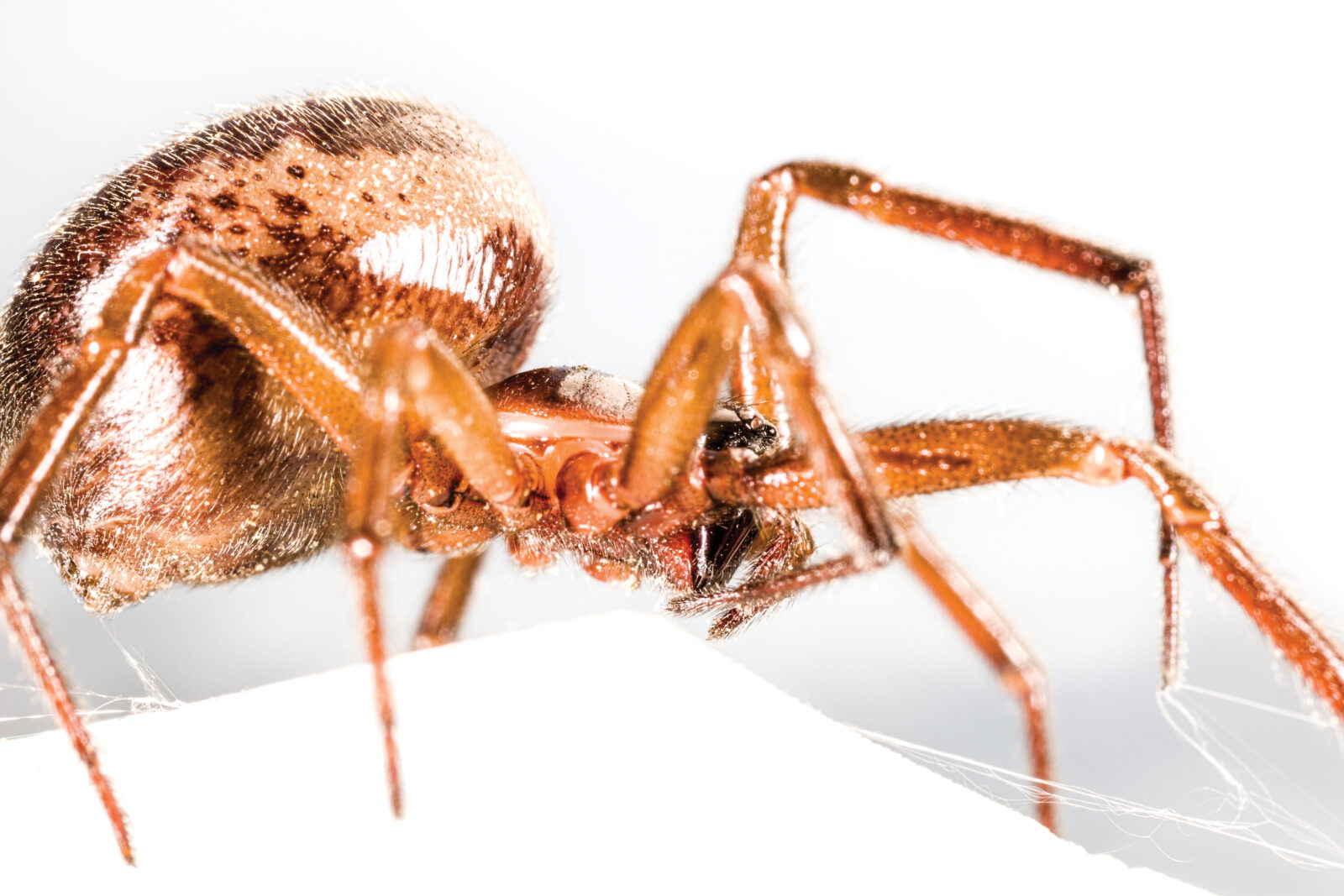
If we see a noble false widow, should we try to kill it? “That’s the very tricky part,” Dugon says. “If I say yes, the whole spider community will hate me. You don’t want to kill organisms, and it’s not the spider’s fault it’s ended up in New Zealand—but if it has a negative impact and it doesn’t belong there, then eradication is the way. They are pests.”
Pest controllers in Wellington are already on high alert following an industry training seminar on the species late last year. Darren Labrum, a longtime pest controller, recently encountered his first noble false widow in a customer’s Karori backyard. “I came across it and gave it a bit of a spray, flushed it out, scooped it up,” he says. He hasn’t yet seen an infestation, but expects demand for his services to grow as the spiders breed—and more people realise what they are. Initially, the spiders will head for windowsills, in between weatherboards and underneath outdoor furniture, before creeping indoors, he says.
“I expect they’ll eventually get inside and get comfortable there, too. Another six months and we’ll see them everywhere—there’s more prey in summer.”
Like so many other invaders, the noble false widow arrived here by very human means: in egg sacs secreted in the folds of a suitcase, the creases of trousers, in a plant bought from the garden centre. Since 2010, 28 live S. nobilis spiders and one egg have been intercepted on sea cargo coming into the country. Now, we’re going to have to learn to share our houses with the spiders, too.
*
Alesha Picknell first noticed the odd-looking spider in her backyard in mid-2023. But she was busy, and she wasn’t absolutely sure what she was looking at. In late 2024, her father uploaded to iNaturalist a photograph of a spider he had found. It was just like the one she’d seen earlier. This time, she moved fast, identifying it as Steatoda nobilis.
A word about iNaturalist, here; it’s a site for nature lovers and scientists both qualified and amateur to identify and discuss flora and fauna, a kind of Facebook for appreciators of wildlife. (“It’s powered by nerds,” leading arachnologist Cor Vink, an associate professor of entomology at Lincoln University, tells me.) On a site where people care deeply about the differences between the 2000-odd spider species in this country, things can get quite heated.
Gavin joined to feel connected to Alesha, who lives in Palmerston North. When he first put up the post of the now-infamous spider, other users didn’t believe the spider had really been found in New Zealand—fair enough, maybe, given that his only other post was a picture of a snail, captioned: “Who is Christopher Luxon?”
“I was just trying to be funny, but I learned my lesson,” Gavin says, as we head into their yard, which backs on to a bushy reserve. The setting sun casts a red hue over clouds to the west, and it’s a still, cold night.
The pair have now found dozens of S. nobilis in dark crannies around the family property, and have so far opted to give them space rather than a good hard stamp.
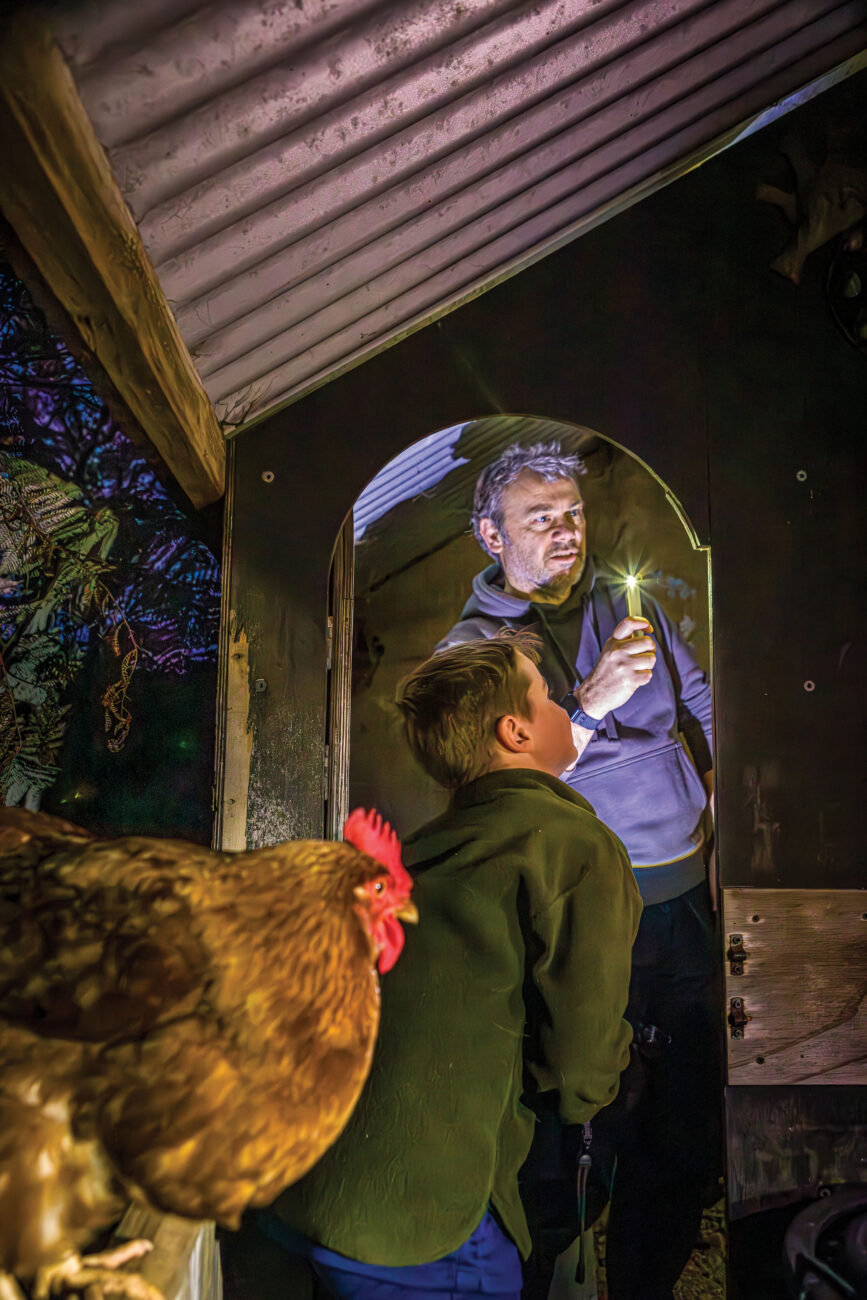
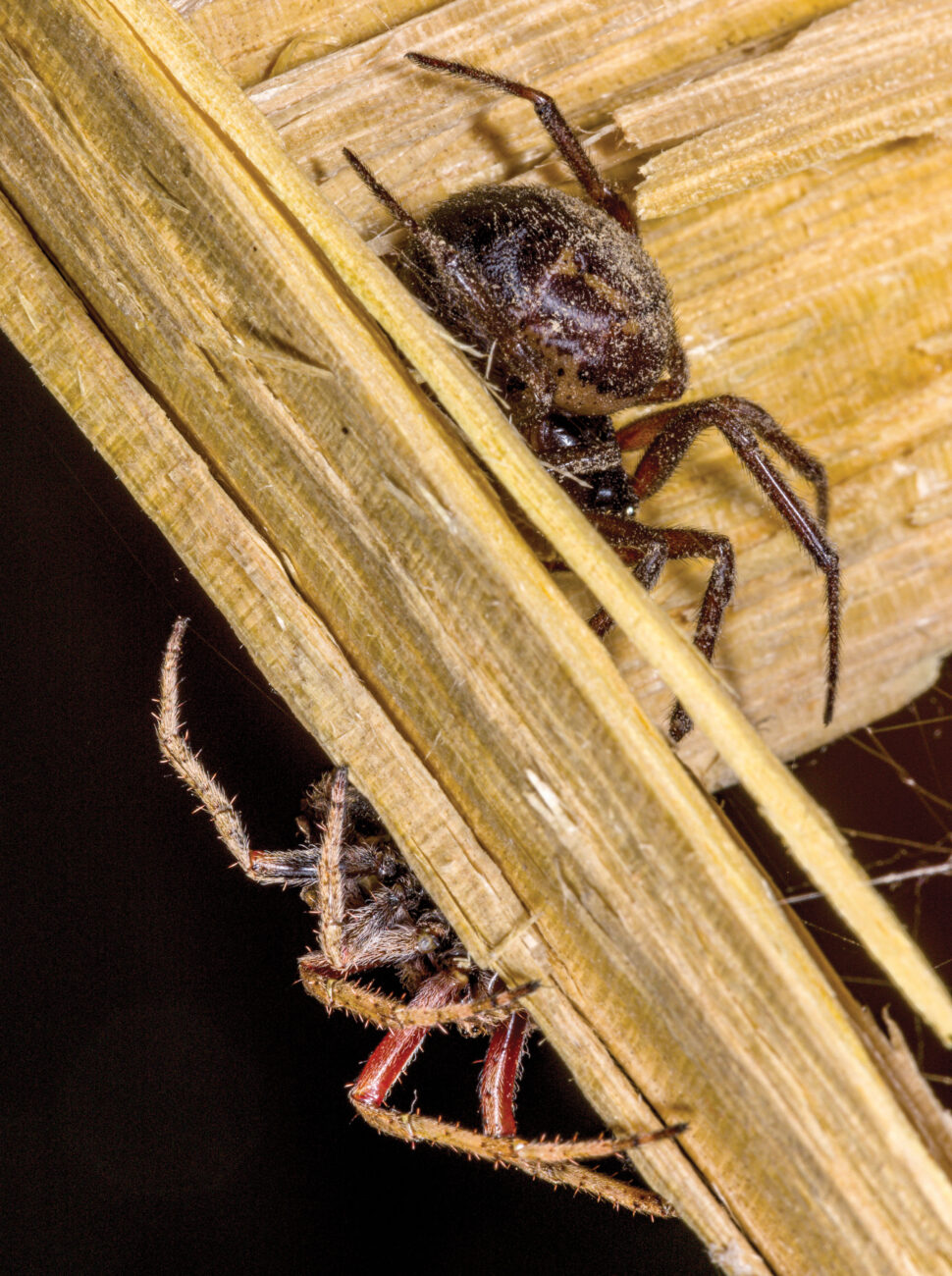
“Here we go,” Gavin says, shining his light on a tangled web in the chicken coop. A noble false widow sits squarely in the centre. “That’s a male; they’re not as big.” Spiders can detect vibrations, and this one has frozen in our pool of light, curling its reddish-brown legs underneath its body. We move on to peer underneath the outdoor picnic table, where an intricate web stretches diagonally from one table leg to the other—yeah, right where your legs go. “It’s messy, unlike the orb weavers,” Alesha says. “They have these long supports as well.”
After her dad posted the spider on iNaturalist, Alesha contacted MPI, who she says were unconvinced as to its identity but sent her specimen containers to fill. They confirmed its identity, based on morphological features—what it looked like—in December 2024. Still, she says, not everyone believed her. She collared Steven Trewick, an evolutionary ecologist at Te Kunenga ki Pūrehuroa Massey University, when she saw him in the lab. “I said, ‘Hey, do you want to see a cool spider?’, and he immediately stole a leg for DNA analysis,” she said. “I understand why everyone was quite sceptical—I think the reason it was being overlooked is because the scientists who were more knowledgeable thought this thing shouldn’t be here, so it must be one of the other species.”
The first to unequivocally back up Alesha’s claim on iNaturalist was Tobias Bauer, a landscape ecologist based at Germany’s State Museum of Natural History Karlsruhe. Bauer was part of a team that in 2019 modelled a map of the world according to the preferences of S. nobilis. They crunched climate data, citizen science, media reports and field surveys in Germany and Ecuador, which had been recently colonised, to predict where the spider was likely to spread. On that map, reproduced on page 69, much of New Zealand is painted red—it would be a “highly suitable” habitat, the team said.
Bauer flew over that same year to see whether S. nobilis was in fact already here. He searched predicted hotspots across all three main islands but came up empty. He has been keeping tabs on iNaturalist ever since, waiting for news of an invasion. “Your climate is more or less oceanic; it’s not so cold in winter and not so hot in summer. We knew this would happen, and South Africa will be next,” he says. On his map, the south coasts of Australia and almost the whole of Tasmania are coloured S. nobilis red, too. Authorities there are now on the lookout.
Bauer, like Dugon, is worried about what the spider might do here. Based on his research, he believes that it could have “severe and unpredictable” impacts on New Zealand’s native wildlife. He points out that while the spider is found in and around houses—on exterior walls, concrete fences or hedges—there is nothing stopping it expanding into the bush once all the prime real estate is bagsed. His modelling paper points out that this has already happened in the south of England, and in France. “If they could colonise natural areas [in New Zealand] they could have a big impact on things like the wētā,” Bauer says. “They just eat all the native insect species.”
After reading MPI’s risk analysis, Bauer thinks our officials are not quite grasping the threat. This spider “laughs” at New Zealand winters, he says, and that, in combination with its venom, the cost of pest control in urban spaces, its track record of shouldering out native species, and the fact it can feed on vertebrates, makes it different. “There is evidence for a greater impact in comparison with other introduced spiders,” he emails.
“I’m usually not an alarmist when it comes to alien species, but S. nobilis is a problematic species due to the combinations of its impacts.”
In Te Waipounamu, Vink has seen this first-hand, saying spiders can spread incredibly quickly and have a significant impact. “If it can survive in England and Ireland, it will have the capability to withstand anything we can throw at it, and for every spider you see, there will be thousands you don’t see.”
There is ample evidence of the devastating impact exotic spiders can have on native spiders, even the well-armed katipō. In sand dunes, the false katipō (Steatoda capensis) can handle a more extreme environment than the katipō and breeds year-round, taking over habitats. Other foreign spiders simply eat the katipō. Exotic spiders are hitting our rare insects, too: in Central Otago, Australian redbacks regularly dine on the critically endangered Cromwell and Alexandra chafer beetles, leaving webs strewn with beetle shells. Vink and his team are now working on a project to attract and kill the male redbacks using pheromones. It’s the kind of targeted intervention that could be needed if—some say when—the noble false widow turns its foothold into a takeover.
*
In May, Trewick’s DNA sequencing results came back: the spider Alesha had shown him was indeed a noble false widow. “I was like, ‘Yes!’ The vindication,” she says. Scientists combed back through old iNaturalist sightings and confirmed that the spider had been here since at least 2020. Alesha and Trewick wrote about this territorial expansion in The Wētā, the news bulletin of the Entomological Society of New Zealand. Like DOC, they urge the public to join the hunt—and document their finds online—to help scientists gauge spread and range.
“We don’t know how abundant it is, we don’t know how widespread it is, but it’s a very invasive species and there are suggestions it’s been around even longer than we think,” Trewick says. He is setting up a network in collaboration with global experts to observe the species, and is seeking funding for this tracking, and to analyse the particular mix of bacteria the spiders here are carrying. The strains on S. nobilis overseas have shown resistance to many antibiotics, making these the biggest threat posed by the spider to human health.
The arrival of S. nobilis should be seen as part of a larger pattern of globalisation and a warming planet converging on ecosystems, Trewick says. “We’re not panicking about a spider invasion yet, but we are interested in this process of colonisation and biodiversity change.”
*
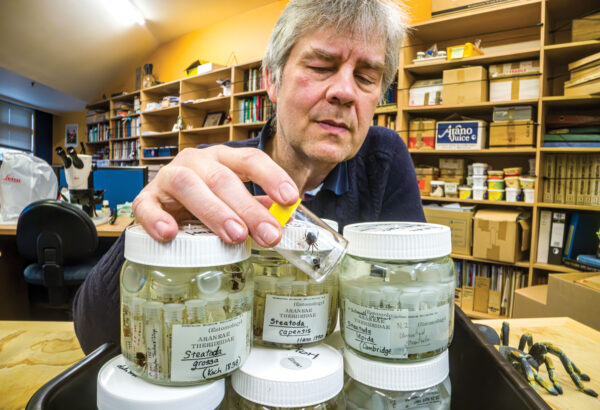
Phil Sirvid, a curator of invertebrates at Te Papa Tongarewa Museum of New Zealand, has spent his career fascinated by arachnids. He is yet to see S. nobilis in the flesh, but he is standing by for the spider wars.
Most of the spiders that live on or in our houses—where the noble false widow will soon come knocking—are exotic species such as daddy long legs and cupboard spiders, so these could be first to fall, he reckons. Most of our native spiders should initially be out of range, as they tend to prefer the bush.
How about S. nobilis versus that other bitey home invader, the white-tailed spider? Sirvid’s hedging his bets. “White-tailed spiders will absolutely try and attack spiders that they didn’t evolve with, plucking at their webs insistently to arouse curiosity before attacking, or sometimes just barrelling in. It’s hard to know how it would go; they’ll probably try to eat each other.” But if a white-tailed gets caught in an S. nobilis web, it’s toast, he says.
Like everyone else, Sirvid expects the noble false widow will spread fast. The less-invasive trapezoid crab spider, he points out, ticked off the entire North Island and made it down to Christchurch in just 20 years. (The redback is also spreading with speed from its bases in Central Otago and New Plymouth, a fact Sirvid considers more alarming when it comes to ecosystem shock and danger to humans.)
New Zealanders, he says, have been living with spiders that bite for a while. The redback has been here since the 1980s, and the white-tailed arrived at least 100 years before that. The native katipō, which dwells in sand dunes people walk over in bare feet, also has a gnarly bite. A katipō bite won’t kill you, Sirvid says, “but you’ll wish you were dead”.
While spiders loom large in our mythologies, Sirvid says, the best thing we can do is be aware of them. Check your bedding. Shake out your gumboots. “When you think about it, spiders have domesticated us. We provide them the things they need, whether we mean to or not.”
*
Back in Porirua, our spider hunt is wrapping up. Alesha has reluctantly agreed to let our photographer take her noble false widow for a series of close-up shots; she is feeling attached to the spider now, and while she knows releasing it is bad for whatever else is living out here, she doesn’t want it to die. Gavin, used to his daughter keeping invertebrate pets ever since she began rescuing wētā and snails as a child, asks her what she’s going to call this specimen.
“You’re the one who found it; you can call it what you want,” Alesha says.
Fine, then. “I’m going to call it the Porirua Punisher,” Gavin says. Alesha rolls her eyes, and we all look into the jar, where the noble false widow is tapping a leg on the glass. If it wants, it can survive there without food for five months. It can wait.