





In the studio with textile artist Rowan Panther
Amid dying kauri in West Auckland’s Waitākere Ranges, Rowan Panther is making masterpieces from muka—plaiting and weaving pale flax fibres into delicate, wearable lace. The leis, collars and chest-pieces are objects of beauty, but they’re also a meditation on what it means to belong in Aotearoa. “I’m kind of using lace as a medium to work out life,” Panther says.
Usually, Panther lives in Doubtless Bay in the Far North, her artworks twists on traditional European lace patterns, made from the leaves of the closest harakeke bush to her back door.
But when I visit during Panther’s residency at Colin McCahon’s 1950s Titirangi home, the 43-year-old is experimenting. Lace in the form of kauri leaves set in 3D around a branch. A long open collar replicating the spiky shapes of pūhā. Each piece takes months to make, and those intricate hours and tiny repetitive movements with pins, paper, and fibre allow plenty of pondering time.
Panther’s ancestors are Irish, English, German and Samoan, and she’s long felt some trepidation as a Pākehā artist working with a taonga species like harakeke. She does everything she can to honour the plant and its whakapapa, including leaving the horsehair-like fibre ends unfinished and free, as a way of ceding control to the flax’s own life-force. But increasingly, her work has become a way to investigate this tension.
“Pākehā is kind of an orphan culture in some ways,” she says. “And it’s very vulnerable to say, ‘I don’t feel like I belong.’ But if you can make something while you’re trying to work out where those feelings come from, then that can be so resonant.”
Panther chose pūhā for a reason.
Beloved by Māori as an edible leafy green, pūhā is nevertheless a 19th-century import from Britain, where it’s known as sow thistle. Depending on the eye of the beholder, pūhā is both kai and weed, exotic and yet naturalised. “It’s one of those things that’s everywhere, but it’s also invisible,” Panther says, showing me the pressed leaves she gathered to use as inspiration, the careful geometric pin-pricked pattern she nutted out in ballpoint pen, and the final, almost finished neckpiece. “I kind of feel like I’m a pūhā.”
In other ways, Titirangi has been a return. Two decades ago, during her last year of studying photography in arts school, Panther discovered lacemaking when her aunt sent her along to a community class there. “I’m a people-pleaser, so I couldn’t say no,” she says. “But it just got me—there’s something in it that just made total sense in my brain.”
During this residency, Panther has also come back to photography, making simple sepia-coloured images of her creations using a technique called salt printing, where you make paper photosensitive, place an object on it, and expose it to sunlight. In this, too, she sees layers of meaning. These days, lace is often seen as dowdy or frivolous—“something to put on your underpants”—but it’s been at the heart of several critical technological developments, Panther says.
Some of the earliest photographs, for instance, were of lace. In 1845, photography pioneer William Henry Fox Talbot made his own salt prints of lace to demonstrate both the detail that could be captured and the commercial possibilities for the huge Victorian lace industry. Later, the binary system developed for industrial lace machines was adapted for early computer code.
In Europe, lace has traditionally been made from cotton, silk, or linen fibres. “But I have decided to make my practice a lot more difficult,” Panther says. Working with an unusual fibre meant she had to develop her own techniques, although she relies on 1980s pattern books for a sense of continuity and legacy. Her work is deliberately subtle, quiet, and drawing on a long history of women’s handcrafting. “It doesn’t need to be neon with flashing lights.”
Panther’s artworks are all made as adornments—for the body, rather than the wall—though as her career progresses, they often end up in art galleries and museums.
As she packs the pieces up and farewells them, she knows that once they emerge from their box, “it’s all going to be care, and gloves, and controlled climates, and they’re no longer functional neck-pieces”. At the same time, she loves that curators and collection managers will treat with care “these things that are kind of like my children”. Some of those children are now under the protection of the most prestigious collections in the world. Four of her leis are in Te Papa; one chest-piece is in the British Museum. “That’s on a little touring exhibition in Spain at the moment. It’s gone more places than I have.”
Has the work helped, then? Is it giving her a greater sense of belonging?
“It’s fluid,” she says. “It’s human nature, I think, to sometimes feel like you’re in the right place at the right time doing the right thing, and then the next day, you might wake up and feel more isolated than before.”
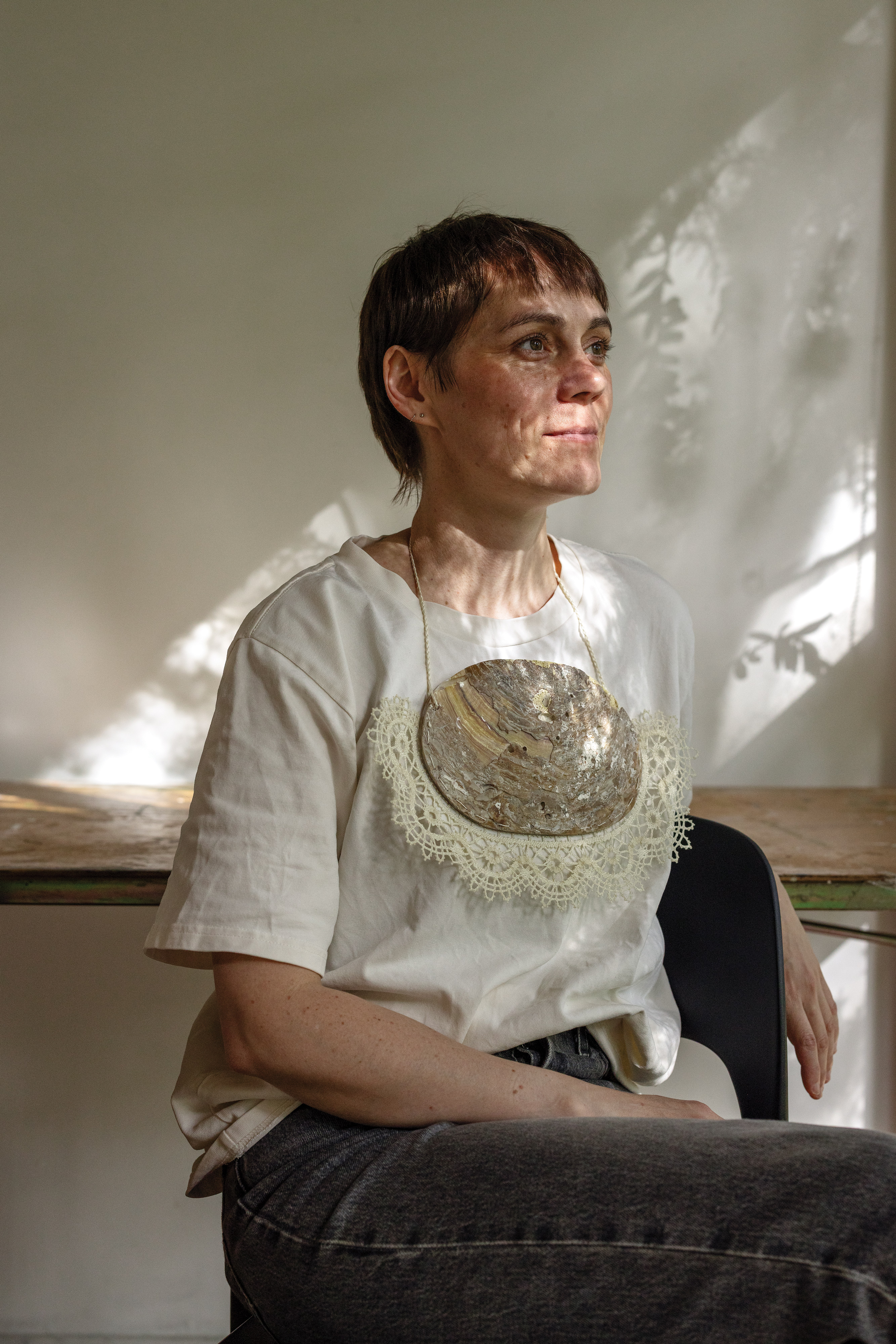
Titled ‘Fa’afetai’—a “thank you” in Samoan to her ancestors—Panther made the chest-piece pictured here in 2023, shortly after her father died. It’s heavy, both physically and spiritually.
While the massive mother-of-pearl shell shimmers with lustre on one side, the reverse bears the scars of the mollusc’s eventful life. “That’s just so closely related to what it means to be human. The longer we’re around for, the more hits you have to take—you’re just acquiring more and more heartache.” When she wears it, the weight leaves marks on her skin.
More by Kate Evans