


Moa once walked all over Aotearoa, pressing heavy feet into mud and sand. Eons later, finding just one of these footprints intact is a small miracle—a fossil that speaks to a movement, a moment in time.
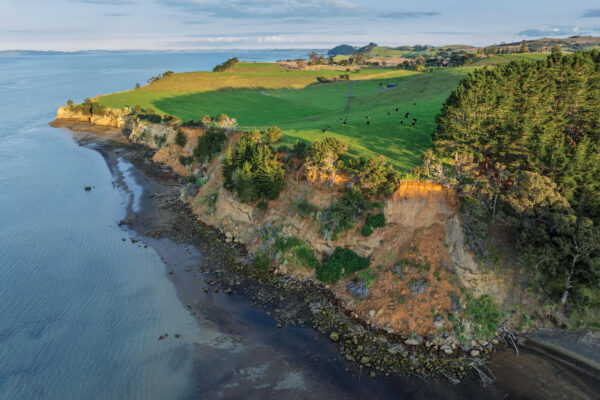
On March 21, 2022, torrential rain hit the Auckland region. Seven hundred lightning strikes crackled to earth in just five minutes. Schools and homes flooded, cars drowned, and either that morning or in the days afterwards, at an isolated beach on the Kaipara Harbour’s South Head, a chunk of crumbly golden sandstone broke from the cliff face and tumbled to the beach below—revealing, for the first time in a million years, a record of a creature making that most ordinary of movements, simply putting one foot in front of another.
Six days later, young Auckland couple Ava Peters and Matt Brown were dawdling back along Mānunutahi Bay after an unsuccessful Sunday rock fishing trip. In the midst of a fresh landslide, among rubble and crushed clumps of pampas, one slab caught Brown’s eye.
It was sitting upright, as if to attention. Walking down its sheer blond surface, raised up in relief, were four three-toed footprints, each larger than a human hand. “Those are moa footprints,” Brown said to his partner. Peters had been a keen fossil-hunter as a child. She wasn’t sure at first, though. Could the prints somehow belong to an escaped ostrich? A huge seagull? But when the couple got closer, it seemed clear—they could have been made only by a moa.
Excited, they contacted Auckland Museum, which got in touch with Ngāti Whātua o Kaipara and local palaeontologist Daniel Thomas. The next day, a group of mana whenua and scientists convened at the beach.
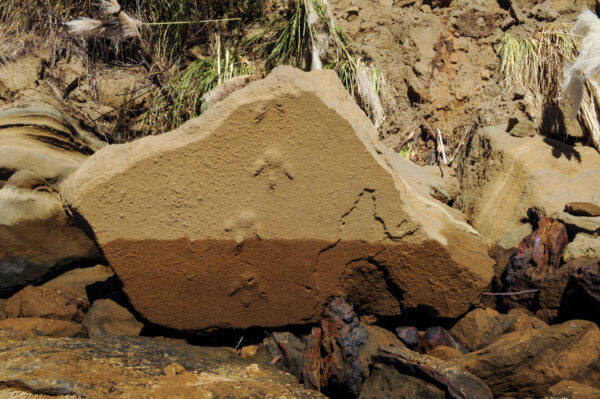
Though Thomas had examined replica moa footprints in the museum before, this was the first time he’d seen the real thing. Moa prints are very rare, and these were exceptional: preserved in hyper-relief, poking up rather than pressed in. That also made the Kaipara prints less likely to be a hoax, Thomas explains: “sticky-outies” are more difficult to fake.
But it was also clear the find—barely more solid than a sandcastle—was in trouble. The bottom half of the block was stained dark, having been doused by the last high tide. Every 12 hours, more of the taonga could wash away.
The team hashed out an improvised retrieval plan, and the museum scientists made detailed measurements. As insurance in case the prints were damaged, Thomas took hundreds of overlapping photos of the footprints—a technique called photogrammetry, which can be used to create 3D digital models. Malcolm Paterson, the tumuaki or head of Ngāti Whātua o Kaipara’s post-settlement companies, appointed rotating shifts of kaitiaki to keep a 24-hour watch on the fossils. “There’s always the chance that someone comes and tries to chisel one out,” he says. “We’d had personal experience of that with some of our cultural taonga in the past.”
The following morning, the rescue began. Because the block was so heavy—an estimated two or three tonnes—and sitting up vertically, the team had decided to trim off the back of the stone until it was light enough to be lifted.
After a karakia, while waiting for the tide to recede, they built a wooden frame to stabilise the front of the block and stop it falling forwards. Then Matt Rayner, a senior researcher at the museum, started slicing into the back of the rock with a concrete-cutting saw. It was late summer, a scorcher; as the sun rose overhead, people took turns with picks and chisels. Every blow removed weight from the rock, but also weakened it.
No-one had done this before, adds Paterson. “Everyone was making it up on the spot, their best efforts, with these really fragile ancient things, and racing the tide, and nightfall.” After six hours of careful scraping, the block was around 20 centimetres thick and weighed several hundred kilograms. It would have to do. The crew moved the frame to the back of the block. There was a conversation, Thomas remembers, an agreement that the whole group bore responsibility—that if the rock broke, and you happened to be standing closest, “please don’t feel bad”. Half a dozen sets of hands tenderly lowered the fossil to the ground.
Crack. The block split, a wavy line through one of the top toe-prints. Unfortunate, but it could have been worse. As the tide approached the tyres of the waiting ute, six of the strongest guys hefted the frame into the tray. Then the fossil was on the move, a winding drive 50 minutes down the peninsula to the headquarters of Ngāti Whātua o Kaipara—who just happened to have the perfect place to store it.
*
Before humans arrived, moa were widespread in Aotearoa. Nine species roamed almost all available habitats, except for the steepest parts of the Southern Alps. Scientists estimate that 1000 years ago, there were more than a million moa in New Zealand—that’s four per square kilometre. Every day, for many millennia, moa walked the wetlands and mudflats and beaches of these islands, leaving footprints behind.
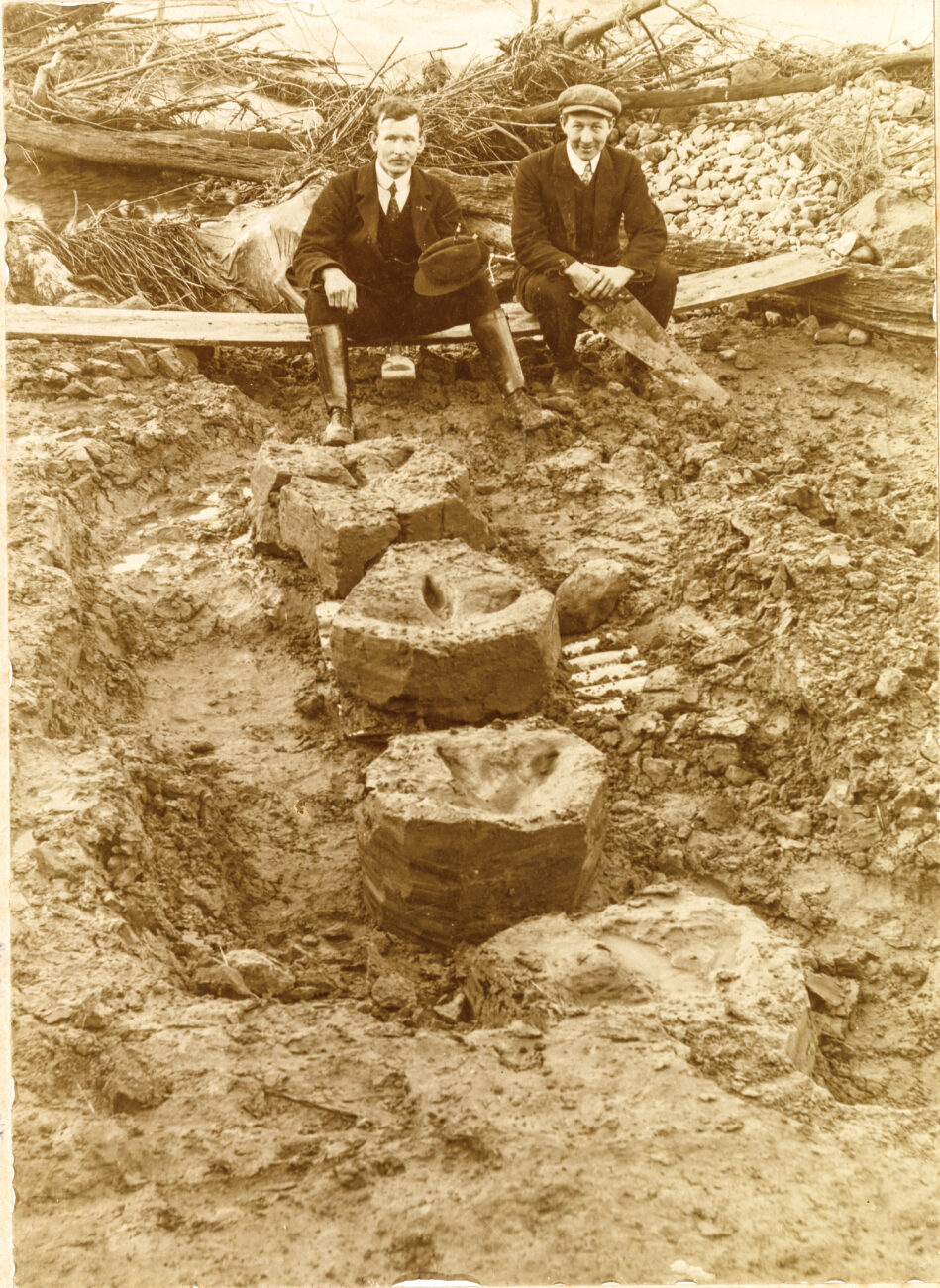
And yet, fossils of these footprints have been found and recorded just 18 times. The first known trackway, a grouping of 18 prints, was discovered near the mouth of the Tūranganui River—downtown Gisborne—in 1866. Over the next century and a half, other footprints turned up, and only some of those made it into museum collections. Despite enormous moa populations in the South Island, which had been home to seven species, only two sets have ever been found there.
A singular footprint is one thing. But if you have three or more in your ancient trackway, you can learn something almost no other fossil can tell you—how an extinct animal behaved. Did it stroll, sprint, bound, or mosey? Did it roll its foot heel-to-toe, or stomp like an angry child? How was its weight distributed? How long were its legs?
“They’re four-dimensional fossils,” says Thomas. “The three dimensions of the shape, plus time.”
In outback Queensland, for instance, a stampede of hundreds of footprints preserve the moment 95 million years ago when around 180 small dinosaurs fled a massive predator—later informing the stampede in Jurassic Park. In Tanzania’s Rift Valley, three ancient humans left a trail of 70 footprints in fresh volcanic ash. More than three million years later, British and American scientists got into an elephant-dung playfight in the same spot. Hitting the deck, one anthropologist realised his face was inches away from a rock full of fossils: the first irrefutable proof our ancestors walked upright long before they grew large brains or tamed fire.
Most fossils show us a creature in death. The fossils of footprints feel emotionally different—recording an ordinary moment in the middle of a life, rather than its sad or violent end. Somehow, these stone traces seem more alive than physical remnants of body and bone—more alive, perhaps, than a genetically resurrected version of a moa might ever be.
*
On a farm, forestry and bush block in north-west Auckland, there is a place of treasures. Called Papaki Mai, the small, nondescript room next to the shed was built at the headquarters of Ngāti Whātua o Kaipara to house a kauri waka found in the Muriwai dunes in 2009. Just outside the door, an enormous eroded whale bone stands guard, grey and mossy, the tohorā placed there to remind the waka of its connection to the moana. Inside, a heat pump keeps temperature and humidity constant.
Next to the shrouded seven-metre waka is a set of three purpose-built cases: small, medium and large, like the three bears’ chairs. Wikiriwhi Ratima, of Ngāti Whātua Te Tao Ū, is showing us around—the organisation’s kaiwhakahaere ngahere kaitiaki, or custodial forest manager, he’s responsible for looking after sacred sites, burial grounds and ancestral remains, and taonga such as these fossils.
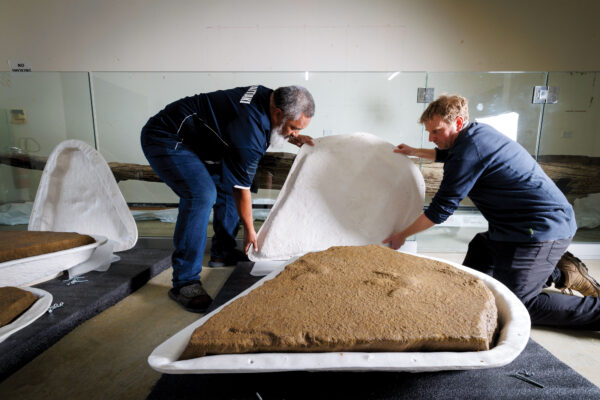
Ratima and Thomas crouch on the floor, spinning wingnuts undone on the largest of the three cases. Ratima pauses for a second before prising it open. “It actually feels a bit like opening a waka tūpāpaku, for our dead,” he reflects. “It’s that sort of feeling right now—like taking the lid off the coffin for the first time.”
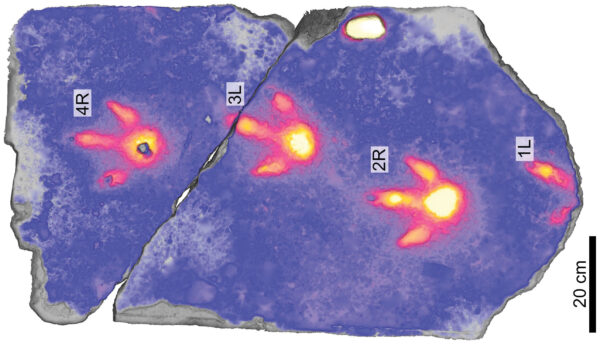
Inside is a dark gold chunk of beach. Two and a half prints rise out of the flat surface; three slow steps. The rounded fleshiness of the pad at the base of the foot conjures the animal somehow—chubby, languorous, and sweet.
There’s a distinctive hole near the tip of the middle toe. Did the bird step on a stone, I wonder? But Thomas points out that similar holes are present on all the footsteps, and more likely represent the small piles of sand flicked up by the moa’s central claw as it walked. The prints have many stories to tell, he says.
Each print is about 20 centimetres long, and the legs of a bipedal animal are almost always about four times the length of its feet. The Kaipara moa, therefore, was around 80 centimetres high at the hip—on a level with some of the smaller North Island moa.
However, when Thomas and team compared the prints to the foot bones of those species, they didn’t quite match up. Either the Kaipara moa was a juvenile of a larger species or it was an unknown ancestor of the birds that Māori encountered when they arrived in Aotearoa. “There is a very real chance that the track maker of the Kaipara footprints was… a species that we just don’t know,” says Thomas.
Two different techniques for estimating the animal’s mass came up with rather different results; it was somewhere between the weight of a toddler (13.8 kilograms) and that of a 10-year-old (29.1 kilograms). Using a more complex equation for calculating walking speed, they concluded the bird was pottering along at 1.7 kilometres per hour, creating the entire trackway in just two seconds.
*
No-one in New Zealand can really be called a “fossil footprint expert”—our few palaeontologists can’t afford to be so specialised—but when the Kaipara prints were found, Auckland Museum staff called Tūhura Otago Museum curator Kane Fleury for advice. At the time, he was in the middle of analysing another moa trackway, the South Island’s first.
In March 2019, Ranfurly tractor driver Michael Johnston had been walking his dogs beside the Kye Burn, a river in Central Otago when, through the clear water of his favourite swimming hole, he spied a line of huge footprints in the mud, a metre or two below the surface.
Johnston alerted the museum, and Fleury and his boss Emma Burns drove out to the site the following week. Burns was on maternity leave, and stood on the bank with her newborn while Fleury donned a GoPro, wetsuit, mask and snorkel and slipped into the river.
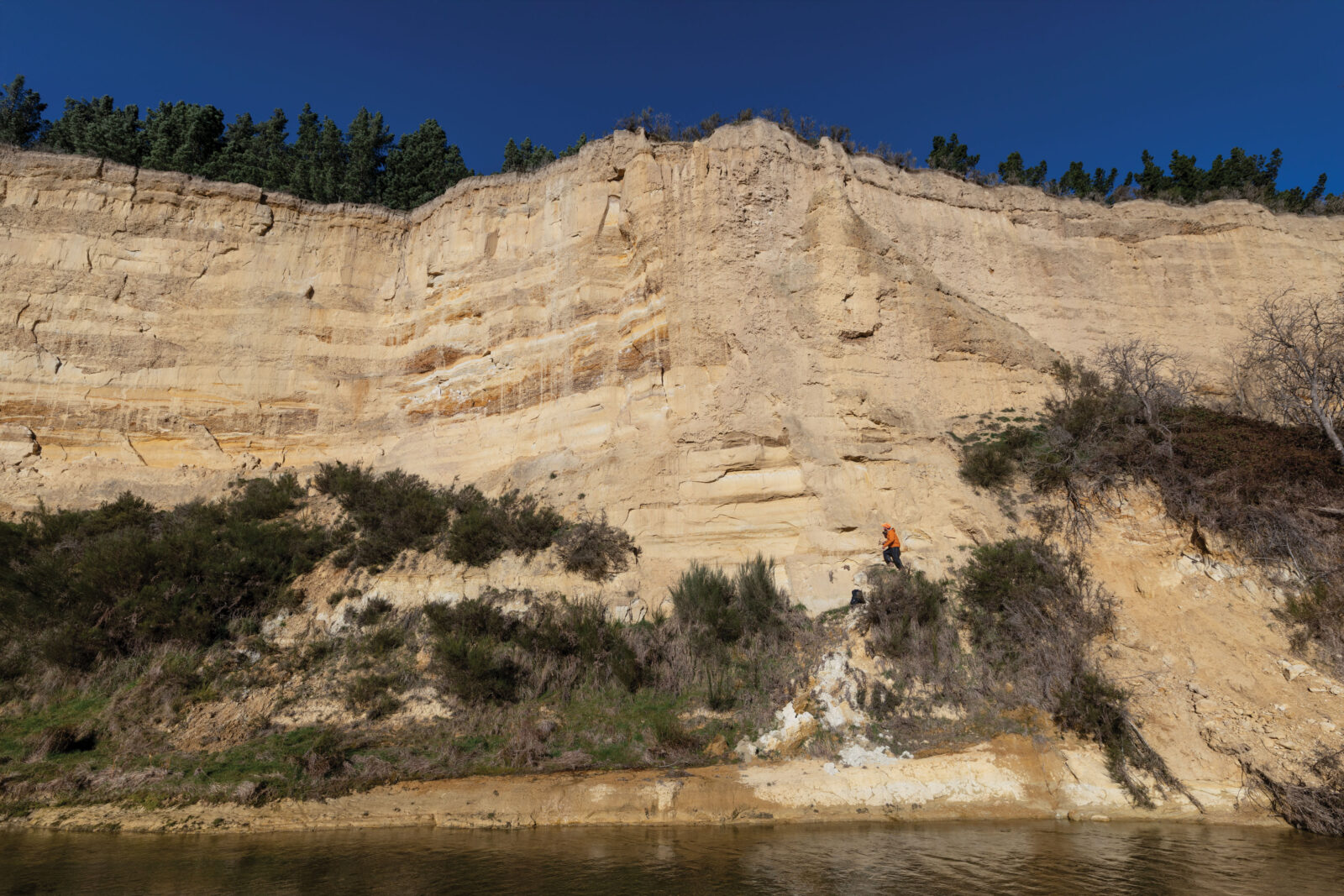
“It was just an incredible moment to witness them in situ and be the first person to have a close-up look at them,” he says. “And then scientist mode kicked in.” Between breaths, he swam down to take photographs and measurements—the distances between the five prints, the angles of the toes.
Fleury knew the next big flood could destroy the fossils. But to get them out, he first had to shift the river. He spent a few months making plans with mana whenua and other palaeontologists, and applying for an expedited resource consent.
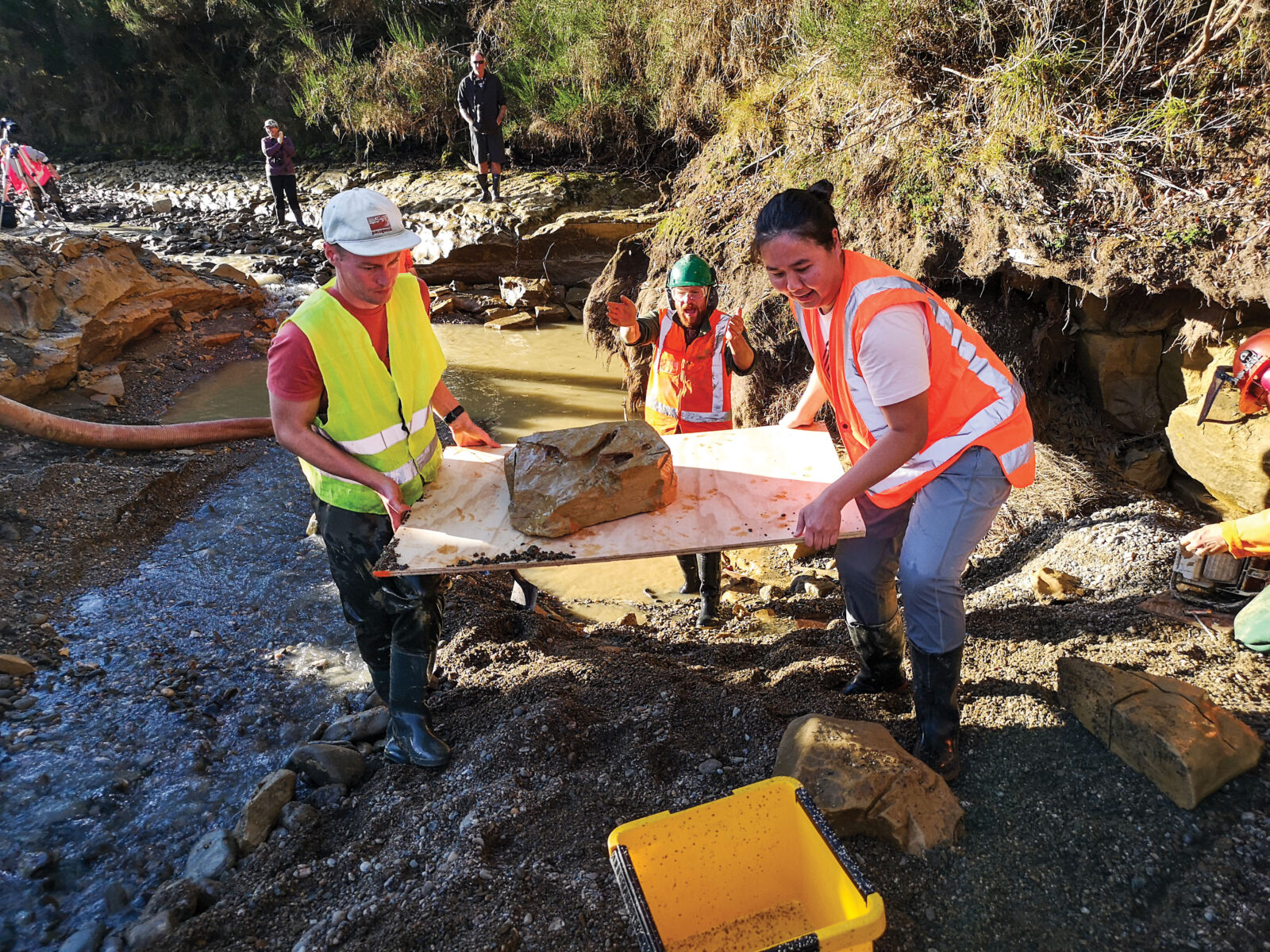
In May, the operation began. Rescuers used heavy machinery to dig a new channel for the braided river through its wide gravel bed, and a hard-working pump sucked water from the swimming hole to expose the prints—seven in all, since two more were discovered under the bank as they worked. “At no point during the excavation was it a certainty that we were going to get those footprints out of the river,” Fleury says.
For three days they worked, at last hammering in wedges to release each footprint from the layer beneath, then lifting the heavy blocks unharmed from the riverbed, the rock so soft Fleury’s own fingerprints remain preserved underneath.
“They’re one of those few objects that you come across in a lifetime as a curator that truly capture the public’s imagination,” he says. “Everybody was captivated by them… But it took us about four or five years to unpick all of those basic questions that everybody has. What was it? How big was it? How old are they?”
The footprints were larger than the Kaipara ones, about 30 centimetres across, and were made by a moa about a metre high at the hip, weighing around 85 kilograms. The prints were similar in size and form—though not identical—to the foot bones of shaggy, chunky Pachyornis elephantopus, the heavy-footed moa.
Analysing the high-resolution photographs taken before the prints were excavated, Fleury and his team discovered an eighth footprint, made by a different moa walking in another direction. “It’s absolutely massive,” says Fleury—corresponding to a 150-kilogram bird, perhaps a female giant moa. Dating the prints was a years-long process involving an Australian particle accelerator, and eventually revealed they were made around 3.6 million years ago— making them the oldest identifiable moa fossils in existence, Fleury says.
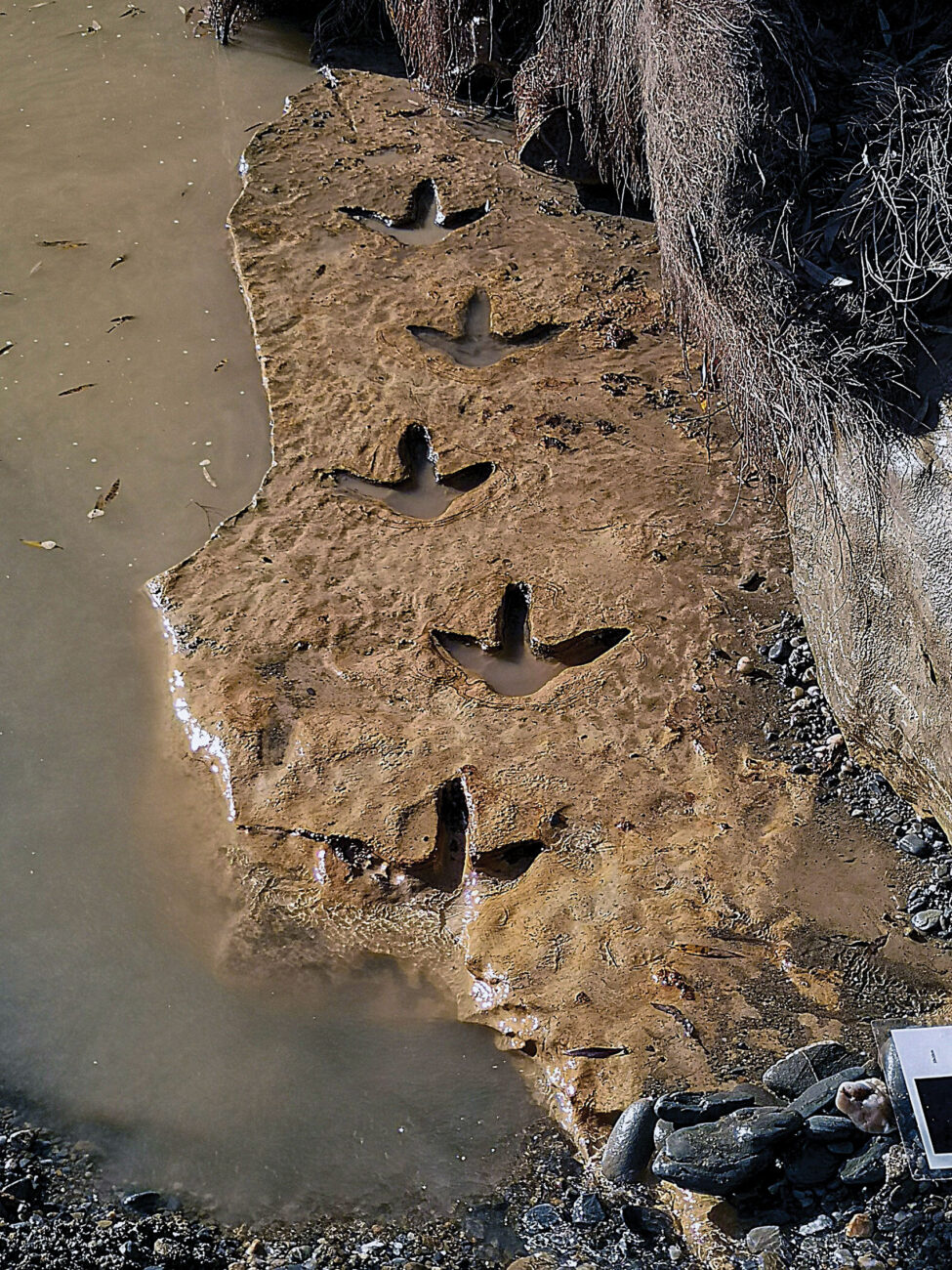
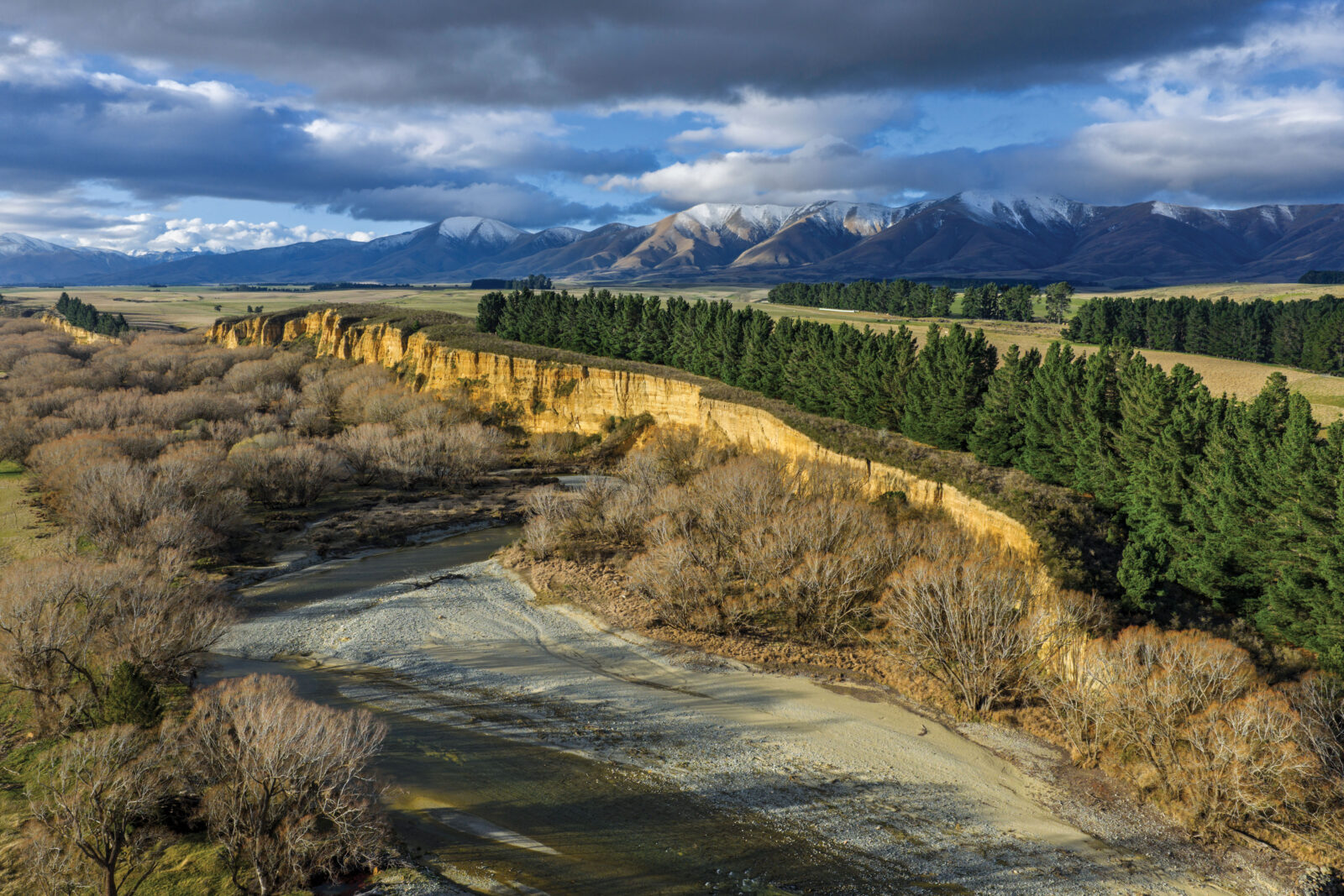
The successful salvage operation was the final stroke of luck in an almost-impossible sequence of events. One day, long ago, two moa walked over a glacial braided river plain, leaving footprints in the fine, silty dust. The prints baked in the sun, and silt, carried by wind or water, gently covered them. For 3.6 million years, as volcanoes erupted and faultlines shuddered, the prints stayed intact and together.
The flooding that brought the fossils to the surface—probably in late 2018—was powerful enough to reveal them, but subsided quickly, leaving them undamaged. In the blink of time before the next flood, the prints were found, and reported to people who had the funds, interest and expertise to extract them.
“It’s an absolute fluke,” says Fleury. “The chances of all of these things happening diminish rapidly at every level.” Each print we find is just such a miracle—an ephemeral mark somehow falling through the innumerable sieves of time.
*
In the years after the Kaipara discovery, Thomas returned three times to Papaki Mai to 3D-scan the prints. By late 2024, it was clear the fossils were slowly but steadily degrading. Without intervention, the taonga would crumble into sand.
Auckland Museum called Alison Douglas and Joanne Wilkinson, fossil preservation experts from the Queensland Museum. The pair were sent a chunk of Kaipara sandstone to experiment on in advance. “Every time you try to preserve something, it’s a completely new situation,” says Wilkinson. “So you have to poke and prod and test things out.”
Ngāti Whātua o Kaipara put the women up in a 70s-era bach on the farm—Wilkinson loved the retro wallpaper—and the preparators spent a month working day and night to turn crumbly moa-print sandcastles into solid blocks. They were also tasked with creating replicas that school kids could get their hands on.
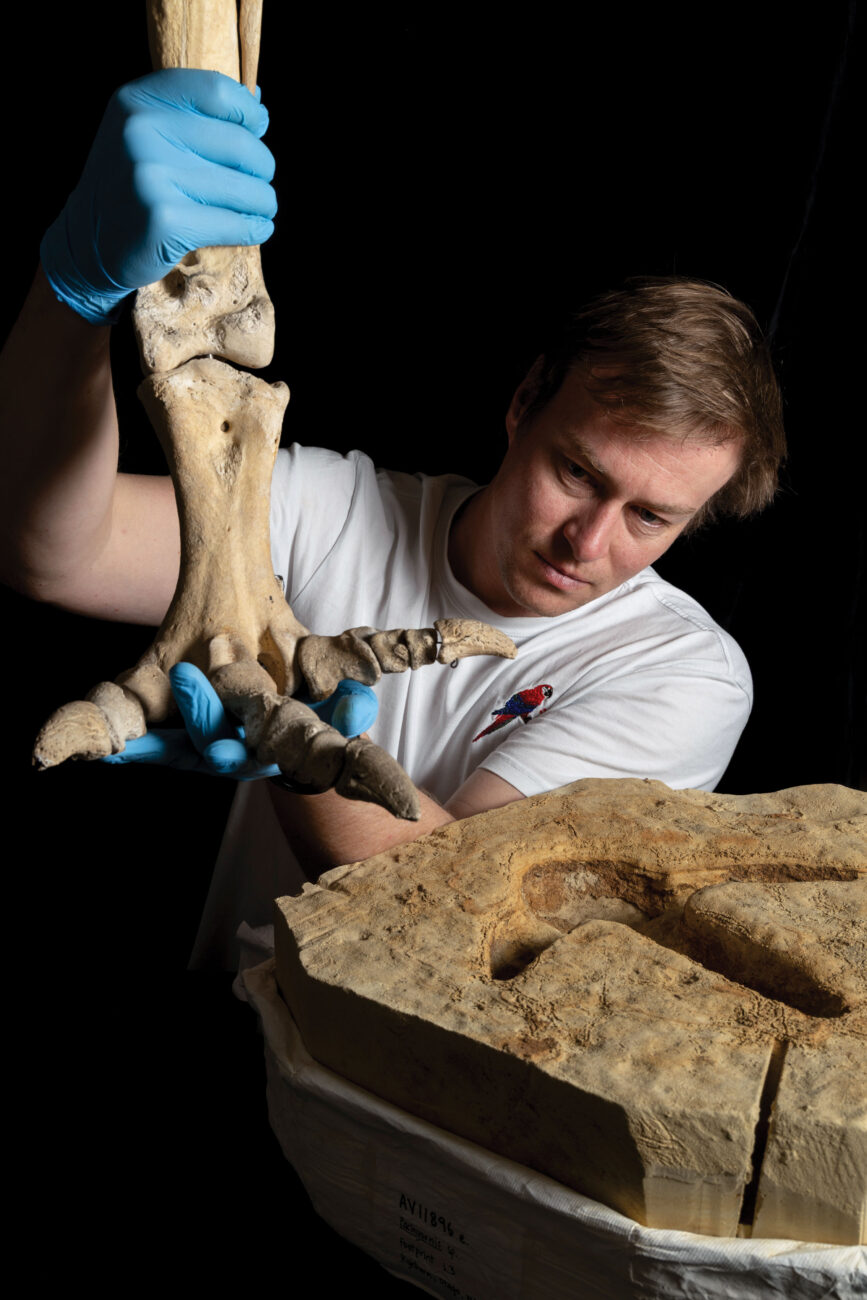
First, the pair spent two days dripping a mixture of acrylic resin and acetone onto every millimetre of the slabs’ surfaces. Drip, drip, drip. Three coats. “It was a very smelly job,” says Wilkinson. “In essence, we’re filling all the little gaps between the sand grains with glue.” Unavoidably, the process darkened the fossils, making them look permanently wet.
Once the resin set, Douglas, an expert in making replicas, built elaborate frames around the slabs using foam and glue guns and plasticine, then sprayed them with a release agent—like greasing a cake tin. Douglas could then pour over liquid silicone, make a mould, and cast replicas of each slab, making sure the colour was a perfect match for the pale gold of the fresh fossil. Finally, the preparators used plaster, fibreglass and polymers to make support cradles for the original fossils—the “coffins” keeping them safe today. Any time they needed something heavy lifted, the boys from the iwi office were glad to help out.
Wilkinson was moved by the welcoming pōwhiri, how museum staff and mana whenua worked together, the whale bone outside the door. “The spiritual element surrounding what we were working on made it just so beautiful and special and rewarding… it was absolutely one of the highlights of my career.”
Today, Ratima has one more rock to show us, inside a wooden crate in the shed next door. To open the lid, he has to shift buckets, hoses, weed eaters and spraying gear. Inside is a second set of moa prints, in a much larger block. In the winter of 2024, geologist Bruce Hayward and a colleague found these prints on a beach a few kilometres south of Mānunutahi Bay. There were 13 footprints in all, spread over several massive rocks, much less manoeuvrable than the previous find. Retrieving even the smallest was a logistical nightmare. Ratima called in lots of favours—“it was those cuzzie-bro sort of talks”—and eventually found a skilled tractor operator willing to risk a machine in the sand.
But the prints had been sitting out in the elements for weeks or months. Their sharp edges had already eroded and blurred, and they did not get the preparation treatment. Now, a year on, only faint outlines remain.
Malcolm Paterson wonders how many other prints have briefly surfaced in his rohe, only to be annihilated, unseen—and how many may yet be uncovered. “I don’t think it’s the end of the story up there, for sure.”
*
The fact that all the Kaipara footprints remain in the care of Ngāti Whātua o Kaipara, rather than in a museum collection, is unconventional. But there are both practical and historical reasons for it, says Paterson. “I don’t necessarily think that we have a greater claim on these fossils than anyone in particular. We didn’t make them. They’re maybe a million years old. Whatever those birds were, they’re the ancestors of the ones that our ancestors knew.”
Certain names of places and people in South Kaipara record ancient stories of moa, he says: a swamp where the birds were trapped and killed, the discovery of a nest filled with eggs. Those tīpuna would have interacted not just with moa, but with their footprints, too—perhaps hunters even followed them to find their quarry.
Pragmatically, the prints are safest kept close to home. Every kilometre travelled by road adds to the risk of damage.
There’s a sense, too, that the iwi’s possession of the fossils might help make amends for the many cultural taonga that rest unseen in the stacks under Aotearoa’s museums, rather than with the descendants of people who made them.
Paterson stresses that his people now have a strong relationship with Auckland Museum. “But our experience over the decades has been that once something’s in there, we are always at risk of losing relationship with it, losing access to it. Here, the footprints are safe in a controlled environment, and they’re pretty available, too.” Scientists can arrange to see the fossils, and the neighbouring primary schools and Kaipara College bring classes every year. “So the local school kids get to see their local heritage.”
More by Kate Evans
More by Richard Robinson
Paterson is an extremely busy man, racing from meeting to meeting, but he makes time to think about extinction. New Zealand’s rarest bird, the tara iti or fairy tern, which numbers in the dozens, resides in his rohe. We both get emotional talking about the loss of the huia. So I have to ask him about the elephant (bird) in the room. What does he make of the plan by US company Colossal to “de-extinct” the moa?
It’s complicated. “It’s really evocative, isn’t it? Might there be a chance of atonement from us humans that made some of these creatures go extinct?” On the other hand, he’s not convinced the gene-edited animal produced would really be a moa—just a bird that looks like one. “That sounds more like a sort of circus trick, really.” It’s a subject his people now need to discuss and come to a position on, he says. “These things seemed pie in the sky even a few years ago. You could kick the can down the road. Not any more.”
*
Mānunutahi looks east across the shallow Kaipara Harbour towards Tapora and Wellsford. It is a wide beach of black sand, cupped by two pine-topped headlands. There is a fresh orange scar on the southern cliff, and a jumble of ochre boulders at the base. It’s here that Peters and Brown found the moa footprints in 2022.
As the day ebbs, Thomas and I walk the beach with photographer Richard Robinson, leaving our own interweaving trails of gumboot prints. When we reach the rubble, Thomas picks up a chunk of Trump-coloured rock and crumbles it between thumb and fingers. It has the consistency of feta cheese, somewhere between sand and stone.
One day, an unfathomably long time ago, a small moa ambled along the sand very close to here.
In the dusky hush, it becomes easier to imagine this bird, with its chubby little feet and slow stroll. It would not have been alone. As we walk, Thomas conjures the coastal forest rowdy with bush birds, shorebirds prodding the tideline, perhaps other species of moa threading out from among the trees.
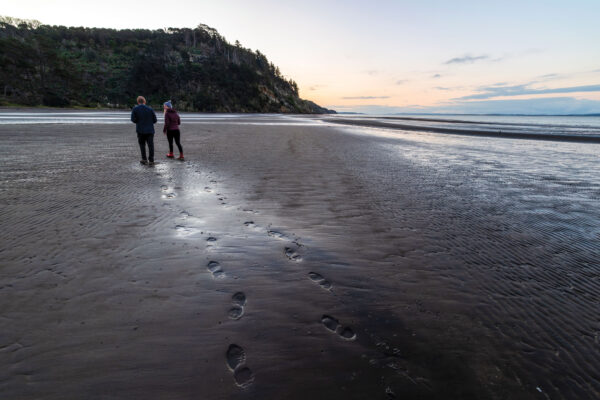
Even now, the beach teems with impressions of animal life. Gull footprints, left by red-bills, I think, the points of their claws poking into the sand, raising tiny mounds. The squiggly signatures of worms, and holes I presume belong to crabs, with perfect round pellets neatly arranged around them.
None of these small scribbles and stamps will become fossils. In a few hours, the tide will rise, rub out these marks—and mine—and in all likelihood there’ll be no lasting record of any of us. As the light fades, we turn and walk back up the track to the road.