






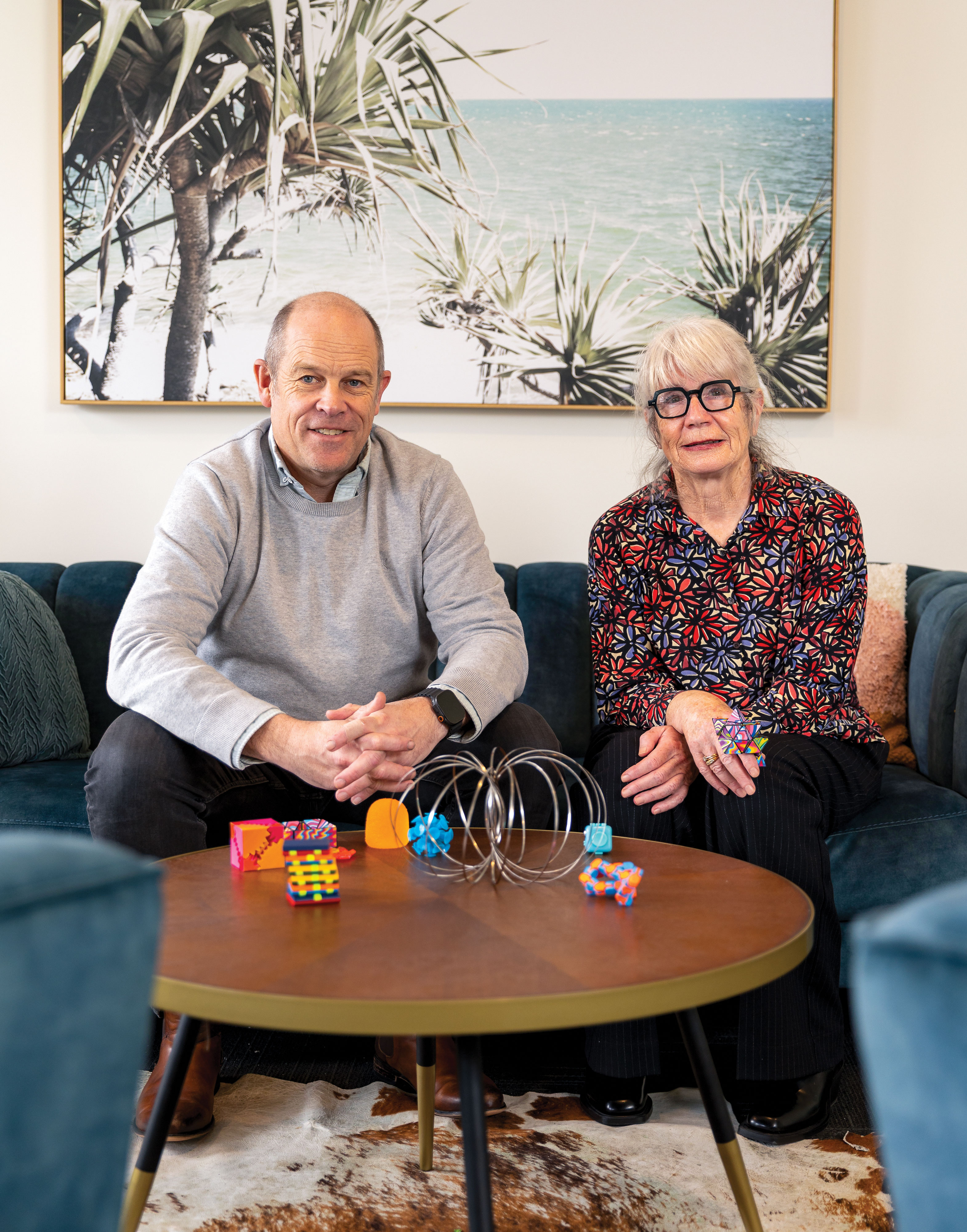
Together, Cameron Lacey and Marie Crowe are delivering a New Zealand-first therapy: psilocybin, the hallucinogen found in magic mushrooms.
The trip unfolds on a green velvet couch, or maybe a beanbag, in a cosy, light-filled room in Christchurch. The patient swallows a capsule, 25 milligrams of psilocybin. Half an hour, maybe 45 minutes later, the colours in the room intensify, edges soften.
“Usually, we’re just chatting at the start, and then they go, ‘I just think I’ll put on my eye mask.’ They get into their groove,” says Marie Crowe, mental health nurse and psychotherapist.
She’s in the room, and so is Cameron Lacey, who in June this year became the first—and, so far, only—psychiatrist in New Zealand permitted to prescribe psilocybin.
The pair are there to observe, to reassure, to hold a hand—or if the patient begins to get anxious, to lead breathing exercises. Everyone reacts differently, Lacey says, but most sit quietly, immersed. Psilocybin-altered perception spans the senses—geometric patterns in your vision, shifting sounds, and touch. Some people feel like they’re being held.
At about hour four, the trip begins to loosen and the patient inches back to reality, and to themselves. They might speak about their experience, with Lacey and Crowe making notes for future therapy sessions.
The entire trip takes seven to eight hours. For Crowe and Lacey it’s an intense day at the office. “Just sitting there, having a chat—you couldn’t imagine why that would be tiring. But you’re actually trying to keep really tuned with the person,” says Crowe.
Both Lacey and Crowe were drawn to the mental health field by its kaleidoscopic nature. “Other areas of nursing are black and white; in mental health everything is grey,” says Crowe. As a young doctor on rotation through different fields, Lacey found his curiosity sparked, an impulse to read and learn even outside of work. “When you’re dealing with people and their stories and their distress, everybody’s different, versus arguably people who’ve had a hip operation are very much the same,” he explains.
And both are driven to learn how to do things better. “We don’t get it right for everybody, unfortunately, in mental health,” Lacey says. Every year, 600,000 New Zealanders experience depression or anxiety, and many don’t find a treatment that works. When combined with psychotherapy, evidence suggests, psilocybin works for about two-thirds of these people.
Intrigued, Crowe and Lacey embarked on a small clinical trial to see whether psilocybin could work in the New Zealand context. They learnt from overseas colleagues—especially those in Australia, where psilocybin was approved for mental health treatment in 2023. They jumped through considerable regulatory hoops, and found patients open to giving it a go.
“People describe it as one of the most significant experiences of their life,” says Lacey. “It shouldn’t be underestimated.”
When news broke that the treatment had been greenlit, Lacey and Crowe were overwhelmed with feedback—from practitioners keen to prescribe, and from people desperate to feel better.
At the moment, psilocybin treatment is available only to those who can afford the hefty price tag: $25,000 to $33,000, about the same as a knee replacement. This inequity of access is “the biggest concern”, says Crowe. Lacey is busy advocating for funded pathways, to ensure it doesn’t become a treatment “reserved for the wealthy”.
Before prescribing, Lacey runs through rigorous criteria: what other interventions has this person tried? What’s their family history, their physical health? Those who fit the bill then meet with Crowe. “I have to see whether I think that I can work with them,” she says. “Because they have to be able to really trust me. And you have to be able to get rapport with the person really quickly.” If they click, Crowe takes them through three sessions of interpersonal therapy, focused on setting an intention for the psilocybin dosing. What keeps their depression simmering along? What do they hope to get out of the experience? Who do they want to be?
Often, the patient will come up with a mantra. I am a worthwhile person, for example. Crowe writes it on a piece of paper and sticks it on the wall as a reminder.
You can’t direct a psilocybin experience, but you can shape it, says Crowe. Through mindset—the intention—and through physical setting. That’s the homely room at their clinical practice, with a green garden outlook. There’s also a “third therapist in the room”, says Lacey: music. Patients are encouraged to don a set of noise-cancelling headphones, and sink into the moment with a playlist that maps to the seven phases of tripping; it’s all ambient, atmospheric songs with nature sounds—no lyrics. “It has to be something that people haven’t heard before, because you don’t want their brain to start anticipating what’s happening with the music,” says Crowe. “Psilocybin pushes you out of the cognitive. You just experience, rather than thinking.”
It’s suspected that psilocybin works by stimulating serotonin (mood regulator) receptors in the brain. It collapses and rewires existing thought patterns. People emerge with a different perception of themselves, and feel more connected to others and to the world. Crowe helps patients make sense of the experience through further talk therapy sessions.
But it doesn’t work for everyone. “We’re cautious not to pin all hope on this,” says Lacey. “There are always other options.”
Sometimes, people find it hard to see that hope, in psilocybin or anything else. Six hundred and seventeen New Zealanders died by suspected suicide in the year to June 2024.
You’re taught how to manage your own welfare and emotions as a psychiatrist, Lacey says. Compartmentalising gets easier the more you do it. To stay grounded amid the heaviness, he spends time with his family, and connecting to nature. Walking in the hills with his two dogs. Crowe also has two dogs who help her decompress: border terriers, Queenie and Duncan. She’s developed a little ritual for her drive home from work. “As soon as I cross over the causeway, I’m home. I’m leaving work behind.”
More by Ellen Rykers