








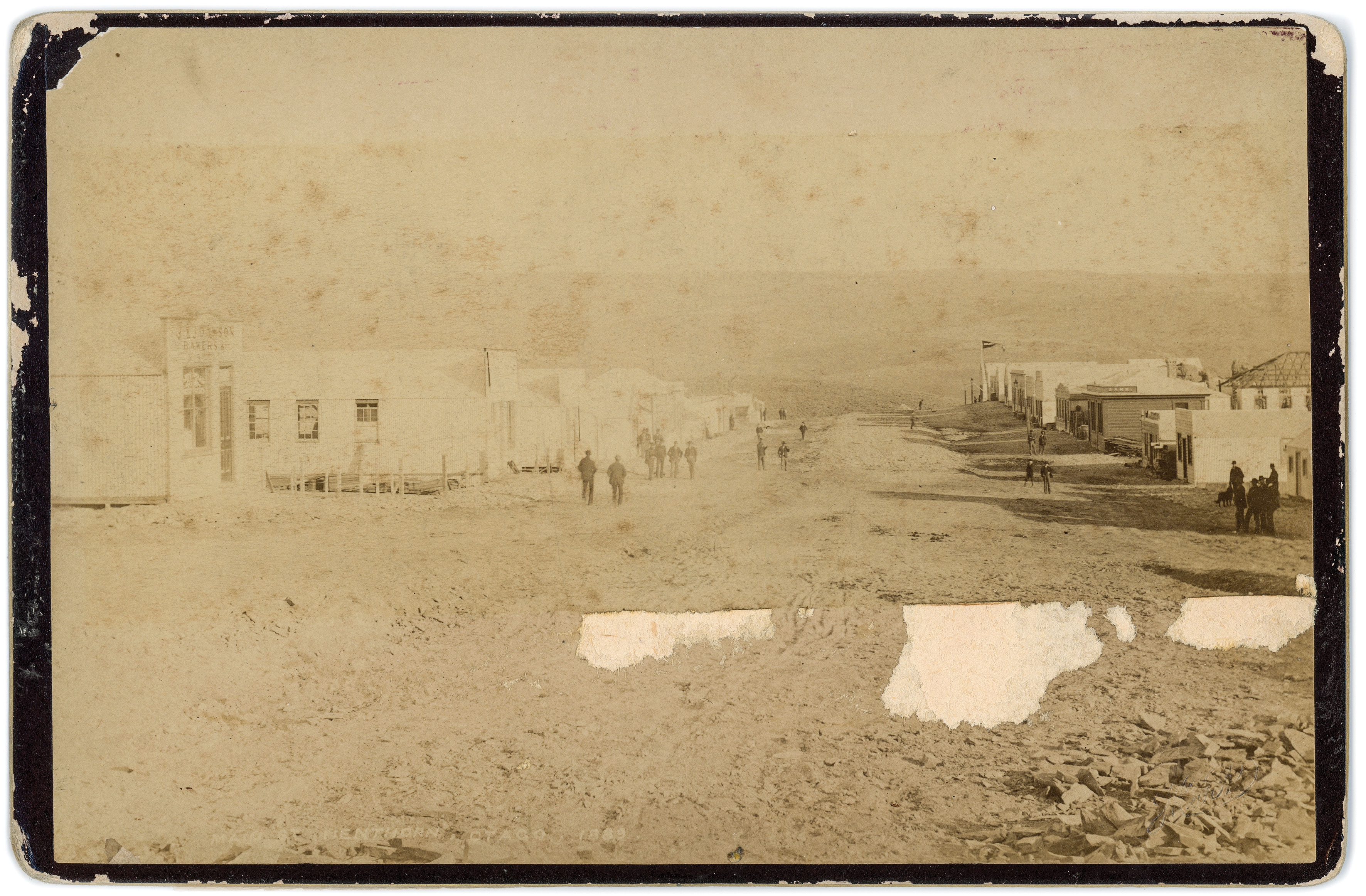
This is thought to be the only photograph that exists of Nenthorn, a bustling town built on a brittle, glinting hope.
By the late 1880s, Otago’s gold rush had faltered as the nation fell into the grip of an economic depression. Hope, along with gold, was in short supply. So when William Macmillan, out rabbiting in the hills of Nenthorn, east of Middlemarch, stumbled on a quartz reef and lodged a claim on it, every gold-fevered, shaky-handed, wealth-aspirant in a 300-mile radius flocked to the scent.
But tapping the riches underground would itself be expensive. Quartz reef mining requires a stamp battery, which in the 19th century meant a water-powered machine that crushed rock to powder with heavy hammers.
Amid the scramble for water rights and claims, more than 30 companies were quickly formed, and promoters in Naseby and Dunedin trumpeted the riches soon to emerge from the “walls of gold” beneath the tussock. Ignoring calmer voices, who questioned the legitimacy of the whole venture, speculators rushed to buy shares.
Nenthorn was soon pegged out in a web of claims, their titles glittering with promise—Golden Causeway, Eureka, Lucky Find.
Within a month or so, a hotel appeared on the site, and three more quickly followed. They could barely keep up with the demand for food, lodging and grog. First the Colonial Bank, then the Bank of New Zealand, opened branches on the main street. Bakeries, butcheries, general stores, timber merchants, stable liveries and houses sprang up as the population swelled to around 350. The town had its own newspaper, the Nenthorn Recorder.
The first exploratory shafts returned astonishing results—at least according to the sharebrokers’ lurid prospectuses. Sceptics, however, pointed out the samples were likely taken from small quantities of gold-rich stone, cherry-picked to boost interest. Many claims remained pegged out but not worked, raising suspicions the companies who held them were mostly interested in mining shareholders’ bank accounts.
Yet by the end of that first year, stamp batteries had been erected and shafts dug to start lifting stone. The following year, 1890, a school was built. The community put down roots. People gathered to watch horse races at the newly constructed track, or to be entertained by travelling theatre groups and minstrel shows. Nenthorn even had its own dramatic society.
But as historian Terry Hearn points out in his book Nenthorn: Gold and the Gullible, the rush—and the town itself—had only been manifested, in a sense, because people so badly wanted it to be real.
It could not last. Nenthorn’s remoteness and a chronic water shortage, which forced miners to use coal-driven steam engines to drive the batteries, added to costs enormously. The quartz seams petered out quickly, and in any case weren’t rich enough in gold to make it pay.
By the end of 1890, less than two years after it all began, companies started going into liquidation and unemployment swept the town. The banks closed, and the hotels. By then, writes Hearn, “the resident magistrates court was probably the busiest place in Nenthorn as miners sued companies, companies sued shareholders, and businessmen sued both in turn and then each other”.
In its final editorial, the Nenthorn Recorder declared the field had been “the happy hunting ground of a horde of unscrupulous schemers, peggers-out, traders in shares, fabricators of deceitful prospectuses and company mongers”.
Nenthorn’s population slowly dwindled over the next decade. The school closed in 1901, and mining activity at the site ceased soon after. Nenthorn was abandoned to the elements.
Today, travellers on the back roads of Otago might stumble on the stone remains of one of the old hotels—a lonely, broken ship in a sea of golden tussock. It’s all that’s left of Nenthorn, the town that, in a moment of avarice and credulity, Otago imagined into being.
More by Bill Morris