Gannets can spot fish from both above and beneath the water by changing the structure of their eyes, in milliseconds. (more…)
More by Skye Wishart



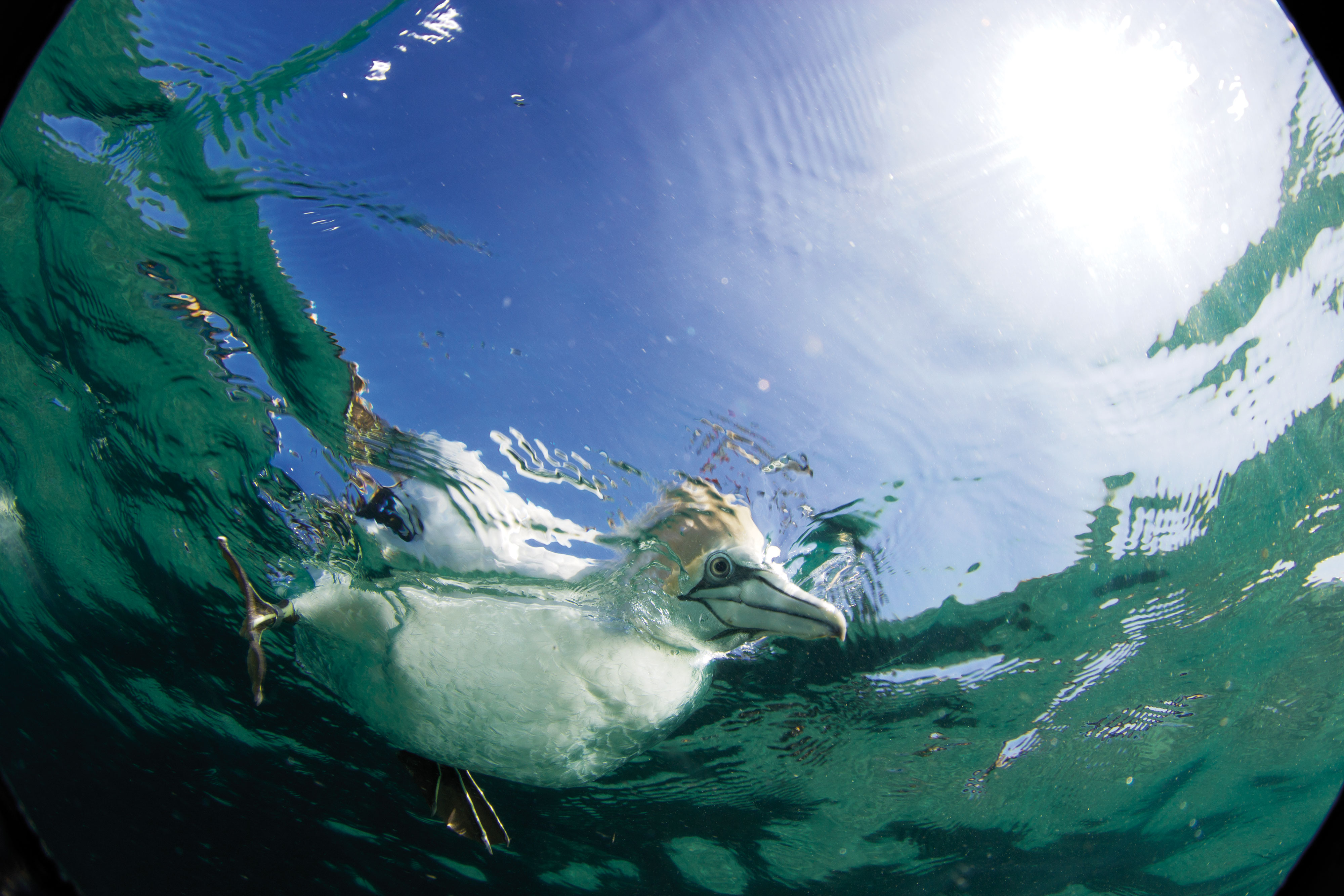
Scientists from Massey University have found that the lenses of the Australasian gannets at Cape Kidnappers change from oval to spherical almost the instant they hit the water.
The eyes of birds, humans and other animals adapted for life above the surface result in blurry vision under water because of the difference in the refractive index of water and air. But eyesight in both mediums is critical to the gannet, whose hunting success depends on it—they’ve been observed catching up to seven fish on a dive. So it’s up to the lens to focus when the cornea, the eye’s other focusing tool, can’t.
With the lens made more spherical when under water, the light bends more, and a sharp image can be focused on the retina.
The spherical lens is common in marine animals such as seals and penguins, but it’s the speed at which the gannet can adapt that’s impressive. Spotting prey from the air, they rotate their bodies and within a second plunge into the water, where their vision transforms immediately from aerial to aquatic.
“The animals are able to make this switch between air and water in 80–120 milliseconds,’ says lead scientist Gabriel Machovsky Capuska. “They are able to see in environments that are physically and chemically completely different.’
More by Skye Wishart
Subscribe to our free newsletter for news and prizes
3
$1 trial for two weeks, thereafter $8.50 every two months, cancel any time
Signed in as . Sign out