




Researchers have long suspected that pigs and other pests were eating our exquisitely rare native frogs. Now, we know for sure—and the scoffing is on an incredible scale.
Have you heard the tale of the frog in the pig? Here’s how it goes. One afternoon in 2010, a hunter was out in Coromandel’s Wharekirauponga Valley when he and his dogs cornered a feral pig in the bottom of a small stream. When he gutted it, he saw the pig’s intestines twitching, and when he slit them open, a tiny frog jumped out. Based on the hunter’s description, it was likely a native species, either an Archey’s or Hochstetter’s frog. That frog had a lucky escape and became the Little Red Riding Hood of the New Zealand bush—an innocent, cut from a big bad belly in the nick of time.
The anecdote appears in a paper published in March in the New Zealand Journal of Ecology. The extraordinary study finally confirms what hunters and conservationists have been saying for some time: feral pigs, along with stoats, weasels, rats, and cats, are eating our native frogs. Researchers counted tiny hands and feet in the digestive tracts of predators to reach their conclusions, but in many cases all visible trace of frog was gone. Only DNA remained.
“There are some really awful, awful things happening out there,” says one of the study authors, Sara Smerdon, a Coromandel conservationist who helped raise the alarm after finding pig excrement all through a torn-up Archey’s frog habitat. “We’ve got a lot of work to do.”
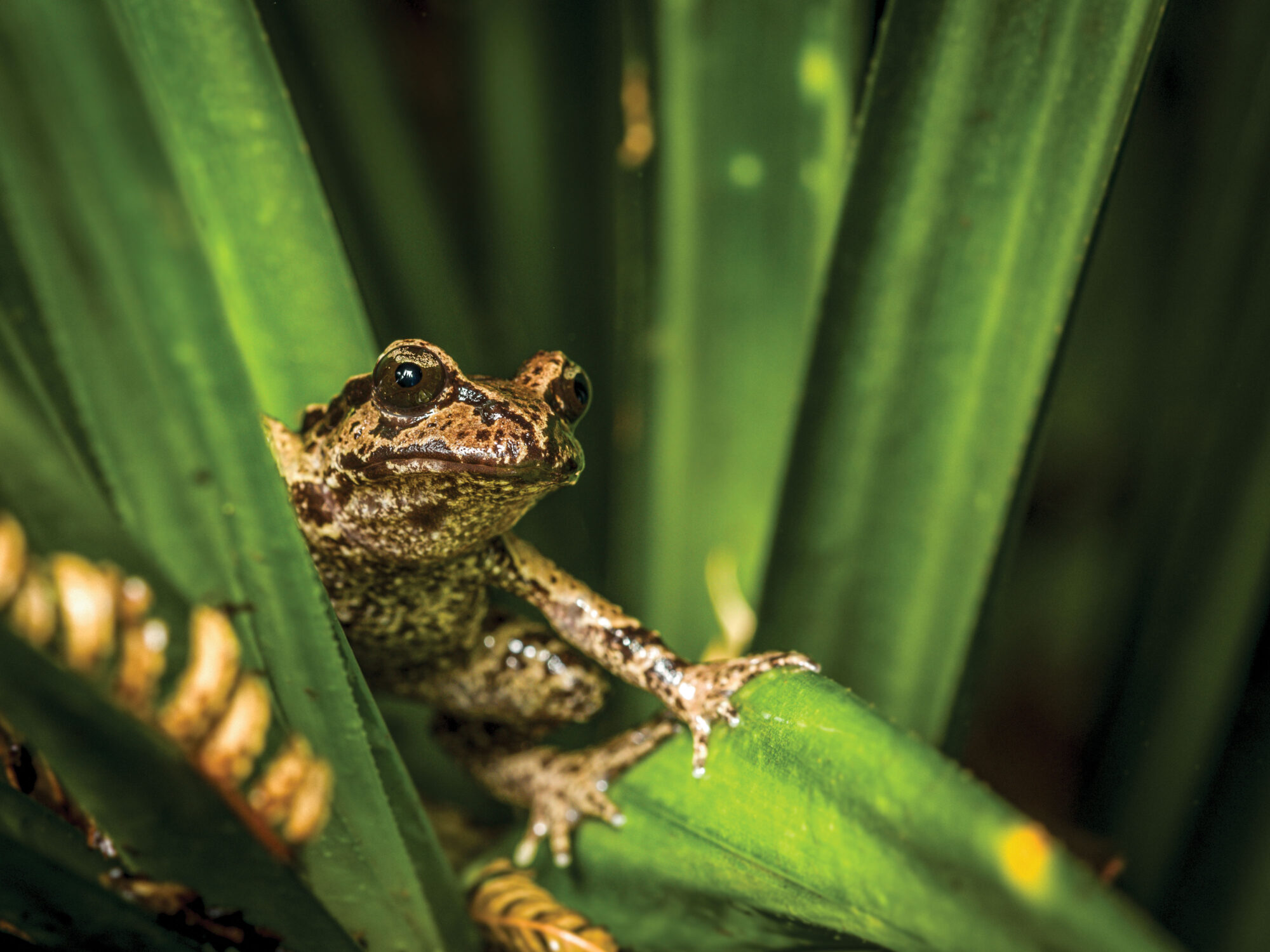
Aotearoa’s three surviving native frogs—the third is the Hamilton’s frog—are about the size of a bottlecap. They are all ancient and strange; they diverged from modern frogs in the Triassic period, and are nearly identical to frogs that lived 150 million years ago, before birds. They retain odd features, such as muscles for tail-wagging.
Our frogs did not evolve defences against any of the ravenous hordes people brought to Aotearoa. They do not croak or leap or spit poison. They have no eardrums. Their defence is in hiding, and an array of toxic glands on the backs of their heads—defences fit for attack from above, for an island of birds. The frogs are no match for the superior snouts of carnivores prowling the modern New Zealand bush.
*
There are few places where our native frogs survive. Mahakirau Forest Sanctuary, in the Coromandel, is a stronghold, home to many frogs, a rogue’s gallery of pests, and Smerdon, an artist turned passionate conservation worker and advocate. The sanctuary is nestled in almost 600 hectares of private sections protected by QEII covenants; it is a forest canopied with northern rātā, miro, kauri, tōtara. As well as the frogs, the forest shelters the extremely rare Northern striped gecko, North Island brown kiwi and kākā, painted cave wētā, and rare forest ringlet butterflies.
[sidebar-1]
Before we arrive, Smerdon warns us to clean our gear to reduce the threat of chytridiomycosis, a highly contagious fungal disease that damages the keratinised tissues of amphibians—particularly the skin, which frogs use to breathe and absorb water. Two decades ago, in the space of five years, the population of Archey’s frogs in the Coromandel crashed—nine of every 10 monitored frogs died. Scientists suspect chytridiomycosis.
How many Archey’s are left? Fraught question, and the answer varies wildly depending whether you’re trying to save the species, or a mining company that wants to dig for gold in frog habitat. Suffice it to say our frogs are in trouble.
The pigs—and ferrets, and stoats, and cats—couldn’t care less.
*
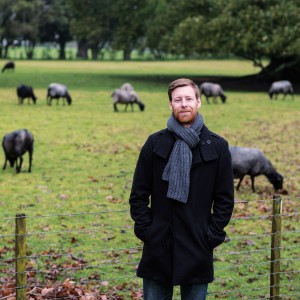
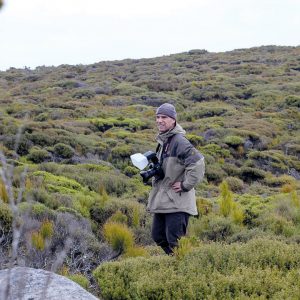
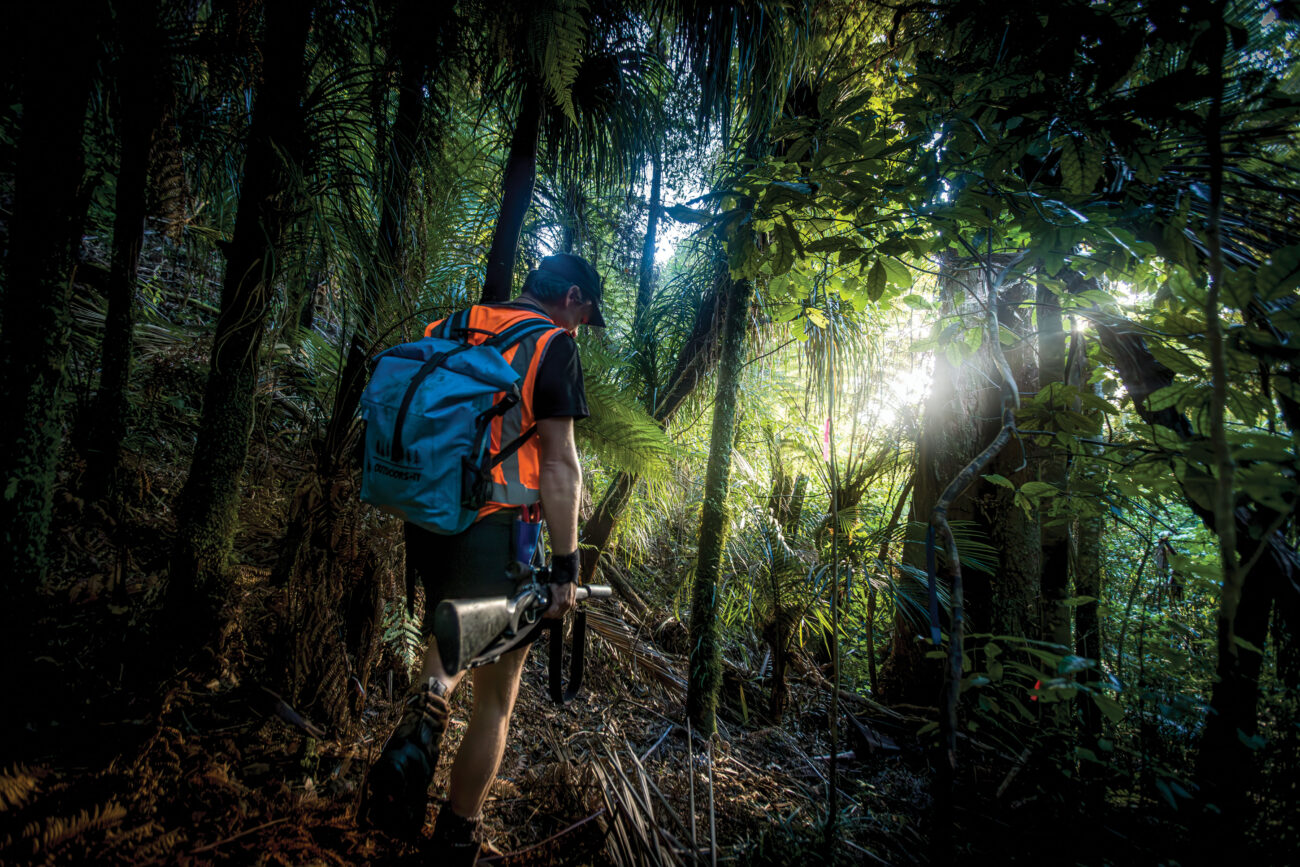
Ruru sweep past the car windscreen as photographer Rob Suisted and I drive in late from Auckland, and in the morning, the air is cut through by swooping kererū. The birds are partly here because the estate is thick with more than 3000 predator traps, and one of those today is human: Mike Kuypers, of Contract Pro, blond, lean and clean-shaven, with the wiry, striated legs of someone who uses them for a living. He’s taken time off a job shooting goats to bring me and Suisted on a pig hunt.
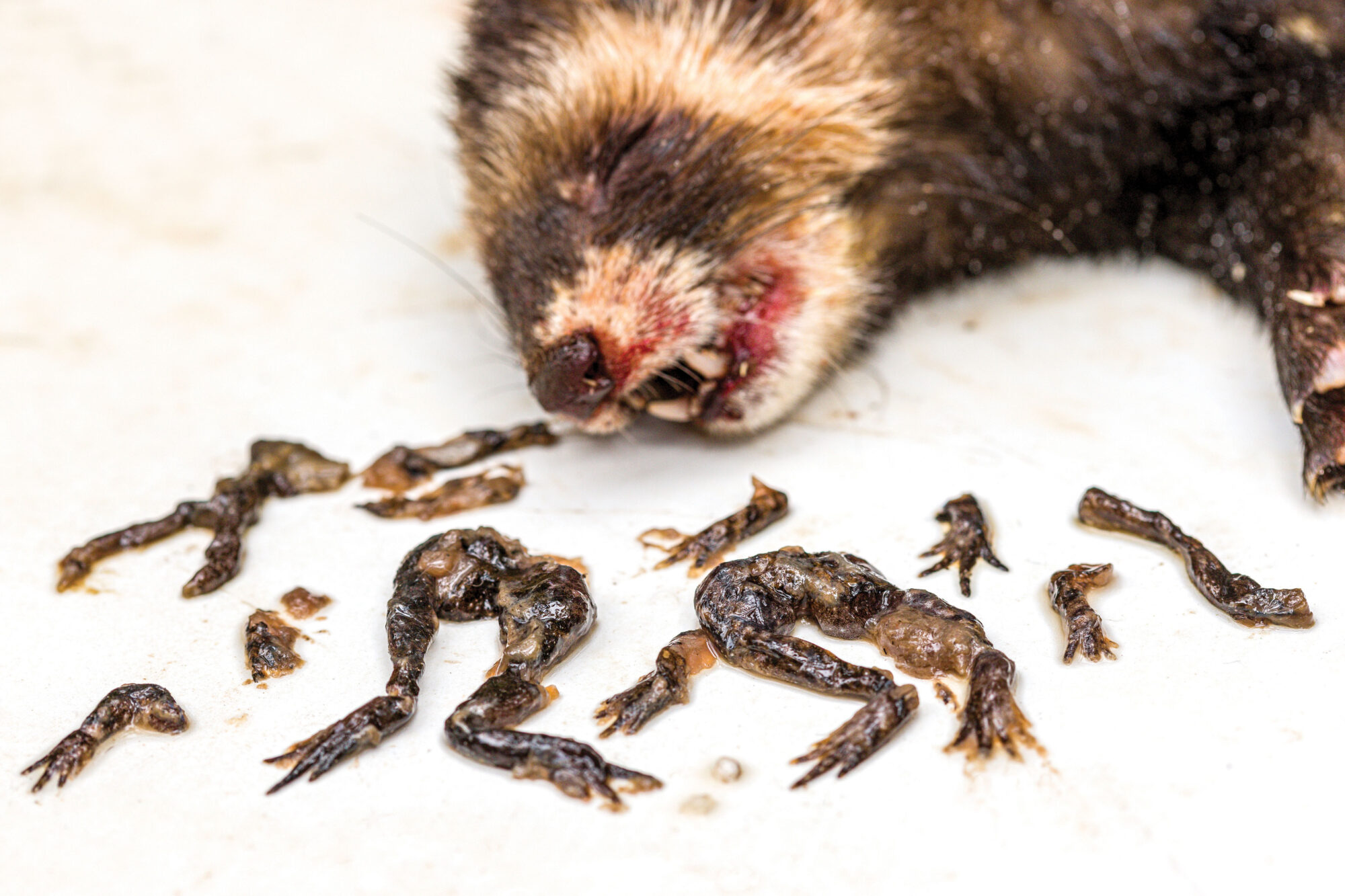
Kuypers is a key part of the origin story of this work. A few years ago, culling pigs in another spot favoured by native frogs, Whareorino Forest in the King Country, he had a look at the stomach contents; knowing what the pigs were eating would help him better target them. Finding bits of frog, he lined up an array of limbs and photographed them. He took down pig after pig, 64 of them, finding frogs in more than a third.
Piecing the gruesome jigsaws together, Kuypers discovered between 10 and 15 frogs in some pigs, averaging out to around six frogs per belly. One sow contained 56 frogs. “I was just a hunter doing his job,” he says. “But 56 frogs was amazing… There was really nothing else in there—just frogs, and lots of parts of frogs as well.”
Introduced frogs were uncommon in the area, and scientists think the 56 all looked like Archey’s, or possibly a mix of Archey’s and Hochstetter’s.
There’s still technically a question mark over whether the pigs are deliberately going for frogs, or somehow snaffling them by mistake, but the sheer numbers suggest it’s no accident.
“I can’t say with certainty,” says Kuypers, “but it seemed that pig was living there just to eat frogs, making them the main content of [its] diet; it seemed to be targeting them so specifically.”
Later, culling goats at Mahakirau, Kuypers showed Smerdon the photos. “I just went, ‘Oh my god, there’s the proof,’” Smerdon says. “‘We need to know if they are having that grave an impact at Mahakirau.’”
She secured funding from Auckland Zoo, the Department of Conservation, and the Waikato Regional Council to cover the work—this time, bringing in molecular sampling at $1000 per pig, as well as searching each stomach and guts by hand. That analysis showed that half of the 12 pigs Kuypers brought down for the study had eaten frog. Two had a particular taste for Hochstetter’s frog: their gut samples contained more DNA sequences from these tiny natives than anything except nīkau palm. Smerdon notes this cull was done during winter, when the frogs were tucked away, semi-dormant and presumably, more difficult to sniff out.
Today, Kuypers suits up in a hi-viz vest and straps on a leather belt with secateurs, then attaches a long knife. Rifle. UHF radio, a personal locator beacon in the bottom of his pack, a metal dog whistle around his neck. He puts a dog’s tracking collar in my backpack in case we get separated.
His highly trained dogs, Chloe and Holly, are wriggling in the back of his ute, their tails beating the back of their cages. Holly pants, ready to go; Chloe is silent and watchful. “Wait,” he warns as he opens their cages, and then they explode off the back of the ute. We follow them into the thick, strangling bush that fills the valleys of the estate.
We trek through the soft humus down to the bottom of a supplejack-tangled valley, the dogs snuffling the ground, the long tracking aerials attached to their collars flicking about like liquorice straps. As I stumble down the steep, uneven valley sides, holding onto trees, I notice how sure-footed Kuypers is on this landscape: hands-free, each step deliberate and solid. The dogs crash ahead.
We approach a patch of clay soil turned over. “Pig root. It’s a few days old, though,” he says, and puts a hand on a nīkau trunk to bend and inspect another patch. Tūī flute in the trees. The dogs return as we enter a small stream; Smerdon has already warned us not to step on any unstable rock, which could be hiding a tiny frog underneath.
“This is a hotspot,” Kuypers says. “It’s damp, cool, soft, and there’s a lot of food for them.”
The dogs lie in the stream to cool their bellies, urgently lapping water. He gives a short command and they’re off up the hill again, on the hunt. We follow. Kuypers seems to absorb the air by osmosis; my breath begins to come heavily. Deep-red miro fruit scatter the ground and a wide, dead nīkau frond sways gently, caught in the branches of a kohekohe. Dozens of hook grass seeds cling to the hair on Kuypers’ legs as he climbs the slope above me.
*
Our three native frogs tend to hop among the top tiers of official threat lists: that’s the existentially bad end, featuring terms like vulnerable, critical, at risk, declining.
Their habitat, too, is limited. Hamilton’s frog is found in the wild only on islands in the Marlborough Sounds. Hochstetter’s has more range, favouring forest streams from Whangārei to East Cape. Archey’s frog lives in the Mahakirau and the Whareorino forests. A satellite population of Archey’s frogs has been set up in the Waikato—these frogs were bred at Auckland Zoo and painstakingly kept free of the chytrid fungus; it’s hoped this population might survive, even if the disease decimates the others.
As for predators? Rats were already on the radar for the Department of Conservation: Archey’s frogs had been found dead, with characteristic rat-bite marks. But because no one had proved that pigs, mustelids or cats had frog on the menu, DOC’s limited resources have, until now, focused on rats.
So the new study, says DOC science adviser Jennifer Germano, is “a pretty big deal”.
The upshot, she thinks, will probably be a combination of predator control and fencing, especially at the most important native-frog habitats. For Smerdon it can’t come soon enough.
Every night, when the predators are out, she worries for the frogs. “It breaks my heart.”
*
Smerdon and Germano both worked on the paper, with DOC liaison Amanda Haigh, led by amphibian specialist Emily Hotham. It is brutal reading. Along with documenting Kuyper’s culls and the DNA analyses, it recounts a series of anecdotal observations of pigs, rats, weka, stoats and ferrets preying on native frogs.
What is called, scientifically, “predator-frog interactions” is for the frogs a horror-show litany of death and dismemberment. A stoat was seen on a walking track in the Hunua Ranges carrying a Hochstetter’s frog in its mouth. Introduced frogs were heard squealing as they died, attacked by cats and weka. A Hamilton’s frog was found with damage to an eye and a chunk taken out of its jaw. In Whareorino, one Archey’s frog was seen with damage to its abdomen, and another with the flesh stripped from its upper hind legs, down to the bones.
“It’s death by a thousand cuts,” says Nicola Toki, the chief executive of Forest & Bird. “Predators, loss of habitat, and climate change are all multiplying their effects on each other and driving extinctions in a way that’s not natural.”
Populations can handle what is known as stochastic events, such as a fire going through and wiping out 90 per cent of a population; so long as they have a good ecosystem that can reproduce at a healthy rate, they can bounce back. “But populations go extinct when there are chronic, continuous impacts that take out a tiny fraction at a time,” Toki says. “Poor old frogs.”
*
Chloe drops to the forest floor and pushes her spine among dry, scratchy fallen mamaku fronds, and Holly follows suit. They are sisters, part Beardie, specialised to hunt only pigs. They’re valuable animals; Kuypers has gotten 10 pigs in one day with these two.
“This was once a nice nīkau,” he says as we walk along a ridge. It’s now a collapsed, dry, brown, stringy stump. “A boar has got in there and ripped it up to get at the starchy root. In some areas nīkau haven’t regenerated for years because this happens as soon as they start up.”
Kuypers glances at his tracker screen. “They’ve got something.” The dogs are on the move. He’s away at a fast clip, crashing down through ponga and supplejack. I hear far-off barking and struggle to keep my footing, tipping down banks of silky soil, rotten ponga trunks collapsing under my hands. Kuypers and Suisted are quickly out of sight, but I follow the crashing and the sound of the dogs, and then a squeal rents the air.
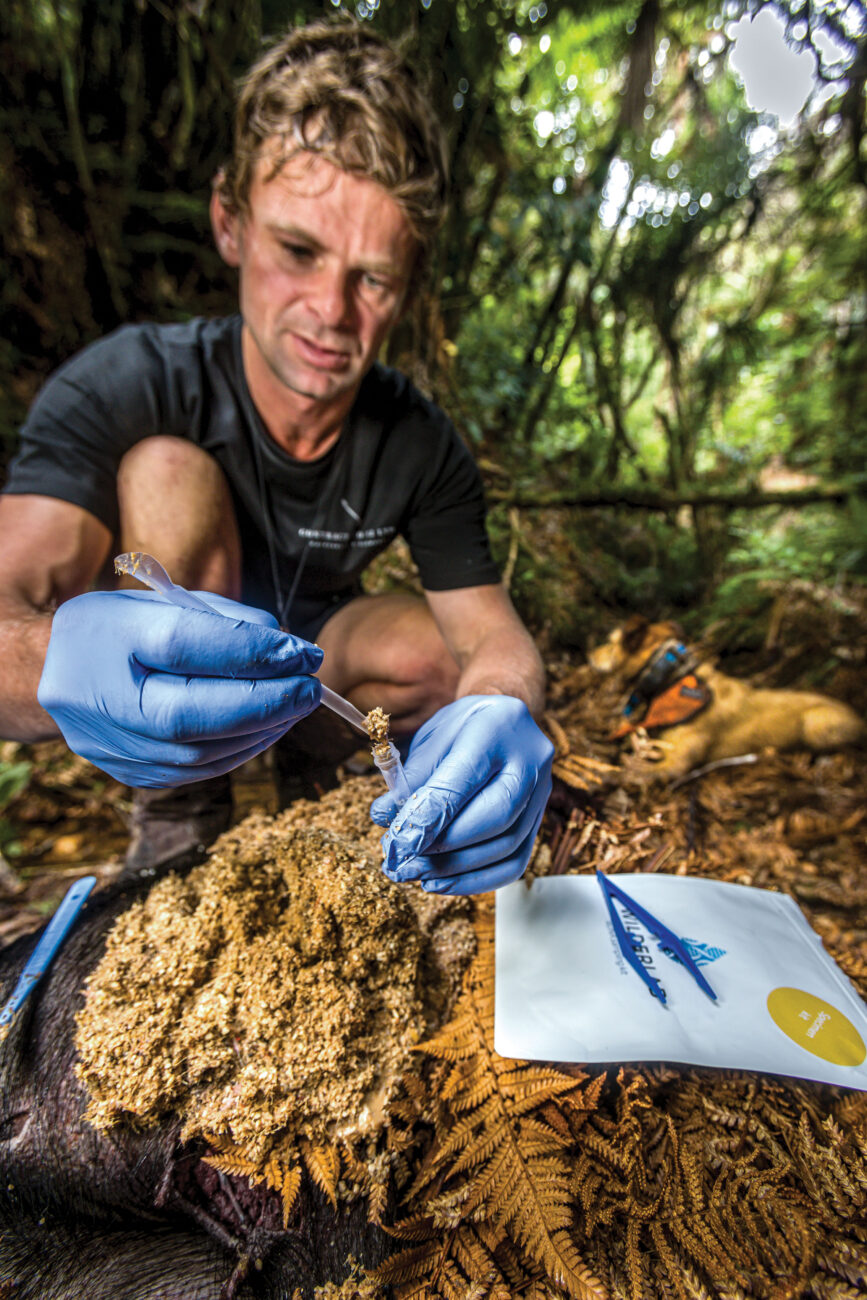
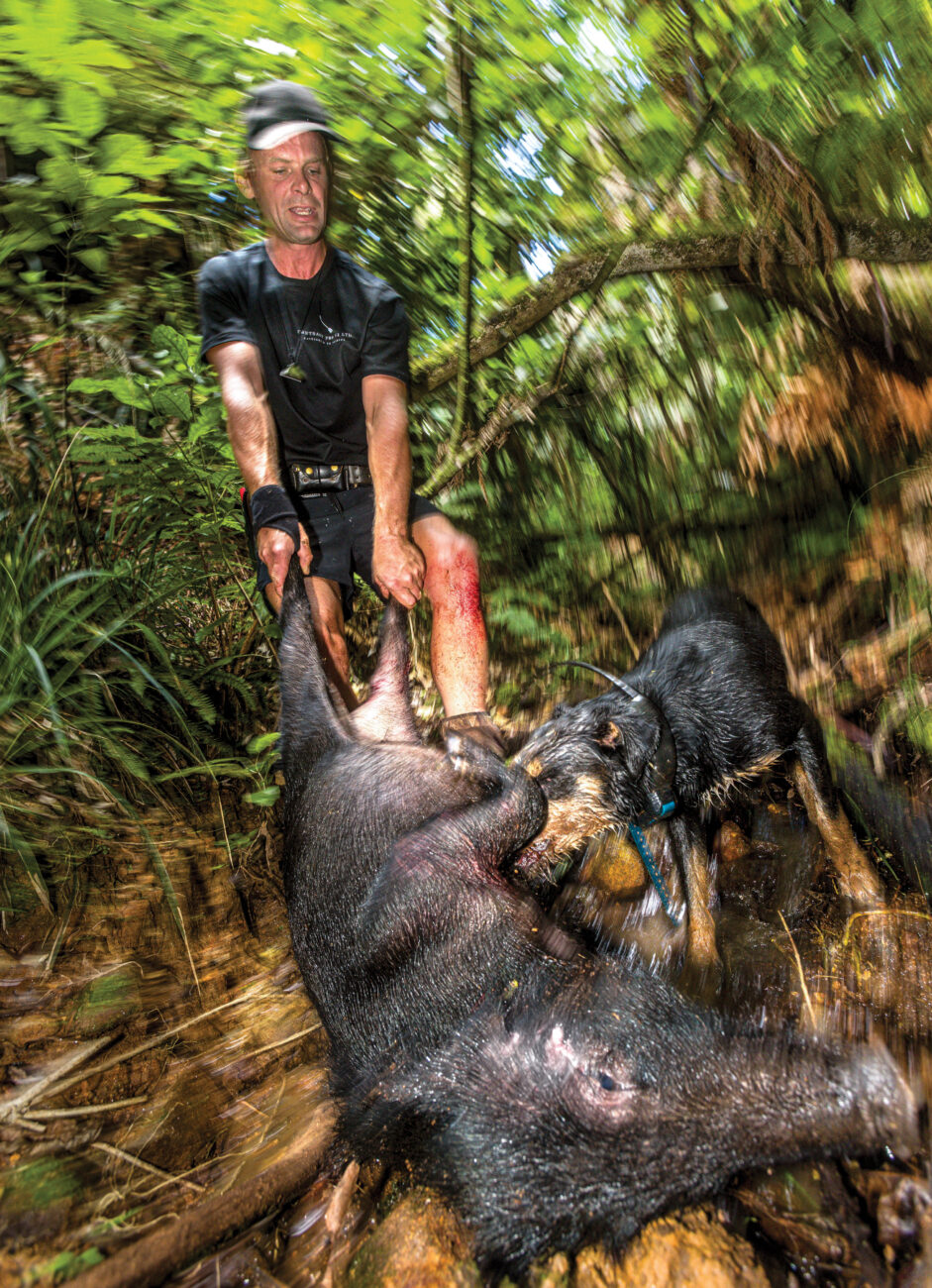
The dogs have the pig, a mature young sow, bailed in a shallow stream. Although Kuypers prefers to shoot, the creek bed is so tight that he kills it with a single stroke from his blade instead. He drags the pig out of the creek, cuts away tangling supplejack, lays it on its back on a carpet of dried fronds, then slices through its belly with his scalpel. The flies turn up instantly as the smell fills the air.
This sow has piglets in its uterus, nearly full-term. He hefts the sow’s taut, iridescent pinky-grey stomach. His job today is to visually inspect its contents, and to take samples of the small intestine, large intestine and stool to see what the pig has been eating. My throat thickens suddenly and I retch at the sweet fruity smell of death and ferment.
Kuypers slits open the stomach, exposing a thick, pale, haggis-like mass. “A possum claw,” he says. “Probably a dead one pulled out of a trap.” As he searches through the morass with his fingers, he finds mostly nīkau seeds and young nīkau shoots that the sow has pulled from the ground and chewed up.
“This is quite smelly,” he says. “She’s obviously been eating carrion. Look, there’s a rat’s tail there. Sara empties the traps and chucks the rats aside and the pigs go around hoovering them up.”
I turn away and breathe through my mouth, staring instead at the patches of thickening red blood coating the stream’s stones like raspberry coulis. A tree branch shifts overhead and a shaft of sunlight moves back and forward on it. It’s quite pretty: the water trickling past, clearing now the ruckus is over, the stream slowly carrying away chunks of blood.
Finally, Kuypers puts a drop of the intestinal contents in the test tube. He covers it with ethanol, caps the tube, drops it into a plastic bag and packs up his kit. He didn’t find any tiny frog legs or hands in any of his sifting, but the test tubes will be sent to Wilderlab, environmental DNA specialists based in Wellington, to scan for invisible traces.
“I do feel sorry for the pigs,” Kuypers says as he strips off his gloves. “I spend so much time following them, and it’s always a bit sad to have to do this.”
A hunter must align and attune with prey in order to find it, and respect it enough to deal with it humanely, and yet still has to kill it; usually Kuypers does this without an audience, and the humanity of his actions is dictated by his conscience. Suisted and Kuypers talk of this, of hunting ethics, and of its philosophy, of Jung, Fromm, and Leopold, as we sidle back up the soft valley sides towards the ute.
*
Sara Smerdon has a macabre treasure hunt for us ready in the garden of her home: a pile of trapped, now-defrosted stoats and ferrets. She’s about to slice them open to see what they’ve been eating. A clutch of tūī sings overhead.
She has laid the lithe, furry bodies on a piece of white corflute on her iron garden table. Behind their cute little cartoon-character faces are razor teeth and serial-killer brains. She snaps on a pair of black gloves and splashes gin on a scalpel to sterilise it, then saws off a ferret ear and drops it into a Ziploc bag marked EARS. Then she slits the animal from anus to throat, wresting apart the borders of the furry skin to reveal magenta-coloured muscle and a tight little packet of red intestines.
Ferrets and stoats are astonishing predators; stoats in particular hunt continuously, day and night. They are nailing the copper skinks, Smerdon says.
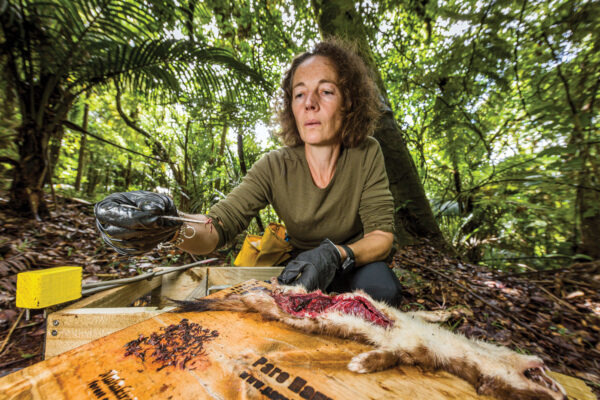
“One stoat even had ornate skink DNA in it,” she says. This rare and secretive lizard, identified by a whitish teardrop mark under its eye, is gradually declining across the country, and hadn’t been found at Mahakirau before. Smerdon’s since found it in more stoats. “We’re adding to our biodiversity list through what we find in the guts of these predators.”
Flies swarm. Smerdon finds wētā parts. A bit of rat skin and fur. A tiny bone. Black feathers. She uses her scalpel to drag intestinal muck off these, and carefully spools them apart to look at their structure. I feel sick again.
“Tūī.”
There is a sliver of spine that she suspects is eel. I open a packet for her, extract a spatula and a test tube and drop them into her stoaty hands. She puts the spine and bone into the tube. “I’d hate it to be the first kiwi that I’ve picked up.” These, too, will be analysed by Wilderlab.
Petrels land in this garden, Smerdon says as she works, prospecting for nesting sites; one burrowed under her caravan for two nights. She holds up a skein of intestine and stretches it until it’s pinkly transparent, looking for any remains of native creatures that might be hiding within. She dumps the organs into a plastic bag to reuse as bait, and snips the tail as well.
More by Naomi Arnold
More by Rob Suisted
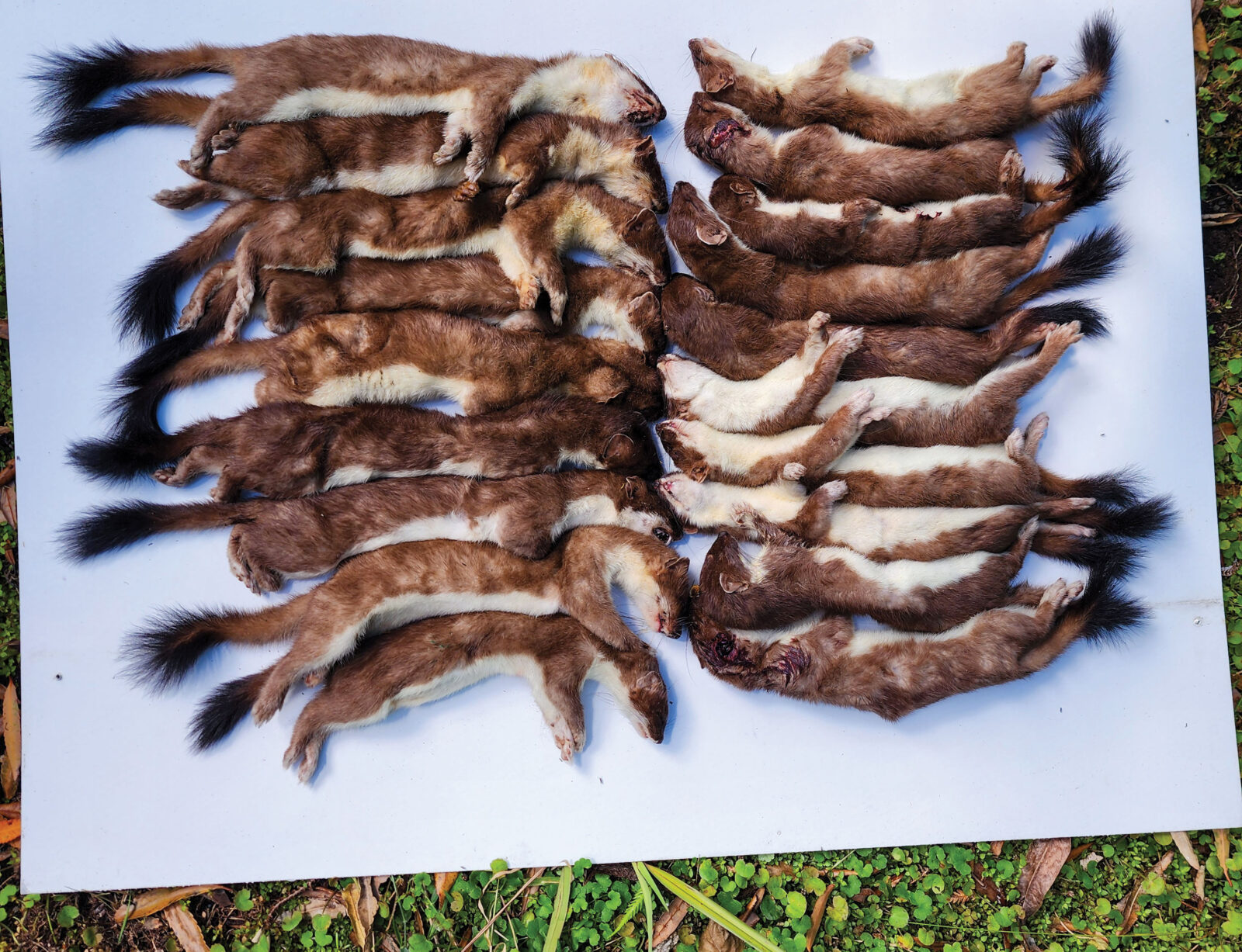
In the sixth stoat she finds the tiny foot of a copper skink and some of its tail. She points out its golden colour, then extracts four more feet and splays each toe on the corflute. The stoat dined on two skinks before it was caught. There were no visible frogs in this particular batch, but she shows us some she’s prepared earlier, pulled from another ferret; Archey’s frog legs and its meaty little buttocks are splayed on the plastic. At least one Archey’s and four Hochstetter’s, in one ferret, from one night’s eating. There is a kind of amphibious personhood in the still, mucky little dismembered hands.
That night, Smerdon takes us out to look for them alive. It’s nearly midnight, and the air is dark, humid and full of rain, a good night to be a frog.
“Step carefully,” she says as we move through the rain on her bush path, scanning our headlamps over ground, shrubbery, trunks, leaves, spotting wētā and scores of pillbugs, the land crustacean that rolls into a tight armoured ball like a tiny steampunk bracelet. I thought we’d be spotting frogs on the ground, but the highest she’s seen one is four metres off the ground, up a tree.
Suddenly, she stops. “There. See?”
I peer. I do not see.
“There. It’s on the kiekie. It’s one of their favourite spots. I’m pointing right at it. See?”
After many long, embarrassing moments, I finally do. It is a Hochstetter’s, unusually crouched on leaf litter; normally, it would be near a seepage. I have just been looking at the dismantled remains of its relatives, but I’m still surprised at how small it is, only half the length of my thumb.
We walk on, carefully, through the rain. A little while later, Smerdon finds a red, brown, and green Archey’s perched on a crown of kiekie, and then several more. The frogs are wet, knobbed, mottled brown and green. I hold my breath, suddenly acutely aware I’m looking at a dinosaur, mostly unchanged since before Aotearoa split from Gondwanaland. Other than the tiniest of pulses at their throats, they are as motionless, silent, and shining as antique jewels.