



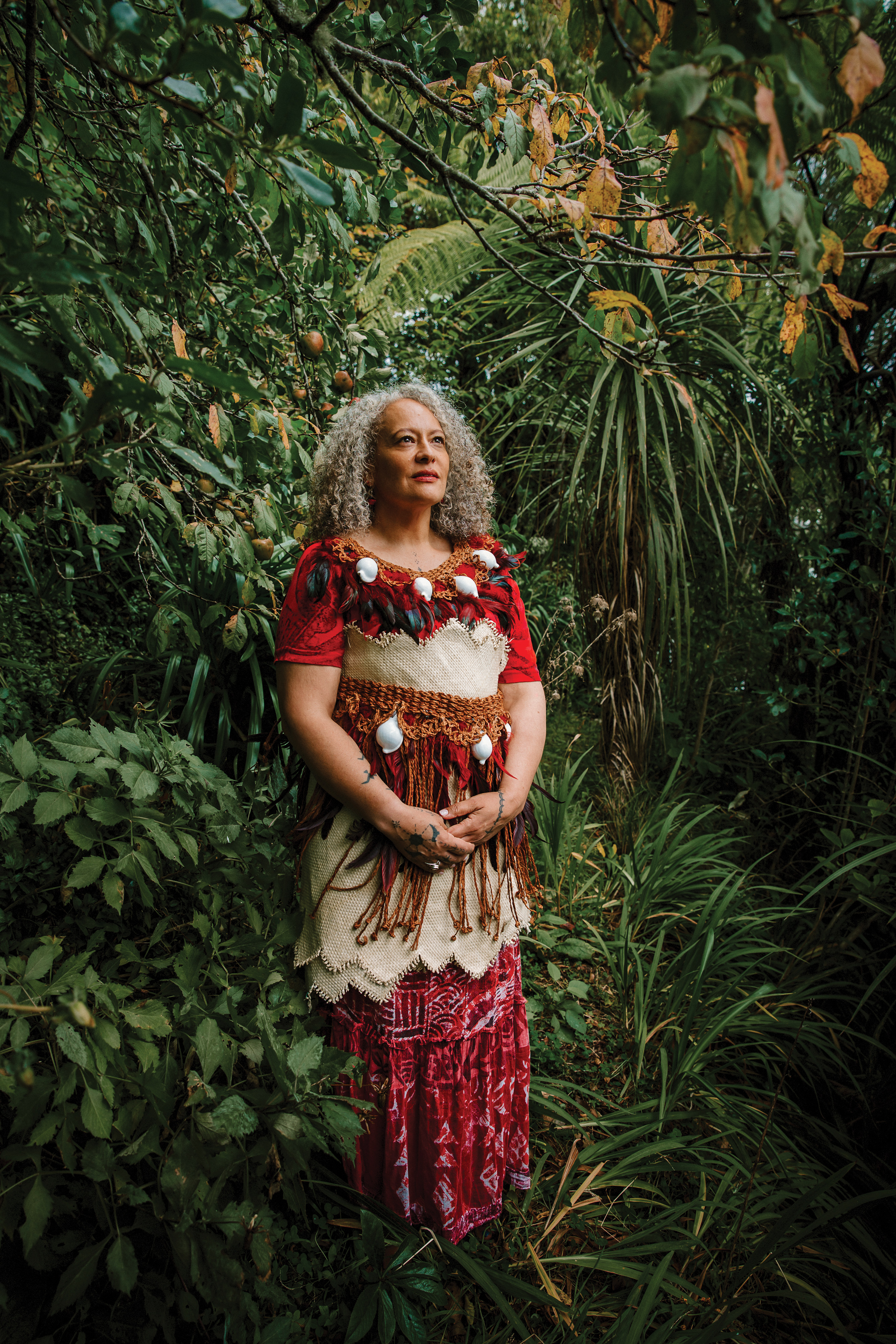
Karlo Mila builds poetry from data and documents.
Day three of oral submissions on the Treaty Principles Bill and Karlo Mila is nervous as hell. She’s been up since 4.30am, writing. Was still writing in the cafe downstairs. As her friend Ala’imalo Falefatu Enari wraps up his introduction, she looks to the ceiling. Shuts her eyes.
Then she looks straight at the camera, and reads her poem.
“How do we speak truth to power? Just as power pretends it has none. As if history has lapsed, exploitation has expired, as if we are speaking to thin air… They say: There’s no need to raise the dead. But the dead raised me and they stand up in our history. They stand up in our genealogy…”
Her voice is strong and loud in the small room. Mila calls out Hobson’s Pledge, the Destiny Church, New Zealand First, BlackRock, the New Zealand Initiative, David Seymour’s Ministry for Regulation, Seymour’s terrible joke about blowing up the Ministry for Pacific Peoples. Near the end, her notes disappear from her phone screen for a moment. She gives a from-her-bones sigh. Then she’s back into it. “You can’t rewrite history…”
National’s James Meager was chairing the session. He would not meet her eyes, she tells me.
*
Mila is 50 and lives in Wellington with her partner and their blended family; she has two adult sons in Auckland. Lately, she has been writing poems that, like her submission on the Treaty Principles Bill, are “fighting, fighting, fighting”. Many of these are based on official documents or academic writing. During her acts of distillery she thinks about the people who are living the hurt catalogued in the research, and need it articulated. She also thinks about her dad; he’s very clever, she says, but he can’t read or write. “If I couldn’t describe something to him, then I was the stupid one.”
She has a PhD in sociology; she studied the lives and experiences of people like herself, second-generation Pacific New Zealanders (her dad is Tongan; her mum is Pākehā; she grew up in Palmerston North). She is a great organiser of people, parties, projects: she makes sense of her ADHD by imagining her brain as a pīwakawaka, curious and quick and flitting impatiently.
Based on her postdoctoral research, in 2010 Mila founded and led an organisation called Mana Moana. It helped reconnect Pacific New Zealanders with ancestral knowledge and worldviews and eventually morphed into a leadership programme. Independent reviewers found it “transformational”, Mila says; around 140 Pacific leaders went through the course over the years. The contract with the Ministry of Business, Innovation & Employment did not survive the change in government. Mila has since watched many of her peers and colleagues lose their jobs, too.
While we talk, she walks in Ōtari-Wilton’s Bush. She is reeling at the news of another person lost to suicide in her community. We have both been reading UNICEF’s ‘Innocenti Report Card 19’. The suicide rate among Aotearoa’s young people, it finds, is higher than in any other country in the OECD or the EU. Of course, it has always been worse for Māori and Pacific kids. The losses, and callousness around them, inspired a poem called ‘Evil Intensified’, in which Mila cites 110 empirical studies regarding the effects of racism.
The first time she wrote like this—she calls it “evidence-based anger”, but it lands with a righteous calm—she was flying to a Commonwealth event in Jamaica. On the plane, she digested a report by the United Nations’ Intergovernmental Panel on Climate Change, and David Wallace-Wells’ The Uninhabitable Earth, and wrote a poem that was later performed by children from all over the world. Quite a weight for little shoulders. Yes, says Mila, but it’s on their shoulders already.
“Last stands are ugly,” she wrote in one of her newer poems. “We cannot leave it to the kids.”
Right now, given Gaza and Trump, the climate, the economy, and politics here at home, Mila has a sense of rolling despair, “these waves of the lack of care and devaluing, on so many levels”. She has written a poem called ‘For my friends who’ve received death threats from white supremacists.’ “I feel like I’m Dr Bad Buzz,” she says. But needs must.
And even so there are bursts of joy. In April, Mila’s whānau spent days immersed in ceremony and kōrero as her partner received his pūhoro, or thigh tattoo. Days later, the two decided to marry. (She proposed on her knees at Mākara Beach, wobbling on the rocks. He teased her about her lack of core strength. There was no poem involved.) In May, she was invited to a Buddhist retreat in Fiji, organised by a group supporting climate activists. The week provided “epiphany after epiphany”: Mila meditates every day now, a fact which cracks her up even as the doing of it steadies her. The day that we talk, the family is getting ready for a 10th birthday party—a disco sleepover, which was sounding like something of an unholy combination at the time but came off beautifully.
Of course, not all of her poems are fighting, and not all of them are based on data and documents. She writes often for her “beloveds”: a poem willing healing for her friend, Green Party co-leader Marama Davidson; a poem mourning and honouring another Green, her friend Fa’anānā Efeso Collins, which she read at his funeral. Her Facebook posts are poems in themselves; she wrote this about Fa’anānā:
“I imagine it stellar, filled with energy, golden, foresty, water-filled, and through such a thin veil. I imagine him presencing himself through dreams, visions, in the midst of peoples’ quiet… I imagine him hovering so lovingly around people he loves. Nothing dissuades me from this thinking…”
“I really believe that,” Mila says gently. She thinks she might turn it into a poem.
More by Catherine Woulfe