




The barbecue has been an integral part of New Zealand social life for—well, not that long, actually.
On October 19, 1863, the events column of the Otago Daily Times invited readers to experience a “POWERFUL NOVELTY”. In fact, there were several: the appearance of a ghost at the Princess Theatre, an exhibition on the American Civil War in progress, and a Grand Gala Day near Ophir, which would culminate in a “BARBECUE”.
This was one of New Zealand’s first recorded barbecues, and given people’s unfamiliarity with the format, the ad explained that it would involve “a Bullock, which will be roasted whole, and a cask of Ale, of which the public are invited to partake”.
For the next 80 years, barbecuing was such a powerful novelty that you could make the news just by having one.
In 1942, American oil borers put on a barbecue at Midhirst, “probably the first ever held in Taranaki”, according to the Taranaki Daily News, and in 1948, a well-travelled Dunedin couple held a barbecue party recorded by the Otago Daily Times. These events had much more in common with hāngī than with the modern barbecue: meat was slow-cooked in a covered pit over the course of a day.
This all began to change in the 1950s. The suburban population in New Zealand boomed; people began entertaining at home. Barbecues, downsized and sped up, were all the rage. They transformed from community-scale events to private ones, and the cooking technique changed from braising, which took hours, to grilling, which didn’t.
That decade, the Listener’s ads promoted jaffle irons for making toasted sandwiches on the barbecue and mustard to spread on barbecued sausages. In 1953, the Australian Women’s Weekly published instructions for building a brick barbecue at home, but by the 1970s, barbecues were widely available to buy, and some were installed in public parks.
By 2004, when an advertising agency investigated New Zealanders’ concepts of national identity, the barbecue was among the cultural icons listed. New Zealand officials often entertain foreign dignitaries by putting on a barbecue: it acts as a kind of quadruple brag about our meat, seafood, informality and outdoorsiness.
Still, barbecue is a universal concept, not a specifically Kiwi one. The word itself comes from the Caribbean: Spanish conquistadors heard the Taíno word “barabicu”, mangled it to “barbacoa”, and started using it to describe the way indigenous Mexicans used earth ovens to slow-cook meat wrapped in leaves.
What’s unusual about the way we barbecue—and the United States, Australia and Great Britain are in on this, too—is that men do it, and have done since the 1950s. Why has the barbecue remained so strongly gendered?
Men taking charge of the barbecue fits with broader cultural ideas, write culinary experts Rob Richardson and Dianne Ma at AUT University: the association of meat and fire with masculinity, the (incorrect) idea that men evolved to hunt while women evolved to gather, or the other (incorrect) idea that men have inherited a kind of epigenetic meat-cooking ability from their neolithic ancestors. (We don’t actually know who was in charge of the grill back then.)
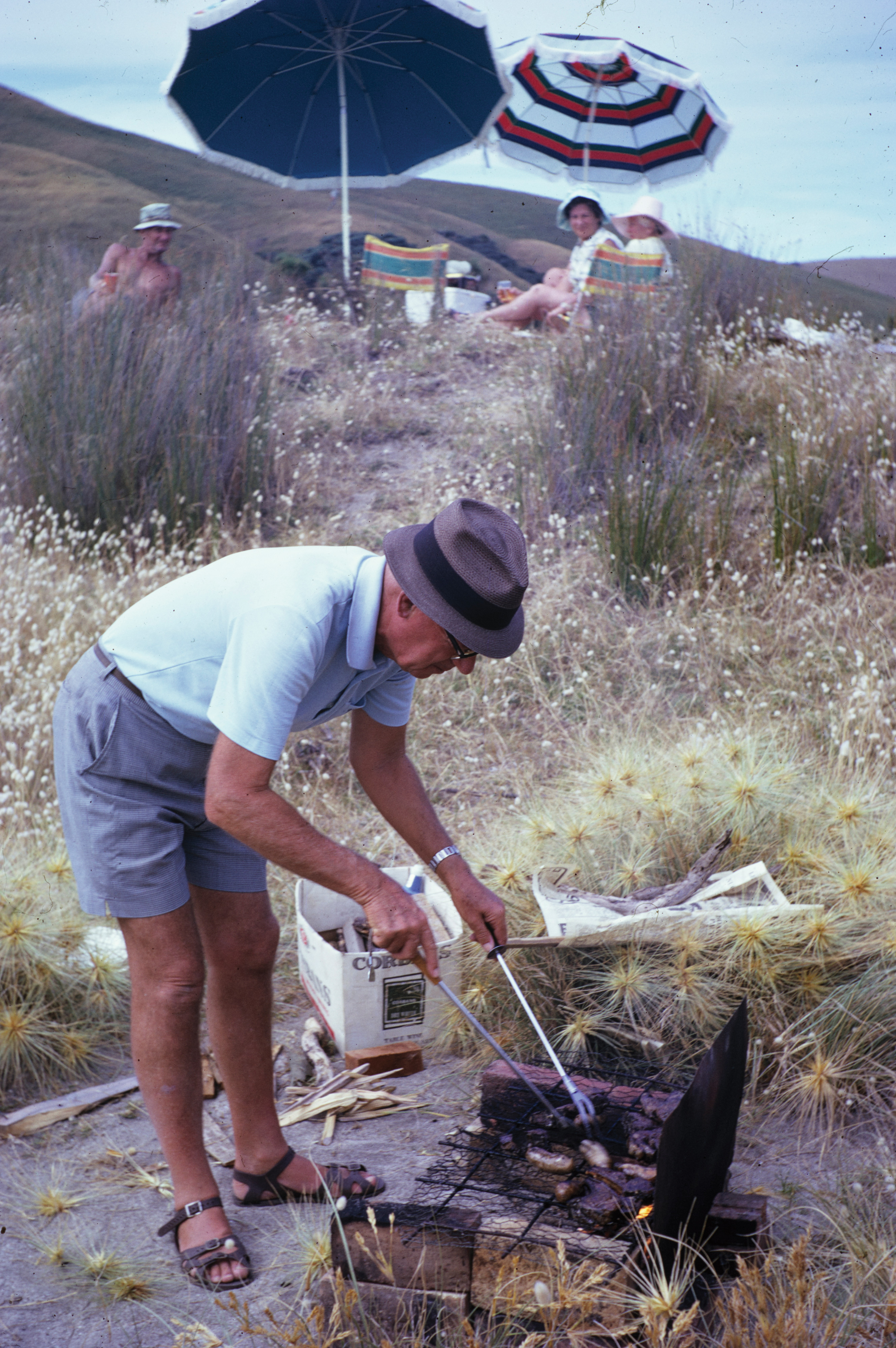
There’s also a more prosaic explanation. US culinary historian Sarah Lohman found that backyard barbecues have been marketed to men from the start. After all, in the 1950s, men represented an untapped consumer base, Lohman suggests: women might point out that a barbecue was unnecessary, as they could already grill meat in the kitchen. Men, however, might spring for a new gadget. Although there will always be some—like John Craig pictured here in 1975—who instead see the potential in a few spare bricks and a snippet of reinforcing steel.
More by Rebekah White