New Zealanders have weak mussels, says Americans (more…)
More by Skye Wishart



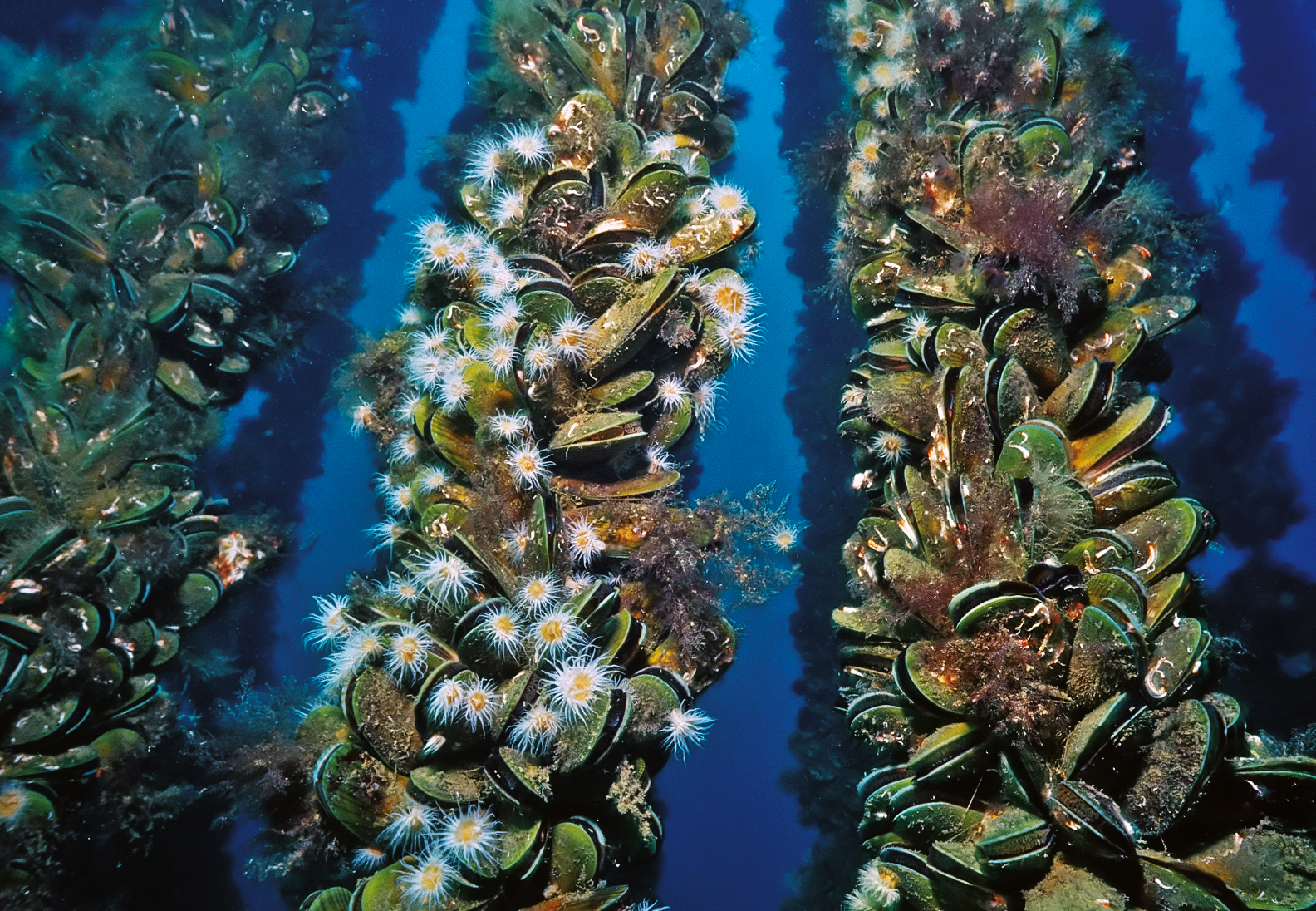
Mussel beards, or byssus, the strong filaments that anchor the mollusc to a fixed surface, have unique properties that may be invaluable for biomedical and nanotechnology engineering, according to research published in Science.
Although very stiff, the cuticle on these threads is also elastic, to cope with the constant push and pull of crashing waves.
“Protective coatings are important for prolonging the lifetime of materials and devices,” says Dr Matthew Harrington, a researcher at the Max Planck Institute of Colloids and Interfaces in Potsdam, Germany. Protecting flexible materials has always been a challenge for industry, and mussels may offer the solution.
The tough epoxy-like coating appears to be bumpy rather than smooth when inspected with an electron microscope and within these clusters of molecules are iron-protein complexes that fix them to their scaffold—bonds that not only have a high breaking point but can also reform if broken.
However, New Zealand’s green-lipped mussel is sub-tidal and doesn’t face such significant wave action. Consequently its byssus lacks those special knobby granules and begin to show cracks at just 30% of the strain endured by its iron-charged American cousin. One advantage of this apparent weakness could be that green-lipped mussels are more easily harvested, helping to contribute more than $200 million to our export economy.
More by Skye Wishart
Subscribe to our free newsletter for news and prizes
3
$1 trial for two weeks, thereafter $8.50 every two months, cancel any time
Signed in as . Sign out